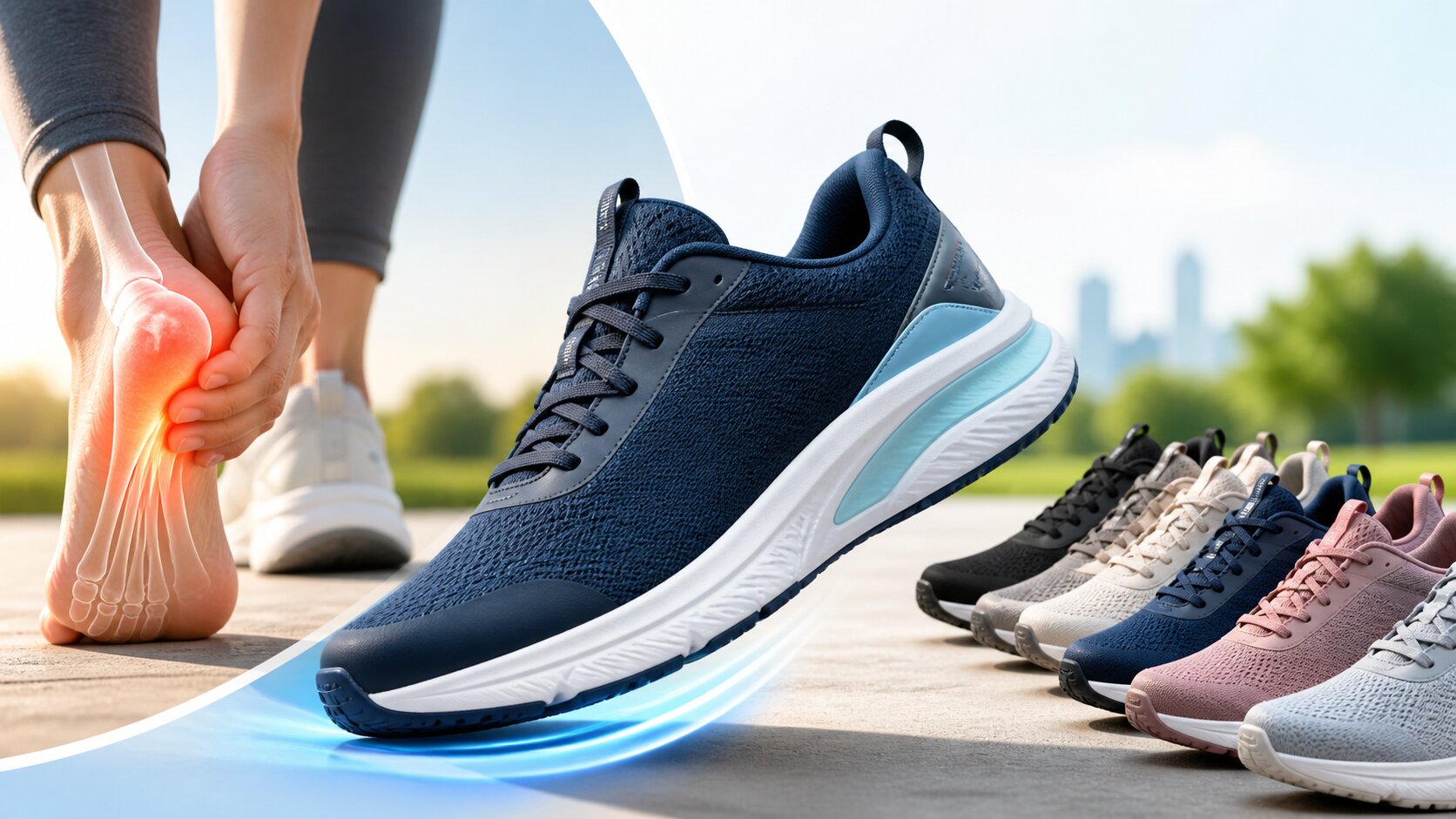

Plantar Fasciitis Exercises That Are Actually Backed by Research
Relieve heel pain, rebuild your arch, and get back to comfortable steps, with the exact stretches and strength moves clinical trials have tested, not just internet advice.
- Evidence-based
- Easy to follow
- Do it at home
- Free printable routine
 Stronger arches,
steadier steps
Free Printable Exercise Guide & 4-Week Tracker
Everything in this article, laid out as a printable, citation-backed PDF you can keep by your bed or on the fridge, including the full weighted heel-raise progression and a daily checklist. It’s free, no email required.
- All 5 core exercises with exact sets, reps, and citations
- The full high-load strength progression, week by week
- A 4-week daily tracker you can check off or print
- The complete reference list, so you can verify every study yourself
⚡ Quick Picks – Best Shoes for Plantar Fasciitis 2026
- 🏆 Best Overall (Women): Skechers Work Max Cushioning Elite SR – Max cushioning + slip-resistant outsole for all-day work shifts
- 🦶 Best Arch Support: Skechers Arch Fit Arcade – Arcata – Podiatrist-certified insole, 120,000 foot scans behind the design
- 💰 Best Value Slip-On (Women): Skechers Work D’lux Walker SR – Ozema – EH-safe, slip-resistant, memory foam under $65
- 👟 Best for Men: Skechers Afterburn M. Fit Wonted – Leather upper, memory foam insole, wide-fit options
- 🏅 Best Max Cushion (Premium): Brooks Women’s Ghost Max 2 – APMA-accepted, nitrogen-infused DNA Loft v3 foam, PDAC A5500 certified
- 😴 Best Hands-Free Slip-On: Skechers Glide-Step Altus Hands Free – Heel Pillow tech + air-cooled memory foam, machine washable
- 👠 Best Casual Work Style (Women): Skechers Uno – Stand On Air – Visible air cushion midsole, stylish wedge design, moderate-to-max cushion
- 🥿 Best Professional Loafer: Clarks Women’s Cheyn Madi Pull-On – Full-grain leather, OrthoLite footbed, office-ready look
The short answer
If you only remember two things, remember these: a plantar-fascia-specific stretch (10-second holds, done first thing in the morning) and a calf stretch against a wall. Both are backed by randomized trials, and together they take under five minutes a day. Once the sharpest morning pain has settled, add a high-load, single-leg heel raise protocol, the routine researcher Michael Rathleff tested in 2014, which outperforms stretching alone for longer-term recovery. Every exercise below comes with its sets, reps, and citations, and you can grab the full printable routine and tracker further down the page.
Understanding Plantar Fasciitis and Why Exercise Works
Plantar fasciitis is degeneration and irritation of the plantar fascia, the thick band of tissue that runs from your heel bone to the base of your toes and holds up the arch of your foot. It’s the most common cause of heel pain in adults, and according to a clinical review published by the National Institutes of Health, it affects roughly 1 in 10 people at some point in their life, accounting for about one million medical visits a year in the United States alone.
Rest alone rarely fixes it. The fascia is a collagen structure that needs controlled mechanical loading, not just time off, to remodel itself into something stronger. That loading happens through a structure called the windlass mechanism: when your big toe bends upward, the fascia winds tight around the heel bone, lifting the arch and turning your foot into a rigid lever for push-off. Every exercise in this guide works by engaging that mechanism, either to gently stretch the fascia (early on) or to load it under control (once the sharpest pain has settled).
Simplified side view of the foot: raising the big toe activates the windlass mechanism, tightening the plantar fascia and raising the arch.
Who’s most at risk
Across the studies reviewed for this guide, a few risk factors show up consistently:
- Age and occupation: most common between ages 40 and 60, and in jobs involving prolonged standing or walking: retail, healthcare, teaching, and food service are among the most frequently reported. If your job keeps you on your feet, see our guides on shoes for standing all day, nursing shoes, and shoes for teachers.
- Foot mechanics: flat feet (pes planus), high arches (pes cavus), overpronation, and limited ankle flexibility are consistently identified risk factors. If any of those describe you, our guides on shoes for flat feet, high arches, and overpronation go into footwear-specific fixes.
- Body weight: a higher BMI is one of the most consistently cited risk factors, since it increases the mechanical load the fascia absorbs with every step.
- Runners: an estimated 42% of middle-distance and 25% of long-distance runners experience plantar fasciitis at some point, among the highest rates of any group studied. See our running shoes for plantar fasciitis guide if that’s you.
- Gender: middle-aged women are disproportionately affected relative to men in most population surveys, which is part of why footwear history (heels, unsupportive flats) is often flagged alongside biomechanics. Our women’s shoes for plantar fasciitis guide covers this in depth.
None of this means exercise is optional if you don’t fit these categories. It just tells you why the condition shows up where it does, and why footwear and body mechanics are part of the same conversation as stretching and strengthening.
The Evidence, Ranked
A 2023 systematic review and meta-analysis pooling 236 studies and more than 15,000 patients graded the certainty of evidence behind the most common plantar fasciitis treatments, measuring short-term pain reduction against a control group. Here’s how exercise-based approaches compare to other conservative options:
| Intervention | Effect on pain (short-term) | Evidence grade | Notes |
|---|---|---|---|
| Low-dye taping | MD −3.60 | Strong | Largest short-term effect; needs reapplication |
| Platelet-rich plasma injection | MD −2.40 | Moderate | Invasive; cost and access limit routine use |
| Low-level laser therapy | MD −2.09 | Moderate | Requires clinical equipment |
| Myofascial release | MD −1.79 | Moderate | Often paired with stretching |
| Stretching / therapeutic exercise | MD −1.14 | Strong | Free, no equipment, done at home: the focus of this guide |
| Extracorporeal shockwave therapy | Effective medium & long term | Strong | The only intervention shown effective beyond the short term |
Two individual trials matter more than any others in this literature:
In a landmark 2003 randomized trial of 101 patients, DiGiovanni and colleagues found that a plantar-fascia-specific stretch eliminated or improved heel pain in 52% of patients at eight weeks, more than double the 22% seen with a standard Achilles stretch alone. A two-year follow-up found 92% of patients across both groups reported total or near-total satisfaction once everyone had switched to the fascia-specific technique.
A decade later, Rathleff and colleagues (2014) directly compared that same stretch against high-load progressive strength training (weighted, single-leg heel raises) in 48 patients with ultrasound-confirmed plantar fasciitis. The strength-training group’s Foot Function Index score was 29 points lower (better) at the three-month mark, a gap well beyond the threshold considered clinically meaningful, with the benefit still holding at 12 months. That single trial is why the routine in the next two sections leads with stretching and builds toward loaded heel raises rather than stopping at stretching alone.
The 5 Core Exercises
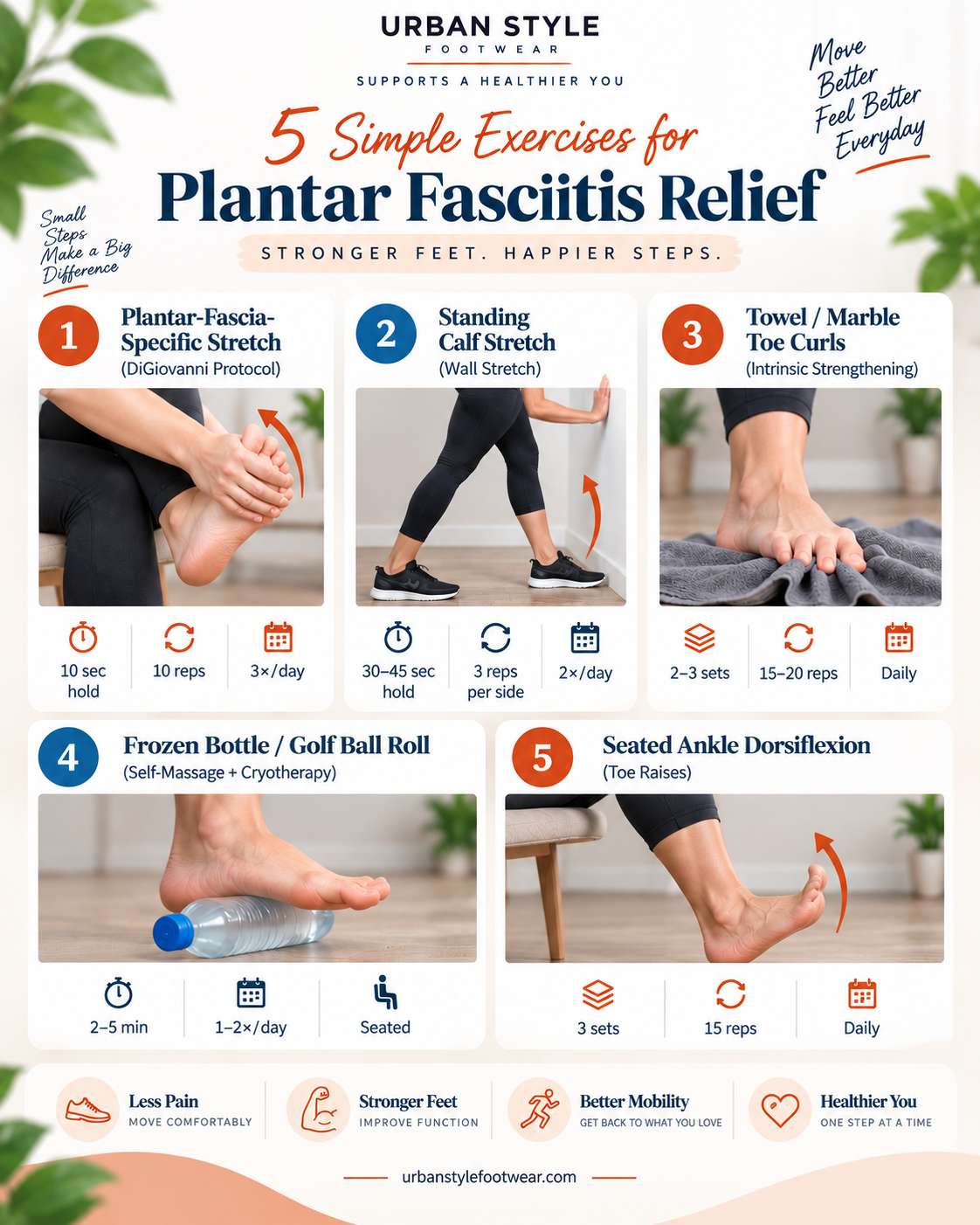
These five movements have direct trial support behind them. The first two carry the strongest and most consistent evidence. Do those daily, without exception, before adding the rest.
01 Plantar-Fascia-Specific Stretch
- Sit down and cross the affected foot over the opposite knee.
- Grasp the base of your toes and pull them back toward your shin until you feel a firm stretch along the arch.
- With your free hand, gently rub across the arch: the fascia should feel taut, like a guitar string.
- Hold for 10 seconds, release, and repeat for 10 reps. That’s one set.
- Perform 3 sets daily: first thing in the morning before standing, and again after any long period of sitting.
02 Standing Calf Stretch (Gastrocnemius & Soleus)
- Stand facing a wall, hands pressed flat against it at shoulder height.
- Step the affected leg back, heel flat on the floor, back knee straight. Lean forward from the ankle until you feel a stretch in the upper calf. Hold 30–45 seconds, then repeat 3 times.
- Then bend the back knee slightly and repeat the same stretch. This shifts the emphasis to the soleus muscle, which sits deeper in the calf and attaches closer to the heel bone.
03 Towel or Marble Toe Curls
- Sit in a chair with a small towel (or 10–15 marbles) flat on the floor under your bare foot.
- Use only your toes to scrunch the towel toward you, or pick up the marbles one at a time and place them in a cup.
- Complete 15–20 repetitions per set, 2–3 sets per foot.
04 Frozen Bottle, Golf Ball, or Tennis Ball Roll
- Sit down and place a frozen water bottle, golf ball, or tennis ball under the arch of your foot.
- Roll it from heel to toe with light-to-moderate pressure for 2–5 minutes.
- Stop immediately if you feel sharp or worsening pain. The pressure should feel firm, never painful.
05 Seated Ankle Dorsiflexion (Toe Raises)
- Sit with your foot flat on the floor.
- Lift only your toes and the front of your foot upward, keeping your heel planted.
- Lower slowly and repeat for 15 reps, 3 sets.
A note on sequencing: every trial cited here used consistency over weeks, not intensity in a single session, as the variable that predicted improvement. Missing a day occasionally won’t undo your progress. Skipping weeks will.
The High-Load Strength Protocol
Once your sharp, first-step pain has softened into a dull, manageable ache, this is the single most important exercise to add: the single-leg heel raise progression from Rathleff et al. (2014), the trial that produced a 29-point Foot Function Index advantage over stretching alone. It works by loading the fascia through the windlass mechanism under real, progressive resistance: the same tension pathway used during a single-leg squat.
| Week | Sets | Reps (RM) | Progression note |
|---|---|---|---|
| Weeks 1–2 | 3 sets | 12 reps | Bodyweight only, lowering from both feet to one |
| Weeks 2–4 | 4 sets | 10 reps | Add load via a weighted backpack |
| Weeks 4+ | 5 sets | 8 reps | Keep adding weight as strength increases |
Weighted single-leg heel raise (every other day)
- Stand on a step with a folded towel placed under the toes of the affected foot, so the toes are slightly extended upward.
- Rise up onto the ball of the affected foot slowly, a 3-second lift.
- Hold for 2 seconds at the top.
- Lower slowly over 3 seconds on the single leg.
- If needed, use both feet to assist the lift, then lower on the single affected leg only, following the sets and reps above.
- Add resistance progressively via a weighted backpack once bodyweight reps feel manageable.
Safety note from the original researchers: the calf raise must be performed slowly: the 3-2-3 tempo above is intentional. Rathleff’s team specifically flagged that moving too fast increases the risk of symptom flare-ups. If pain spikes during or after a session, reduce the load or reps before increasing either again.
Household Tools You Can Use (Towel, Ball, Band)
You don’t need a gym or a clinic to run this program. Here’s which household object supports which exercise, useful if you searched for plantar fasciitis exercises with a towel, a tennis ball, a resistance band, or a foam roller specifically:
Plantar Fasciitis Exercises for Beginners
If your heel pain is new, sharp, and you haven’t exercised it at all yet, don’t start with the full program above. Begin here instead, for the first one to two weeks:
- Morning towel stretch only (Exercise 1): before your feet touch the floor, 3 sets of 10-second holds.
- Wall calf stretch (Exercise 2): twice a day, gentle and static, never bouncing.
- Frozen bottle roll (Exercise 4): once daily, seated, as a soothing end-of-day habit.
Once those three feel comfortable and your morning pain has softened from a sharp stab to a dull ache (usually one to two weeks in), add the toe curls and ankle dorsiflexion (Exercises 3 and 5), then introduce the single-leg heel raise protocol from the high-load section above.
Low-Impact Cardio You Can Still Do
Plantar fasciitis doesn’t mean you have to stop moving. It means choosing activities that don’t hammer the heel with repetitive impact while the fascia recovers.
- Swimming and water walking: zero impact on the heel, full range of motion.
- Stationary cycling: the pedal stroke avoids the heel-strike phase that aggravates most cases.
- Elliptical training: a reasonable middle ground if you want a walking-like motion without the impact of pavement.
- Walking, at a shorter distance and slower pace: supported by proper walking shoes with adequate cushioning and a firm heel counter, walking is generally fine and often recommended, as long as it doesn’t push your pain above a mild, 2-to-3-out-of-10 level.
Whatever you choose, the same rule applies: a dull, warming ache is acceptable; a sharp, stabbing pain is your body telling you to stop and scale back.
Exercises and Habits to Avoid
Bouncing or ballistic stretching
A cold, inflamed fascia is inelastic. Bouncing on a step to “loosen it up” causes microscopic tearing rather than a controlled stretch. Every stretch in this guide should be slow, static, and held, never bounced.
Walking barefoot on hard floors first thing in the morning
Overnight, the fascia shortens back into a resting position. Stepping straight onto bare tile or hardwood forces it to stretch violently under full bodyweight before you’ve done any preparatory stretching. Keep supportive slippers by the bed and slip into them before your first step, a habit closely tied to why morning heel pain is worse than the rest of the day.
Curling your toes during a calf stretch
Letting the toes claw at the floor while stretching the calf actually shortens the fascia, working against the stretch you’re trying to achieve. Keep the toes relaxed and flat.
High-impact running or jumping through sharp pain
A dull ache during exercise is generally fine to work through; a sharp, stabbing pain is not. Continuing to run or jump on an acutely inflamed fascia typically extends recovery rather than “toughing it out.”
Doing the whole routine in unsupportive shoes
Exercises rebuild internal strength; shoes reduce the daily mechanical load the fascia has to absorb the other 16 hours of the day. Wearing the wrong shoe category in between exercise sessions can undo a meaningful share of that day’s progress.
Building Your Weekly Routine
Here’s how the exercises above fit together across a typical day and week. This mirrors the schedule used in the RCTs referenced throughout this guide.
| When | What | Frequency |
|---|---|---|
| Before first steps (AM) | Plantar-fascia-specific stretch | Every day |
| After long sitting | Repeat the fascia-specific stretch | As needed, several times daily |
| Twice daily | Standing calf stretch (straight & bent knee) | Every day |
| Once daily | Towel/marble curls + seated dorsiflexion | Every day |
| Every other day | Single-leg heel raise protocol | 3–5× per week |
| Optional, end of day | Frozen bottle or ball roll | 1–2× per day |
The heel raise protocol is deliberately programmed every other day rather than daily. That rest interval gives the fascia and calf muscle the 48 hours needed to recover and adapt between loading sessions.
Realistic Recovery Timeline
Plantar fasciitis is frustrating partly because it resolves on a tissue-healing timescale, not a symptom-relief timescale. Here’s what the published follow-up data actually shows:
Many people notice reduced morning stiffness with consistent stretching, though the underlying tissue is still remodeling.
The point where high-load strength training shows its clearest advantage over stretching alone in trial data.
Typical window for the condition to fully resolve with consistent conservative care, per clinical follow-up data.
About 80% of cases have improved by this point; roughly 10% become persistent or chronic despite treatment, and around 5% ultimately require a surgical or procedural intervention.
Collagen remodeling, the process by which stressed fascia tissue actually repairs and strengthens, happens over weeks to months, not days. Every trial cited in this guide used follow-up windows of eight weeks to twelve months, not days, which is the timescale worth planning around. For a closer look at how footwear choices affect that timeline specifically, see how long plantar fasciitis takes to heal with the right shoes.
Where Footwear Fits In
Exercise addresses the tissue itself. Footwear addresses the daily mechanical load that tissue has to absorb the rest of the day. The research treats them as complementary strategies, not competing ones.
A systematic review in the British Journal of Sports Medicine found that orthotics correcting foot pronation were effective at reducing pain and improving function, and a separate meta-analysis of seven randomized trials found a measurable pain-reduction effect from foot orthoses compared with no orthosis at all. A 2014 study in the Journal of Foot and Ankle Research found that cushioned insole inserts significantly reduced plantar pressure during walking: the mechanical load thought to drive fascia irritation in the first place. It’s also worth knowing that footwear itself can be a contributing cause, not just a treatment, which is why the right pair matters at every stage of recovery.
In practical terms, three structural features do most of the work:
- Arch support matched to your foot type redistributes pressure away from the fascia’s attachment point at the heel. See our breakdown of insoles versus supportive shoes if you’re deciding between the two.
- Cushioning (EVA foam, gel inserts) absorbs impact force at heel-strike, reducing the jarring load transmitted up through the fascia with every step.
- Heel stability: a firm, well-structured heel counter limits excess pronation, one of the most consistently cited biomechanical risk factors across the studies referenced in this guide.
If you’re not sure what to look for, our plantar fasciitis shoe buying guide and how to choose shoes for plantar fasciitis walk through the specifics, and our full best shoes for plantar fasciitis hub rounds up every category. A supportive pair of everyday shoes doesn’t replace the exercises in this guide, but skipping it while doing them is a bit like icing a sprained ankle and then re-spraining it on the walk home.
- Do your morning stretch before your feet touch the floor
- Keep a supportive pair of slippers or shoes within reach of the bed
- Add the heel raise protocol every other day once sharp pain has eased
- Pair the routine with footwear built for your foot type, not just what’s on sale
- Reassess with a professional if there’s no real change after 6–8 weeks
Free Printable Exercise Guide & 4-Week Tracker
Everything in this article, laid out as a printable, citation-backed PDF you can keep by your bed or on the fridge, including the full weighted heel-raise progression and a daily checklist. It’s free, no email required.
- All 5 core exercises with exact sets, reps, and citations
- The full high-load strength progression, week by week
- A 4-week daily tracker you can check off or print
- The complete reference list, so you can verify every study yourself
Match Your Situation to a Shoe Guide
Exercise rebuilds the fascia’s strength; the right shoe reduces the load it has to absorb in between sessions. Once you’ve got the routine above underway, these guides go deeper on the footwear side, organized by what actually applies to you.
By foot type or condition
By activity
By occasion or occupation
By brand
Frequently Asked Questions
How often should I do plantar fasciitis exercises?
The fascia-specific stretch and calf stretch should be done daily, ideally two to three times a day, especially first thing in the morning and after long periods of sitting. The high-load heel raise protocol is programmed every other day, so the fascia and calf muscle have 48 hours to recover between loading sessions.
What exercises should I avoid with plantar fasciitis?
Avoid bouncing or ballistic stretches, high-impact running or jumping through sharp pain, and any stretch where your toes curl inward instead of staying relaxed. Barefoot walking on hard floors, especially first thing in the morning, isn’t an exercise, but it undoes exercise progress just as reliably.
Can I still exercise or run with plantar fasciitis?
Low-impact cardio (swimming, cycling, and the elliptical) is generally safe throughout recovery. Walking and running are usually fine if the pain stays at a dull, mild level (roughly 2 to 3 out of 10); a sharp or worsening pain is the signal to scale back and lean more heavily on the stretching and loading routine above.
Is walking good for plantar fasciitis?
Generally, yes, in supportive shoes and at a comfortable pace. Complete inactivity isn’t shown to speed recovery, and walking keeps the surrounding muscles engaged. What matters is the shoe you’re walking in and whether the activity keeps your pain in a mild, manageable range.
What exercises or habits actually cause plantar fasciitis in the first place?
It’s rarely one single movement. The consistent contributors across the research are a sudden increase in running or standing volume, tight calves and limited ankle flexibility, unsupportive footwear over time, and biomechanical factors like flat feet or overpronation that increase strain on the fascia with every step.
How long before these exercises start working?
Many people notice a reduction in morning stiffness within two to six weeks of consistent stretching. The high-load strength protocol shows its clearest advantage at the three-month mark in trial data, and full tissue remodeling typically continues for six to nine months.
Do I need strengthening exercises, or is stretching alone enough?
Stretching alone produces real, measurable improvement, especially early on. But the strongest single trial in this literature found that high-load strength training outperformed stretching alone at three months and held that advantage at twelve. The most effective approach combines both, rather than treating them as alternatives.
Are night splints worth combining with this routine?
A night splint holds the ankle at roughly a 90-degree angle overnight, preventing the fascia from shortening while you sleep, which can reduce the intensity of first-step morning pain. It’s a reasonable complement to the exercises here rather than a replacement for them. See our night splints versus shoes comparison for more detail.
Should I still stretch if I have a heel spur, not just plantar fasciitis?
Yes. A heel spur is a bone growth caused by chronic pulling from an inflamed fascia, not a separate injury requiring different treatment. Stretching and loading the fascia relieves the underlying tension regardless of whether a spur is present. Our plantar fasciitis vs. heel spurs guide breaks down the distinction if you’re not sure which applies to you.
What’s the fastest way to reduce plantar fasciitis pain?
There’s no true shortcut, but the fastest-acting combination in the research is the morning fascia-specific stretch paired with a frozen bottle or ball roll for acute pain relief, done consistently every day rather than sporadically. Sharp pain reduction still takes weeks, not days. Anyone promising an overnight fix is overselling the evidence.
External Sources & References
Every clinical figure in this guide traces back to a peer-reviewed journal, a clinical trial registry, or a recognized medical organization. You can verify any of them directly:
- DiGiovanni BF, Nawoczenski DA, Lintal ME, et al. Tissue-specific plantar fascia-stretching exercise enhances outcomes in patients with chronic heel pain: a prospective, randomized study. J Bone Joint Surg Am. 2003;85(7):1270–1277. View on PubMed
- Rathleff MS, Mølgaard CM, Fredberg U, et al. High-load strength training improves outcome in patients with plantar fasciitis: a randomized controlled trial with 12-month follow-up. Scand J Med Sci Sports. 2014. View on PubMed
- Kamonseki DH, Gonçalves GA, Yi LC, Júnior IL. Effect of stretching with and without muscle strengthening exercises for the foot and hip in patients with plantar fasciitis: a randomized controlled single-blind clinical trial. Man Ther. 2016;23:76–82.
- Siriphorn A, Eksakulkla S. Calf stretching and plantar fascia-specific stretching for plantar fasciitis: a systematic review and meta-analysis. J Bodyw Mov Ther. 2020;24(4):222–232.
- Koc TA, Bise CG, Neville C, et al. Heel Pain – Plantar Fasciitis: Clinical Practice Guidelines, Revision 2023. J Orthop Sports Phys Ther. 2023;53(12):CPG1–CPG39. Read the full guideline (JOSPT)
- Plantar Fasciitis – StatPearls, National Center for Biotechnology Information (NIH). Read on NCBI Bookshelf
- Cleveland Clinic. Plantar Fasciitis: Symptoms, Causes & Treatment. my.clevelandclinic.org
- Cleveland Clinic. 5 Plantar Fasciitis Stretches and Exercises. health.clevelandclinic.org
- Mayo Clinic. Plantar Fasciitis: Diagnosis & Treatment. mayoclinic.org
- American Physical Therapy Association (ChoosePT). Six Exercises for Plantar Fasciitis and Heel Pain. choosept.com
- American Podiatric Medical Association. Heel Pain. apma.org