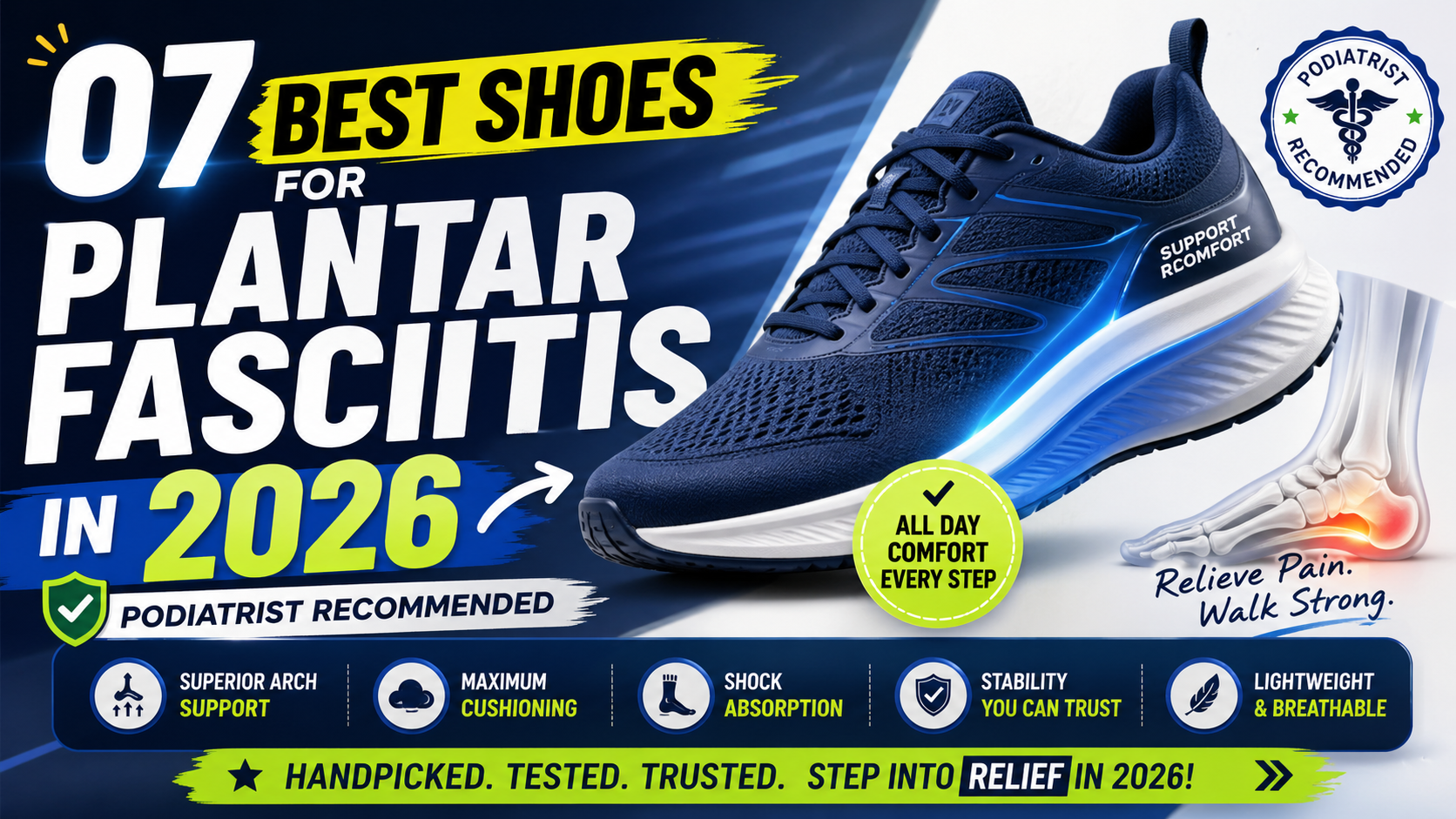

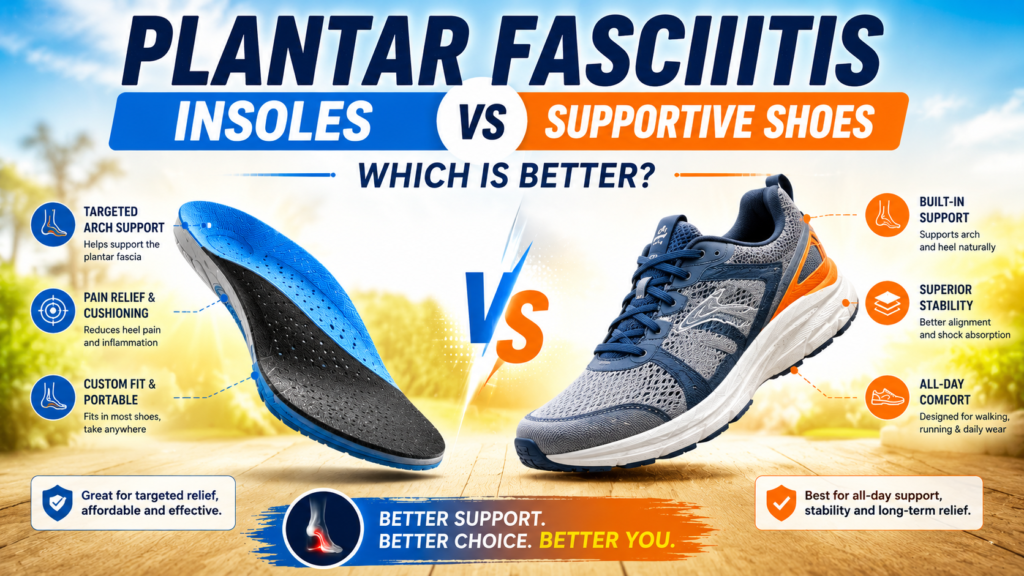
Plantar Fasciitis Insoles vs Supportive Shoes: Which Is Better?
✅ Expert Verified | 🛍️ Amazon US Products | 📅 Updated June 2026
The short answer: supportive shoes work faster for most people. Insoles work better when the shoe itself is already good. The combination of both is what most podiatrists in the US actually recommend but you don’t always need to spend money on both at the same time.
Here is the full breakdown of what works, what does not, and exactly when to use each.
Top Picks – Plantar Fasciitis Insoles and Supportive Shoes 2026
⚡ Best Shoes & Insoles for Plantar Fasciitis 2026

Dr. Scholl’s Plantar Fasciitis Relief Orthotics
Immediately relieves heel pain & prevents PF from coming back. Shock-absorbing heel cup + arch support. Full-length, easy trim.

PowerStep Pinnacle Max Arch Support Insoles
Podiatrist-designed for PF, heel spurs & foot fatigue. Maximum cushioning + premium arch support. Made in USA, FSA/HSA eligible.

Brooks Adrenaline GTS 22
APMA-accepted, GuideRails holistic support, DNA LOFT cushioning. The most validated structured support shoe in the category. Built-in arch control reduces need for aftermarket insoles.
🛒 Check Price on Amazon
Brooks Women’s Ghost 14
35,357 reviews spanning multiple years – real durability data. BioMoGo DNA midsole, Segmented Crash Pad, PDAC A5500 diabetic certified. Works with or without aftermarket insoles.
🛒 Check Price on Amazon
Skechers Max Cushioning Endeavour
Air-Cooled Goga Mat insole + Natural Rocker Technology. One of the few budget-friendly shoes where the built-in insole actually outperforms most aftermarket options.
The Real Question Americans with Plantar Fasciitis Are Asking
A woman named Brandy came into our shop near Westheimer Road in Houston last fall. She had already spent $60 on a pair of Dr. Scholl’s insoles and stuffed them into her old running shoes. Two months later the heel pain was still there every morning. Her question was simple: “Did I buy the wrong insoles, or do I need different shoes?”
That question – insoles vs supportive shoes – is one of the most common and least clearly answered topics in footwear. Most articles either push insoles because they’re Amazon affiliate products or push shoes for the same reason. This guide does neither.
The honest truth: the two work differently, on different parts of the problem, and the right answer depends entirely on what is causing your specific foot pain.
If you’re still in the research phase, our guide on what to look for in plantar fasciitis shoes breaks down the biomechanical factors worth understanding before spending money on either option.
What Is Plantar Fasciitis and Why Does It Matter for This Decision?
Plantar fasciitis is inflammation of the plantar fascia – a thick ligament running from your heel bone (calcaneus) to your toe bases. It becomes irritated when the fascia is repeatedly overstretched, usually due to excessive pronation, inadequate arch support, or high heel-strike impact without proper cushioning.
The first-morning step pain that most Americans describe – that stabbing sensation when your foot hits the floor – happens because the fascia tightens overnight in a contracted position. When you stand, it stretches suddenly.
Both insoles and supportive shoes target this problem. But they target it in different ways:
Supportive shoes control the mechanics of how your foot moves through the full stride cycle.
Insoles add targeted arch support and cushioning directly under the plantar fascia.
Neither is automatically better. The right choice depends on what your current shoes are doing and what your specific foot needs.
Plantar Fasciitis Insoles vs Supportive Shoes: The Core Difference
When Supportive Shoes Win
For most Americans dealing with plantar fasciitis – especially those in places like Chicago, Phoenix, or Nashville who spend long days walking or standing – the right shoe handles significantly more of the problem than an insole alone.
Here is why: a quality supportive shoe controls your entire foot’s motion path from heel strike through toe-off. The medial post prevents inward arch rolling (overpronation). The heel counter locks the calcaneus in place. The heel-to-toe drop (8-10mm is ideal) reduces Achilles-fascia tension. A deep-cushioned midsole absorbs heel-strike shock before it reaches the fascia.
An insole placed in a flat, unsupportive shoe fixes arch pressure but leaves all of those other mechanics unaddressed. David, a retail manager at a store on Michigan Avenue in Chicago, tried three different insole brands before finally getting a proper supportive shoe. Two weeks after switching, his morning heel pain dropped by about 70 percent. The insoles hadn’t failed – the shoe structure around them had.
Choose supportive shoes first if:
- You currently wear flat fashion shoes, casual sneakers, or worn-out athletic shoes
- Your PF is new (under 3 months)
- You stand or walk more than 5,000 steps daily
- You have not yet tried structured footwear
Our best shoes for plantar fasciitis guide covers the top options across all activity types if you want to compare before deciding.
When Insoles Win
Insoles genuinely outperform shoes in one specific scenario: when you already have a structurally sound shoe but it lacks sufficient arch depth for your foot type.
This is common with flat feet and high arches – two conditions where standard factory insoles miss the mark regardless of how good the shoe is. A person with a significantly high arch will find that most factory insoles create a gap between the insole and their arch, providing zero support where they actually need it.
Michael, a warehouse supervisor in Memphis, had been wearing Brooks Ghost 14s – an excellent, APMA-accepted shoe. But his high arch meant the insole never made full contact. A custom-fitted orthotic changed everything for him within 10 days. The shoe was right. The insole needed to match his specific arch.
Choose insoles first if:
- You already own a quality supportive shoe but still have daily pain
- A podiatrist has identified specific overpronation or supination
- You have high arches or severe flat feet
- You need a solution that works across multiple pairs of shoes
The Honest Problem with Most Aftermarket Insoles
Walk into any Walgreens or CVS in Texas, Florida, or anywhere else in the US and you will find a wall of insoles. Most of them have one real flaw: they are designed for the average arch, not your arch.
Over-the-counter insoles like Dr. Scholl’s provide cushioning and mild arch support. They work well for mild PF. But for moderate to severe cases, the arch support density and positioning are often wrong for the individual foot.
Here is the biomechanics breakdown:
Cushioning insoles (gel or foam) absorb shock but do not control motion. Good for impact; poor for overpronation.
Arch support insoles (semi-rigid or rigid) control pronation but may feel uncomfortable initially. These are the ones podiatrists actually recommend.
Custom orthotics (prescription) are molded to your exact foot shape. Most effective for complex cases. Cost $300-$600. Covered partially by many US insurance plans.
The mistake Americans make most often: buying cushioning insoles for a motion-control problem. If overpronation is your issue, a gel insole will not fix it no matter how expensive it is.
The Honest Problem with Most “Supportive” Shoes
Not every shoe marketed for plantar fasciitis actually delivers structural support. Many are simply well-cushioned shoes with marketing language on the box.
The three signals of a genuinely supportive shoe for PF:
1. Published heel-to-toe drop (8-10mm): Reduces Achilles tension. Most good shoes have this but do not advertise it. Look for it in the specs.
2. Named midsole technology: ABZORB, ENCAP, GuideRails, DNA LOFT, VersoShock. Vague “cushioning” language is a red flag.
3. APMA Seal of Acceptance: The American Podiatric Medical Association only accepts shoes meeting their biomechanical standards. Brooks Adrenaline GTS and Ghost 14 both carry this certification. It is a meaningful signal.
Shoes that compress flat within 3 months are the most common complaint from customers. Budget shoes with unmarked EVA foam midsoles typically flatten fastest. Quality midsole materials – ENCAP, ABZORB, DNA LOFT – maintain structure 10-14 months under daily wear.
For runners specifically, our best running shoes for plantar fasciitis guide compares the top options with heel drop specs included.
Can You Use Both at the Same Time?
Yes, and often this is the most effective approach – but only if the insole is compatible with the shoe.
The key requirement: the shoe must have a removable factory insole. If you add an aftermarket insole on top of a fixed insole, you raise the heel height unevenly, change the heel-to-toe drop, and can actually create more problems than you solve.
Shoes with removable insoles include most Brooks models, New Balance Fresh Foam Roav, Gravity Defyer g-Defy Mighty Walk, and most orthopedic brands.
Shoes without removable insoles include some budget options, fashion sneakers, and certain Dansko clogs.
When using both:
- Remove the factory insole completely
- Insert the aftermarket orthotic or insole
- Check that heel height is consistent (not raised beyond normal)
- Walk on a hard floor for 5 minutes before judging comfort
Jessica, a nurse at a hospital near Peachtree Street in Atlanta, uses Brooks Adrenaline GTS with custom orthotics her podiatrist prescribed. She removes the factory insole entirely and inserts the custom orthotic. This combination handles her 12-hour shifts without afternoon heel pain – a result neither the shoe alone nor the orthotic alone had achieved.
For healthcare workers dealing with PF, our best work shoes for plantar fasciitis guide covers the practical options for long standing shifts.
Decision Framework: Which Should You Buy First?
✅ Step-by-Step Decision Guide
- Evaluate your current shoes. Are they flat, unsupportive, or over 12 months old? Start with new supportive shoes.
- Assess your arch type. Flat feet or very high arches often need insoles regardless of shoe quality.
- Check your activity level. 8,000+ steps daily? Shoes carry more load and need to handle more mechanics.
- Rate your pain severity. Mild (occasional): start with supportive shoes. Moderate-severe (daily, both feet): consider seeing a podiatrist for orthotic evaluation.
- Check your shoe’s insole. Removable? Good – you can add orthotics later if needed. Fixed? Stick with shoes that have better built-in support.
- Give it 2-3 weeks. A proper supportive shoe needs 2 weeks break-in. Do not judge by day 1 discomfort.
What Podiatrists in the US Actually Recommend
Most podiatrists at practices across the US – from Beverly Hills, California to Midtown Manhattan – follow a consistent protocol for new plantar fasciitis patients:
Step 1: Switch to supportive shoes with proper heel drop immediately. This alone resolves mild PF in 60-70% of patients within 6-8 weeks.
Step 2: If pain persists at 6 weeks, add over-the-counter arch support insoles (semi-rigid, not gel cushioning).
Step 3: If pain persists at 3 months, order custom orthotics and consider physical therapy.
The American Physical Therapy Association notes that most plantar fasciitis cases resolve with conservative treatment – primarily footwear changes and stretching – without needing injections or surgery.
Custom orthotics are not the first step. They are the third step when steps one and two have not resolved the issue.
A Note on Insoles Inside Non-Supportive Shoes
This is worth stating directly because it is the most common mistake: adding arch support insoles to flat fashion shoes does not create a supportive shoe.
A flat shoe with an insole is still a flat shoe. The heel counter is still shallow. The midsole is still foam without compression resistance. The heel-to-toe drop is still close to zero. The insole addresses the arch contact point – but the shoe’s structural problems remain.
This is why many Americans spend $50 on insoles, feel temporary relief, and then find the pain returns. The insole was doing part of the job. The shoe was undermining the rest.
If you are choosing between spending $50 on insoles for old flat shoes versus spending $60-$70 on a quality new supportive shoe, spend it on the shoe. The structural benefit is larger.
Walking Shoes vs Running Shoes: Does It Matter for PF?
Yes. The activity determines which features matter most.
Walking shoes are designed for heel-to-toe roll with lower lateral motion. For plantar fasciitis, heel cushioning and arch support matter more than forward propulsion.
Running shoes are designed for higher-impact heel strike and faster turnover. For PF runners, both cushioning density and motion control matter simultaneously.
Using a running shoe for all-day walking is fine. Using a casual walking shoe for running with PF is not – the cushioning compresses faster under running impact.
Our best walking shoes for plantar fasciitis guide covers the walking-specific options with proper arch support specs.
FAQ: Insoles vs Supportive Shoes for Plantar Fasciitis
Q: Do I need insoles if I already have supportive shoes? A: Not necessarily. Quality supportive shoes with APMA-accepted midsole technology are often sufficient for mild to moderate PF. Add insoles only if pain persists after 3-4 weeks in good shoes, or if a podiatrist identifies specific arch conditions requiring additional support.
Q: Can insoles make plantar fasciitis worse? A: Yes, if they are the wrong type. Gel cushioning insoles in a shoe without heel support can temporarily relieve impact pain while allowing overpronation to continue. Overpronation is the more common root cause of PF. This worsens the condition over time. Use semi-rigid arch support insoles, not pure cushioning.
Q: What is better: custom orthotics or supportive shoes? A: For most Americans with standard PF, supportive shoes provide faster relief at a fraction of the cost. Custom orthotics are most effective for specific biomechanical conditions – significant overpronation, supination, or structural abnormalities – identified by a podiatrist. Start with shoes unless a specialist recommends otherwise.
Q: How long before insoles or shoes help plantar fasciitis? A: Supportive shoes: noticeable improvement within 1-2 weeks, significant relief by week 4. Over-the-counter insoles in quality shoes: 2-3 weeks. Custom orthotics: 3-6 weeks for full adaptation. Persistent pain after 8 weeks warrants a podiatrist visit.
Q: Can I use running shoe insoles in work shoes? A: Sometimes. Athletic insoles are typically thicker and may not fit properly in dress shoes or boots without removing the factory insole. Measure the depth of your work shoe before transferring insoles from athletic footwear.
Q: Are expensive insoles worth it for plantar fasciitis? A: OTC insoles in the $30-$60 range perform comparably to $100+ OTC options for most people. The meaningful price jump is from OTC to custom ($300-$600) – and that jump is only justified when a podiatrist determines your foot biomechanics require it.
Q: What shoes should I avoid with plantar fasciitis? A: Flat-soled shoes (flip flops, ballet flats, some dress shoes), zero-drop minimalist shoes during active PF, heavily worn shoes where the midsole has compressed, and fashion sneakers with decorative but non-functional “support” branding.
Q: How often should I replace insoles? A: OTC insoles: every 6-12 months under daily wear. Custom orthotics: every 2-3 years, though the shell may last longer than the cushioning layer. Signs of needed replacement include visible compression, heel cup deformation, or return of pain symptoms.
Q: Do both insoles and shoes wear out at the same rate? A: No. Shoes typically last 10-14 months under daily wear with quality midsoles. OTC insoles last 6-12 months. This means in a 12-month period, you may need to replace insoles once before the shoe needs replacing.
Q: Is plantar fasciitis permanent if I do not treat it? A: Not typically, but untreated PF can take 12-18 months to resolve on its own and may worsen during that time. Early footwear intervention significantly shortens recovery time. Most US cases resolve with proper shoes and stretching within 6-8 weeks.
Final Verdict: Insoles or Shoes?
If you have plantar fasciitis and your current shoes are flat, old, or unsupportive – start with shoes. The structural benefit of a quality supportive shoe outweighs any insole you can buy for the same price.
If you already wear quality supportive shoes and still have daily pain – add insoles. Semi-rigid arch support insoles address the contact point between your specific arch and the shoe.
If you have severe or recurring PF – use both, and see a podiatrist. A combination of a properly structured shoe with removable insole plus a custom or high-quality OTC orthotic is what most US podiatrists recommend for persistent cases.
The mistake to avoid: spending $60 on insoles for $30 flat shoes. That combination helps temporarily and fails over time. Invest in the shoe first. Add the insole second if needed.
For a full comparison of the best supportive shoes by activity type, start with our best shoes for plantar fasciitis guide, which covers running, walking, work, and dress options in one place.
Affiliate Disclosure
We may earn a small commission at no extra cost to you when you purchase through our Amazon links. These commissions keep this site running and updated. We only recommend products we would suggest to friends and family dealing with foot pain – nothing on this list is here for commission alone.
All prices and ratings current as of June 2026. Verify on Amazon before purchasing.