
Worst Shoes for Plantar Fasciitis (Avoid These)
⚠️ Expert Verified | 🩺 Podiatric Research-Backed | 📅 Updated September 2026
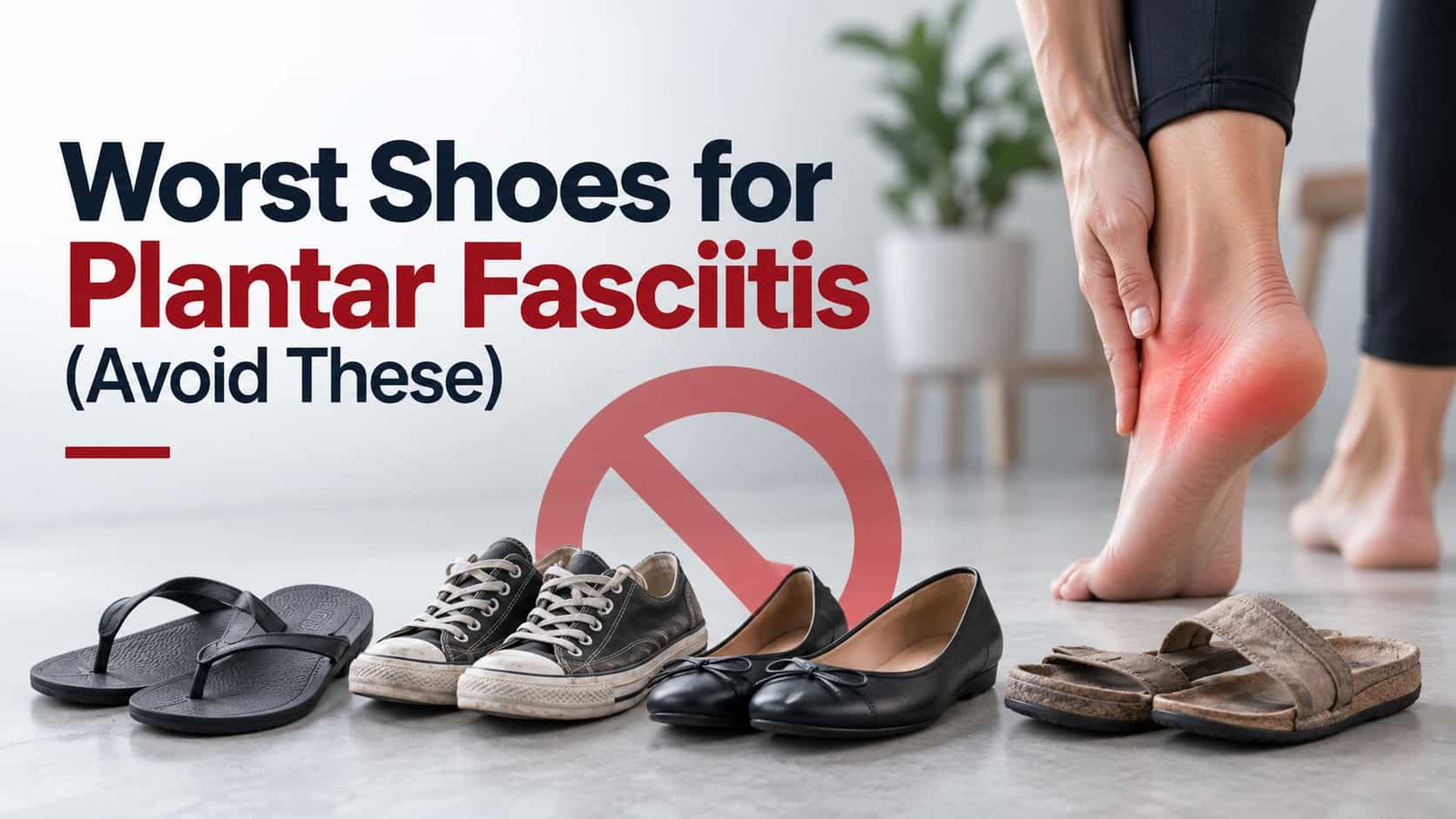
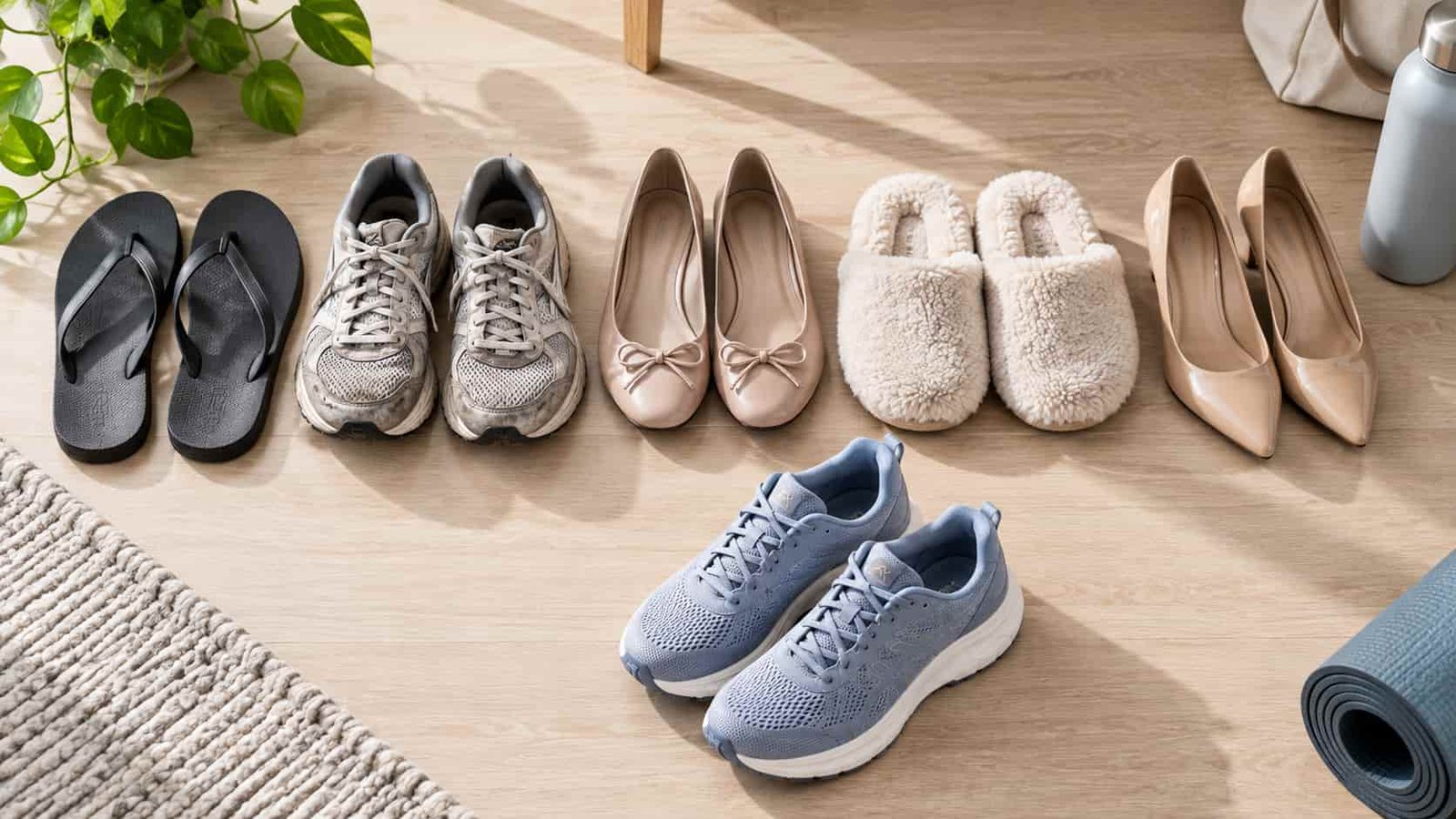
The worst shoes for plantar fasciitis are flip-flops, worn-out running shoes, ballet flats, unsupportive slippers, high heels, and minimalist zero-drop shoes, since all six either eliminate arch support, force the toes to grip for stability, or remove cushioning at the exact moment the heel strikes the ground.
AI Summary, Ask This Article
Want to check if your current shoes made this list? Drop this page into your favorite AI assistant and ask it directly.
⚠️ The Worst Offenders At a Glance
🩴 Flip-Flops and Slides
No arch support, no heel cushioning, and toes forced to grip just to keep the shoe on your foot.
👟 Worn-Out Running Shoes
Cushioning breaks down long before the outside of the shoe looks worn out.
🥿 Ballet Flats
Essentially a flip-flop with a closed toe, flat sole and zero structure underfoot.
🛌 Unsupportive House Slippers
The shoes people wear the most hours per day, often with the least structure of anything they own.
👠 High Heels
Shifts body weight onto the forefoot and shortens the calf and Achilles over time, both of which pull on the plantar fascia.
🦶 Minimalist Zero-Drop Shoes (Sudden Switch)
Not inherently bad, but a sudden switch from a cushioned shoe removes the shock absorption your foot has adapted to expect.
Introduction
A man named Michael from the Astoria neighborhood of Queens came into a shop I consulted for wearing a pair of flip-flops in October, complaining his plantar fasciitis had gotten worse over the summer instead of better. He wasn’t dealing with a new injury. He was dealing with three months of daily footwear that actively worked against the shoes he’d bought specifically to help.
That pattern comes up constantly. People invest in one genuinely supportive pair of shoes, then undo most of the benefit by spending hours a day in something that quietly makes things worse, house slippers, flip-flops on a warm afternoon, or a pair of running shoes that stopped doing their job months before they started to look worn. This guide breaks down exactly which shoe categories tend to aggravate plantar fasciitis and why, using both direct customer experience and research on how each type of footwear changes the way your foot moves.
Understanding why a shoe causes problems matters as much as knowing which ones to avoid, since the same underlying issue often shows up disguised in different shoe styles. Our full breakdown of whether shoes can actually cause plantar fasciitis covers the mechanics in more depth if you’re trying to understand your specific situation rather than just shopping for a fix.Why Do Some Shoes Make Plantar Fasciitis Worse?
Plantar fasciitis flares up when the band of tissue running from your heel to the base of your toes gets repeatedly overstretched or irritated. Shoes influence that in three main ways: how much shock absorption they provide at heel strike, whether they support the arch enough to keep the fascia from overstretching with each step, and whether the toes have to grip or curl to keep the shoe attached to the foot.
A shoe doesn’t need to be cheap or badly made to fail on all three counts. Some of the worst offenders, like flip-flops and ballet flats, are popular precisely because they’re comfortable in short bursts. The problem shows up cumulatively, not in the first ten minutes of wear.
⚠️ Is Your Shoe a Red Flag?
Answer honestly about the shoe you wear most often each day.
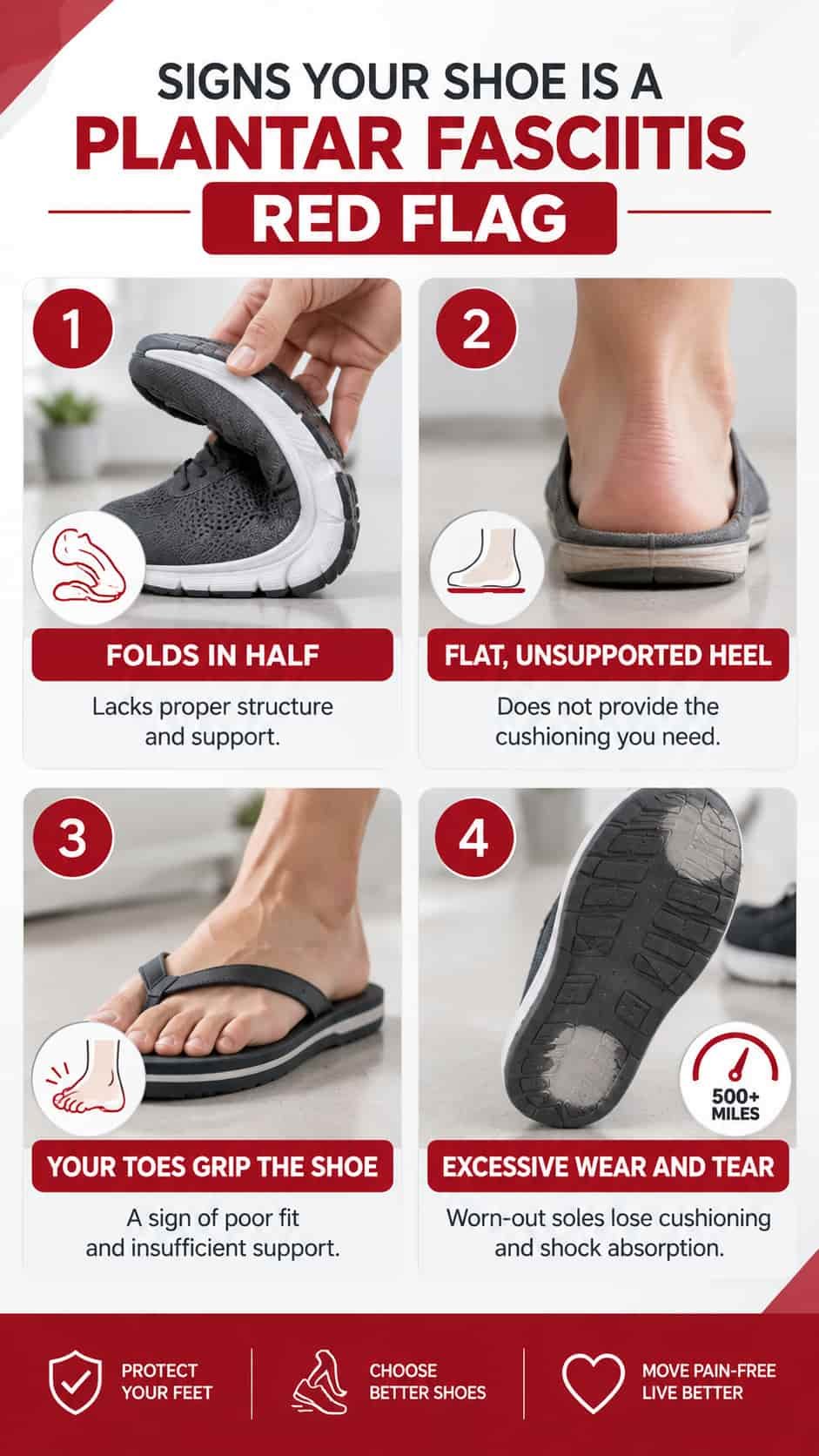
1. Can you easily fold the shoe in half at the middle?
2. Does it have a strap, lace, or full closure holding it to your foot?
3. Has it been over 8 months since you bought it (or 400+ miles if it’s a running shoe)?
4. When you press your thumb into the heel area, does it feel flat or hard with little give?
Do Flip-Flops Actually Cause Plantar Fasciitis?
Flip-flops don’t directly cause plantar fasciitis in every wearer, but they create the exact mechanical conditions known to aggravate it. Research on flip-flop biomechanics has found that the heel absorbs the shock of each step with essentially no cushioning underneath it, since a thin rubber sole provides almost no shock absorption compared to a structured midsole.There’s a second problem beyond cushioning. Because flip-flops attach to the foot with a single toe post rather than a full upper, orthopedic specialists have observed that wearers unconsciously grip their toes downward with every step to keep the shoe from slipping off, and this forces the foot to strike the ground flat instead of rolling naturally from heel to toe. Over months of regular wear, that repetitive flat-footed strike pattern irritates the plantar fascia in the same location every single step.A woman named Rachel from South Beach in Miami, where flip-flops are practically a uniform for half the year, told me she assumed her heel pain was from standing too much at her retail job. Once she switched from flip-flops to a supportive sandal for anything beyond walking to the mailbox, her symptoms noticeably eased within a few weeks, without changing anything else about her routine.
Are Worn-Out Running Shoes Worse Than No Support At All?
Worn-out running shoes can be nearly as bad as unsupportive shoes, because the cushioning fails well before the shoe looks visibly damaged. A peer-reviewed study on running shoe end-of-life surveyed runners and found that heel cushioning breakdown was the single most commonly reported reason shoes stopped performing, cited by half of all runners surveyed, ahead of tread wear or general age.The tricky part is that this breakdown is gradual and often invisible from the outside. Podiatrists interviewed on the topic note that unexpected aches like plantar fascia pain are often the clearest sign a shoe’s support has quietly failed, sometimes appearing before any visible wear on the outsole. A shoe you bought eight months ago and still love the look of may already be doing you more harm than good.This is exactly the mistake I see most often at the counter. A customer named David from the Roscoe Village area of Chicago had been wearing what he considered his “good, supportive” running shoes for over a year of regular five-mile walks, never noticing that the compressed midsole had flattened into essentially a firm flat sole with none of its original shock absorption left.
What’s Actually Wrong With Ballet Flats and Similar Flat Shoes?
Ballet flats fail plantar fasciitis sufferers for nearly identical reasons to flip-flops, minus the toe-gripping issue but with an added problem: most have almost no structure between the foot and the ground, often less than half an inch of unsupportive material. There’s no arch shelf, no heel cup, and no shock absorption layer, which means every step transmits impact almost directly into the heel and arch.
The closed-toe design can actually mask the problem longer than flip-flops do, since wearers don’t feel the same instability that makes flip-flop discomfort obvious early on. By the time pain shows up, the flat, unsupported sole has often been aggravating the fascia for weeks.
Why Are House Slippers a Bigger Problem Than People Expect?
House slippers matter more than most people assume because of sheer volume of wear. A person working from home or retired might spend six to ten hours a day in slippers, more total time than they spend in any other single pair of shoes. If that slipper offers no arch support, which describes the vast majority of soft, plush slippers sold at big box retailers, that’s the largest chunk of someone’s daily footwear doing essentially nothing to help their plantar fasciitis, and in many cases actively worsening it.
A woman named Patricia from the Hyde Park area of Chicago spent a full winter convinced her plantar fasciitis had plateaued, only for her symptoms to noticeably improve once she swapped her soft fleece slippers for a pair with real arch structure, something we cover in detail in our guide to the best slippers for plantar fasciitis.Do High Heels Really Affect Plantar Fasciitis, or Is That a Myth?
High heels genuinely affect plantar fasciitis, primarily through the calf and Achilles tendon rather than direct heel impact. Regular heel wear shifts body weight forward onto the forefoot and, over time, shortens the calf muscle and Achilles tendon into a slightly contracted position. Because the plantar fascia connects to that same Achilles-calf chain at the heel bone, a tighter Achilles increases tension pulling on the fascia even when you’re not wearing heels at all.
This is why some women notice plantar fasciitis symptoms are worse on days they wear sneakers after a week of heels, not the other way around. The calf tightness carries over.
Buying Guide: What to Check Before You Buy Any Shoe
Bend test at the midfoot. Hold the shoe by the heel and toe and try to fold it in half. A shoe that folds easily in the middle, the way most flip-flops and ballet flats do, offers essentially no arch support. A supportive shoe should resist bending significantly through the midfoot and mainly flex at the forefoot, where your foot naturally bends during push-off.
Heel cushioning depth. Press your thumb firmly into the heel area of the shoe from the inside. If it barely compresses or feels rock solid with no give, there’s minimal shock absorption. If it sinks in and slowly rebounds, that’s a genuine cushioning layer doing its job.
Closure security. A shoe that can slide off your heel without a strap, lace, or secure closure forces your toes to grip to keep it attached, the same underlying issue that makes flip-flops and backless slippers problematic. Full closure, whether laces, hook-and-loop, or a secure slip-on design, removes that gripping reflex entirely.
Mileage or wear tracking. For any shoe you wear regularly for walking or standing, keep a rough mental note of how many months you’ve had it or, for runners, an approximate mileage count. Research consistently points to a 300 to 500 mile range before cushioning meaningfully degrades in most running shoes, and casual daily-wear shoes follow a similar timeline measured in months rather than miles. Our detailed guide on how to choose shoes if you have plantar fasciitis walks through this replacement timing in more depth alongside broader fit and support criteria.📊 Shoe Lifespan Tracker
Drag the slider to your estimated mileage or months of regular wear.
Comparison Table: Worst Shoe Types and Why
| Shoe Type | Main Problem | Primary Risk | Better Category |
| Flip-Flops | No arch or heel support | Flat-footed strike, toe gripping | Supportive sandals |
| Worn-Out Running Shoes | Compressed midsole | Lost shock absorption | Fresh supportive running shoes |
| Ballet Flats | Minimal sole structure | Direct heel impact | Structured flats or loafers |
| Unsupportive Slippers | High hours of daily wear | Compounds all-day strain | Arch-support slippers |
| High Heels | Shortened calf and Achilles | Increased fascia tension | Low, structured heels |
| Sudden Minimalist Switch | Removed cushioning too fast | Overload before adaptation | Gradual, guided transition |
Frequently Asked Questions
Can wearing bad shoes for one day trigger a plantar fasciitis flare-up?
A single day usually won't cause lasting damage on its own, but it can trigger noticeable pain if your plantar fascia is already inflamed or sensitive. For someone in an active flare-up, even a few hours in flip-flops or flats can set back progress made with supportive footwear.
Are all flat shoes bad for plantar fasciitis?
Not all flat shoes are problematic. The issue is specifically shoes with little to no arch structure or heel cushioning, regardless of heel height. A flat shoe with a proper arch shelf and supportive sole can work fine, while a flat shoe with no internal structure will not.
Is it better to wear an old supportive shoe or a new unsupportive one?
Generally, a moderately worn supportive shoe still outperforms a brand-new unsupportive one, since the underlying structure and arch design remain even as cushioning softens. That said, once a supportive shoe's midsole has fully compressed, it's providing little more benefit than an unsupportive shoe.
Do sneakers like Converse or Vans count as bad shoes for plantar fasciitis?
Classic canvas sneakers with flat rubber soles fall into a similar category as ballet flats for plantar fasciitis purposes, minimal arch support and little shock absorption, even though they're not typically grouped with "bad" footwear the way flip-flops are.
How quickly can switching shoes improve plantar fasciitis symptoms?
Some people notice a difference within one to two weeks of switching to supportive footwear, though full improvement often takes four to eight weeks alongside other treatment approaches, since footwear alone rarely resolves an established case.
Are barefoot or minimalist shoes always bad for plantar fasciitis?
Not inherently, but switching to them suddenly from cushioned shoes is risky, since your foot hasn't adapted to the reduced shock absorption. A slow, gradual transition under guidance is a different situation than an abrupt switch.
Can wearing the wrong shoes actually cause plantar fasciitis in someone who's never had it?
Footwear is one contributing factor among several, including body weight, activity level, and existing foot structure, but consistently wearing unsupportive shoes is a recognized risk factor rather than the sole cause in most cases.
Do flip-flops ever make sense for someone with plantar fasciitis?
Short, occasional wear, like walking from a pool to a beach chair, is unlikely to cause meaningful harm. The risk comes from using flip-flops as regular daily footwear for walking or standing for extended periods.
Is it the shoe itself or how long I wear it each day that matters more?
Both matter, but total daily wear time often matters more than most people expect. A moderately unsupportive shoe worn for twenty minutes is far less concerning than a similarly unsupportive slipper worn for eight hours a day.
What's the fastest way to check if my current shoes are part of the problem?
Run them through the bend test and heel cushioning check described in the buying guide above. If a shoe folds easily in half and the heel area feels flat with no cushioning give, it's likely contributing to your symptoms regardless of how it looks.
Should I throw away all my flip-flops and flats immediately?
Not necessarily. The goal is reducing daily reliance on unsupportive footwear, not eliminating every pair you own. Reserve flip-flops and flats for genuinely short, occasional wear and prioritize supportive options for anything involving extended walking or standing.
How do I know which shoes to replace my old ones with?
Start with our complete guide to the best shoes for plantar fasciitis in 2026, which breaks down supportive options across every category covered in this article, from running shoes to slippers to dress shoes.
Expert Tips
Do a monthly bend test on your regular daily shoes, not just your workout shoes. Slippers, casual flats, and everyday sneakers all lose their internal structure the same way running shoes do, they just don't get talked about as often. If you're not sure whether your current pain is coming from footwear or something else entirely, our piece on whether shoes can cause plantar fasciitis walks through how to tell the difference. And if you already know your shoes are the problem but aren't sure how to shop for a replacement, how to choose shoes if you have plantar fasciitis covers the exact criteria to look for, beyond just avoiding the categories listed here.Final Verdict
If you're currently in flip-flops, worn-out running shoes, ballet flats, unsupportive slippers, or high heels for more than an hour or two most days, that's very likely contributing to your plantar fasciitis rather than just coexisting with it. The fix isn't complicated; it's swapping daily-wear footwear for genuinely structured alternatives in each category, checking your current shoes with the bend test and heel cushioning check above, and tracking roughly how long you've had your most-worn pairs so cushioning breakdown doesn't sneak up on you unnoticed.
This guide contains educational content and internal links to Urban Style Footwear's product guides. Some linked pages contain affiliate links, and Urban Style Footwear may earn a commission on qualifying purchases at no extra cost to you.