
Shoe Materials Explained: What Shoes Are Made Of and How to Tell Them Apart
Short answer: most shoes are made from four material families. Leather (full grain, top grain, suede, nubuck), textiles (canvas, mesh, knit, wool), synthetics (PU, PVC, TPU, microfiber) and sole compounds (rubber, EVA, PU, TPR). By volume, rubber and plastic shoes lead world trade at about 50% of pairs exported, textiles follow at 29% and leather at 15%. Leather still earns the most money, at 38% of export value. The fastest way to know what your shoe is made of is the label inside the tongue. In the EU and UK, a pictogram must show the main material of the upper, the lining and the sole.
Key takeaways
- The sole usually fails before the upper. Lab work on EVA midsoles found peak foot pressure rose about 100% after 500 km of running. The upper looked fine.
- “Genuine leather” is a real leather, not a top grade. It usually means a lower layer of the hide. Full grain sits at the top.
- Unworn shoes can still fall apart. PU soles break down from humidity over time. SATRA, the footwear testing body, treats about 3 years as a reasonable expectation before problems, sooner if the shoes get wet.
- In the US, non-leather that looks like leather should be disclosed. The FTC Leather Guides cover footwear and use terms like “imitation leather” or “vinyl”.
- No single material is “best”. Match the material to your climate, how sweaty your feet get, and how long you want the pair to last.
A shoe looks like one object, but it is closer to a small engineering project. MIT researchers who studied a typical running shoe counted 65 separate parts and more than 360 processing steps to put them together [1]. Each part is chosen for a different job. Leather or mesh for the upper, foam for cushioning, rubber for grip, a stiff counter to hold your heel in place.
That is why “what is this shoe made of?” rarely has a one-word answer. In my years of shoe retail, the most common question I heard wasn’t about brand or price. It was some version of “will this last, and how do I look after it?” Both answers come down to materials. This guide is the hub for every material article on Urban Style Footwear. Start here, then go deeper with the links in each section.
What are shoes made of? A part-by-part breakdown
Think of a shoe in layers, from the outside in and the top down. Every layer has its own typical materials, and the label laws in Europe and the UK only ask brands to name three of them: the upper, the lining and sock, and the outer sole [2]. For a full tour of the parts, see our anatomy of a shoe guide.
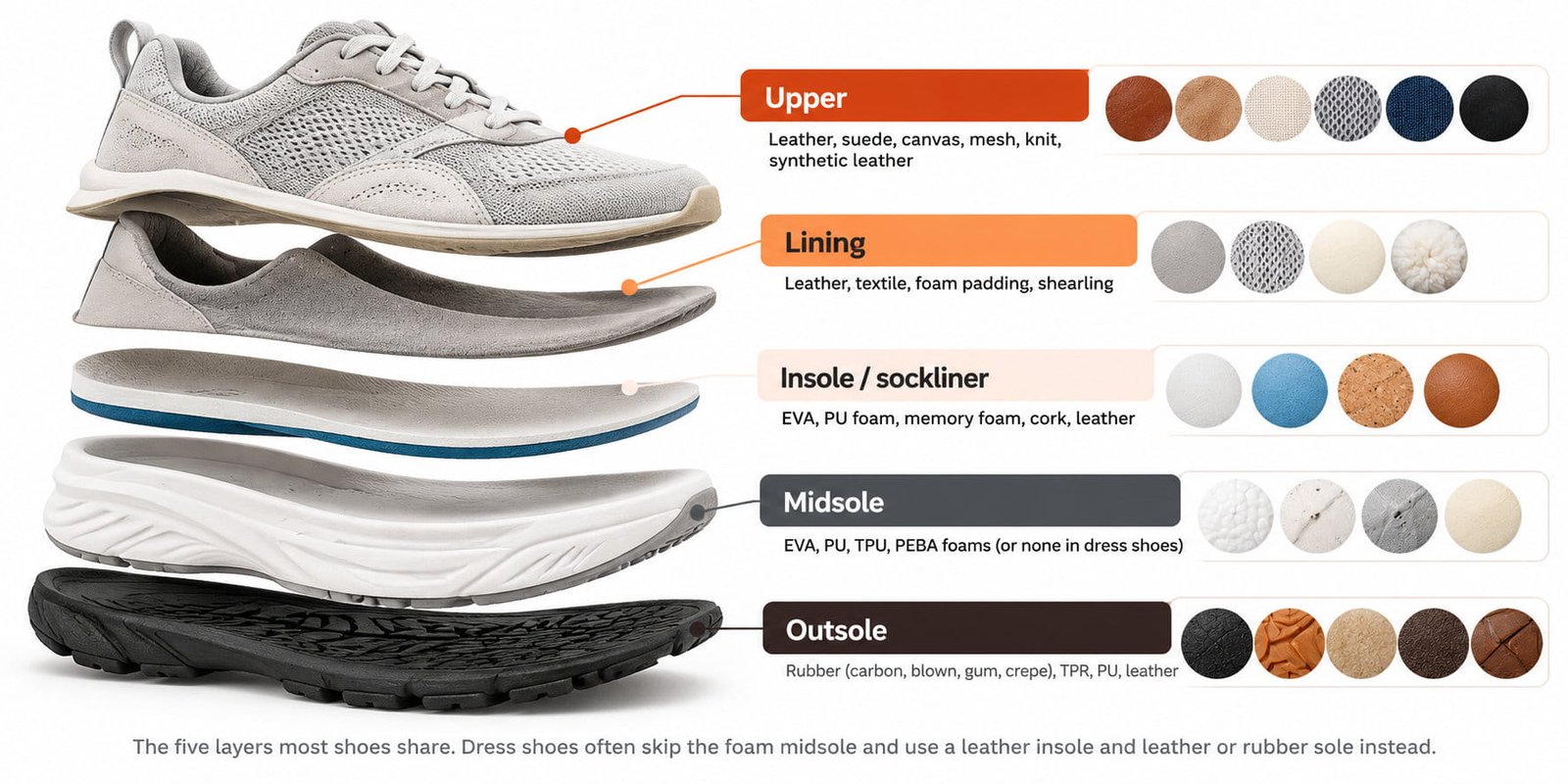
| Part | Its job | Common materials | Go deeper |
|---|---|---|---|
| Upper | Wraps the foot, sets the look, breathability and water resistance | Full grain or corrected leather, suede, nubuck, canvas, engineered mesh, knit, PU or microfiber synthetic leather | Material families |
| Lining | Comfort against the skin, moisture handling | Pig or cow leather, polyester textile, foam padding, shearling in winter boots | What is shearling |
| Insole / sockliner | First layer under the foot, light cushioning | EVA or PU foam, memory foam, cork, leather | Insole vs midsole vs outsole |
| Midsole | Main cushioning and stability in athletic shoes | EVA, PU, TPU (for example Boost), PEBA in racing shoes | Running shoe foam guide |
| Outsole | Grip and abrasion resistance | Carbon rubber, blown rubber, gum rubber, crepe, TPR, PU, leather | Rubber soles explained |
| Heel counter and toe puff | Hidden stiffeners that hold the shape | TPU, thermoplastic sheets, leatherboard | What is TPU in shoes |
| Safety toe (work boots) | Impact and compression protection | Steel, aluminium, composite (fiberglass, carbon fiber, plastic) | Steel toe vs composite toe |
Shoe materials by the numbers
Most material guides skip the data. Here is what the industry figures actually say, with the source for each one.
One thing stands out. Leather is now a minority material by pair count. A UN report noted that 2008 was the first year that less than half of all footwear was made of leather [5]. Synthetics, textiles and molded rubber took over the volume end of the market, while leather kept the premium end. That split explains a lot of what you see on shelves.
The 5 shoe material families
Every material in this guide fits one of five families. Each card gives you the short version and links to the full article.
1. Leather
Animal hide, tanned so it does not rot. The top layer (full grain) is the strongest and develops a patina. Lower layers are sanded, coated or split into suede. Leather breathes, molds to your foot and can be resoled for years on a stitched shoe.
Best for: dress shoes, boots, long-life everyday shoes. Watch out: needs conditioning, heavier, not vegan.
- Full grain vs top grain leather
- What is full grain leather?
- What is top grain leather?
- What is genuine leather?
- What is patent leather?
- What is suede?
- What is nubuck leather?
- Suede vs nubuck
- Leather vs suede shoes
- How to tell if shoes are real leather
- Chrome vs vegetable tanned leather
- Shell cordovan leather
- What is nappa leather?
- What is shearling?
- Exotic leather shoes
2. Textiles and knits
Woven, knitted or engineered fabrics. Canvas is a tight cotton weave. Mesh is an open weave, usually polyester, built for airflow. Knit uppers such as Flyknit and Primeknit are made from yarn in one piece, so they fit like a sock. Wool adds warmth and odor resistance.
Best for: running, gym, summer, casual sneakers. Watch out: soaks up water, stains easily, wears through at the toe.
3. Synthetics
Plastics made to look or work like leather, or to add structure. PU (polyurethane) synthetic leather is the most common “leather look” on budget shoes. PVC is tougher and more waterproof but stiffer. Microfiber leather is a higher grade synthetic. TPU is the hard plastic in overlays and heel counters. Neoprene is the stretchy rubber foam of water shoes.
Best for: budget, vegan, rain and easy-clean shoes. Watch out: PU can peel and crack, many synthetics breathe poorly.
4. Sole materials
Soles need grip, flex and wear resistance. Carbon rubber is the hard-wearing black rubber on running outsoles. Blown rubber is lighter and softer. Gum and crepe are natural-look rubbers. EVA is a light foam that is cheap and comfortable but compresses. TPR is a rubber-like plastic common on casual shoes and slippers.
Best for: matching grip and weight to your activity. Watch out: foams flatten, PU soles can crumble with age.
5. Safety and specialist materials
Work and outdoor footwear adds protective materials you never see. Steel or composite toe caps, puncture-resistant plates, and waterproof membranes such as Gore-Tex sit between the upper and the lining.
Best for: job sites, hiking, wet climates. Watch out: added weight, membranes reduce breathability.
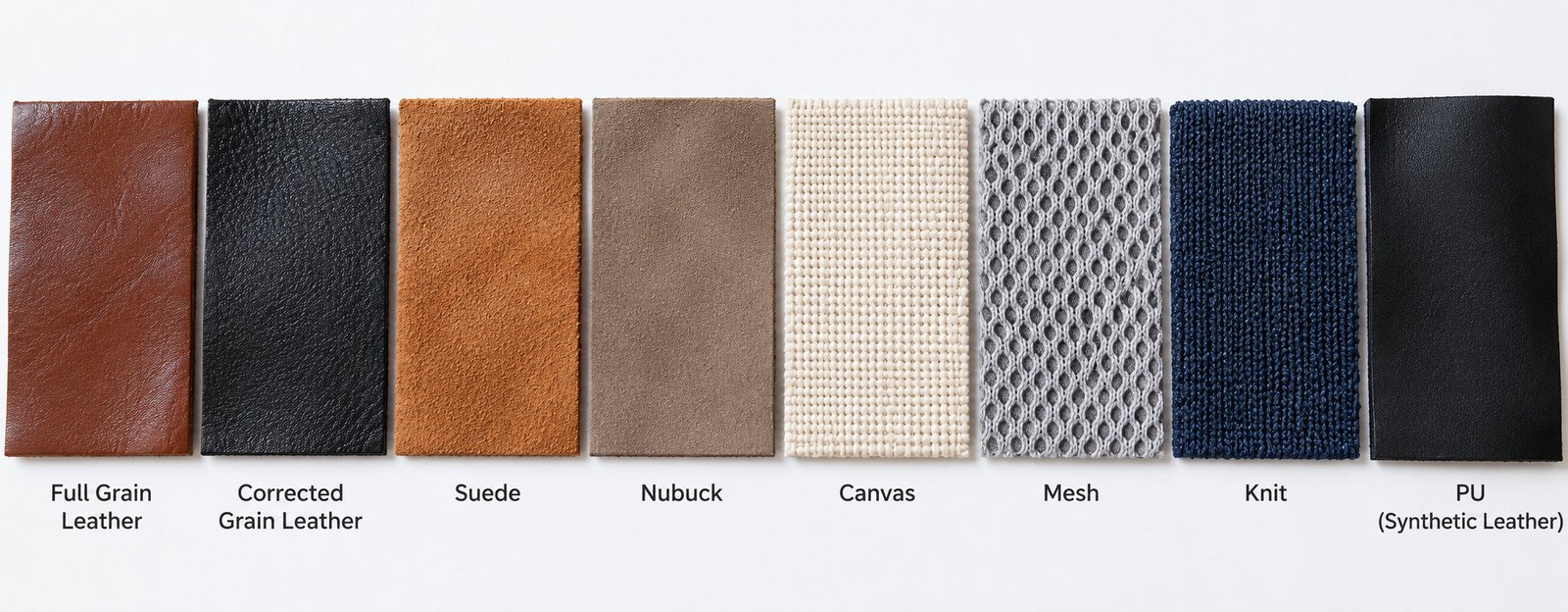
Shoe material comparison table
This table compares the upper materials you will meet most often. The ratings are relative and come from how each material is built: grain structure, weave density, coatings. They are not a lab score. A cheap pair in a good material can still fail early if the stitching or glue is poor.
| Material | Breathability | Water resistance | Durability | Care effort | Vegan | Typical use |
|---|---|---|---|---|---|---|
| Full grain leather | Good | Fair, better with wax | Excellent | Medium (condition) | No | Dress shoes, boots |
| Top grain / corrected leather | Fair | Fair to good (coated) | Good | Low to medium | No | Sneakers, mid-price dress shoes |
| Suede | Good | Poor without spray | Fair | High | No | Casual shoes, desert boots |
| Nubuck | Good | Fair | Good | High | No | Work and outdoor boots |
| Patent leather | Poor | Good | Fair (creases crack) | Low | No | Formal shoes |
| Canvas | Good | Poor | Fair | Low (washable) | Yes | Casual sneakers |
| Engineered mesh | Excellent | Poor | Fair | Low | Yes | Running, gym |
| Knit (Flyknit, Primeknit) | Excellent | Poor | Fair | Low | Usually | Running, lifestyle |
| Merino wool | Good | Poor to fair | Fair (pills) | Low | No | Casual, travel |
| PU synthetic leather | Poor to fair | Good | Fair (peels) | Low | Yes | Budget and vegan shoes |
| Microfiber leather | Fair | Good | Good | Low | Yes | Sports shoes, football boots |
| PVC | Poor | Excellent | Good | Low | Yes | Rain boots, jelly shoes |
Rule of thumb from the table: the more a surface is coated, the more water it keeps out and the less sweat it lets escape. That trade-off runs through every material on this page.
What actually wears out first (with evidence)
Most guides answer “what is the most durable shoe material?” with “leather” and move on. That is only half the story. In real use, shoes rarely fail in the upper first. They fail in the foam, the glue line or the sole. Here is what the research and testing bodies show.
1. Foam midsoles flatten long before they look worn
In a University of Birmingham study published in the Journal of Biomechanics, peak pressure under runners’ feet rose by an average of about 100% after a 500 km run in EVA-midsole shoes. Electron microscope scans showed damage to the foam cells after 750 km [7]. A 2020 study of 33 runners in the same shoe model found midfoot peak pressure climbed from about 387 kPa when new to about 590 kPa at 700 km [8]. The uppers looked fine. The cushioning had gone. Our guide on how long running shoes last covers what that means for replacing them.
2. PU soles can crumble even if you never wear them
Polyurethane reacts with moisture in normal air over time (hydrolysis). SATRA, the UK footwear research and testing body, says three years is a reasonable expectation before PU footwear may be affected, especially if it has been wet. It describes this as an effective “use by” date that starts when the sole is molded, not when you buy it [9]. One safety footwear maker states its basic PU sole lasts about 1.5 years in tropical conditions and 3 years in normal conditions [10].
Real owners report the same thing. On the MoneySavingExpert forum, buyers describe hiking boots crumbling after little wear and a pair that “crumbled to nothing in the box” while stored unused [11]. If you buy shoes to keep for “best”, store them cool, dry and ventilated, and wear them now and then. More in our guide to midsole hydrolysis.
3. Synthetic leather tends to fail at the surface
PU synthetic leather is a plastic coating on a fabric backing. When it fails, it usually cracks at the flex line or peels where the coating separates from the backing. Real leather creases but does not delaminate. That is why “PU leather peeling” is one of the most common complaints about budget shoes. See how to fix peeling shoes for what can and cannot be saved.
4. Textiles wear through at the toe and heel
Mesh and knit uppers give up where they rub: the big toe area and the inside heel lining. A hole in the heel lining is usually a fit or heel counter issue, not just weak fabric. Our guide to fixing holes in shoes explains both.
So what lasts longest?
A full grain leather upper on a stitched sole you can replace. A Goodyear welted boot can be resoled several times, so the long-life part (the upper) outlives the short-life part (the sole). For athletic shoes, the honest answer is different. The midsole sets the lifespan, so pick the foam and outsole rubber for your mileage rather than the upper.
How to identify what your shoe is made of
You do not need a lab. Work through these checks in order and you will get it right almost every time. Our dedicated guide shows each one with photos: how to tell if shoes are real leather.
- Read the label first. Look inside the tongue, on the heel lining or under the insole. In the EU and UK you will find pictograms for the upper, lining and sole. US labels often use words like “leather upper”, “man-made materials” or “synthetic”.
- Look at a cut edge. Real leather shows a fuzzy, fibrous edge. Synthetic leather shows a fabric backing or a smooth, uniform plastic edge. Check inside the collar or around the eyelets.
- Check the grain. Full grain leather has small, uneven pores and natural marks. A perfectly regular pattern usually means embossed corrected leather or a synthetic.
- Press and flex. Leather wrinkles into fine, irregular creases and slowly recovers. PU often forms sharper, regular creases that stay.
- Smell it. Leather has an earthy smell. Synthetics smell of plastic or chemicals, especially when new.
- Do a drop of water test on a hidden spot. Untreated leather and suede darken as they absorb a drop. PVC and coated surfaces bead it off. Dab it dry straight away.
- Compare price and claims. A “full grain leather” shoe at a fast-fashion price deserves a second look. Do not use the burn test you see online. It damages the shoe and is unsafe.
Shoe labels and symbols decoded
This is where most guides are vague. Here is exactly what the rules say in the two places most of our readers buy from.
EU and UK: four material symbols, three shoe parts
EU Directive 94/11/EC, and the UK’s Footwear (Indication of Composition) Labelling Regulations 1995, require shoes to show the main material of the upper, the lining and sock, and the outer sole. Brands may use words or pictograms [2] [12].
| Rule | What it means for you |
|---|---|
| Three parts are labelled | Upper (outside), lining and sock (inside, including the insole), outer sole (bottom). Midsoles are not covered. |
| The 80% rule | The label names the material making up at least 80% of the upper and lining surface, and of the outsole volume. If no material reaches 80%, the two main materials must be listed. |
| “Coated leather” is specific | Leather whose surface coating is more than 0.15 mm thick but no more than one third of the total thickness. Patent leather often falls here. |
| Reconstituted leather is not “leather” | Material broken into fibers or powder and re-formed into sheets cannot use the leather symbol. |
| On the shoe itself | At least one shoe in each pair must carry the label. Shops using pictograms must display a notice explaining them. |
United States: leather claims are policed, fabric content is not
The US has no pictogram system for shoes. Two federal rules matter instead:
- FTC Leather Guides (16 CFR Part 24) list footwear as a covered product. If a part looks like leather but is not, that should be disclosed, for example “imitation leather”, “simulated leather” or “vinyl”. Ground or bonded leather should not be called leather without disclosing the percentage of leather fiber and non-leather content [13].
- Textile Fiber Products Identification Act. Footwear is not on the list of products the textile labelling rules cover (16 CFR 303.45). That is why American sneaker labels rarely give fiber percentages [14].
So what does “man-made materials” mean on a US shoe? It is a catch-all for synthetics: PU or PVC coatings, polyester mesh, nylon and plastic overlays. It is not a quality grade. Treat it as “not leather, not natural fiber” and look at the product photos and description for the details.
Which shoe material should you choose?
Start from your situation, not the material. This is the table I would use at the fitting stool.
| Your situation | Choose | Avoid | Why |
|---|---|---|---|
| Sweaty feet or hot climate | Engineered mesh, knit, unlined leather, merino wool | PVC, patent leather, heavily coated PU | Coatings trap moisture, and damp shoes smell faster. See sweaty feet in shoes. |
| Rain and puddles | Waxed full grain leather, PVC or rubber boots, membrane shoes | Suede, canvas, mesh | Open textiles soak through in minutes. See waterproof vs water resistant. |
| Cold and snow | Treated leather or nubuck, shearling lining, rubber outsole | Mesh, canvas, leather soles | Insulation plus grip matter more than the upper alone. |
| Standing all day | Leather or microfiber upper, PU or rubber outsole, removable insole | Thin EVA-only soles | EVA compresses with load. Durable outsoles keep support longer. |
| Running and gym | Engineered mesh or knit, carbon rubber outsole, modern foam | Heavy leather, leather soles | Weight and breathability matter. See the foam guide. |
| Longest life possible | Full grain leather on a welted or stitched sole | Glued PU soles kept for years | The upper can outlive several resoles. |
| Vegan | Microfiber, PU, canvas, knit, plant-based leathers | Leather, suede, wool, some glues | Check glues and linings too. See what is vegan leather. |
| Tight budget | Canvas, PU with a rubber outsole | “Genuine leather” at fast-fashion prices | A good canvas shoe beats a poor leather one. |
| Kids | Washable canvas or mesh, rubber sole, hook and loop straps | Stiff leather, slick soles | Kids outgrow shoes long before materials wear out. |
Material certifications worth looking for
Most shoe material guides skip the certification logos on shoe boxes, even though they tell you more than any marketing line. Here are the ones that matter most for footwear.
| Label | Applies to | What it tells you |
|---|---|---|
| Leather Working Group (LWG) | Leather | The tannery was audited for environmental performance and chemical management. Over a third of global finished leather is assessed this way [6]. It rates the tannery, not the shoe factory. |
| OEKO-TEX | Textiles, leather | The material was tested for listed harmful substances. |
| bluesign | Textiles, chemicals | The chemicals and processes used to make the fabric were screened. |
| Global Recycled Standard (GRS) | Recycled polyester, rubber | Recycled content claims are verified through the supply chain. |
A certification covers a material or a site. It does not tell you how long the shoe will last. For sustainability claims that sound too good, read our guide to spotting greenwashing in footwear.
How to care for each shoe material
| Material | Clean with | Never | Full guide |
|---|---|---|---|
| Smooth leather | Damp cloth, leather cleaner, then conditioner | Soak it or dry it on a heater | Clean leather shoes, condition leather |
| Suede | Suede brush and eraser, dry methods | Use water or soap first | Clean suede shoes |
| Nubuck | Nubuck brush, specialist cleaner | Use suede crepe brushes too hard | Clean nubuck |
| Patent leather | Damp cloth, a little glass cleaner or petroleum jelly for scuffs | Store pressed against other shoes (colors transfer) | Clean patent leather |
| Canvas | Mild soap and a soft brush, air dry | Use a hot dryer | Clean canvas shoes |
| Mesh and knit | Soft brush, cool water, laces out | Scrub hard (fibers fuzz) | Clean mesh shoes, clean knit shoes |
| PU and faux leather | Damp cloth, mild soap | Use alcohol or harsh solvents | Clean faux leather |
| Sheepskin and shearling | Sheepskin cleaner, cool water, shape and air dry | Machine wash hot | Clean sheepskin boots |
| Rubber and foam soles | Soap, soft brush, eraser for scuffs | Leave in direct sun for long periods (yellowing) | Clean shoe soles, whiten yellow soles |
For a full routine across every material, see our shoe care and cleaning guide.
5 shoe material myths
Myth 1: “Genuine leather” means top quality
It means the product contains real leather. In practice it is often a lower layer of the hide, below full grain and top grain. Our full grain vs top grain guide shows the full ladder.
Myth 2: Synthetic always means cheap and bad
A good microfiber upper can outlast a poor corrected leather one, and engineered mesh outperforms leather for running. The quality of the build matters as much as the material.
Myth 3: Shoes last forever if you do not wear them
PU soles and some foams age with time and humidity, worn or not [9]. Storage conditions matter more than mileage for these.
Myth 4: Waterproof is always better
Membranes keep rain out but also slow down sweat escaping. In warm, dry weather a breathable mesh shoe is more comfortable. See what is Gore-Tex.
Myth 5: Leather is the most eco-friendly choice because it is natural
Every material has a footprint. MIT found most of a running shoe’s emissions come from manufacturing energy rather than the raw material itself [1]. Wearing a pair longer is usually the biggest win. Read more in our sustainable shoes guide.
Shoe materials FAQ
What is the most common shoe material?
By number of pairs, rubber and plastic shoes lead. They made up about 50% of exported pairs in 2023, ahead of textiles at 29% and leather at 15% [4].
What is the most durable shoe material?
For uppers, full grain leather. For soles, carbon rubber. The longest-lasting shoes combine both with a stitched construction that can be resoled. In athletic shoes the foam midsole usually sets the lifespan.
What does “synthetic” or “man-made” mean on a shoe?
It means the material is made from plastics or synthetic fibers, such as PU, PVC, polyester or nylon, rather than leather or natural fiber. It is a description, not a quality grade.
Is PU leather real leather?
No. PU leather is a polyurethane coating on a fabric backing. In the US, the FTC Leather Guides say non-leather that looks like leather should be disclosed, for example as “imitation leather” [13].
Is suede real leather?
Yes. Suede is real leather, usually the inner split of the hide, sanded to a soft nap. Nubuck is also real leather, but sanded on the outer grain side. See suede vs nubuck.
What do the symbols on shoes mean?
EU and UK shoes use four symbols: a hide shape for leather, a hide with a diamond for coated leather, a woven pattern for textile, and a diamond for other materials. They appear next to icons for the upper, lining and sole [2].
Which shoe material is best for sweaty feet?
Breathable uppers such as engineered mesh, knit, merino wool or unlined leather, with a moisture-wicking sock. Avoid PVC and heavily coated synthetics.
Why do shoe soles crumble?
Mostly PU hydrolysis. The polyurethane breaks down with moisture in the air over time. SATRA says about three years is a reasonable expectation before PU footwear may be affected, sooner if it gets wet [9].
Is leather or synthetic better for shoes?
Leather breathes better, molds to your foot and lasts longer if cared for. Synthetics are cheaper, lighter, vegan and need less care. Choose by use: leather for long life and dress wear, synthetics for budget, rain or vegan needs.
Can I machine wash my shoes?
Canvas and many mesh shoes can be washed on a gentle cold cycle. Leather, suede, nubuck and most dress shoes should not. See our washing machine guide.
Every shoe material guide on Urban Style Footwear
Leather
- Full grain vs top grain leather
- What is full grain leather?
- What is top grain leather?
- What is genuine leather?
- What is patent leather?
- What is suede?
- What is nubuck?
- Suede vs nubuck
- How to tell if shoes are real leather
- Leather vs suede shoes
- Chrome vs vegetable tanned leather
- Shell cordovan leather
- What is shearling?
- Exotic leather shoes
- What is nappa leather?
Related hubs: running shoe foam, anatomy of a shoe, shoe care and cleaning, shoe style guide.
Sources
- MIT News Office, “Study finds the bulk of shoes’ carbon footprint comes from manufacturing processes” (2013), on the lifecycle study by Kirchain, Olivetti and colleagues in the Journal of Cleaner Production.
- Directive 94/11/EC on labelling of the materials used in the main components of footwear, legislation.gov.uk.
- World Footwear, “24.6 billion pairs: global footwear production in 2025”, World Footwear Yearbook 2026 (APICCAPS), August 2026.
- World Footwear, “Leather footwear leads exports in value, but rubber and plastic leads in volume”, World Footwear Yearbook (2023 data), September 2024.
- UNIDO, Future Trends in the World Leather and Leather Products Industry and Trade (2010).
- Leather Working Group, official site.
- Verdejo, R. and Mills, N.J., “Heel-shoe interactions and the durability of EVA foam running-shoe midsoles”, Journal of Biomechanics 37 (2004) 1379 to 1386.
- Escamilla-Martinez, E. et al., “Longitudinal Analysis of Plantar Pressures with Wear of a Running Shoe”, International Journal of Environmental Research and Public Health (2020).
- SATRA, “Learning from footwear failures”.
- Safety Jogger, “Hydrolysis, the crumbling of shoe soles explained” (manufacturer data).
- MoneySavingExpert Forum, “Crumbling shoe / boot soles, sole hydrolysis” (owner reports, January 2024).
- Business Companion (UK trading standards), “Labelling of footwear”.
- eCFR, 16 CFR Part 24, Guides for Select Leather and Imitation Leather Products.
- eCFR, 16 CFR 303.45, Coverage and exclusions from the Textile Act.
How this guide was made: I wrote it from years of hands-on shoe retail experience, current industry data, peer-reviewed research and the labelling laws themselves. Durability ratings in the comparison table are editorial and explained above. We update this page when new data or rules come out. Last reviewed October 19, 2026.