
Best ASICS for Plantar Fasciitis 2026: Gel-Nimbus vs Kayano vs GT-2000 Compared
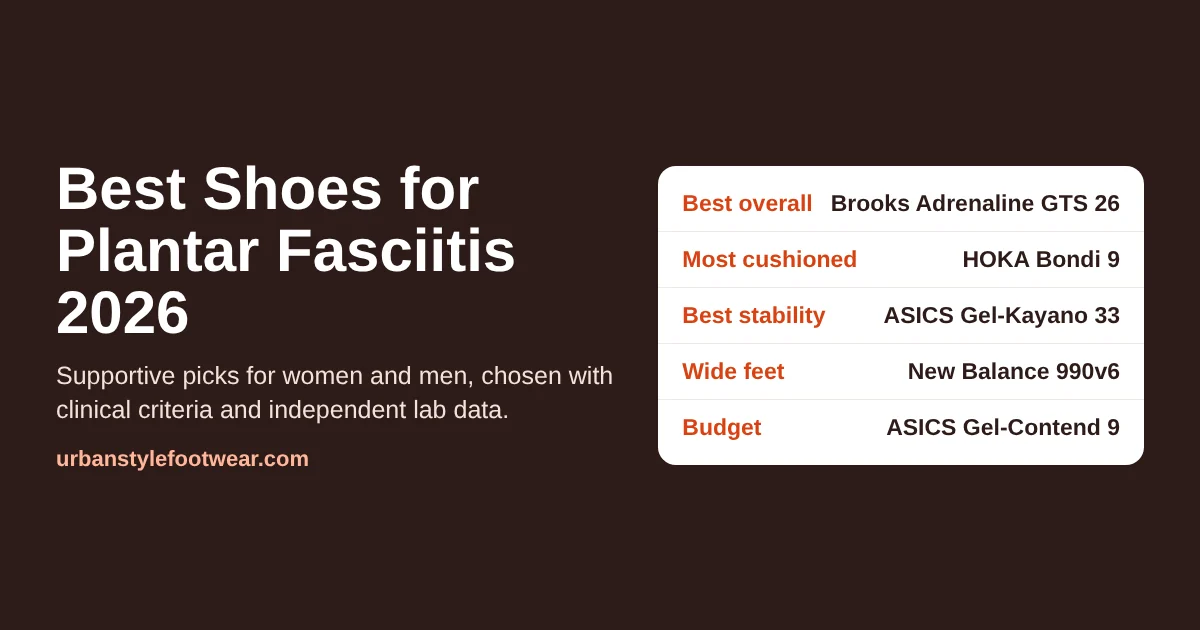
Quick answer: The best ASICS for plantar fasciitis is the Gel-Nimbus 28 if you have neutral or high arches and want maximum heel cushioning, and the Gel-Kayano 33 if you have flat feet or your ankles roll inward. The GT-2000 15 gives lighter, cheaper stability, the Gel-Cumulus 28 is the mid-price neutral pick, and the Gel-Excite 11 and Gel-Contend 9 are the budget options. Previous versions (Nimbus 27, Kayano 31 and 32, GT-2000 13 and 14) work almost as well and often cost less. Shoes ease heel pain but do not cure it on their own: pair them with daily calf and arch stretches.
Key facts
- Pick by foot type first: flat feet or overpronation suit ASICS’ stability shoes (Kayano, GT-2000); neutral or high arches suit the cushioned neutral shoes (Nimbus, Cumulus).
- Current 2026 models: Gel-Kayano 33, Gel-Nimbus 28, Gel-Cumulus 28, GT-2000 15 (August 2026) and Novablast 6.
- Lab-tested cushioning: the Kayano 33 measured 132 SA heel shock absorption in RunRepeat’s 2026 tests, well above the 100 SA they suggest for plantar fasciitis.
- Moderate drop: ASICS’ main running shoes now use about an 8 mm heel-to-toe drop, a range many specialists suggest for heel pain.
- Most people recover: more than 90% improve within 10 months of simple treatment such as stretching, supportive shoes and inserts (AAOS).
Best ASICS for Plantar Fasciitis: Our Picks at a Glance
Every pick meets the same baseline: a firm heel counter, a cushioned heel, a sole that resists twisting and a removable insole for orthotics. Then each one solves a different problem. Not sure which is yours? Use the ASICS finder.

 Best Overall for Heel Pain
ASICS Gel-Nimbus 28
The softest, thickest heel cushioning in the ASICS line for walking, standing and easy runs.
Read reviewCheck price on Amazon Best for Flat Feet and Overpronation
ASICS Gel-Kayano 33
ASICS’ most supportive cushioned shoe for flat feet, ankles that roll in and long days on your feet.
Read reviewCheck price on Amazon Best Value Stability
ASICS GT-2000 15
Lighter, cheaper stability than the Kayano for mild flat feet and walkers who also jog.
Read reviewCheck price on Amazon Best Mid-Price Neutral Shoe
ASICS Gel-Cumulus 28
Balanced cushioning for all-day walking and easy running, one step below the Nimbus in price and softness.
Read reviewCheck price on Amazon Best for Running With Mild Heel Pain
ASICS Novablast 6
A cushioned, lively trainer for runners whose heel pain is mild or settling.
Read reviewCheck price on Amazon Best Budget Walking Shoe
ASICS Gel-Excite 11
Softer than the Contend and cheaper than the Cumulus, for daily walking and the gym.
Read reviewCheck price on Amazon Lowest-Price Pick
ASICS Gel-Contend 9
The most affordable ASICS with rearfoot GEL; best paired with an arch-support insole.
Read reviewCheck price on AmazonAs an Amazon Associate we earn from qualifying purchases, at no extra cost to you. We never show prices because they change daily; the buttons show the current price. Where our photo or link shows an earlier version, we say so in the review.
Which ASICS Is Best for Your Plantar Fasciitis?
Answer four questions and get the ASICS model that fits your feet, your day and your budget.
Not sure about your feet? Look at an old pair of shoes from behind. Heels worn and tilted inward usually mean overpronation. The finder is a starting point based on shoe design, not a diagnosis.
Best ASICS for Plantar Fasciitis: Comparison Table
Compare support type, cushioning, drop and widths side by side. “Stability” shoes guide feet that roll inward; “neutral” shoes suit average and high arches.
| Model | Best for | Type | Cushioning | Heel drop | Widths | Version our link shows |
|---|---|---|---|---|---|---|
| ASICS Gel-Nimbus 28 | Best Overall for Heel Pain | Neutral, max cushion | Maximum | About 8 mm | Men’s standard, 2E, 4E; women’s standard and wide | Nimbus 27 |
| ASICS Gel-Kayano 33 | Best for Flat Feet and Overpronation | Stability (max support) | High | About 8 mm (lab: 8.5 mm) | Men’s narrow to extra wide; women’s narrow, standard, wide | Kayano 31 / 32 |
| ASICS GT-2000 15 | Best Value Stability | Stability (moderate) | Medium to high | About 8 mm | Men’s standard, 2E, 4E; women’s narrow, standard, wide | GT-2000 13 |
| ASICS Gel-Cumulus 28 | Best Mid-Price Neutral Shoe | Neutral | High | About 8 mm | Standard and wide | Cumulus 26 |
| ASICS Novablast 6 | Best for Running With Mild Heel Pain | Neutral, bouncy trainer | High, springy | About 8 mm | Standard; wide in some sizes | Novablast 5 |
| ASICS Gel-Excite 11 | Best Budget Walking Shoe | Neutral | Moderate | Moderate | Standard and wide in many sizes | Gel-Excite 11 |
| ASICS Gel-Contend 9 | Lowest-Price Pick | Neutral | Moderate | Moderate | Standard and wide in many sizes | Gel-Contend 9 |
The ASICS Lineup Explained: Which Line Is Right for Heel Pain?
ASICS names can be confusing, but the running range is a simple ladder. Each step up adds cushioning (and price). For plantar fasciitis, most people do best at or near the top of their lane.
Neutral cushioning
For neutral or high arches.
Stability
For flat feet or ankles that roll in.
Energetic trainers
For runners whose pain is mild or settling.
Highlighted models are our picks. Lifestyle shoes look like runners but use older technology; see other ASICS models.
The Best ASICS for Plantar Fasciitis: Detailed Reviews
Each review explains what the shoe does for heel pain, where it falls short and who it suits. Lab figures come from independent testers (RunRepeat and RTINGS) rather than brand claims. “SA” is heel shock absorption measured to ASTM F1976; RunRepeat suggests at least 100 SA for plantar fasciitis.

1. ASICS Gel-Nimbus 28
Current model: Gel-Nimbus 28 (launched early 2026). RTINGS lab comparisons rate its cushioning as deeper and more protective than the GT-2000 15 over long distances. Our women’s and men’s links go to the Gel-Nimbus 27, the previous version with a very similar neutral, max-cushion design, which is often cheaper while stock lasts.
- Very thick heel cushioning softens each heel strike on hard floors and pavement.
- Wide base for a max-cushion shoe, so it feels planted rather than tippy.
- Firm heel counter and a stretchy knit upper that copes with feet that swell during the day.
- Removable insole leaves room for an orthotic.
- No medial support: flat feet that roll inward usually do better in the Kayano or GT-2000.
- Heavier and more expensive than the Cumulus.
- Very soft foam can feel less steady if your ankles are weak.
Best match: neutral or high arches, sharp heel pain on hard floors, long walks, standing shifts and heavier walkers who want maximum cushioning.
2. ASICS Gel-Kayano 33
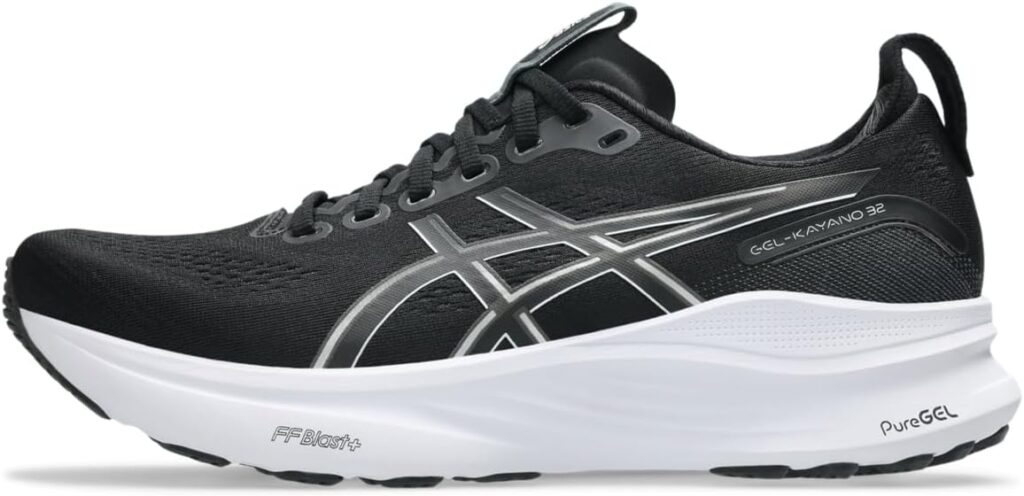
Independent lab data (RunRepeat, 2026): 36.8 mm heel stack, 8.5 mm drop, 132 SA heel shock absorption (well above the 100 SA RunRepeat suggests for plantar fasciitis) and a 93/100 stability score. RunRepeat calls it the softest Kayano yet. Our links go to the women’s Kayano 31 and men’s Kayano 32, earlier versions of the same guided-stability shoe that are often discounted.
- Guides feet that roll inward, which takes strain off the arch and the plantar fascia.
- High, cushioned heel with lab-measured shock absorption well above the plantar fasciitis guideline.
- Firm heel counter and a sole that resists twisting.
- The widest range of widths in the ASICS lineup.
- Heavy: about 298 g (10.5 oz) for a men’s shoe in lab tests.
- Premium price; the GT-2000 offers lighter guidance for less.
- Can feel too guided if you have high arches.
Best match: flat feet, overpronation, heavier walkers, long shifts on hard floors, orthotic users, and anyone a podiatrist has told to wear a stability shoe.
3. ASICS GT-2000 15
Current model: GT-2000 15 (released August 2026). RTINGS lab comparisons find it much lighter and more energetic than the Gel-Nimbus 28, with dedicated guidance for overpronation. Our women’s link goes to the GT-2000 13, an earlier version that is often discounted.
- Gentle guidance for feet that roll inward, without the Kayano’s weight.
- Cushioned heel and a firm heel counter.
- Lighter, livelier ride for people who walk and run.
- Usually costs noticeably less than the Kayano.
- Less cushioning than the Nimbus or Kayano for very long standing shifts.
- Wide sizes are not stocked in every color; check the size options before ordering.
Best match: mild to moderate flat feet or overpronation, walk-and-jog routines, and anyone who finds the Kayano too heavy or too expensive.
4. ASICS Gel-Cumulus 28
Current model: Gel-Cumulus 28 (launched early 2026). The Cumulus sits one step below the Nimbus in ASICS’ neutral line: slightly less cushioning, lighter and usually cheaper. Our link goes to the women’s Gel-Cumulus 26, an earlier version.
- Plenty of heel cushioning for daily walking and easy runs.
- Lighter and steadier-feeling than max-cushion shoes.
- Removable insole for orthotics.
- Earlier versions are often heavily discounted.
- Less heel cushioning than the Nimbus for severe heel pain.
- No medial support for flat feet.
Best match: neutral arches, mild to moderate heel pain, mixed walking and running, and anyone who finds the Nimbus too bulky.

5. ASICS Novablast 6
Current model: Novablast 6. RTINGS found it absorbs more impact under both the heel and forefoot than the GT-2000 15 and rates it the better daily trainer. Our links go to the Novablast 5, the previous version.
- Deep cushioning with a rolling, springy feel that makes runs less punishing.
- Lighter than the Nimbus.
- A good choice when you are easing back into running.
- Bouncier and less stable than the GT-2000 or Kayano: not ideal during a bad flare-up or with flat feet.
- Less structured heel than ASICS’ stability shoes.
Best match: runners with neutral feet and mild or improving heel pain who want cushioning without a heavy shoe.
6. ASICS Gel-Excite 11
The Gel-Excite pairs a rearfoot GEL unit with ASICS’ softer AMPLIFOAM PLUS foam. It is the step between the entry-level Contend and the Cumulus, which makes it the best value ASICS for walking with mild heel pain.
- Rearfoot GEL plus a softer foam than the Contend.
- Light and flexible enough for daily walks and gym sessions.
- Removable insole: add an arch support for more help.
- Less cushioning and structure than the Cumulus or GT-2000.
- Not built for long standing shifts or flat feet that roll inward.
Best match: mild heel pain, daily walking on a budget, gym and casual wear.

7. ASICS Gel-Contend 9
The Gel-Contend is ASICS’ entry-level shoe: rearfoot GEL, AMPLIFOAM cushioning and a removable insole. On its own it is a light-duty shoe. Paired with an over-the-counter arch support it becomes a solid budget setup for walking.
- Rearfoot GEL cushioning at an entry-level price.
- Removable insole: pair it with an arch support for a strong budget combination.
- Light, easy and comfortable for errands and short walks.
- Firmer and thinner cushioning than the Excite, Cumulus or Nimbus.
- Not designed for long shifts or high mileage.
Best match: tight budgets, light walking, and people who will add an arch-support insole.
Gel-Nimbus vs Gel-Kayano vs GT-2000 for Plantar Fasciitis
These three are the ASICS most often recommended for heel pain. The short version: Nimbus for cushioning, Kayano for maximum support, GT-2000 for lighter support at a lower price.
| Gel-Nimbus 28 | Gel-Kayano 33 | GT-2000 15 | |
|---|---|---|---|
| Type | Neutral, max cushion | Stability, max support | Stability, moderate |
| Best foot type | Neutral or high arches | Flat feet, strong overpronation | Mild flat feet, mild overpronation |
| Heel cushioning | Highest | High | Medium to high |
| Weight | Heavy | Heavy | Lightest of the three |
| Heel drop | About 8 mm | About 8 mm | About 8 mm |
| Price level | Premium | Premium | Mid |
| Choose it if | Heel pain on hard floors, long walks, standing shifts | Feet roll in, heavier build, orthotics, long shifts | You want support without bulk, or you walk and jog |
Nimbus vs Kayano: both are ASICS’ most cushioned shoes; the difference is support. If your arches collapse or your old shoes wear on the inside of the heel, choose the Kayano. If your arches are normal or high, the Nimbus is softer and usually more comfortable. Kayano vs GT-2000: both are stability shoes. The Kayano has more cushioning and more support; the GT-2000 is lighter and cheaper and is enough for mild overpronation. Read more on stability vs neutral shoes for plantar fasciitis.
Best ASICS for Plantar Fasciitis for Women
ASICS builds women’s versions on a women’s last, with a narrower heel and a slightly different arch shape, and stocks women’s narrow (2A), standard (B) and wide (D) widths. For most women with heel pain, start with the Gel-Nimbus (neutral) or Gel-Kayano (flat feet). For walking on a budget, the Gel-Excite 11 is the best value.
| Shoe | Best for | Key features | Amazon |
|---|---|---|---|
| ASICS Gel-Nimbus 27 (women’s) | Heel pain on hard floors, neutral arches | Max cushion, wide base, knit upper | Check price |
| ASICS Gel-Kayano 31 (women’s) | Flat feet, overpronation | Guided stability, narrow to wide sizes | Check price |
| ASICS GT-2000 13 (women’s) | Mild flat feet, walk and jog | Lighter stability, lower price | Check price |
| ASICS Gel-Cumulus 26 (women’s) | Daily walking, neutral feet | Balanced cushioning, often discounted | Check price |
| ASICS Novablast 5 (women’s) | Running with mild heel pain | Bouncy, high cushioning, light | Check price |
| ASICS Gel-Excite 11 (women’s) | Budget walking and gym | Rearfoot GEL, AMPLIFOAM PLUS | Check price |
| ASICS Gel-Contend 9 (women’s) | Lowest price | Rearfoot GEL, removable insole | Check price |
More options: best women’s shoes for plantar fasciitis and women’s walking shoes for plantar fasciitis.
Best ASICS for Plantar Fasciitis for Men
Men’s ASICS come in standard (D), wide (2E) and extra wide (4E) in most stability and cushioned models, which matters for heavier men and wide feet. The Gel-Kayano is the go-to for flat feet and heavier builds; the Gel-Nimbus is the softest option for neutral feet.
| Shoe | Best for | Key features | Amazon |
|---|---|---|---|
| ASICS Gel-Nimbus 27 (men’s) | Heel pain on hard floors, heavier walkers | Max cushion, 2E and 4E widths | Check price |
| ASICS Gel-Kayano 32 / 33 (men’s) | Flat feet, overpronation | Guided stability, narrow to extra wide | Check price |
| ASICS GT-2000 15 (men’s) | Mild flat feet, walk and jog | Lighter stability, 2E and 4E | Check price |
| ASICS Gel-Cumulus 28 (men’s) | Daily walking, neutral feet | Balanced cushioning | Check price |
| ASICS Novablast 5 (men’s) | Running with mild heel pain | Bouncy, high cushioning, light | Check price |
| ASICS Gel-Contend 9 (men’s) | Lowest price | Rearfoot GEL, removable insole | Check price |
More options: best men’s shoes for plantar fasciitis and shoes for plantar fasciitis and wide feet.
Best ASICS for Walking, Standing and Running With Plantar Fasciitis
| Activity | Neutral feet | Flat feet | Budget |
|---|---|---|---|
| Walking | Gel-Nimbus 28 or Gel-Cumulus 28 | GT-2000 15 | Gel-Excite 11 |
| Standing all day | Gel-Nimbus 28 | Gel-Kayano 33 | Gel-Contend 9 plus an arch-support insole |
| Running | Gel-Nimbus 28 (easy runs), Novablast 6 (mild pain) | GT-2000 15 or Gel-Kayano 33 | Gel-Pulse or Gel-Excite 11 |
| Gym and casual | Gel-Cumulus 28 | GT-2000 15 | Gel-Excite 11 or Gel-Contend 9 |
Walking: heel pain is usually worst on the first steps of the day and on hard pavements, so prioritize heel cushioning over lightness. Standing: standing still loads the heel more than walking does; choose the most cushioned shoe in your lane and rotate two pairs. Running: cut mileage during a flare-up and avoid very soft, unstable shoes until pain settles. See walking shoes, shoes for standing all day and running shoes for plantar fasciitis.
Are ASICS Good for Plantar Fasciitis?
Yes, the right ASICS models are among the best shoes for plantar fasciitis, but not every ASICS shoe qualifies. The Gel-Kayano, Gel-Nimbus and GT-2000 have the features foot specialists look for: a cushioned and slightly raised heel, a firm heel counter, a midsole that resists twisting and a removable insole. ASICS’ cheaper models (Contend, Excite) are fine for light use, and its lifestyle sneakers (Gel NYC, Gel-1130, GT-2160) are style shoes, not support shoes.
If your doctor or podiatrist suggested ASICS, they most likely meant one of the stability or cushioned running models, which match the advice of the American College of Foot and Ankle Surgeons to wear shoes with good arch support and a slightly raised heel. No shoe brand heals plantar fasciitis by itself; shoes reduce strain while stretching, activity changes and time do the healing.
Comparing brands? See ASICS vs New Balance for plantar fasciitis, Brooks, HOKA, Saucony and our full guide to the best shoes for plantar fasciitis.
ASICS GEL Technology Explained: Does It Help Heel Pain?
ASICS’ signature GEL is a silicone-based cushioning insert placed in the heel. Recent Nimbus and Kayano versions use ASICS’ softer PureGEL, while budget models such as the Contend and Excite use a traditional rearfoot GEL unit. Here is what matters for plantar fasciitis:
- The foam does most of the work. Independent lab tests measure cushioning for the whole heel, and most of it comes from the midsole foam (ASICS’ FF BLAST family in the higher models, AMPLIFOAM in the budget ones). Treat GEL as a bonus, not a reason to choose a shoe.
- More stack means more protection. The Nimbus and Kayano have the thickest midsoles in the ASICS range, which is why they score highest for heel cushioning.
- Stability systems guide, they do not block. Recent Kayano versions use ASICS’ 4D Guidance System and recent GT-2000s use the 3D Guidance System. Both widen and firm up the sole to slow inward rolling, rather than using the hard plastic posts of older shoes.
Be wary of pages that claim a specific GEL or foam “reduces heel pain by X%”. ASICS does not publish clinical figures like that, and no independent trial supports them.
Heel drop: why ASICS’ 8 mm suits most heel pain
Heel-to-toe drop is the height difference between heel and forefoot. Many specialists suggest a moderate to higher drop (about 8 to 12 mm) for plantar fasciitis because it eases tension on the calf and Achilles, which pulls on the plantar fascia. Earlier Kayano and Nimbus versions used 10 mm or more; recent versions use about 8 mm (RunRepeat measured 8.5 mm on the Kayano 33). That still sits in the recommended range. If you have tight calves or Achilles pain as well, avoid low-drop and zero-drop shoes during a flare-up.
Old Version or New? Kayano 31 vs 32 vs 33, Nimbus 27 vs 28, GT-2000 13 vs 14 vs 15
ASICS updates its main running shoes about once a year. The core design (support type, drop and fit) changes far less than the marketing suggests, so last year’s model is usually a smart buy for plantar fasciitis, often at a lower price.
| Line | Current | Previous versions still sold | Buy the older one? |
|---|---|---|---|
| Gel-Kayano | Kayano 33 (2026) | Kayano 32, 31 | Yes. Same guided-stability idea and a similar drop. The 33 is softer, according to RunRepeat. |
| Gel-Nimbus | Nimbus 28 (2026) | Nimbus 27, 26 | Yes. Still max-cushion neutral shoes. |
| GT-2000 | GT-2000 15 (August 2026) | GT-2000 14, 13 | Yes for walking. The 15 is the pick if you also run. |
| Gel-Cumulus | Cumulus 28 (2026) | Cumulus 27, 26 | Yes. Often heavily discounted. |
| Novablast | Novablast 6 | Novablast 5 | Yes for easy running. |
GT-2000 14 vs 15 for plantar fasciitis: both are moderate stability shoes with a similar drop and heel structure, so either will help. Choose the 15 for the newest cushioning, or the 14 if it is cheaper in your size. Kayano 31, 32 or 33: all three suit flat feet and heel pain; the 33 is the softest. Avoid going back further than three versions, as stock may be old and foam can harden in storage.
Other ASICS Models People Ask About
These come up often in searches. Most are fine for some people, but none beat our picks for heel pain.
| Model | What it is | Good for plantar fasciitis? |
|---|---|---|
| Gel-Pulse | Budget neutral running shoe | Yes, for mild pain. RunRepeat measured 134 SA heel shock absorption on the Gel-Pulse 17, well above the plantar fasciitis guideline. |
| GT-1000 | Budget stability running shoe | Good for mild flat feet on a budget; less cushioning than the GT-2000. |
| Gel NYC | Lifestyle sneaker inspired by 2000s runners | Fine for light casual wear. No modern stability features, so not a first choice during a flare-up. |
| Gel-1130 | Retro running-style lifestyle shoe | Firmer and style-focused. Okay for short wear only. |
| GT-2160 | Lifestyle reissue of a 2010s stability runner | Looks like a stability shoe but uses older technology. The modern GT-2000 15 is better for heel pain. |
| Gel-Kayano 14 | Retro lifestyle reissue | Not the same as the current Kayano 33. A style shoe, not a support pick. |
| Gel-Venture | Budget trail-style shoe | Firmer ride with a grippy sole. Okay for short walks and light trails, not for standing all day. |
| Gel-Quantum | Lifestyle sneaker with visible GEL | Comfortable for casual wear but heavy and not built for support. |
| Older FF BLAST trainers | Lightweight neutral runners | Less heel cushioning than the Nimbus or Cumulus. Fine for mild cases only. |
| Tennis shoes (Gel-Resolution, Solution) | Court shoes | Stable for court sports, but too firm for walking with heel pain. |
ASICS Sizing and Widths for Plantar Fasciitis
- Size: most people wear their usual running shoe size in ASICS. Leave about a thumb’s width between your longest toe and the tip of the shoe. Check our shoe size conversion chart if you buy in UK or EU sizes.
- Width codes: women’s narrow is 2A, standard is B and wide is D. Men’s standard is D, wide is 2E and extra wide is 4E. A women’s B width is the normal width, so it is fine for plantar fasciitis unless your feet are wide or swell.
- Orthotics: all our picks have removable insoles. Take your orthotic when you try shoes on; the Kayano and Nimbus have the most interior volume.
- Swelling: try shoes on in the afternoon, when feet are largest.
- Replace them: about every 300 to 500 miles, or sooner if the heel counter softens or the midsole creases deeply. See how long walking shoes last.
When ASICS Alone Are Not Enough
Good shoes are one part of the treatment. Foot and ankle specialists also recommend:
- Daily stretching of the calf and plantar fascia, especially before your first steps in the morning. See plantar fasciitis exercises.
- An arch-support insole if your shoes feel flat. Over-the-counter supports helped about as much as custom orthoses in a randomized trial. See insoles vs shoes.
- Supportive house shoes instead of walking barefoot on hard floors. See slippers for plantar fasciitis.
- Night splints for stubborn morning pain. See night splints vs shoes.
How We Chose These ASICS
- Clinical criteria first. We started from what foot and ankle specialists recommend for plantar fasciitis (ACFAS, AAOS): arch support, a cushioned and slightly raised heel, stability and a removable insole.
- Independent lab data. We used published lab measurements from RunRepeat and RTINGS (stack height, drop, shock absorption, weight and stability) instead of brand claims.
- Current models only. We checked every model against 2026 release dates. Where our photo or link shows an earlier version, we say so, and we add a search link for the current model.
- Fit experience. We weighed widths, heel fit and orthotic room, because a shoe that does not fit cannot help.
- No paid placements. ASICS did not pay for this page. We earn a small commission if you buy through our links, which never changes our ranking. Read how we test shoes and our affiliate disclosure.
Sources: RunRepeat: ASICS Gel-Kayano 33 lab review; RTINGS: Gel-Nimbus 28 vs GT-2000 15; RTINGS: Novablast 6 vs GT-2000 15; RunRepeat plantar fasciitis walking shoe lab tests (2026); AAOS OrthoInfo: Plantar Fasciitis and Bone Spurs; ACFAS FootHealthFacts: Plantar Fasciitis; Landorf et al. (2006), foot orthoses for plantar fasciitis.
Best ASICS for Plantar Fasciitis: FAQ
What is the best ASICS shoe for plantar fasciitis?
The Gel-Nimbus 28 for neutral or high arches and the Gel-Kayano 33 for flat feet or overpronation. The GT-2000 15 is the best value stability option, and the Gel-Excite 11 is the best budget pick for walking.
Are ASICS good for plantar fasciitis?
Yes, the cushioned and stability running models are. The Kayano, Nimbus, GT-2000 and Cumulus have a cushioned heel, a firm heel counter and a removable insole. ASICS lifestyle sneakers such as the Gel NYC and Gel-1130 are not designed for support. See are ASICS good for plantar fasciitis?
Which ASICS are best for plantar fasciitis for women?
The women’s Gel-Nimbus (neutral arches), Gel-Kayano (flat feet) and GT-2000 (lighter stability). On a budget, the women’s Gel-Excite 11 or Gel-Contend 9. See the women’s table.
Which ASICS are best for plantar fasciitis for men?
The men’s Gel-Kayano for flat feet and heavier builds, the Gel-Nimbus for maximum cushioning, and the GT-2000 15 for lighter support. All three come in 2E and 4E widths. See the men’s table.
Is the ASICS Gel-Kayano good for plantar fasciitis?
Yes. The Kayano is ASICS’ most supportive cushioned shoe and the best ASICS for flat feet with heel pain. The Kayano 33 measured 132 SA heel shock absorption in RunRepeat’s lab, well above their 100 SA guideline. The Kayano 31 and 32 work almost as well and often cost less.
Is the ASICS Gel-Nimbus good for plantar fasciitis?
Yes, especially for neutral or high arches. It has the thickest, softest heel cushioning in the ASICS line. The Nimbus 27 is a good lower-cost alternative to the Nimbus 28.
Gel-Nimbus or Gel-Cumulus for plantar fasciitis when walking?
The Nimbus if heel pain is moderate to severe or you walk on hard surfaces for long periods. The Cumulus if pain is mild and you want a lighter, cheaper shoe. The Nimbus is the higher, more cushioned model.
Is the ASICS GT-2000 good for plantar fasciitis? GT-2000 14 or 15?
Yes, for mild flat feet or overpronation. It is lighter and cheaper than the Kayano. The GT-2000 14 and 15 share a similar drop and heel structure, so either helps; buy the 15 for the newest cushioning or the 14 if it is cheaper.
Is the ASICS Gel-Excite 11 good for plantar fasciitis?
Yes, for mild heel pain and daily walking on a budget. It has rearfoot GEL and a softer foam than the Contend. For severe pain, long shifts or flat feet, step up to the Cumulus, GT-2000 or Kayano.
Is the ASICS Gel-Contend 9 good for plantar fasciitis?
It is a decent budget shoe for light walking, especially with an arch-support insole added. It has less cushioning than the Excite, Cumulus or Nimbus, so it is not ideal for long days on your feet.
Is the ASICS Novablast good for plantar fasciitis?
For running with mild or improving heel pain and neutral feet, yes. It is bouncy and well cushioned but less stable than the GT-2000 or Kayano, so skip it during a bad flare-up or if you have flat feet.
Is the ASICS Gel-Pulse 17 good for plantar fasciitis?
For mild pain on a budget, yes. RunRepeat measured 134 SA heel shock absorption, above their plantar fasciitis guideline. It has less cushioning than the Cumulus or Nimbus.
Are the ASICS Gel NYC, Gel-1130 or GT-2160 good for plantar fasciitis?
They are lifestyle sneakers based on older running designs. They are fine for light casual wear, but they lack the cushioning and support of current running models. During a flare-up, wear a Nimbus, Kayano or GT-2000 instead.
Which ASICS are best for heel spurs?
The same as for plantar fasciitis: the Gel-Nimbus or Gel-Kayano for maximum heel cushioning. Heel spurs do not cause the pain themselves, according to the AAOS, so cushioning and support are what help.
Which ASICS if I am heavier, wear orthotics or underpronate?
Heavier walkers with flat feet: the Gel-Kayano in 2E or 4E. Orthotic users: the Kayano or Nimbus, which have removable insoles and the most interior room. Underpronation (supination) or high arches: a neutral cushioned shoe such as the Nimbus or Cumulus, not a stability shoe.
Which ASICS if I have Achilles tendonitis and plantar fasciitis?
A cushioned shoe with a moderate drop, such as the Gel-Nimbus or Gel-Cumulus (about 8 mm), or the Kayano if your feet roll in. Avoid low-drop shoes until both settle, and see a clinician if pain persists.
My doctor recommended ASICS. Are they the best for healing?
Doctors often suggest ASICS stability or cushioned running shoes because they match clinical advice: arch support, a cushioned heel and a firm heel counter. They are a good choice, but no single brand is the only option. Shoes reduce strain; healing comes from stretching, activity changes and time.
Is a women’s B width okay for plantar fasciitis?
Yes. B is the standard women’s width. Choose D (wide) if your feet are wide, swell during the day or feel squeezed, and 2A if your heel slips.
Should I buy last year’s ASICS model?
Usually yes. The Kayano 32, Nimbus 27 and GT-2000 14 offer nearly the same support as the current versions and are often cheaper. See old version or new.
How long do ASICS running shoes last?
About 300 to 500 miles, or roughly 6 to 12 months of daily walking. Replace them sooner if the heel counter softens, the sole wears unevenly or heel pain returns.
Still not sure which pair is right?
Our Shoe Finder matches shoes from every brand to your feet, your pain points and how you spend your day.
Try the Shoe Finder