
How Long Does Plantar Fasciitis Take to Heal With Proper Shoes?
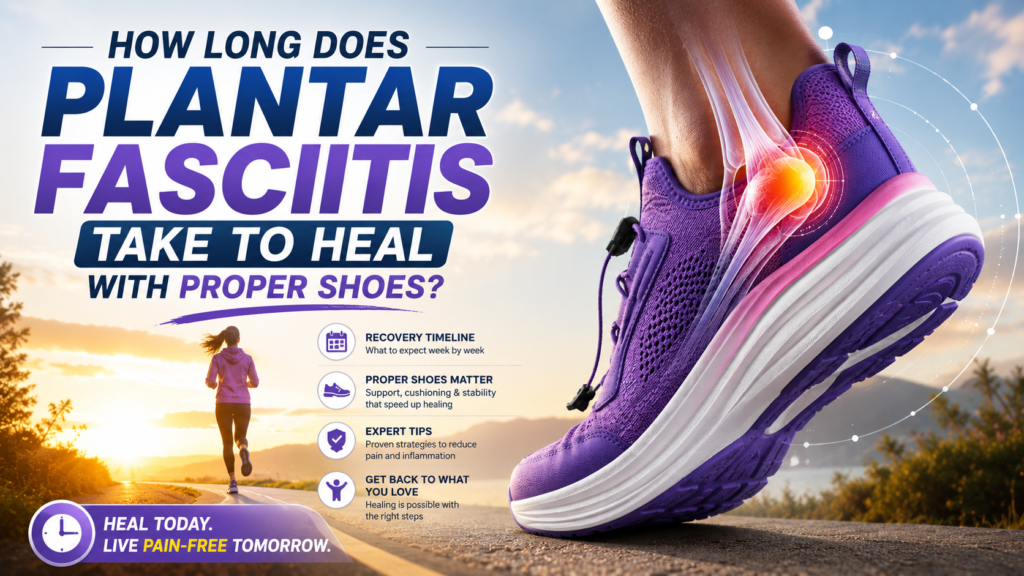
Plantar fasciitis typically takes 6 to 12 weeks to improve significantly with proper supportive footwear, though full recovery can take 3 to 6 months depending on severity. Shoes with semi-rigid arch support, 8-12mm heel-to-toe drop, and adequate cushioning reduce fascial strain with every step, allowing the micro-tears at the heel attachment to heal. Recovery time without proper footwear can extend indefinitely, since walking on unsupportive shoes re-injures the fascia daily before it has a chance to repair.
⚡ Top 5 Shoes That Speed Up Plantar Fasciitis Recovery

Brooks Adrenaline GTS 22
GuideRails support reduces overpronation-driven fascia strain. DNA LOFT cushioning absorbs heel impact at landing – the moment of peak fascial loading.
🛒 Check Price on Amazon
Brooks Women’s Ghost 14
35,357 reviews of real recovery stories. Neutral cushioning ideal for those without overpronation – softens every heel strike during the healing window.
🛒 Check Price on Amazon
Skechers D’Lites Biggest Fan
26,890 reviews at under $40. Air-Cooled Memory Foam plus shock-absorbing midsole – proof that recovery footwear doesn’t require a premium price tag.

G-Defy Mighty Walk
Patented VersoShock sole plus two included orthotics. Wide and Extra Wide options reduce forefoot pressure that compounds heel strain during recovery.

Skechers Summits Dazzling Haze
Heel Pillow technology plus Air-Cooled Memory Foam. No bending to tie laces – useful during the acute phase when reaching down aggravates the fascia.
🛒 Check Price on AmazonWhy Recovery Time Varies So Much From Person to Person
A patient named Michael came into my shop off Lamar Boulevard in Austin three months into his plantar fasciitis. He’d been wearing the same flat work boots every day, hoping the pain would just go away on its own. It hadn’t. It had gotten worse.
His coworker, a woman named Jessica who works the same warehouse floor, had recovered in about seven weeks. Same job. Same flooring. Same number of hours standing. The difference: she switched to supportive shoes in week one. He waited until week twelve.
That’s the entire story of plantar fasciitis recovery time. It’s not really about how bad your case is when it starts. It’s about how much additional damage accumulates while you wait to fix the mechanical cause.
Plantar fasciitis is a repetitive strain injury. The fascia gets micro-tears from repeated overload – usually a combination of inadequate arch support, excessive heel impact, and tight Achilles tendons pulling on the heel bone. Healing requires the tears to repair faster than new strain creates them. Unsupportive shoes tip that balance in the wrong direction every single day you wear them.
This guide breaks down realistic healing timelines, what actually happens biomechanically during recovery, and why the right shoes – not just any shoes labeled “comfortable” – determine whether you’re looking at 6 weeks or 6 months.
How Long Does Plantar Fasciitis Actually Take to Heal?
Yes, plantar fasciitis heals – and proper footwear is the single most controllable factor in how long that takes. Most people see meaningful pain reduction within 6-8 weeks of consistent supportive shoe use. Full resolution typically takes 3-6 months. Without addressing footwear, many cases drag on for a year or longer, becoming chronic.
Here’s the realistic breakdown by severity:
Mild PF (recent onset, pain only in mornings): 4-8 weeks with proper shoes. The fascia hasn’t developed significant scar tissue yet. Reducing daily strain allows normal healing to proceed quickly.
Moderate PF (pain throughout the day, present for 1-3 months): 8-16 weeks. Some adaptive scar tissue has formed. Recovery requires both reducing strain and allowing existing inflammation to resolve.
Severe/Chronic PF (pain for 6+ months, possible heel spur development): 4-12 months, sometimes longer. Chronic cases often involve secondary compensations – altered gait patterns, tightness in the calf and hip, sometimes knee or back pain from months of favoring the affected foot. Footwear alone may not be sufficient; physical therapy and possibly podiatric intervention become part of the timeline.
A woman named Sarah from the Park Slope neighborhood in Brooklyn told me she’d had heel pain for nearly eight months before she finally addressed her footwear. Her recovery still took four months after that – but four months is far better than the indefinite continuation she was facing.
What’s Actually Happening in Your Foot During Recovery
Understanding the biomechanics helps explain why shoe choice matters so much for timeline.
📈 Plantar Fasciitis Recovery Timeline With Proper Shoes
Reduced heel impact means less daily micro-trauma. The inflammation cycle begins to break because you’re no longer re-injuring the fascia faster than it can repair itself. Most people won’t notice dramatic improvement yet, but the healing process has started.
Morning heel pain often starts decreasing first. Proper heel-to-toe drop (8–12mm) reduces tension on the Achilles tendon and plantar fascia, making those first morning steps less painful.
Daytime pain during walking and activity typically improves. Collagen fibers inside the fascia begin reorganizing and strengthening, which is the actual tissue repair phase supported by proper arch support and cushioning.
Many people with mild to moderate plantar fasciitis feel mostly normal again. The fascia has regained much of its strength, but supportive footwear remains important to avoid setbacks during remodeling.
Full structural healing phase. Chronic cases may still experience occasional stiffness or flare-ups after high-activity days, but the tissue is significantly stronger and more resilient.
The biomechanical thread running through every phase: heel impact reduction, arch collapse prevention, and Achilles tension management. These are exactly the three factors covered in our detailed breakdown of what to look for in plantar fasciitis shoes – if you haven’t read that guide yet, it explains the engineering specifics behind each feature mentioned here.
Why Your Current Shoes Might Be the Reason You’re Not Healing
This is the conversation I have most often in my shop. Someone has been “doing everything right” – stretching, icing, resting on weekends – but the pain isn’t going away. Almost always, the answer is in their shoes.
A man named David from the Capitol Hill area of Seattle had been dealing with PF for five months. He was diligent about stretching every morning. But he worked retail, standing on concrete floors for 9-hour shifts in flat canvas sneakers with essentially zero arch support and zero heel drop.
Every shift, he was undoing whatever progress his morning stretching achieved. The fascia would start to calm down overnight, then get re-strained within the first hour of his shift. This cycle can continue indefinitely – some people deal with “chronic” PF for years simply because nobody identified that their daily footwear was actively preventing healing.
It’s worth asking the broader question too: certain shoe designs don’t just fail to help PF – they actively contribute to causing it in people who didn’t have it before. Flat shoes, worn-out cushioning, and zero-drop minimalist designs used for high-impact activity are common culprits. Our detailed look at whether shoes can cause plantar fasciitis covers this connection if you’re trying to figure out what triggered your case in the first place.
Do You Need Insoles, New Shoes, or Both?
This question comes up constantly, and the honest answer depends on your current shoes’ baseline construction.
If your current shoes have decent structure – a firm heel counter, reasonable midsole material, just inadequate arch support – adding a quality orthotic insole can be enough. The shoe’s structure does the heavy lifting; the insole fine-tunes arch contact.
If your current shoes are fundamentally flat, worn out, or made of collapsed foam, no insole fixes that. You’re putting a good insole into a shoe that can’t support it. New shoes with built-in arch engineering are the better investment.
For most people in the moderate-to-severe category, the combination works best: supportive shoes with removable insoles, allowing future upgrade to custom orthotics if needed. Our comparison of plantar fasciitis insoles versus supportive shoes walks through this decision in more depth, including cost considerations that matter for budget-conscious shoppers.
Recovery Timeline by Activity Type
Your job and daily activity level significantly affect how quickly proper shoes translate into healing – because they determine how many “loading cycles” your fascia experiences per day.
Desk workers / low-activity jobs: Fastest typical recovery – often 4-6 weeks for mild cases. Fewer daily steps means fewer opportunities for re-injury, so the healing process has more uninterrupted time.
Teachers, retail, hospitality (moderate standing/walking): 6-10 weeks typical for mild-moderate cases. The G-Defy Mighty Walk’s wide-width options and dual orthotics are popular among this group specifically because all-day standing on hard floors compounds fatigue-related form breakdown by afternoon.
Nurses, warehouse staff, food service (heavy standing, 10+ hour shifts): 8-14 weeks typical, sometimes longer for chronic cases. If your work involves this level of demand, our dedicated guide on the best work shoes for plantar fasciitis for people who stand all day covers footwear specifically engineered for these conditions.
Runners and athletes: Variable, often 8-16 weeks, because returning to running too early is the most common cause of re-injury in this group. Most podiatrists recommend a graduated return – walking in supportive shoes first, then short runs, building mileage slowly. Our guide on the best running shoes for plantar fasciitis covers the engineering differences between recovery-phase and full-training shoes.
The Role of Heel-to-Toe Drop in Recovery Speed
This is one of the most underappreciated factors in PF healing time, and it’s worth explaining clearly.
The Achilles tendon attaches to the heel bone directly adjacent to where the plantar fascia attaches. When your heel sits at the same height as your forefoot – zero drop – your Achilles is in a lengthened position throughout your gait. That length creates constant tension pulling on the heel bone, which transfers directly into fascial loading.
An 8-12mm heel-to-toe drop shortens the Achilles’ effective length. Less tension on the heel bone means less pull on the fascia attachment with every single step – potentially thousands of steps per day.
During active recovery, this small mechanical difference compounds. Across 12 weeks of healing, a shoe with appropriate drop reduces the cumulative fascial loading by a meaningful margin compared to a flat or zero-drop shoe. That’s not a guess – it’s the same biomechanical principle that explains why morning pain (when the Achilles is tightest from overnight shortening) is the most common PF symptom.
This is also why switching to “barefoot style” or minimalist shoes during active PF recovery is one of the most common mistakes I see. The trend toward zero-drop is fine for people with healthy, adapted feet. For active plantar fasciitis, it works against the recovery you’re trying to achieve.
Real-World FAQ – Questions People Actually Search
Q: How long does plantar fasciitis take to heal with the right shoes? Most people see meaningful improvement within 6-8 weeks of consistent use of properly supportive shoes, with full healing typically taking 3-6 months. Mild cases caught early can resolve in as little as 4 weeks. Chronic cases (6+ months untreated) can take longer and may require additional treatment alongside footwear changes.
Q: Can plantar fasciitis go away without changing shoes? It’s possible but significantly slower and less reliable. If your current shoes provide adequate arch support and proper heel drop, rest and stretching alone might resolve mild cases. However, most plantar fasciitis develops because of footwear-related strain in the first place – continuing in the same shoes that contributed to the problem makes spontaneous resolution unlikely.
Q: When does plantar fasciitis go away – is it permanent? Plantar fasciitis is not permanent for the vast majority of people. It’s a repetitive strain injury that heals when the strain is reduced enough for tissue repair to outpace damage. Permanent or recurring cases usually involve either continued exposure to the original cause (unsupportive footwear, occupational demands) or undiagnosed contributing factors like leg length discrepancy or severe structural flat feet.
Q: Why is my plantar fasciitis worse in the morning? Overnight, your foot rests in a relaxed, plantarflexed position, allowing the plantar fascia and Achilles tendon to shorten. The first steps in the morning suddenly stretch this shortened tissue, causing the characteristic stabbing pain. Shoes with proper heel elevation worn throughout the day help maintain a less-shortened resting length, reducing this morning pain spike over time.
Q: How quickly will new shoes reduce plantar fasciitis pain? Some people notice reduced end-of-day soreness within the first week of switching to properly supportive shoes – this reflects reduced acute strain. Meaningful reduction in morning pain and activity-related pain typically takes 3-4 weeks, as this reflects actual tissue-level changes rather than just reduced daily aggravation.
Q: Does walking barefoot make plantar fasciitis worse? Yes, particularly on hard floors. Walking barefoot eliminates any cushioning, arch support, or heel elevation, maximizing both impact force and Achilles tension with every step. Many people unknowingly extend their recovery by going barefoot at home – even for short distances to the bathroom or kitchen – while wearing supportive shoes only when leaving the house.
Q: Can the wrong shoes make plantar fasciitis take longer to heal? Yes, significantly. If daily footwear continues creating the same mechanical strain that caused the injury, healing can be indefinitely delayed regardless of stretching, icing, or rest. This is the most common reason people experience “chronic” plantar fasciitis lasting many months or years – the underlying mechanical cause was never addressed.
Q: Is it normal for plantar fasciitis to come back after it heals? Recurrence is common if the underlying mechanical factors return – reverting to unsupportive shoes, significant weight gain, sudden activity increases, or worn-out shoe replacement with another unsupportive pair. The fascia tissue remains somewhat more vulnerable to re-injury for months after symptoms resolve, which is why maintaining supportive footwear habits matters even after pain is gone.
Q: How do I know if my shoes are helping or hurting my plantar fasciitis recovery? Track your pain pattern over 2-3 weeks. If morning pain and end-of-day soreness are gradually decreasing, your shoes are helping. If pain is static or increasing despite consistent wear, the shoe likely lacks adequate arch support, has insufficient heel drop, or the midsole has already compressed (common in budget shoes after 3-4 months). Press your thumb into the arch of the insole – if it stays compressed, that’s your answer.
Q: Should I wear supportive shoes even when I’m not in pain anymore? Yes, for at least several months after symptoms resolve. The fascia tissue is still completing its remodeling process even after pain disappears. Reverting immediately to unsupportive footwear during this window is one of the most common causes of recurrence within the first year.
What This Means for Your Shoe Decision
If you’re reading this because you’re currently dealing with plantar fasciitis, the takeaway is straightforward: the shoes you wear today are either actively contributing to your healing or actively working against it. There’s not really a neutral option.
The five shoes featured in this guide cover the realistic range of needs – from the GuideRails support of the Brooks Adrenaline GTS 22 for those who overpronate, to the budget-friendly Skechers D’Lites for those who need genuine support without the premium price, to the G-Defy Mighty Walk’s included orthotics for people on their feet all day.
For a complete view of every category – running, walking, work shoes, slip-ons, dress shoes, and more – our full roundup of the best shoes for plantar fasciitis in 2026 breaks down every option by use case.
Recovery timelines aren’t fixed. They’re influenced every single day by what’s on your feet. The sooner the mechanical cause is addressed, the sooner the clock on healing actually starts.
Disclosure
We may earn a small commission at no extra cost to you if you purchase through our Amazon links. These commissions help keep this site running and updated. We only recommend products backed by real engineering and genuine customer validation.