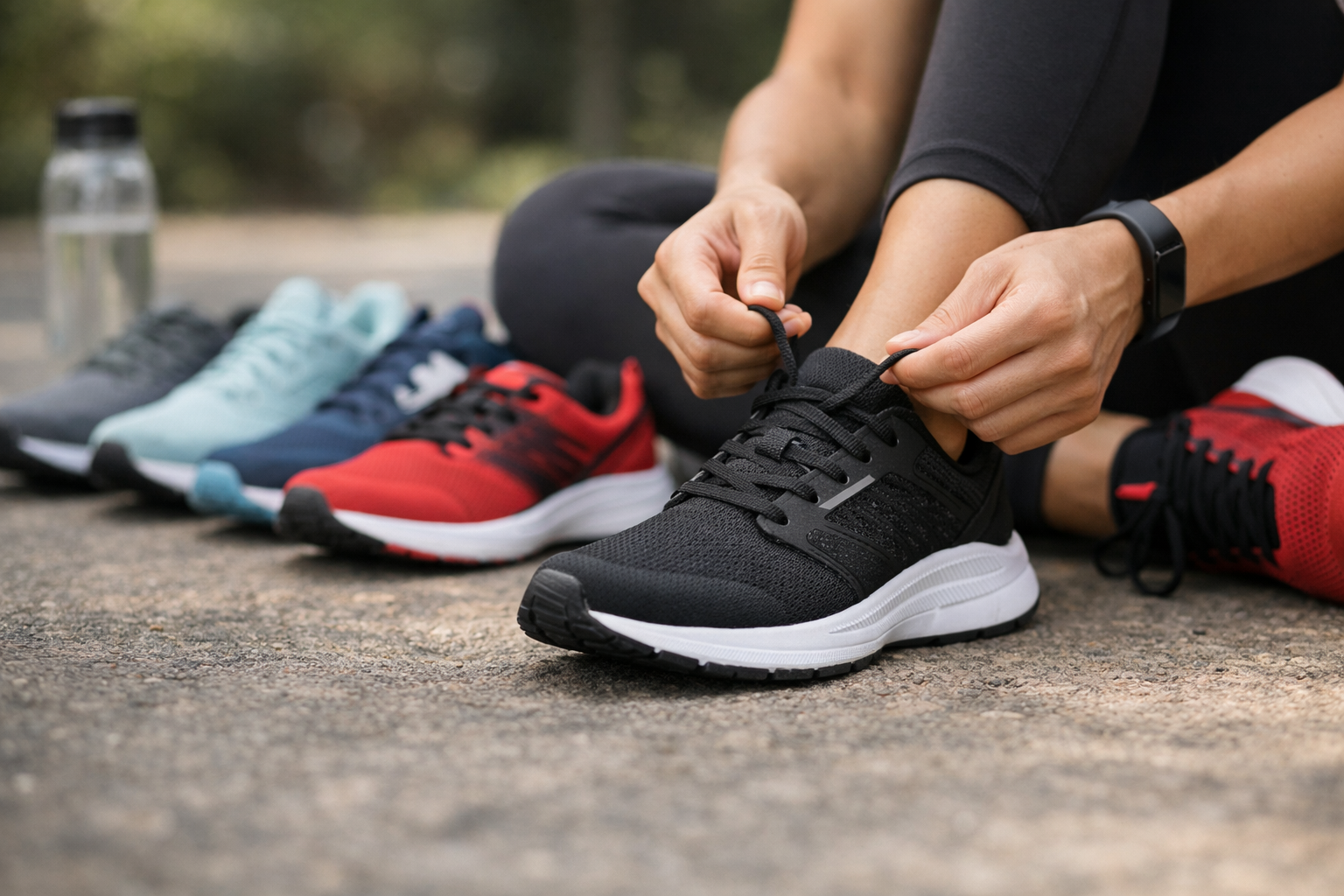

Can Shoes Cause Plantar Fasciitis? (What Every American Should Know)
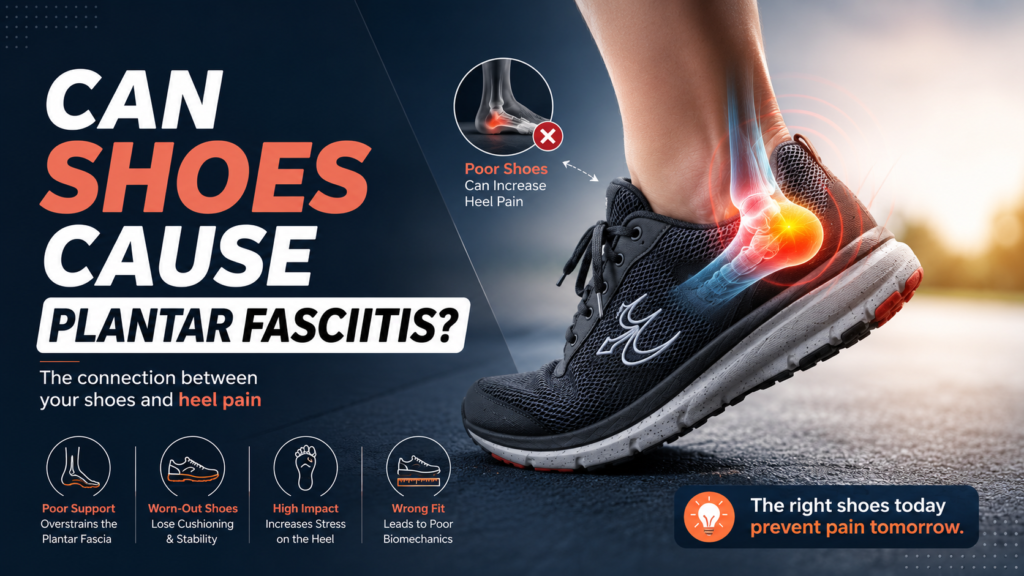
Yes, shoes can directly cause plantar fasciitis. Footwear with insufficient arch support, flat EVA midsoles, zero heel-to-toe drop, or narrow toe boxes forces the plantar fascia to absorb load it isn’t designed to handle. Over time, this repeated strain creates microscopic tears at the heel attachment point — the source of the sharp morning pain most PF sufferers describe.
The question I hear more than any other isn’t “what shoe helps plantar fasciitis?” It’s this one: “Did my shoes cause this in the first place?”
The honest answer is yes. In most cases, absolutely yes.
Most Americans spend 8 to 16 hours a day in footwear. Whatever you’re wearing is either protecting your fascia or slowly damaging it. There’s rarely a neutral option. The wrong shoe doesn’t just fail to help – it actively creates the condition.
James works construction in Houston’s Midtown district. He came in after eight months of heel pain that started six weeks into a new pair of work boots he’d bought from a big-box store near Highway 59. “I just needed something tough,” he said. “I didn’t think about support.”
His boots were excellent for toe protection. They were flat, rigid, and completely unsupportive through the arch. Eight months later, his podiatrist confirmed plantar fasciitis.
His shoes didn’t just fail him. They caused his injury.
This guide explains exactly how that happens which shoe features trigger PF, which shoe types are the most common offenders, and what to look for instead. Toward the end, you’ll find five vetted options that actually protect rather than damage.
What Is Plantar Fasciitis and Why Do Shoes Matter So Much?
The plantar fascia is a thick band of connective tissue running from your heel bone to the base of your toes. Its job is to support your arch and absorb load during each step. It handles enormous force every step you take puts approximately 1.25 times your body weight through that band.
When the fascia is repeatedly stretched beyond its tolerance, microscopic tears develop at the heel attachment point. The inflammation that results is plantar fasciitis. That familiar first-step-in-the-morning pain is your fascia contracting overnight and then being forcibly stretched when you stand.
Shoes determine how much load that fascia handles per step.
A shoe with a proper contoured arch support reduces fascia stretch by maintaining the arch’s natural curve. A shoe without that support lets the arch collapse with every step, stretching the fascia repeatedly across thousands of daily footstrikes.
Over days, weeks, or months that repetition creates injury.
The 5 Shoes That Actually Protect Your Plantar Fasciitis
You now understand what causes PF and what features to look for. These five options represent what properly supportive footwear looks like across different use cases and price points.
⚡ Top Picks — Best Shoes for Plantar Fasciitis 2026

Brooks Adrenaline GTS 22
GuideRails holistic support, DNA LOFT cushioning, PDAC A5500 diabetic certified. The most validated support shoe for PF prevention and recovery.
🛒 Check Price on Amazon
Brooks Women’s Ghost 14
35,357 reviews validate years of real-world performance. DNA LOFT midsole, Segmented Crash Pad, PDAC A5500 diabetic certified.
🛒 Check Price on Amazon
Skechers Max Cushioning Endeavour
#1 Best Seller. Air-Cooled Goga Mat sustained rebound, Natural Rocker Technology for smooth heel-to-toe transitions, machine washable.

HKR Women’s Walking Shoes
45,771 reviews — the most-reviewed option here. Arch support insole, memory foam construction, elastic slip-on. Best validated budget option for everyday PF protection.

Gravity Defyer Mighty Walk Women’s
Patented VersoShock energy return, wide toe box, two removable orthotics included. Best for nurses, teachers, and retail workers standing 8+ hours daily.
The 7 Shoe Features That Cause Plantar Fasciitis
Understanding exactly which features damage the plantar fascia is the most useful thing you can learn about this condition. Most people focus on finding the right shoe after PF develops. Understanding what to avoid prevents it from developing at all.
⚠️ 7 Shoe Features That Directly Cause Plantar Fasciitis
Cause 1: Flat Insoles With No Arch Support
This is the most common cause. And the most preventable.
A flat insole provides no contact with your arch. Your foot’s natural arch structure is unsupported. With each step, your arch collapses inward slightly a motion called overpronation. The plantar fascia is stretched every time that happens.
Over a 10,000-step day, that’s 10,000 repetitive micro-stretches. Week after week, this creates cumulative damage at the heel attachment point.
The insoles that collapse fastest are the cheap foam inserts found in fashion sneakers and big-box store athletic shoes. They feel comfortable initially because the foam is soft. By month two or three, that foam has compressed to essentially flat. The arch support that existed on day one is gone. Customers tell me this all the time: “It felt fine when I bought it, then suddenly my heel started hurting.”
The foam didn’t suddenly fail. It had been failing gradually since day one.
Cause 2: Zero Heel Drop or Sudden Drop Changes
Heel-to-toe drop is the height difference between the heel and forefoot of a shoe. Standard athletic shoes run 8-12mm. Zero-drop minimalist shoes run 0-4mm.
Zero-drop isn’t inherently bad. But it creates a specific problem for the plantar fascia: maximum Achilles tendon stretch with every step.
Your Achilles and your plantar fascia share a mechanical connection. When the Achilles is under tension, that tension pulls on the heel bone specifically at the fascia attachment point. Zero-drop shoes maximize that Achilles tension continuously.
The issue compounds when people switch drop levels suddenly. Ashley, a yoga instructor in Nashville’s Germantown neighborhood, wore heels for years then switched to minimalist flat shoes overnight. “My podiatrist told me the abrupt change was what caused it,” she said. “I went from 3-inch heels to zero-drop flats in the same week.”
That transition compressed the adjustment period that should take 3-6 months into a single week. Her Achilles shortened in heels. Zero-drop demanded sudden, extreme lengthening. The fascia paid the price.
Cause 3: Worn-Out Midsoles
Shoes that look fine on the outside are often completely failed on the inside.
EVA foam midsoles have a lifespan. Running shoes: 300-500 miles. Daily wear shoes: 6-12 months. After that, the foam has permanently compressed. The visible shoe looks the same. The cushioning and arch support are functionally gone.
Most Americans wear their shoes well past this point. The shoe looks fine. The upper isn’t torn. Why replace it?
Because the midsole is already flat, every step is now ground contact with minimal cushioning. The fascia absorbs the impact that the midsole should be handling.
David, a warehouse supervisor in Cincinnati’s East End neighborhood, wore the same steel-toed work boots for 22 months. “They looked practically new,” he said. “I couldn’t figure out why my heel hurt.”
His boots’ midsoles had completely compressed by month eight. He wore failed footwear for 14 additional months, loading his fascia with unabsorbed ground impact for over a year.
Cause 4: Narrow Toe Boxes
A narrow toe box does something subtle but damaging: it forces your toes to grip.
When your toes can’t spread naturally, they press together and curl slightly downward, a gripping motion your foot uses to stabilize itself in a tight space. That toe-gripping tightens the plantar fascia band from the front end, increasing tension at the heel attachment point.
Fashion footwear is the primary offender here. Pointed-toe dress shoes. Narrow athletic shoes marketed for sleek aesthetics. Shoes where the forefoot narrows sharply toward the toe cap.
Women experience this more than men because women’s fashion shoes have historically been engineered for appearance over biomechanics. A pointed-toe pump creates both the toe compression problem and the heel-height problem simultaneously.
Cause 5: Excessive Heel Height Followed by Flat Shoes
High heels shorten your Achilles tendon and calf muscles over time. Your body adapts to the elevated position. Switching to flat shoes, even supportive flat shoes, then demands sudden Achilles lengthening that the tissue isn’t prepared for.
This is one of the most common PF triggers in women between 30-50 who’ve spent years in heels. They switch to “healthier” flat shoes and develop PF within weeks. The flat shoes aren’t the cause; the sudden drop transition is.
The solution isn’t to keep wearing heels. It’s to transition gradually: drop heel height incrementally over several months, stretch the Achilles and calf daily during the transition, and start with moderate-drop shoes (6-8mm) rather than jumping to zero-drop.
Cause 6: Rigid Forefoot With No Flexibility
The plantar fascia must flex at toe-off, the moment your heel lifts and your toes bear your full weight before the next step. A shoe with a rigid forefoot prevents the natural bend that allows easy toe-off.
When the shoe won’t flex, your foot must force flexion through the shoe’s resistance. That forced flexion under full body weight creates intense fascia strain at exactly the moment the fascia is already maximally loaded.
Work boots are particularly prone to this. The steel reinforcement needed for safety often creates forefoot rigidity that biomechanically damages the fascia. James’s boots from the opening example had this specific problem.
The fix is forefoot flex grooves, engineered cuts in the outsole that allow natural bending at the toe-off point without sacrificing shoe structure elsewhere.
Cause 7: No Heel Cup or Shallow Cup Depth
Your heel needs structural containment. Without a deep heel cup, your heel slides laterally with each step. That sliding creates two problems:
Problem 1: Friction at the attachment point where the fascia meets the heel bone.
Problem 2: Inconsistent loading — each step lands slightly differently because heel position isn’t stabilized. Inconsistent loading prevents the fascia from adapting to a consistent stress pattern, keeping it in a perpetual micro-injury cycle.
Budget shoes and fashion footwear typically have heel cups under 0.5 inches deep. Quality therapeutic footwear reaches 1+ inches. That depth difference is significant. The deeper the cup, the more your heel is positioned correctly and held there.
Which Types of Shoes Most Commonly Cause Plantar Fasciitis?
Knowing the features is helpful. Knowing which specific shoe categories carry those features is more actionable.
| Shoe Type | PF Risk | Main Problem Feature | Arch Support | Who’s Most Affected |
|---|---|---|---|---|
| High Heels (3+ inches) | VERY HIGH | Achilles shortening + drop | None | Women 30-50 |
| Flat Fashion Sneakers | HIGH | Flat insole + no arch | None | All ages, all day wear |
| Flip Flops / Bare Sandals | HIGH | Zero support + toe gripping | None | Summer, beach states |
| Minimalist / Barefoot Shoes | HIGH | Zero drop + minimal cushion | Minimal | Runners, fitness people |
| Unsupported Work Boots | HIGH | Rigid forefoot + flat sole | Low | Construction, warehouse |
| Old/Worn Athletic Shoes | MEDIUM-HIGH | Compressed midsole | Was adequate, now gone | All active adults |
| Pointed Dress Shoes | MEDIUM-HIGH | Narrow toe box + no arch | None | Office workers |
| Supported Walking Shoes | LOW | None when current | Good | Daily wearers |
| APMA-Approved Running Shoes | VERY LOW | Engineered to prevent PF | Excellent | Runners, active adults |
The Flip Flop Problem: America’s Summer PF Epidemic
Every summer, podiatry offices across the country fill up with the same complaint. People spent Memorial Day weekend in flip flops and their heels have hurt ever since.
Flip flops are the single most common shoe-related PF trigger in America.
Here’s why they’re so damaging: they combine zero arch support, zero heel cup, zero cushioning, and toe-gripping compensation all in one package. Your toes must grip the flip flop with every step to keep it on your foot. That gripping tightens the fascia from the front. The flat sole provides no arch support. Every step is maximum fascia load with minimum structural support.
A weekend at a Tampa Bay beach in flip flops can set off a PF flare that lasts six months.
Emily, a 34-year-old teacher from Atlanta’s Grant Park neighborhood, had never experienced heel pain before a beach vacation in Florida. “I wore the same $12 flip flops every day for a week,” she said. “Three weeks later I could barely walk in the morning.”
She hadn’t changed anything else. Same weight, same activity level. Just seven days of flip flops on hard sand.
Supportive sandals with arch support and heel cups are available, our best sandals for plantar fasciitis guide covers options that handle summer conditions without destroying your fascia.
The Minimalist Shoe Problem: When “Natural” Backfires
Minimalist and barefoot shoes became popular in the early 2010s based on research suggesting that natural foot motion reduces injury. That research had merit — in populations that grew up walking barefoot and have adapted musculature to support it.
Most Americans haven’t walked barefoot since childhood. Our feet have adapted to supported footwear. The intrinsic muscles that would support our arches in barefoot movement are underdeveloped from decades of shoe support.
Switching to zero-drop minimalist shoes without a proper transition protocol is one of the fastest ways to develop plantar fasciitis in an otherwise healthy foot.
The transition should take 3-6 months minimum. Most people do it in 2 weeks. The fascia doesn’t have time to adapt. Micro-tears begin immediately.
If you want to explore minimalist shoes, the protocol is: reduce drop gradually, increase barefoot time slowly, strengthen foot intrinsic muscles through specific exercises, and give your fascia months, not weeks, to adapt.
The Work Shoe Problem: Standing Jobs and Bad Footwear
Teachers, nurses, retail workers, restaurant staff, warehouse supervisors. These are the people I see most consistently with plantar fasciitis.
They share a common situation: standing on hard floors for 8-12 hours in whatever footwear they could find. Often in shoes chosen for appearance (teachers), affordability (retail workers), or safety certification alone (warehouse staff).
Hard floors concrete, linoleum, ceramic tile are merciless. They provide zero shock absorption. Every foot of cushioning and arch support must come from the shoe itself.
Michael, a floor supervisor at a large distribution center outside Indianapolis, wore budget composite-toe work shoes for three years. “Safety rating was all I checked,” he said. His shoes met every OSHA requirement. They had no arch support, a flat EVA midsole that compressed by month four, and zero heel cup depth.
By year two, he had bilateral plantar fasciitis.
Safety certification and biomechanical support are completely separate standards. A shoe can pass every workplace safety test and still destroy your feet over 18 months of daily wear.
For people in standing occupations, our best work shoes for plantar fasciitis guide covers options that meet both safety and biomechanical requirements simultaneously.
How Long Does It Take for Bad Shoes to Cause Plantar Fasciitis?
There’s no single timeline. Several factors determine how quickly inadequate footwear triggers PF:
Body weight: Higher body weight increases load per step proportionally. PF can develop faster in people carrying extra weight in poor footwear.
Daily step count: Someone taking 15,000 steps daily in bad shoes accumulates damage faster than someone taking 5,000.
Activity type: Running creates 2-3x bodyweight impact per step vs walking’s 1.25x. Runners in unsupported shoes can develop PF in weeks.
Pre-existing foot structure: Flat feet (overpronation) and high arches (supination) are both high-risk structures. Flat-footed people in unsupported shoes are in a particularly accelerated damage cycle.
Surface hardness: Concrete creates more impact than asphalt, more than wood, more than grass. The same shoe performs differently on different surfaces.
Most commonly, the timeline is 4-16 weeks of daily wear in inadequate footwear before symptoms appear. Some people develop symptoms faster. Some take longer. The damage accumulates invisibly until the inflammation threshold is crossed.
Can Better Shoes Reverse Plantar Fasciitis Once It’s Developed?
Yes. This is important. Shoes caused it. Different shoes can help resolve it.
The fascia is connective tissue. Given the right conditions reduced load, proper alignment, adequate cushioning it heals. The microscopic tears that created the inflammation can repair. The key is stopping the cycle of re-injury.
Switching to properly supportive footwear is the single most effective intervention for mild-to-moderate plantar fasciitis. It addresses the cause, not just the symptoms.
Several things need to happen simultaneously:
1. Remove the offending shoes. Continuing to wear flat, unsupported, or worn-out shoes while seeking treatment extends the re-injury cycle indefinitely.
2. Transition to supported footwear. Contoured arch support, appropriate heel drop (6-10mm), and deep heel cups reduce fascia load per step. The fascia gets less damage per day and can begin net healing.
3. Stretch consistently. Calf stretches and plantar fascia stretches reduce Achilles tension that pulls on the heel attachment. Fifteen minutes morning and evening consistently outperforms occasional stretching.
4. Replace shoes on schedule. Even the best PF shoes need replacement. Every 6-12 months, depending on daily use. Don’t wait until pain returns — replace preventively.
The question of whether insoles or supportive shoes provide better results is worth understanding before you spend money on either. Our plantar fasciitis insoles vs shoes guide breaks down which approach works better for different situations.
What to Look For in Shoes That Won’t Cause Plantar Fasciitis
Now that you know what causes PF, the positive checklist follows logically:
✅ What to Look for in Shoes That Protect Your Plantar Fascia
When Shoes Alone Aren’t Enough
Supportive footwear is the most important intervention for shoe-caused PF. But it’s rarely sufficient alone.
Stretching matters. The calf and Achilles tightness that develops alongside PF needs to be addressed directly. A simple stretch: stand facing a wall, one foot back with heel flat on the floor, lean gently forward until you feel the calf stretch. Hold 30 seconds. Repeat three times each side. Morning and evening.
Night splints help. They hold the foot in slight dorsiflexion overnight, preventing the fascia from contracting during sleep. The first step in the morning — the most painful one — hurts because the fascia contracted overnight and is suddenly stretched. Night splints reduce that contraction. They’re not comfortable initially. They work.
Rest matters. If you’re in an acute PF flare, continuing high-impact activity in even the best shoes slows healing. Ice 15-20 minutes after activity. Reduce running mileage. Substitute cycling or swimming temporarily.
For people choosing between orthotic insoles and upgraded footwear, the decision depends on the severity and how much existing footwear you want to salvage. Our plantar fasciitis insoles vs shoes guide covers that decision in detail.
Real-World FAQ: Shoes and Plantar Fasciitis
Q: Can shoes cause plantar fasciitis?
Yes, directly. Shoes with flat insoles, zero arch support, excessive heel height, narrow toe boxes, or worn-out midsoles force the plantar fascia to absorb load it isn’t designed to handle. Over weeks or months of daily wear, this causes the microscopic tears and inflammation that defines plantar fasciitis.
Q: What shoes are most likely to cause plantar fasciitis?
High heels (over 2 inches), flat fashion sneakers, flip flops, minimalist zero-drop shoes, and worn-out athletic shoes past 500 miles are the most common triggers. Work boots without arch support affect construction, warehouse, and manufacturing workers specifically.
Q: How long does it take for bad shoes to cause plantar fasciitis?
Generally 4-16 weeks of daily wear in inadequate footwear before symptoms appear. People with flat feet, high body weight, high daily step counts, or who work on hard floors develop symptoms faster. Runners can develop PF in as little as 2-4 weeks in unsupported shoes.
Q: Can switching shoes help heal plantar fasciitis?
Yes. Since bad shoes cause PF, better shoes help heal it. Switching to properly supportive footwear with contoured arch support, appropriate heel drop, and deep heel cups reduces fascia load per step and allows the tissue to begin net healing. Most people see improvement within 2-4 weeks of consistent use of supportive footwear.
Q: Are flip flops bad for plantar fasciitis?
Very bad. Flip flops combine zero arch support, zero heel cup, zero cushioning, and force toe-gripping compensation to keep the shoe on. Every feature of a flip flop maximizes fascia strain. Even a weekend in flip flops can trigger PF in people who are already borderline.
Q: Do worn-out shoes cause plantar fasciitis?
Yes, and this is underrecognized. A shoe that once provided excellent support becomes a flat, unsupportive shoe after 300-500 miles or 6-12 months of daily wear. The midsole compresses permanently. The arch support disappears. People keep wearing them because they look fine on the outside.
Q: Can high heels cause plantar fasciitis?
Yes, in two ways. First, high heels provide no arch support. Second, long-term heel use shortens the Achilles and calf muscles. Switching to flat shoes then demands sudden extreme Achilles lengthening, one of the most common PF triggers in women between 30 and 50.
Q: What shoes should I avoid with plantar fasciitis?
Avoid: flat-soled fashion sneakers, flip flops and unsupported sandals, minimalist zero-drop shoes, high heels over 2 inches, any shoe past its midsole lifespan, and pointed-toe shoes that compress the forefoot. Our best shoes for plantar fasciitis guide covers what to choose instead.
Q: Is barefoot walking bad for plantar fasciitis?
Usually yes during active PF. Hard floor barefoot walking kitchen tiles, concrete, hardwood removes all cushioning and support. The fascia handles raw ground contact. Brief barefoot time on soft grass or sand is generally tolerable. Extended barefoot time on hard surfaces during PF recovery extends healing time significantly.
Q: How often should I replace shoes to prevent plantar fasciitis?
Running shoes: every 300-500 miles. Daily walking shoes: every 6-9 months. Work shoes: every 9-12 months depending on hours worn daily. Don’t use appearance as the replacement trigger; the midsole fails long before the outsole shows significant wear.
Final Thoughts
The most important thing to understand about plantar fasciitis and shoes is this: your footwear is either protecting your fascia or slowly damaging it every day. There’s rarely a neutral position.
The good news is that shoe-caused PF is among the most preventable and most treatable conditions in podiatry. Stop wearing the shoes that caused the problem. Start wearing shoes with genuine arch support, appropriate heel drop, adequate cushioning depth, and a wide toe box. Stretch consistently. Replace footwear on schedule.
Most people see meaningful improvement within 2-4 weeks of switching to supportive footwear. Complete resolution typically takes 2-6 months depending on severity.
Millions of Americans are walking around right now in shoes that are actively damaging their plantar fascia. Most of them don’t know it yet. The pain hasn’t started, or it started recently, and they haven’t connected it to their footwear.
Now you know. The next step is straightforward.
For a full guide to the best footwear options across every category, our best shoes for plantar fasciitis guide covers running, walking, dress shoes, work shoes, sandals, and slippers all in one place.
Disclosure
We may earn a small commission at no extra cost to you if you purchase through our Amazon links. These commissions help keep this site running. We only recommend footwear that genuinely addresses plantar fasciitis mechanics.