
How to Choose Shoes for Plantar Fasciitis (Step-by-Step Expert Guide 2026)
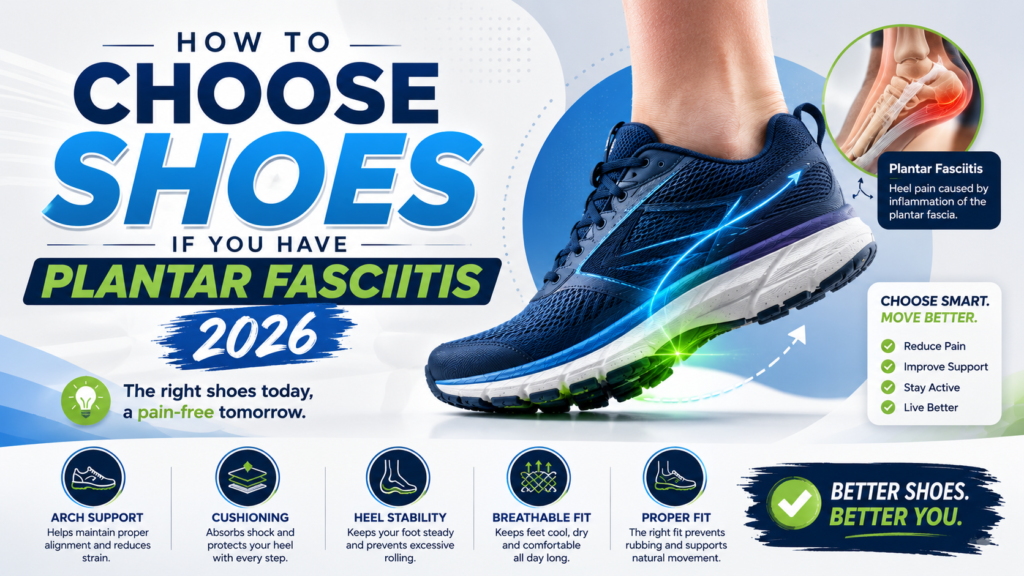
To choose shoes for plantar fasciitis, look for contoured arch support matching your foot type, 6-10mm heel-to-toe drop reducing Achilles tension, a deep heel cup preventing lateral heel motion, medium-to-high density EVA or GEL midsole maintaining cushioning over time, and a wide enough toe box preventing the gripping compensation that worsens fascia strain.
Choosing the right shoes for plantar fasciitis isn’t complicated once you know what to look for. But most people go into it the wrong way – they look for comfort, pick the softest shoe, and end up no better or actively worse six weeks later.
Soft isn’t the same as supportive. That’s the most important thing I can tell you.
Maria, a retail store manager near Houston’s Galleria area, came in after three months of morning heel pain that started worsening despite buying two pairs of “comfortable” shoes from a chain store. Both pairs were well-cushioned. Neither had meaningful arch support. Her foot was pronating with every single step, loading her fascia repeatedly, regardless of how plush the midsole felt.
She left with a properly fitted shoe with a contoured arch, a 8mm drop, and a deep heel cup. Within three weeks her morning pain had reduced by about half.
The shoe choice was right this time. Not because it was softer – it wasn’t. Because it addressed the actual biomechanical problem.
This guide walks you through exactly how to make that kind of decision: how to identify your arch type, what drop level you need, what midsole materials actually last, how to test fit properly, and what to avoid. At the end, you’ll find ten vetted options that put these principles into practice.
If you want to understand what features to look for at a technical level before shopping, this detailed buying guide covers every spec in depth.
Step 1: Identify Your Arch Type First
This is the step most people skip entirely. It’s also the most important.
Your arch type determines what kind of support your foot needs. Buying the wrong arch support for your foot type can make PF worse, not better.
There are three arch types:
How to Check Your Arch Type at Home
The wet foot test takes 30 seconds. Wet the bottom of your foot, step onto a piece of cardboard or brown paper bag, and look at the imprint.
A connected band between heel and forefoot that’s about half your foot width: normal arch. A nearly complete footprint with minimal narrowing: flat arch (overpronation). A very thin or disconnected band with only heel and ball visible: high arch (supination).
Lisa, a kindergarten teacher in Phoenix’s Tempe area, had never heard the word overpronation before she did this test. “I looked at the imprint and my whole foot was on the paper,” she said. The wet test told her everything she needed to know about why neutral shoes kept failing her.
For flat-footed people specifically, stability shoes with medial posts are not optional. They’re the entire point. Our best shoes for plantar fasciitis guide includes stability and neutral options sorted by arch type.
Step 2: Understand Heel-to-Toe Drop
Heel-to-toe drop is the height difference between the heel and forefoot of a shoe. This single measurement has more effect on plantar fasciitis than almost any other feature, and most Americans have never heard of it.
Here’s why it matters: your Achilles tendon and your plantar fascia are mechanically connected through the heel bone. When the Achilles is under tension, it pulls on the heel attachment of the fascia. Drop controls Achilles tension.
| Drop Level | Range | Achilles Tension | PF Impact | Best For |
|---|---|---|---|---|
| Zero Drop | 0mm | Maximum | HIGH RISK | Not recommended for PF |
| Low Drop | 1-4mm | High | CAUTION | Only after full Achilles adaptation |
| Medium Drop | 6-10mm | Moderate (ideal) | RECOMMENDED | Most PF sufferers, daily wear |
| High Drop | 10-12mm | Lower | ACCEPTABLE | Runners with tight Achilles |
| Very High Drop (Heels) | 20mm+ | Artificially shortened | HIGH RISK | Avoid for PF management |
The 6-10mm sweet spot applies to most PF sufferers. This range reduces Achilles tension enough to take pressure off the heel attachment without forcing the extreme changes that zero-drop demands.
One thing I tell every customer: if you’re currently in high heels or elevated work boots and switching to a lower drop, do it gradually. Your Achilles has adapted to its current position. Dropping two inches of heel height overnight is a common PF trigger. Transition over 4-8 weeks using progressively lower drops.
Step 3: Know What Midsole Materials Actually Last
The midsole is the most important part of a PF shoe. It’s also the part that fails fastest and invisibly.
Standard EVA foam: Compresses 30-40% within 300-500 miles or 6-9 months of daily wear. Feels soft initially, then progressively firms into a flat insole as cells crush permanently. Budget shoes use lower-density EVA that bottoms out faster.
High-density EVA: Same material, higher density. Slower compression rate. Better for PF because support lasts longer. Common in mid-range and premium options.
DNA LOFT (Brooks): Nitrogen-infused foam with uniform cell structure. Compresses more consistently and rebounds better over extended use. APMA-validated.
GEL technology (ASICS): Silicone compound that absorbs impact then returns to shape. Positioned at heel strike for direct PF protection. Doesn’t permanently compress the way foam does.
Goga Mat (Skechers): High-rebound foam that bounces back after compression. Better longevity than standard EVA in comparable price range.
VersoShock (Gravity Defyer): Spring-based absorption system that returns energy upward. Reduces cumulative fatigue on long standing shifts.
The practical implication: you should replace budget shoes (standard EVA) every 4-6 months. Mid-range shoes (high-density EVA, Goga Mat) every 6-9 months. Premium shoes (DNA LOFT, GEL) every 9-12 months.
Wearing shoes past their midsole lifespan is one of the most common reasons PF fails to heal. The shoe that helped you in month two has often become a flat, unsupported shell by month six.
Step 4: Understand Arch Support – What It Is and What It Isn’t
This is where shoe marketing misleads people most aggressively.
“Arch support” on a shoe label can mean anything from a raised foam bump to an engineered contoured insole designed from 120,000 foot scans. The term is not regulated.
Real arch support has specific characteristics:
Contoured shape: It matches the curve of your arch rather than providing a generic raised platform. Your arch makes contact with the support along its full length, not just at one point.
Appropriate firmness: Too soft and it compresses flat under body weight. Too firm and it creates pressure points. Medium-firm TPU or dense EVA maintains contact without causing discomfort.
Medial post for overpronators: A firmer density section on the inner (medial) side of the midsole that prevents the arch from rolling inward. Not all shoes have this – it’s specific to stability models.
Heel cup integration: The arch support works with the heel cup. A great arch and no heel cup leaves the heel free to slide, undoing the alignment benefit.
Testing arch support at home: press your thumb firmly into the insole arch area. If it compresses to flat easily, it won’t provide meaningful support under body weight. Real arch support offers noticeable resistance.
Michael, a nurse in Charlotte’s South End neighborhood, bought four pairs of shoes with “arch support” on the label before understanding this distinction. “They all felt supportive when I pressed them with my thumb in the store,” he said. “Then I stood on them for ten hours and they were flat.”
He was pressing with his thumb – maybe 10 pounds of force. His body weight during standing shifts is 180 pounds. The difference in resistance matters.
Step 5: Get Fit Right – Sizing for PF Specifically
Shoe fit for plantar fasciitis has specific requirements that differ from casual shopping:
Time of day: Feet swell throughout the day. Measure and shop in the late afternoon or after activity. Morning measurements often result in shoes that feel tight by 3pm. This is particularly important because PF inflammation causes additional swelling.
Length: Thumb’s width of space at the toe tip. PF causes compensatory toe gripping that worsens in tight shoes.
Width: Enough room for your toes to spread naturally. Narrow toe boxes force gripping that tightens the fascia from the front, increasing heel attachment strain.
Heel fit: The heel should not slip. Heel slipping creates friction at the exact location where PF originates. A properly fitted heel stays in place without tightness.
Brooks specifically recommends: ordering half to one full size larger than your dress shoe size. This is not a generic disclaimer – it reflects real customer feedback about their lasts running narrow.
Jessica, a flight attendant based out of DFW Airport who stands 8-10 hours per shift, spent months in shoes a half size too small before understanding this. “I thought tight was more supportive,” she said. “My podiatrist explained that tight creates compensatory movement that makes everything worse.”
The ideal fit: heel is secure, toes have room, no pressure points anywhere, foot doesn’t slide forward when walking downhill.
Step 6: Match the Shoe to Your Activity
Different activities create different PF load patterns. A shoe optimized for running handles heel-strike impact differently than a shoe optimized for standing.
For running with PF: You need shock absorption that handles 2-3x bodyweight impact per step. GuideRails or stability systems for overpronators. DNA LOFT, ASICS GEL, or equivalent midsoles that maintain performance across 300+ miles. APMA-certified options provide clinical validation. Our best running shoes for plantar fasciitis guide covers running-specific options in full detail.
For walking with PF: Somewhat lower impact (1.25x bodyweight per step), but longer duration. Sustained cushioning matters more than peak absorption. The midsole needs to maintain support across 8-10 hours of use, not just 45 minutes. Our best walking shoes for plantar fasciitis guide covers walking-specific criteria.
For standing all day: Static standing concentrates load on the fascia attachment without the dynamic cushioning that walking provides. Anti-fatigue technology (VersoShock, Natural Rocker) actively returns energy rather than just absorbing it. Our best work shoes for plantar fasciitis guide is specifically built for nurses, teachers, retail workers, and warehouse staff.
For casual daily wear: Balanced cushioning, appropriate drop, fashion-compatible appearance. The slip-on format suits people with morning PF pain who find bending painful. Our best slip-on shoes for plantar fasciitis guide covers hands-free options that don’t sacrifice support.
Step 7: Common Shoe Shopping Mistakes to Avoid
Twenty years of fitting shoes means seeing the same mistakes repeatedly across every city and customer type.
Mistake 1: Choosing softness over support. The softest shoe in the store feels incredible for the first hour. Then the foam compresses and you’re walking on nothing. Aim for responsive firmness – the shoe should feel supportive, not squishy.
Mistake 2: Wearing shoes past their lifespan. Budget shoes: replace at 4-6 months. Running shoes: replace at 300-500 miles. The midsole fails before the outsole shows wear. Don’t judge by appearance.
Mistake 3: Buying the wrong arch support for your foot type. Stability shoes on a supinator cause lateral foot pain. Neutral shoes on a severe overpronator continue the PF cycle. Know your arch type first.
Mistake 4: Shopping in the morning. Your feet at 8am are smaller than at 5pm. PF inflammation adds additional afternoon swelling. Shop late. Size for your swollen foot.
Mistake 5: Switching drop levels too fast. Going from 2-inch heels to zero-drop in a week is a PF trigger. Going from 12mm to 6mm too quickly is enough to strain the Achilles. Allow 4-8 weeks minimum for any significant drop change.
Mistake 6: Ignoring home footwear. Many people invest in proper shoes for work then wear flat, unsupported slippers at home. Your fascia heals during the hours you’re not working. Flat home footwear undoes the recovery that work shoes are building. Our best slippers for plantar fasciitis guide covers therapeutic home options.
Mistake 7: Assuming expensive always means better. The $36.88 HKR Walking Shoes in the product cards below have 45,771 reviews. They outperform many $150 fashion sneakers for PF because they actually address the biomechanics. Price follows features, not the other way around.
Step 8: Understand the Role of Insoles
Supportive shoes and insoles are not interchangeable. They serve different functions and sometimes work better together.
A good shoe provides structural support: midsole cushioning, heel cup depth, forefoot flexibility, and drop management.
A good insole addresses arch contact specifically: custom-molded support for your individual arch curve.
For mild-to-moderate PF in people with standard foot structures, a well-engineered shoe insole is usually sufficient. For severe PF, unusual arch geometry, or people who’ve tried multiple shoes without success, custom orthotics over a quality shoe base often provide the additional specificity needed.
Some shoes – Gravity Defyer, Orthofeet, several FitVille models – include two removable orthotics specifically because they understand this relationship. They provide a quality base shoe plus upgradeable insole support in the same package.
Whether to prioritize insoles or shoes depends on your specific situation. Our plantar fasciitis insoles vs shoes guide covers that decision in practical terms.
Step 9: Know the PF Shoe Checklist Before You Buy
Before any purchase, run through this:
📋 PF SHOE SHOPPING CHECKLIST – CHECK BEFORE BUYING
Step 10: Brand-Specific Notes for American Shoppers
You’ll encounter the same handful of brands repeatedly when researching PF shoes in the US market. Here’s an honest summary of what each does best:
Brooks: APMA certification on multiple models. GuideRails bilateral stability system. DNA LOFT foam with genuine longevity. Best for runners who want clinical backing. Our best Brooks shoes for plantar fasciitis guide covers the full lineup.
HOKA: Maximum foam stack height. Meta-rocker geometry reduces toe-off fascia extension. Best for people who need maximum cushioning volume. Our best HOKA shoes for plantar fasciitis guide covers all HOKA models.
New Balance: ABZORB midsole technology balancing cushioning with compression resistance. ENCAP medial post for overpronation control. Wide width availability. Our best New Balance for plantar fasciitis guide covers their full PF lineup.
ASICS: Rearfoot GEL technology targeted at heel strike specifically. PureGEL is 65% softer than standard GEL. Stability models (GT-2000, Kayano) for overpronators.
Skechers: Goga Mat high-rebound foam. Natural Rocker Technology. Hands-free Slip-ins. Good value, widely available. Best for budget-conscious buyers and people needing slip-on convenience.
Gravity Defyer: VersoShock energy-return system. Two orthotics included. Best for nurses, teachers, and anyone standing 8+ hours daily.
Real-World FAQ: Shoe Shopping for Plantar Fasciitis
Q: How do I choose shoes for plantar fasciitis?
Choose based on arch type first (stability for flat feet, neutral for normal arch, cushioned neutral for high arch), then confirm 6-10mm heel drop, deep heel cup, quality midsole material, and wide enough toe box. Size in the afternoon after swelling has occurred. Match the shoe to your specific activity.
Q: What arch type is best for plantar fasciitis?
No single arch type is “best” – you need shoes matched to your actual arch. Flat arches need stability shoes with medial posts. Normal arches work with neutral shoes. High arches need highly cushioned neutral shoes. Buying stability shoes for a high arch causes lateral pain. Buying neutral shoes for a flat arch continues the PF cycle.
Q: Should I size up for plantar fasciitis shoes?
Usually half a size. Brooks explicitly recommends half to full size up. Most PF shoes benefit from slightly more room to accommodate swelling and prevent toe compression. Shop in the afternoon when feet are at their largest. The heel should remain secure even with extra length.
Q: How long before PF shoes start working?
Typically 1-2 weeks to notice difference in morning pain, 4-6 weeks for meaningful daily reduction, 2-4 months for significant overall improvement. Consistency matters more than the exact shoe – wearing the right shoe every day for 3 months outperforms wearing a perfect shoe intermittently.
Q: Is it better to spend more money on PF shoes?
Not always. The HKR Walking Shoes in this article at $36.88 have 45,771 reviews. They genuinely work for moderate PF. The Brooks Ghost 14 at a higher price has APMA certification and better midsole longevity. Spend more when you need clinical backing, better material longevity, or specific technology. Don’t spend more for brand names alone.
Q: Can I wear the same shoes every day for PF?
Ideally rotate two pairs. Midsoles need 24-48 hours to fully rebound after compression. Daily rotation extends lifespan and ensures you always wear shoes at full cushioning capacity. If budget only allows one pair, that’s better than wrong shoes – just replace on schedule.
Q: What’s the difference between running and walking shoes for PF?
Running shoes are engineered for 2-3x bodyweight impact per step. Walking shoes handle 1.25x bodyweight but sustain that load over longer durations. Running shoes often prioritize impact peak absorption. Walking shoes often prioritize sustained cushioning consistency. Using running shoes for walking generally works. Using walking shoes for running creates PF risk.
Q: Should I choose lace-up or slip-on shoes for plantar fasciitis?
Both work if engineered correctly. Lace-ups allow precise daily fit adjustment as swelling changes. Slip-ons eliminate the bending that causes sharp morning pain for many PF sufferers. If your worst pain is first thing in the morning when bending hurts, slip-ons are worth prioritizing.
Q: Can shoes alone cure plantar fasciitis?
Rarely alone. Shoes address the biomechanical cause. Stretching reduces Achilles and calf tightness that loads the fascia. Reduced high-impact activity allows healing. Night splints prevent overnight fascia contraction. Together these create healing conditions. Shoes are the most important single intervention, but complete resolution usually requires the full protocol.
Q: How do I know if my current shoes are causing PF?
Check these: midsole compresses easily when pressed (bottomed out), no visible arch support structure, heel slips when walking, narrow toe box compressing toes, zero-drop design. If any of these apply to your current shoes, they’re contributing to your PF. Our can shoes cause plantar fasciitis guide explains the mechanisms in detail.
Top 10 Recommended Shoes – Matched to This Buying Guide
Every shoe below meets the criteria this guide outlines: proper arch support, appropriate drop, quality midsole, adequate heel cup, and real-world validation from thousands of American buyers.
⚡ Top 10 Picks – Best Shoes for Plantar Fasciitis 2026

Brooks Adrenaline GTS 22
GuideRails bilateral stability controls both overpronation and supination. DNA LOFT cushioning maintains support across 500+ miles. The most clinically validated running shoe for PF.
🛒 Check Price on Amazon
Brooks Women’s Ghost 14
Most validated women’s shoe in this category. BioMoGo DNA + DNA LOFT dual cushioning, PDAC A5500 diabetic certified, smooth heel-to-toe transitions across all landing types.
🛒 Check Price on Amazon
Skechers Max Cushioning Endeavour
#1 Best Seller. Goga Mat high-rebound sustained cushioning, Natural Rocker Technology smooth heel-to-toe transitions. Machine washable for hygiene. 19% discount.

HKR Women’s Walking Shoes
45,771 reviews validate this entry-level option. Arch support insole, memory foam construction, elastic slip-on closure. Best proof that affordable shoes can genuinely address PF.

Dr. Scholl’s Women’s Time Off
Style-forward platform sneaker with anatomical cushioning. Recycled materials throughout. 1,000+ monthly buyers show consistent demand from fashion-conscious PF sufferers.

Gravity Defyer Mighty Walk Women’s
Patented VersoShock energy return technology, two removable orthotics included, wide toe box, multiple width options. Nurses, teachers, and retail workers – this is the one.

Skechers Women’s D’Lites Biggest Fan
Iconic Skechers D’Lites design with Air-Cooled Memory Foam. Lightweight shock-absorbing midsole. 26,890 reviews. Massive 35% discount makes premium memory foam accessible.

Skechers Summits Dazzling Haze Slip-ins
Hands-free Slip-ins technology with Heel Pillow stability. Air-Cooled Memory Foam insole. 23,559 reviews validate consistent performance. Best for morning PF sufferers who find bending painful.
🛒 Check Price on Amazon
Brooks Glycerin GTS 20
Maximum cushioning plus GuideRails stability combined in one premium platform. DNA LOFT v3 is Brooks’ softest foam. APMA and PDAC dual certification. For runners who want pillowy softness with stability.
🛒 Check Price on Amazon
HOKA ONE ONE Women’s Bondi 8
APMA approved. Maximum foam stack height. Extended heel crash pad geometry. Meta-rocker sole reduces toe-off fascia extension. Best for women needing maximum cushioning protection for severe PF.
🛒 Check Price on AmazonClosing Thoughts
Choosing shoes for plantar fasciitis is a skill, not a guess. Once you know your arch type, understand heel drop, and can evaluate midsole quality, you’ll make better decisions in 10 minutes than most people make after six months of trial and error.
The formula is consistent: match arch type to shoe category, confirm 6-10mm drop, verify arch support resists compression, check heel cup depth, size for swollen feet, and replace on schedule.
Everything else – brand preferences, color choices, slip-on vs lace-up – is secondary to those fundamentals.
For more specific guidance by category, use these starting points: best sneakers for plantar fasciitis, best boots for plantar fasciitis, and best slippers for plantar fasciitis each cover their specific category in full detail.
Disclosure
We may earn a small commission at no extra cost to you if you purchase through our Amazon links. These commissions help keep this site running. We only recommend footwear that genuinely addresses plantar fasciitis mechanics.