

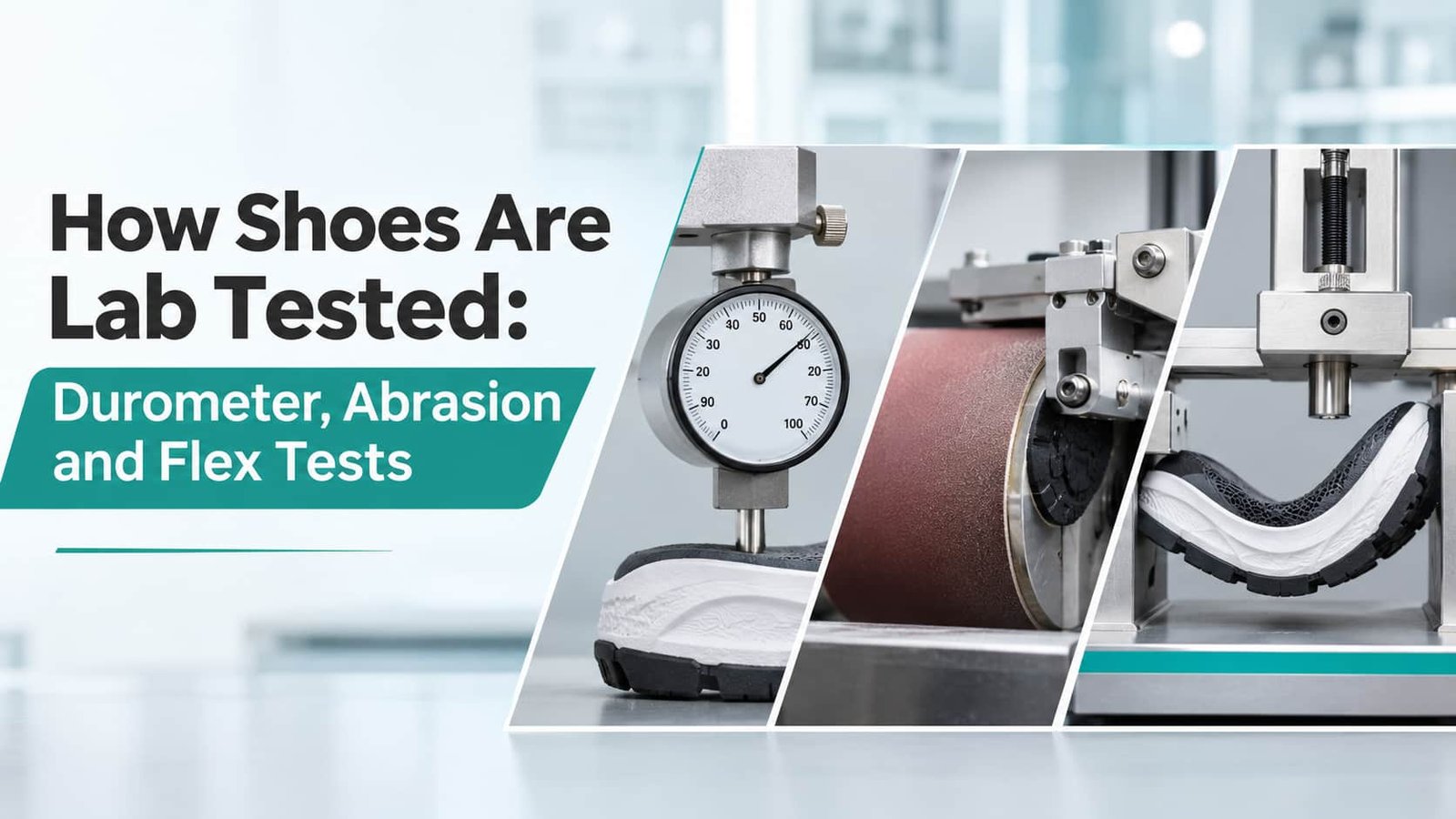
How Shoes Are Lab Tested: Durometer, Abrasion and Flex Tests
Footwear Testing Guide | Updated November 2026
Summarise This Guide with AI
Open an assistant and submit the prefilled request. The assistant reads this page only after you submit it. The guide covers durometer, abrasion, flex and cushioning tests, and the standards behind them.
Shoe lab testing uses standardised machines to measure how a shoe’s materials and construction perform. Durometer tests measure firmness, abrasion tests measure wear on a rotating drum, flex tests check for cracking under repeated bending, and impact tests show how cushioning responds to a drop. Each test follows a published standard, which is what makes results comparable.
Key Takeaways
- A lab test is only as useful as the standard behind it. Results from one standard rarely line up with another.
- Durometer testing measures firmness on a 0 to 100 scale. It is a control test, not a direct measure of comfort.
- Abrasion testing measures how much material a sample loses on an abrasive sheet. It does not predict how long your shoes will last.
- Flex testing looks for cracks that grow during repeated bending, which matters most for soles with deep grooves or weak spots.
- Cushioning tests use a falling weight, and the result depends on the energy and specimen thickness used. Numbers from different energy levels cannot be compared directly.
What Shoe Lab Testing Actually Measures
When a brand says its shoes were “lab tested,” that phrase can mean very different things. Some tests check the surface of an upper for rubbing wear. Others look at a whole shoe’s ability to bend without breaking. A third group measures the chemistry or density of a foam. Understanding what each test measures is the first step to understanding any claim.
A shoe is not one material. It is a stack of components, each with its own job. The outsole needs abrasion resistance, the midsole needs cushioning and rebound, the upper needs flex and tear strength, and the insole needs to keep its shape. A shoe lab tests these parts separately and then sometimes as a complete assembly. If you want a refresher on the parts themselves, the anatomy of a shoe guide walks through each layer, and the pillar on shoe materials covers how those materials are chosen.
Lab testing answers specific questions in controlled conditions. How firm is this foam? How much rubber wears away after a set distance on an abrasive drum? At what point does a sole crack under repeated bending? How much of a falling weight’s energy does the cushioning absorb? Each question has a method, a machine, and a result. The value of testing comes from repeating the same method the same way every time.
What lab testing does not do is tell you whether a shoe will fit your foot or feel right on your stride. Those are human questions, and they depend on shape, weight, gait, and how the shoe is worn. Keep that limit in mind through the rest of this guide.
Why Standards Matter: ASTM, ISO and SATRA
Almost every lab test is defined by a published standard. The standard sets the sample size, the machine settings, the conditions, and how the result is calculated. Without that, two labs could run “the same test” and get numbers that cannot be compared.
Three bodies come up most often in footwear testing:
- ASTM International publishes methods used across North America and widely in industry. ASTM D2240 covers durometer hardness for rubber and some plastics, and ASTM F1976 covers impact attenuation of athletic shoe cushioning.
- ISO (the International Organization for Standardization) publishes global methods. ISO 4649 covers abrasion resistance of rubber using a rotating drum. Footwear-specific safety requirements also reference European methods such as EN ISO 20344 and EN ISO 20345.
- SATRA is a footwear and leather testing organisation based in the UK that publishes its own numbered test methods, such as TM174 for abrasion and TM60 for flex, many of which feed into international standards.
You will see a mix of these names in lab reports. A report that says “tested to ASTM F1976” is describing a cushioning test with a defined drop mass and energy. A report that says “SATRA TM174” is describing a drum abrasion test with its own procedure. Neither result can be directly compared with a result from a different method, even if the two tests sound alike.
Standards also get updated. ISO 4649 has been revised several times, and the current edition is ISO 4649:2024. SATRA updated its drum abrasion method in 2016 so that it now offers two ways to measure volume loss. When you read an older report, check which edition of the method it used.
Durometer Testing: Measuring Firmness
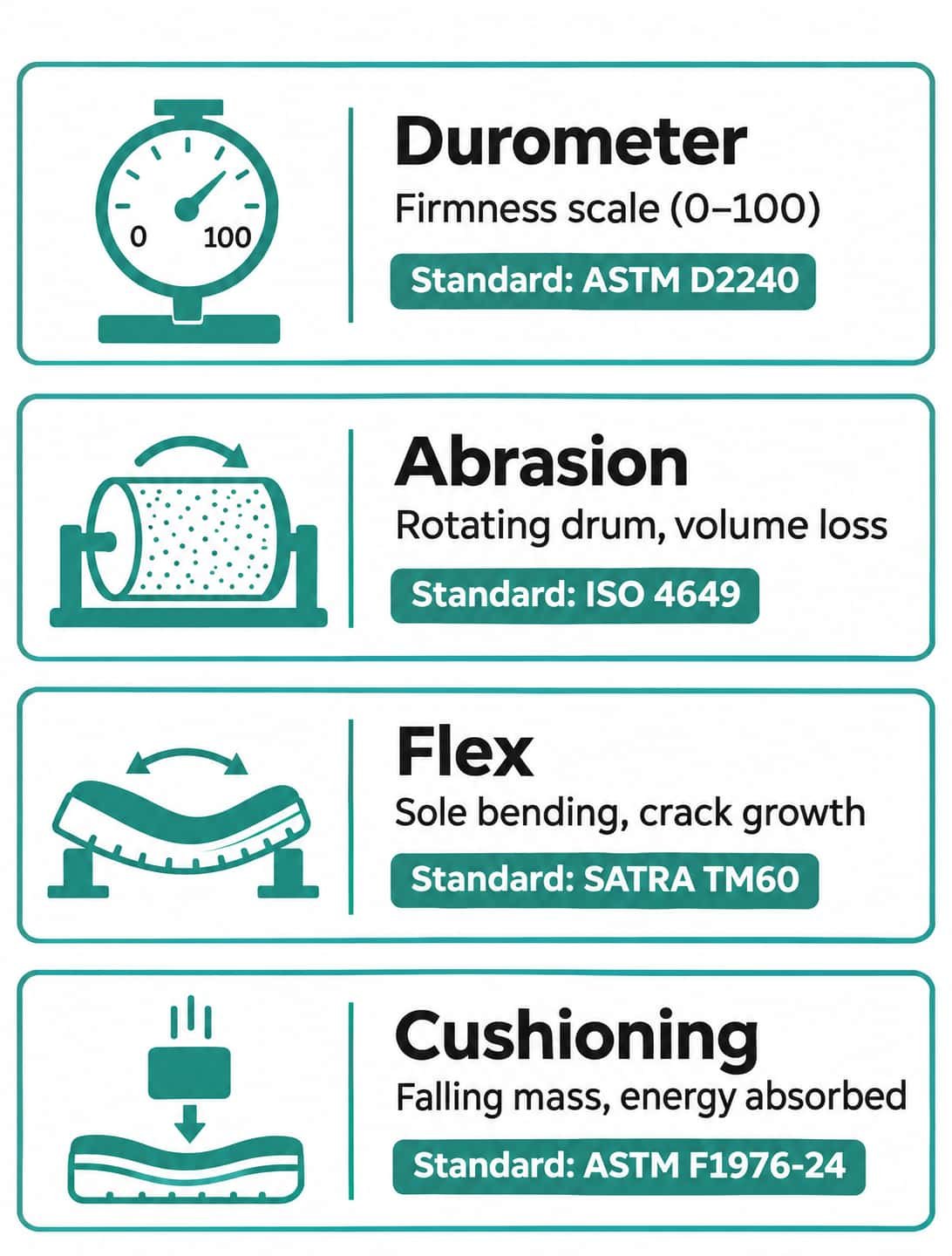
A durometer is a handheld or bench-mounted instrument that presses a pointed indenter into a material and reads how far it sinks in. The reading appears on a scale from 0 to 100, with higher numbers meaning a harder material. In footwear, durometer tests are most often used on soles, midsoles, and foams.
The standard most often cited for this method is ASTM D2240. It describes several durometer types, and the two most common in shoe work are the Shore A scale for softer materials like rubber and many foams, and the Shore D scale for harder plastics. The scale you use depends on the material. A reading taken on the wrong scale can look impressive without meaning anything useful.
Here is where readers often get the wrong idea. A higher durometer number is not automatically better. A harder midsole can feel stiff and slow, while a softer one can feel plush but collapse faster under load. The standard itself describes durometer testing as an empirical method that is mainly useful for quality control. The numbers are good for checking that each batch of material matches a target, and for comparing one sample with another made the same way. They are not a direct measure of comfort, cushioning, or durability.
Durometer readings are also sensitive to temperature, sample thickness, and how long the indenter is held in place. Labs control those variables, which is why a well-written report will list the test conditions alongside the reading. If a report gives a single number with no scale, no standard, and no conditions, treat it as a rough indicator at best.
For a deeper look at foam materials, the guide on running shoe foam explains how different foam compounds differ in feel and structure, and the EVA foam explainer covers one of the most common midsole materials.
Abrasion Testing: The Rotating Drum
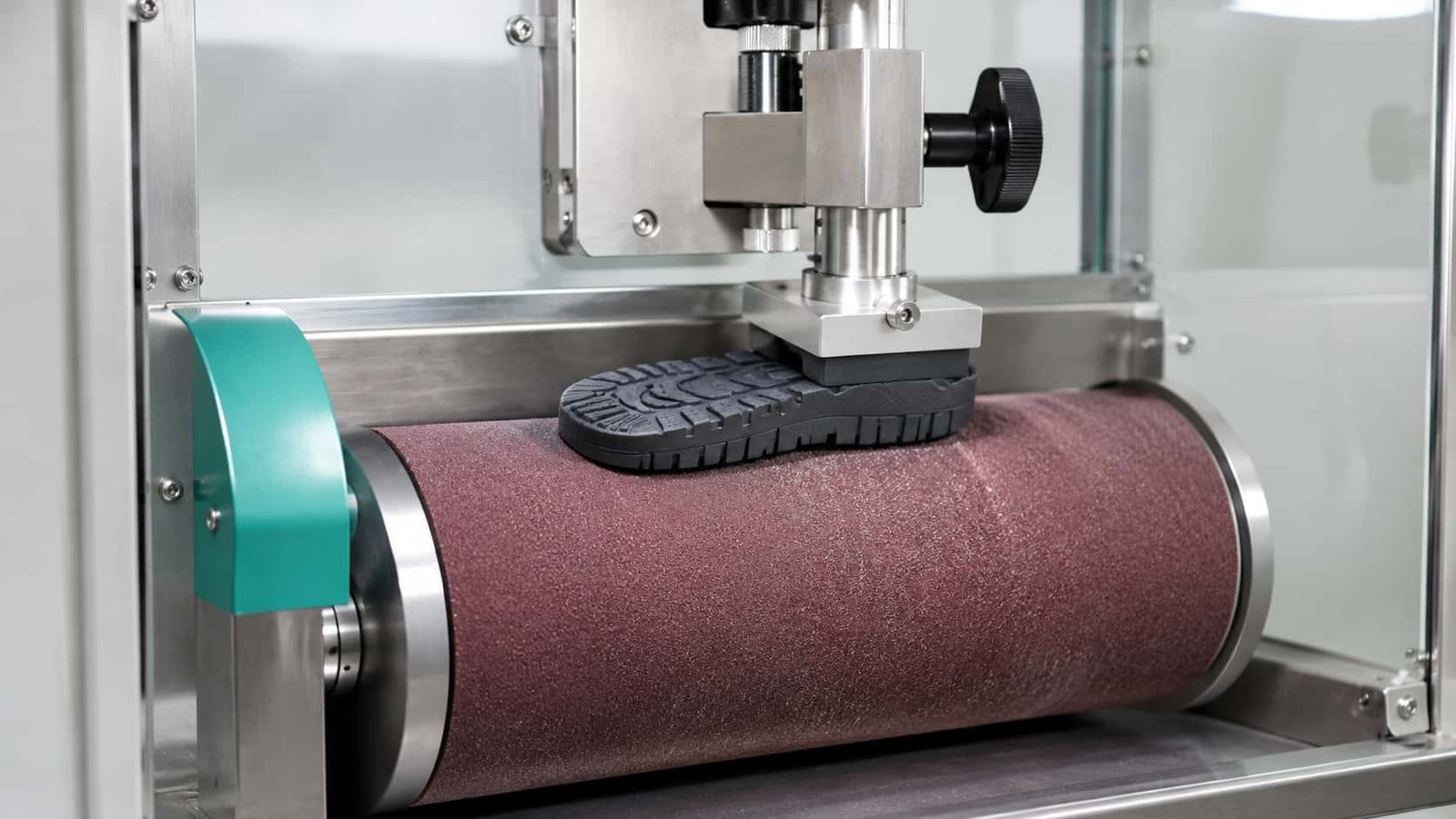
Abrasion testing answers a simple question: how quickly does a sole material wear away? The classic method uses a rotating drum wrapped in abrasive sheet. A sample is pressed against the drum and moved across it for a set distance or number of revolutions. The sample is weighed or measured before and after, and the result is expressed as volume loss.
The current international reference for rubber abrasion is ISO 4649:2024, which describes two methods, one with a fixed sample and one with a rotating sample. The standard reports results as relative volume loss or as an abrasion resistance index compared to a reference compound. That comparative approach is important. The absolute loss depends on the abrasive sheet, the adhesive used on it, and how worn the drum is, so most labs run a reference material alongside the sample.
SATRA’s rotating drum method, TM174, was updated in 2016 to offer two ways of measuring volume loss. One measures loss using density, and the other measures displaced volume directly. A SATRA bulletin on sole testing also describes a drum method for soles in which the drum runs under the specimen at a fixed speed over a set distance, which is one reason you may see distance quoted in reports.
Abrasion results are useful, but they have limits. The ISO standard itself notes that no close relation between this abrasion test and service performance can be inferred. In plain terms, a sole that loses less volume on a drum is likely to be more abrasion resistant in the lab, but that does not mean it will last a set number of kilometres on a pavement. Wear in real life depends on surface type, body weight, stride, and how often you walk on wet ground.
Abrasion resistance matters most for outsoles, especially on heels and forefoot areas that take the most contact. Rubber compounds are the usual choice for this reason. If you want to understand why rubber is used so widely, the guide on rubber shoe soles explains the trade-offs between grip, durability, and weight. For a practical look at how wear develops over time, see how long running shoes last.
Flex Testing: Cracks Under Repeated Bending
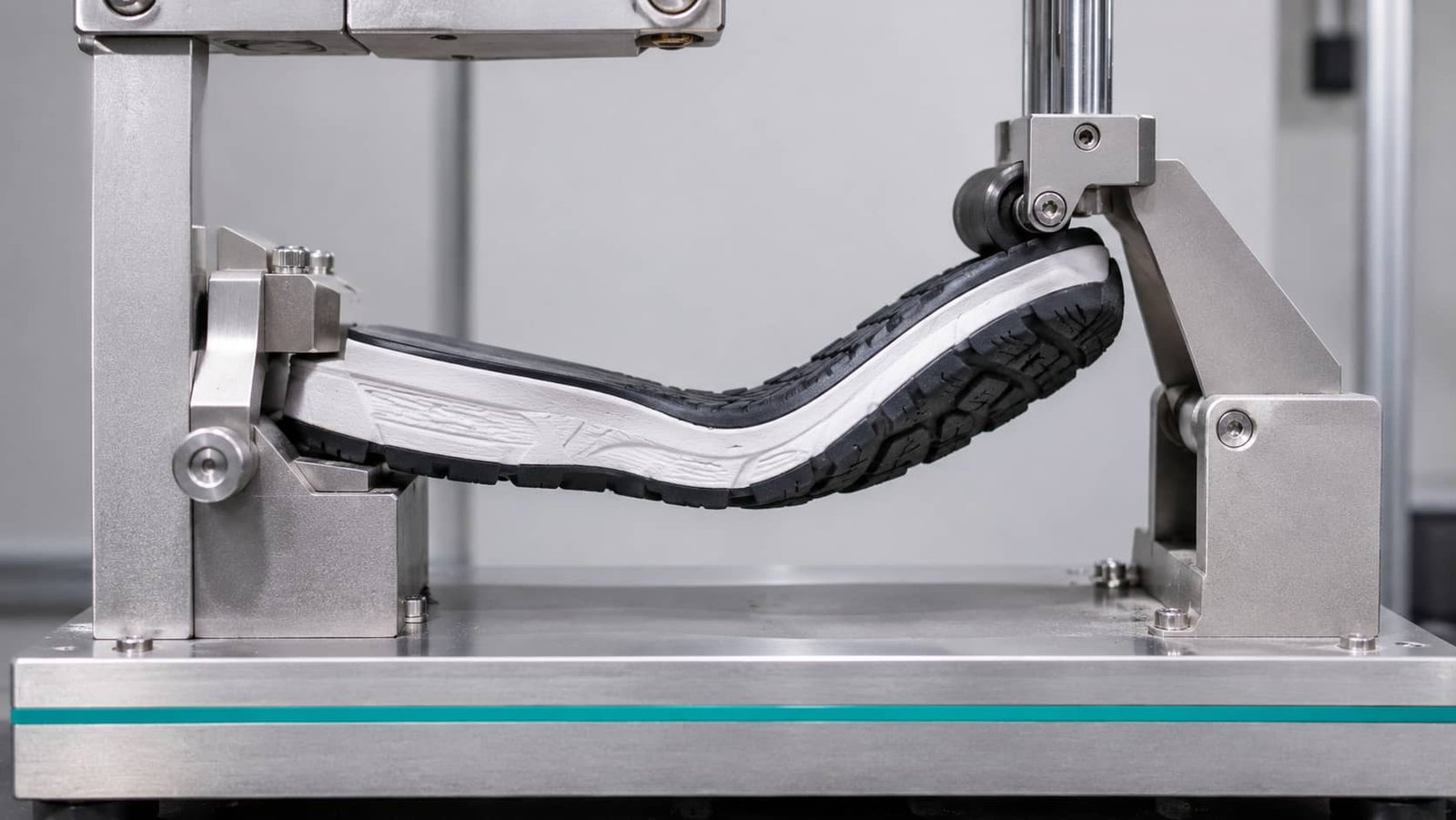
Flex testing is about failure over time. A sole or whole shoe is bent back and forth thousands of times, and the test records when a crack starts or grows. This is a different question from abrasion. A sole can resist wear well and still crack along a groove if it is made from a brittle material or has a weak bond.
Labs use several flex methods depending on what they want to test. The SATRA Ross flex method, described in TM60, tests non-leather soles for resistance to cut growth when repeatedly flexed. It is best suited to smooth soles or those with shallow tread, typically under about 2 mm of pattern depth, according to SATRA’s own equipment guidance. For deeper treads, the Bata belt method (SATRA’s STM 612 machine) is often used because it does not need a cut to be made before the test starts. Whole-sole flex methods such as the STM 465 focus the bending on one position, which can show weak points near the forefoot.
Temperature matters too. Some materials become brittle in the cold, so labs run flex tests at low temperature when a standard calls for it. SATRA’s equipment list includes a low-temperature version of its Ross flex machine, which is a reminder that a sole that passes at room temperature may behave differently on a winter morning.
Flex results are most helpful when read alongside the construction. A sole with a deep, sharp groove may flex differently from a flat one even if both use the same rubber. Adhesion between layers is also part of the picture, since a bond can fail before the material does. Commercial labs such as Bureau Veritas offer whole-shoe flex testing and sole adhesion checks for brands that want to substantiate claims. Their service pages describe the kinds of cracking and debonding they look for, which is useful background even if you never order a test yourself.
The practical lesson is to look for flex data that matches how you will use the shoe. A walking shoe that bends mainly at the forefoot should be tested in that zone, while a shoe with a rigid carbon plate has a different flex profile altogether. The methodology behind most consumer reviews is covered in more detail on the how we test shoes methodology page.
Cushioning Tests: Measuring Impact Attenuation
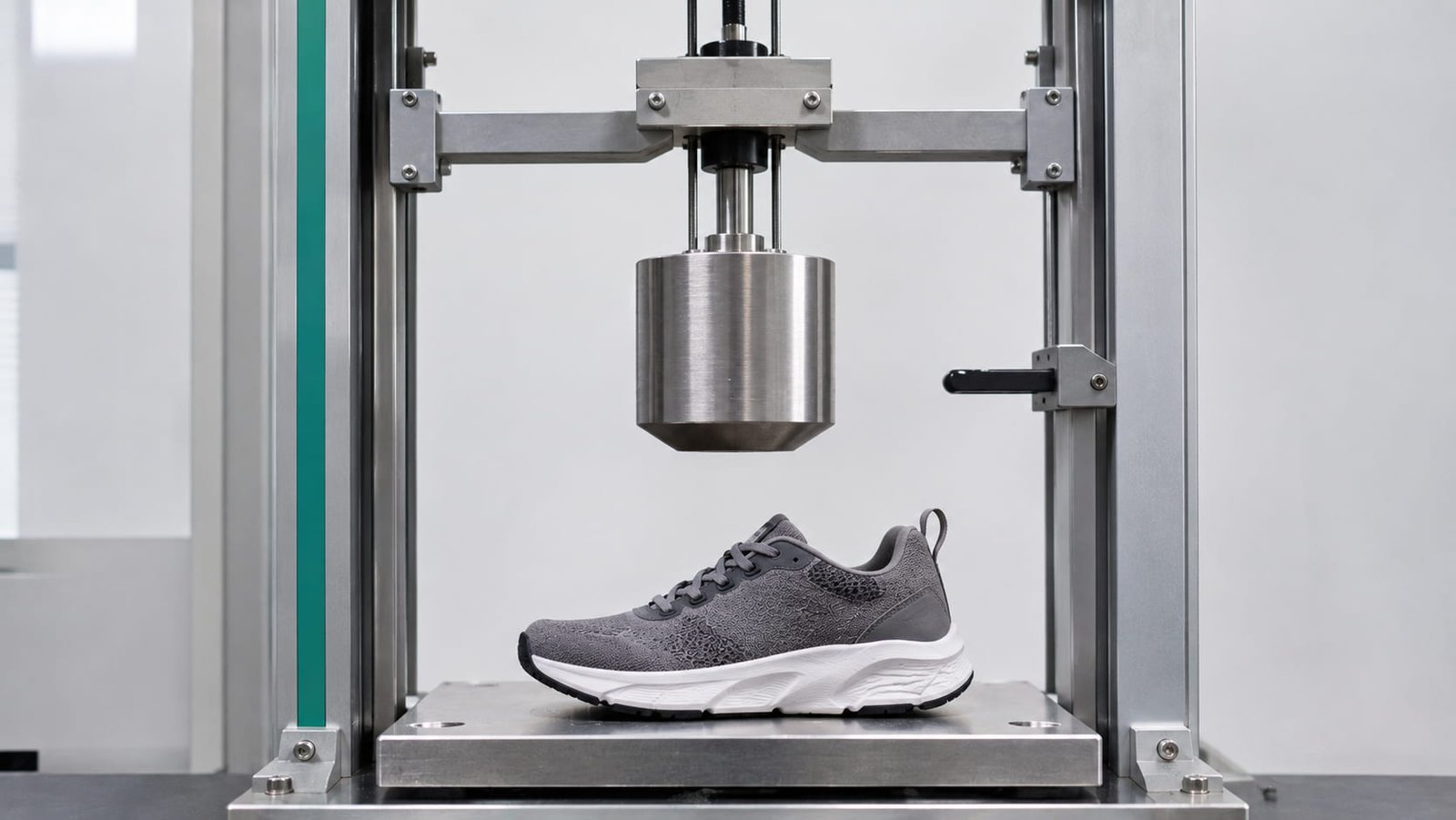
Cushioning is the hardest property to test well, because it depends on how fast and how hard a foot lands. The most widely used standard for athletic shoes is ASTM F1976-24, titled Standard Test Method for Impact Attenuation of Athletic Shoe Cushioning Systems and Materials. The current edition uses a gravity-driven impact test in which an 8.5 kg mass is dropped from a height of 30 to 70 mm onto the heel or forefoot of a shoe or cushioning sample.
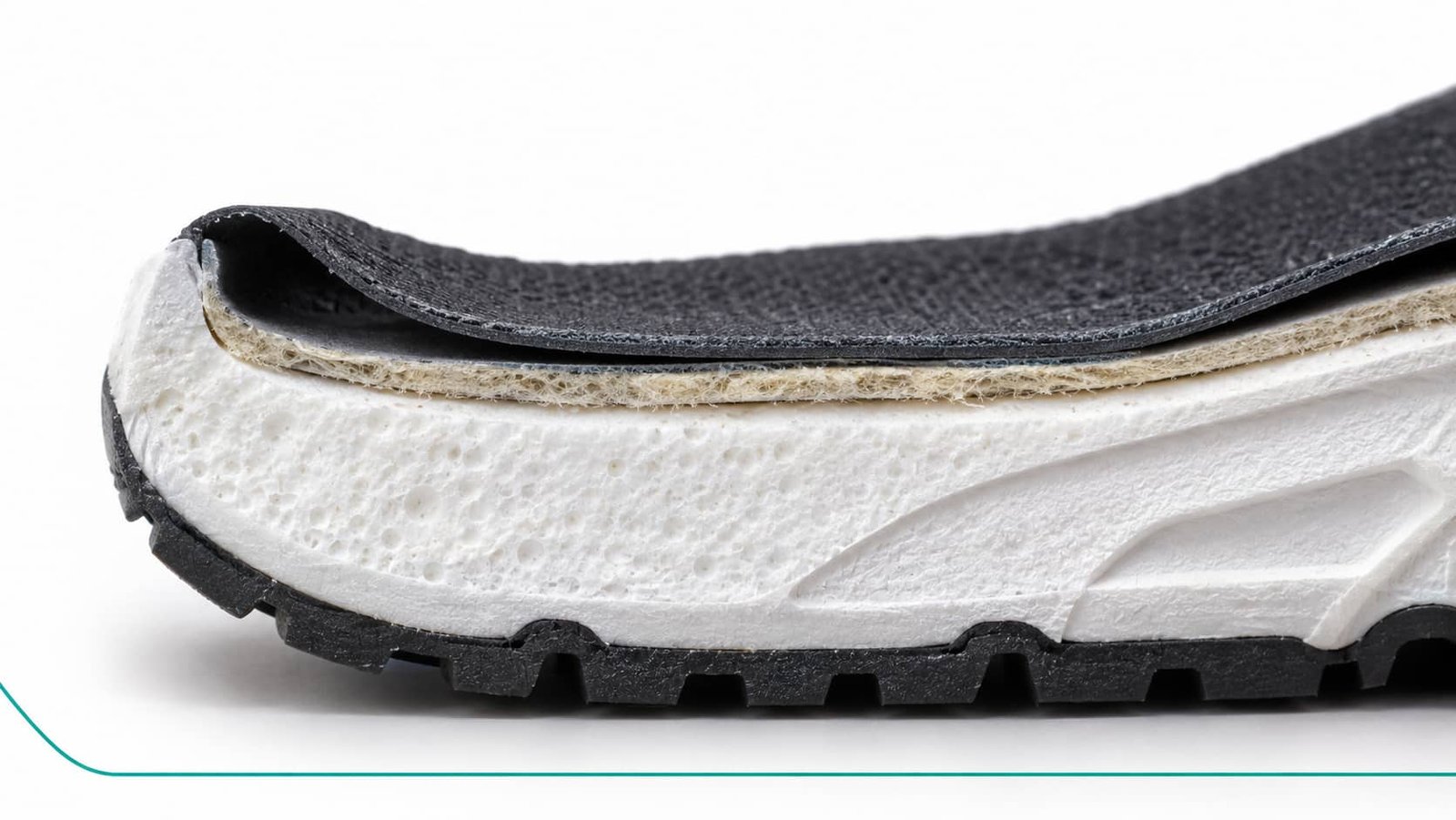
The method measures how the cushioning system absorbs and spreads that impact. It records force, displacement, and related values during the impact. The standard defines the cushioning system broadly. It includes the outsole, the midsole, the insole, parts of the upper that sit under the foot, and any removable insock. That means the result reflects the whole stack, not just the foam.
The energy used in the test changes the result. The standard gives a nominal value of 5 J for shoes subject to moderate impacts, such as running shoes, and mentions 7 J and 3 J for shoes that take higher loads, such as basketball shoes. The standard explicitly warns that results from different energy levels are not directly comparable. The same goes for different masses and different specimen thicknesses. A cushioning number is only meaningful when the energy, mass, and thickness are reported with it.
The standard also notes that cushioning can change with use and with prior loading. A midsole that has been compressed in an earlier test may respond differently in the next one. This is why labs condition samples and why age and wear matter when you compare results. A brand-new shoe and a shoe with 300 kilometres on it can give very different impact readings.
The standard is careful about what it can claim. It states that there is no direct evidence of a correlation between scores on the test and the probability of injury for a particular product. Impact test results can correlate with in-vivo loads experienced by runners and with subjective feel in some studies, but the method is a comparison tool, not a promise about your joints.
For a closer look at energy return and how it differs from simple cushioning, read the guide on energy return in running shoes. The way midsoles are shaped and moulded also changes how cushioning behaves, which is covered in how midsoles are made.
Comparing the Four Core Tests
The four tests answer different questions, so it helps to see them side by side. A shoe that scores well in one test may still underperform in another, which is why serious footwear testing uses several methods rather than a single number.
| Test | What it measures | Common standard | Main limit |
|---|---|---|---|
| Durometer | Firmness or indentation resistance | ASTM D2240 | Control test, not a direct comfort measure |
| Abrasion | Material loss on an abrasive drum | ISO 4649; SATRA TM174 | Comparative, not a lifespan prediction |
| Flex | Crack growth under repeated bending | SATRA TM60; Bata belt; whole-sole methods | Depends on pattern depth and temperature |
| Cushioning | Force and energy absorbed on impact | ASTM F1976-24 | Changes with energy, mass and thickness |
The table shows that no single test covers everything. A durometer reading says nothing about crack growth, and an abrasion result says nothing about impact response. When you read a report, ask which of the four questions it answers and which it skips.
Reading a Test Report Without Being Misled
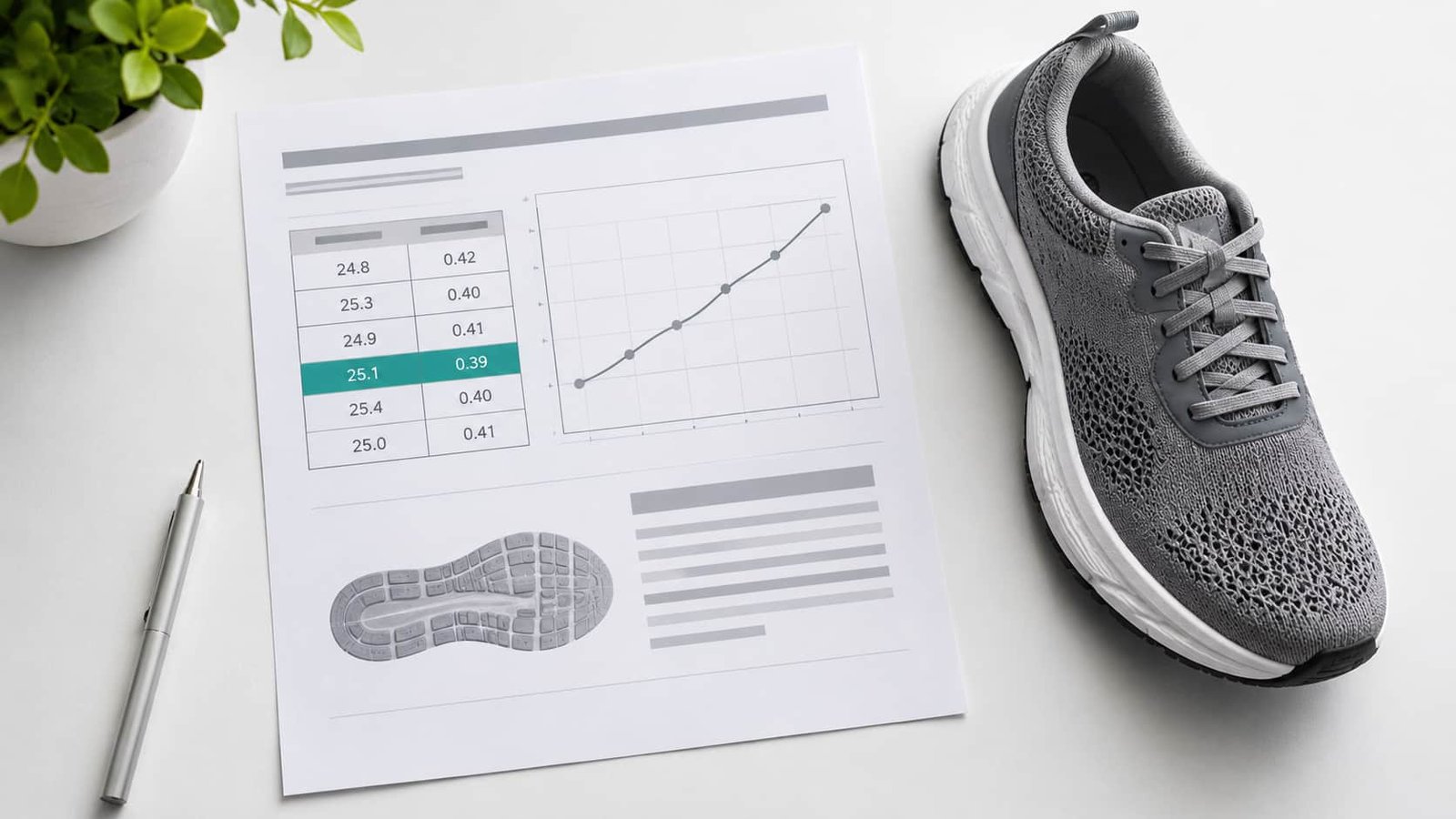
Lab reports can look authoritative, but they are easy to misread. A few checks will help you understand what you are looking at.
Start with the standard. Every result should name the method, and ideally the edition. “Tested for abrasion” is not enough. “Abrasion tested to ISO 4649” tells you the method, and the edition tells you the date. Next, check the conditions. Temperature, humidity, sample thickness, energy, and number of cycles all change the result. A report that leaves these out is harder to trust.
Then look at the comparison. A single number is rarely meaningful on its own. A good report compares the sample with a reference compound, a previous batch, or a competing product tested the same way. If no comparison is offered, the number tells you little about whether the shoe is better or worse than anything else.
Finally, read the limits. Reputable methods often include notes that caution against over-reading the results. ISO 4649 says no close relation can be inferred between its abrasion results and service performance. ASTM F1976 says there is no direct evidence linking its scores to injury probability. When a report or marketing page drops those caveats, the claim has moved beyond what the test supports.
Words like “best” or “most durable” are not test results. They are conclusions, and they need the data to back them up. If a brand makes a claim that cannot be traced to a named test, a named standard, and reported conditions, treat the claim as marketing rather than evidence.
Practical Decision Guide
The right tests depend on what you need from a shoe. Here is a simple way to think about which results matter most for different readers.
- Daily walkers on hard pavement: Abrasion data on the outsole matters most, along with flex results for the forefoot. A durable outsole and a sole that bends where you walk will help more than a high cushioning score alone.
- Runners who log long distances: Cushioning data with clear energy and thickness details is useful, and so is wear data on the heel. Compare results only with other shoes tested the same way.
- People buying trail or wet-ground shoes: Abrasion and flex results on the outsole and tread are most relevant. Consider how deep the tread pattern is, since flex results change with groove depth.
- Buyers of work or safety footwear: Look for references to recognised safety test methods such as the EN ISO 20344 and 20345 families, and check that the report names the exact standard and edition used.
- Anyone with foot pain or a specific medical condition: Lab results are not a substitute for professional assessment. A podiatrist or physiotherapist can advise on what kind of cushioning, support, and fit may suit you.
Across all these groups, the same rule applies. A test is most useful when its method matches your use. A shoe lab result from a standard you do not understand is less helpful than a simple explanation of what the number means for your walking or running.
Common Myths About Lab Testing
Myth: A higher durometer number means a better shoe.
A harder sole is not automatically better. Firmness is a design choice that depends on the job the sole needs to do.
Myth: An abrasion test tells you how long your shoes will last.
It tells you how a sample behaves on a drum under set conditions. Real wear depends on your surface, weight, and habits.
Myth: Cushioning scores can be compared across any two shoes.
They can only be compared when the energy, mass, and thickness match. Otherwise the numbers are not directly comparable, as the standard itself warns.
Myth: A passed test means a shoe is safe for everyone.
Passing a standard means the product met that method’s requirements. It does not promise a result for every foot, gait, or injury history.
Myth: Lab testing replaces fit and comfort checks.
Testing measures material and construction. Fit and comfort depend on your foot shape and how you move, so try shoes on and walk in them.
Frequently Asked Questions
What does a shoe lab test usually check?
Common tests check firmness with a durometer, abrasion resistance on a rotating drum, flex durability under repeated bending, and cushioning response to a falling weight. Some labs also test sole adhesion, slip resistance, and waterproofing.
What is a durometer test in shoes?
It is a method that presses an indenter into a sole or foam and reads the result on a scale from 0 to 100. It is commonly run to ASTM D2240 and is mainly used for quality control.
Does abrasion testing predict how long shoes will last?
Not directly. ISO 4649 notes that no close relation between its results and service performance can be inferred. Abrasion data is useful for comparing materials, but real-world wear depends on use.
What is ASTM F1976 used for?
ASTM F1976-24 measures the impact attenuation of athletic shoe cushioning systems and materials, using an 8.5 kg mass dropped from 30 to 70 mm. It is a comparison method, and the standard states there is no direct evidence linking its scores to injury probability.
Why are cushioning test results hard to compare?
Results change with the energy applied, the mass used, and the thickness of the specimen. Numbers from tests run at different energy levels are not directly comparable, and the standard says so explicitly.
What is SATRA and why does it appear in test reports?
SATRA is a UK-based footwear and leather testing organisation that publishes numbered test methods, such as TM174 for drum abrasion and TM60 for Ross flex. Many labs use its methods alongside international standards.
Can I get my own shoes lab tested?
Yes, commercial footwear labs offer testing for brands and sometimes for individuals. Ask for the standard, the conditions, and the comparison data you want before ordering.
Should lab test results decide which shoe I buy?
They can help you narrow down options, but they should not decide alone. Fit, comfort, your activity, and any foot concerns matter just as much, and a professional can help if you have pain or a medical condition.
Conclusion
Shoe lab testing is a set of controlled methods, each designed to answer one specific question about firmness, wear, flex, or cushioning. The standards behind those methods make results comparable, but only when you know which standard was used and what conditions applied. Read reports with that in mind, and treat each number as a piece of evidence rather than a final verdict.
The most useful next step is to look at the test data for the shoes you are considering. Check whether the outsole abrasion, flex, and cushioning results were run with named methods and comparison points. For a broader view of the materials behind those results, start with the shoe materials pillar, and browse the wider footwear knowledge hub when you want to learn more.
Sources
- ASTM International. ASTM D2240: Standard Test Method for Rubber Property-Durometer Hardness. https://store.astm.org/d2240-15r21.html
- ISO. ISO 4649:2024, Rubber, vulcanized or thermoplastic – Determination of abrasion resistance using a rotating cylindrical drum device. https://www.iso.org/standard/86603.html
- ASTM International. ASTM F1976-24: Standard Test Method for Impact Attenuation of Athletic Shoe Cushioning Systems and Materials. https://store.astm.org/f1976-24.html
- ANSI Blog. ASTM F1976-24: Testing Athletic Shoe Cushioning. https://blog.ansi.org/ansi/laboratory/astm-testing/astm-f1976-24-testing-athletic-shoe-cushioning/
- SATRA. Flexing and abrasion assessment updates (TM174 revision). https://satra.com/bulletin/article.php?id=1791


