

Rubber vs EVA Soles: Grip, Weight, and Durability Compared
Editorial Guide | Footwear Materials |
Summarise this rubber vs EVA guide with AI
Open an assistant and submit the prefilled request. The assistant reads the page only after you submit it.
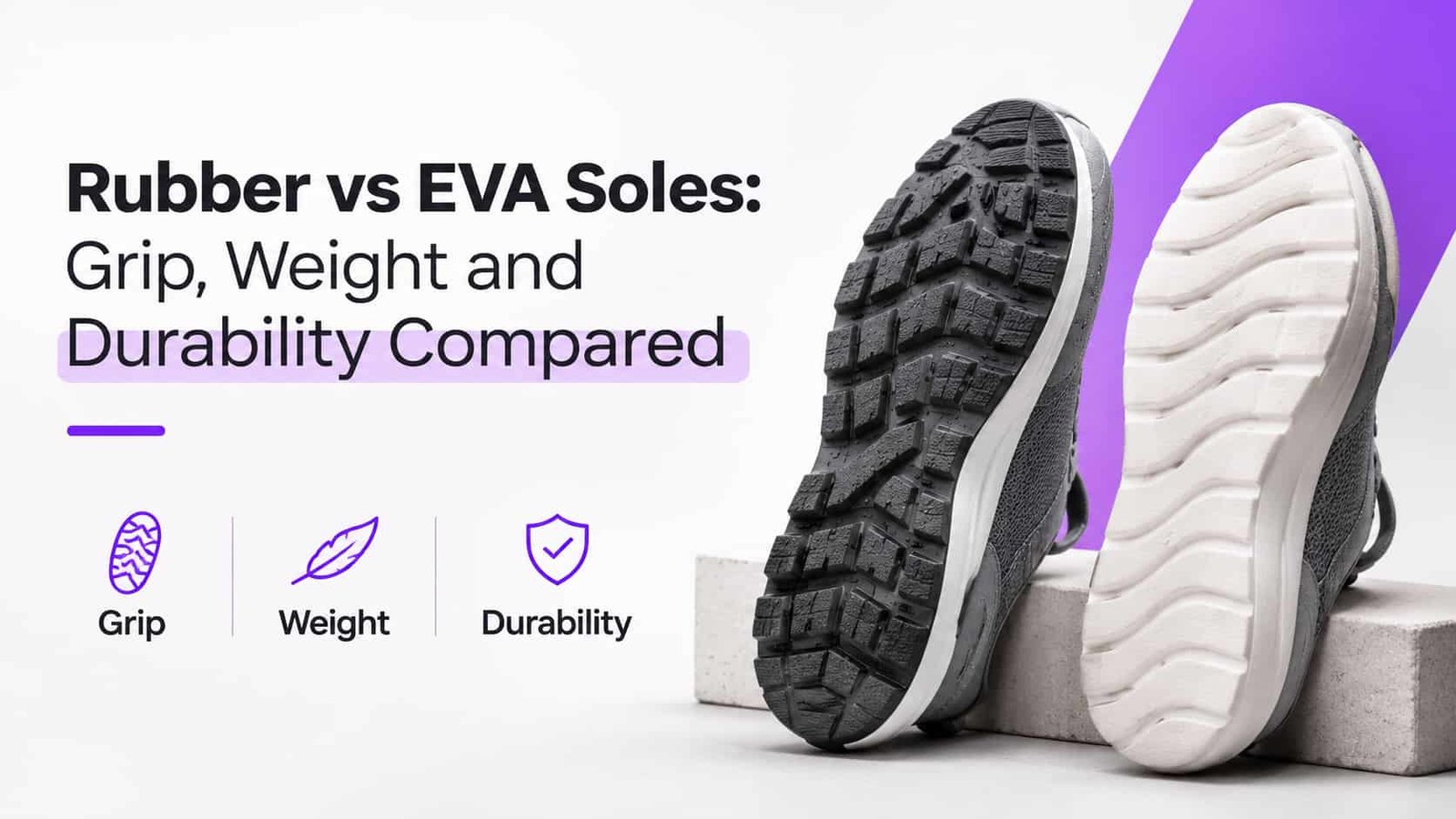
Rubber soles generally grip better on wet and smooth ground and tend to last longer under abrasion, but they are heavier. EVA soles are lighter and more cushioned, yet they often lose firmness with use and can be less grippy on wet, smooth surfaces. Choose rubber for wet or rough ground, and EVA for light, cushioned everyday shoes.
Key takeaways
- Rubber generally offers stronger grip on wet and smooth surfaces. Tread design and compound matter as much as the material name.
- EVA is lighter and softer underfoot, which suits everyday walking shoes and many running midsoles.
- Rubber is denser and heavier. It usually holds its shape well and resists abrasion better on rough ground.
- EVA can compress and lose firmness over time. The rate depends on density, body weight, use and storage.
- Claims about EVA safety, microplastics and European restrictions vary widely. Check them against the rules that actually apply.
Rubber and EVA are the two soles you will meet most often in everyday footwear, and they are often set against each other because they sit at opposite ends of a trade-off. Rubber is dense, tough and grippy. EVA is light, springy and easy to shape into a cushioned midsole. If you have wondered why one pair of sneakers feels planted on a wet floor while another feels bouncy on a long walk, this difference is a large part of the answer.
This guide compares the two on the four things buyers usually notice first: grip, weight, durability and cushioning. It also addresses the safety and environmental questions that come up often, with a focus on what can and cannot be said with confidence. For the wider picture of how soles fit into a shoe, start with our shoe materials guide.
One note on method. This is a desk comparison. It draws on material descriptions, regulatory sources and general engineering principles. It does not report lab friction or wear tests carried out for this article. Our methodology page explains how we approach reviews more broadly.
What Rubber and EVA Soles Are
Rubber outsoles are usually made from natural rubber, synthetic rubber or blends of both. Natural rubber is harvested as latex from rubber trees. Synthetic rubber is made from petroleum-based monomers, as described in the overview of synthetic rubber. Manufacturers usually add fillers such as carbon black and cure the compound so it keeps its shape under load. Those filler and curing choices are a large part of why two “rubber” soles can behave very differently. A softer compound grips more readily, while a harder, more heavily filled compound usually resists wear for longer. Our rubber shoe soles guide covers the common types, including gum rubber and carbon rubber, in more detail.
EVA stands for ethylene-vinyl acetate, a copolymer of ethylene and vinyl acetate. In footwear, EVA is usually foamed. Gas cells are introduced during manufacture, so the finished material is largely air by volume. The result is a lightweight, springy material whose feel depends on its density. Denser EVA is firmer and tends to hold its shape better. Less dense EVA is softer and lighter but compresses more readily. Our EVA foam explainer goes deeper into how the foam is made.
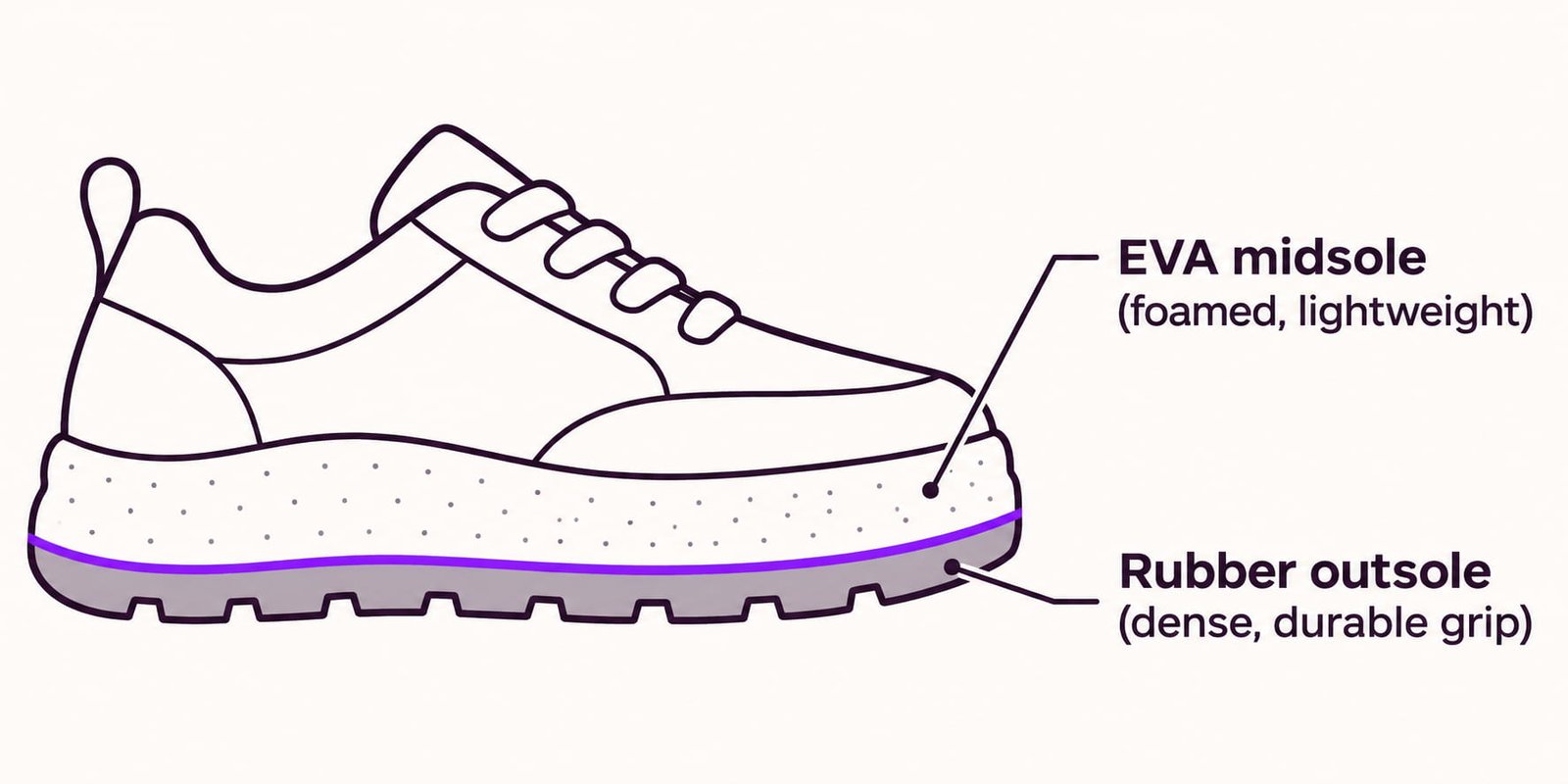
It helps to know where each material usually sits, because they are less often rivals inside one shoe than neighbours. In a typical sneaker, the midsole is the layer between the upper and the ground, and the outsole is the part that touches the ground. Many shoes use EVA for the midsole and rubber for outsole pads on the heel and forefoot. That is why a shoe can be light and cushioned while still gripping well where it matters most. Our guide to insole, midsole and outsole explains these layers in more detail.
So the useful question is rarely “rubber or EVA” in the abstract. It is which material should carry ground contact and which should carry cushioning, given how the shoe will be used.
Grip: Where Each Sole Performs
Grip is friction between two surfaces. Friction depends on the materials involved, the roughness at the contact area, the load, and anything between the surfaces, such as water, oil or dust. For a shoe sole, the compound, the tread pattern and the floor all matter.
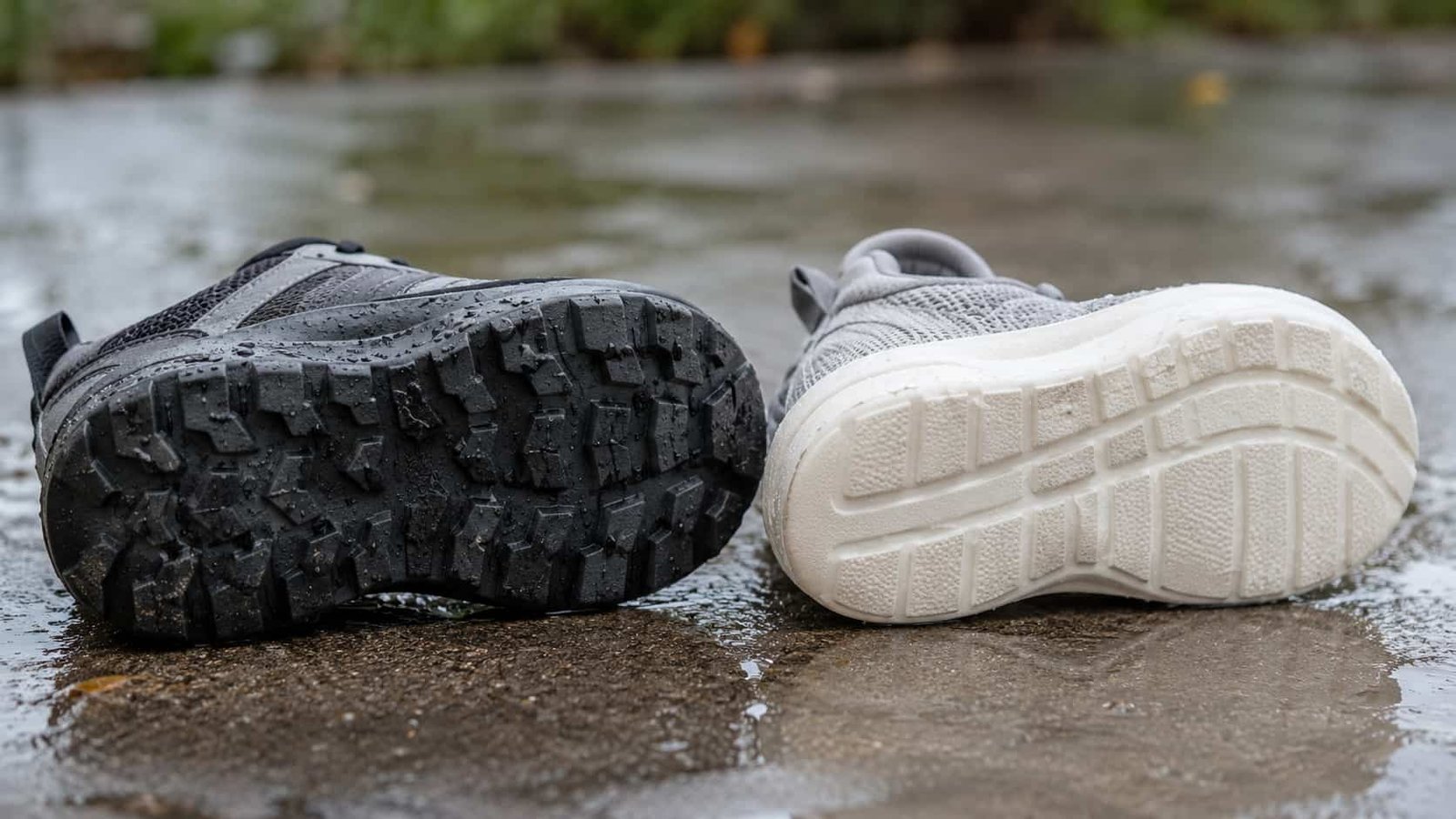
Rubber generally performs well across a wide range of surfaces. A softer, well-formulated rubber conforms to tiny irregularities in the floor, which increases the real contact area. Tread channels then carry water and debris away from the contact patch, so the rubber keeps touching the surface instead of riding on a film of water. This is why rubber with a visible tread is usually the safer choice for wet tile, wet stone, painted concrete and other smooth, wet surfaces.
EVA behaves differently. Its foamed structure is less dense than solid rubber, and its surface is often smooth unless a tread pattern is moulded into it. On dry, textured ground such as asphalt, many EVA soles provide adequate grip for everyday walking. On wet or polished surfaces the picture changes. Water can reduce contact between a smooth EVA surface and the floor, and the sole can slide more readily. Designers improve EVA grip with moulded texture, sipes (narrow cuts in the tread) or rubber pads at contact points, a common approach in running and casual shoes.
Two points are easy to miss. First, grip is not a fixed property of a material. The same rubber sole can grip well on one floor and poorly on another, especially once it is worn smooth or contaminated with dust or oil. Second, standardised slip tests exist, but they use specific surfaces and conditions. Read their results as comparisons under those conditions, not as promises for every floor. Our guide to shoe traction covers how traction is judged and why the surface matters so much.
If you want to understand how rubber compounds are branded, our Vibram soles guide explains one well-known family of outsole rubbers and what the name does and does not tell you.
The practical takeaway is simple. If wet floors are part of the plan, a rubber outsole with a visible tread is the safer starting point. If the plan is mostly dry ground, EVA can be perfectly adequate, provided the tread or pad design suits the surface.
Weight and Cushioning
Weight is where EVA has its clearest advantage. Because foamed EVA contains a large volume of gas, a midsole of a given thickness weighs considerably less than a solid rubber sole of the same size. For shoes worn all day, or for running and fast walking, that difference is noticeable. Less weight on the foot is a point many designers prioritise.
Cushioning is a related but separate idea. EVA compresses under load and then rebounds, which gives the springy, soft feel many people associate with comfortable everyday shoes. Rubber is much firmer. It offers protection from sharp or uneven surfaces and a stable platform, but it returns less energy and feels stiffer underfoot. A rubber sole can be made thinner or softer to add comfort, but the base material still behaves differently from foam.
Lighter and softer is not automatically better for every walker. Some people prefer a firmer platform, especially on uneven ground, where stability can matter more than softness. Comfort also depends on fit, foot shape, body weight and how the shoe is laced and built. Our article on running shoe foam explains how midsole foams are compared, and why a foam’s feel depends on more than its base material.
When you compare two shoes, look at midsole material and thickness as well as the outsole. A listing that says only “rubber sole” or “EVA sole” leaves out the part that often matters most for cushioning. Manufacturers usually publish midsole and outsole materials in the product details, which is the best place to start.
Durability and Wear
Durability has several parts, and the two materials do not perform the same way in each. Rubber generally resists abrasion better, so it wears more slowly against rough surfaces such as concrete, gravel and kerbs. That is one reason rubber is common on the bottom of shoes meant for city walking, work and outdoor use.
EVA’s main durability concern is compression. Because the foam is designed to compress and rebound, repeated loading can reduce its resilience over time. Designers often describe this as the midsole “packing out” or flattening. The rate depends on foam density, the wearer’s weight and gait, how much the shoe is used, and the conditions it is exposed to. Prolonged heat, such as a hot car interior, can also deform foam, so a shoe left somewhere hot may feel firmer or softer afterwards.
EVA outsoles on lightweight slides and sandals can wear quickly on rough ground. That is one reason many casual designs pair EVA with rubber pads at contact points. Rubber outsoles on the same kinds of shoes often last longer, although they add weight.
It is tempting to look for a single number here, but no sensible guide can promise one. Lifespan depends on how the shoe is used, how far it is walked or run, on what surfaces, at what body weight, and how it is stored. Our guide on how long running shoes last explains the general factors, and the same logic applies to casual footwear. Two shoes built from identical materials can wear very differently.
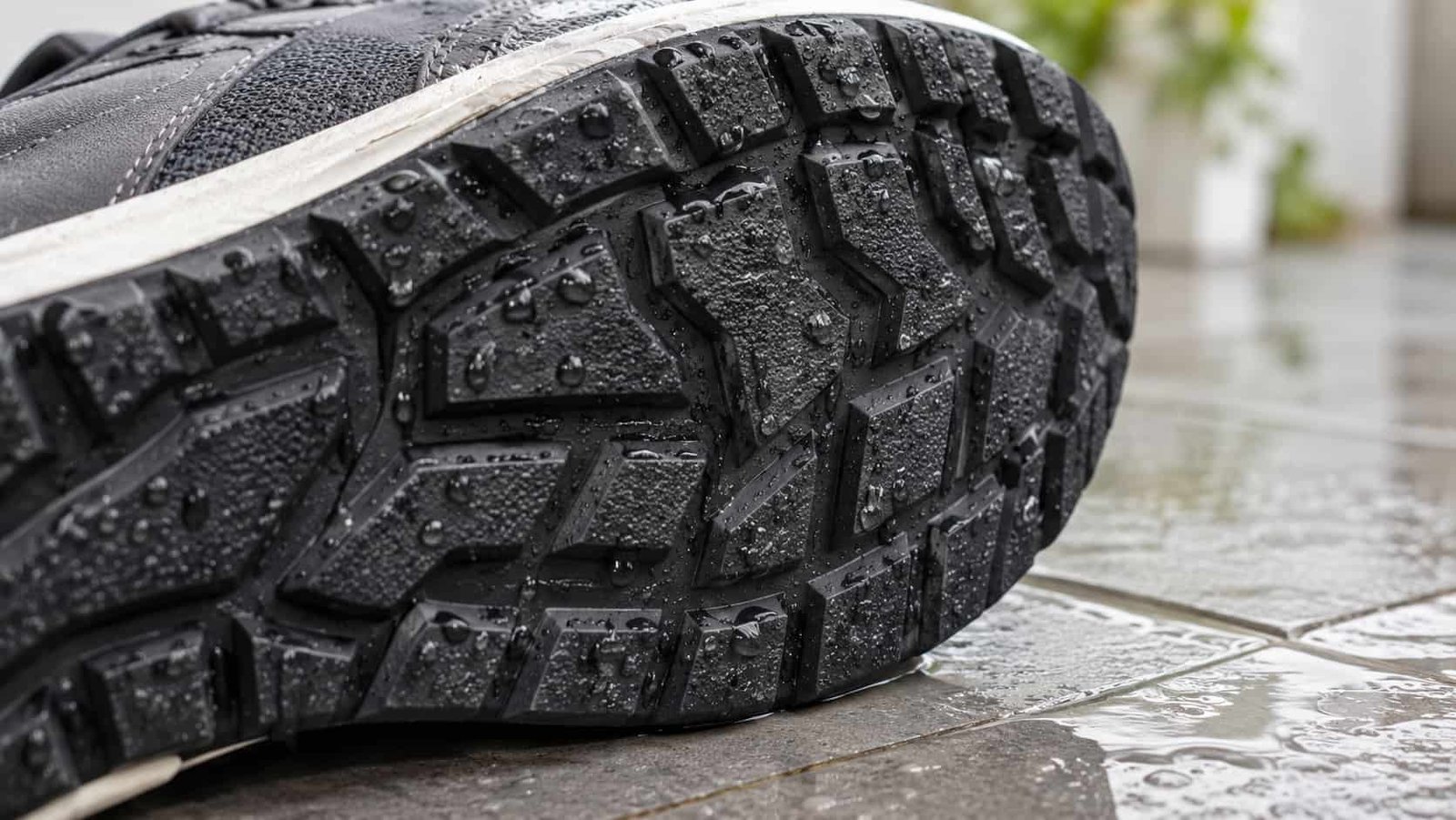
The best durability signals are the ones you can check yourself. Look at the depth of the outsole tread, whether rubber has worn through to the midsole at the heel or forefoot, and whether the midsole still springs back after a day’s use. If the heel foam feels flat while the forefoot still springs, the shoe may suit less demanding use from here on.
Water and Cleaning
Both materials handle water well in the sense that matters most for soles. Dense rubber absorbs very little water. Foamed EVA is typically described as closed-cell, meaning most of its gas cells are sealed rather than connected, so the foam resists soaking up water. That structure is a large part of why EVA works well in pool shoes, slides and wet-weather footwear.
Waterproofing, however, is a property of the whole shoe. A sole cannot keep water out alone if the upper is porous or the seams are open. For how the whole shoe handles water, see our guide to how waterproof shoes work.
Cleaning should be gentle with both. Rubber can usually take a stiff brush, lukewarm water and mild soap. EVA can also be cleaned with mild soap and a soft brush, but harsh solvents, strong bleaches and high heat can damage the foam surface and its resilience. Dry soles naturally, away from direct heat, and do not put foam midsoles in a dryer. For step-by-step sole cleaning, see our guide to cleaning shoe soles. For uppers and general upkeep, read how to clean shoes and maintain them.
Safety and Environmental Claims
Online discussion of EVA often mixes three different questions: whether the finished material is safe to wear, whether it sheds particles in use, and whether it is restricted in some markets. Each has a different answer, and claims often run ahead of the evidence, so it helps to take them one at a time.
Safety. Finished footwear is sold widely, and the materials in it fall under chemical rules that apply to specific substances rather than to whole polymer families. EVA’s composition depends on the manufacturer and can include additives such as colourants, stabilisers and processing aids. For a specific product, the most useful documents are the supplier’s safety data and any product-specific declarations. People with known sensitivities to particular additives or materials should take that question to a qualified professional rather than rely on general articles, including this one.
Microplastics. Any synthetic polymer can release fragments when abraded, and footwear is one possible source. Published measurements of particle release from footwear are limited, and results depend heavily on test conditions, surfaces and method. A reasonable reading is that EVA and rubber both belong to the group of materials that can shed fragments under abrasion, and that general sources do not settle how much. Treat any specific figure with caution unless it comes with a clear method. The microplastics overview explains the terms and why measurement is difficult. Abrasion from rough ground is the more plausible route for fragment release, though that is a general principle rather than a measured result.
Restrictions. Claims that EVA is “banned in Europe” do not match how EU chemical law works. The main framework, REACH, is built around registering substances, sharing safety information and restricting specific substances of concern. The ECHA guidance on REACH explains how the system works, and the candidate list of substances of very high concern shows which individual substances are under review. For a particular additive or product, those sources answer the question. A blanket claim about a whole material does not.
Environment. EVA is a synthetic polymer made from petroleum-derived feedstocks. It is not readily biodegradable under normal conditions, and recycling options for mixed foam footwear are limited and depend on local collection systems. Rubber has a more mixed picture. Natural rubber is plant-derived, but many outsole compounds are synthetic or blended and face similar end-of-life challenges. For background on how plastics and rubber-like materials are recovered, see the overview of plastic recycling.
Neither material is a clear environmental winner on every measure. A shoe’s overall impact depends on its design, how long it lasts, and what happens to it at the end of its life.
Side-by-Side Comparison
| Feature | Rubber | EVA |
|---|---|---|
| Typical role | Outsole at ground contact | Midsole, sometimes outsole in light shoes |
| Grip on wet, smooth surfaces | Generally stronger, especially with tread | Often weaker on smooth, wet surfaces |
| Grip on dry ground | Good across most compounds | Good on textured surfaces; varies |
| Weight for the same size | Heavier, because it is denser | Lighter, because it is foamed |
| Cushioning feel | Firm and protective | Softer, springier, more compressible |
| Abrasion resistance | Generally high | Lower on rough ground |
| Firmness over time | Holds its shape well | Can compress and lose firmness with use |
| Water absorption | Low, because it is dense | Low, because it is closed-cell foam |
| Cleaning | Stiff brush, mild soap, lukewarm water | Mild soap and soft brush; avoid harsh solvents and heat |
| Environmental note | Natural or synthetic; natural rubber is plant-derived | Petroleum-derived polymer; limited recycling routes |
Which Sole Suits Which Shoe
The right choice depends on where and how the shoe will be used. These are general guidelines, not rules.
For wet city days, kitchens, outdoor work and any setting with smooth, damp floors, a rubber outsole with a visible tread is the safer starting point. The extra weight is a fair trade for better grip in those conditions.
For everyday walking on dry ground, light casual sneakers and shoes worn for long periods, EVA is a strong choice. Cushioning and low weight make a real difference over a full day, and grip on dry, textured ground is usually adequate for that use.
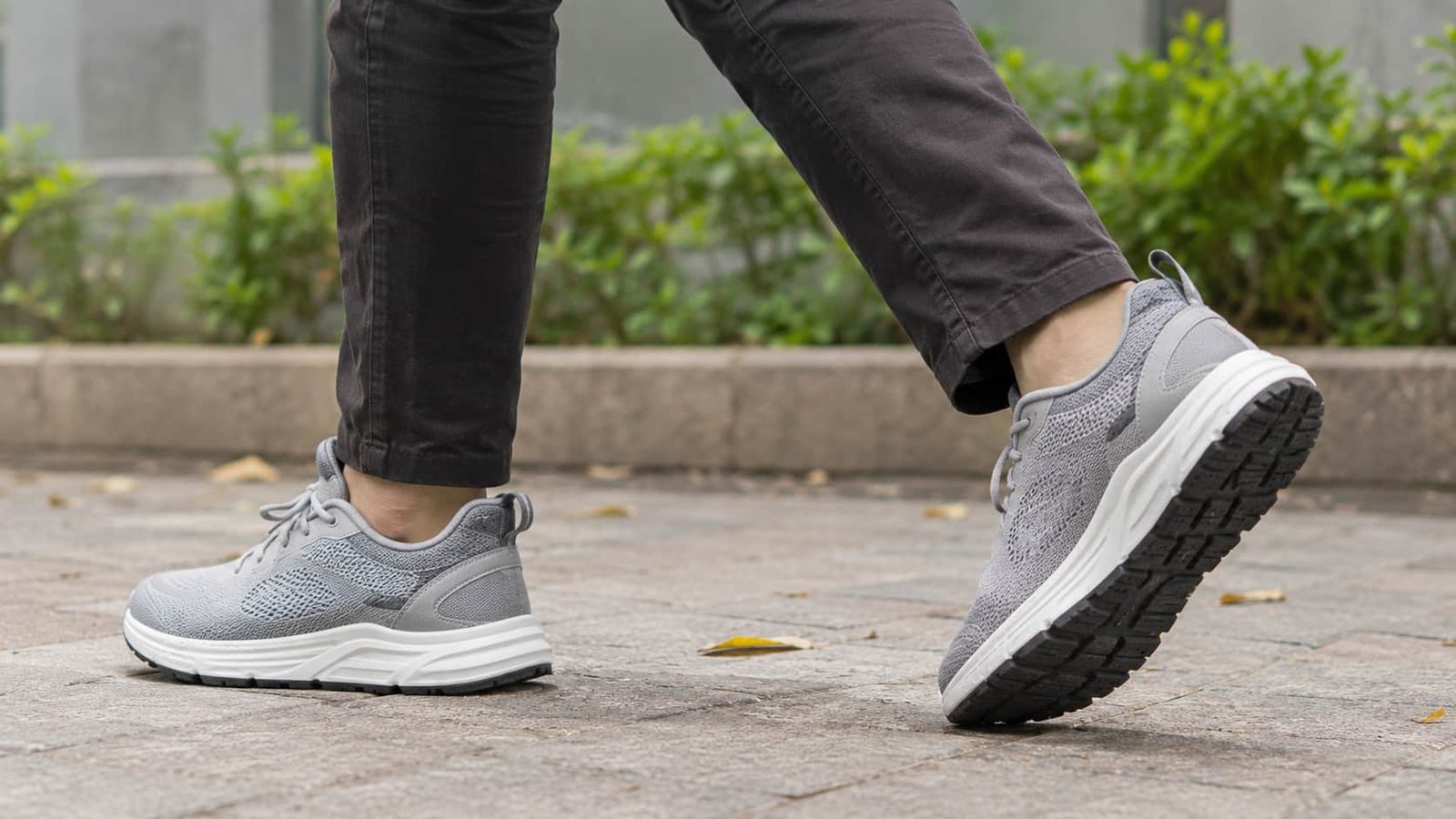
For running, EVA-based midsoles are common because of their weight and cushioning, and rubber pads often sit at the contact points where wear is highest. The best choice depends on the runner’s gait, surfaces and preferences, so fit and feel should lead the decision.
For hiking and rough terrain, rubber outsoles with deeper lugs are usually the better choice. They resist abrasion and grip loose or uneven ground. EVA can work in lighter trail designs, but expect faster wear on sharp rock or gravel.
For slides and recovery sandals, EVA’s light weight and water resistance are the main attractions. Keep expectations realistic about wear on rough ground, and consider a rubber sole if you plan to walk long distances outdoors.
For budget-conscious buyers, EVA is common in lower-priced shoes because it is easy to mould. A low price alone says little about durability, so compare the outsole, midsole and tread before deciding.
If you are also weighing leather soles, our rubber vs leather soles comparison covers the other end of that choice.
Myths Worth Dropping
“EVA is always slippery.” EVA can be slippery on wet, smooth surfaces, but grip depends on tread, texture and the floor. On dry, textured ground it is often fine.
“Rubber lasts forever.” No sole material lasts forever. Rubber resists abrasion well, but it can still wear through, crack with age or lose grip once smooth.
“Heavier soles are always more durable.” Weight and durability are not the same thing. Density, compound, design and use all matter, and a heavy sole can wear quickly if its compound is soft.
“EVA always flattens within months.” Compression depends on density, load, heat and use. Some EVA midsoles keep their feel for a long time, while others flatten sooner. Be wary of any timeline not tied to a specific product and pattern of use.
“A ban on EVA means it is unsafe.” A restriction on a specific substance is a narrow rule, not a verdict on a whole material. Read the actual rule before drawing a conclusion.
Frequently Asked Questions
Which is better for walking, rubber or EVA soles?
For long walks on dry, textured ground, EVA is often more comfortable because it is lighter and more cushioned. For walks on wet or smooth surfaces, rubber with a visible tread usually gives more confidence. Many walking shoes combine both, with EVA in the midsole and rubber at the contact points.
Are EVA soles slippery?
They can be, particularly on wet, polished or smooth surfaces. Grip depends on the tread pattern, the texture of the sole and the floor itself. EVA with a moulded tread or rubber pads at contact points usually grips better than a smooth, unpatterned EVA surface.
Are EVA soles waterproof?
EVA is a closed-cell foam, so it resists absorbing water. That does not make a shoe waterproof on its own. Whether a shoe keeps water out depends on the upper, the seams and the construction as a whole.
Is EVA toxic?
Safety depends on the specific product, including its additives and how it was made. General claims in either direction are hard to support. Shoppers with known sensitivities should check the manufacturer’s safety information and speak with a qualified professional if they have concerns.
Does EVA shed microplastics?
Any synthetic polymer can release fragments when abraded, and footwear is one possible source. Published measurements are limited and depend on test conditions, so precise claims about how much is released are hard to support. Abrasion from rough ground is the more plausible route for fragment release.
Is EVA foam banned in Europe?
No blanket ban on EVA as a material exists under the main EU chemical framework. REACH restricts specific substances, and those restrictions can apply to additives used in some products. For a particular substance, check the current ECHA lists and restrictions rather than relying on a general claim.
Is EVA environmentally friendly?
Not in a simple sense. EVA is a petroleum-derived synthetic polymer that is not readily biodegradable, and recycling for mixed foam footwear is limited. Its overall impact depends on how long the shoe lasts, how it is made and what happens to it at end of life.
Which sole lasts longer, rubber or EVA?
Rubber generally resists abrasion better, so it often lasts longer on rough ground. EVA can lose firmness through compression over time. The answer depends on compound, density, use and conditions, so compare specific products rather than materials in general.
Final Thoughts
Rubber and EVA are less competitors than complementary materials. Rubber earns its place where grip, abrasion resistance and firmness matter most. EVA earns its place where lightness, cushioning and easy shaping matter most. Many good shoes use both, each where it performs best.
When you compare two shoes, look past the label. Check the outsole tread, the midsole material and thickness, and how the shoe is meant to be used. If you are narrowing down a purchase, our shoe finder can help you compare options by use, and the shoe materials guide covers the other materials in one place.
Sources and further reading
- Friction (general overview of the physics behind grip)
- Synthetic rubber (petroleum-based rubber materials)
- Latex (the source of natural rubber)
- Foam (general overview of foamed materials)
- Copolymer (the chemistry behind EVA)
- Microplastics (definitions and measurement challenges)
- Biodegradation (what it means for synthetic polymers)
- Plastic recycling (general recovery routes and limits)
- ECHA: Understanding REACH (European Chemicals Agency guidance)
- Regulation (EC) No 1907/2006 (REACH), EUR-Lex (primary legal text)
- ECHA: Candidate List of substances of very high concern


