

PU Leather Shoes: What They Are and How Long They Last
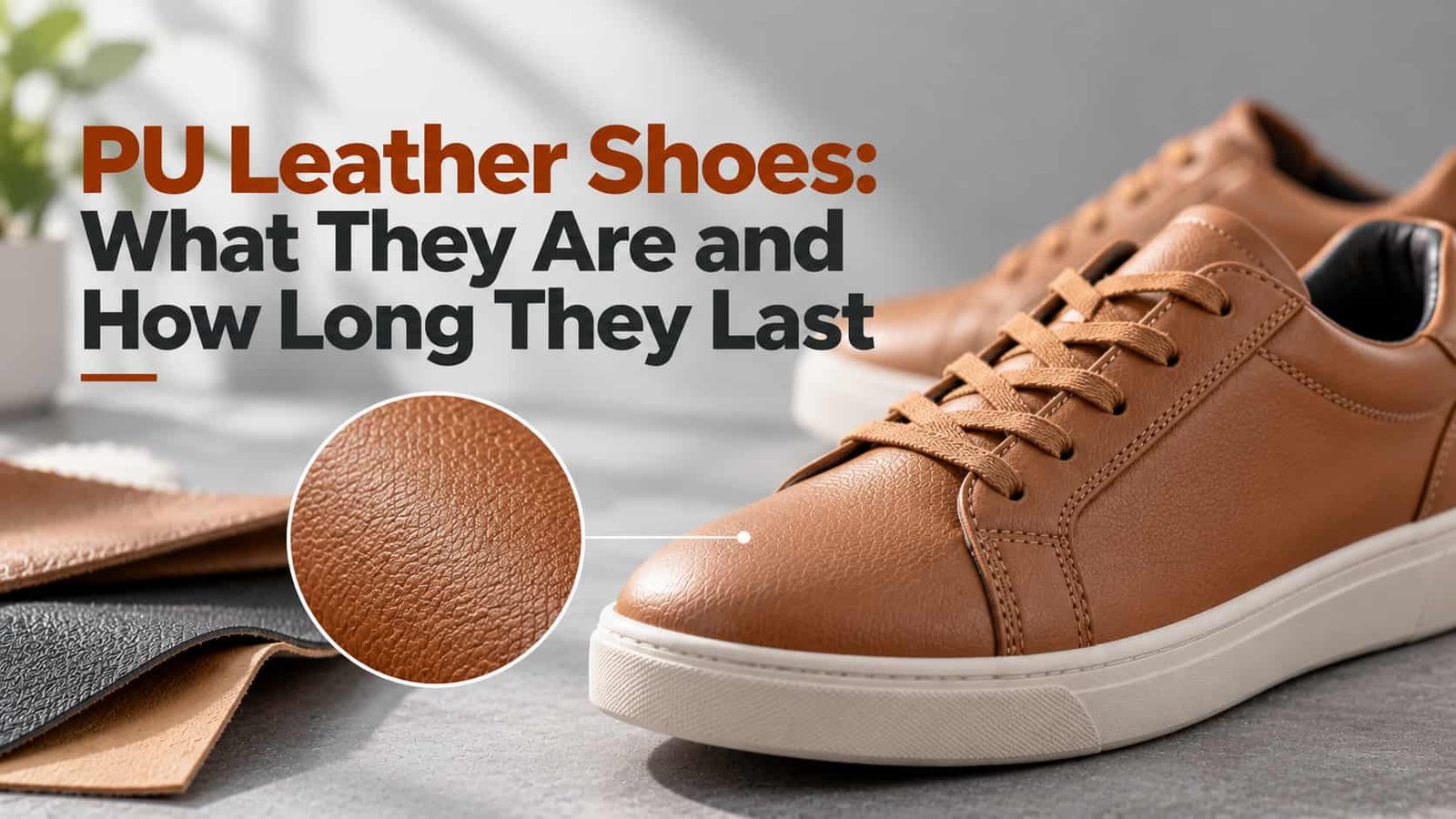
PU leather is a synthetic material made by coating a fabric or textile base with polyurethane, a plastic polymer, to imitate the look of real leather. It is usually cheaper, easy to wipe clean and free of animal hide. Its weak points are breathability and durability: the coating can crack, peel or break down over time, especially with heat, moisture and age.
Key Takeaways
- PU leather is a coated synthetic, not real leather. Polyurethane is applied to a fabric or textile backing to give a leather-like surface.
- It is often cheaper and easier to clean. The surface wipes clean and suits budget and vegan footwear.
- It breathes less than real leather. The coating limits airflow, so feet can feel warmer and damper.
- Lifespan depends on the coating and storage. Peeling and cracking are the usual failure points, and heat and humidity speed them up.
- Check the label and the product description. “Synthetic,” “faux” and “vegan” are not all the same as PU.
PU Leather Shoes at a Glance
| Feature | PU leather |
| What it is | Polyurethane coating on a fabric or textile base |
| Animal hide | None |
| Look and feel | Smooth, uniform, often glossy |
| Breathability | Limited by the coating |
| Water | Surface resists light wet, but water can get in at seams |
| Durability | Varies; coating can peel or crack |
| Cost | Usually lower than real leather |
| Care | Wipe clean, gentle cleaning, dry away from heat |
| Typical use | Budget, fashion, vegan and everyday shoes |
These are general tendencies. Quality varies a lot between makers, so check each pair’s material breakdown.
What PU Leather Is
PU stands for polyurethane, a plastic polymer. In shoes, PU leather is a fabric or textile base coated with a polyurethane layer that is embossed or finished to look like grain leather. It is a form of synthetic leather, sometimes called faux leather or artificial leather.
The name can cause confusion. “PU” tells you the coating is polyurethane, but it does not tell you how thick the coating is, what the base fabric is, or how well it was bonded. Two PU shoes can perform very differently.
For the broader material picture, the shoe materials guide places PU alongside real leather, textiles and other synthetics.
How PU Leather Is Made
Manufacturers usually start with a fabric base, often a knitted or non-woven textile. A polyurethane mix is spread over the base as one or more layers. The coating is then cured, textured or embossed to imitate the grain of leather, and finished with colour.
The base and the coating both matter. A thin coating on a loose base is more likely to peel. A thicker, well-bonded coating on a firm base tends to last longer. The exact processes vary by maker, so treat this as a general outline.
PU Leather Compared with Real Leather
| Feature | PU leather | Real leather |
| Material | Polyurethane coating on fabric | Animal hide |
| Look | Uniform, consistent | Natural variation |
| Breathability | Lower | Generally higher, depends on finish |
| Cost | Usually lower | Usually higher |
| Repair | Limited; peeling is hard to fix | Can often be conditioned and resoled |
| Wear pattern | Coating cracks or peels | Creases soften, surface ages |
| Care | Wipe, gentle clean | Condition and polish |
Real leather is generally more breathable and repairable, and it develops a patina over time. PU is easier to keep uniform and usually cheaper. Neither is automatically better. The right choice depends on your budget, how long you want the shoes to last, and whether you need a vegan option.
For how real leather grades differ, see full grain vs top grain.
Comfort and Breathability
PU leather is comfortable from the first wear in many cases, because the surface is smooth and the coating is often flexible. Some PU uppers are stiffer than real leather, so check the flex at the vamp.
Breathability is the main drawback. The coating limits airflow, so feet can feel warmer and damper, especially in heat or during long days. A breathable lining and an open insole help, but the upper itself will usually breathe less than an open knit or real leather.
This is an editorial judgment based on how coated materials behave. It is not a standardised test result.
How Long PU Leather Lasts
There is no reliable fixed lifespan for PU leather shoes. Durability depends on the coating thickness, the bonding to the base, the sole construction, how often the shoes are worn, and how they are stored.
The coating is the most common failure point. It can crack at the flex points, such as the vamp and the toe box, and it can peel away from the base. Heat, humidity and age can make the coating brittle over time, even when the shoes are not worn much.
Sole construction matters too. A glued sole on a PU shoe often cannot be resoled, so the whole pair can reach the end of its life sooner. A stitched or cemented sole with a durable outsole gives more options for repair.
Why PU Leather Peels and Cracks
Peeling and cracking are the most common complaints about PU shoes. They happen for a few reasons:
- Flex points. Repeated bending stresses the coating where the shoe creases.
- Heat and dryness. Heat and very dry conditions can make the coating brittle.
- Humidity and age. Moisture and time can cause hydrolysis in polyurethane, weakening the coating.
- Poor bonding. A weak bond between coating and base is more likely to fail.
- Storage. Shoes left in hot cars, damp cupboards or stacked in plastic can deteriorate faster.
Once a PU coating has cracked or peeled, it usually cannot be fully restored. Light surface repairs may help in some cases, which is covered in our guide on how to fix peeling shoes.
Water and Weather
The PU surface resists light wet better than suede or nubuck, and it wipes clean easily. That makes it practical for everyday use on mixed days.
PU is not waterproof, though. Water can get in at seams, stitching and cut edges, and repeated soaking can damage the coating. Hot weather and direct heat can also soften or crack the surface.
If PU shoes get wet, wipe off the water with a dry cloth, stuff them with paper to hold their shape, and let them dry at room temperature, away from radiators and direct sun. For background on membranes and treatments, see how waterproof shoes work.
Pros and Cons
What PU leather does well
- Lower price than real leather
- Smooth, uniform look that suits fashion and formal styles
- Easy to wipe clean
- Vegan and free of animal hide
- Resists light surface wet better than suede
Where PU leather struggles
- Breathes less than real leather
- Coating can crack, peel or break down over time
- Hard to repair once the coating fails
- Can feel warmer and damper in heat
- Quality varies widely between makers
How to Tell PU from Real Leather
Use these checks before you buy. None is conclusive alone, so combine them.
- Read the material information. Look for “PU,” “polyurethane,” “synthetic” or “faux” on the label or product page. Some brands say “vegan” without naming the material, so check.
- Check the edges. Real leather often shows a fibrous cut edge. PU usually shows a fabric backing or a smooth, uniform layer.
- Look at the grain. A perfectly regular, repeated pattern suggests an embossed coating rather than natural grain.
- Smell it. PU often smells of plastic or chemicals when new, while real leather has a more natural smell.
- Flex it. Real leather creases softly and recovers. PU can show sharper creases that stay.
Be careful with the terms used in marketing. “Genuine leather” may still be a lower split layer, and “vegan leather” can be PU or another material. For the wider leather question, see what is genuine leather.
Caring for PU Leather Shoes
PU care is gentle. The aim is to keep the coating flexible and avoid harsh products that can strip the surface.
- Wipe after wear. Use a soft, dry cloth to remove dust.
- Clean marks gently. Use a damp cloth with a little mild soap, then wipe dry.
- Dry slowly. Let the shoes dry at room temperature, away from heat and direct sun.
- Store carefully. Keep the shoes in a cool, dry place, ideally with shoe trees, and avoid hot cars.
- Rotate your shoes. Resting a pair lets the coating recover from repeated flexing.
Avoid alcohol, acetone, bleach, strong solvents and heat sources. These can damage the coating and cause peeling. For full steps, see how to clean faux leather shoes. For wider routines across materials, see how to clean shoes and maintain them.
Who Should Choose PU Leather
| Your situation | PU may suit you if | Consider real leather if |
| Budget | You want a leather look at a lower price | You want a shoe that can be resoled |
| Vegan choice | You prefer no animal hide | You want natural leather |
| Use | You need shoes for occasional or fashion wear | You need shoes for heavy daily use |
| Climate | Your weather is mild or dry | You live somewhere hot and humid |
| Care | You want easy wipe-clean upkeep | You are happy to condition and polish |
| Longevity | You accept a shorter lifespan for a lower price | You want to keep shoes for years |
For help narrowing options by use and style, the shoe finder is a useful next step. If you want a vegan option with other materials, see vegan shoes.
Myths Worth Dropping
- “PU leather is real leather.” It is a synthetic coating on a fabric base.
- “PU is always cheap quality.” Quality varies. A well-made PU shoe can be fine for the right use.
- “PU lasts as long as real leather.” Lifespan is usually shorter, mainly because the coating can crack or peel.
- “PU is waterproof because it wipes clean.” It resists surface wet, but water can still get in at seams.
- “Vegan always means PU.” Vegan shoes may use PU, but they can also use other materials, so check.
Frequently Asked Questions
What is PU leather?
PU leather is a synthetic material made by coating a fabric base with polyurethane. It is designed to look like real leather and is often used in budget, fashion and vegan shoes.
Is PU leather real leather?
No. PU leather is synthetic. It has no animal hide in its structure, though it is made to imitate the look of real leather.
Is PU leather durable?
It can last for a reasonable time with gentle use, but the coating is the weak point. It can crack, peel or break down, especially with heat, moisture and age. Real leather is usually more repairable.
Is PU leather better than real leather?
Not in every way. PU is usually cheaper, uniform and easy to wipe clean, and it is vegan. Real leather is usually more breathable, repairable and long-lasting, and it develops a patina.
Why does PU leather peel?
The coating can separate from the base, often at flex points, after repeated bending, heat, humidity or age. A weak bond or thin coating makes peeling more likely.
How long do PU leather shoes last?
There is no reliable fixed lifespan. It depends on the coating, bonding, sole construction, use and storage. Peeling and cracking are the usual reasons PU shoes wear out.
Is PU leather waterproof?
No. The surface resists light wet, but water can get in at seams and stitching, and repeated soaking can damage the coating.
How do I clean PU leather shoes?
Wipe with a soft, dry cloth, clean marks with a damp cloth and a little mild soap, then wipe dry. Let the shoes air dry away from heat, and avoid alcohol, acetone and bleach.
Final Thoughts
PU leather is a polyurethane coating on a fabric base, made to imitate real leather. It is usually cheaper, easy to clean and vegan, but it breathes less and its coating can crack or peel over time. It suits budget, fashion and occasional wear, and it is a poorer choice for shoes you want to keep for years.
Before buying, read the material information, check the construction and the sole, and be honest about how you will use the shoes. For the wider picture, start with the shoe materials guide.
External References
- Wikipedia, “Polyurethane” (the polymer used in the coating): en.wikipedia.org/wiki/Polyurethane
- Wikipedia, “Artificial leather” (definition of synthetic leather): en.wikipedia.org/wiki/Artificial_leather
- Federal Trade Commission, Guides for Select Leather and Imitation Leather Products (16 CFR Part 24): ecfr.gov (16 CFR Part 24)


