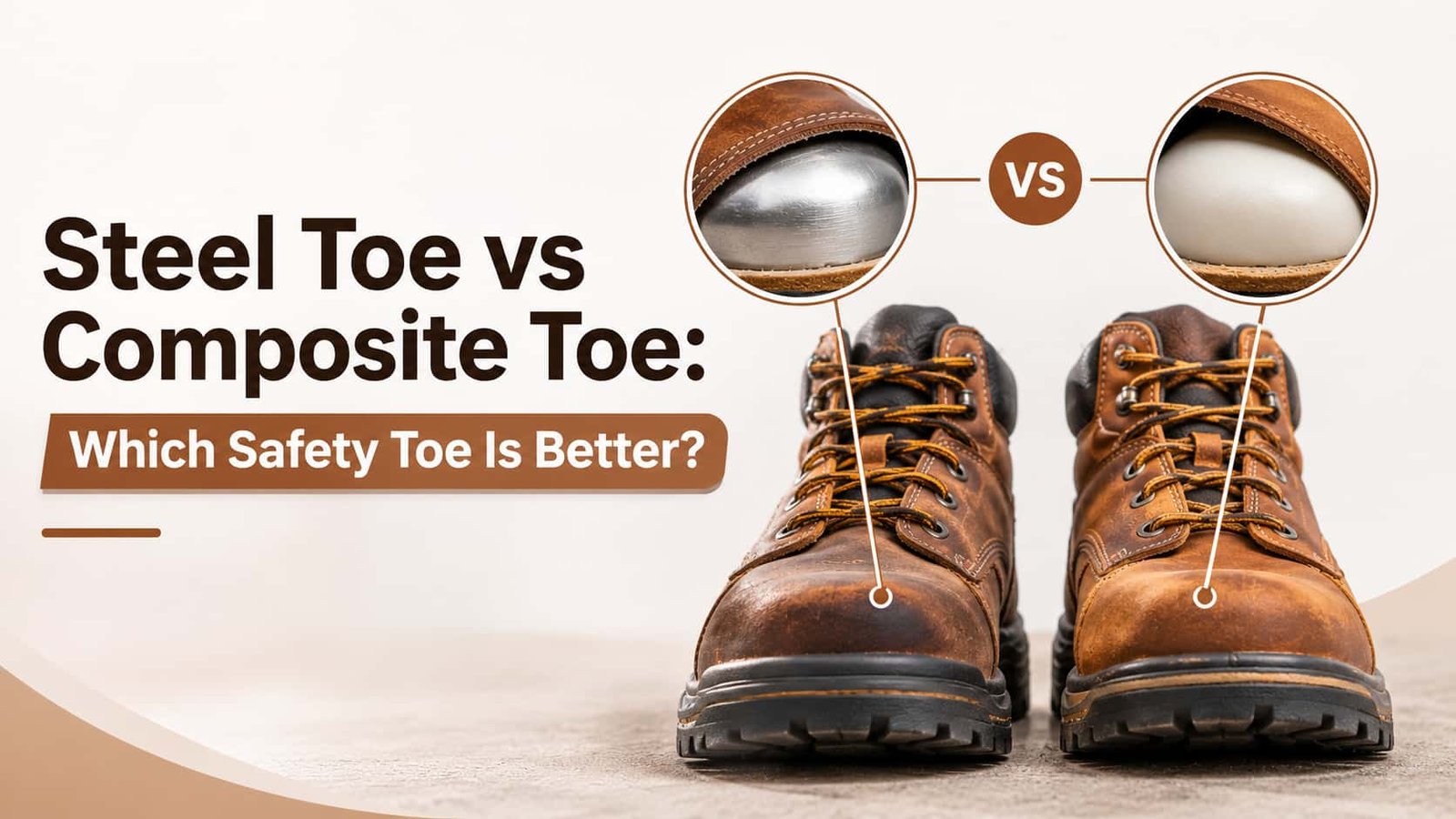
Steel Toe vs Composite Toe: Which Safety Toe Is Better?
Summarise this safety toe guide with AI
Open an assistant and submit the prefilled request. The assistant reads the page only after you submit it.
Quick answer: Neither toe is better in every case. Steel toes are often the lowest-cost option and handle heavy impacts well, but they conduct cold and heat and set off metal detectors. Composite toes are non-metallic, usually lighter, and clear most metal detectors, but they cost more and are bulkier. Both must pass the same ASTM F2413 impact and compression tests to be sold as safety footwear in the United States. Your work environment should decide the choice.
Key takeaways
- Steel, composite and alloy toe caps must all meet the same ASTM F2413 impact and compression ratings for safety footwear sold in the United States. The label on the boot matters more than the material name.
- Steel toes are usually the most affordable and have a long track record, but they conduct temperature and set off metal detectors.
- Composite toes are non-metallic, which helps at airport or courthouse screening points and in some electrical work, but they are often bulkier and cost more.
- Weight differences between the two vary by boot, so compare actual boot weights rather than assuming one type is always much lighter.
- Metal components elsewhere in the boot, such as shanks and eyelets, can still trigger detectors, so a “composite” label does not guarantee a clear pass.
- Check the ASTM label, the electrical hazard rating if you need one, and the fit before buying.
What the Two Toe Types Actually Are
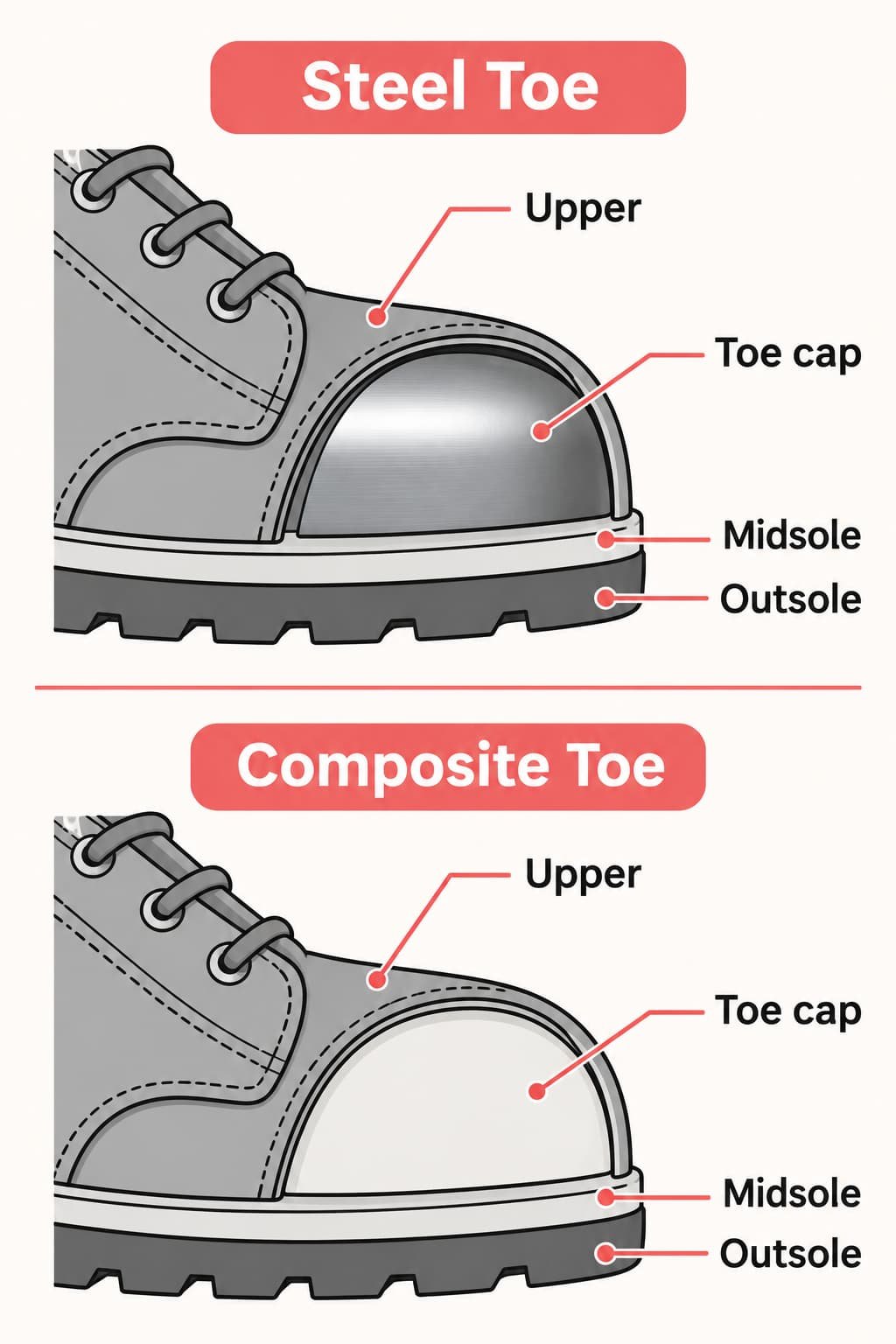
A safety toe is a reinforced cap built into the toe box of a boot or shoe. Its job is to protect the toes from falling or rolling objects and from compression, such as a foot pinned under a heavy load. The cap sits above the toes inside the shoe, so it is not visible from outside unless you look at the lining or the tongue.
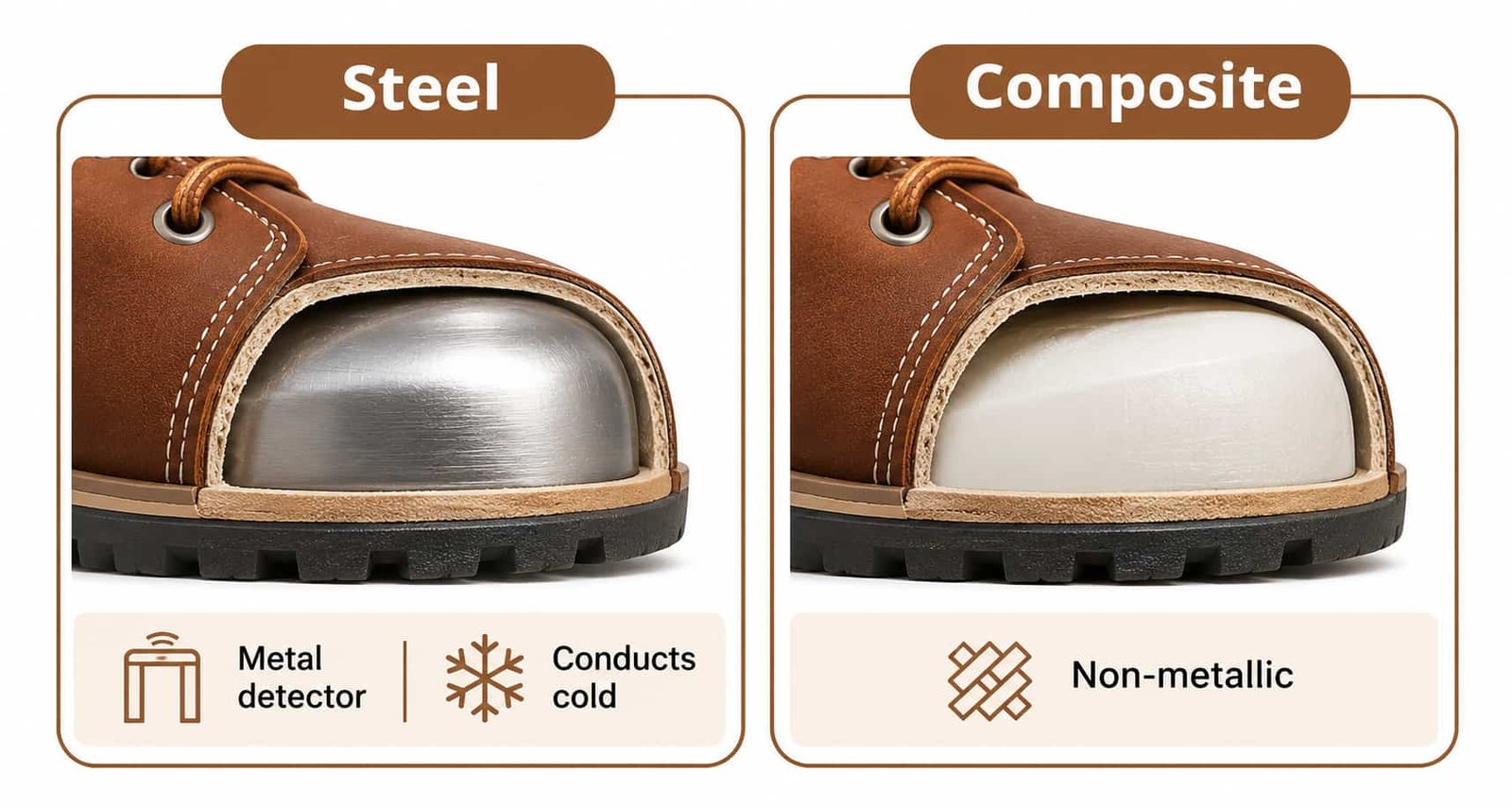
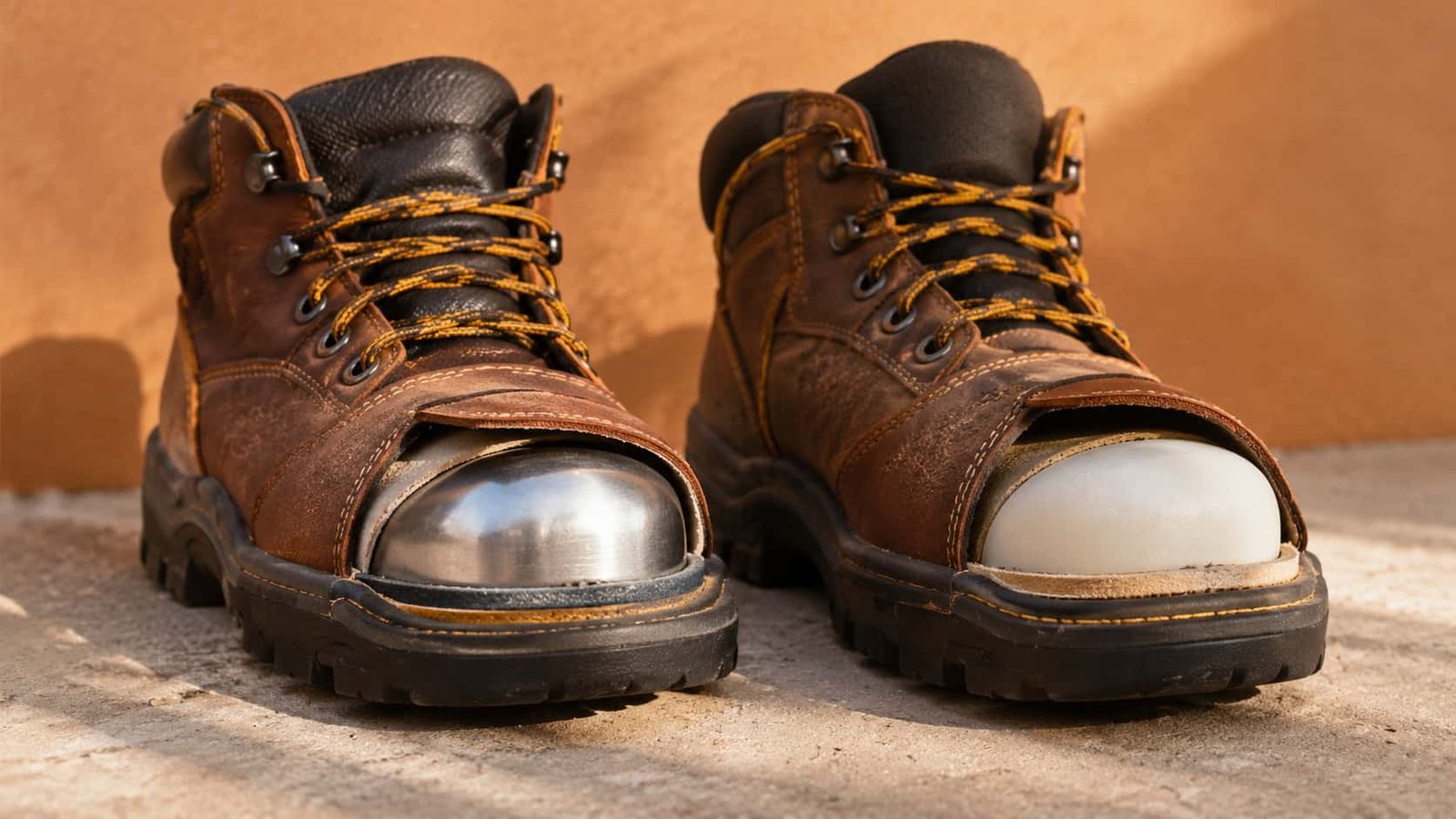
A steel toe is a formed shell of metal, usually carbon steel. It has been used in work footwear for decades and is the traditional standard. Steel is dense and strong, which allows a relatively thin cap to meet high impact ratings.
A composite toe is made from non-metallic materials. Manufacturers commonly use fiberglass, carbon fiber, Kevlar, plastic or a blend of these. The cap is typically moulded rather than stamped, and it is designed to deliver the same protection level as steel while avoiding metal’s conductivity.
The term alloy toe appears in many buying guides, and it is worth mentioning because it is often compared alongside the other two. Alloy toes are made from lightweight metals such as aluminium or titanium. They are still metal, so they share some of steel’s limitations, and they are not the subject of this guide.
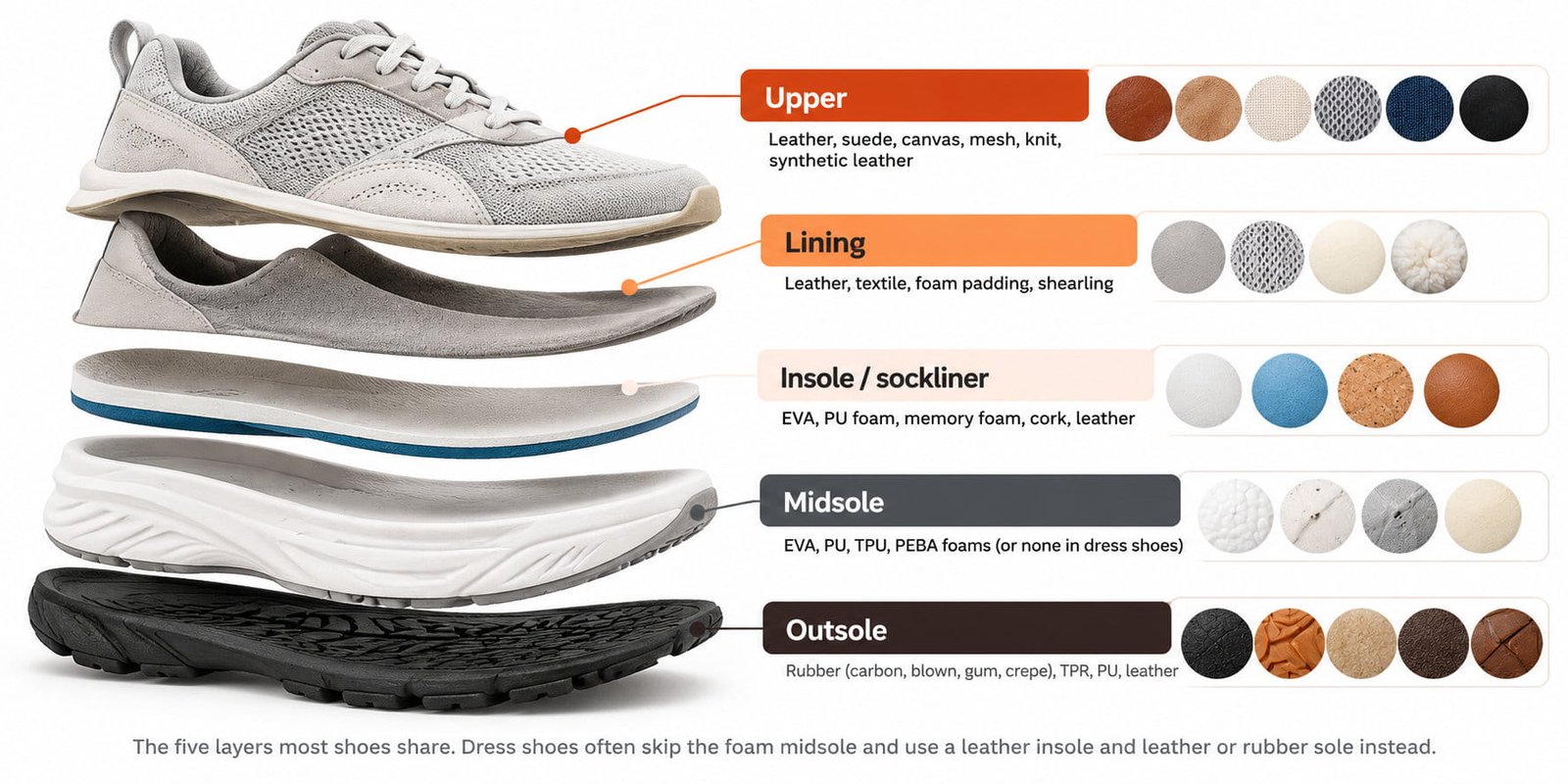
If you are still learning how a boot is built, the shoe anatomy overview explains where the toe box sits in the overall construction, and the guide to insoles, midsoles and outsoles covers the layers beneath the foot.
The Standard Both Toes Must Meet
The most useful fact for buyers is that the material is not what determines whether a toe is protective. The rating is.
In the United States, OSHA’s foot protection standard, 29 CFR 1910.136, requires employers to make sure employees wear protective footwear where there is a danger of foot injuries from falling or rolling objects, objects piercing the sole, or electrical hazards. The standard points to consensus specifications, including ASTM F2412 for test methods and ASTM F2413 for performance requirements. You can read the regulation on the OSHA foot protection standard.
ASTM F2413 is the performance specification most people see on a boot label. It covers impact resistance, compression resistance and, where marked, electrical hazard protection. Footwear meeting the Class 75 level is marked I/75 and C/75. Those markings refer to a 75 foot-pound impact and a compression load of 2,500 pounds, according to the summaries published by several safety suppliers.
The impact test is worth understanding. Keen Utility, a footwear manufacturer, describes the method on its safety toe impact testing explainer. A weight of about 50 pounds is dropped from roughly 18 inches onto the toe, delivering about 75 foot-pounds of force. A piece of clay placed inside the cap is measured afterwards, and the cap passes if the clay is not compressed beyond a set limit. That is a manufacturer’s description of a standard test, so it helps you understand the principle, but you should confirm the exact requirements in the standard itself.
Key implications for buyers:
- A composite toe and a steel toe marked I/75 and C/75 meet the same impact and compression requirement.
- ASTM-compliant safety toes must have built-in, non-removable caps. Removable add-on guards are a different category.
- The label is usually stitched onto the tongue or printed inside the boot. If you cannot find it, do not assume the boot is certified.
One caution is important. OSHA sets the requirements and points to consensus standards. It does not approve individual brands, so a product page that says “OSHA approved” should be read carefully. Look for the ASTM marking on the actual footwear and check the product’s specifications.
Steel Toe: Strengths and Limits
Steel toes have strong advantages, and they remain the default choice in many industries.
Strengths:
- Proven track record. Steel toe caps have been used in footwear for many decades, and workers and employers know how they perform.
- Strong impact resistance for thin profiles. Steel is dense, so a relatively slim cap can meet high ratings.
- Lower cost in many cases. Steel toe boots are often the most affordable option at a given price point, though prices vary widely by brand and construction.
- Generous toe room. Some buyers find steel caps leave slightly more room in the toe box than bulkier composite caps.
Limits:
- Heavier. Steel adds weight, which accumulates over a long shift.
- Conducts temperature. Steel transfers cold in winter and heat in summer directly to the toes. Workers in cold storage, foundries or outdoor winter jobs notice this most.
- Conducts electricity. A steel cap can create a conduction path in electrical work. Electrical hazard protection depends on the whole boot, but steel toes are generally not used where the toe itself must be non-conductive.
- Triggers metal detectors. Anyone who passes through airports, courthouses, secure facilities or some retail loss-prevention systems will set off the alarm.
- Can be damaged by severe impact. Dents in a steel cap may alter its protective clearance, which is one reason to replace a boot after a serious impact.
Steel is a sensible choice for heavy construction, general industrial work and anywhere that metal detectors are not a factor and temperature is moderate. It is less suitable for workers who must pass through screening every shift or who handle live electrical systems.
Composite Toe: Strengths and Limits
Composite toes were developed to address the main complaints about steel: weight, temperature conductivity and metal detection. Their strengths reflect those goals.
Strengths:
- Non-metallic. Composite caps do not set off most metal detectors on their own, which is why airport, courthouse and secure-facility workers often choose them.
- Does not conduct heat or cold. Composite caps insulate better than steel, making them more comfortable in cold storage, outdoor winter work and hot environments.
- Suitable for electrical work. Because the cap contains no metal, composite toes help in electrical environments. The boot still needs an electrical hazard rating if that protection is required.
- Often lighter. Composite caps are commonly lighter than steel, though the size of the difference varies by design.
Limits:
- Often bulkier. Some composite caps take up more space in the toe box, which can affect fit in narrow boots.
- Usually more expensive. Composite boots often cost more than steel equivalents, though not always.
- Durability depends on material and use. Some composite caps handle abrasive environments well, while others may wear differently. Check the specific product for guidance on the environments it is built for.
- Damage visibility. A steel cap that is dented is easy to see. A composite cap that has cracked or deformed internally may not be obvious from the outside, which is why any boot that has taken a heavy impact should be inspected and replaced when in doubt.
Composite is the better fit for workers who pass through metal detectors, handle live electrical systems, or work in extreme temperatures. Its bulk and price are the main reasons some buyers stay with steel.
Side-by-Side Comparison
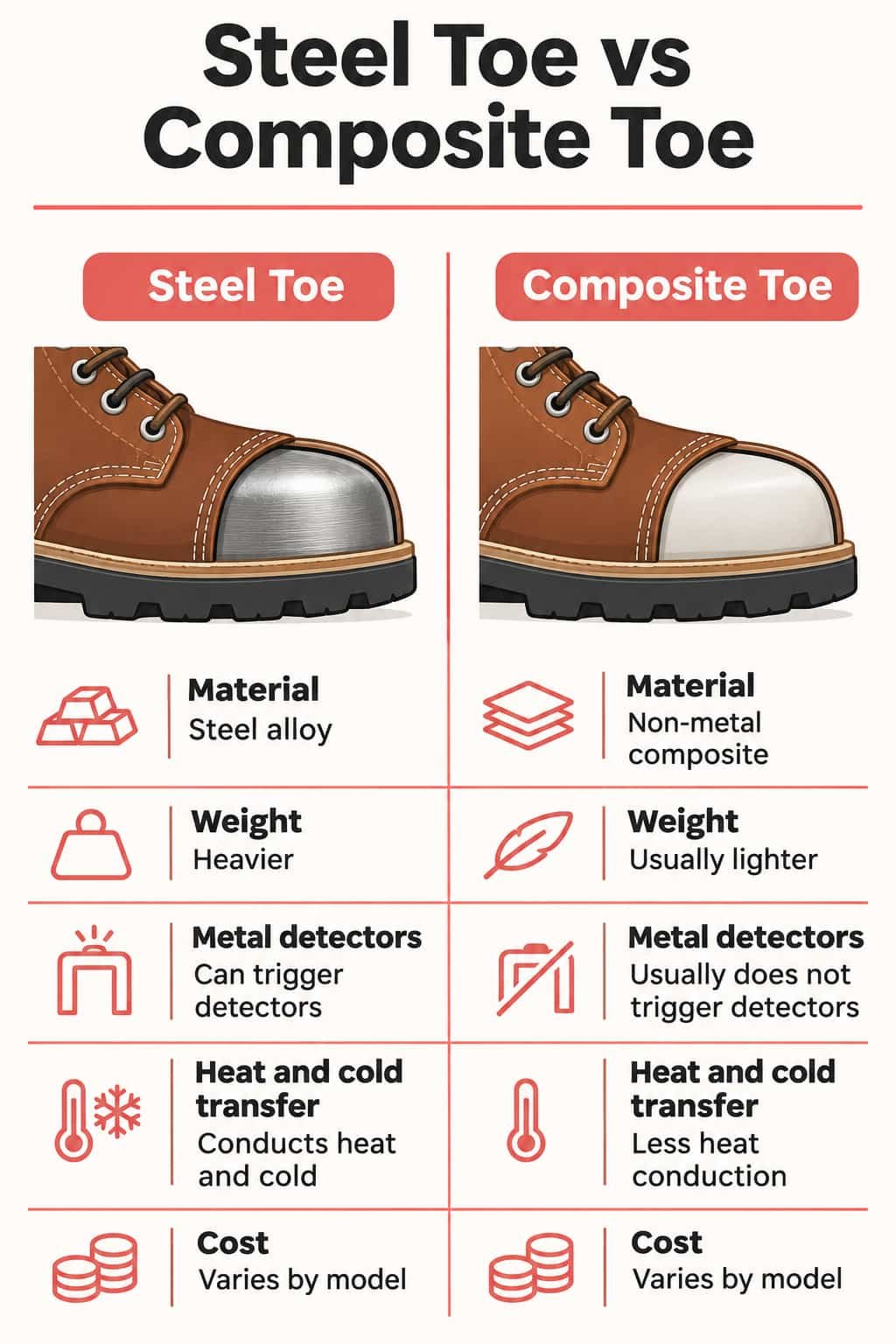
Both toe types must meet the same ASTM F2413 impact and compression requirements. The table below focuses on the differences that affect daily use.
| Factor | Steel toe | Composite toe |
|---|---|---|
| Cap material | Carbon steel | Fiberglass, carbon fiber, Kevlar, plastic or blends |
| Impact and compression rating | Can meet ASTM F2413 I/75 and C/75 | Can meet ASTM F2413 I/75 and C/75 |
| Metal detector clearance | Usually sets off detectors | Usually clears detectors, but other metal parts may not |
| Temperature conduction | Conducts cold and heat | Does not conduct cold or heat significantly |
| Electrical conduction | Conductive cap | Non-metallic cap, supporting electrical hazard work when rated |
| Weight | Heavier in many designs | Often lighter, varies by boot |
| Toe box room | Often slimmer caps, more room in some designs | Can be bulkier, check fit |
| Typical price | Often lower at equivalent quality | Often higher, varies by brand |
| Best suited to | Heavy industrial work and moderate-temperature sites without screening | Screening points, electrical work, temperature extremes, long shifts on hard floors |
The table does not declare a winner because there is none across all jobs. Read it as a set of trade-offs. The right row for you depends on where you work and what you carry through the day.
Where Each Toe Fits
Choosing between steel and composite is easier once you identify the single most important hazard at your workplace. Here are common scenarios.
Construction and heavy industrial sites. Steel is a strong and cost-effective choice where heavy falling objects are the main risk and temperatures are moderate. Many crews have used steel for years, and replacement stock is widely available.
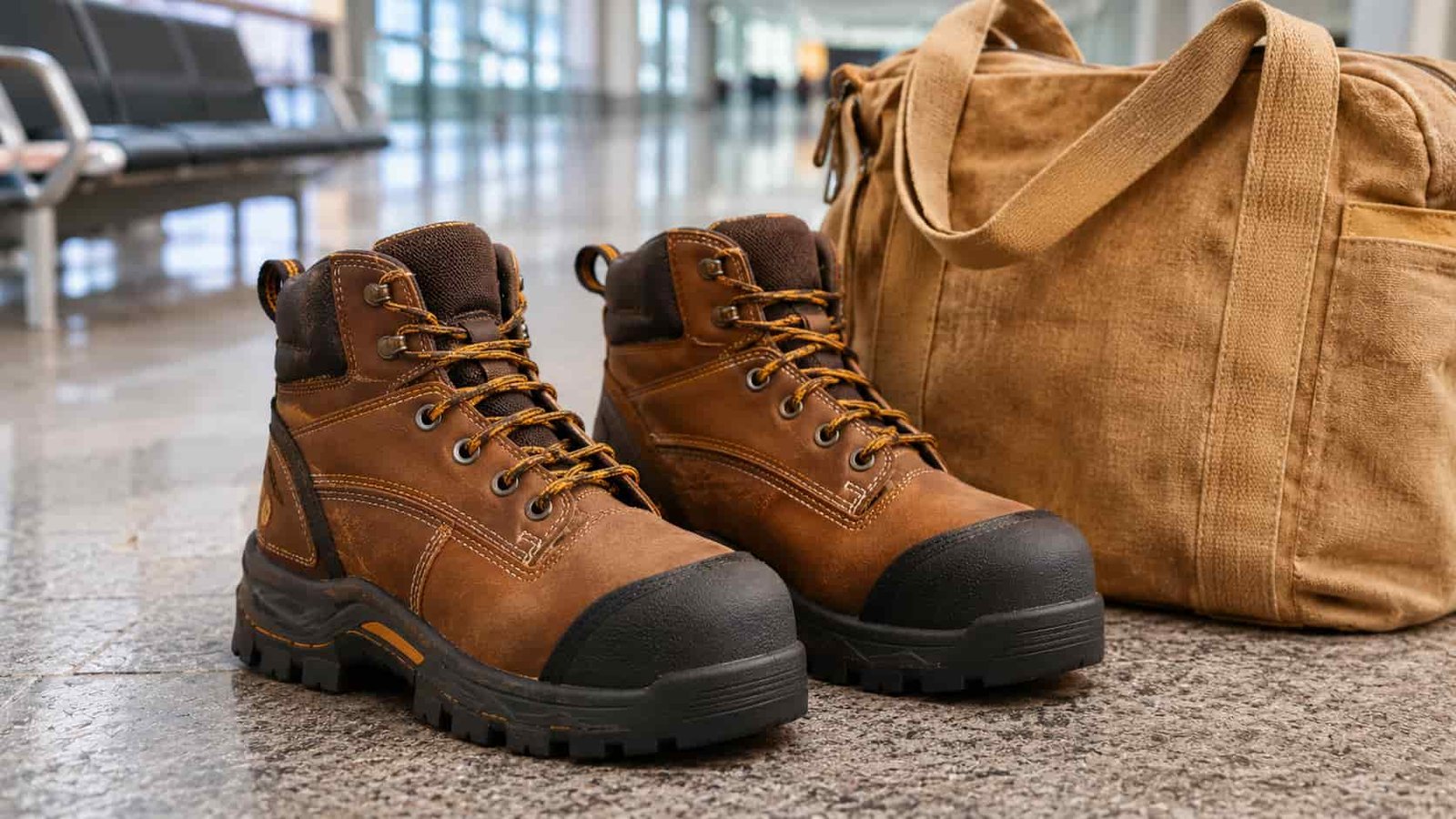
Airports, courthouses and secure facilities. Composite is usually the practical choice. Workers who pass through metal detectors multiple times a day avoid repeated delays when the boot clears the screening point. Check the whole boot, because shanks, eyelets and other hardware can still trigger alarms.
Electrical and utility work. Composite is often preferred because it contains no metal cap. Electrical hazard protection is a separate rating, so confirm that the boot carries the EH marking and matches your site’s requirements.
Cold storage, outdoor winter work and foundries. Composite caps help keep toes warmer in cold conditions because they do not conduct temperature as steel does. In hot environments, composite also avoids the transfer of heat through the cap. Foundry and welding environments need additional heat-resistant features beyond the toe, so check the outsole and upper ratings too.
Long shifts on hard floors. Workers who walk on concrete all day often say that lighter boots reduce fatigue. Composite may help here, but the weight of the whole boot, the midsole and the fit matter at least as much as the cap.
Light manufacturing and warehouse work. Either toe can work. Steel may be cheaper for the same level of protection, while composite may be preferred if the site has screening or temperature concerns.
Fictional example: Marcus, an electrician who works in the Short North neighbourhood of Columbus, Ohio, moves between commercial building sites and a city substation. He spends much of his day near live wiring, and his supervisor requires non-conductive protection. Steel was the easy default, but a composite boot with the electrical hazard marking suited his work better. He chose it for the non-conductive construction, then checked the label before buying. This scenario is illustrative and not based on a real person.
Weight, Comfort and Fatigue
Weight is one of the most common reasons people switch from steel to composite. The claim is often made in general terms, but the actual difference varies by boot.
Some safety guides describe composite caps as only slightly lighter than steel, sometimes a matter of grams for the cap itself. Others describe a more noticeable difference across the whole boot. Both descriptions can be correct depending on the design, so the most reliable approach is to compare the listed weight of specific boots in the same size, rather than relying on the cap material alone.
Comfort involves more than weight. Consider these factors:
- Toe box shape. A bulkier cap can press on the toes if the box is narrow. Try boots on and wiggle your toes.
- Heel lock. The heel should stay in place without the forefoot squeezing.
- Insole and midsole. Cushioning and support often have more effect on long-shift comfort than the cap.
- Socks. Test boots with the socks you plan to wear on the job.
If you want to understand how cushioning materials differ, the EVA foam explainer covers one common midsole material, and the running shoe foam guide explains how foams are compared more generally.
Electrical Hazards and Metal Detectors
These two concerns are often mixed up, so it helps to separate them.
Electrical hazard protection refers to the boot’s ability to resist the passage of electrical current through the footwear to the ground. It is marked as EH on ASTM-compliant footwear. OSHA’s guidance notes that electrical hazard, safety-toe shoes are non-conductive and prevent the wearer’s feet from completing an electrical circuit to the ground. OSHA also cautions that these protections can be compromised if the soles are worn through or metal particles become embedded in the sole or heel. Electrical hazard protection is a property of the whole boot, not only the toe cap.
Metal detector clearance depends on whether the boot contains metal. A composite toe with no metal shank or eyelets will usually pass a detector. Steel toes will set it off. Some boots carry metal shanks in the midsole or metal hardware in the lacing, and those components can trigger alarms even when the toe is composite. Check the construction details before assuming a clear pass.
Non-conductive protection and metal-free construction are related but not identical. A boot can have a composite cap and still lack EH protection, and a boot with EH protection can contain some metal in the construction. The label tells you what the boot is rated for.
If you work around electricity, follow your employer’s requirements and the markings on the boot. Do not assume a composite cap alone makes a boot safe for electrical work.
Durability After Impact
Durability is a question of two kinds: how the cap holds up over years of normal wear, and how it responds after a serious impact.
Over normal use, the sole and upper usually wear out before the cap does. Abrasion from concrete, mud and chemicals affects the outside of the boot first. Composite caps may be less affected by moisture and corrosion than steel, which can rust if the boot is repeatedly wet and not dried properly. Steel’s corrosion risk depends on the coating and the environment.
After a severe impact, the picture changes. A steel cap that has been dented may no longer provide its original clearance, and the dent is usually visible. Composite caps can suffer internal damage that is not obvious from the outside. Several safety suppliers recommend replacing any boot that has taken a heavy blow to the toe, regardless of how it looks, and that is sound editorial guidance because you cannot always see the cap’s condition.
Follow your employer’s policy for inspection and replacement. Many workplaces have written procedures for damaged PPE, and those procedures should take precedence over general advice.
The guide to how long running shoes last covers wear signs in athletic footwear, and many of the same principles, such as checking for sole separation and uneven wear, apply to work boots.
A Practical Decision Guide
Use this sequence to narrow your choice.
- Start with the rules. Check whether your employer or site requires a specific rating, such as I/75, C/75 or EH. If the requirement is specific, that is your starting point.
- Identify your main hazard. Is it falling objects, electricity, temperature, metal detectors or long hours on concrete? The dominant hazard usually points to one toe type.
- Check the screening situation. If you pass metal detectors daily, composite is usually the practical choice, but confirm the whole boot is free of metal parts that would trigger the alarm.
- Compare weight and fit. Try boots on in the afternoon, when feet are slightly swollen, and wear your work socks.
- Set a budget that includes replacement. A cheaper boot that must be replaced sooner may cost more over time. Consider how long you expect the boot to last in your conditions.
- Confirm the label. Look for the ASTM F2413 marking on the boot before buying.
By reader type:
- Budget-focused buyers in general industrial work: Steel is often the most economical route to a certified safety toe.
- Electricians and utility workers: Composite with the EH marking is commonly preferred, provided the boot meets site requirements.
- Airport, courthouse and security staff: Composite, with attention to metal shanks and hardware.
- Cold storage and outdoor winter workers: Composite helps reduce the transfer of cold to the toes.
- Workers focused on all-day comfort on hard floors: Consider composite, but test the whole boot’s weight and fit.
For readers who want to match a boot to a specific activity or environment, the shoe finder tool can help narrow choices by use case before you compare individual products.
We have not lab tested safety boots for this article, and we are not claiming any test results. The recommendations above are editorial judgements based on the standards and the manufacturer and safety-supplier information listed in the sources. Our general approach to evaluating footwear is described on the how we test shoes methodology.
Myths Worth Dropping
Myth: Steel toes offer more protection than composite. Both must meet the same ASTM F2413 impact and compression requirements when marked as safety footwear. The rating on the boot is the measure to use.
Myth: OSHA requires steel toes in certain industries. OSHA requires protective footwear where a foot hazard exists and points to consensus standards for performance. It does not mandate steel for particular trades. Your employer’s hazard assessment determines what is needed.
Myth: A composite toe makes the whole boot metal-free. Shanks, eyelets, screws and other hardware may contain metal even when the toe cap does not. Check the construction.
Myth: Composite toes are always lighter. Many composite caps are lighter, but the difference varies, and the boot’s overall weight depends on the sole, upper and lining as well.
Myth: Electrical protection comes from the toe cap alone. EH protection depends on the whole boot, including the sole, and it can be compromised by wear or embedded metal.
Myth: A boot that looks fine after a heavy blow is still safe. A damaged cap may not show visible signs. Replace the boot when your employer’s policy or a serious impact calls for it.
Caring for and Replacing a Safety Toe
Good care extends the life of the boot and helps the cap keep its protective performance.

Routine care:
- Brush off mud and grit after each shift. Dried debris can abrade the upper and sole.
- Clean the outer surface with a damp cloth and mild soap. Avoid soaking the boot.
- Dry the boot at room temperature. Do not place it near a heater, because heat can warp rubber and degrade adhesives.
- Use boot trees or paper to hold the shape while drying.
- Store boots in a dry, ventilated place away from direct sunlight.
Signs to replace or inspect:
- The toe cap has been struck hard, even if the boot looks intact.
- The sole has separated from the upper or shows deep cracks.
- The electrical hazard sole is worn through or has metal particles embedded in it.
- The toe area has visible deformation or the boot no longer fits securely.
- The boot is no longer clearly marked with the rating it originally carried.
For general shoe care methods that apply to many materials, the shoe cleaning and maintenance guide covers the basics. Remember that work boots often have leather or synthetic uppers with different care needs, so check the manufacturer’s care instructions before using any product.
The rubber shoe sole guide explains how rubber outsoles behave over time, which is relevant for EH soles in particular.
Frequently Asked Questions
Is a composite toe as safe as a steel toe?
When both are marked as ASTM F2413 I/75 and C/75, they meet the same impact and compression requirements. Protection depends on the rating and on whether the boot fits and is in good condition.
Does OSHA approve composite toe boots?
OSHA sets the requirements and points to consensus standards, including ASTM F2413. It does not approve individual brands. Look for the ASTM marking on the boot itself.
Will a composite toe set off a metal detector?
Usually not, because the cap is non-metallic. Metal shanks, eyelets or other hardware can still trigger an alarm, so check the whole boot.
Are composite toes better for electrical work?
They are often preferred because the cap contains no metal. Electrical hazard protection is a separate rating that applies to the whole boot, so look for the EH marking and confirm it meets your site’s requirements.
Which toe type is lighter?
Composite is often lighter, but the difference varies by boot. Compare the weight of specific models in the same size.
Is steel better for heavy construction?
Steel is a strong and widely used option for heavy falling-object hazards, and it is often more affordable. Composite can also meet the same ratings, so the choice depends on site conditions and personal comfort.
What is an alloy toe, and how does it compare?
An alloy toe uses lightweight metals such as aluminium or titanium. It can be lighter and thinner than steel, but it is still metal, so it can set off detectors and conduct heat. It is usually more expensive than steel.
Should I replace a boot after a heavy impact?
Replace or inspect the boot according to your employer’s policy. Even if the outside looks undamaged, the cap may have been affected, so it is safer to replace it when in doubt.
Verdict
Steel toes and composite toes are both legitimate, certified options for safety footwear. The rating on the boot, not the material name, establishes that a toe meets the impact and compression requirements. Once that baseline is met, the choice comes down to your environment.
Steel is often the more economical choice for heavy industrial work and moderate-temperature sites where metal detectors are not a factor. Composite suits people who pass through screening points, handle electrical work, face temperature extremes or spend long shifts on hard floors, provided they check the rest of the boot for metal parts and confirm any electrical rating.
Before you buy, identify your main hazard, check your site’s rules, confirm the ASTM label, try the boot on in the way you will wear it, and consider how the boot will be maintained and replaced. For more on the materials that make up the rest of a boot, start with the shoe materials pillar.
Sources
- Occupational Safety and Health Administration. “1910.136 Foot protection.” https://www.osha.gov/laws-regs/regulations/standardnumber/1910/1910.136
- Occupational Safety and Health Administration standard interpretations for 1910.136, including the wearing of steel-toe shoes by electrical tradesmen and the ANSI compression and impact requirements. https://www.osha.gov/laws-regs/standardinterpretations
- National Institutes of Health, Division of Occupational Health and Safety, “Eye on Safety” newsletter, October 2018, on foot protection and electrical hazard footwear. https://ors.od.nih.gov/sr/dohs/Documents/eye-on-safety-newsletter-2018-october.pdf
- Keen Utility, “Safety Talk: Impact Testing Safety Toe Shoes,” describing the ASTM F2413-18 I/75 and C/75 impact method. https://www.keenfootwear.com/blogs/keen-blog/safety-toe-impact-test-safety-talk