
Danner Boots Sizing Guide: Widths, Lasts and Which Styles Run Long
Most brand size guides start with a conversion table. Danner’s does not, and that is the first thing worth knowing. Danner sells in US sizes, tells you to size by a Brannock device, and puts the real fit information where a table would normally be: in a short “How It Fits” note on each product page, and in a handful of support articles about widths, lasts and break-in. That is more useful than it sounds, because a Danner boot’s fit depends on the last it is built on, and the same US 10 can fit differently in a Mountain Light than in a Mountain 600. This guide gathers what Danner actually says, style by style, explains the width system it uses, and walks through a fit test you can do at home. It does not invent a US to UK or EU table, because Danner does not publish one.
Quick answer: Danner sizes in US sizes using a Brannock device and does not publish a UK or EU conversion chart. Its Mountain Light and Light Revival Jones Canyon pages say the style runs a little long and recommend sizing down a half size. Its Mountain 600 pages say to size down a half size if you are between sizes. Its Super Rain Forest page says the 516 last suits narrower feet and recommends EE for wider feet.
Sizing system
US sizesDanner lists US sizes and recommends a Brannock device.
Width labels
B, D, EE, 3E, 4EDanner names these widths on its extended sizing page.
Half size rule
Style specificSeveral pages say size down half a size. Others do not.
Why Danner Does Not Publish a Size Chart
Danner’s support page on determining your boot size says its products are sized by the Brannock device and listed in US sizes. Its page on converting to US sizing says to take the actual measurements of your foot, in inches, and match them to a US size on a Brannock chart. We looked for a US to UK to EU table, a foot length in centimeters, and a men’s to women’s rule on Danner’s pages and found none. So a table from us would be a guess presented as fact, and we have left it out.
What Danner does say, repeatedly, is that boots are built for their intended use, so sizing can differ by style, and that the “How It Fits” section on each product page is where to look. That is the structure of this guide: first the system Danner uses, then the widths, then the style notes, then a way to test the result.
How Danner Wants You to Measure: The Brannock Device
A Brannock device is the metal foot measuring tool you find in many shoe and boot stores. Danner recommends it because, in its words, it indicates both the length and the width of your foot. That is the right instinct for a brand that sells several widths: a length-only number would leave you guessing on width. Danner’s page points to the Brannock website and to retailers that have one.
If you do not have a device nearby, you can still get most of the way with a measurement at home. Our guide to measuring your foot at home shows how to measure length and width on paper. Treat the result as a starting point for the Brannock chart that Danner links to, not as a replacement, because Danner’s own page says to use the measurements of your foot in inches.
One general point that Danner’s pages do not make: measure both feet, late in the day, standing, and use the larger one. Feet are rarely identical and tend to swell a little by evening, so that is the reading that should decide the size.
Danner Widths: B, D, EE, 3E and 4E Explained
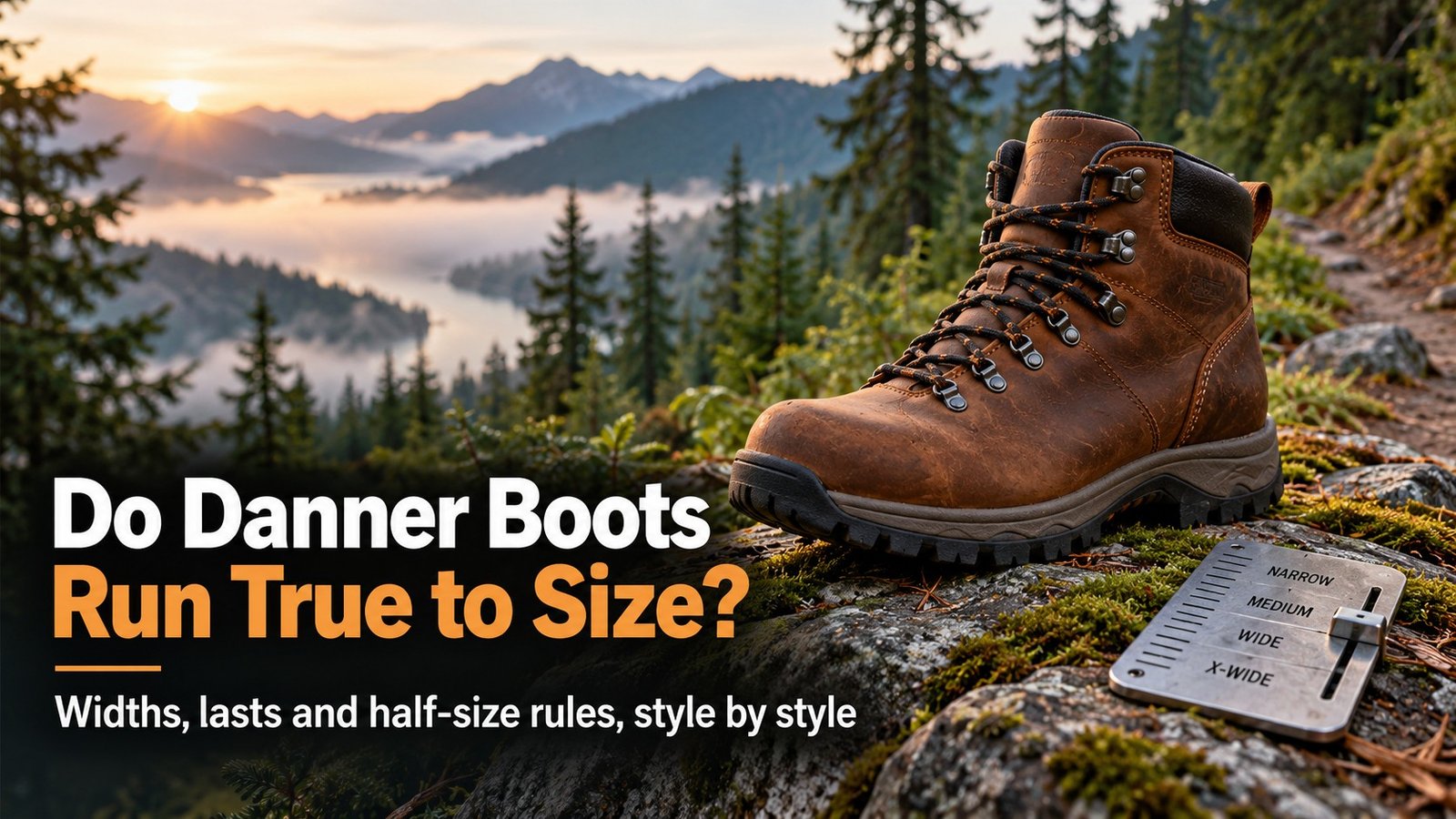
Danner’s extended sizing page is really a width page. It names the standard width as men’s D and women’s M, which is what most of its footwear comes in. Wide is men’s EE, and the page calls it common. Narrow is men’s B, available on several styles, and extra wide comes as 3E or EEE and 4E or EEEE, also on several styles.
| Width | Danner’s label | What Danner says |
|---|---|---|
| Narrow | Men’s B | Offered in several styles |
| Standard | Men’s D and Women’s M | What most Danner footwear comes in |
| Wide | Men’s EE | Also common |
| Extra wide | 3E/EEE and 4E/EEEE | Offered in several styles |
Source: Danner support page on extended sizing. Availability changes by style and color.
To find a style in your size and width, Danner says to use the size and width filters in the men’s or women’s All Footwear category. That filter is the quickest way to avoid falling for a boot that is not made in your width, and we recommend using it before you read reviews, since a review of the wrong width tells you little. For a plain explanation of what each letter means across brands, see our shoe width guide.
Why Some Danner Styles Only Come in EE
This is the width question people ask most, and Danner has a specific answer. Some styles come only in EE, because they were originally built on a narrower last and were redesigned on an EE (wide) last to be more comfortable for everyday wear in town and on the trail. Danner adds that these boots should not feel exceptionally wide on someone with an average width foot. The Mountain Light page says it the other way round: the EE width “is designed to fit an average width foot, similar to a D width.”
The practical meaning is that EE is not always a wide-foot option on these styles. It can simply be the standard fit for that boot. If you wear a D in other brands and are looking at an EE-only Danner, do not assume it will be too wide. Check the style’s How It Fits note, and use the home fit test below to decide. Danner’s wording is still a description from the brand, so the test is the final check.
Style by Style: What Danner’s Fit Notes Say
Here are the fit notes on the Danner product pages we could read. The pages did not list sizes and widths in the content we could read, since those appear in drop-down menus, so use this table for the fit guidance, not for availability.
| Style (page we read) | Last | What Danner says |
|---|---|---|
| Mountain Light, black, GORE-TEX | 650 (EE) | EE is designed to fit an average width foot, similar to a D. Relaxed fit for casual everyday wear. Runs a little long, so size down a half size. |
| Danner Light Revival, Jones Canyon | 650 EE | Same wording: average width foot, similar to D, runs a little long, size down a half size. |
| Super Rain Forest 8, black, composite toe | 516 | Slender profile built around a safety toe. Fits narrow feet better than wider feet. If you have a wider foot, order EE. |
| Mountain 600 4.5 inch, black/khaki (men’s) | DPDX | Low profile for everyday wear, with enough room for comfort. If you are between sizes, size down a half size. |
| Women’s Mountain 600 4.5 inch, brown/red | DPDX | Same DPDX wording: if you are between sizes, size down a half size. |
Source: Danner product pages as read on October 31, 2026. Fit notes can change when Danner updates a style. Check the page for your boot.
Three patterns stand out. First, boots on the 650 last run a little long, and Danner’s answer is to size down a half size. Second, the 516 safety toe last is slender and suits narrower feet, with EE suggested for wider feet. Third, the DPDX last on the Mountain 600 has a half size rule that applies only if you fall between sizes. That is different from “size down” as a blanket instruction, and it matters: someone who sits clearly at one size should not size down.
We did not find a How It Fits note on every Danner style, so for a boot not listed here, use the same approach: read the note on that product page, find the last in the specifications, and compare it to the table.
Should You Size Down a Half Size in Danner Boots?
It depends on the style, and Danner’s pages are clear about that. For the 650 last styles it recommends sizing down a half size, because the boot runs a little long. For the DPDX last it recommends sizing down only if you are between sizes. For the 516 it does not give a length rule. It gives a width rule.
Here is a way to use that. Start with your Brannock size. If the boot is on the 650 last, try the half size smaller. If it is on the DPDX last, stay at your size unless you are between two sizes, in which case try the smaller one. If it is on the 516 last, stay at your size and decide whether you need EE. Then run the fit test below. A half size is a small change, and a size that fits your length but squeezes your width is the wrong boot, not the wrong size. If the smaller size is tight across the ball of the foot, the answer is a wider width, not the bigger length.
These steps are our reading of Danner’s notes. Danner does not publish a single rule for all its boots, and says that sizing can differ by style.
The At-Home Fit Test Danner Recommends
Danner’s New Boots page says to test the fit by wearing your boots inside your house, and describes what to feel for. For hiking and lifestyle boots, they should feel a little snug on the sides right out of the box, which reduces side to side friction. Your toes should not touch the front when you stand with your full weight on one foot. Your heel should not slide up the back noticeably as you walk. Pinching, especially at the big or little toe, suggests you may need a wider width or a larger size. Casual wear may feel a bit roomier overall.
For work and uniform boots, Danner says the toe box should widen slightly to give a stable platform, the boot should match the shape of your foot, and you should feel cushioning and support for long days on your feet.
Wear the socks you will use, stand on a hard floor and walk up and down stairs if you can. A boot that is only a little snug on the sides is behaving as Danner describes. A boot that pinches a toe, or lets your heel lift every step, is the wrong fit and should go back.
Break-In, Stretching and Returns
Danner is open about the fact that new boots can be stiff. Its New Boots page says boots may be slightly stiff or snug out of the box and should relax and soften over a few weeks. It suggests wearing them around the house or on short outings for a couple of hours a day for about a week, and a bit longer for boots with thicker leather or stiffer parts. Conditioner can speed up softening on full-grain leather only. Moleskin or blister pads can protect hot spots, and keeping feet dry helps.
For a persistent tight spot after several weeks, the page says a cobbler or shoe repair shop can stretch a leather boot, and that Danner’s Portland factory store offers the service. A boot stretch is also listed as a recrafting option on the Mountain 600 pages. That helps width, not length, so it does not rescue a boot that is too short or too long.
On returns, the page says that if the fit is wrong after the indoor test you can return new, unused boots bought on Danner.com for a full refund, with free return shipping on US orders. Check the current policy at checkout, since it can change. The reason to test indoors first is simple: a refund only works on unworn boots.
Socks and Insoles
Danner’s page recommends merino wool socks, which wick moisture. It does not say how socks change sizing. A general rule applies here: test with the sock you will actually wear. A thick merino hiking sock takes real room, so a boot that feels perfect with a thin sock can be tight with a cushioned one. The Mountain 600 pages mention an Ortholite footbed. If you wear custom insoles, bring them to the fitting and check that the heel still holds with them in.
Coming From Another Brand
Because Danner does not publish conversions, the best bridge from another brand is a measurement, not a number. If you know your Brannock size, start there. If you only know a size from another brand, read the notes on that brand’s page. We have guides for boot and trail brands whose charts are published, including KEEN, Merrell, SOREL, Dr. Martens and Red Wing. Compare them for context only. Boots built on different lasts will not match by number. For the general conversion between countries, use our US vs UK vs EU conversion guide, but remember that Danner lists US sizes.
What we verified and what Danner does not state
- We read Danner’s support articles on determining boot size, converting to US sizing, extended sizing, EE-only styles, and its New Boots care page, plus the product pages listed in the sources. Danner’s page on boot lasts was not readable.
- Danner does not publish a UK, EU or centimeter table on any page we could read, so we did not make one.
- The fit notes in the style table are Danner’s, shortened. The half size steps in this guide are our reading of them and are labeled as such.
- Sizes and widths available for each style appear in drop-down menus that we could not read, so we do not list them.
Danner Sizing: Common Questions
Do Danner boots run true to size?
Danner does not give one answer. Its Mountain Light and Light Revival pages say the style runs a little long and to size down a half size. Its Mountain 600 pages say to size down a half size if you are between sizes.
Does Danner have a size chart?
Danner lists US sizes and recommends a Brannock device. We did not find a UK, EU or centimeter conversion chart on its pages.
What does EE mean on Danner boots?
EE is Danner’s wide width for men. On some styles it is the only width because the boot was redesigned on an EE last, and Danner says these should not feel exceptionally wide on an average foot.
Should I size down in Danner Mountain Light boots?
The Mountain Light page says the style runs a little long and recommends sizing down a half size.
Should I size down in Danner Mountain 600 boots?
The Mountain 600 pages we read say if you are in between sizes, size down a half size. They do not say to size down for everyone.
What widths does Danner make?
Danner names narrow (men’s B), standard (men’s D, women’s M), wide (men’s EE) and extra wide (3E/EEE and 4E/EEEE) on its extended sizing page. Availability varies by style.
Are Danner Super Rain Forest boots narrow?
The page says the 516 last fits narrow feet better than wider feet and recommends EE for a wider foot.
How long does it take to break in Danner boots?
Danner says boots should relax over a few weeks and suggests wearing them for a couple of hours a day for about a week, longer for thicker leather.
Can Danner boots be stretched?
Danner’s New Boots page says a cobbler can stretch leather boots, and that its Portland factory store offers the service. Some pages list a boot stretch as a recrafting option.
Can I return Danner boots that do not fit?
The New Boots page says new, unused boots bought on Danner.com can be returned for a full refund after the indoor fit test, with free return shipping on US orders. Check the current policy.
Putting It Together: A Danner Sizing Routine
With Danner, the most reliable size guide is the one on the product page. Measure with a Brannock device, check the last and the How It Fits note, choose the width first and the length second, and test the boots indoors before you commit. A half size down is right for some styles and wrong for others, and the fit test will tell you which one you have.
More Boot and Trail Size Guides
Size and fit
Sources
More Brand Size Guides
Every brand sizes a little differently, so check the guide for the exact brand you are buying. If you are not sure of your starting size, use our shoe size conversion chart and calculator to convert between US, UK and EU sizes first, then compare it with the brand charts below.
Running, training and basketball
- Nike size chart
- Jordan sizing guide
- Adidas shoe size guide
- New Balance size chart
- ASICS sizing guide
- Brooks shoe size guide
- HOKA size chart
- Saucony sizing guide
- Mizuno shoe size guide
- Altra size chart
- On sizing guide
- Salomon shoe size guide
- PUMA size chart
- Reebok sizing guide
- Under Armour shoe size guide
- K-Swiss size chart
Lifestyle sneakers and casual shoes
- Skechers sizing guide
- Converse shoe size guide
- Vans size chart
- Veja sizing guide
- Golden Goose shoe size guide
- Allbirds size chart
- HEYDUDE sizing guide
- Steve Madden shoe size guide
Boots and outdoor footwear
- Merrell size chart
- KEEN sizing guide
- LOWA shoe size guide
- Red Wing size chart
- Blundstone sizing guide
- Dr. Martens shoe size guide
- SOREL size chart
- UGG sizing guide
- Hunter shoe size guide