
Shoe Width Explained: Width Letters, Measurements, Charts & How to Find Your Fit
Shoe size is not only about how long your foot is.
Two people can both wear a US men’s size 9 and still need completely different shoes because their feet have different widths. One person may fit comfortably in a standard width, while another may need a wide or extra-wide shoe.
That is why understanding shoe width can be just as important as knowing your shoe length.
Shoe width can be represented by letters such as B, D, E, EE and EEE, by terms such as narrow, regular and wide, or by measurements in millimetres. The system depends on the country, sizing standard and manufacturer.
There is also no single width scale that works perfectly across every brand. A width letter should therefore be treated as part of a particular sizing system rather than a universal measurement.
This guide explains how shoe width works, what the different width letters mean, how to measure your feet, and how to choose the right width when buying shoes.
What Is Shoe Width?
Shoe width describes how much space a shoe provides across the foot, particularly around the forefoot and the widest part of the foot.
It is different from shoe length.
For example, you might see a shoe listed as:
US Men’s 10 D
Here:
- 10 represents the length size.
- D represents the width.
A shoe marked 10 EE has the same nominal length size but provides a wider fit than a 10 D in systems where EE represents a wider width.
However, width letters are not universal. The meaning of a letter depends on the sizing system and the manufacturer.
The Brannock Device, one of the best-known foot-measuring systems in the United States, uses width designations including AAA, AA, A, B, C, D, E, EE and EEE. Brannock also notes that width varies with foot length.
Why Shoe Width Matters
A shoe can be the correct length and still fit poorly if it is too narrow or too wide.
Research into footwear fit has found that width is a significant part of overall fit. A systematic review of footwear studies found that between 63% and 72% of participants were wearing shoes that did not properly accommodate either the length or width of their feet. In one study included in the review, 88% of women were wearing footwear narrower than their feet.
Another study involving 1.2 million 3D foot scans from North America, Europe and Asia found substantial variation in foot dimensions between regions and sexes. The researchers concluded that at least three shoe widths per length class were required to provide a proper fit for 90% of customers.
This helps explain why simply choosing a longer shoe when a shoe feels too narrow is not always a good solution.
A longer shoe may give your toes more space from front to back without providing the additional width your foot actually needs.
Shoe Width Letters Explained
Width letters are used in several footwear sizing systems. The exact meaning can vary by manufacturer, so always check the brand’s own sizing information when available.
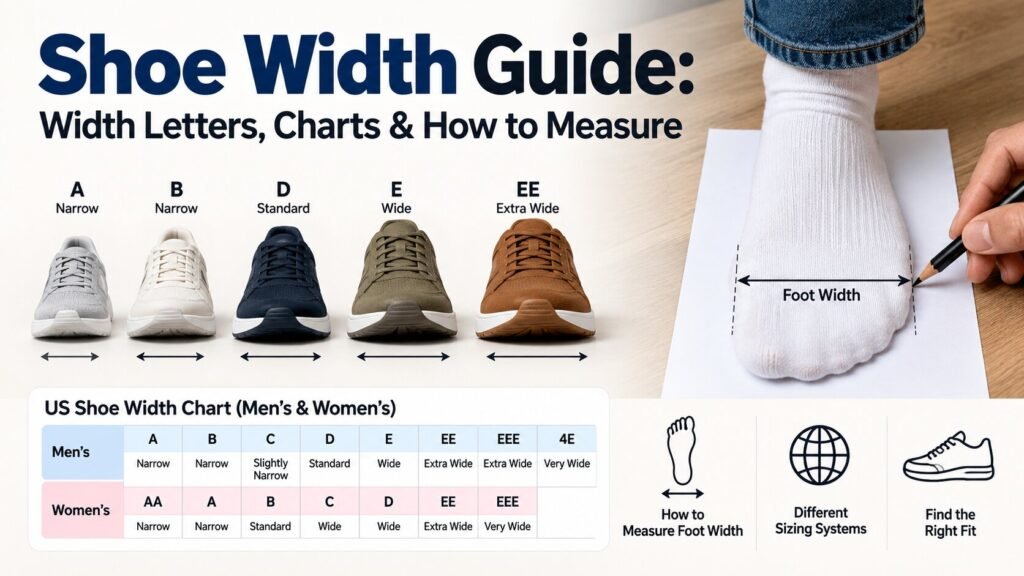
Common US Men’s Shoe Widths
A commonly used US width sequence is:
| Width | Common description |
|---|---|
| AAA | Extra narrow |
| AA | Narrow |
| A | Narrow |
| B | Narrow |
| C | Slightly narrow |
| D | Standard or medium |
| E | Wide |
| EE / 2E | Extra wide |
| EEE / 3E | Extra-extra wide |
| 4E and above | Very wide or extra wide |
These labels are not universal across every manufacturer.
Brannock’s own system includes AAA through EEE, with widths separated by 3/16 inch, although the actual width also varies according to foot length.
Common US Women’s Shoe Widths
Women’s footwear commonly uses a different starting point for standard width.
A simplified representation is:
| Width | Common description |
|---|---|
| AAA | Extra narrow |
| AA | Narrow |
| A | Narrow |
| B | Standard or medium |
| C | Slightly wide |
| D | Wide |
| EE / 2E | Extra wide |
| EEE / 3E | Very wide |
These descriptions should be treated as general guidance rather than a universal conversion system.
For example, a B width in a women’s shoe does not necessarily have the same physical dimensions as a B width in another manufacturer’s range.
Men’s vs Women’s Shoe Width
One of the most common sources of confusion is assuming that the same width letter means exactly the same thing in men’s and women’s footwear.
It does not always work that way.
In many US sizing systems:
- D is commonly used as a standard men’s width.
- B is commonly used as a standard women’s width.
- Wider widths may be identified as 2E, 3E or 4E.
- Narrower widths may use A, AA or AAA.
The actual dimensions depend on the shoe’s length, construction and manufacturer.
This is why comparing the letter alone can be misleading.
What Do D, EE and 2E Mean?
D width
D is commonly used as a standard or medium width in men’s US footwear.
In women’s footwear, D is commonly associated with a wide width.
EE and 2E
EE is often written as 2E.
It generally indicates a wider fit than E or D, depending on the sizing system.
3E and EEE
EEE is often written as 3E and indicates a wider fitting category.
4E
4E is commonly used for very wide footwear.
Some manufacturers offer even wider options, such as 6E.
The important point is that these labels should not be converted into one universal millimetre measurement without considering the shoe’s length and the manufacturer’s sizing system.
Why Width Letters Are Not Universal
There is no single worldwide width scale used by every footwear manufacturer.
A width letter can represent a different physical width depending on:
- Shoe length
- Sizing system
- Manufacturer
- Shoe construction
- Last shape
- Intended use
- Men’s, women’s or children’s footwear
- The measurement method used
Brannock specifically notes that width measurements vary with foot length, while its fitting guidance also explains that manufacturers may use terms such as narrow, wide, regular and extra wide for width categories.
That means you should not assume that an EE shoe from one brand will have exactly the same internal dimensions as an EE shoe from another brand.
Shoe Width vs Foot Width
Your foot width and the internal width of a shoe are not necessarily identical measurements.
Your foot changes shape when you stand and walk, and the shoe also needs enough space to accommodate movement.
Researchers have used different methods to assess foot and footwear width, including direct measurements, foot tracings and footwear measurements. A recent systematic review found that there is still variation in how appropriate footwear width is defined, which is one reason standardized assessment methods remain important.
This is also why a shoe that looks wide externally may not necessarily provide enough usable space inside the forefoot.
What Is Mondopoint Shoe Width?
Mondopoint is different from many traditional shoe-size systems because it is based on measurements of the foot.
ISO 9407:2019 defines Mondopoint as a footwear sizing system based on defined measurements of the foot the footwear is intended to fit. The standard uses measurements in millimetres.
For example, a Mondopoint marking can include foot length and width information.
The advantage of a measurement-based system is that it gives more direct information about the physical dimensions being used to describe the intended fit.
ISO’s footwear vocabulary also defines Mondopoint as a system based on foot length and the linear width of the foot, measured in millimetres.
How to Measure Your Foot Width at Home
You can get a useful estimate of your foot width at home with a piece of paper, a pencil and a ruler.
What you need
- A blank sheet of paper
- A pencil
- A ruler or measuring tape
- The socks you normally wear with the shoes
Step 1: Place your foot on the paper
Stand normally with your weight distributed on the foot.
Do not measure while sitting if you want a measurement that reflects your normal weight-bearing foot.
Step 2: Mark the widest points
Mark the widest points on both sides of your foot.
For most people, this is around the broadest part of the forefoot.
Step 3: Measure the distance
Measure the straight-line distance between the two widest points.
Record the result in millimetres or centimetres.
Step 4: Measure both feet
Do not assume your left and right feet are identical.
Measure both feet and record both measurements.
Step 5: Compare the measurement with the brand’s chart
This is the most important step.
Your measurement alone does not automatically tell you whether you need a D, E, EE or another width.
Compare your measurement with the specific shoe manufacturer’s size and width chart.
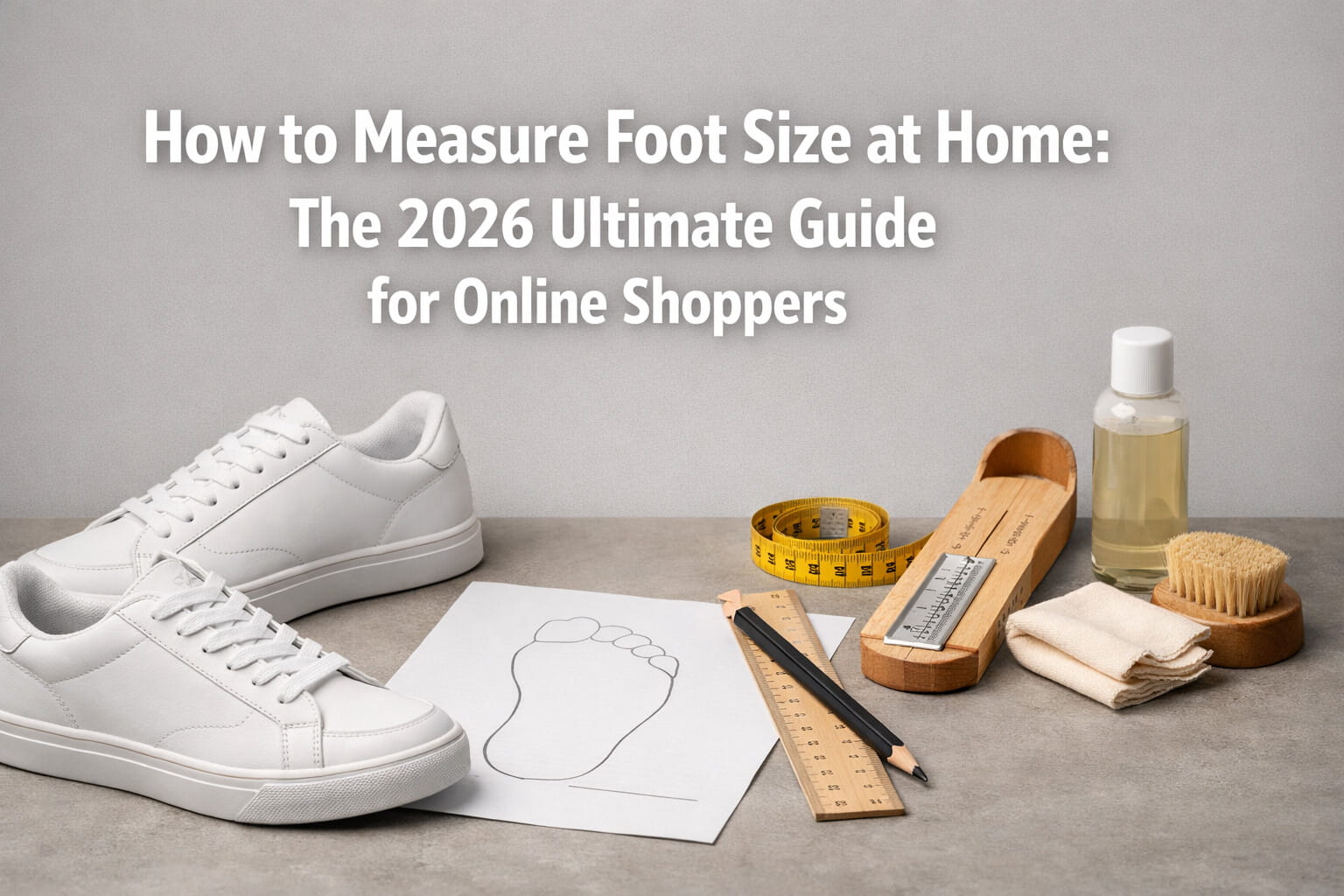
For a more detailed step-by-step method, see our guide on how to measure your foot size at home.
How to Know If Your Shoes Are Too Narrow
Common signs of a shoe that is too narrow can include:
- Your little toe is pushed against the side of the shoe.
- The widest part of your foot spills over the shoe’s sole.
- Your forefoot feels squeezed.
- You develop pressure points around the sides of your feet.
- Your toes feel compressed.
- The upper stretches significantly around the widest part of your foot.
- You experience discomfort even though the shoe length appears correct.
These signs do not prove that the shoe is too narrow, but they are useful indicators that width should be reassessed.
Research has found that poorly fitting footwear is associated with foot pain and several foot problems, although the exact relationship varies between populations and studies.
How to Know If Your Shoes Are Too Wide
A shoe can also be too wide.
Possible signs include:
- Your foot moves excessively from side to side.
- Your heel slips despite the shoe being correctly tied.
- Your foot does not feel securely supported.
- You need to tighten the laces excessively.
- The shoe creases or collapses in areas that do not match your foot shape.
The goal is not to find the widest shoe possible.
The goal is to find a shoe that provides enough space without allowing excessive movement.
Should You Buy a Longer Shoe If It Feels Too Narrow?
Usually, increasing the shoe length is not the best solution to a width problem.
If your toes already have sufficient front-to-back space but your forefoot feels compressed, moving to a longer size may create excessive length without solving the underlying width issue.
A better approach is often to compare the same shoe in a wider width, if the manufacturer offers one.
This is particularly important because shoe sizing is not perfectly standardized. ISO 19407:2023 describes conversion tables as guidelines because different shoe-size systems developed independently and there is no single universal solution to shoe-size conversion.
How Shoe Width Changes With Shoe Length
Width cannot always be treated as a fixed measurement.
The same width designation can correspond to different physical widths at different shoe lengths.
For example, a D-width shoe in one length is not necessarily physically identical in width to a D-width shoe several sizes larger.
Brannock’s system accounts for this relationship when determining width, rather than treating every width letter as one fixed millimetre value.
This is one reason simple width conversion charts can be misleading.
Wide vs Extra-Wide Shoes
The terms wide and extra wide describe categories rather than universal measurements.
Depending on the manufacturer, you may see:
- Wide
- W
- 2E
- EE
- 3E
- EEE
- 4E
- XW
- EW
- 6E
The exact meaning depends on the brand.
If you regularly need wide footwear, look for brands that publish actual foot-width or shoe-dimension information instead of relying only on the letter.
Does Foot Width Change?
Foot dimensions are not completely static.
Foot shape and dimensions can vary with age, activity, body weight, loading and other factors. Footwear research also shows considerable variation in foot morphology between individuals and populations.
The analysis of 1.2 million 3D foot scans found significant differences in mean foot measurements between regions and between sexes, along with substantial variation within groups.
That means a width that worked well for you several years ago may not always be the best choice today.
Shoe Width for Running and Sports Shoes
Width becomes particularly important in athletic footwear because your feet experience repeated loading and movement.
Running shoes are also designed around specific lasts and constructions, so the amount of usable forefoot space can differ even when two shoes have the same nominal length and width.
When choosing sports shoes:
- Measure your feet.
- Check the manufacturer’s sizing information.
- Pay attention to forefoot width and toe-box shape.
- Consider the socks you normally wear.
- Try the shoes on after your feet have been active if possible.
- Make sure your heel feels secure without excessive pressure across the forefoot.
Do not assume that a wide shoe is automatically the best choice. The correct fit depends on your foot shape and the shoe’s construction.
Shoe Width for Children
Children’s feet change as they grow, so width should not be ignored when buying children’s footwear.
A shoe that is long enough can still be too narrow.
Research on children’s footwear has found substantial variation in how fit is assessed, and width recommendations are not always supported by standardized measurement criteria.
Parents should therefore check both length and width rather than simply buying a larger size to allow for growth.
Shoe Width Conversion: Can You Convert Widths?
There is no reliable universal conversion that turns every width letter into one exact millimetre measurement.
For example:
D = X mm
is not a universally valid rule.
The physical width represented by D can depend on the shoe size, sizing system and manufacturer.
Instead of trying to convert a width letter between brands, use the manufacturer’s own chart whenever one is available.
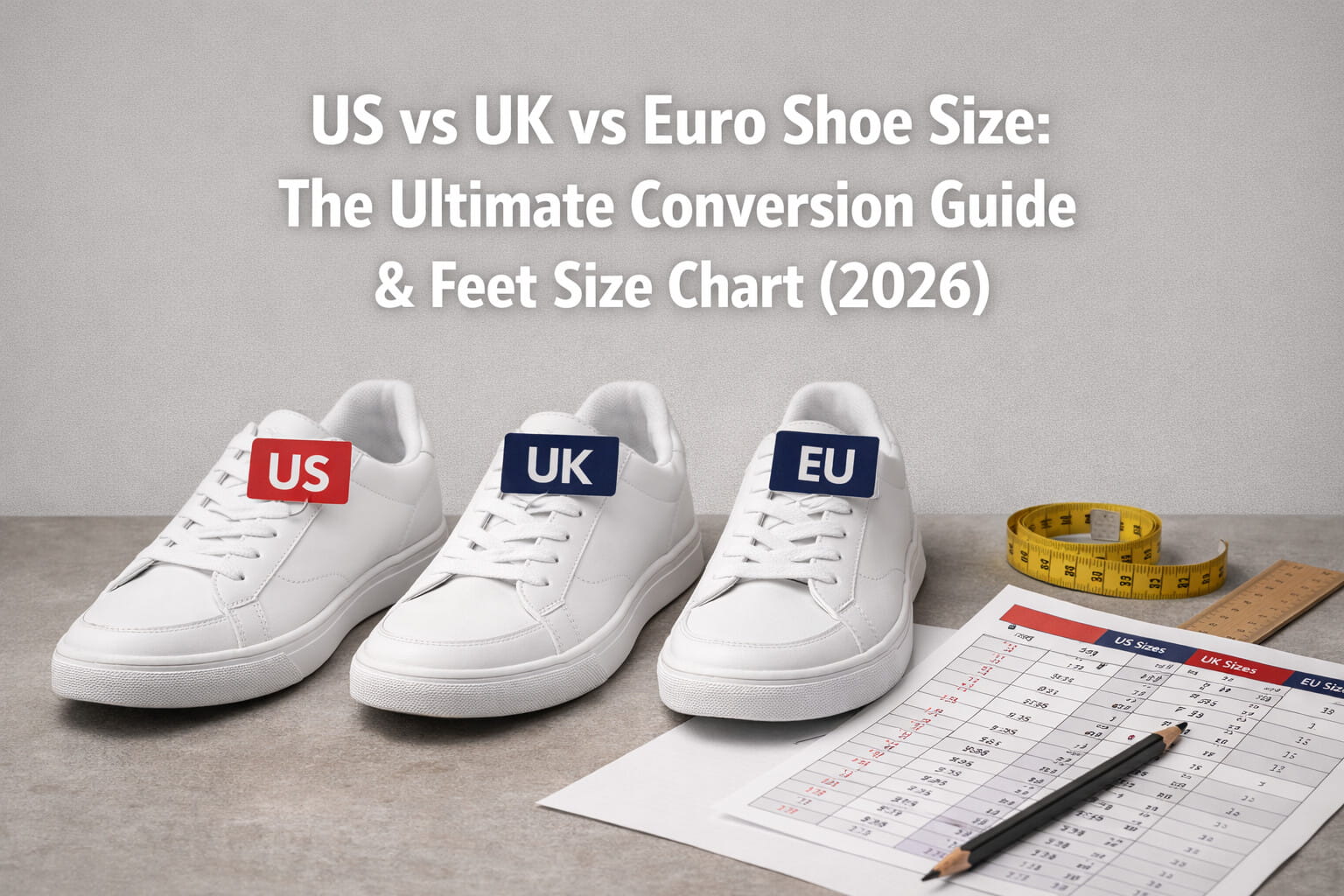
For international shoe sizing, our shoe size conversion chart and calculator can help you compare common sizing systems, but remember that conversion charts provide estimates rather than guaranteeing an identical fit between brands.
Common Shoe Width Questions
Is D a wide shoe?
It depends on the sizing system.
D is commonly a standard or medium men’s width in US sizing, while D is commonly considered wide in women’s US footwear.
Is 2E the same as EE?
Usually, yes.
In many US sizing systems, 2E and EE are different ways of representing the same width category.
However, always check the manufacturer’s chart.
Is 4E wider than 2E?
Generally, yes.
4E is commonly used to describe a wider category than 2E.
The exact physical dimensions still vary by manufacturer and shoe length.
Is B a narrow shoe?
It depends on whether you are looking at men’s or women’s sizing.
B is commonly used as a standard women’s width in US footwear, while B is generally a narrower men’s width.
How do I know if I need wide shoes?
Start by measuring your feet and comparing the measurement with the manufacturer’s width chart.
If your foot extends beyond the shoe’s widest area, or the sides of your forefoot feel compressed even when the length is correct, you may need a wider fitting shoe.
Are shoe widths the same across brands?
No.
Width labels are not perfectly standardized across brands, so an EE from one manufacturer should not automatically be assumed to fit exactly like an EE from another.
The Bottom Line
Shoe width is an important part of finding a comfortable fit, but width letters are not universal measurements.
A D, EE, 2E or 4E label only makes sense within the sizing system used by a particular manufacturer. Your foot length, foot width, shape, the shoe’s last and the intended use all influence how a shoe fits.
The most reliable approach is simple:
Measure your feet, check both length and width, then use the manufacturer’s own size chart before buying.
If you are between widths, have noticeably different left and right feet, or regularly experience pressure around the forefoot, measuring your feet professionally can provide a better starting point than relying on a generic conversion chart.
For more help, see our guides on how to measure your foot size at home, men’s shoe width, women’s shoe width, and shoe size conversion.
Sources and Further Reading
- ISO 9407:2019, Mondopoint system of sizing and marking
- ISO 19407:2023, Footwear sizing and conversion of sizing systems
- Brannock Device, fitting instructions
- Brannock Device, history and sizing system
- Telfer & Woodburn, 3D surface scanning for foot measurement
- Incorrectly fitted footwear, foot pain and foot disorders, systematic review
- Analysis of 1.2 million foot scans from North America, Europe and Asia
- Diabetes Foot Ulcer Prevention, review of footwear width assessment