
Brooks Shoe Size Chart: US, UK & EU Men’s Sizes and Fit Guide
⚡ Quick Answer
- Brooks men’s shoes are commonly listed in US, UK and European sizes.
- The correct Brooks size should be based on your foot measurement and preferred fit, not simply your usual dress-shoe size.
- Brooks recommends about a thumb’s width of space between your longest toe and the end of the shoe.
- For running shoes, Brooks says you may want to consider a half size up from your measured size.
- Width matters too. Brooks men’s widths include Narrow, Medium, Wide and Extra Wide on applicable models.
- If you are between sizes, compare your measurement with the current Brooks chart and consider how you will use the shoes.
Brooks Shoe Size Chart: The Quick Answer
If you are looking for the right Brooks shoe size, start with your actual foot length, then compare it with the Brooks men’s US, UK and EU sizing system. Brooks currently lists men’s sizes from US 5 through US 16 in its men’s footwear chart, with corresponding UK and European sizes.
Brooks does not treat your everyday dress-shoe size as a perfect running-shoe reference. Its current guidance recommends ordering Brooks running shoes around half to one full size larger than a dress shoe, while its general men’s size guide recommends considering a half size up from the measured size.
The other part people often overlook is width. A shoe can have the correct length but still feel wrong if the forefoot is too narrow or the heel does not hold securely. Brooks offers men’s Narrow, Medium, Wide and Extra Wide widths on applicable footwear.
For the most reliable result, measure both feet, use the larger measurement as your starting point, and check the fit while standing.
Brooks Men’s Shoe Size Chart
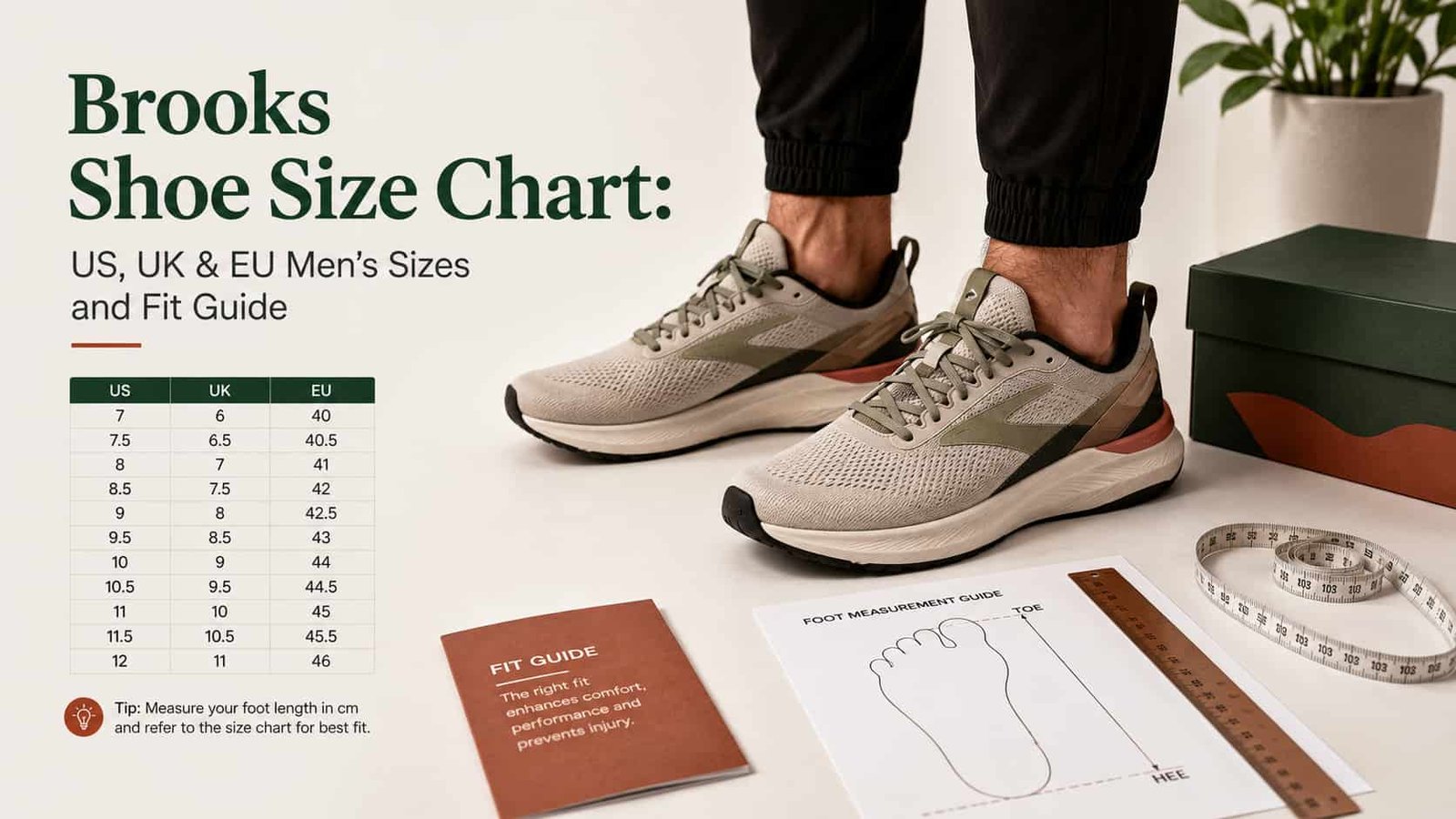
The Brooks men’s shoe size chart below shows the brand’s published US, UK and European size equivalents. Use it as a conversion reference, then check your actual foot measurement and the fit of the specific shoe.
| US Men’s | UK Men’s | EU |
| 5 | 4 | 37.5 |
| 5.5 | 4.5 | 38 |
| 6 | 5 | 38.5 |
| 6.5 | 5.5 | 39 |
| 7 | 6 | 40 |
| 7.5 | 6.5 | 40.5 |
| 8 | 7 | 41 |
| 8.5 | 7.5 | 42 |
| 9 | 8 | 42.5 |
| 9.5 | 8.5 | 43 |
| 10 | 9 | 44 |
| 10.5 | 9.5 | 44.5 |
| 11 | 10 | 45 |
| 11.5 | 10.5 | 45.5 |
| 12 | 11 | 46 |
| 12.5 | 11.5 | 46.5 |
| 13 | 12 | 47.5 |
| 14 | 13 | 48.5 |
| 15 | 14 | 49.5 |
| 16 | 15 | 50.5 |
This conversion is based on Brooks’ current men’s footwear size chart.
A useful point to remember is that US, UK and EU numbers are not interchangeable measurements. A US 10 does not mean 10 centimetres, for example. The safest approach is to measure your feet and then use the appropriate regional size.
If you want a broader comparison across men’s footwear brands, you can also use the men’s shoe size chart on Urban Style Footwear when comparing different brands.
Image placement: Add the main Brooks men’s size-chart infographic immediately after this table.
A note about CM measurements
You may see online charts that attach a centimetre measurement to every Brooks men’s size. Be careful with these tables.
Brooks’ current public sizing pages provide men’s US, UK and EU conversions, while its general size-guide page presents a foot-length-in-CM table under the women’s shoe section. It would therefore be misleading to copy those women’s CM figures and present them as an official Brooks men’s CM chart.
For this reason, this guide recommends using your own measured foot length rather than relying on an unofficial CM-to-Brooks conversion.
How Does Brooks Shoe Size Conversion Work?
Brooks shoe size conversion is straightforward when you are moving between US, UK and European sizing, but you should always keep the men’s chart separate from women’s sizing.
For example, according to Brooks’ men’s chart:
- US 8 = UK 7 = EU 41
- US 9 = UK 8 = EU 42.5
- US 10 = UK 9 = EU 44
- US 11 = UK 10 = EU 45
- US 12 = UK 11 = EU 46
- US 13 = UK 12 = EU 47.5
- US 14 = UK 13 = EU 48.5
If you are comparing a Brooks running shoe with another brand, do not automatically assume that the same number will produce the same fit. Brands use different lasts, uppers, toe boxes and width options.
For a wider international comparison, the global shoe size converter can help you understand how US, UK and EU sizing systems relate to one another.
💡 Fit Tip
Use size conversion to understand the number printed on the box. Use your foot measurement and the actual fit of the shoe to decide whether that number is right for you.
How Do You Measure Your Feet for Brooks Shoes?
The best way to choose a Brooks size is to measure your feet at home before ordering. A few minutes with paper, a pencil and a ruler can give you a much better starting point than guessing from an old pair of shoes.
What you need
- A sheet of plain paper
- A pencil or pen
- A ruler or measuring tape
- The socks you expect to wear with the shoes
- A flat wall and hard floor
Step 1: Put the paper against a wall
Place the paper on a hard, level floor with one edge touching the wall.
Stand with your heel gently against the wall.
Do not measure while sitting. Your foot spreads differently when you put your full body weight on it.
Step 2: Stand naturally
Put your weight evenly on both feet.
Keep your heel against the wall and avoid pushing your foot forward.
If another person can help you, ask them to mark the longest point of your foot while you stand naturally.
Step 3: Mark your longest toe
Mark the end of your longest toe on the paper.
Do not assume the big toe is always the longest. Foot shapes vary, and the second toe can sometimes extend farther.
Step 4: Measure the distance
Measure from the wall edge of the paper to the mark.
Record the measurement in centimetres or millimetres.
Repeat the process for the other foot.
Step 5: Use the larger foot
If one foot is slightly longer than the other, use the larger foot as your starting point.
This is especially important when buying running shoes because your feet need enough room to move naturally during activity.
Step 6: Consider the socks
If you normally run in performance socks, measure while wearing those socks or at least account for them when assessing the final fit.
A very thin sock and a thick winter sock can make the same shoe feel noticeably different.
If you want a more detailed visual walkthrough, you can follow the step-by-step foot measurement guidance available in our shoe sizing resources.
Image placement: Add a realistic foot-measurement infographic immediately after this measurement section.
📏 Quick Measurement Check
- Measure both feet.
- Measure while standing.
- Use the longer foot as your reference.
- Measure with the socks you normally wear.
- Do not treat the measured foot length as the exact physical length of the shoe.
Are Brooks Shoes True to Size?
Brooks shoes can feel true to size for many runners, but “true to size” is not the same thing as “buy exactly the same number you wear in every shoe.”
Brooks itself recommends that running shoes may need to be around half to one full size larger than a dress shoe. Its current general men’s guide also says to consider a half size up from your measured size.
That advice makes sense because running shoes are not worn like formal shoes.
During a run or long walk, your feet can move forward inside the shoe, your toes need room to spread, and your feet may change slightly in volume during the day.
So if your normal dress shoe is a US 10, you should not automatically order every Brooks running shoe in US 10.
Instead:
Measure first → compare sizing → check width → allow appropriate toe room → evaluate the actual fit.
Brooks product-level guidance can also vary by model. For example, current Brooks product information may describe particular models as true to size while still recommending that customers use their established running-shoe size and width.
👟 What “True to Size” Really Means
It means a shoe generally follows its expected sizing, not that your usual size in every other brand is guaranteed to fit. Your foot shape, width, socks, running style and the particular Brooks model can all affect the final fit.
What Brooks Shoe Width Should You Choose?
Length gets most of the attention, but width can be just as important.
Brooks currently lists four men’s width categories:
| Brooks Men’s Width | Brooks Width Code | General Fit |
| Narrow | B | Less room than standard |
| Medium | D | Standard men’s width |
| Wide | 2E | More room through the shoe |
| Extra Wide | 4E | Maximum available men’s width |
Not every Brooks model is available in every width, so availability depends on the shoe.
Medium width
Medium is the standard men’s width. If regular-width shoes generally feel comfortable and you do not experience pressure at the sides of your forefoot, Medium may be the natural starting point.
Wide width
Wide can make a meaningful difference if your feet feel compressed even though the length is correct.
Look for signs such as:
- Pressure across the ball of the foot
- Little room for the forefoot to spread
- The upper stretching noticeably over the sides
- Your little toe feeling squeezed
- Persistent side pressure despite having enough length
Extra Wide
Extra Wide provides more room than Wide and can be useful for people who consistently need additional volume and width.
Narrow
Narrow shoes provide a closer fit than the standard men’s width.
A narrow shoe can help when your foot moves excessively from side to side in a standard-width model, but it should never create pressure or numbness.
Brooks explains that width differences involve the amount of upper material and, for Extra Wide, a wider footbed as well.
Image placement: Add a four-panel Brooks width comparison infographic here showing Narrow, Medium, Wide and Extra Wide.
How Should Brooks Shoes Fit?
A properly fitted Brooks shoe should feel secure without feeling restrictive.
The heel should stay comfortably in place. The midfoot should feel held rather than squeezed. The toes should have enough room to move without your foot sliding excessively inside the shoe.
Brooks recommends about a thumb’s width of space between your longest toe and the end of the shoe.
Check the toe box
Stand up and make sure your longest toe is not touching the front.
Your toes should have enough space to move naturally.
Check the heel
Walk around and gently test the heel.
A small amount of natural movement is different from your heel repeatedly lifting out of the shoe.
Check the midfoot
The lacing area should feel secure.
You should not need to overtighten the laces simply to stop your foot from moving.
Check the width
Look for pressure points around the ball of the foot and little toe.
If the length feels right but the sides feel cramped, changing width can be more sensible than simply buying a longer shoe.
Check both feet
Always test the fit based on the larger foot.
A shoe that feels perfect on the smaller foot can still be too short for the other foot.
✅ Correct-Fit Checklist
- Longest toe has comfortable space in front.
- Heel feels secure without painful pressure.
- Midfoot feels supported rather than squeezed.
- Toes can move naturally.
- There is no obvious side pressure.
- You do not need to overtighten the laces.
- The fit remains comfortable when standing and walking.
What Are the Signs Brooks Shoes Are Too Small?
A Brooks shoe is probably too small if your toes repeatedly touch the front, the sides of your feet feel compressed, or you develop pressure points during normal movement.
Watch for these signs:
- Toes touching the front while walking
- Toenails hitting the front of the shoe
- Numbness or tingling
- Pressure over the little toe
- Pressure across the ball of the foot
- The upper visibly stretching around your forefoot
- Your toes feeling cramped after a longer walk or run
- Discomfort that gets worse as you continue exercising
One important point is that a shoe can be too small even if it feels acceptable when you first put it on.
A five-minute fitting test is not always enough. Walk around, stand naturally and pay attention to how your feet feel after some movement.
If the length is good but the forefoot is cramped, investigate the width before automatically going up another half size.
What Are the Signs Brooks Shoes Are Too Big?
A Brooks shoe may be too large when your foot moves excessively inside the shoe or you have to tighten the laces unusually hard to keep the shoe secure.
Look for:
- Your heel repeatedly lifting
- Your foot sliding forward
- Excessive movement from side to side
- Creasing in an uncomfortable position
- Needing to overtighten the laces
- Feeling unstable while walking or running
- A large amount of unused space in front of your toes
Buying a running shoe too large simply to get more growing room is not a good sizing strategy.
You want functional space, not excessive empty space.
Brooks specifically recommends a thumb’s width of room at the front, which provides a useful practical reference.
⚠ Common Sizing Mistake
Do not solve every fit problem by going up a size. If the shoe is long enough but feels tight across the sides, the problem may be width. If it feels loose everywhere, going smaller may be more appropriate. The goal is balanced length, width and security.
Why Your Brooks Size May Differ From Your Dress Shoe Size
This is one of the most common questions people have when moving into running shoes.
A dress shoe and a running shoe have different jobs.
Dress shoes are often fitted for a relatively structured, close appearance. Running shoes need to accommodate movement, repeated impact and natural foot expansion.
Brooks therefore advises customers to order running shoes around half to one size larger than their dress-shoe size.
That does not mean everyone should blindly add a full size.
Your actual foot measurement remains the better starting point.
For example, if you normally wear a US 10 dress shoe, start by measuring your feet rather than automatically ordering a Brooks US 11.
This is particularly useful when your old running shoes are from another brand.
How to Choose Between Two Brooks Sizes
Sometimes your measurement or previous experience puts you between two options.
When that happens, consider these factors:
Choose based on the longer foot.
Your smaller foot should not determine the size if the other foot needs more room.
Consider how you will use the shoe.
A running shoe may need more practical toe room than a casual shoe.
Check your socks.
The socks you wear during activity can change the fit.
Consider width separately.
If the length is right but the shoe is tight across the forefoot, look for a width option rather than automatically choosing a longer size.
Try the shoes later in the day when possible.
Feet can change in volume during the day, making a later fitting useful.
Brooks Shoe Size for Running vs Walking
The same basic sizing principles apply whether you are buying Brooks shoes for running, walking or everyday activity.
However, the way the shoe feels during movement matters.
For running, pay particular attention to:
- Toe clearance
- Heel security
- Forefoot comfort
- Sock thickness
- Width
- Movement inside the shoe
For everyday walking, comfort and stability may take priority over some performance-specific characteristics.
If you are comparing different brands for walking, you can also use the general men’s footwear sizing reference to understand how the sizing systems compare.
How Often Should You Recheck Your Brooks Shoe Size?
Your adult shoe size does not usually change dramatically from week to week, but your fit can change over time.
Weight changes, activity levels, age, foot swelling and changes in footwear preferences can all affect comfort.
More importantly, the shoes themselves change as they are used.
If a pair that previously felt comfortable suddenly starts causing pressure, do not assume you simply need to “break them in.”
Check:
- Your current foot measurement
- The condition of the shoes
- Whether the upper has changed shape
- Whether your socks have changed
- Whether your preferred width has changed
Running shoes also have a practical lifespan. Brooks product guidance indicates that typical life expectancy can be around 300 to 500 miles for certain running shoes, depending on use and activity.
Common Brooks Shoe Sizing Mistakes
Choosing the same number as your old dress shoes
This is one of the easiest mistakes to make.
Brooks itself recommends running shoes that are larger than a typical dress-shoe size.
Measuring only one foot
Feet are often slightly different.
Measure both and use the larger foot as your reference.
Measuring while sitting
Your foot behaves differently when it is bearing weight.
Stand naturally when measuring.
Ignoring width
If the length is correct but the shoe feels tight around the forefoot, the issue may be width rather than length.
Buying much larger for extra room
More space is not automatically better.
Too much room can allow unwanted movement and make the shoe feel unstable.
Assuming every Brooks model feels identical
Different models can have different design intentions and fit characteristics. Brooks itself notes that exact shoe dimensions do not tell the whole fit story because foot shape, biomechanics and design intention also matter.
Expert Fit Tips for Brooks Shoes
💡 Tip 1: Measure before replacing an old pair
Your old shoe size is a useful reference, but it should not replace an actual measurement when you are ordering a new model.
💡 Tip 2: Check width before adding length
If your toes have enough front-to-back room but the forefoot feels squeezed, investigate the width option instead of automatically buying a longer shoe.
💡 Tip 3: Test the fit standing up
Walking around while standing gives you a more useful impression of fit than checking the shoe while seated.
💡 Tip 4: Give the toes room to move
The goal is not to pin the foot in place. Your heel and midfoot should feel secure while your toes have enough room to move naturally.
Brooks Size Chart: A Practical Example
Imagine your current dress shoes are US 9.5.
Instead of immediately ordering Brooks US 9.5, measure both feet.
Suppose your left foot and right foot produce slightly different measurements. Use the larger foot as your reference, then compare the result with the Brooks men’s sizing chart.
Next, think about width.
If the length feels appropriate but the sides are tight, a Wide version may be worth investigating if that model is available in that width.
If the shoe feels loose and your heel moves excessively, simply adding more space is unlikely to solve the problem.
This is why good shoe fitting is not just about finding one number.
It is about finding the right length + width + volume + purpose + personal fit preference combination.
Brooks Shoe Widths at a Glance
| Width | Brooks Men’s Code | Best Starting Point |
| Narrow | B | Feet that need a closer fit |
| Medium | D | Standard men’s width |
| Wide | 2E | More forefoot and upper room |
| Extra Wide | 4E | Maximum room among listed men’s widths |
Availability varies by model.
When Should You Consider a Half Size Up?
A half size up can make sense when:
- Your longest toe feels close to the front
- You are between sizes
- You use the shoe for running
- Your feet need more room during longer activity
- Your measured size feels slightly short
- Your current running shoes already fit better in the next half size
Brooks’ current men’s guide specifically says to consider buying a shoe half a size up from your measured size.
However, this should be treated as guidance, not an automatic rule.
If a half size up creates excessive heel movement, the better answer may be a different width, different model or different lacing approach.
When Should You Not Size Up?
Do not automatically size up if:
- Your current length already feels comfortable
- Your toes have adequate space
- Your heel is slipping
- Your foot moves excessively inside the shoe
- You are only trying to compensate for a width problem
- The shoe feels loose rather than comfortably spacious
The right shoe should feel secure and comfortable at the same time.
Frequently Asked Questions
What size is a US 10 in Brooks men’s shoes?
A Brooks men’s US 10 corresponds to UK 9 and EU 44 in Brooks’ current men’s footwear chart.
What size is a US 9 in Brooks men’s shoes?
A Brooks men’s US 9 corresponds to UK 8 and EU 42.5. Always check the current chart before ordering because regional sizing can differ between brands.
Are Brooks running shoes true to size?
Brooks shoes can fit true to size for many people, but Brooks recommends considering a half size up from your measured size and says running shoes may be half to one full size larger than your dress-shoe size. Your foot shape, width and the particular model still matter.
Should I buy Brooks running shoes one size bigger?
Not necessarily. Brooks says running shoes may be around half to one size larger than dress shoes, while its general guide suggests considering a half size up from your measured size. The best choice depends on your foot measurement and the final fit.
How much room should Brooks shoes have at the front?
Brooks recommends approximately a thumb’s width between your longest toe and the end of the shoe. This provides practical space without requiring you to buy an unnecessarily long shoe.
What is a men’s D width in Brooks shoes?
D is Brooks’ standard Medium men’s width. Brooks also lists B as Narrow, 2E as Wide and 4E as Extra Wide for men’s footwear where those widths are offered.
What is Brooks 2E width?
2E is the Wide men’s width used by Brooks. It provides more room than the standard D width and may be worth considering if your foot feels compressed across the forefoot while the shoe is otherwise long enough.
What is Brooks 4E width?
4E is Brooks’ Extra Wide men’s width. It offers more room than the standard and Wide options, although not every Brooks shoe model is available in every width.
Should I measure both feet before buying Brooks shoes?
Yes. Measuring both feet is a good practice because the two feet may not be exactly the same length. Use the larger foot as your primary reference when deciding on size.
Why do my Brooks shoes feel tight even though the length is correct?
The problem may be width rather than length. If your toes have enough front-to-back space but the sides of the forefoot feel compressed, investigate whether a Wide or Extra Wide version is available for that model. Brooks provides multiple men’s width options on applicable shoes.
Why do my Brooks shoes feel too loose after going up a size?
Increasing length can create unwanted movement if the original issue was not length. If your heel starts lifting or your foot slides inside the shoe, reconsider the size and width combination rather than automatically going larger.
Can I use my dress shoe size to buy Brooks running shoes?
You can use it as a starting reference, but it should not be your only guide. Brooks recommends running shoes around half to one full size larger than dress shoes, so measuring your feet and checking the Brooks chart is a better approach.
Does Brooks use the same sizing for unisex shoes?
Brooks states that all-gender or unisex sizes match men’s sizes according to industry standards.
Final Brooks Shoe Fit Checklist
👟 Ready to Order? Check These First
The Conclusion on Brooks Shoe Sizing
The best Brooks shoe size is not simply the number you normally wear in another pair of shoes.
Start with your actual foot measurement. Use the current Brooks men’s US, UK and EU chart to understand the conversion, then check toe room, heel security and width.
Brooks recommends approximately a thumb’s width of space between your longest toe and the front of the shoe, and its current men’s sizing guidance suggests considering a half size up from the measured size.
Most importantly, do not overlook width. A shoe that is long enough can still be uncomfortable if it is too narrow, while a shoe that is unnecessarily long can create unwanted movement.
Take a few minutes to measure before ordering. That simple step gives you a much stronger starting point for finding a Brooks shoe that feels comfortable from the first run.
If you are comparing Brooks with other major footwear brands, Urban Style Footwear also has dedicated guides for Nike sizing, Adidas sizing and New Balance sizing.
RELATED READING
For readers who want to compare sizing beyond Brooks, these are the most relevant internal resources:
- Men’s shoe size chart for a broader men’s sizing reference.
- Global shoe size converter for comparing US, UK and EU sizing systems.
- Shoe size conversion chart and calculator when you want to work through a specific conversion.
- New Balance shoe size chart for comparing another major running-shoe brand.
- Hoka shoe size chart for another running-focused sizing comparison.