
How to Measure Foot Size at Home: Step-by-Step Shoe Size Guide
Buying shoes online is much easier when you know your actual foot measurements instead of relying only on the shoe size you usually wear.
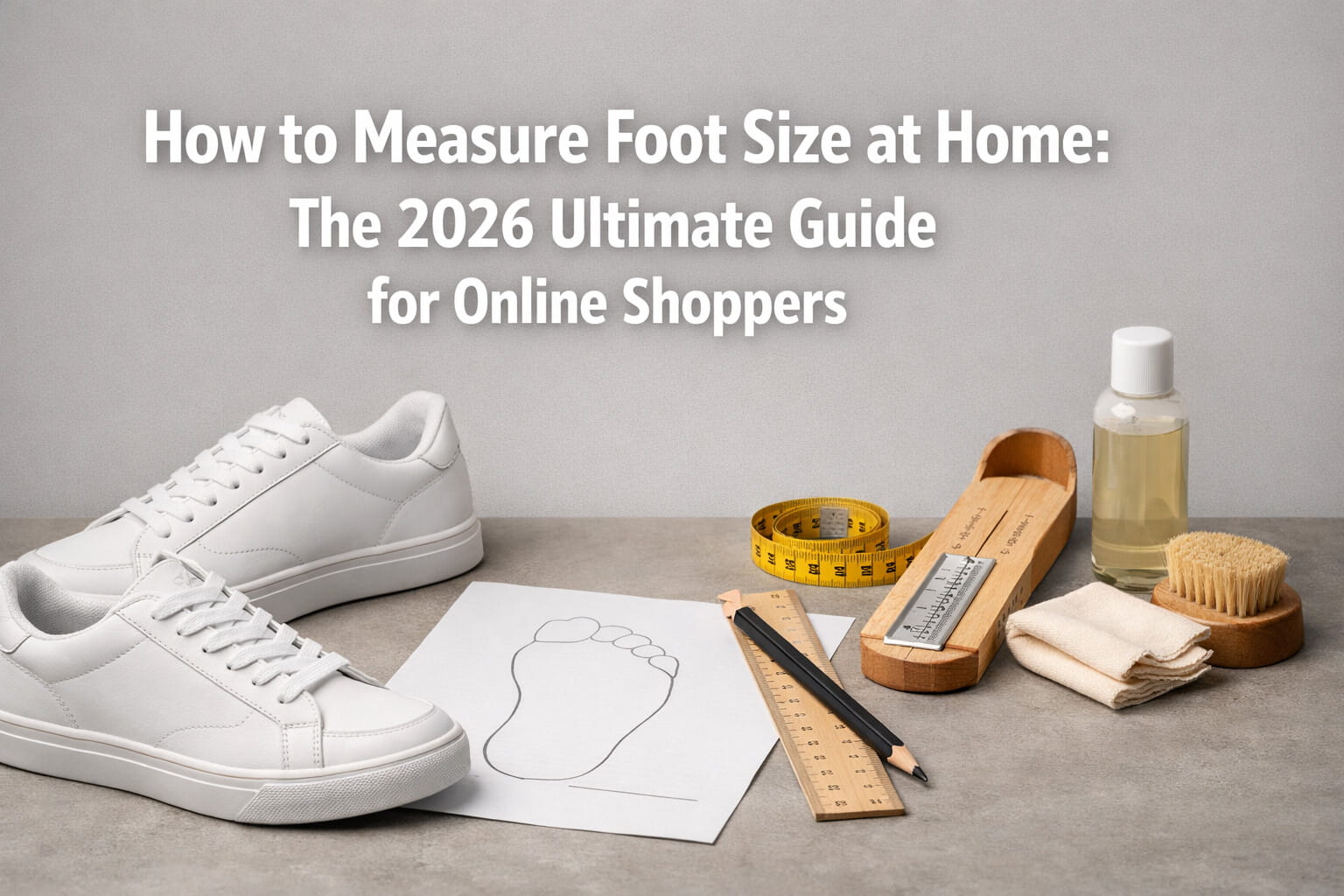
The good news is that you can measure your foot size at home with a sheet of paper, a pencil and a ruler or measuring tape. For a reliable measurement, stand naturally on a hard, flat surface, keep your heel against a wall, mark the end of your longest toe and measure the distance in centimeters or millimeters.
Always measure both feet, because they may not be exactly the same size. Once you have your measurements, compare the larger foot with the specific shoe brand’s size chart before ordering.
Quick answer: To measure your foot size at home, place a sheet of paper against a wall, stand on it with your heel touching the wall, mark your longest toe, and measure from the heel to the toe mark. Repeat for the other foot and use the larger measurement when checking the manufacturer’s size chart.
Shoe Size Conversion
Women’s Shoe Size Chart
| US/CA | UK/IN | EU | JP/MX | CN | Inches | CM |
|---|---|---|---|---|---|---|
| 4 | 2 | 34 | 21 | 32 | 8.3″ | 21.2 |
| 5 | 3 | 35 | 22 | 34 | 8.7″ | 22.0 |
| 6 | 4 | 36 | 23 | 36 | 9.0″ | 22.9 |
| 7 | 5 | 38 | 23.5 | 37 | 9.3″ | 23.7 |
| 8 | 6 | 39 | 24.5 | 39 | 9.7″ | 24.6 |
| 9 | 7 | 40 | 25.5 | 41 | 10.0″ | 25.4 |
| 10 | 8 | 41 | 26 | 42 | 10.3″ | 26.2 |
| 11 | 9 | 43 | 27 | 44 | 10.7″ | 27.1 |
| 12 | 10 | 44 | 28 | 46 | 11.0″ | 27.9 |
Men’s Shoe Size Chart
| US/CA | UK/IN | EU | JP/MX | CN | Inches | CM |
|---|---|---|---|---|---|---|
| 6 | 5 | 38 | 23.5 | 37 | 9.3″ | 23.7 |
| 7 | 6 | 39 | 24.5 | 39 | 9.7″ | 24.6 |
| 8 | 7 | 40 | 25.5 | 41 | 10.0″ | 25.4 |
| 9 | 8 | 41 | 26 | 42 | 10.3″ | 26.2 |
| 10 | 9 | 43 | 27 | 44 | 10.7″ | 27.1 |
| 11 | 10 | 44 | 28 | 46 | 11.0″ | 27.9 |
| 12 | 11 | 45 | 29 | 48 | 11.3″ | 28.8 |
| 13 | 12 | 46 | 29.5 | 49 | 11.7″ | 29.6 |
| 14 | 13 | 48 | 30.5 | 51 | 12.0″ | 30.5 |
Kids’ Shoe Size Chart (5-12 Years)
| US/CA | UK/IN | EU | JP/MX | CN | Inches | CM |
|---|---|---|---|---|---|---|
| 10.5 | 9.5 | 28 | 17 | 24 | 6.8″ | 17.1 |
| 12 | 11 | 30 | 18.5 | 27 | 7.3″ | 18.4 |
| 13.5 | 12.5 | 32 | 19.5 | 29 | 7.8″ | 19.7 |
| 1 | 13 | 32 | 20 | 30 | 7.9″ | 20.1 |
| 2 | 1 | 33 | 21 | 32 | 8.3″ | 21.0 |
| 4 | 3 | 36 | 22.5 | 35 | 8.9″ | 22.6 |
| 6 | 5 | 39 | 24.5 | 39 | 9.6″ | 24.3 |
| 7 | 6 | 40 | 25 | 40 | 9.9″ | 25.2 |
Quick Steps: How to Measure Foot Size at Home
If you need the answer quickly, follow these steps:
- Place a sheet of paper on a hard floor against a wall.
- Wear the socks you normally use with the shoes.
- Stand upright with your heel lightly touching the wall.
- Keep your weight evenly distributed on both feet.
- Mark the end of your longest toe.
- Measure from the back of your heel to the toe mark.
- Record the measurement in centimeters or millimeters.
- Repeat the process for your other foot.
- Measure the width if you need a wider or narrower fit.
- Compare the larger foot measurement with the brand’s official size chart.
Important: Do not automatically add a fixed amount such as 0.5 cm or 1 cm to every foot measurement. The appropriate fit allowance depends on the shoe type, construction and manufacturer’s sizing instructions.
What You Need to Measure Your Foot
You do not need a professional shoe-fitting device to get a useful measurement at home.
Gather these items:
- A sheet of plain paper
- Pencil or pen
- Ruler or measuring tape
- Hard, flat floor
- Tape to hold the paper in place
- The socks you normally wear with the shoes
For better accuracy, ask another person to mark your longest toe while you stand naturally.
How to Measure Foot Size at Home: Step-by-Step
Step 1: Measure at the Right Time
Try to measure your feet in the late afternoon or evening.
Feet can change slightly throughout the day, so measuring later can give you a more representative measurement for everyday footwear.
If you are measuring for a particular activity, use the socks you normally wear for that activity.
For example:
- Running shoes → wear your usual running socks.
- Hiking boots → wear your normal hiking socks.
- Casual sneakers → use your everyday socks.
- Sandals → follow the manufacturer’s instructions for barefoot fitting.
Step 2: Place the Paper Against a Wall
Put the paper on a hard, flat floor.
Position one edge of the paper directly against the wall.
If the paper moves easily, secure it with tape.
Avoid carpets or thick rugs because they can make it harder to maintain a consistent position.
Step 3: Stand Correctly
Place one foot on the paper.
Move your heel back until it is lightly touching the wall.
Stand naturally and distribute your weight evenly across the foot.
Do not:
- Sit down while measuring.
- Curl your toes.
- Push your heel aggressively into the wall.
- Lean your body forward.
- Stand only on one side of your foot.
Your foot spreads naturally when it carries your body weight, so standing gives you a more useful measurement than measuring while sitting.
Step 4: Mark Your Longest Toe
Have someone mark the point where your longest toe ends.
Your longest toe may be:
- Your big toe, or
- Your second toe.
Do not assume the big toe is always the longest.
Keep the pencil as vertical as possible when making the mark so that the measurement does not become artificially shorter.
Step 5: Measure Your Foot Length
Step away from the paper.
Measure the straight distance from the edge of the paper where your heel was positioned to the mark for your longest toe.
Record the result in centimeters and millimeters.
Example
If your measurement is:
26.4 cm
that is:
264 mm
Record the measurement rather than immediately converting it into a US, UK or EU size.
Your foot measurement is more useful as a starting point than your old shoe size.
Step 6: Measure Your Other Foot
Repeat the same process for your other foot.
For example:
| Foot | Length |
| Left | 26.0 cm |
| Right | 26.4 cm |
In this example, the right foot is larger.
Use the 26.4 cm measurement when comparing the shoe with the manufacturer’s size chart.
How to Measure Foot Width at Home
Foot length is only part of getting a good fit.
Two people can have the same foot length but require different widths.
To measure your foot width:
- Stand naturally on the paper.
- Trace your foot with the pencil held vertically.
- Find the widest part of your foot, usually around the ball of the foot.
- Measure straight across that area.
- Repeat on the other foot.
- Record the larger width measurement.
Example
Foot length: 26.4 cm
Foot width: 10.2 cm
Do not automatically convert your width into a letter such as D, E or EE. Width standards vary between brands and footwear categories.
If the manufacturer provides a width chart, compare your measurement with that chart.
Why Foot Length and Width Both Matter
A shoe can be long enough but still be too narrow.
Common signs that a shoe may be too narrow include:
- Pressure along the sides of your feet
- Toes being squeezed together
- Your foot spilling over the edge of the sole
- Numbness or uncomfortable pressure
- Repeated rubbing at the widest part of your foot
A shoe that is too wide can also cause problems, including excessive movement and heel slipping.
This is why choosing footwear based only on length is not always enough.
Foot Measurement vs Shoe Size: What’s the Difference?
Your foot length is a physical measurement.
Your shoe size is a sizing label used by a particular sizing system or footwear brand.
These are not exactly the same thing.
For example, a foot measuring 26.4 cm does not automatically mean that every brand’s US, UK or EU shoe with a corresponding conversion will fit identically.
Different shoes can have different:
- Toe-box shapes
- Widths
- Heel construction
- Materials
- Internal volume
- Lasts
- Intended uses
A running shoe, formal shoe, hiking boot and sandal can therefore require different fit considerations.
The safer process is:
Measure your foot → use the larger foot → check width → check the manufacturer’s chart → consider the shoe type → choose the recommended size.
How to Choose Your Shoe Size After Measuring
Once you know your foot measurement, do not immediately rely on a generic conversion formula.
Instead:
1. Find the manufacturer’s size chart
Look for the official chart on the product or brand website.
2. Find the CM or MM measurement
If the brand provides a foot-length measurement, use that as your main reference.
3. Check whether the chart describes foot length
Some charts use foot length while others may provide different measurements.
Read the chart carefully.
4. Check the width
If the brand provides width options, compare your width measurement.
5. Read the fit notes
A shoe may be described as:
- Narrow fit
- Standard fit
- Wide fit
- Roomy toe box
- Snug fit
These descriptions can matter as much as the numerical size.
US, UK, India and EU Shoe Size Conversion
International shoe sizing can be confusing because different regions use different systems.
You may encounter:
- US
- UK
- India
- EU
- CM
- JP
A conversion chart can provide a useful starting point, but it should not replace the manufacturer’s official chart.
For a quick comparison of US, UK, EU and CM sizes, use our shoe size conversion calculator.
For a deeper explanation of international sizing, see our US vs UK vs EU shoe size conversion guide.
If you are specifically shopping in India, our Indian shoe size vs UK shoe size guide provides additional information about the sizing systems commonly encountered by Indian shoppers.
Why shouldn’t you rely only on conversion?
A US 9, UK 8 or EU 42 can fit differently depending on the brand and model.
The most reliable workflow is:
Foot measurement in CM/MM → brand chart → shoe-specific fit information.
Foot Length Reference Chart
The following table is intended as a general measurement reference, not a universal shoe-size chart.
| Foot Length | Millimeters |
| 22.0 cm | 220 mm |
| 23.0 cm | 230 mm |
| 24.0 cm | 240 mm |
| 25.0 cm | 250 mm |
| 26.0 cm | 260 mm |
| 27.0 cm | 270 mm |
| 28.0 cm | 280 mm |
| 29.0 cm | 290 mm |
| 30.0 cm | 300 mm |
Why don’t we give one universal US/UK/EU answer?
Because international sizing is not perfectly standardized.
A conversion can be useful for understanding a general size range, but the manufacturer’s own chart should take priority when buying a specific shoe.
Interactive Foot Measurement Checker
Check Your Foot Measurement
Enter the measurements of your larger foot. We’ll help you check whether you have recorded the information needed before using a shoe-size chart.
Did You Measure Your Foot Correctly?
Before converting your measurement into a shoe size, use this quick checker.
Enter the measurement of your larger foot and, if available, your foot width.
Your measurement is not automatically a shoe size. Use the result with the manufacturer’s official size chart.
[INSERT CUSTOM FOOT MEASUREMENT CHECKER HERE]
Measurement checklist
Your measurement is ready to use if:
☑ You measured while standing
☑ Your heel was against a wall
☑ You measured the longest toe
☑ You measured both feet
☑ You recorded the larger measurement
☑ You used the correct socks
☑ You checked width when necessary
☑ You will compare the result with the brand’s chart
What Is the Best Time to Measure Your Feet?
Late afternoon or evening is generally a good time to measure your feet because your feet can change during the day.
For consistency:
- Measure both feet during the same session.
- Wear your normal socks.
- Stand naturally.
- Use a hard floor.
- Record your measurements in CM or MM.
If you are buying footwear for a specific activity, reproduce the conditions you expect to use when wearing the shoes.
How Should a Properly Fitting Shoe Feel?
Measuring your foot is only the first step.
After you choose a size, the shoe should also feel comfortable when standing and walking.
Toe Box
Your longest toe should not be pressed against the front of the shoe.
Your toes should have enough room to move naturally.
Width
The sides of your foot should not feel compressed.
Heel
Your heel should feel secure without excessive movement or painful pressure.
Overall Feel
A correct numerical size does not guarantee a correct fit.
Shoe shape, width, materials and construction all influence comfort.
Can You Use an Insole to Check Shoe Fit?
If the shoe has a removable insole, it can provide an additional fit check.
Remove the insole and place it on a flat surface.
Stand on it naturally and check:
- Where your heel sits
- Whether your longest toe reaches the front
- Whether the widest part of your foot fits within the insole
- Whether the insole shape matches your foot
However, an insole check should be treated as an additional guide rather than a replacement for the manufacturer’s size information.
How to Measure Kids’ Feet at Home
Children’s feet change quickly, so choosing a size based only on age is unreliable.
For children who can stand:
- Place paper against a wall.
- Have the child stand naturally.
- Keep the heel against the wall.
- Mark the longest toe.
- Measure the foot length.
- Repeat for the other foot.
- Compare the larger measurement with the manufacturer’s children’s size chart.
For a broader age-based reference, see our children’s shoe size by age chart.
You can also use our kids shoe size chart when you already know the child’s approximate measurement.
Important for Parents
Do not choose children’s footwear based only on age.
Children of the same age can have significantly different foot lengths and widths.
Actual measurement should take priority.
Best Ways to Measure Foot Size
| Method | Best For | Advantages | Limitations |
| Paper + wall | Online shoe shopping | Simple and inexpensive | Requires correct positioning |
| Foot tracing | Length and width | Shows foot shape | Pencil angle can affect result |
| Direct ruler measurement | Quick estimate | Fast | Difficult to position accurately |
| Professional foot measuring device | Detailed fitting | More comprehensive | Requires equipment |
| Professional fitting | Difficult fit problems | Expert assessment | Requires in-person visit |
| Phone scanning app | Quick digital estimate | Convenient | Results vary by device and software |
For most online shoppers, the paper-and-wall method is a practical way to establish your foot length and width.
10 Common Foot Measurement Mistakes
1. Measuring While Sitting
Your foot carries weight differently when you stand.
Better: Measure while standing naturally.
2. Measuring Only One Foot
Your feet may not be identical.
Better: Measure both.
3. Measuring Only the Big Toe
Your second toe may be longer.
Better: Measure to whichever toe extends farther.
4. Holding the Pencil at an Angle
An angled pencil can produce an inaccurate outline.
Better: Keep the pencil vertical.
5. Measuring on a Soft Carpet
Soft flooring can affect your position.
Better: Use a hard, flat surface.
6. Ignoring Width
Length alone does not describe complete shoe fit.
Better: Measure width when necessary.
7. Using Your Old Shoe Size
Your previous size is only a reference.
Better: Use current measurements.
8. Adding a Fixed Amount Automatically
There is no single allowance that works for every shoe.
Better: Follow the manufacturer’s fit instructions.
9. Using One Universal Conversion Formula
International sizing systems do not align perfectly.
Better: Check the brand’s chart.
10. Ignoring the Type of Shoe
A running shoe and a formal shoe may require different fit considerations.
Better: Consider the shoe’s intended use.
How Often Should You Measure Your Feet?
Adults do not necessarily need to measure their feet every time they buy shoes.
However, it is useful to remeasure when:
- Your normal shoes suddenly feel tight.
- You notice changes in foot shape.
- You are buying from a new brand.
- You are ordering expensive footwear online.
- You are buying a significantly different type of shoe.
- Your previous measurements are several years old.
For children, measurements should be checked more frequently because their feet are growing.
How to Measure Foot Size for Online Shopping
When buying shoes online, use this simple workflow:
Before opening the product page
Measure:
Length + Width
On the product page
Check:
Brand + Shoe Model + Size Chart
Before selecting the size
Compare:
Your larger foot measurement + Brand’s chart
Before checkout
Check:
Fit description + Return policy + Customer reviews
Do not rely entirely on reviews saying “runs small” or “runs large.” Customer opinions can vary because people have different foot shapes.
Quick Example: Choosing a Size Online
Imagine you measure your feet and get:
Left foot: 25.9 cm
Right foot: 26.3 cm
Your larger foot is:
26.3 cm
Now imagine the shoe brand’s chart provides sizes based on foot length.
Instead of choosing a size from memory:
- Find the 26.3 cm measurement on the brand chart.
- Check the recommended size.
- Check the width.
- Read the shoe’s fit description.
- Check whether the shoe is narrow, standard or wide.
- Select the size recommended by that brand.
This approach is more reliable than saying, “I normally wear a size 9, so I’ll order size 9 again.”
Frequently Asked Questions
How do I measure my foot size accurately?
Place paper against a wall, stand naturally with your heel touching the wall, mark your longest toe and measure the distance from heel to toe. Repeat for both feet and use the larger measurement when checking the manufacturer’s size chart.
How do I measure foot size in centimeters?
Measure the straight distance from the back of your heel to the end of your longest toe. Record the result in centimeters. For example, 26.4 cm equals 264 mm.
How do I measure shoe size at home without a Brannock device?
Use the paper-and-wall method. Measure both feet while standing, record the larger foot’s length and width, then compare those measurements with the shoe brand’s official size chart.
How do I measure my foot length?
Stand on paper with your heel against a wall. Mark the end of your longest toe, then measure from the wall-side edge of the paper to that mark.
How do I measure foot width at home?
Stand on paper and measure across the widest part of your foot, usually around the ball of the foot. Repeat for both feet.
Should I measure both feet?
Yes. Feet are often slightly different in length or width. Use the larger measurement when checking the manufacturer’s size chart.
What is the best time to measure your feet?
Late afternoon or evening is generally preferable because feet can change throughout the day.
How much space should be in front of my toes?
There is no single universal measurement that works for every shoe. Your toes should have enough room to move naturally without being pressed against the front. Follow the shoe manufacturer’s fit recommendations.
Is shoe size the same across brands?
No. Brands and shoe models can differ in shape, width, materials and construction. Always check the specific manufacturer’s size chart.
Is Indian shoe size the same as UK shoe size?
UK-style sizing is commonly used in India, but you should still check the sizing system shown by the retailer or manufacturer rather than assuming every brand uses exactly the same standard.
For more information, see our Indian shoe size vs UK shoe size guide.
How do I convert US shoe size to EU?
Use a conversion chart as a general reference, but check the specific brand’s chart for the shoe you are buying.
You can use our US, UK, EU and CM shoe size conversion calculator for a quick comparison.
Can I measure my foot by tracing it?
Yes. Tracing can be useful for checking both length and width. Keep the pencil vertical and stand naturally while tracing.
Does foot width affect shoe size?
Yes. A shoe can have sufficient length but still be too narrow. If you regularly experience side pressure, check whether the brand offers wider sizes.
Why are my feet different sizes?
Small differences between feet are normal. Always consider the larger foot when selecting footwear.
Can I measure my foot using my existing shoes?
Your existing shoes can provide a reference, but they should not replace an actual foot measurement. Different brands and models can fit differently even when the numerical size is the same.
Final Takeaway: Measure First, Convert Second
Finding the right shoe size starts with knowing your actual foot measurements.
Use a simple paper-and-wall method, measure both feet while standing, record the length of the larger foot, and measure width when necessary.
Then use the manufacturer’s size chart for the exact shoe you want to buy.
Remember:
Measure your foot → record the larger measurement → check width → compare with the brand chart → consider the shoe type → choose the recommended size.
Your usual shoe size is a useful reference, but your current measurements are a much better starting point when shopping online.
If you frequently buy footwear online, save your foot length and width in your phone. That way, you can quickly compare your measurements whenever you shop.
For your next purchase, use our shoe size conversion calculator to compare international sizing systems, or explore our US vs UK vs EU shoe size guide for a more detailed explanation.