
Birkenstock Shoe Size Chart (US, UK & EU) + Foot Length Guide
Get a quick summary of this Birkenstock sizing guide
Use your preferred AI assistant to summarize the Birkenstock US, UK and EU sizing information, foot measurement guidance, and width recommendations.
The easiest way to choose a Birkenstock size is to start with your actual foot length in millimeters, then compare it with the brand’s size chart. For men’s sizing, Birkenstock currently lists US 6-6.5 as EU 39, US 7-7.5 as EU 40, US 8-8.5 as EU 41, and continues through US 17-17.5 as EU 50. Birkenstock also provides both narrow and regular width options for many models, so length alone is not the whole fitting picture. If your measurement falls between sizes, Birkenstock recommends choosing the next size up.
The important takeaway: don’t choose your Birkenstock size simply because you normally wear that number in another brand. Measure both feet, check the EU size, then confirm the appropriate width.
Birkenstock Shoe Size Chart
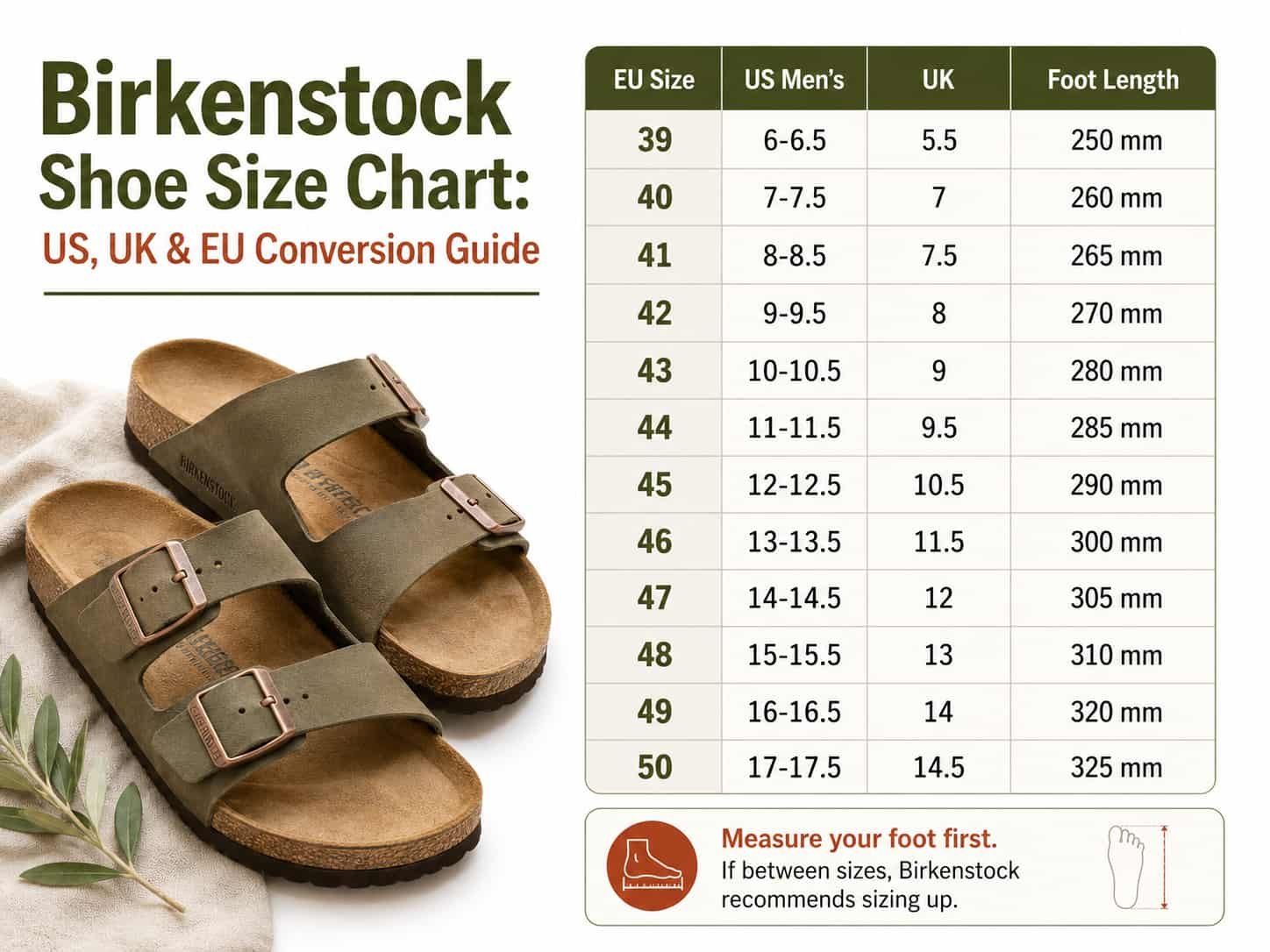
If you are looking for a quick Birkenstock shoe size chart, this is the most useful starting point for men’s sizing. The table below follows the current Birkenstock US/EU men’s size mapping and the corresponding foot-length measurements published by Birkenstock.
| Birkenstock EU | US Men’s | UK Men’s | Approx. Foot Length |
| 39 | 6-6.5 | 5.5 | 250 mm |
| 40 | 7-7.5 | 7 | 260 mm |
| 41 | 8-8.5 | 7.5 | 265 mm |
| 42 | 9-9.5 | 8 | 270 mm |
| 43 | 10-10.5 | 9 | 280 mm |
| 44 | 11-11.5 | 9.5 | 285 mm |
| 45 | 12-12.5 | 10.5 | 290 mm |
| 46 | 13-13.5 | 11.5 | 300 mm |
| 47 | 14-14.5 | 12 | 305 mm |
| 48 | 15-15.5 | 13 | 310 mm |
| 49 | 16-16.5 | 14 | 320 mm |
| 50 | 17-17.5 | 14.5 | 325 mm |
📏 Check Your Birkenstock Size
Enter your larger foot length in millimeters. This quick reference uses Birkenstock’s published men’s sizing measurements.
Birkenstock's official sizing information uses EU sizing as a central reference and provides corresponding US and UK sizes. Its current men's chart also shows the foot-length ranges used in its fit guide.
How to read the chart
If you normally wear a US men's 10, for example, you will see Birkenstock's US 10-10.5 range associated with EU 43.
That does not mean every person who wears US 10 should automatically order EU 43.
Your foot measurement should be the deciding factor, especially if you are switching from another footwear brand.
One useful feature of Birkenstock's system is that the EU size remains consistent across its men's chart while the US and UK equivalents are shown alongside it.
Birkenstock Size Conversion: US, UK and EU
Birkenstock sizing can feel different if you are accustomed to buying shoes primarily by US sizing.
The brand's footwear uses European sizing prominently, so it is useful to know your EU equivalent before ordering.
For example:
- US Men's 6-6.5 = EU 39
- US Men's 7-7.5 = EU 40
- US Men's 8-8.5 = EU 41
- US Men's 9-9.5 = EU 42
- US Men's 10-10.5 = EU 43
- US Men's 11-11.5 = EU 44
- US Men's 12-12.5 = EU 45
- US Men's 13-13.5 = EU 46
- US Men's 14-14.5 = EU 47
- US Men's 15-15.5 = EU 48
- US Men's 16-16.5 = EU 49
- US Men's 17-17.5 = EU 50
If you regularly shop across different brands, our men's shoe size chart is useful for comparing standard men's sizing before you move into Birkenstock's EU-based system.
For a broader conversion check, you can also use our global shoe size converter rather than trying to estimate the conversion mentally.
Is Birkenstock true to size?
Birkenstock is generally best approached by foot measurement rather than your usual shoe number.
The reason is simple: different footwear brands use different lasts, shapes and sizing conventions. A US 10 in one sneaker brand should not automatically be treated as an exact match for another footwear brand.
Birkenstock's own fit guidance asks you to measure foot length and width before selecting a size. If you are between sizes, the brand recommends going up to the next size because feet can expand during the day.
There is another important difference.
A properly fitted Birkenstock should not feel like a tightly enclosed fashion sneaker. The footbed is designed to provide room around the foot, including space for the toes.
So when trying a pair for the first time, don't immediately assume that a little space around your foot means the shoe is too large.
The position of your heel, toes and foot inside the footbed matters more than simply making the shoe feel tight.
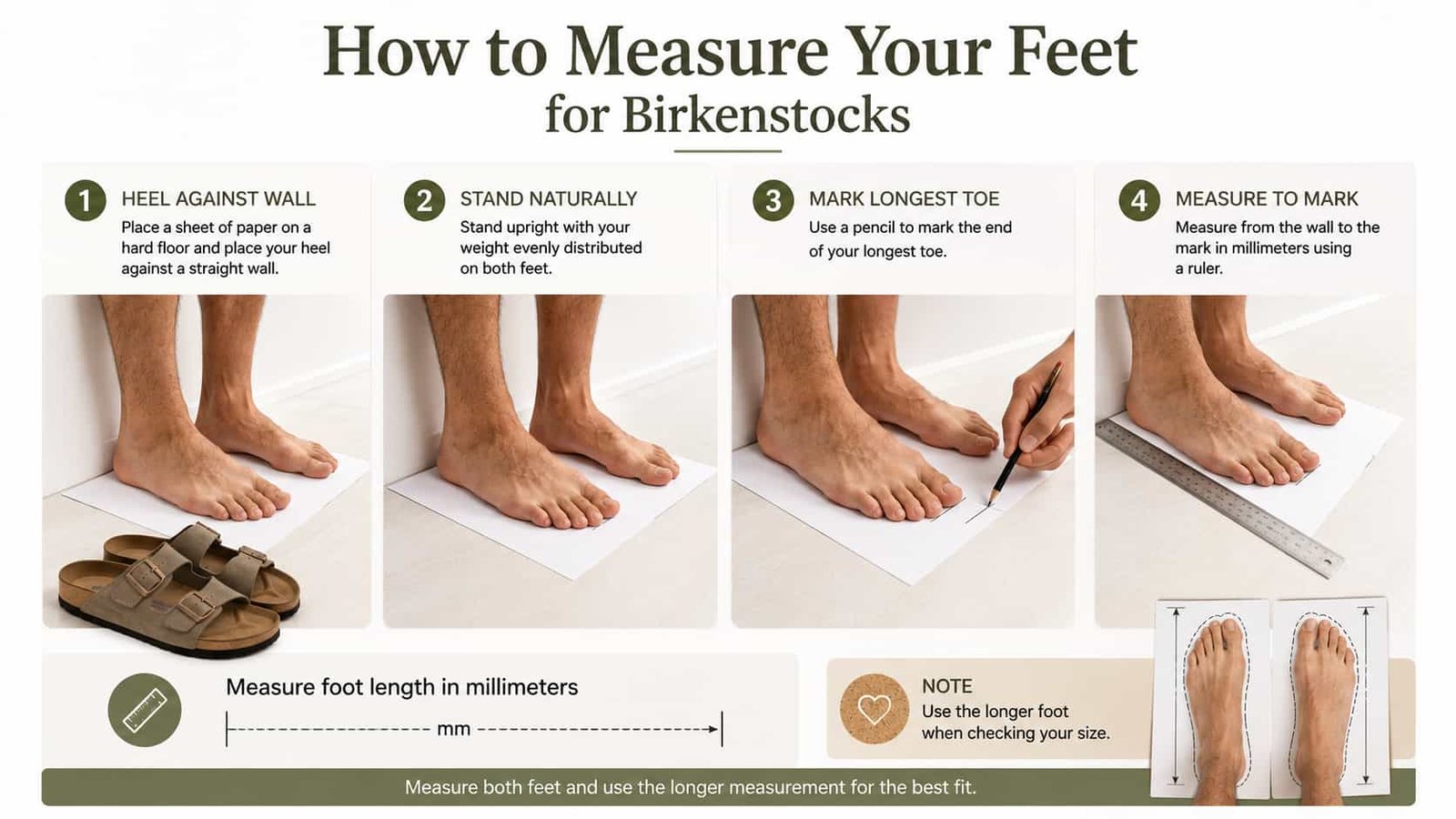
How to measure your feet for Birkenstock shoes
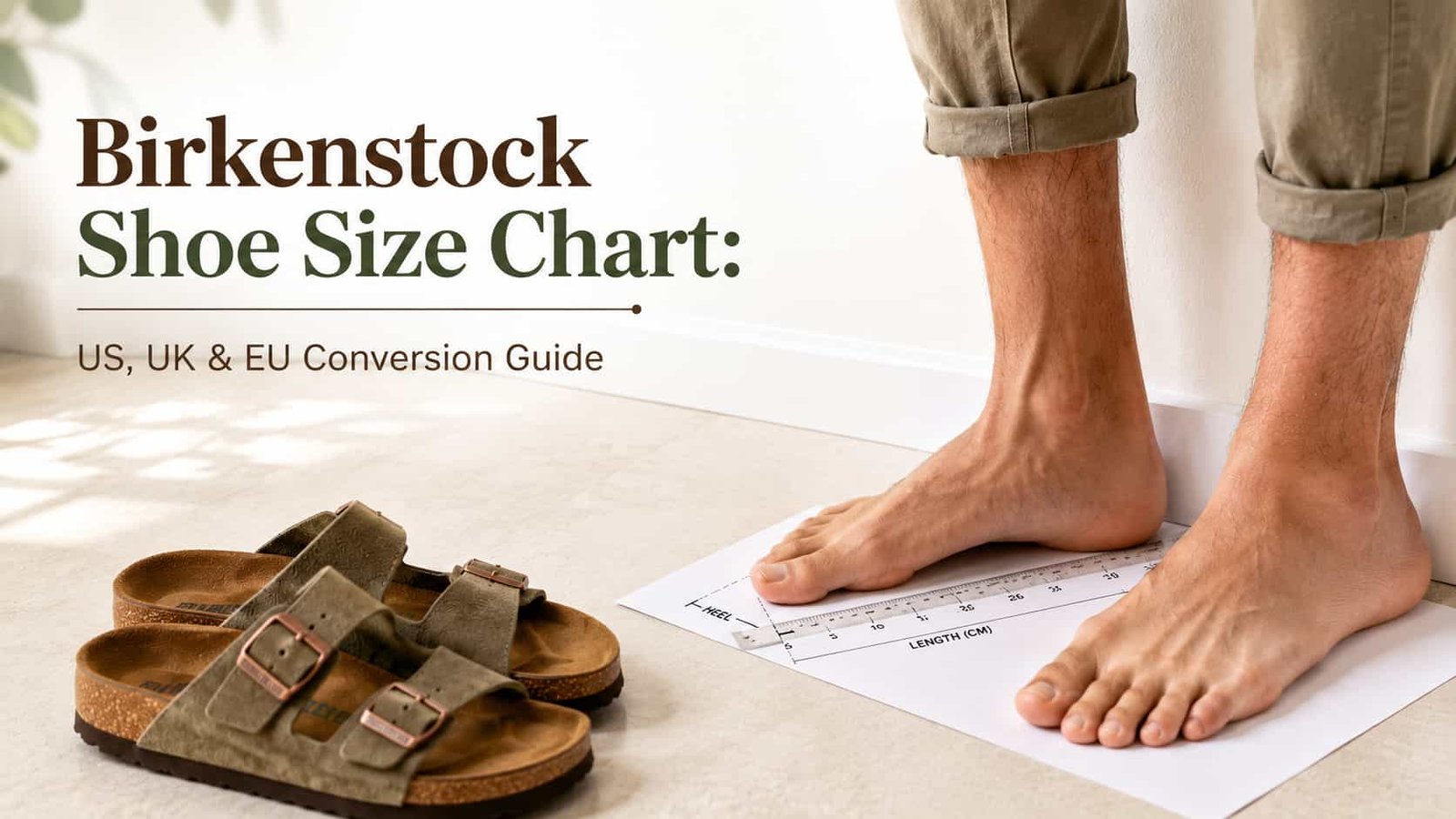
Measuring your feet at home is straightforward, and it is one of the best ways to improve your chances of ordering the right Birkenstock size online.
Birkenstock recommends measuring in the evening because feet can expand during the day. Its measurement instructions use paper, a pencil and a ruler, with the heel positioned against a wall.
What you need
- Two sheets of paper
- A pencil
- A ruler or measuring tape
- A flat wall
- The socks you normally intend to wear, if applicable
Step 1: Place the paper on a flat floor
Put a sheet of paper on a hard, flat surface.
Avoid measuring on thick carpet because it can make it harder to keep your foot and ruler in a consistent position.
Step 2: Stand with your heel against the wall
Stand naturally with your heel touching the wall.
Keep your weight distributed normally rather than leaning forward or pulling your foot backward.
Step 3: Mark your longest toe
Use a pencil to mark the point corresponding to your longest toe.
Don't assume that your big toe is always the longest. Foot shapes vary.
Step 4: Measure the length
Measure from the heel position to the longest-toe mark.
Record the measurement in millimeters because Birkenstock's sizing information uses millimeter measurements.
Step 5: Measure both feet
Repeat the process for your other foot.
This is important because your left and right feet may not be identical.
Use the larger measurement when deciding between sizes.
Step 6: Measure width
Length is only one part of the Birkenstock fitting process.
Measure across the widest part of your foot around the ball of the foot.
Birkenstock provides width information alongside its length measurements, allowing you to determine whether a narrow or regular fit is more appropriate.
✓ Before You Order Checklist
- Measure both feet while standing.
- Record measurements in millimeters.
- Use the larger foot as your reference.
- Check both length and width.
- Compare your measurement with the Birkenstock chart.
- Check whether your selected model is available in narrow or regular width.
- Review the retailer's return policy before purchasing.
Birkenstock narrow vs regular width
Choosing the correct width is one of the most overlooked parts of Birkenstock sizing.
Many Birkenstock models are available in narrow and regular widths. The correct option depends on the shape and width of your foot, not simply whether you normally describe your feet as "wide" or "narrow."
Regular width
Regular width is intended for normal and wider foot shapes.
Your foot should sit comfortably inside the footbed without being forced against the side edges.
Narrow width
Narrow width is designed for slimmer feet.
It should still leave some space around the foot. Narrow does not mean that your toes should be squeezed together.
Birkenstock notes that its footbeds include a printed footprint indicator. The narrow version uses a solid footprint, while the regular version uses an outline footprint.
The key fitting principle
Your foot should be comfortably positioned inside the footbed rather than sitting on its edges.
Birkenstock describes the desired fit as having your feet nestled into the footbed without resting on the inside or outside edge.
💡 Fit Tip
Don't choose a Birkenstock size simply because it matches your usual sneaker number. Measure both feet first, then compare the larger measurement with the Birkenstock chart. This is especially useful when moving between brands or international sizing systems.
How much room should you have in Birkenstocks?
Birkenstocks are designed differently from many close-fitting sneakers.
You should not judge the size solely by whether your toes touch the front of the footwear.
There should be enough room for your foot to sit naturally on the footbed without your toes or heel being pressed against the edges.
At the same time, excessive space can indicate that the size or width is not right.
When you stand naturally, check whether:
- Your heel sits comfortably within the heel area.
- Your toes have room to move naturally.
- Your foot is not hanging over the side edges.
- Your toes are not pressed against the front.
- Your foot is not pushed against the back edge.
- The straps or upper can be adjusted without needing excessive tightening.
The goal is secure without being cramped.
⚠ Common Sizing Mistake
A roomy Birkenstock is not automatically an oversized Birkenstock. The footbed is designed differently from a close-fitting sneaker, so focus on where your heel, toes and sides of your foot sit rather than trying to make the footwear feel tight.
What size Birkenstock should I get if I am between sizes?
If your measurement falls between two Birkenstock sizes, the official recommendation is to choose the next size up. Birkenstock explains that feet can become slightly larger under load and can expand during the day.
This is particularly useful when shopping online.
For example, if your measurement does not clearly fall into one size range, don't try to force the smaller size simply because you prefer a closer fit.
Instead:
- Measure both feet.
- Compare the larger foot with the chart.
- Check the width.
- Move up if you are between sizes.
- Check the fit when standing naturally.
📐 Size Snapshot
Example measurement: 280 mm
Birkenstock EU reference: 43
US Men's: 10-10.5
UK: 9
Next step: Check width and model-specific fit.
Does Birkenstock sizing differ from Nike, Adidas or other brands?
Yes, you should not assume that your Birkenstock size will match the number printed inside another brand.
Sneakers and sandals can have different shapes, internal dimensions and intended fits.
For example, someone who normally buys a particular US size in Nike may still need to use Birkenstock's EU chart when purchasing a Boston, Arizona or another Birkenstock model.
If you are comparing several brands, our Nike shoe size chart and Adidas shoe size chart can help you understand how the sizing systems differ.
The important point is not to convert blindly from one brand number to another.
Measure first, convert second.
How should Birkenstock sandals fit?
A Birkenstock sandal should feel secure while allowing your foot to sit naturally on the footbed.
When standing:
- Your heel should remain comfortably inside the heel area.
- Your toes should have room to move.
- Your foot should not spill over the sides.
- Straps should hold the foot without creating pressure.
- Your toes should not be forced against the front edge.
Don't tighten the straps excessively to compensate for an incorrect size.
If you need to pull the straps unusually tight just to stop your foot from moving around, reconsider the size or width.
How should Birkenstock clogs fit?
The same basic principles apply to clogs, but the upper can make the fit feel different from an open sandal.
Your heel and toes should remain comfortably positioned on the footbed.
A clog should not feel as though your foot is sliding significantly from front to back with every step.
At the same time, don't expect the fit to feel as snug as a performance running shoe.
The footbed is an important part of the Birkenstock experience, so allow enough room for your foot to sit naturally.
What are the signs that my Birkenstocks are too small?
A pair may be too small if you notice several of these signs:
- Toes are pressed against the front edge.
- Heel extends beyond the heel area.
- Foot hangs over the side edges.
- Toes feel compressed.
- The foot cannot sit naturally on the footbed.
- Straps create pressure even when adjusted correctly.
- Walking feels restricted.
One quick test is to stand naturally and look at the position of your entire foot.
If your foot is being pushed against the boundaries of the footbed, don't assume the footwear will "stretch enough" to solve the problem.
What are the signs that my Birkenstocks are too big?
A size may be too large if:
- Your foot moves excessively inside the footbed.
- Your heel repeatedly lifts away from the heel area.
- Your toes slide forward during normal walking.
- You have to tighten the straps unusually far.
- The footwear feels difficult to control.
- There is excessive space around the foot.
Some room is normal.
Excessive movement is not.
A roomy Birkenstock and an oversized Birkenstock are not the same thing.
How often should you measure your feet?
You do not need to measure your feet every time you buy shoes, but measurement is worthwhile when:
- You are buying Birkenstocks for the first time.
- Your usual size feels different.
- You have changed brands.
- Your feet have changed over time.
- You are ordering a different type of footwear.
- You are unsure between two sizes.
- One foot appears noticeably larger than the other.
For an online purchase, spending a few minutes measuring before ordering is much easier than discovering after delivery that you chose the wrong size.
Can you use your existing shoe size to choose Birkenstocks?
Your existing shoe size can be a starting reference, but it should not be your only measurement.
If you normally wear US Men's 10, for example, Birkenstock currently maps that range to EU 43. But if your actual foot measurement points elsewhere, use the measurement and fit information rather than assuming your usual brand size is automatically correct.
This is especially important if your current shoes are from a brand with a different shape.
Common Birkenstock sizing mistakes
Choosing the size only from your sneaker size
This is probably the most common mistake.
Your existing size provides useful context, but your actual foot dimensions provide better information.
Ignoring width
A correct length with an unsuitable width can still create a poor fit.
Measuring only one foot
Your feet may differ slightly.
Always measure both.
Measuring while sitting
Your foot behaves differently when it is bearing weight.
Stand naturally during the measurement.
Assuming more room is always better
Birkenstocks should provide natural space, but excessive movement is not a sign of a better fit.
Treating every Birkenstock model exactly the same
Different styles can have different uppers, strap arrangements and construction.
Use the model's specific product information when available.
Birkenstock sizing for online shopping
Buying footwear online becomes much easier when you approach sizing systematically.
Before adding a pair to your cart:
Measure:
Record both foot lengths in millimeters.
Compare:
Use the Birkenstock size chart rather than relying only on your usual shoe size.
Check width:
Determine whether narrow or regular is more appropriate.
Check the model:
Look at the product's specific fit information.
Check the retailer's return policy:
Sizing decisions are easier when you understand your options before purchasing.
If you frequently shop across US, UK and EU sizing systems, our shoe size conversion chart and calculator can also help you compare measurements.
Birkenstock size chart: the numbers at a glance
For quick reference, these are the most commonly searched men's conversions:
| US Men's | Birkenstock EU | UK Men's | Foot Length |
| 6-6.5 | 39 | 5.5 | 250 mm |
| 7-7.5 | 40 | 7 | 260 mm |
| 8-8.5 | 41 | 7.5 | 265 mm |
| 9-9.5 | 42 | 8 | 270 mm |
| 10-10.5 | 43 | 9 | 280 mm |
| 11-11.5 | 44 | 9.5 | 285 mm |
| 12-12.5 | 45 | 10.5 | 290 mm |
| 13-13.5 | 46 | 11.5 | 300 mm |
| 14-14.5 | 47 | 12 | 305 mm |
| 15-15.5 | 48 | 13 | 310 mm |
| 16-16.5 | 49 | 14 | 320 mm |
| 17-17.5 | 50 | 14.5 | 325 mm |
These conversions are based on Birkenstock's current published men's sizing information.
Frequently Asked Questions
What size is a US Men's 10 in Birkenstock?
A US Men's 10-10.5 corresponds to Birkenstock EU 43 in the current men's size chart. The associated foot-length measurement is approximately 280 mm. However, check your actual foot length and width before ordering because your usual US size is only a starting reference.
Is Birkenstock sizing the same as regular shoe sizing?
Not necessarily. Birkenstock uses European sizing prominently, and the fit of its footbed is different from many conventional sneakers. Your normal US shoe size can help you estimate a starting point, but measuring your foot in millimeters gives you a more reliable basis for selecting the size.
Should I size up in Birkenstocks?
If your measurement falls between two sizes, Birkenstock recommends choosing the next size up. The brand notes that feet can expand during the day and that foot measurements can change slightly under load.
Are Birkenstocks true to size?
There is no single universal answer because "true to size" depends on the brand and shoe size you normally wear. The safest approach is to compare your actual foot length and width with Birkenstock's sizing information rather than assuming your regular sneaker size will be identical.
How do I know whether I need Birkenstock narrow or regular?
Measure your foot length and width, then compare those measurements with Birkenstock's width information. Narrow is designed for slimmer feet, while regular is intended for normal and wider foot shapes. Your foot should sit comfortably inside the footbed without being pushed against the side edges.
Should my toes touch the front of Birkenstocks?
Your toes should not be pressed against the front edge. Birkenstock's footbed is designed to provide natural space around the foot, so don't judge the fit by trying to make the footwear feel tightly packed around your foot.
Should I measure both feet for Birkenstocks?
Yes. Measure both feet because they may differ slightly in length or width. When the measurements are different, pay attention to the larger foot when selecting your size.
Is EU 40 the same as a US Men's 7?
Birkenstock's current men's chart lists EU 40 as US Men's 7-7.5. The corresponding foot-length measurement is approximately 260 mm.
Can I use a ruler to measure my foot?
Yes. A ruler or measuring tape can be used for a basic home measurement. Birkenstock's measurement instructions recommend paper, a pencil and a ruler, with the heel against a wall and the longest toe marked.
When is the best time to measure your feet?
Birkenstock recommends measuring in the evening because feet can expand during the day. Measuring while standing also gives a more useful representation of your loaded foot dimensions.
Final takeaway
Finding the right Birkenstock size does not have to involve guesswork.
Start with your foot length in millimeters, compare it with the Birkenstock size chart, check your width, and remember that your normal sneaker size is only a reference point.
For men's Birkenstock sizing, EU 39 through EU 50 covers the current chart, with corresponding US and UK conversions. If you are between sizes, Birkenstock recommends moving to the next size up.
The best approach is simple: measure both feet, choose based on the larger measurement, check the width, and evaluate the fit while standing.
If you are still comparing different footwear sizing systems, start with our men's shoe size chart and then use the global shoe size converter when you need to compare US, UK and EU sizing.
Related Guides
If you are researching footwear sizing, these are the most relevant next resources:
- Men's Shoe Size Chart for general men's sizing and foot-length guidance.
- Global Shoe Size Converter for US, UK and EU conversions.
- Shoe Size Conversion Chart Calculator for quick size comparisons.
- Hoka Shoe Size Chart for another popular footwear sizing system.
- Skechers Shoe Size Chart for comparison with another major footwear brand.