
Women’s Shoe Size Chart (Global Guide, US, UK, India, EU & CM)
⚡ Quick Answer
- Shoe size numbers differ by country, but foot length in centimeters stays the same everywhere, so it’s the most reliable way to shop across any system.
- US, UK, and India generally use different scales, though UK and India sizing are close enough to treat as the same number for most everyday shoes.
- EU sizing runs on its own separate scale, based on a metric measuring system rather than inches.
- Half sizes and width both affect comfort beyond the base length number, in every country’s sizing system.
- Use the interactive size finder below to check your size across US, UK, India, and EU at once.
A women’s shoe size chart maps foot length to a size number, but that number changes depending on which country’s system a retailer uses. Foot length in centimeters or inches is the one measurement that stays consistent everywhere, which makes it the safest starting point when shopping across borders. UK and India generally share very similar sizing, while the US runs on its own scale and the EU uses a different metric-based system entirely. Measuring your foot directly, rather than assuming a size number carries over from one country to another, is the most reliable way to get an accurate fit no matter where you’re shopping from.
Women’s Shoe Size Chart (US, UK, India, EU & CM)
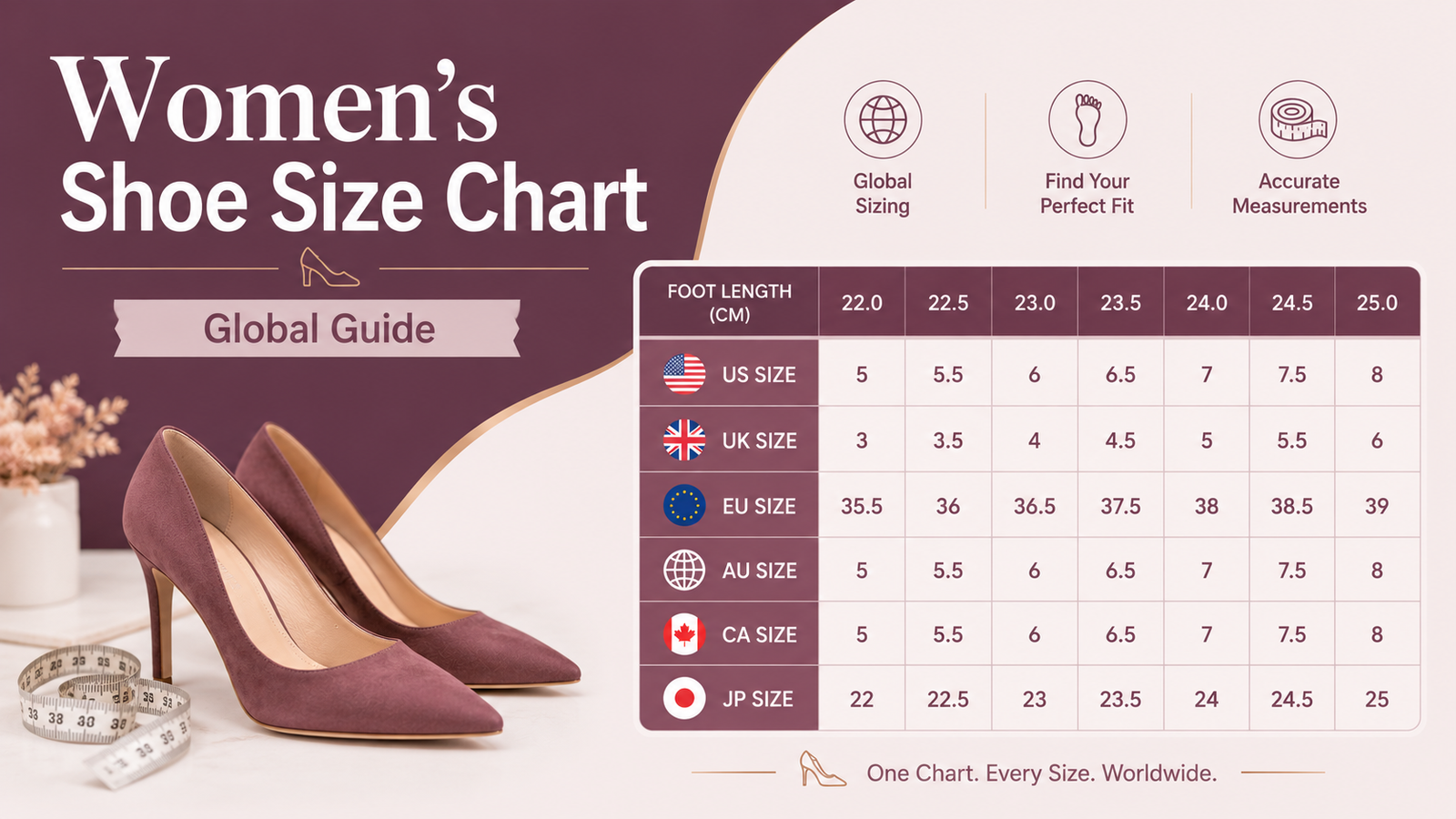
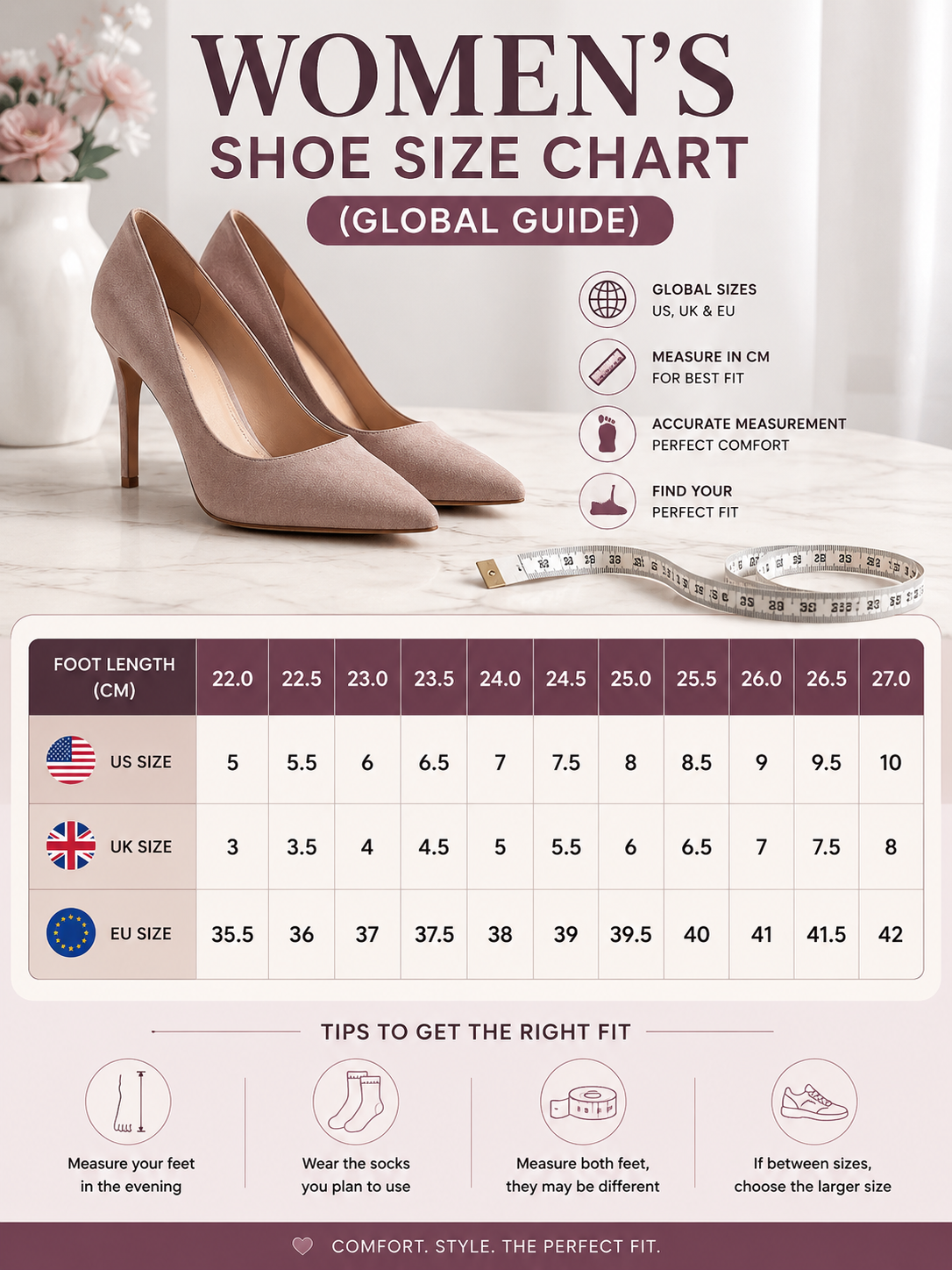
This chart lines up foot length against the major sizing systems used worldwide. Foot length in centimeters is listed first since it’s the one number that doesn’t change no matter which country you’re shopping from.
| Foot Length (cm) | Foot Length (in) | US Size | UK / India Size | EU Size |
| 21.6 cm | 8.5 in | 5 | 3 | 35 |
| 22.6 cm | 8.9 in | 6 | 4 | 36 |
| 23.5 cm | 9.25 in | 7 | 5 | 37 |
| 24.4 cm | 9.6 in | 8 | 5.5 to 6 | 38 to 39 |
| 25.1 cm | 9.9 in | 9 | 6.5 to 7 | 40 |
| 26.0 cm | 10.25 in | 10 | 7.5 to 8 | 41 |
| 27.0 cm | 10.6 in | 11 | 8.5 to 9 | 42 |
A quick tip that saves a return shipment: when a size falls between two rows, use the centimeter measurement as the tie-breaker, since size labels round differently across brands and regions.
👠 Did You Know?
India’s shoe sizing largely follows the same scale as the UK, both based on a measuring system that predates the metric EU scale and the separate US system. That’s why a UK size and an Indian size are usually the same number, while a US or EU size for the same foot looks completely different.
Why Sizing Numbers Differ Around the World
Shoe sizing was never standardized globally, so different regions built their own scales at different points in history, using different base units.
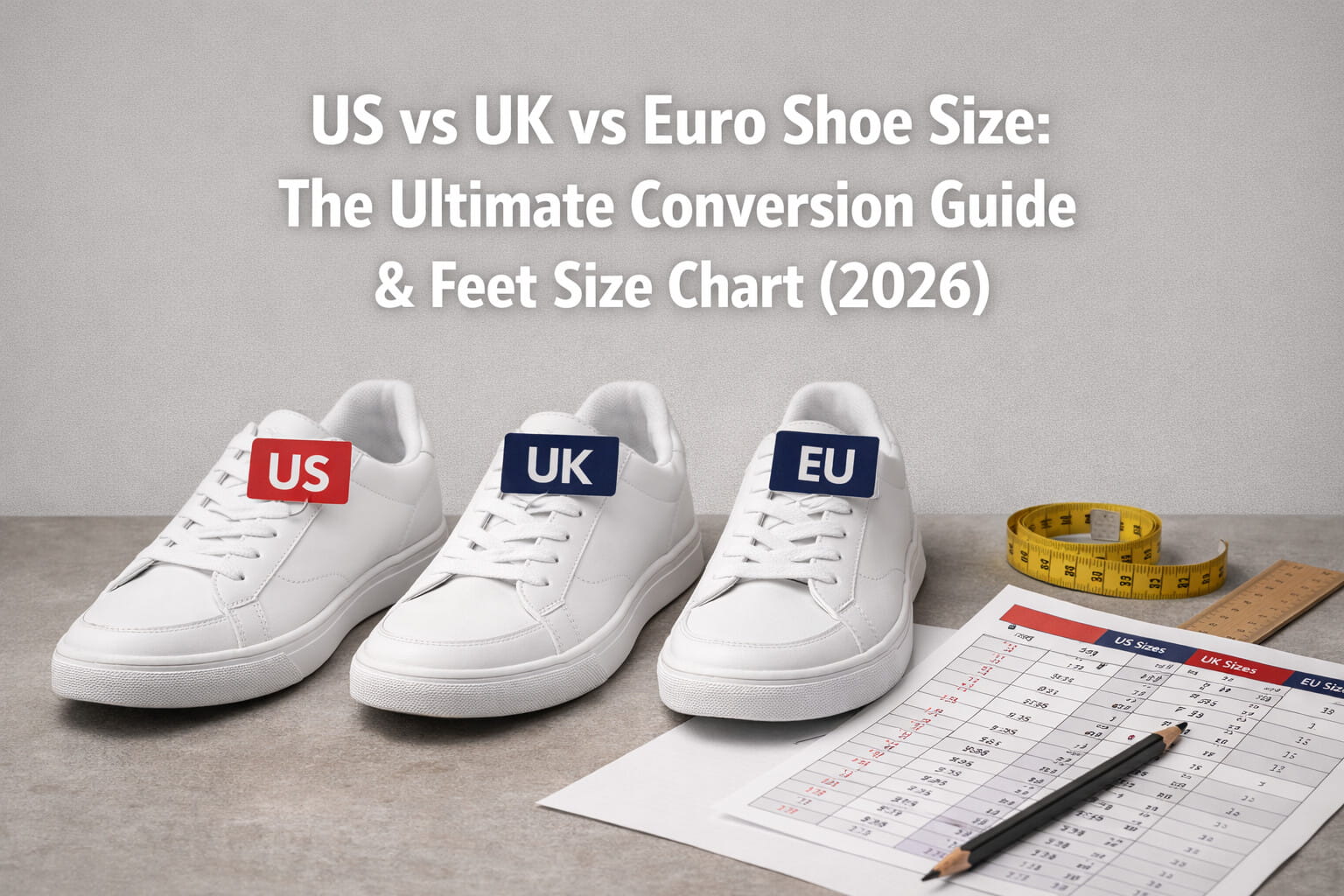
The UK and India both measure from a shared historical standard, which is why their numbers line up closely for most everyday shoes. The US system uses a similar unit of measurement but starts counting from a different baseline, so US sizes typically run a size or so larger than the equivalent UK or Indian number for the same foot. The EU system is different again, built around a metric unit called the Paris point rather than inches at all, which is why EU numbers look so much larger even though they represent a similar foot length.
None of these systems is more accurate than another. They’re just different starting points, which is exactly why foot length is the more dependable number to shop by.
Interactive Women’s Size Finder
Enter your foot length below and this tool will show the closest match across US, UK, India, and EU sizing at once.
Women’s Shoe Size Finder
Enter your foot length to see the closest US, UK/India, and EU size.
This is a general estimate based on standard sizing. Individual brands can run slightly larger or smaller.
For a deeper breakdown across the full size range with more conversion detail, our Women's Shoe Size Conversion Chart covers it in more depth than this overview.
💡 Expert Tip
Measure your foot length in the evening rather than first thing in the morning. Feet naturally swell a little through the day, so an evening measurement gives a more realistic sense of how a shoe will feel by the time you've been on your feet for hours, no matter which country's sizing you end up using.
How to Measure Your Foot at Home
A five minute measurement at home beats guessing from a size worn in a different brand or country.
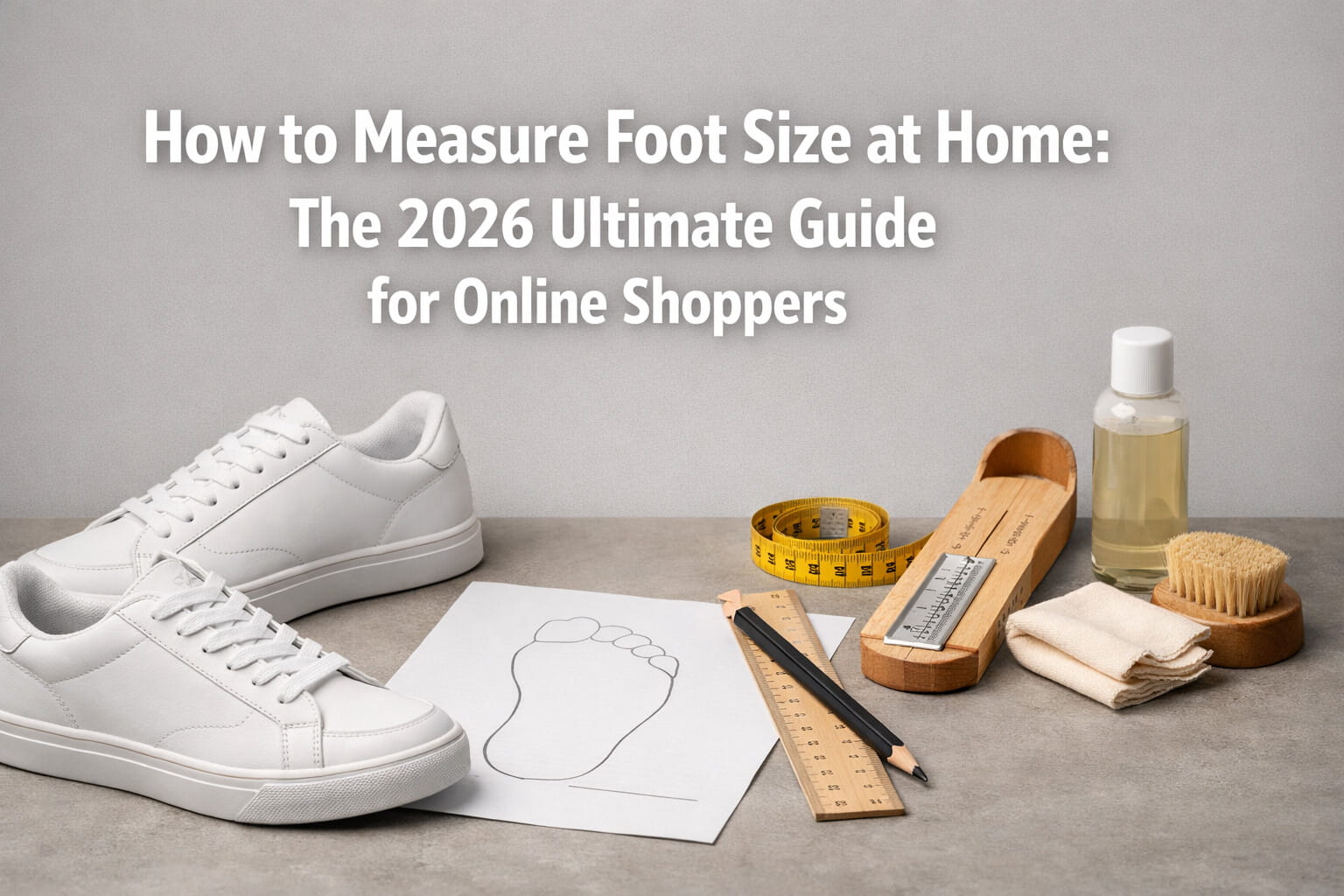
Step 1: Trace your foot on paper. Stand on a flat sheet of paper with your heel against a wall or straight edge.
Step 2: Mark the heel and longest toe. Trace around the entire foot, then mark the very back of the heel and the tip of the longest toe.
Step 3: Measure the straight-line distance. Use a ruler to measure heel to toe in centimeters, since that's the number that transfers cleanly across every sizing system.
Step 4: Measure both feet. Use the larger measurement as your final number, since one foot is often slightly longer than the other.
Step 5: Match against the chart. Compare your number to the chart above, or use the interactive finder for an instant result across all four systems.
If you'd like the full step-by-step version of this process with more detail, our How to Measure Women's Feet guide walks through it further.
✅ Shopper Checklist
- Measure both feet, standing, in the evening if possible.
- Record your foot length in centimeters, not just a size number.
- Check which country's sizing system a retailer is using before ordering.
- Confirm width separately if a specific spot on the foot repeatedly feels tight.
- Check a brand's specific size chart before ordering online, especially across borders.
Understanding Half Sizes
Half sizes exist in every major sizing system because a full size can be too big a jump for some feet, especially when the difference between comfortable and tight comes down to a fraction of a centimeter.
Choosing between a whole size and the half size below it usually comes down to two things: sock or stocking thickness, and personal preference for a snugger versus roomier fit. If you're regularly stuck between two half sizes across different brands or regions, our Women's Half Size Guide covers how to decide which direction to round.
⚠ Common Mistake
Assuming a size number carries over directly from one country to another is one of the most common mistakes in cross-border shoe shopping. A "size 8" means something different depending on whether it's US, UK, Indian, or EU sizing, so always check which system a listing is actually using before ordering.
Width Sizing for Women's Shoes
Length isn't the only variable that determines comfort. Width affects fit just as much, particularly for anyone who's found that a correctly sized shoe still feels tight or loose across the middle of the foot, regardless of which country's size label is on the box.
Standard, wide, and narrow width options exist for a reason, and not every brand offers all three. If a properly sized shoe consistently leaves marks along the sides or feels loose despite the correct length, our Women's Wide Shoe Size Chart or Women's Narrow Shoe Size Chart can help narrow down the right fit.
Signs a Shoe Fits Correctly
A properly sized shoe should check these boxes regardless of style or which country it was sized in.
- About a thumb's width of space between the longest toe and the front of the shoe.
- No slipping at the heel while walking.
- No pinching or pressure points across the widest part of the foot.
- The shoe bends naturally at the ball of the foot rather than in the middle of the arch.
Common Buying Mistakes When Shopping Across Countries
A handful of habits show up repeatedly with online shoe shopping across different regions.
Assuming size stays consistent across countries. A size 8 in the US, a size 8 in the UK, and a size 8 in the EU are three completely different foot lengths. Checking which system a listing uses matters as much as checking the number itself.
Ignoring the centimeter measurement when it's available. Many international listings include foot length in centimeters alongside the size number. That figure is usually more reliable than the label, especially when a site has been translated or converted between systems inconsistently.
Skipping the width check. Assuming a fit problem is a length issue when it's actually a width issue leads to a cycle of buying the wrong size repeatedly, in any country's sizing system.
Buying Guide by Shoe Type
Fit priorities shift slightly depending on the category of shoe, no matter which region you're shopping in.
Sneakers and athletic shoes. A little extra room at the toe accommodates foot swelling during activity, so sizing true to measurement or slightly larger tends to work well.
Dress shoes and heels. A closer, more precise fit matters more here, since excess length affects how securely the shoe stays on during wear.
Boots. Consider sock thickness for the season, since boots paired with thick socks may need a touch more room than the base measurement suggests.
Sandals. True to measurement generally works best, since there's less material to accommodate any sizing buffer.
📏 Size Snapshot
Foot Length: 24.4 cm / 9.6 inches
US Size: 8
UK / India Size: 5.5 to 6
EU Size: 38 to 39
For more detail on typical size ranges and how they vary by region, our Average Women's Shoe Size article breaks it down further.
Expert Tips for Sizing Accuracy Anywhere
Tip 1. Keep a written record of your measured foot length in centimeters, since having that number on hand speeds up shopping from any region's sizing system without needing to reconvert each time.
Tip 2. Remeasure once a year or after any significant weight change, since foot length and width can shift gradually without much notice.
Tip 3. When ordering from an unfamiliar retailer, look specifically for a foot length in centimeters on the product page rather than relying on the size label alone.
Tip 4. If you regularly buy from one brand, note whether they run large, small, or true to size in your usual sizing system, since this pattern tends to stay consistent across their catalog.
FAQs
Is a UK size the same as an Indian size? Yes, for the most part. UK and Indian shoe sizing generally follow the same scale, so a UK size 5 and an Indian size 5 typically refer to the same foot length. Small differences can still show up between individual brands.
How do I convert my shoe size to a different country's system? Foot length in centimeters is the most reliable conversion method, since size numbers can round differently between brands and regions. Match your measured foot length to the chart above to find the closest equivalent across US, UK, India, and EU sizing.
Why does the EU size number look so much bigger than my usual size? EU sizing uses a completely different scale based on a metric measuring system called the Paris point, rather than inches. An EU size 38 or 39 represents a similar foot length to a US size 8, even though the numbers look far apart.
Should I size up or down for half sizes? Round up if your foot length falls between two half sizes, especially for shoes without much stretch. Rounding down works better if a slightly snugger fit is preferred and the shoe has flexible material.
How do I know if I need a wide or narrow width? Check for red marks or pressure along the sides of a properly sized shoe, which usually points to a wide fit being needed. Gapping or a loose feel across the middle of the foot despite correct length points toward a narrower fit.
Does shoe size change with age? Yes, foot length can gradually increase with age for many people, due to natural changes in connective tissue over time. Remeasuring periodically, rather than assuming a size from years ago is still accurate, helps avoid discomfort no matter where you're shopping from.
Why do different brands fit differently even in the same labeled size and country? Shoe sizing isn't perfectly standardized even within one country's system, so manufacturing and last shapes vary by brand. Checking a specific brand's size chart, especially foot length in centimeters, is more reliable than assuming a consistent fit across every brand.
Is it normal for one foot to be a different size than the other? Yes, this is common. Always size to the larger foot, and consider an insole or thicker sock on the smaller foot side if the fit feels loose there.
What's the best way to measure foot length accurately at home? Trace your foot on paper while standing, then measure the straight-line distance from the heel to the longest toe with a ruler, ideally in centimeters. Standing gives a more accurate reading than measuring while seated, since feet spread out slightly under weight.
Do sneakers and dress shoes use the same size chart? The base size chart is generally the same, but fit priorities differ. Sneakers often benefit from a touch of extra room, while dress shoes and heels typically need a closer, more precise fit for the shoe to stay secure.
How often should I remeasure my shoe size? Once a year is a reasonable habit, or sooner after any significant weight change, pregnancy, or if shoes that used to fit start feeling different. Foot size isn't necessarily fixed for life the way many people assume, in any country's sizing system.
CONCLUSION
A women's shoe size comes down to foot length, and that measurement is the one thing that stays consistent no matter which country's sizing system you're shopping in. US, UK, India, and EU numbers all point back to the same underlying foot length, they just count differently to get there.
Use the interactive size finder above to check your size across all four systems at once, and remeasure periodically since foot length can shift gradually over time. For width, half size, or conversion questions specific to your situation, the related guides below cover each in more detail.
RELATED ARTICLES
- Women's Shoe Size Conversion Chart
- Women's Wide Shoe Size Chart
- Women's Narrow Shoe Size Chart
- How to Measure Women's Feet
- Women's Shoe Width Guide
- Women's Half Size Guide
- Average Women's Shoe Size