
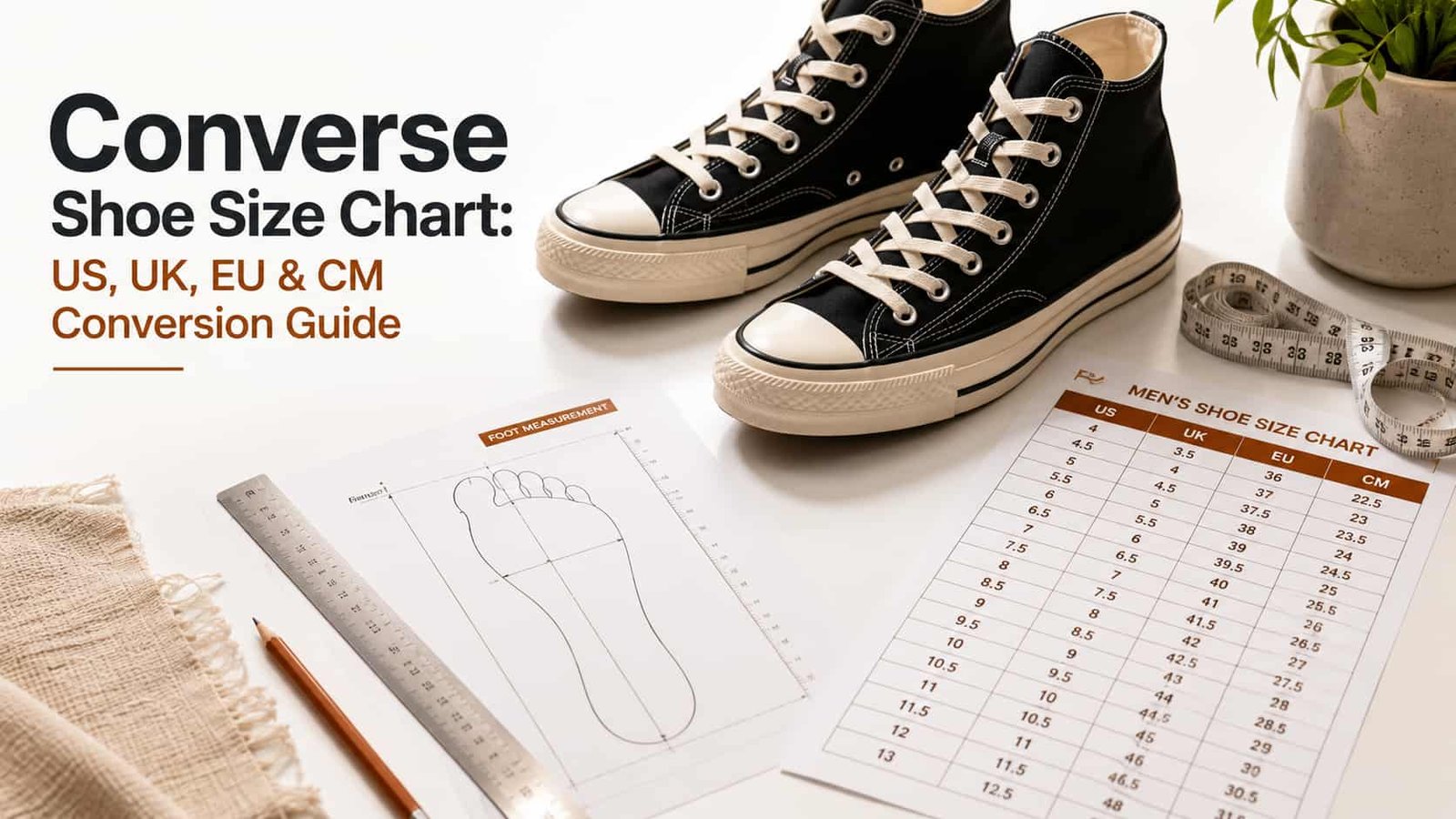
Converse Shoe Size Chart: US, UK, EU & CM Conversion Guide
Quick Answer: What Converse Size Should You Buy?
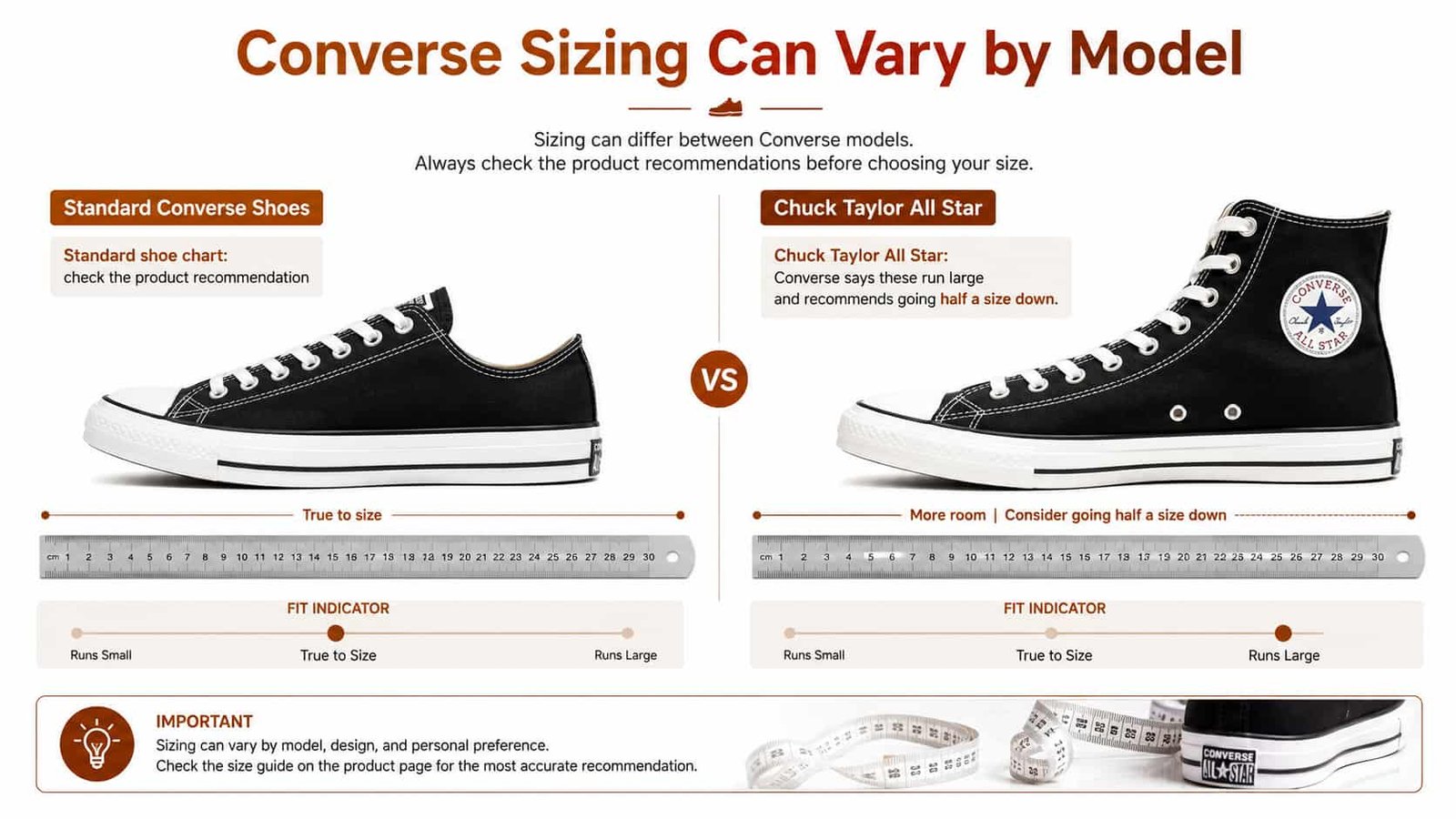
If you are looking at a Converse shoe size chart, start with your measured foot length in centimetres, then compare it with the correct Converse model chart. Converse sizing is not identical across every style. Its standard shoe guide notes that fit can vary by product, while its Chuck Taylor All Star guide says those shoes run large and recommends going half a size down.
For example, in Converse’s standard men’s chart, a US Men’s 10 corresponds to UK 9.5, EU 44 and 28 cm. In the Chuck Taylor All Star chart, US Men’s 10 corresponds to UK 10, EU 44 and 28.5 cm. That difference is exactly why checking the model-specific chart matters.
The safest approach is simple: measure both feet, record the longer foot, identify your model, then use the corresponding Converse chart.
⚡ Quick Answer
- Measure your foot before choosing your Converse size.
- Use centimetres as your main reference when possible.
- Converse sizing can vary between shoe models.
- Chuck Taylor All Stars are listed by Converse as running large.
- Do not assume your usual sneaker size will fit every Converse style.
Converse Shoe Size Chart
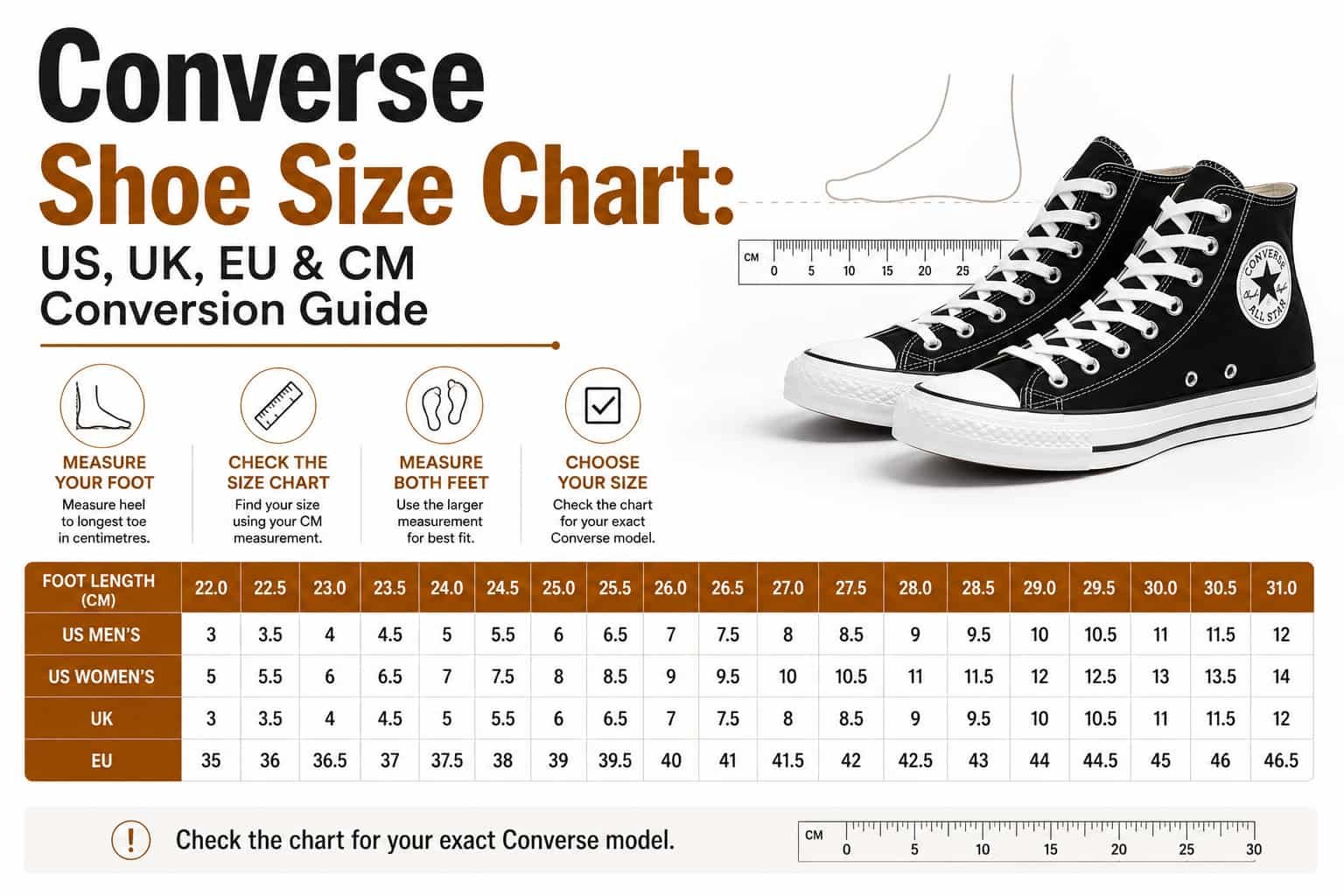
The table below shows the standard Converse men’s shoe size conversion across US, UK, EU and centimetres. Converse’s official standard shoe chart also provides women’s equivalents and notes that fit can vary by product, so use the model-specific product information when available.
| US Men’s | US Women’s Equivalent | UK | EU | Foot Length |
| 3 | 4.5 | 2.5 | 35 | 21 cm |
| 3.5 | 5 | 3 | 35.5 | 21.5 cm |
| 4 | 5.5 | 3.5 | 36 | 22 cm |
| 4.5 | 6 | 4 | 37 | 22.5 cm |
| 5 | 6.5 | 4.5 | 37.5 | 23 cm |
| 5.5 | 7 | 5 | 38 | 23.5 cm |
| 6 | 7.5 | 5.5 | 38.5 | 24 cm |
| 6.5 | 8 | 5.5 | 39 | 24.5 cm |
| 7 | 8.5 | 6 | 40 | 25 cm |
| 7.5 | 9 | 6.5 | 40.5 | 25.5 cm |
| 8 | 9.5 | 7 | 41 | 26 cm |
| 8.5 | 10 | 7.5 | 42 | 26.5 cm |
| 9 | 10.5 | 8 | 42.5 | 27 cm |
| 9.5 | 11 | 8.5 | 43 | 27.5 cm |
| 10 | 11.5 | 9 | 44 | 28 cm |
| 10.5 | 12 | 9.5 | 44.5 | 28.5 cm |
| 11 | 12.5 | 10 | 45 | 29 cm |
| 11.5 | 13 | 10.5 | 46 | 29.5 cm |
| 12 | 13.5 | 11 | 46.5 | 30 cm |
| 12.5 | 14 | 11.5 | 47 | 30.5 cm |
| 13 | 14.5 | 12 | 47.5 | 31 cm |
| 13.5 | 15 | 12.5 | 48 | 31.5 cm |
| 14 | 15.5 | 13 | 49 | 32 cm |
| 14.5 | 16 | 13.5 | 49.5 | 32.5 cm |
| 15 | 16.5 | 14 | 50 | 33 cm |
Important: This is the standard Converse chart. Chuck Taylor All Star sizing is presented separately by Converse, so do not use this table blindly for every Converse model.
A useful example
If your foot measures around 28 cm, the standard Converse chart places you at US Men’s 10, UK 9.5 and EU 44. But if you are buying a Chuck Taylor All Star, the Chuck Taylor chart lists US Men’s 10 at 28.5 cm, which illustrates why the shoe model matters.
💡 Expert Tip
Do not convert your regular sneaker size to Converse automatically. Start with your actual foot measurement, then check the specific Converse model you want to buy.
Converse Size Finder
Here is a simple interactive tool you can place directly inside your WordPress article.
It is designed as a helpful starting point rather than a replacement for the official model-specific Converse chart.
Find Your Starting Converse Size
Enter your longer foot measurement in centimetres to get a starting US, UK and EU size.
This tool gives a starting point based on the measurement entered. Converse fit can vary by model, so check the size recommendation for the exact shoe before ordering.
Converse US, UK, EU and CM Size Conversion
Converting between US, UK and EU sizes is useful when shopping internationally, but foot length is the most practical starting point because sizing systems do not increase in exactly the same way.
For example, the standard Converse chart maps US Men’s 8 to UK 7, EU 41 and 26 cm. US Men’s 10 maps to UK 9.5, EU 44 and 28 cm.
If you regularly compare brands, you may also find our men’s shoe size chart useful because it gives you a broader reference point before comparing Converse with other footwear brands.
For international shopping, our global shoe size converter can also help you understand how US, UK and EU sizing systems relate.
Why CM can be easier
Suppose your foot measures 27.5 cm.
Instead of remembering several conversions, you can look for the Converse size corresponding to 27.5 cm and then check the US, UK and EU values.
That is especially helpful when buying from an international website where the size selector may use a different system.
Does Converse Run True to Size?
Converse sizing depends on the shoe model, so there is no single true-to-size rule for every Converse shoe. Converse’s standard shoe guide says fit may vary and recommends checking individual product details. Its Chuck Taylor All Star guide specifically says those sneakers run large and recommends going half a size down.
This distinction matters because someone saying “Converse runs big” may be talking specifically about Chuck Taylor All Stars, while another person may be wearing a different Converse model.
The practical rule
Use this order:
1. Identify the Converse model.
2. Measure both feet.
3. Check the model’s size chart.
4. Compare your measurement with the chart.
5. Consider the fit preference and shoe construction.
This is much more reliable than simply choosing the size you normally wear in another sneaker.
Why Can Converse Shoe Sizes Differ Between Models?
Different Converse models can have different fit characteristics, so the same numerical size does not automatically feel identical across the entire range.
Converse’s official size information distinguishes between its standard shoes and Chuck Taylor All Star sizing. The standard chart includes styles such as Jack Purcell, One Star, Pro Leather and other models, while the Chuck Taylor guide has its own measurements.
That means your first question should not be:
“What is my Converse size?”
A better question is:
“What size should I choose for this specific Converse model?”
That small change can prevent a surprisingly common sizing mistake.
Chuck Taylor All Star sizing
Converse states that Chuck Taylor All Star sneakers run large and recommends going half a size down. Its chart also gives separate US, UK, EU and length measurements.
Standard Converse shoes
For standard Converse shoes, the official chart gives a different conversion table and warns that fit may vary by product.
IMAGE PLACEMENT: Add a model comparison infographic here showing “Standard Converse vs Chuck Taylor sizing”.
How to Measure Your Feet for Converse Shoes
The best Converse shoe size chart is only useful when your measurement is accurate.
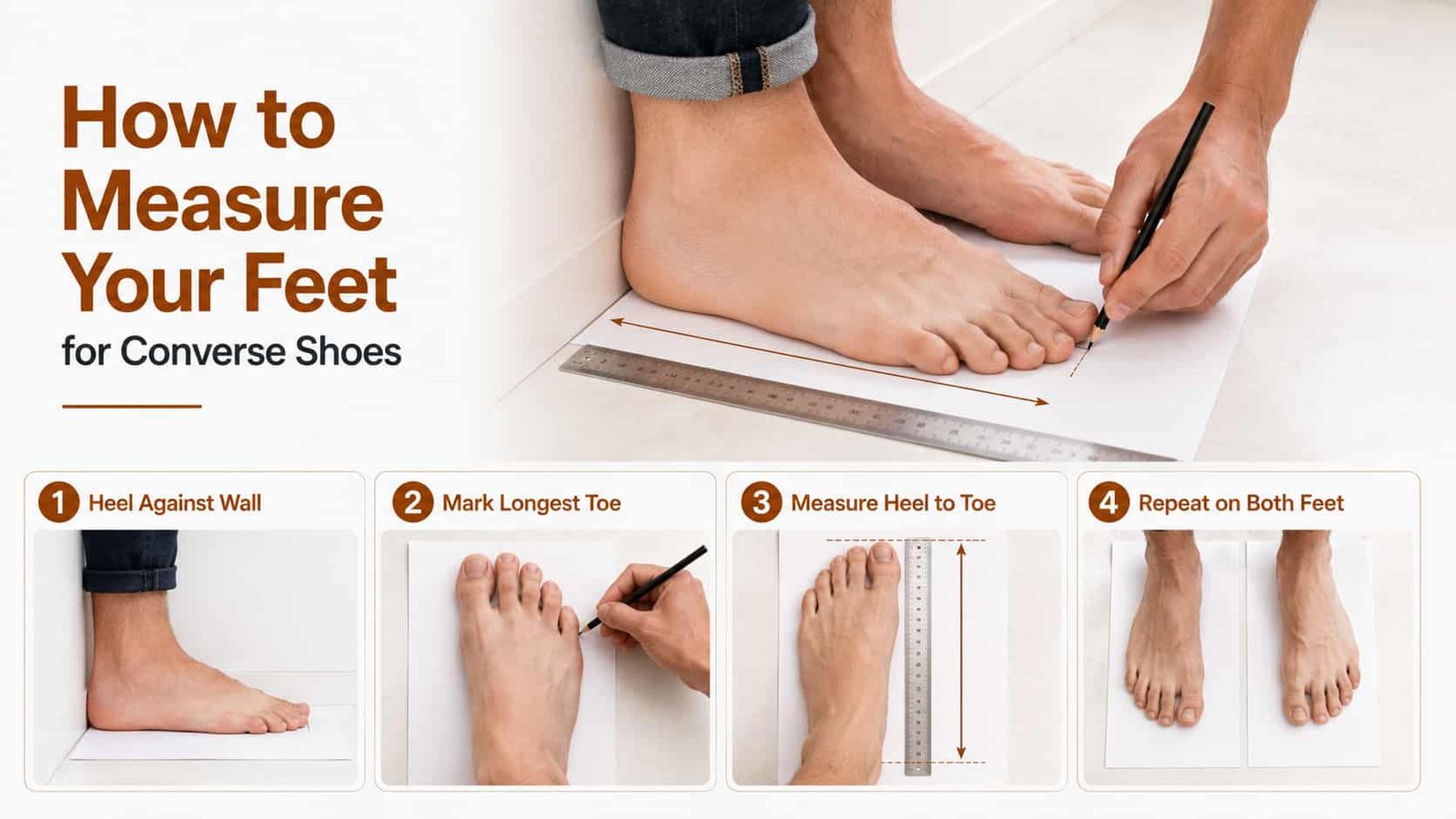
Converse recommends measuring on a hard, flat surface with your heel against a wall. It also recommends measuring both feet because one foot can be longer than the other.
What you need
- A blank sheet of paper
- A pencil
- A ruler or measuring tape
- A flat wall
- The socks you expect to wear with the shoes
Step 1: Place the paper against a wall
Put the paper on a hard, flat floor and position one edge against the wall.
Step 2: Put your heel against the wall
Stand naturally with your heel touching the wall.
Do not sit down for the main measurement. Your foot can spread differently when you are standing.
Step 3: Mark the longest toe
Ask someone to mark the end of your longest toe.
Your longest toe may not always be your big toe.
Step 4: Measure heel to toe
Measure from the back edge of the heel position to the longest toe mark.
Record the result in centimetres.
Step 5: Repeat on the other foot
Measure your other foot using exactly the same method.
If one foot is longer, use the longer measurement when selecting your shoe size.
Step 6: Compare with the correct Converse chart
Now compare your measurement with the chart for the exact Converse model.
This final step is important. Measuring your feet accurately does not help if you then use the wrong model’s size chart.
Should You Measure With Socks On?
Yes, if you normally wear the Converse shoes with socks, measuring while wearing those socks can give you a more realistic idea of the space your foot needs.
For thin everyday socks, the difference may be small. With thicker socks, the extra volume can matter more.
The goal is not to create an artificially large measurement. The goal is to recreate the conditions in which you will actually wear the shoes.
What If You Are Between Converse Sizes?
If your measurement falls between two sizes, do not automatically choose the larger size simply because it gives you more room.
First check:
- The exact Converse model
- The model’s fit recommendation
- Whether you prefer a close or relaxed fit
- The socks you plan to wear
- Whether the shoe is available in a wider option
For Chuck Taylor All Stars, Converse’s official guidance says the shoes run large and recommends going half a size down.
For other Converse styles, follow the individual product recommendation because the standard guide notes that fit can vary by product.
How Should Converse Shoes Feel When They Fit Correctly?
A well-fitting Converse shoe should feel secure without creating painful pressure.
You should look for:
- Your toes having enough room to move naturally
- No painful pressure at the front
- Your heel staying reasonably secure
- No severe rubbing around the sides
- No uncomfortable squeezing across the widest part of the foot
- The shoe feeling stable when walking
A shoe should not need to be painfully tight to feel secure.
At the same time, excessive empty space can allow your foot to move too much inside the shoe.
How Do You Know Converse Shoes Are Too Small?
Common warning signs include:
- Your longest toe presses against the front
- Your toes feel cramped
- The upper creates strong pressure over the forefoot
- You develop rubbing quickly
- Your foot feels numb or uncomfortable
- Your heel-to-toe movement feels restricted
- You avoid wearing the shoes because they hurt
One important point: do not expect a significantly tight shoe to “stretch into the perfect size.” Material can soften with wear, but that does not turn an incorrectly sized shoe into a correctly sized one.
How Do You Know Converse Shoes Are Too Big?
A Converse shoe may be too large when:
- Your heel repeatedly slips
- Your foot moves forward inside the shoe
- You have to overtighten the laces
- Your toes grip the floor to keep the shoe secure
- The shoe feels unstable when walking
- You have excessive movement inside the heel
A common mistake is buying a shoe too large because you want it to last longer.
⚠ Common Mistake
Choosing a much larger shoe just to get more wear can create unnecessary movement inside the shoe. Aim for a comfortable fit first, then consider the model’s recommended sizing.
How Does Converse Fit Different Foot Widths?
Foot length is only one part of fit.
Two people can have the same heel-to-toe measurement but very different foot shapes.
One person may have:
- A narrow heel
- A wide forefoot
- A high instep
Another person may have:
- A broader heel
- A lower instep
- A narrower forefoot
Converse’s official standard size guide also lists wide width sizes, with additional volume and a broader platform compared with standard widths.
If the length feels correct but the sides feel uncomfortably tight, do not immediately assume you need a longer shoe.
The problem may be width.
Converse Shoe Size Conversion vs Other Brands
Your Converse size should not automatically be assumed to equal your Nike, Adidas, New Balance or Hoka size.
Different brands use different lasts, measurements and fit philosophies.
If you are switching from another brand, start with your foot length rather than transferring the number directly.
For example, if you normally wear a particular size in Nike, that information can be useful as a reference, but it should not replace measuring your foot.
You can compare your results with our Nike shoe size chart and Adidas shoe size chart when shopping across brands.
If you regularly wear running shoes, our New Balance shoe size chart and Hoka shoe size chart can also help you compare brand-specific sizing.
What Should You Check Before Ordering Converse Online?
Before pressing the buy button, take 30 seconds to check these details:
Your foot measurement: Know the longer foot measurement in centimetres.
Your Converse model: Check whether it is a Chuck Taylor, standard Converse sneaker or another model.
The model-specific chart: Do not assume every Converse shoe follows the same conversion.
Width: If your length is correct but the shoe feels tight across the forefoot, investigate width rather than simply adding length.
Socks: Think about what you will actually wear with the shoes.
Return policy: Check the retailer’s current return conditions before ordering.
Common Converse Sizing Mistakes
Choosing your usual sneaker size without measuring
Your regular size is a useful reference, but it is not a guarantee.
Treating every Converse shoe as the same
This is one of the biggest mistakes. Converse itself provides separate sizing information for different shoe groups.
Ignoring centimetre measurements
US and UK numbers can be confusing when shopping internationally. CM gives you a much more direct measurement reference.
Measuring only one foot
Feet are not always identical.
Measuring while sitting
Your weight-bearing foot can behave differently when you stand.
Buying too large for extra room
More room is not always better. Excessive movement can make a shoe feel unstable.
Assuming a tight shoe will stretch enough
Comfortable materials can soften, but they cannot fix a fundamentally wrong size.
👟 A Fitting Tip Worth Remembering
After years of fitting footwear, one lesson remains consistent: the best starting point is the foot, not the number printed on your old shoes. Measure first, then use the correct brand and model chart.
How Often Should You Recheck Your Converse Size?
Adults’ feet do not usually change size as quickly as children’s feet, but your fit can still change over time.
Weight changes, activity levels, swelling, footwear habits and changes in foot shape can all influence comfort.
If a pair that previously felt comfortable suddenly feels tight or unstable, remeasure rather than assuming the shoe has changed.
For a broader understanding of adult sizing, our shoe size conversion chart and calculator can be useful when comparing different sizing systems.
Converse Shoe Size FAQs
Does Converse run true to size?
It depends on the model. Converse’s standard shoe guide says fit may vary by product, while the official Chuck Taylor All Star guide says those shoes run large and recommends going half a size down. Check the model-specific chart instead of applying one rule to every Converse shoe.
Should I size down in Converse?
For Chuck Taylor All Stars, Converse officially recommends going half a size down because the shoes run large. For other Converse models, follow the product-specific recommendation because sizing can vary. Your foot measurement should remain the starting point.
What is a US Men’s 10 in Converse?
In Converse’s standard men’s chart, US Men’s 10 corresponds to UK 9.5, EU 44 and 28 cm. However, the Chuck Taylor All Star chart lists US Men’s 10 as UK 10, EU 44 and 28.5 cm, which shows why model-specific sizing matters.
What is a US Men’s 9 in Converse?
The standard Converse men’s chart lists US Men’s 9 as UK 8, EU 42.5 and 27 cm. If you are buying a specific Converse model, check its own chart before ordering because the conversion can differ between models.
What is a US Men’s 8 in Converse?
The standard Converse chart lists US Men’s 8 as UK 7, EU 41 and 26 cm. Use this as a standard-chart reference, then confirm the sizing information for the exact shoe you are purchasing.
How should I measure my feet for Converse?
Place paper against a wall on a hard floor, put your heel against the wall, stand naturally and mark the longest toe. Measure the heel-to-toe distance, then repeat on the other foot. Converse recommends measuring both feet because they can differ.
Should I measure both feet before buying Converse?
Yes. One foot can be slightly longer than the other. Use the longer measurement when comparing your feet with the Converse size chart. This simple step can prevent choosing a size based on the smaller foot.
Is Converse sizing the same as Nike?
Not necessarily. Converse and Nike use their own sizing information and footwear constructions. Your Nike size can provide a rough reference, but measuring your foot and checking the Converse chart is a more dependable approach.
Is Converse sizing the same as Adidas?
No single conversion should be assumed. Even when two brands display the same US size, their shoes can feel different because of shape, construction and fit. Measure your foot and compare the measurement with the relevant Converse chart.
Are Converse shoes good for wide feet?
Some Converse sizing information includes wide width options. If the shoe feels tight across the forefoot while the length is correct, look at width availability instead of automatically moving to a longer size.
Why does my usual Converse size feel different in another model?
Different Converse models can have different fit characteristics. Converse separates its standard shoe chart from its Chuck Taylor All Star chart, and the brand specifically notes that fit can vary by product.
Should I buy Converse shoes with extra room?
A little comfortable space is different from buying a shoe that is obviously too large. Your toes should not be crushed against the front, but your foot should also remain reasonably secure. Follow the model’s fit recommendation rather than deliberately buying much larger.
Final Thoughts
Finding the right Converse size does not have to involve guesswork.
The most reliable process is simple: measure both feet, record the longer measurement, identify the exact Converse model, and then use the appropriate US, UK, EU and CM chart.
Most importantly, do not assume every Converse shoe fits exactly the same way. The official Converse guides show that model-specific sizing matters, particularly for Chuck Taylor All Stars.
If you are still comparing sizes across brands, use our global shoe size converter or shoe size conversion chart and calculator to make the comparison easier.
Measure first. Check the model. Then choose your Converse size with confidence.
Helpful Shoe Size Guides
Comparing Converse with other footwear brands? Explore these sizing guides.
Quick tip: Brand sizing can vary slightly, so compare the actual foot measurement with the relevant size chart whenever possible.