
Foot Comfort and Supportive Footwear: Massage, Shoes and Everyday Habits That Help
The short answer
For everyday foot comfort, the basics matter more than any technique: shoes that fit properly, enough support for how you use your feet, regular movement and rest, and a quick check of your feet. A foot massage or a gentle reflexology routine can add relaxation, but it does not fix a poor-fitting shoe. Orthopaedic guidance is consistent on the fit points: shop late in the day, leave about half an inch beyond your longest toe, choose a roomy toe box, keep heels low, and look for a shoe that bends at the toes, not the arch.
- Fix first: fit, support and cushioning that match your day.
- Then add: a few minutes of foot massage for relaxation.
- See a clinician for pain that is severe, lasts beyond 2 weeks of self-care, or comes with numbness or tingling.
Start with fit: a 5-point check
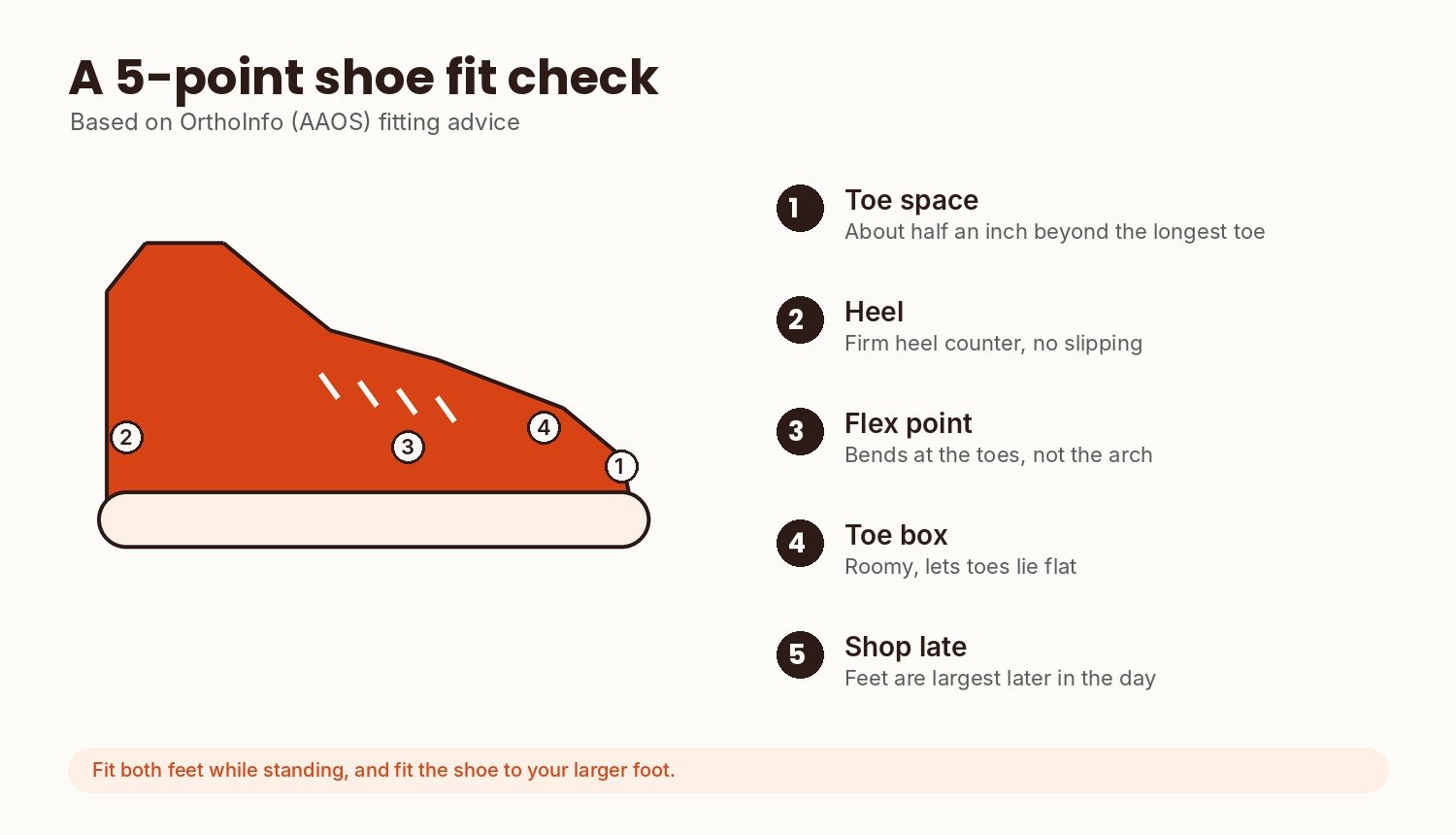
The American Academy of Orthopaedic Surgeons’ patient site, OrthoInfo, gives these fitting tips:
- Shop late in the day, when feet are most swollen.
- Have both feet measured every year while standing, because body weight widens the foot. If one foot is larger, fit the shoe to that foot.
- Do not choose by size alone. Sizing varies by brand and style, so try shoes on.
- Leave about half an inch between your longest toe, which may not be your big toe, and the tip of the shoe.
- Choose a roomy toe box that lets toes lie flat. If a shoe is too wide, try a brand with a wider toe box rather than a bigger size.
- Wear the sock you will use with the shoes when you try them on, and avoid shoes that must be stretched or padded to stay on.
- Look for a shoe that bends at the toes, not the arch, and for flat feet, a stiff heel counter.
- Keep heels under about 2 inches, or add a platform under the toe box if you prefer higher heels.
OrthoInfo also notes that leather is sturdier, while mesh and synthetic materials lose shape and support sooner. See how we evaluate shoes in our shoe testing methodology.
Match the shoe to the problem
| Your situation | What to look for | Read next |
|---|---|---|
| Standing or walking most of the day | Cushioning, a stable base and room for toes | Best shoes for standing all day |
| Heel or arch pain, especially first steps in the morning | Supportive shoes with cushioned heels, with insoles or heel pads where helpful (NHS, OrthoInfo) | Plantar fasciitis shoes guide, morning heel pain shoes |
| Walking comfort with nerve damage or reduced feeling | Well-fitting shoes worn at all times, even indoors (CDC), with a roomy toe box | Best walking shoes for neuropathy |
| Comfort at home | Supportive slippers or house shoes rather than going barefoot on hard floors | Best orthopedic slippers, slippers for plantar fasciitis |
| Not sure why your feet hurt | Start with causes before products | Why do my feet hurt?, Foot pain guide |
Footwear habits to avoid
NHS advice for plantar fasciitis lists several habits that strain the foot, and they apply more widely:
- High heels, and tight, pointed shoes
- Flip-flops and backless slippers
- Walking barefoot on hard surfaces
- Prolonged standing or walking without breaks
OrthoInfo also says to limit flip-flops, which strain the toes and arch, and to choose sandals with ankle straps and arch support.
Where foot massage fits in
A foot massage is a pleasant, low-risk way to relax tired feet. It does not correct fit or support, and reflexology has not been proven to treat any condition. The National Center for Complementary and Integrative Health says the claim that reflexology promotes relaxation and healing is not proven, and Cleveland Clinic says there is no evidence it works better than a foot massage.
- Quick routine: use our 10-minute home routine, with the zones shown on the foot reflexology chart.
- Foot massage or reflexology? See reflexology vs foot massage.
- Devices: see the best reflexology foot massagers.
- Evidence: does foot reflexology work?
If you have numb feet, diabetes, clots, foot wounds or other conditions, ask a clinician first. The complete guide to foot reflexology has the full safety list.
Daily foot care
The CDC’s foot-care advice for people with diabetes is a sound routine for anyone:
- Check both feet every day for cuts, redness, swelling, sores, blisters, calluses or nail changes.
- Wash in warm, not hot, water, dry thoroughly, and moisturize the tops and soles but not between the toes.
- Wear shoes, socks or slippers, even indoors.
- Trim toenails straight across and smooth sharp edges.
- Break in new shoes gradually.
For nerve-related symptoms, see reflexology for neuropathy in feet.
When to see a clinician
Get medical advice if:
For heel pain, see plantar fasciitis, heel pain when walking and our guide to reflexology and plantar fasciitis.
Signs your shoes are the problem
- Pain or burning in the ball of the foot after walking, which can mean too little cushioning or a narrow toe box.
- Toes that cramp, curl, or have red marks, corns or calluses from rubbing.
- Heels that slip, blister or ache by the end of the day.
- Uneven sole wear, or a shoe that leans to one side when set on a table.
- Aches in the arch or heel that ease when you take your shoes off.
- Black or bruised toenails after exercise.
If symptoms continue after switching to well-fitting shoes, see a clinician. Our why do my feet hurt? guide covers the other causes.
Insoles or supportive shoes: which first?
Start with the shoe. A shoe that fits well, with space for your toes, a firm heel counter and a sole that bends at the toes, is the foundation. An insole inside a shoe that does not fit just crowds your foot. Insoles can then add cushioning or support where you need it, and for heel pain the NHS suggests supportive shoes and considering insoles or heel pads. A podiatrist can advise on insoles for flat feet, high arches or recurring pain. Be careful with strong claims about insoles curing conditions.
Comfort habits for a long day on your feet
- Alternate weight between feet and shift position every so often, and use an anti-fatigue mat if you stand in one spot.
- Sit for short breaks, and lift and circle your ankles to promote movement.
- Rotate two pairs of shoes so each has time to dry and recover.
- Wear moisture-wicking socks that fit without bunching.
- Stretch your calves and soles morning and evening. See our stretching guide.
- Finish the day with a gentle foot massage, using the 10-minute routine.
When to replace shoes
There is no single mileage or month limit that suits everyone. Use condition as your guide. Replace shoes when the cushioning feels flat or the midsole is visibly compressed or creased, the outsole is worn through or uneven, the upper has lost its shape, or your feet or legs start to ache in a pair that used to be comfortable. OrthoInfo notes that mesh and synthetic materials lose shape and support sooner than leather. Shoes worn daily for work wear out faster than occasional shoes. See also our guide to the best shoes for standing all day.
Foot types and what to look for
- Flat or low arches: OrthoInfo advises a stiff heel counter, and a stable shoe that does not twist easily. A podiatrist can advise on insoles.
- High arches: look for cushioning, since stiff arches absorb less shock, and a stable base.
- Wide feet: choose brands that offer wider widths or a wider toe box, rather than going up a size, as OrthoInfo suggests.
- Narrow feet: a snug heel and secure laces keep your foot from sliding forward.
- One foot larger than the other: fit the larger foot.
Because sizing varies by brand and style, size alone is not enough. Try shoes on, walk around, and check for slipping and pressure points. For help with sizes, see our shoe size conversion chart.
Bunions, hammertoes and corns: shoe choices
Shoes that squeeze the toes can aggravate bunions, hammertoes, corns and calluses. Choose a roomy, deep toe box, soft uppers without hard seams over sore spots, and low heels. Avoid pointed toes and high heels, which push the toes together. Corns and calluses that become painful, bleed or look infected should be seen by a clinician, particularly if you have diabetes or reduced feeling. See why do my feet hurt? for other causes of foot pain, and our complete guide to foot reflexology if you want a relaxing foot routine on top of good shoes.
Frequently asked questions
How do I know if my shoes fit properly?
Try them on late in the day with the socks you will wear. You should have about half an inch beyond your longest toe, a roomy toe box that lets toes lie flat, a snug heel that does not slip, and a shoe that bends at the toes, not the arch.
What is the best time of day to buy shoes?
Late in the day, when feet are most swollen, according to OrthoInfo.
Do I need arch support?
It depends on your foot and your symptoms. OrthoInfo advises a stiff heel counter for flat feet, and the NHS suggests supportive shoes and consideration of insoles or heel pads for plantar fasciitis. A podiatrist can advise on insoles.
Are flip-flops bad for your feet?
OrthoInfo says to limit them because they strain the toes and arch, and the NHS lists them among footwear to avoid with plantar fasciitis.
Can foot massage replace good shoes?
No. Massage can relax tired feet, but it does not fix fit or support.
How often should I have my feet measured?
OrthoInfo advises having both feet measured every year while standing, because body weight widens the foot.
How much room should there be in the toe box?
About half an inch between your longest toe and the end of the shoe, and enough width for your toes to lie flat.
Are expensive shoes better for your feet?
Not necessarily. Fit, support and suitability for your activity matter more than price.
Is it bad to walk barefoot at home?
On hard floors for long periods it can strain your feet, and the NHS lists it among habits to avoid with plantar fasciitis. Supportive slippers can help.
Should I buy shoes in the morning or evening?
Evening, when feet are most swollen, according to OrthoInfo.
More in the foot reflexology series
- Foot pressure points: acupressure points and what they claim
- Reflexology vs acupressure: zones compared with points
- Foot reflexology for headaches and migraines: what trials found
- Foot reflexology for sleep: research and a bedtime routine
Sources
- OrthoInfo (AAOS): Shoes: Finding the Right Fit
- NHS: Plantar fasciitis (last reviewed February 14, 2025)
- CDC: Diabetes and Your Feet (last reviewed May 15, 2024)
- NCCIH: Reflexology
- Cleveland Clinic: Reflexology (published August 30, 2022)
Educational information only, not medical advice.