
How to Do Foot Reflexology at Home: A Gentle 10-Minute Routine
The short answer
You can do a safe, relaxing foot reflexology routine at home in about 10 minutes: warm the foot, then use your thumbs with comfortable pressure on the toes, ball, arch, inner edge and heel in turn, and finish with long strokes. Repeat on the other foot. It is a relaxation routine, not a treatment. Reflexology has not been proven to cure or prevent any disease, so do not use it to replace medical care.
- Time: about 5 minutes per foot.
- Pressure: 4 to 6 out of 10. Stop at 7 or above, or at any sharp pain.
- Skip it, or ask a clinician first, if you have numb feet, diabetes, clots, circulation problems, foot wounds or infections, gout, or you are pregnant.
Before you start
- Check your feet. Look for cuts, blisters, rashes, swelling or redness. If you find any, skip the session.
- Get comfortable. Sit with your back supported and rest one foot on the opposite knee, or on a towel on a stool.
- Wash and dry your feet, then warm them with a towel or a few minutes in comfortably warm (not hot) water. If you have reduced feeling, test any water temperature with your hand, not your foot.
- Optional: a small amount of unscented lotion or oil reduces friction. Trials of reflexology often use oils, but skin can react, so avoid anything that has irritated you before.
- Have the chart nearby. Our foot reflexology chart shows the zones this routine follows.
The 6-step routine
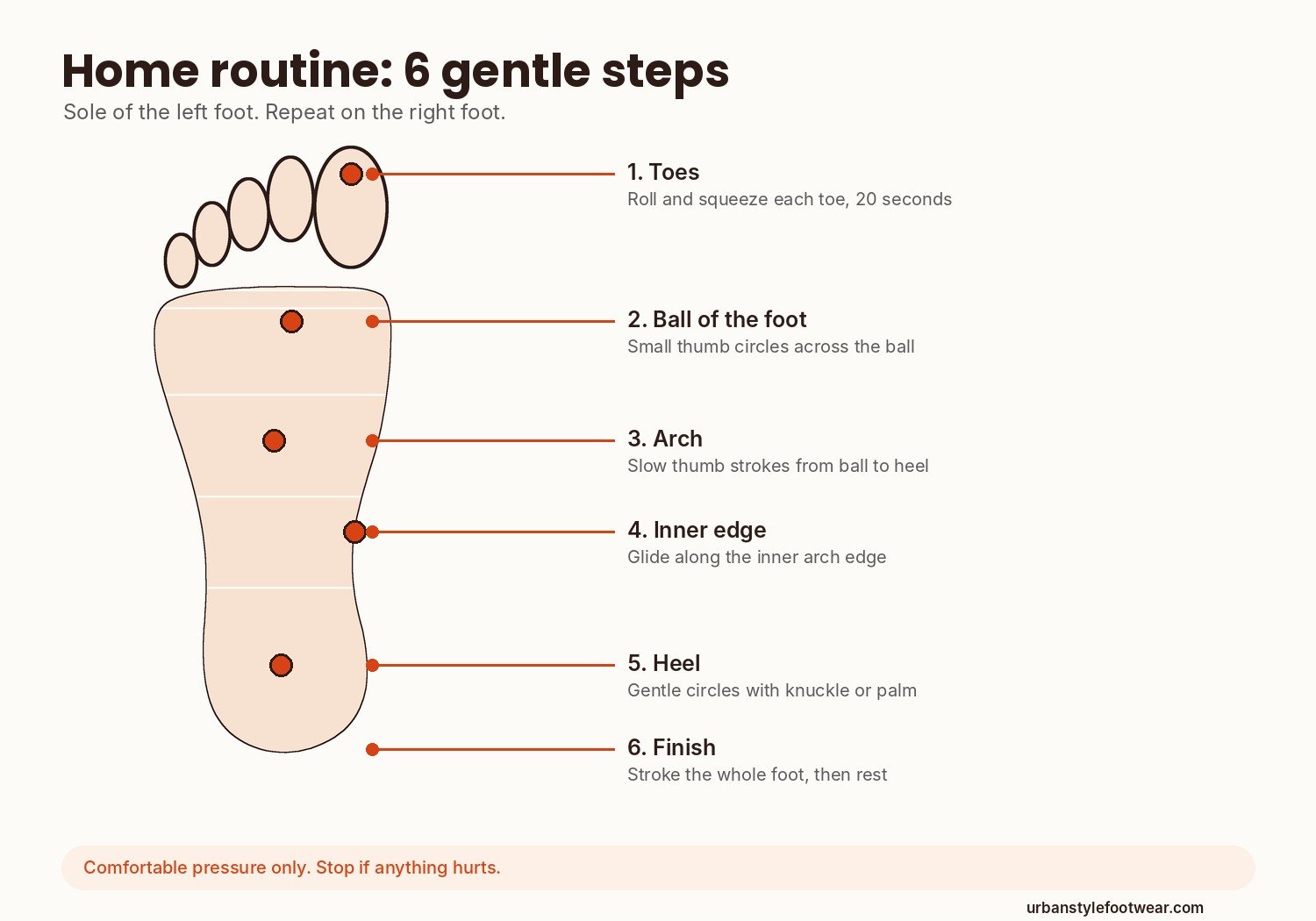
- Toes (about 1 minute). Hold the foot with one hand. With the other, gently squeeze and roll each toe between thumb and finger, working from the big toe to the little toe. Traditionally these zones map to the head and sinuses.
- Ball of the foot (1 minute). Use small thumb circles across the pad below the toes. Traditionally this is the chest and shoulder area.
- Arch (1 minute). Make slow, firm thumb strokes from the ball down toward the heel. Traditionally the arch maps to the digestive organs and kidneys. If the arch is sore, lighten the pressure.
- Inner edge (30 seconds). Glide your thumb along the inside edge of the foot, from the big toe toward the heel. This line is traditionally the spine.
- Heel (1 minute). Use gentle circles with a knuckle or the palm of your hand. This zone is traditionally the pelvis and lower back.
- Finish (30 seconds). Stroke the whole foot with long, light movements from toes to ankle, then rest the foot and breathe.
Repeat on the other foot. The map comes from tradition and is not anatomy. You do not need to believe it for the routine to feel good, and the relaxation is the realistic benefit. Cleveland Clinic describes a professional session as about 50 minutes, roughly 25 minutes per foot, so this is a short at-home version.
How hard to press
Use this scale. Pressure that is too light does little, and too much creates tension and can cause soreness or bruising.
A tender spot is not a diagnosis. Reflexologists say tenderness points to a problem in the matching organ, but there is no research support for that. Feet are tender for ordinary reasons such as shoes, standing and tight calves.
How often and for how long
No research establishes an ideal dose. For context, here is what recent trials used:
- A 2025 randomized trial in people with chronic lymphocytic leukemia used 10-minute foot reflexology sessions daily for 4 weeks, and sleep scores improved compared with the control group. The authors noted limits, including no sham control and short follow-up.
- A 2026 randomized trial in 40 adults with poor sleep used 20-minute reflexology sessions with aromatic oils daily for 21 days, with sleep scores improving from 14.25 to 10.30 in the treated group. The control group sat quietly for 20 minutes.
Those are examples of what researchers tested, not recommendations. A reasonable approach for healthy adults is a 10-minute routine a few times a week, or in the evening to wind down. Stop if the feet feel sore afterward. For the sleep research in detail, see foot reflexology for sleep.
Common mistakes
- Pressing too hard. More pressure is not better.
- Working through pain. If something hurts sharply, stop.
- Treating a symptom with the chart. Do not use foot zones to self-treat headaches, digestive problems or heel pain. See a clinician. Our guides on headaches and migraines and plantar fasciitis explain what is known.
- Using a hard tool on a sore heel. Balls and rollers add pressure fast. If you want a device, see our best reflexology foot massagers.
- Skipping safety checks if you have diabetes or numb feet.
Who should not do this at home
Ask a clinician first, or skip, if you have:
- Diabetes with nerve damage, or any numbness in the feet. You may not feel injury. See reflexology for neuropathy in feet.
- Circulation problems, a history of blood clots, or inflammation of leg veins
- Foot ulcers, open wounds, a fungal infection such as athlete’s foot, gout, or a recent foot injury or surgery
- A low platelet count, thyroid problems, or epilepsy (cautions noted by Cleveland Clinic and Cancer Research UK)
- Pregnancy. Evidence of harm is weak, but do not use reflexology to try to induce labour, and talk to your midwife or doctor first
Side effects are usually mild and short-lived, such as light-headedness or tender feet. Seek medical care for severe foot pain, swelling, redness or fever.
For the full background, read our complete guide to foot reflexology, or compare with a regular foot massage.
Setting up: space, tools and timing
A good setup makes the routine feel easier and more consistent than any technique detail.
- Seat: sit on a chair or the edge of the bed and rest one ankle on the opposite knee, or sit on the floor with your back supported. You should be able to reach the sole without straining.
- Lotion or oil: a small amount reduces friction and ticklishness. Skip it if you have a skin reaction or plan to use a tool.
- Tools: your thumbs and knuckles are enough. If you want a tool, a smooth massage ball is gentler than spiked devices. See our guide to foot massagers for devices.
- Timing: after a warm shower, at the end of the workday, or before bed. Avoid doing it right after a heavy meal.
- Environment: dim light, a quiet room and slow breathing make the routine more relaxing.
Troubleshooting: ticklish, sore or feeling nothing
- My feet are very ticklish. Use firmer, slower pressure instead of light touch, warm the foot first, and rest your whole hand on the foot for a few seconds before moving.
- Some spots feel tender. Mild tenderness is common in tired feet. Stay at comfortable pressure, work around the area gently, and do not dig in.
- I feel nothing. Pressure may be too light, or your feet may be calloused. Increase slightly, but if you have reduced feeling in your feet, stop and read our neuropathy safety guide.
- My feet are sore afterwards. You used too much pressure or too long. Next time cut the time in half and lighten up. Some people also feel a little light-headed, so sit still for a moment before standing.
- I fall asleep. That is fine, and a common reason people use the routine at night.
Adapting the routine to your day
- Desk workers: take 3 minutes mid-afternoon for toe circles and arch strokes, and stand up and walk between sessions.
- People on their feet all day: focus on the arch and ball of the foot, and pair it with supportive shoes. See foot comfort and supportive footwear.
- Runners and walkers: use light pressure after activity, not on an inflamed heel.
- Older adults: choose a stable seat, keep pressure light and check feet for skin changes. If balance is a concern, avoid standing on massage balls.
Doing it for someone else
Giving a partner or parent a foot routine is a nice way to relax together. Ask about comfort throughout, avoid anyone with the conditions in our safety lists, and do not press harder to try to treat a symptom. Some people dislike touching another person’s feet, and that is fine. Washing the feet first and using a towel makes it more pleasant. For the evidence and the full list of cautions, see the complete guide to foot reflexology.
A 5-minute version and a weekly plan
If 10 minutes feels like too much, a 5-minute version still gives most of the relaxation: warm the foot for 30 seconds, squeeze and roll each toe, make slow thumb circles across the ball and arch for a couple of minutes, then finish with a few strokes from toes to ankle. Repeat on the other foot.
- Monday, Wednesday, Friday: the full 10-minute routine.
- Tuesday, Thursday: 5-minute version, or just toe and ankle circles.
- Weekend: a longer, slower session with a warm foot soak if your feet are healthy.
Keep a note of how your feet and mood feel afterwards, and adjust. If you notice no benefit after a few weeks, nothing is lost by stopping. It is a comfort routine, not a treatment. For the evidence, see does foot reflexology work?
Frequently asked questions
How do you do reflexology on your own feet?
Warm the foot, then use your thumbs with comfortable pressure on the toes, ball, arch, inner edge and heel in turn, finishing with long strokes. About 5 minutes per foot is enough for a first routine.
How long should a foot reflexology session last at home?
About 10 minutes in total is a reasonable start. Professional sessions run about 50 minutes, according to Cleveland Clinic.
How often can I do foot reflexology?
No ideal frequency has been established. Healthy adults commonly use a short routine a few times a week or in the evening. Stop if your feet feel sore.
Can I do reflexology on myself?
Yes, if you are healthy and use gentle pressure. People with numb feet, clots, wounds, infections or pregnancy should check with a clinician first.
Does foot reflexology hurt?
It should not. Aim for firm but pleasant pressure, about 4 to 6 out of 10.
Do I need oil or lotion?
No. A small amount of unscented lotion or oil can reduce friction. Avoid anything that has irritated your skin.
How often should I do foot reflexology at home?
A few times a week, or daily for 10 minutes if it feels good. There is no proven dose, so follow how your feet feel.
Do I need to follow the chart exactly?
No. A simple routine of warming, toes, ball and arch, then heel gives most of the relaxation. The foot reflexology chart is optional background.
Can I use a foot roller or ball instead of my hands?
For healthy feet, a smooth ball or roller is fine at moderate pressure. Avoid them on an inflamed heel, wounds, or numb feet.
Should I drink water afterwards?
You can, as part of general hydration. The idea that reflexology flushes toxins is not supported by evidence, so do not rely on it.
More in the foot reflexology series
- Foot pressure points: acupressure points and what they claim
- Reflexology vs acupressure: zones compared with points
- Does foot reflexology work?: what the research shows
- Foot comfort and supportive footwear: fit and everyday habits
Sources
- Cleveland Clinic: Reflexology (published August 30, 2022)
- Cancer Research UK: Reflexology (reviewed June 17, 2022)
- NCCIH: Reflexology
- Foot reflexology and sleep quality in chronic lymphocytic leukemia under chemotherapy, 2025 (PubMed 41132190)
- Foot reflexology massage with aromatic oils and sleep quality, randomized trial, 2026 (PubMed 42428595)
- Healthline: What is reflexology? (updated January 14, 2026)
Educational information only, not medical advice.