
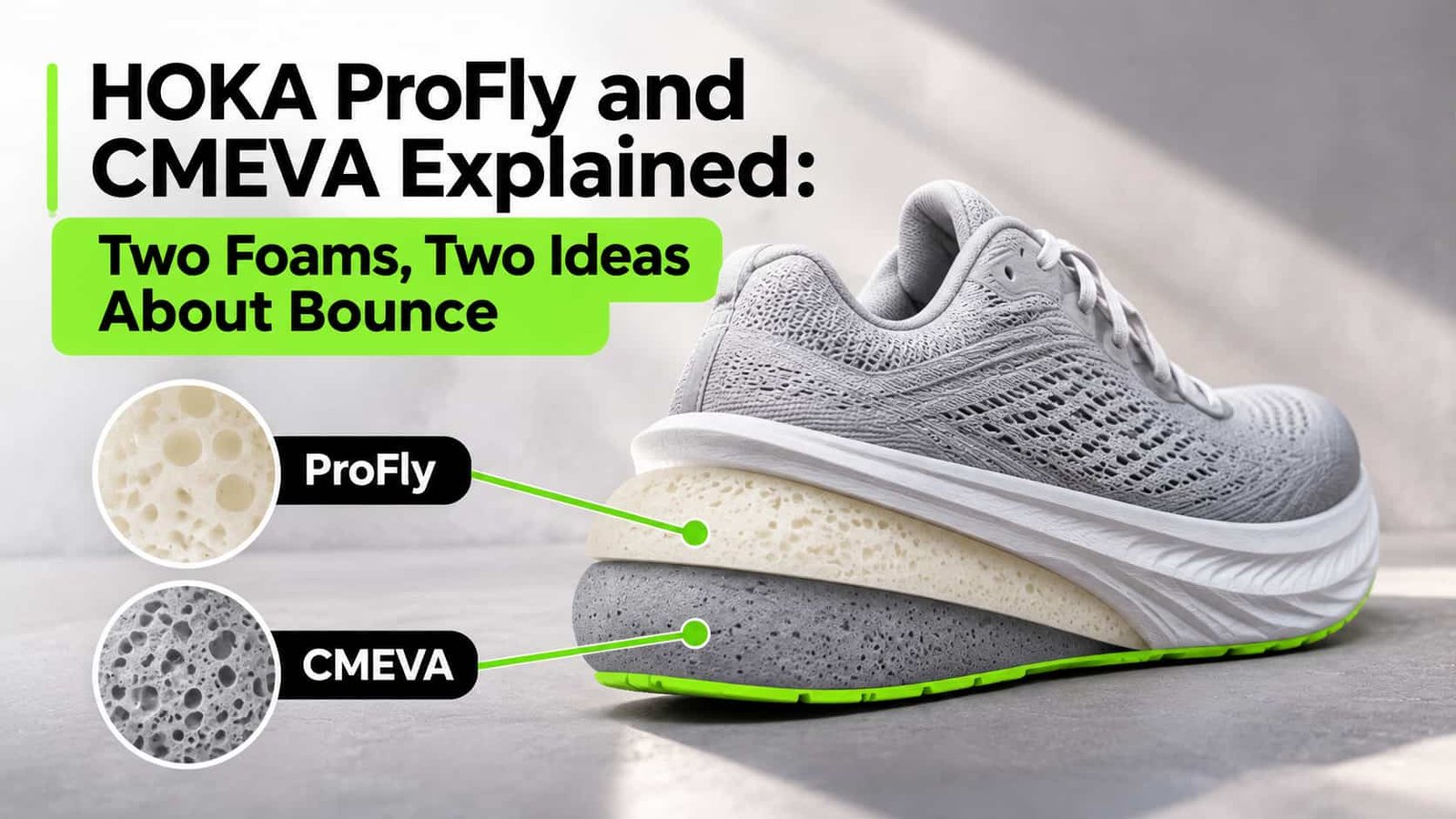
HOKA ProFly and CMEVA Explained: Two Foams, Two Ideas About Bounce
Summarise this guide with AI
Open your preferred assistant and submit the prefilled request. The assistant only reads this page after you submit it.
- What HOKA ProFly’s dual-layer midsole is and how its layers work
- What CMEVA is, and how it differs from ProFly
- What lab tests show about energy return and shock absorption
- Which HOKA shoes suit plush, protective running
Quick answer: ProFly is HOKA’s stacked, dual-layer midsole system, with a softer top foam for comfort and a firmer bottom foam for toe-off. CMEVA is an older HOKA foam used in Clifton and Arahi models. Lab testing has found CMEVA’s energy return low, and HOKA’s newer PROGLIDE+ foam in the Clifton PRO measured higher. Check the midsole name on the product page before you buy.
Key Takeaways
- ProFly is an architecture, not one foam. HOKA describes a soft top layer for its signature cushioning and a firmer bottom layer for propulsive toe-offs.
- CMEVA is a single foam with a limited rebound. Reviewers describe it as outdated, and lab results put Clifton 11 energy return at 46.8% in the heel, below the 58.7% average.
- HOKA has started naming its foams. RunRepeat notes that the brand has long avoided naming its foams, and the Clifton PRO’s PROGLIDE+ is a supercritical EVA that measured higher than CMEVA.
- The ride is protective and stable. CMEVA-based shoes score well on shock absorption, which matches HOKA’s long-standing focus.
- Specifications vary by model. Public data does not fully confirm the composition of every ProFly layer, so compare the full shoe.
What Is HOKA ProFly?
HOKA’s ProFly page describes ProFly as a stacked, dual-layer midsole for a snappier ride. The two-part midsole pairs a soft top layer, which delivers HOKA’s signature cushioning, with a responsive bottom layer that provides propulsive toe-offs. HOKA’s meta description puts it simply: a firm bottom foam for propulsive toe-offs, with the classic soft top foam for cushioning.
That structure matters more than any single foam. A dual-layer midsole lets a brand put comfort where the foot lands and firmness where the foot pushes off. It also explains why ProFly appears across different HOKA categories, from everyday and race-oriented shoes to some trail models.
ProFly is best read as a design approach. The foams inside it can change from model to model, and HOKA does not publish a full formula for each layer. That is why a ProFly shoe can feel very different from another ProFly shoe.
For background on midsole layers, our midsole, insole and outsole guide explains how stacked foams work.
What Is CMEVA?
CMEVA is one of HOKA’s long-running midsole foams, found in models including the Clifton and Arahi lines. RunRepeat’s Clifton 11 review describes it as an outdated foam that is heavier than supercritical EVA, and it notes that HOKA kept CMEVA in the Clifton 11 despite the chance to upgrade.
The foam’s main strengths are protection and a soft, stable landing. Lab tests in RunRepeat’s Clifton 11 review recorded 146 SA in the heel for shock absorption, compared with an average of 131 SA across the tested sample, which shows that CMEVA-based shoes can be very protective.
Its main weakness is rebound. The same review measured energy return at 46.8% in the heel and 50.1% in the forefoot, against an average of 58.7%. The reviewer described that as a missed opportunity for HOKA, given the brand’s access to more advanced foams.
Our EVA foam explainer covers the base material most HOKA foams are built from, and helps explain why supercritical versions behave differently.

ProFly and CMEVA Are Not the Same
This is the most common point of confusion. ProFly is the system, the layered architecture HOKA uses to build the midsole. CMEVA is a specific foam. A ProFly shoe may use one foam in its top layer and another in its bottom layer, and the foam names do not always appear on the shoe.
HOKA’s reviews also show that the brand has used different foams in its layered designs over time. RTINGS describes the Clifton 9 as using an updated ProFly+ midsole, and reviewers have described the Clifton PRO’s PROGLIDE+ as a supercritical EVA that replaced the CMEVA used in the Clifton 11.
For readers, the practical rule is this: ProFly tells you about the structure, and the foam name tells you about the material. Read both before you decide.
How ProFly’s Two Layers Work
The logic of ProFly rests on two jobs for two layers. The top layer is the one your foot meets first. HOKA’s description calls it soft and responsible for the brand’s classic cushioning. This layer sets the comfort, the landing and the feel of the ride.
The bottom layer sits lower and is firmer. HOKA says it provides propulsive toe-offs, which means it helps the shoe push you forward as you leave the ground. A firmer base can stabilise a tall midsole and give a more direct feel at pace.
This split has trade-offs. A firmer bottom layer can make a shoe feel more energetic at push-off, but it can also make the ride feel less plush at the start of the stride. The balance depends on the thickness and density of each layer, which differs between models.
RunRepeat’s review of the Clifton PRO notes that the shoe’s roomier feel and its softer heel landings are a product of its overall geometry as well as its foam. That reminds readers that the layers work within a larger design.
For a closer look at how stack height and geometry shape the feel of tall midsoles, read our anatomy of a shoe guide.

Feel, Stack and Stability
HOKA shoes are known for tall stacks, and the feel is one of the main reasons people buy them. Reviewers describe a plush, enveloping ride that absorbs impact well, with a rocker geometry that helps the foot roll forward.
RunRepeat’s Clifton 11 review measured a heel stack of 41.4 mm taller than the Clifton 10, and noted that runners who want a substantial amount of foam under the heel will not be disappointed. That height brings protection and a secure feel, but it also raises the centre of gravity, which some runners find less stable on uneven ground.
Stability is less about the foam and more about the shoe’s design. HOKA offers a range of neutral and stability models, and the foam is one part of the stability picture. Reviewers have noted that very soft, tall midsoles can feel less controlled for runners who overpronate. RunRepeat’s foam guide makes the same point, advising that pronators think carefully before choosing a skyscraper-high, soft shoe.
If you are unsure which category suits you, our shoe finder can filter by use case, and a fit specialist or podiatrist can assess your needs in person.
Energy Return: What the Lab Tests Show
Energy return is the clearest way to see how much bounce a foam gives back. It is also where CMEVA-based HOKA shoes have struggled most in independent testing.
| Shoe | Foam | Energy return (heel / forefoot) | Heel shock absorption |
|---|---|---|---|
| HOKA Clifton 11 | CMEVA | 46.8% / 50.1% (average 58.7%) | 146 SA (average 131 SA) |
| HOKA Clifton PRO | PROGLIDE+ (supercritical EVA) | 53.6% / 58.5% | Reported as excellent (no figure given in source) |
RunRepeat’s Clifton 11 review recorded 46.8% energy return in the heel and 50.1% in the forefoot, against an average of 58.7% across the tested sample. The reviewer’s conclusion was that CMEVA limits bounce, and that runners who need energy return should look elsewhere.
RunRepeat’s wider foam guide adds context. It compares HOKA’s Arahi 8, which uses CMEVA, with the Mach 6, which uses a supercritical EVA called scEVA, and reports that the foams differ in softness-recovery behaviour in the lab. Its table lists the Arahi 8 CMEVA at 35.8 AC durometer and the Mach 6 scEVA at 39.5 AC, showing that the two foams sit at different points on the softness scale.
The newer PROGLIDE+ foam offers a clear improvement. RunRepeat’s Clifton PRO review measured energy return at 53.6% in the heel and 58.5% in the forefoot. That is above the Clifton 11’s CMEVA result, but still below the lab average, and the reviewer described it as well below what they expect from a modern running shoe.
RunRepeat also notes that softness and energy return are separate properties. Its foam guide says that softer shoes do not automatically return more energy, and that a compliant midsole can lose energy if it compresses too deeply or rebounds slowly.
Two cautions apply. Different publications use different test methods, so compare results only within one source. And RTINGS, which uses its own methodology, describes the Clifton 9’s ProFly+ midsole as having very poor energy return, which is consistent with the overall picture.
Shock Absorption and Protection
Shock absorption is where HOKA’s approach works best. RunRepeat’s Clifton 11 review measured 146 SA in the heel and 117 SA in the forefoot, which places the shoe well above average in the heel. The same review described the Clifton 11 as focused on a highly protective ride.
The Clifton PRO’s shock absorption also sits high, according to RunRepeat’s review, which describes its impressive comfort and excellent shock absorption. Reviewers consistently point to protection as the core strength of HOKA’s tall foams.
Protection is not the same as responsiveness. A shoe can absorb a great deal of impact and still feel dull at push-off. That is why many runners pair a protective daily shoe with a faster shoe for workouts, rather than expecting one shoe to do everything.
Our guide to what shock absorption means in running shoes explains the difference between absorbing impact and returning energy.

Weight and Temperature
Weight is a practical consideration for tall HOKA shoes. RunRepeat’s Clifton 11 review recorded a weight of 9.4 oz (266 g), and noted that the shoe is lighter than its predecessor. The reviewer argued that switching to a lighter foam could have trimmed another 10 to 15% of the weight while keeping the same geometry.
The Clifton PRO measured 9.3 oz (264 g) in RunRepeat’s review, close to the 9.2 oz average. Weight alone does not determine how a shoe feels, but for long runs, the difference between a shoe that is close to average and one that is heavier can matter.
Temperature also affects foam. RunRepeat’s Clifton PRO review recorded a 22% increase in firmness after 20 minutes in the freezer, which the reviewer described as expected for an EVA foam. The foam guide’s data on Arahi 8 CMEVA shows a 31% softness loss in the freezer test, which is larger than the Vomero Plus ZoomX result in the same table (6%) but smaller than the Mach 6 scEVA (42%).
For runners who train in cold weather, these figures suggest that a foam’s behaviour in low temperatures is worth checking before buying. Our shoe care guide covers safe storage and drying, which also matter after cold, wet runs.
Durability and Care
Durability depends on the foam, the outsole and how you run. Public long-term data for HOKA’s ProFly and CMEVA foams is limited, and the research for this article did not identify independent mileage studies for either.
Some indirect information is available. RunRepeat’s Clifton 11 review noted that the outsole design uses plenty of exposed foam across the midfoot and thick rubber pods in the forefoot and heel. Exposed foam can wear faster than rubber, so the outsole layout is a useful clue, though not a measurement.
Reviewers have also noted that HOKA’s rubber and outsole performance varies by model. RunRepeat’s Clifton PRO review found that the new Super Abrasion Rubber compound was not very impressive in its traction test, which suggests that grip and wear should be judged model by model.
Practical care helps any foam last. Rotate pairs so each shoe has time to recover, avoid storing shoes in hot cars, and let them dry naturally after wet runs. Our guide to how long running shoes last explains the signs of worn cushioning, including loss of protection and a flat, tired ride.
Which HOKA Shoes Use These Foams?
HOKA’s range changes often, so treat this list as a guide and check each product page for the current midsole. The examples below come from HOKA’s ProFly page and independent reviews.
ProFly running and racing shoes. HOKA’s ProFly page lists running and racing shoes built on the dual-layer system. Its filters include a “Plated” feature and a “Race” category, and it lists the Cielo FLYX, a responsive race shoe weighing 5.80 oz (HOKA’s stated weight). Check each model’s midsole on its product page before buying.
Clifton 9. RTINGS describes the Clifton 9 as using an updated ProFly+ midsole, offering cushioning comfort with good stability. Its review rates energy return as very poor, which is a useful warning for runners who want bounce.
Clifton 11. RunRepeat’s review describes the Clifton 11 as using CMEVA, with energy return of 46.8% in the heel and 50.1% in the forefoot, and shock absorption of 146 SA in the heel. The reviewer recommended the shoe for plush, low-energy running.
Clifton PRO. RunRepeat’s review describes the Clifton PRO as using PROGLIDE+, a supercritical EVA that replaced the CMEVA of the Clifton 11. Its energy return measured 53.6% in the heel and 58.5% in the forefoot. The reviewer noted that HOKA has long avoided naming its foams, and that the PRO name is a challenge for the shoe to meet.
Arahi 8. RunRepeat’s foam guide lists the Arahi 8 as using CMEVA, with a durometer of 35.8 AC and a 31% softness loss after 20 minutes in the freezer.
Mach 6. The same guide lists the Mach 6 as using scEVA, with a durometer of 39.5 AC and a 42% softness loss in the same freezer test.
For a broader look at how HOKA’s models compare, our shoe finder can filter by use case, and our footwear knowledge hub covers related guides.
Who Should Choose a ProFly or CMEVA Shoe?
Choose a ProFly or CMEVA-based shoe if you want a plush, protective ride for easy and recovery miles, you prioritise heel protection, or you walk and stand for long periods. Those are the strengths of HOKA’s tall, soft designs.
Look elsewhere if you want energetic push-off for tempo runs or racing. RunRepeat’s Clifton 11 review explicitly recommends other shoes for energy return, and the Clifton PRO’s energy return remains below average. For speed, look at HOKA’s ProFly race shoes or foam-led shoes from other brands.
Consider the stack height carefully. Tall midsoles can feel less stable for runners who overpronate or prefer a low, close-to-ground feel. Try the shoe on, walk and jog in it, and check the drop and weight for your size.
Budget realistically. HOKA shoes often sit in the mid to premium range. Compare the price per mile you expect to run, and remember that a shoe’s protective qualities may matter more for longer, slower miles.
Anyone with specific foot or joint concerns should speak to a podiatrist or physiotherapist before choosing a shoe. This article does not offer medical advice.
For how our comparison content is prepared, see our methodology page.

Common Myths
Myth: ProFly and CMEVA are the same foam. ProFly is a dual-layer system, and CMEVA is one foam. A ProFly shoe can use different foams in its layers.
Myth: Tall and soft means bouncy. Lab results show that softness and energy return are separate. CMEVA-based shoes are protective but have recorded low energy return.
Myth: Every HOKA shoe uses the same foam. HOKA uses different foams across its range, including CMEVA, supercritical EVA and ProFly layers. Check each model.
Myth: HOKA has always named its foams. RunRepeat notes that HOKA has long avoided naming its foams, though the Clifton PRO’s PROGLIDE+ marks a change.
Myth: A firmer bottom layer always means a faster shoe. A firmer base can help toe-off, but the overall geometry, stack and weight also determine how fast a shoe feels.
Frequently Asked Questions
What is HOKA ProFly?
ProFly is HOKA’s stacked, dual-layer midsole system. HOKA describes a soft top layer for cushioning and a firmer bottom layer for propulsive toe-offs.
What is CMEVA?
CMEVA is a HOKA foam used in models including the Clifton 11 and Arahi 8. Reviewers describe it as outdated and heavier than supercritical EVA, and lab tests have recorded low energy return.
Is ProFly better than CMEVA?
They are not directly comparable, because ProFly is a layered design and CMEVA is a foam. A ProFly shoe may use newer foams than CMEVA, and the overall ride depends on the model.
Is HOKA good for energy return?
Most HOKA tall, soft shoes are built for protection rather than rebound. Some newer models, such as the Clifton PRO, measured higher than older CMEVA shoes, but still below the lab average.
Are HOKA shoes good for walking?
Their protective, cushioned ride suits walking and long days on your feet. RunRepeat’s reviews describe the softer models as suitable for easy miles and comfort-focused use.
Does CMEVA lose softness in the cold?
Reviewers’ freezer tests show that CMEVA and other EVA foams firm up at low temperatures. RunRepeat’s Arahi 8 test recorded a 31% softness loss, though results vary between models.
Should I choose a ProFly shoe for racing?
Choose a race-oriented ProFly model if you want a lighter, more responsive shoe. Check the energy return results and weight for the specific model before you buy.
Final Verdict
HOKA ProFly is a dual-layer midsole system, with a soft top layer for cushioning and a firmer bottom layer for toe-off. CMEVA is an older HOKA foam that provides protection and a soft, stable landing but limited rebound. Independent tests show that CMEVA-based shoes like the Clifton 11 return less energy than the average shoe, while the newer PROGLIDE+ foam in the Clifton PRO improves on it without closing the gap.
If you want a plush, protective ride for easy miles, HOKA’s tall, soft shoes are a strong choice. If you want energy at pace, look at the ProFly race models and check the lab results for the specific shoe. Before buying, check the midsole name, the weight and the price, and try the shoe on if you can.
Sources
- HOKA. ProFly™ Shoes: Racing, Everyday & Trail Running. hoka.com/en/us/profly
- HOKA. HOKA Technology. hoka.com/en/us/hoka-technology
- RunRepeat. HOKA Clifton 11 Review. runrepeat.com/hoka-clifton-11
- RunRepeat. HOKA Clifton PRO Review. runrepeat.com/hoka-clifton-pro
- RunRepeat. The Ultimate Guide to Running Shoe Foams. runrepeat.com/guides/running-shoe-foams-guide
Lab figures come from each publication’s own test method and are not directly comparable across sources. Brand descriptions are HOKA’s own.