

Foot Reflexology for Plantar Fasciitis: Can It Help Heel Pain?
The short answer
Foot reflexology has not been shown to treat plantar fasciitis. In a search of the Europe PMC research database in October 2026, I found no randomized trial of reflexology specifically for plantar fasciitis. A gentle foot massage may feel soothing, but the treatments with the best track record are stretching, supportive shoes, activity changes and, if needed, physiotherapy. The American Academy of Orthopaedic Surgeons says more than 90% of people improve with simple nonsurgical measures.
- Heel pain is a foot problem, not a signal from an organ. Reflexology charts map the heel to the pelvis and lower back.
- If you try reflexology, keep pressure light on the heel and arch and treat it as relaxation, not therapy.
- See a doctor if self-care has not helped after 2 weeks, if pain is severe, or if you have tingling or numbness.
What plantar fasciitis is
Plantar fasciitis causes pain under the foot, around the heel and arch. According to the NHS, it is usually worst with the first steps after sleeping or resting, eases with movement and returns after long periods of standing, walking or running. For the full picture, read our guides to plantar fasciitis, heel pain when walking and why heels hurt in the morning.
Heel pain vs the reflexology chart
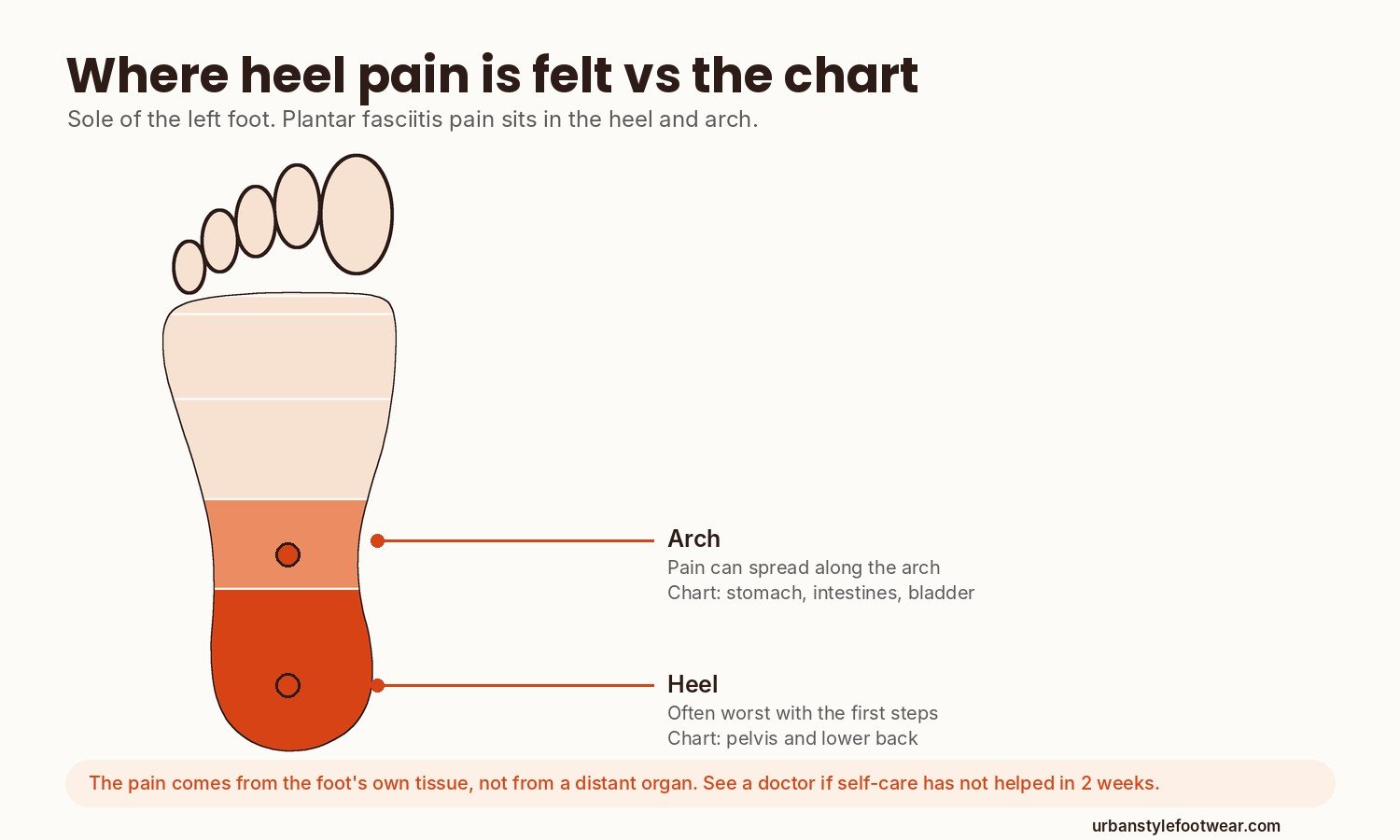
On a traditional chart, the arch maps to the digestive organs and the heel to the pelvis and sciatic nerve. See our foot reflexology chart. That mapping is a tradition. Plantar fasciitis is pain in the tissue of the foot itself, so the cause and the fix are local.
What the evidence says
- Reflexology for plantar fasciitis: no randomized trial turned up in my October 2026 search of Europe PMC. Absence of evidence is not evidence of harm, but it means no one can claim reflexology treats it.
- Reflexology in general: the National Center for Complementary and Integrative Health says the claim that reflexology promotes relaxation and healing is not proven, and Cleveland Clinic says there is no evidence it works better than a foot massage. See does foot reflexology work?
- Standard care: OrthoInfo, the patient site of the American Academy of Orthopaedic Surgeons, describes calf and plantar fascia stretching as the most effective way to relieve pain and says more than 90% of patients improve with simple methods, within 10 months.
What actually helps
| Approach | What it involves | Source |
|---|---|---|
| Stretching | Gentle stretches for the sole and heel, and calf stretches | OrthoInfo, NHS |
| Supportive shoes | Cushioned shoes and heels, silicone heel pads or insoles | OrthoInfo, NHS |
| Ice | An ice pack wrapped in a towel for up to 20 minutes every 2 to 3 hours (NHS), or rolling the foot over a cold bottle (OrthoInfo) | NHS, OrthoInfo |
| Activity changes | Low-impact exercise such as cycling or swimming, and less prolonged standing | OrthoInfo, NHS |
| Pain relief | Paracetamol or ibuprofen may help. OrthoInfo cautions against anti-inflammatories for more than a month without medical advice | NHS, OrthoInfo |
| Physiotherapy and podiatry | Exercises, possible massage, insoles and night splints | OrthoInfo, NHS |
| If persistent | Injections or shock-wave therapy, and rarely surgery | OrthoInfo, NHS |
The NHS advises avoiding prolonged standing or walking, high heels, tight pointed shoes, flip-flops or backless slippers, and walking barefoot on hard surfaces. For shoes, see our guides to the best shoes for plantar fasciitis, slippers for plantar fasciitis and plantar fasciitis exercises.
If you want to massage your feet
A gentle massage can be a pleasant addition to the above. If you do it, keep it supportive, not aggressive:
- Do it after a warm shower, or after resting, when the foot is relaxed.
- Use light to moderate pressure along the arch, from the ball toward the heel, about 3 to 5 out of 10. Do not dig into a very tender heel.
- Avoid hard tools such as balls or rollers on an inflamed heel, because pressure builds quickly. If you want a device, see our best reflexology foot massagers.
- Stop if pain increases. Massage should not replace stretching or supportive footwear.
Our home reflexology routine is gentle enough for most healthy adults, with the heel treated lightly.
When to see a doctor
See a GP or doctor if:
- The pain is severe, keeps returning or is getting worse
- It has not improved after 2 weeks of self-care
- You have tingling or numbness in the foot
- You have diabetes and foot pain. Foot pain with diabetes needs medical review
- The heel is swollen, red, hot, or you cannot put weight on it
This list follows NHS guidance (reviewed February 14, 2025), plus common-sense signs of injury or infection. Not all heel pain is plantar fasciitis, so a clinician should confirm the diagnosis. For wider foot pain causes, see our foot pain guide and the main foot reflexology guide.
Why the first steps hurt most
Many people on forums describe the same pattern: a stabbing heel pain with the first steps out of bed that eases as you walk. The plantar fascia, the band of tissue along the sole, tightens during rest and is stressed again when you load it suddenly. That is why gentle movement before standing can help, and why long periods on hard floors or a sudden jump in activity can bring it back. See our guide to why heels hurt in the morning.
Two stretches that have the best track record
OrthoInfo describes these as the most effective way to relieve the pain. Do them gently and stop if sharp pain develops.
- Plantar fascia stretch. Sit, cross the affected foot over the opposite knee, and pull the toes back toward the shin until you feel a stretch in the arch. Hold about 10 seconds, repeat around 10 times, a few times a day, and do it before your first steps in the morning.
- Calf stretch. Stand facing a wall with the affected leg behind you, heel on the floor and knee straight, and lean forward until you feel a stretch in the calf. Hold about 10 seconds and repeat.
See our plantar fasciitis exercises guide for more.
What recovery usually looks like
Plantar fasciitis can be slow. OrthoInfo says more than 90% of people improve with simple methods, usually within about 10 months, and the NHS advises seeing a doctor if it has not improved after 2 weeks of self-care. Progress is often uneven, with good and bad days. Signs you are on the right track include less pain with the first steps, longer comfortable walking, and fewer flare-ups. Setbacks commonly follow long standing days, unsupportive shoes or too much activity too soon.
When heel pain is not plantar fasciitis
Not all heel pain is plantar fasciitis, and a clinician should confirm the diagnosis. Other possibilities include pain at the back of the heel from the Achilles tendon, a stress fracture, a pinched nerve, a heel bruise, or arthritis. Red flags include pain after an injury, severe swelling, redness or heat, numbness or tingling, and pain at night or at rest. See our heel pain when walking guide and the foot pain guide.
A quick shoe checklist for heel pain
- A cushioned heel and a supportive midsole.
- A shoe that bends at the toes, not the middle of the arch.
- A snug heel counter so your heel does not slide.
- No flip-flops or backless slippers for long periods, and no walking barefoot on hard floors.
- A fit check late in the day, with a half inch beyond your longest toe.
Our foot comfort and supportive footwear guide and plantar fasciitis shoes guide go deeper.
Staying active while it heals
Complete rest is rarely the answer. OrthoInfo and the NHS both suggest switching to low-impact activity such as swimming or cycling while the heel settles, and gradually building back up. A few practical rules help:
- Increase walking or running by small steps, not sudden jumps.
- Vary surfaces, and avoid long periods on hard floors without supportive shoes.
- Do your stretches before getting out of bed and after activity.
- If pain climbs to a sharp level during an activity, ease off.
- Do not walk barefoot at home on hard floors. Wear supportive slippers. See slippers for plantar fasciitis.
Questions to ask a podiatrist or physiotherapist
- Is this definitely plantar fasciitis, or could something else be causing my heel pain?
- Which stretches and strengthening exercises should I do, and how often?
- Would insoles, heel pads or a night splint help in my case?
- Which activities should I reduce or change for now?
- When would injections, shock-wave therapy or other options be worth considering?
- Is any gentle massage appropriate for me?
If you still enjoy foot massage, our home routine is gentle enough when the heel is treated lightly.
Frequently asked questions
Can reflexology help plantar fasciitis?
It has not been shown to. I found no randomized trial of reflexology for plantar fasciitis. Stretching, supportive shoes and activity changes have the best track record.
Where is the heel pressure point in reflexology?
On a traditional chart the heel maps to the pelvis, lower back and sciatic nerve. Heel pain from plantar fasciitis is a local foot problem, not a signal from those areas.
Is foot massage good for plantar fasciitis?
Gentle massage may feel soothing, and OrthoInfo lists physical therapy that may include massage. It should not replace stretching or supportive footwear, and hard pressure on a sore heel can make things worse.
What is the fastest way to relieve plantar fasciitis?
There is no instant cure. OrthoInfo says stretching is the most effective way to relieve the pain, and most people improve with simple measures within about 10 months.
Should I massage the arch if it hurts?
Use light pressure and stop if it hurts more. See a clinician if pain lasts beyond 2 weeks of self-care.
Can I use a foot massager for heel pain?
Use low settings and avoid direct pressure on an inflamed heel. See our review of reflexology foot massagers.
Should I massage plantar fasciitis?
Gentle massage may feel soothing, but it should not replace stretching or supportive footwear. Avoid pressing hard on an inflamed heel.
Can I walk with plantar fasciitis?
Usually yes, in supportive shoes and at a comfortable level. Reduce long standing and high-impact activity, and see a clinician if pain is severe or you cannot bear weight.
Does ice help plantar fasciitis?
The NHS suggests an ice pack wrapped in a towel for up to 20 minutes every 2 to 3 hours, and OrthoInfo suggests rolling the foot over a cold bottle.
How long does plantar fasciitis last?
It varies. OrthoInfo says most people improve with simple methods within about 10 months. See a doctor if there is no improvement after 2 weeks of self-care.
More in the foot reflexology series
- Foot pressure points: acupressure points and what they claim
- Reflexology vs foot massage: how they differ
- Reflexology vs acupressure: zones compared with points
- Foot reflexology for headaches and migraines: what trials found
- Foot reflexology for sleep: research and a bedtime routine
- Reflexology for neuropathy in the feet: safety first
- Foot comfort and supportive footwear: fit and everyday habits
Sources
- OrthoInfo (AAOS): Plantar Fasciitis and Bone Spurs
- NHS: Plantar fasciitis (last reviewed February 14, 2025)
- NCCIH: Reflexology
- Cleveland Clinic: Reflexology (published August 30, 2022)
- Europe PMC (literature search for reflexology and plantar fasciitis trials, October 2026)
Educational information only, not medical advice.