
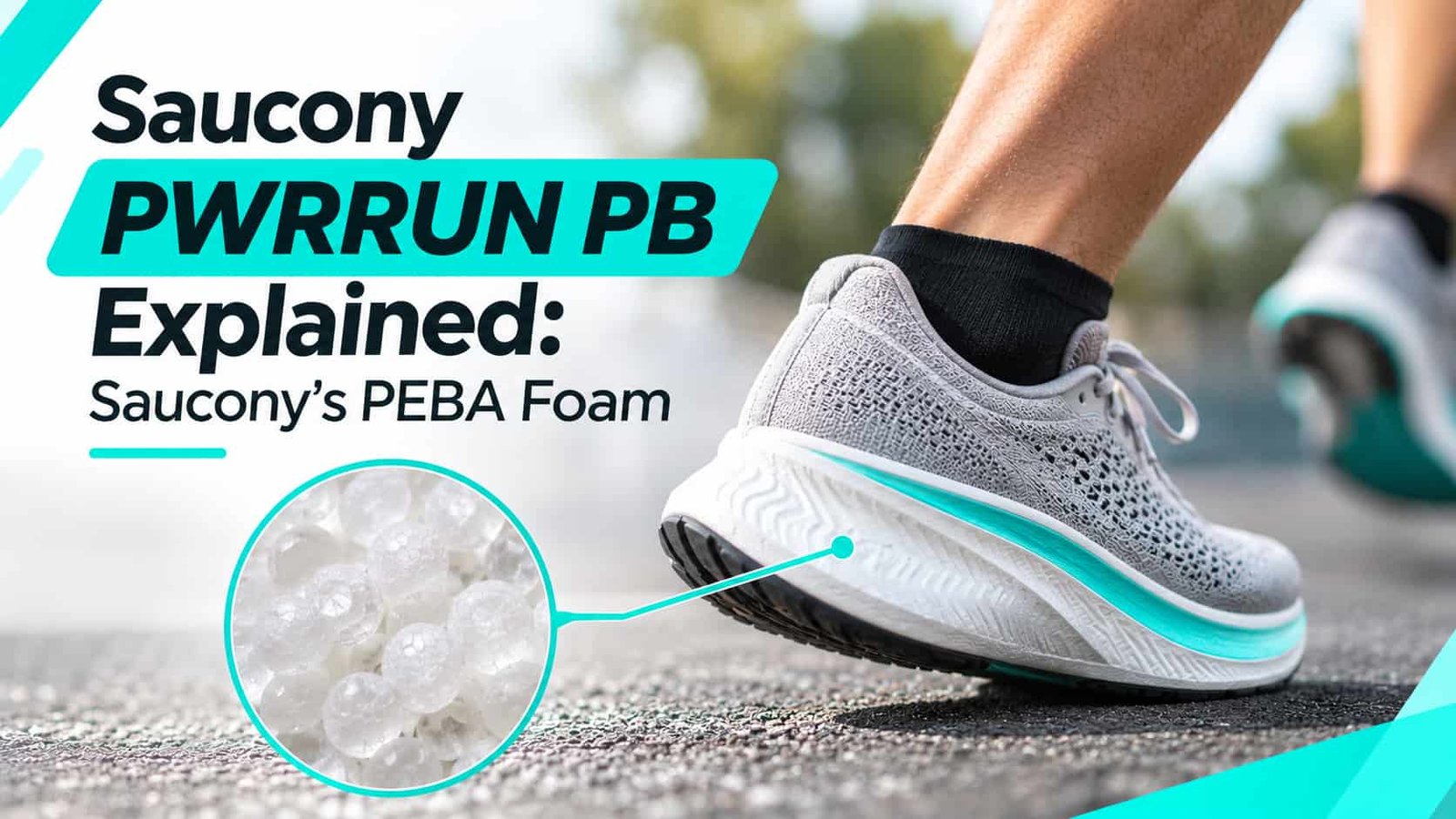
Saucony PWRRUN PB Explained: Saucony’s PEBA Foam
Editorial Guide | Saucony Foams |
Summarize this guide with AI
Choose an assistant and submit the prefilled request. The assistant reads the page only after you submit it.
- PWRRUN PB is Saucony’s PEBA foam, built from fused beads for speed and tempo running.
- Saucony claims about 88% energy return, a manufacturer figure without an independent test in the sources reviewed.
- PB sits below PWRRUN HG and is positioned for speedwork and racing, not daily miles.
- Durability is the main trade-off, and runner reports of long mileage are anecdotal.
PWRRUN PB is Saucony’s PEBA foam, made from small pellets fused into beads and designed for lightweight cushioning and fast running. Saucony claims about 88% energy return for it, a manufacturer figure that the sources reviewed do not test independently. PB sits below PWRRUN HG, the premium racing foam, and suits speedwork, tempo runs, and racing.
Key takeaways
- PWRRUN PB is a PEBA foam. PEBA is a thermoplastic elastomer, and PB stands for “polyether block amide.”
- Saucony claims about 88% energy return for PB and about 95% for PWRRUN HG. Both are manufacturer figures without a published test method.
- PB is positioned for speedwork, tempo runs, and racing. It is not the foam for slow daily miles.
- Durability is the main trade-off. PEBA is generally described as less durable than EVA or TPU, and runner reports of very high mileage are anecdotal.
- Model lists differ across Saucony’s pages, so confirm the foam in the current product description before buying.
Why PB Needs Its Own Guide
Most PWRRUN explainers stop at the family level. That is useful, but it leaves a practical question open. If you are looking at a shoe that says “PWRRUN PB,” how does it differ from PWRRUN HG, and from the softer PWRRUN+ TPU foam?
The answer matters because PB and HG are both PEBA, yet Saucony places them at different points on its performance ladder. PB is the approachable race-oriented option. HG is described as the top of the range. PWRRUN+ is a softer, more durable TPU foam for longer and more comfortable runs. Knowing where PB sits saves time when you compare shoes.
For the wider family, read our overview of Saucony PWRRUN. This article focuses only on PB, and the rest of the foam picture is covered in our running shoe foam guide.

What PWRRUN PB Is Made Of
PWRRUN PB is a PEBA foam. SneakerLens explains the name: “The ‘PB’ stands for PEBA, or Polyether Block Amide, which is a type of thermoplastic elastomer (TPE).” The foam is made from small pellets that are fused into beads. SneakerLens says the process often uses a supercritical fluid, which expands the material into a lightweight structure.
Saucony describes the foam as “a very special type of PEBA foam” with foam beads added. Its foam-technologies page calls PEBA “famed for exceptional energy return,” and says PB is more responsive and cushioned at speed, light in weight, and consistent “in all temperatures.” These are brand descriptions, not test data.
Two points matter in practice. First, the bead structure is what gives the foam its light, springy character. Second, PEBA is a different chemistry from EVA and TPU, so the foam behaves differently across temperature, pace, and wear. Our explainer on what EVA foam is covers the most common alternative.
PB, HG, PWRRUN+ and PWRRUN: The Ladder
The easiest way to place PB is on a ladder. Each rung is a different foam, with different strengths. The table below sets out the brand’s stated positions and the claims made for each, based on the pages reviewed.
| Foam | Material | Stated position | Energy-return claim | Durability description |
|---|---|---|---|---|
| PWRRUN | EVA blend | Daily, reliable | Not stated | “Lasting comfort” (brand) |
| PWRRUN+ | Steam-fused TPU | Softer, more durable | Not stated | “Exceptionally durable over long distances” (brand) |
| PWRRUN PB | PEBA beads | Speed, tempo, racing | About 88% (manufacturer claim, relayed) | “Surprisingly resilient” (anecdotal) |
| PWRRUN HG | Supercritical PEBA | Premium racing | About 95% (manufacturer claim, relayed) | Not stated |
In plain terms, PB sits between the everyday EVA and TPU options and the premium HG racing foam. It is built to be lighter and more responsive than the daily foams, while staying a step below the top racing setup. The sources do not say how much lighter or more responsive it is, so treat the ladder as a sequence of design intent, not measured performance.
If you are choosing between PB and PWRRUN+, the question is usually how much rebound you want against how much durability and softness you need. Shoes that pair PWRRUN+ with long-run use tend to suit runners who want a plush ride. PB suits runners who want a faster, more energetic feel.

How PB Feels on the Road
Reviewers describe PB as lively. SneakerLens says reviewers often call it “poppy” or “trampoline-like.” Saucony’s meta description says the shoes are designed for “lightweight cushioning, responsive most comfort, speed, and smooth running performance every day.” The phrase “every day” sits oddly beside the race-oriented positioning, and it is worth noticing that the same foam is marketed for both.
A springy feel can be a real asset at speed. It can also feel unstable to some runners at slow paces, because the foam pushes back strongly under the foot. This is a personal judgment. Your stride, pace, and weight change how the foam behaves, so try the shoe on a short easy run before committing to a longer session.
Saucony claims the feel stays consistent across temperatures. The brand says PB “maintains its soft, springy feel regardless of temperature.” That claim is plausible for a PEBA foam, but no test data is given, so treat it as a manufacturer position.
Energy Return: What the 88% Claim Means
The most quoted figure for PB is an energy-return claim of about 88%. SneakerLens reports that “Saucony claims an 88% energy return” for PB. The same article gives PWRRUN HG a figure of 95%. The Saucony pages reviewed for this article describe PB’s energy return in qualitative terms, such as “exceptional energy return,” without giving the 88% figure in the body text. That makes 88% a manufacturer claim relayed by a third party, and it should be read that way.
Energy return is a measure of how much of the energy you put into a foam comes back on push-off. It depends on the material, the foam density, the shape of the midsole, and the runner. A passive foam cannot return more energy than it receives, so any figure above a certain level should be read as a marketing expression, not a literal measurement. The 88% and 95% figures are best used to compare PB with HG within the brand’s own system, not as a universal number.
Independent guides place PEBA high on energy return, with TPU in the middle and EVA lower. RunRepeat’s running shoe foams guide uses this ranking. It shows the direction of the trade-off, not the exact difference between PB and HG.
Energy return in a shoe also depends on how the rest of the shoe supports the foam. A high-rebound midsole in a shoe with a poor heel or an unstable platform may feel less effective than the same foam in a better-built shoe. Our methodology page explains how this site approaches shoe reviews, which is relevant when you read any energy-return claim.
Weight: The “50% Lighter” Claim
SneakerLens says PB is “about 50% lighter than traditional EVA.” That is a precise claim with no stated method, sample, or comparison shoe. It is also a comparison of foam types, not shoes, so it does not tell you how much a finished PB shoe will weigh.
Shoe weight depends on the whole build. The upper, the outsole rubber, the stack height, and the size all change the result. When you compare two PB shoes, compare weights in the same size, and check the listed weight rather than assuming the foam is the only factor.
Saucony’s own product pages list PB shoes such as the Endorphin Azura, which are marketed for lightweight cushioning. No specific weight figures appear in the pages reviewed, so the practical step is to weigh the shoe yourself or check the current spec sheet.
Durability and Mileage
Durability is the trade-off most readers want to understand, and it is the least documented part of the PB story. SneakerLens calls the foam “surprisingly resilient” and says “many runners report getting 300, 400, or even 500+ miles” from shoes such as the Endorphin Speed 3. Those are runner reports, not a controlled test. The article also refers to the Endorphin Speed 4 and 5, so the reference to the Speed 3 is not explained further.
Saucony does not give a mileage figure for PB in the pages reviewed. Its guide for runners says foam lifespan “varies based on the foam type, mileage, running surface, and individual running mechanics.” That sentence is the most accurate summary of the subject.
As a general rule, PEBA foams are often described as less durable than EVA or TPU in foam comparisons, because their high rebound usually comes with a shorter working life. Race-oriented shoes also tend to be used harder. Treat PB as a foam for focused sessions rather than a foam for maximum mileage, and plan to replace race-day shoes sooner than daily trainers.
For a broader view of shoe life, read our guide to how long running shoes last. Practical checks include watching for a flattened midsole, a worn heel, or a loss of the springy feel you noticed when the shoe was new.
Which Shoes Use PB, and Why the Lists Differ
Saucony’s pages list different shoes for PB, which is why this article does not give a single definitive list.
- Saucony’s foam-technologies page names PB in the Endorphin Speed 5, Triumph 23, and Tempus 2.
- Saucony’s PWRRUN PB category page features the Endorphin Azura and the Xodus Ultra 4 under its “Featured PWRRUN PB” heading. It also shows a filter count of 27 products, without naming the others.
These lists do not match, and model years and listings change. The practical rule is to check the foam named in the current product description for the exact model you are considering. Do not rely on a list in an article, including this one, as the final word on what is in a shoe today.
Who Should Choose PB
These are editorial judgments based on Saucony’s stated uses and the independent rankings above. They are not findings from lab testing.
PB suits you if:
- your main sessions are speedwork, tempo runs, or racing
- you want a lighter, more responsive feel than a daily trainer
- you are happy to replace the shoe sooner than a daily trainer
Consider PWRRUN+ instead if:
- most of your running is long, easy miles
- you want a softer ride that stays consistent late in a run
- durability per pound matters more to you than rebound
Consider PWRRUN HG instead if:
- you are racing and want the premium setup Saucony positions at the top of the range
- the extra cost is acceptable for a shoe you will use only for key events
Be cautious with PB if:
- your pace is slow and your stride is not settled, because a springy foam can feel unstable
- you want a shoe that will last for many months of daily use

Myths Worth Dropping
Myth 1: PB is the same as HG. Both are PEBA, but Saucony positions HG as its premium racing foam, and the two are presented as different rungs of the same ladder.
Myth 2: The 88% figure is an independent measurement. It is a manufacturer claim that a third-party article relays. No test method is published in the sources reviewed.
Myth 3: PB lasts as long as a daily trainer. PEBA is commonly described as less durable than EVA or TPU. Runner reports of 300 to 500 miles exist, but they are anecdotal.
Myth 4: The foam alone decides how the shoe feels. Shoe geometry, upper fit, and outsole design all shape the ride, so compare the complete shoe.
How to Judge a PB Shoe Before You Buy
- Confirm the foam. Find “PWRRUN PB” in the product description of the current model. If it says only “PWRRUN,” check the foam page on the brand’s site.
- Check the intended use. Race-oriented PB shoes are different from daily trainers, even when the foam name is the same.
- Weigh it in your size. Use a kitchen scale and compare like-for-like models.
- Try a short easy run. Notice whether the springy rebound feels helpful or unsettling at your pace.
- Plan your replacement. Track the miles and check the outsole and midsole regularly, especially for race-focused shoes.
Our shoe finder can help you compare options by use before you narrow down to a specific foam.
Frequently Asked Questions
What is PWRRUN PB foam?
PWRRUN PB is Saucony’s PEBA foam. It is made from fused beads and designed for lightweight, responsive running. Saucony positions it for speed, tempo runs, and racing.
What is the difference between PWRRUN PB and PWRRUN HG?
Both use PEBA. Saucony describes HG as its premium racing foam with the highest energy-return claim in the family. PB is positioned one step below it and is described as lighter and more approachable.
Is PWRRUN PB better than PWRRUN+?
That depends on your running. PB is built for speed and a lively feel. PWRRUN+ is a softer TPU foam built for comfort and durability over longer runs. Choose by the kind of miles you run most.
How long does PWRRUN PB foam last?
Saucony does not give a mileage figure for PB. Runner reports of 300 to 500 miles exist, but they are anecdotal. Foam life varies by mileage, surface, and running style, so track your own shoes.
Is the 88% energy-return figure accurate?
It is a manufacturer claim relayed by a third-party article. The sources reviewed do not include an independent test that confirms it. Use it as the brand’s own position, not as a measured result.
Can I use PB shoes for long runs?
Some runners do, but PB is positioned for faster efforts and racing. If you plan to run long distances in PB shoes, check how the shoe feels after an extended run and keep an eye on the midsole’s condition.
Final Verdict
PWRRUN PB is Saucony’s PEBA foam for speed, tempo runs, and racing. It sits below the premium PWRRUN HG and is designed to feel light and responsive. The 88% energy-return figure is a manufacturer claim, and Saucony does not publish the test method behind it. Durability is the main trade-off, and runner reports of long mileage are anecdotal.
The most useful next step is to confirm the foam in the exact shoe you are considering, then decide whether your main sessions need PB’s rebound or a softer, more durable foam. For the wider foam landscape, start with our running shoe foam guide.
Sources