

Foot Reflexology for Headaches and Migraines: What Studies Show and When to See a Doctor
The short answer
Foot reflexology may reduce the duration and severity of migraine for some people, but the evidence is limited and small, and no foot pressure point has been proven to cure or prevent headaches. A 2025 randomized trial found shorter and less severe migraine attacks with reflexology added to usual drug treatment, but no significant change in how often attacks occurred. A 2024 systematic review found only three qualifying studies and advised caution. Treat reflexology as a possible comfort measure alongside medical care, never a replacement.
- Where charts place the head: the big toe (head and brain), with the other toes as sinus zones.
- Named foot points often cited: Liver 3 and Gallbladder 41 on the top of the foot.
- Get urgent help for a sudden, extremely painful headache, or a headache with weakness, confusion, vision loss, a stiff neck or a head injury. See the red flags below.
Headache red flags: when not to self-treat
Call emergency services or go to A&E for a headache with:
- A seizure, or numbness or weakness in the body or face
- A sudden onset that is extremely painful
- A head injury in the last 3 months
- Difficulty speaking, balancing, walking or remembering things
- Drowsiness or confusion, or loss of vision
- A rash that does not fade when a glass is rolled over it
- A very high temperature, a stiff neck, or sensitivity to bright lights
The NHS also advises urgent medical help for a headache triggered or worsened by coughing, sneezing, bending or exercise, a headache with vomiting, jaw pain when eating, or a sore scalp. See a doctor if headaches are frequent or getting worse.
This list comes from the NHS (last reviewed April 17, 2024). A foot massage is not the right response to any of these.
Where charts place the head zones
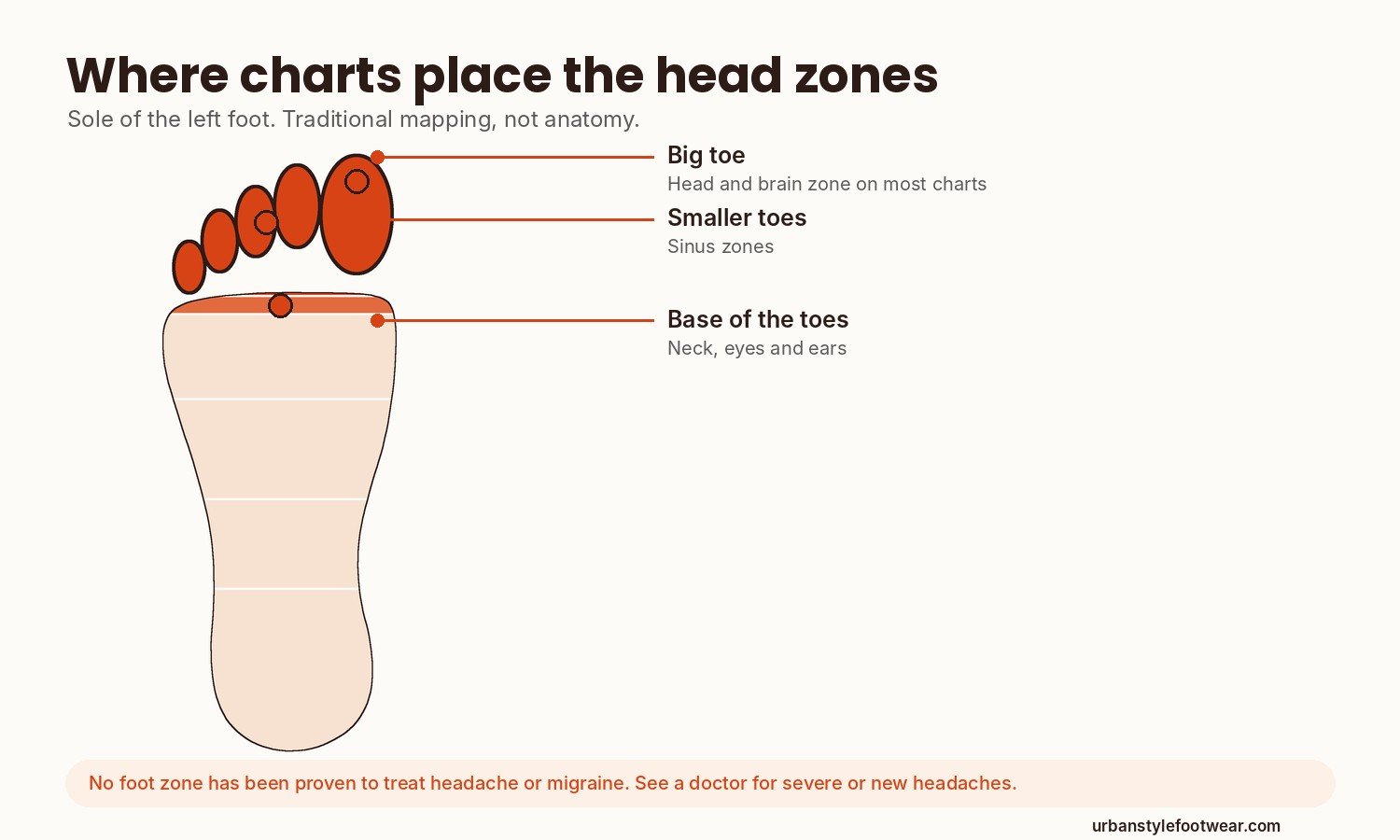
On most charts the big toe stands for the head and brain, the smaller toes for the sinuses, and the base of the toes for the neck, eyes and ears. See our original foot reflexology chart for the full map. The mapping is traditional, and reflexologists often add that tenderness in the toes signals a problem in the head. There is no research supporting that idea.
Pressure points on the feet for headaches
Acupressure guides name specific foot points for headaches. These are traditional associations, not proven treatments:
| Point | Where | Traditionally linked to |
|---|---|---|
| Liver 3 (Taichong) | Top of the foot, in the groove between the big toe and second toe bones, a couple of finger-widths behind the toe web | Tension headaches, migraine |
| Gallbladder 41 (Zulinqi) | Top of the foot, in the groove between the fourth and fifth toe bones, behind the toe web | Headaches at the side of the head |
More on how these differ from reflexology zones in our guide to foot pressure points.
What the studies show
| Study | Design | What it found |
|---|---|---|
| Momennasab et al., 2025 (Iran) | Randomized trial. Three groups: reflexology plus drug treatment, sham reflexology plus drug treatment, and drug treatment alone. 84 enrolled, 75 completed. | Significantly shorter attacks (p = 0.024) and lower severity (p = 0.043) than the other two groups. Frequency did not differ significantly (p = 0.288). Authors called for further studies. |
| Tedeschi et al., 2024 | Systematic review of plantar reflexology for headache | 23 candidate studies, only 3 met the criteria (2 randomized trials and 1 pilot). Results were favourable, but the authors advised caution and called for higher-quality research. |
| Imani et al., 2018 (Iran) | Randomized trial in 75 coronary care patients with nitroglycerin-induced headache. Control, reflexology (big toe, the head zone) and placebo (heel massage) groups. | Headache intensity differed significantly between groups after treatment. This was a drug-induced headache in hospital patients, not typical migraine. |
How to read these results
- The best-designed trial included a sham group, which makes the finding more meaningful, but it was small and from a single setting.
- It was an add-on. Everyone kept taking their usual treatment, so reflexology was an extra, not an alternative.
- Frequency did not change. Reflexology did not reduce how often attacks came, so there is no evidence it prevents migraine.
- The headache types differ. Nitroglycerin-induced headache is not the same as migraine.
For how this fits into the wider picture, see does foot reflexology work?
If you want to try it
- Rule out red flags above first, and get a diagnosis if headaches are new, frequent or changing.
- Sit comfortably and warm the feet.
- Use gentle thumb circles on the big toe pad and the base of the toes, then along the top of the foot between the toe bones. Keep pressure at about 4 to 6 out of 10.
- Spend about 5 minutes per foot, and stop if anything hurts.
- Keep a short headache diary so you can see whether it helps you.
Use our home routine for a full sequence. Do not use it if you have numb feet, clots, foot wounds or other conditions listed in the complete guide to foot reflexology.
What has better evidence for migraine
If you have migraine, talk to a doctor about proven acute and preventive treatments and about identifying your triggers. Reflexology may sit beside those, as relaxation, but it should not replace them. If poor sleep is part of your picture, see our guide on reflexology for sleep.
Headache red flags: when it is not a reflexology question
Most headaches are not dangerous, but some need urgent care. The NHS advises getting urgent help for a sudden, very severe headache, a headache with a stiff neck, fever or a rash, confusion, drowsiness, vision changes, weakness or slurred speech, or a headache after a head injury. If any of these apply, call emergency services or seek urgent care instead of trying a foot routine. Also see a doctor if headaches are new after age 50, keep getting worse, wake you at night, or you need pain relief on many days a month.
Common headache types and what each needs
| Type | Typical pattern | What helps most |
|---|---|---|
| Tension-type | Dull pressure or band around the head, often with stress or tight neck muscles | Rest, hydration, posture, stress management, simple pain relief as directed |
| Migraine | Throbbing, often one-sided, with nausea or light and sound sensitivity | A doctor-led plan, trigger management, medication when prescribed |
| Cluster | Severe, around one eye, in repeated bouts | Specialist care |
| Medication-overuse | Frequent headaches in people using pain relief often | Medical review to adjust medication |
Reflexology has been studied mainly for tension-type headaches and migraine, with mixed and low-certainty results, as covered above. It is best seen as a relaxation add-on.
Tracking triggers with a headache diary
A diary gives you and your doctor more useful information than any foot technique. For 4 to 6 weeks, note the date and time, how severe it was from 0 to 10, how long it lasted, what you had eaten and drunk, how you slept, your stress level, any medication taken, and whether you tried the foot routine and how you felt afterwards. Patterns often emerge, such as a link with skipped meals, dehydration, poor sleep or screen time. Bring the diary to appointments.
During an attack: practical steps
- Rest somewhere dark and quiet, and drink water.
- Take your prescribed or recommended medication early, as advised by your doctor, rather than waiting.
- If you want to try a foot massage, keep it gentle and short. Strong pressure during an attack can add discomfort, and some people with migraine find touch unpleasant.
- Use the foot routine more as a preventive, calming habit between attacks. See our home routine and foot pressure points guides.
- Keep taking any preventive medicine. Do not stop it because a foot routine seems to help.
Sleep, regular meals, hydration, movement and stress care often matter more than any point on the foot. Our sleep guide covers a wind-down routine, and the complete guide covers safety.
Lifestyle factors that often matter more
- Regular sleep. Both too little and irregular sleep are common triggers. See our sleep guide.
- Regular meals and hydration. Skipped meals and dehydration are frequent culprits.
- Caffeine. Keep intake steady, since sudden changes can trigger or worsen headaches.
- Screens and posture. Long periods looking at a screen, with neck and shoulders tense, can bring on tension-type headaches. Take breaks, and adjust your seat and screen height.
- Stress. Relaxation practices, including a calming foot routine, may help some people cope.
- Frequent pain relief. Using painkillers often can itself cause headaches, so ask your doctor if you need them many days a month.
What to bring to a doctor visit
To make an appointment more useful, bring your headache diary, a list of all medicines and supplements, how often headaches disrupt work or sleep, any family history of migraine, and a list of things you have already tried, including foot massage. Be open about complementary therapies, because they can matter if a medicine or condition makes them unsuitable. For the wider context, see our complete guide to foot reflexology.
Frequently asked questions
Does foot reflexology help migraines?
A 2025 randomized trial found shorter and less severe migraine attacks when reflexology was added to usual treatment, but not fewer attacks. The evidence is limited, and a 2024 review urged caution.
Which pressure point on the foot is for headaches?
Acupressure guides often name Liver 3 and Gallbladder 41 on the top of the foot, and reflexology places the head zone in the big toe. No point has been proven to treat headaches.
Where is the migraine pressure point on the foot?
Liver 3 sits on the top of the foot in the groove between the big toe and second toe bones. It is a traditional association, not a proven treatment.
Can foot massage stop a headache?
It may help you relax, which can ease tension. It has not been shown to stop headaches reliably.
How long should I massage my feet for a headache?
There is no proven dose. About 5 minutes per foot with gentle pressure is a reasonable approach for most healthy adults.
When is a headache an emergency?
If it comes on suddenly and is extremely painful, or comes with weakness, confusion, vision loss, a stiff neck, a seizure or follows a head injury, get emergency help.
Which foot point is best for a headache?
No foot point has been proven to relieve headaches. Charts map the big toe to the head, and acupressure guides name points such as Liver 3 on the top of the foot, but these are traditions, not tested treatments.
Can foot reflexology stop a migraine?
Not reliably. Evidence is limited and low in certainty. Use a doctor-led plan for migraines, and treat reflexology as optional relaxation.
Is it safe to massage my feet during a migraine?
For most healthy adults, gentle pressure is low risk, but some people find touch unpleasant during an attack. Stop if it makes things worse.
When should I see a doctor about headaches?
Seek urgent care for sudden severe headaches or those with fever, stiff neck, confusion, vision or speech changes. See a doctor for frequent, worsening or new headaches.
More in the foot reflexology series
- Reflexology vs foot massage: how they differ
- Reflexology vs acupressure: zones compared with points
- Foot reflexology for plantar fasciitis: heel pain and what helps
- Reflexology for neuropathy in the feet: safety first
- Best reflexology foot massagers: devices and what to know
- Foot comfort and supportive footwear: fit and everyday habits
Sources
- NHS: Headaches (last reviewed April 17, 2024)
- Efficacy of foot reflexology in reducing migraine pain: a randomized controlled trial, 2025 (PubMed 40486630)
- Plantar reflexology as a complementary approach for headache management, systematic review, 2024 (PubMed 39267896)
- Reflexology massage on nitroglycerin-induced migraine-type headache, placebo-controlled trial, 2018 (PubMed 30028477)
- Cleveland Clinic: What Is Acupressure? How It Works (published January 30, 2025)
- NCCIH: Reflexology
Educational information only, not medical advice. Seek medical care for severe, sudden or changing headaches.