
Foot Pressure Points: Where They Are, What They Do and What Research Shows
The short answer
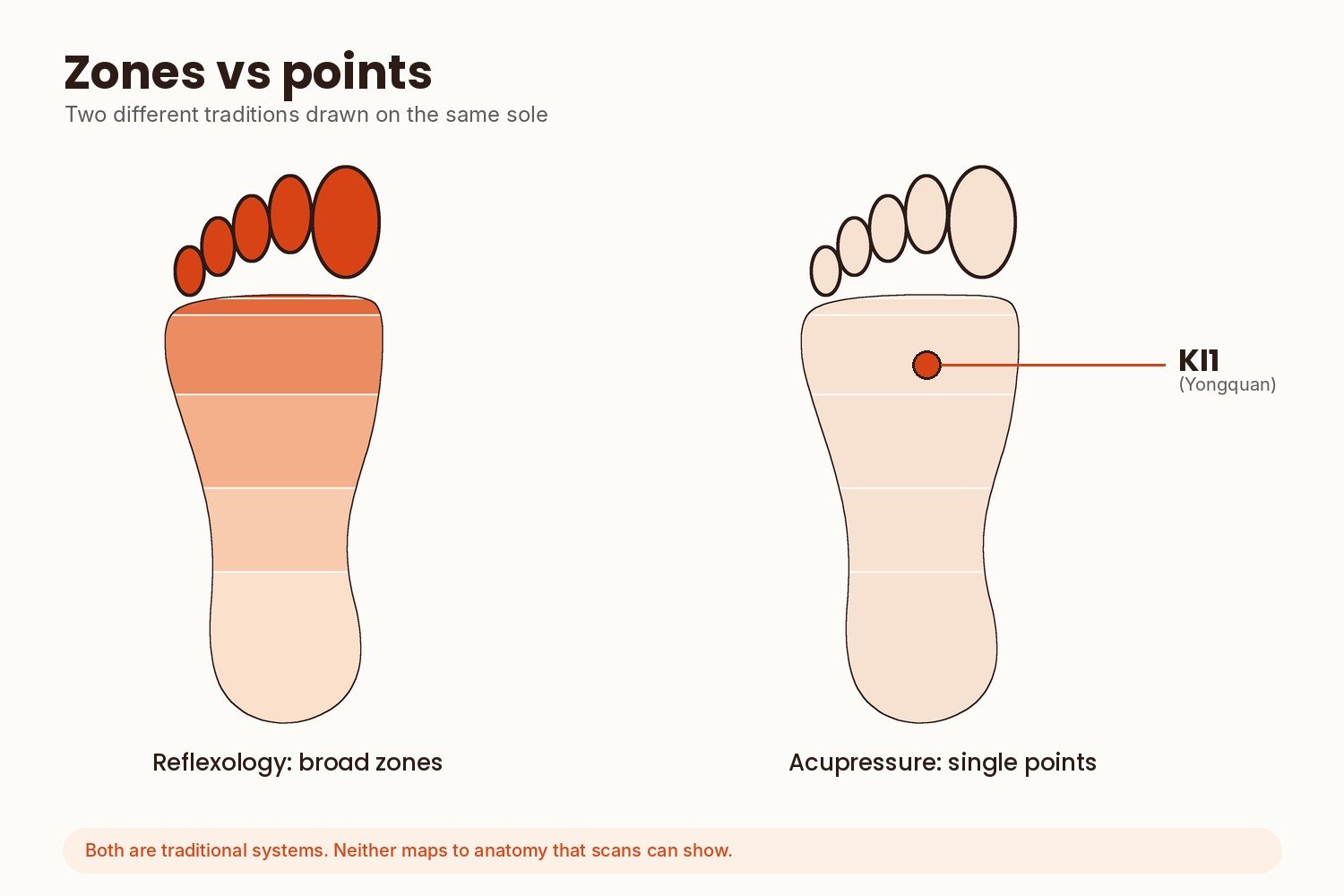
“Pressure points on the feet” can mean two different traditions. Reflexology zones are broad areas of the sole said to correspond to organs. Acupressure points are small, named spots (such as Kidney 1 on the sole or Liver 3 on the top of the foot) taken from traditional Chinese medicine. Pressing either one can feel relaxing. Neither has been shown to treat disease, and no pressure point on the foot has been proven to cure a headache, migraine or any other condition.
- Most useful way to use them: a few minutes of comfortable pressure for relaxation.
- How hard: firm but never sharp or painful. Do not press hard enough to bruise.
- Be careful if you: have diabetes or numb feet, circulation problems, blood clots, foot wounds or infections, or are pregnant. Ask a clinician first.
Reflexology zones vs acupressure points
Searches for “foot pressure points” mix up two systems that grew from different ideas. The figure below shows the difference at a glance.
| Reflexology | Acupressure | |
|---|---|---|
| Origin of the idea | Zone therapy, where regions of the foot map to body parts | Traditional Chinese medicine, where points sit on channels called meridians |
| What gets pressed | Areas of the sole, toes and sometimes the hands or ears | Small named points on the foot, ankle, leg and elsewhere |
| How it is done | Thumb and finger pressure in sequence, across both feet | Steady pressure on one point at a time with a thumb or finger |
| Cleveland Clinic’s description | Pressure on points on the feet, hands or ears believed to correspond to body parts | Self-applied massage on “acupoints”, the needle-free cousin of acupuncture |
For a deeper comparison, see reflexology vs acupressure. For the full reflexology picture, see our complete guide to foot reflexology and the original foot reflexology chart.
Named foot acupressure points and where they are
These are the points most often named in foot-pressure guides. Locations follow standard acupuncture point descriptions. They are given so you can understand what a guide is pointing at, not to suggest that each treats the condition it is traditionally linked to.
| Point | Where it is | Traditionally linked to |
|---|---|---|
| Kidney 1 (Yongquan) | On the sole, in the hollow toward the front when the toes are curled, just under the ball of the foot | Calming, grounding |
| Liver 3 (Taichong) | On the top of the foot, in the groove between the bones of the big toe and second toe, a couple of finger-widths behind the toe web | Tension, headaches |
| Gallbladder 41 (Zulinqi) | On the top of the foot, in the groove between the bones of the fourth and fifth toes, behind the toe web | Headaches, side-of-head pain |
| Kidney 3 (Taixi) | In the hollow between the inner ankle bone and the Achilles tendon | Energy, lower back |
| Bladder 60 (Kunlun) | In the hollow between the outer ankle bone and the Achilles tendon | Back and heel pain |
| Spleen 6 (Sanyinjiao) | On the inner lower leg, about four finger-widths above the inner ankle bone, behind the shin bone | Digestion, sleep, women’s health |
| Stomach 36 (Zusanli) | On the leg, about four finger-widths below the kneecap and one finger-width outside the shin bone | Digestion, fatigue |
Cleveland Clinic names Kidney 1 on the sole and Stomach 36 on the leg in its acupressure guide, and notes that research on how well acupressure works is still ongoing.
Reflexology zones on the sole
In reflexology you are not hunting for one exact spot. You work across zones: toes (head and sinuses), ball of the foot (chest), arch (digestive organs and kidneys) and heel (pelvis and lower back). The foot reflexology chart shows each region on the left and right foot.
Pressure points on the feet for headaches
This is one of the most searched foot-pressure topics, so here is the honest summary. Acupressure guides often name Liver 3 and Gallbladder 41 for headaches, and reflexology charts place the head zone in the big toe. Some small trials of plantar reflexology for migraine are encouraging, but a 2024 systematic review found only three studies that met its criteria and its authors called for higher-quality research. We cover the studies, and when a headache needs urgent care, in foot reflexology for headaches and migraines.
How to press a foot point safely
- Wash and warm the foot. Sit comfortably with the foot resting on the opposite knee.
- Find the point using the descriptions above. A point often feels slightly tender or hollow.
- Use steady pressure with a thumb or finger for about 30 to 60 seconds. This is a commonly suggested timing, not an evidence-based dose.
- Breathe slowly and keep your shoulders relaxed.
- Release gradually and move to the next point, then repeat on the other foot.
Use this comfort scale: aim for about 4 to 6 out of 10, which feels like a firm but pleasant pressure. Stop at 7 or above, or if you feel sharp, burning or electric pain. Cleveland Clinic advises against pressing hard enough to bruise and suggests stopping if you feel worse. A longer, step-by-step routine is in our guide to doing foot reflexology at home.
What the evidence says
- Reflexology: the National Center for Complementary and Integrative Health says the claim that reflexology promotes relaxation and healing is not proven. Cancer Research UK says there is no scientific evidence it cures or prevents any disease. Cleveland Clinic says there is no evidence it works better than foot massage. See does foot reflexology work? for the full review.
- Acupressure: Cleveland Clinic lists a 2024 review reporting positive effects for gastrointestinal problems, with variable results, and a 2021 trial in which acupressure with acupuncture helped sleep in people with breast cancer. That trial combined the two methods, so it does not isolate foot points.
- The honest limit: trials rarely test a single foot point in isolation, and many are small. The best-supported reason to use these points is relaxation.
Who should avoid foot pressure points
Talk to a clinician first if you:
- Have diabetes, neuropathy or reduced feeling in the feet. You may not notice damage from pressure.
- Have poor circulation, a history of blood clots, or leg vein inflammation
- Have foot wounds, ulcers, a fungal infection, gout or a recent injury or surgery
- Are pregnant. Several acupressure points on the foot and ankle are traditionally avoided in pregnancy, so ask your midwife or doctor.
- Take blood thinners or have a low platelet count
See reflexology for neuropathy in feet if you have numbness. If your feet hurt, the cause is usually mechanical, so start with the foot pain guide.
Pressure points, trigger points and reflexology zones: three different ideas
People often mix up three separate concepts, and forum threads about foot massage show the confusion clearly. Keeping them apart makes every foot-pressure claim easier to judge.
- Acupressure points come from traditional Chinese medicine. They are small, named locations, such as Kidney 1 on the sole, that are said to sit on channels of energy. The channel model is a tradition, not something anatomy has confirmed.
- Reflexology zones come from a different tradition. They are broader areas of the foot that are said to correspond to organs and body parts. See our foot reflexology chart for the map and its limits.
- Trigger points are a muscle concept. They are tender, tight spots in a muscle that can hurt locally or refer discomfort nearby. A sore knot in the arch or calf is a muscle issue, whatever any chart says.
That last point matters. If pressing a spot on your arch is tender, the most likely explanation is that the muscles and tissue of the foot are tired or tight, not that a distant organ needs attention. For a fuller comparison of the first two, read reflexology vs acupressure.
How firm and how long to press
No study has established a correct dose for pressing a foot point. Practitioners and guides vary, so treat any specific number as a convention, not a proven prescription. A sensible, low-risk approach is:
- Pressure: firm enough to feel, light enough to stay comfortable. A useful self-check is to stay around 4 to 6 out of 10 for healthy feet, and lower if you are sensitive.
- Time: hold steady pressure or make slow circles for roughly 20 to 60 seconds per spot, then release and breathe.
- Total session: 5 to 10 minutes per foot is plenty. More is not better.
- Frequency: a few times a week, or daily if it feels good and your feet are not sore.
Sharp pain, tingling, or a bruised feeling means you are pressing too hard. Ease off or stop.
Common mistakes
- Pressing as hard as possible. Pain does not mean it is working. Bruising and soreness can make walking uncomfortable.
- Chasing one magic point. No single point has been shown to cure a symptom. Many people get the same relaxation from slow strokes across the whole foot.
- Using it instead of care. Persistent pain, numbness or swelling needs a clinician. A foot point is not a diagnostic test.
- Ignoring skin. Do not press on cuts, blisters, infections or inflamed skin.
- Working on cold, stiff feet. A few minutes of warmth and gentle stroking first makes pressing more comfortable.
Who benefits most and who should skip it
Foot pressure is most useful as a calming ritual for healthy adults, especially after a long day on your feet. The research behind relaxation and anxiety is stronger than the research behind treating specific conditions, which our guide on whether foot reflexology works covers in detail.
Skip or check with a clinician first if you have diabetes with reduced feeling, neuropathy, a blood clot, a foot fracture, an open wound, active gout or an infection, or if you are pregnant. See reflexology for neuropathy in the feet for the extra precautions when sensation is reduced. For a step-by-step routine that avoids hard pressing, use the home routine.
Frequently asked questions
What are the pressure points on the feet?
There are two systems. Reflexology uses zones across the sole, and acupressure uses small named points such as Kidney 1 on the sole and Liver 3 on the top of the foot. Both are traditional and not anatomical.
Which pressure point on the foot is for headaches?
Acupressure guides often name Liver 3 and Gallbladder 41, and reflexology places the head in the big toe. Evidence is limited, and a sudden or severe headache needs medical care.
Where is Kidney 1 on the foot?
On the sole, in the hollow just under the ball of the foot toward the front when the toes are curled.
How long should I press a foot pressure point?
Many guides suggest 30 to 60 seconds of steady pressure. This is a convention rather than an evidence-based dose. Stop if it hurts.
Do foot pressure points really work?
They can feel relaxing, which is a real benefit. Evidence that they treat specific diseases is weak or absent.
Is it safe to press foot pressure points while pregnant?
Ask your midwife or doctor first. Some points on the foot and ankle are traditionally avoided in pregnancy.
Can foot pressure points cure anything?
No. Foot pressure points have not been shown to treat or cure a condition. They may help you relax, which can make you feel better, but they are not a substitute for medical care.
Is it normal for a foot pressure point to hurt?
Mild tenderness is common, especially in tired feet. Sharp or lingering pain is a sign to stop. Do not press harder to push through it.
Why are my feet ticklish when I press them?
Soles are rich in nerve endings. Slower, firmer strokes feel less ticklish than light touch, and warming the foot first helps. If it is still unpleasant, a different technique or skipping the area is fine.
Can I do foot pressure points on myself?
Yes, for healthy feet. Use a comfortable seat, moderate pressure and short sessions, and stop if anything hurts or feels numb.
More in the foot reflexology series
- Reflexology vs foot massage: how they differ
- Foot reflexology for sleep: research and a bedtime routine
- Foot reflexology for plantar fasciitis: heel pain and what helps
- Best reflexology foot massagers: devices and what to know
- Foot comfort and supportive footwear: fit and everyday habits
Sources
- Cleveland Clinic: What Is Acupressure? How It Works (published January 30, 2025)
- Cleveland Clinic: Reflexology (published August 30, 2022)
- NCCIH: Reflexology
- Cancer Research UK: Reflexology (reviewed June 17, 2022)
- Tedeschi et al., 2024: Plantar reflexology for headache management, systematic review (PubMed 39267896)
Educational information only, not medical advice. Point locations are traditional descriptions and do not imply a proven treatment effect.