

Foot Reflexology Chart: Zones, Left and Right Foot, and What the Map Really Means
The short answer
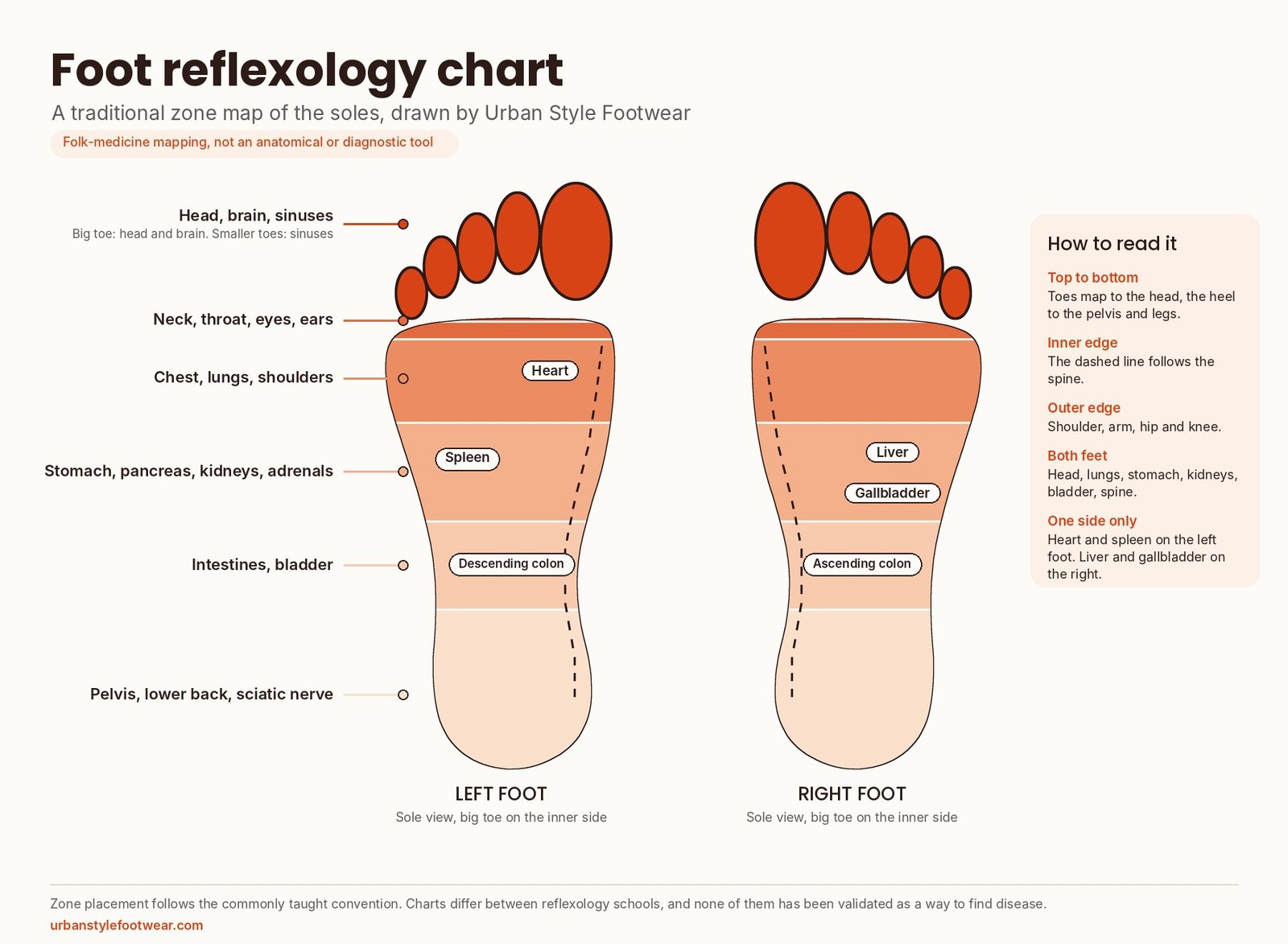
A foot reflexology chart is a map of the soles that links areas of the feet to parts of the body. The toes are mapped to the head and sinuses, the ball of the foot to the chest, the arch to the digestive organs and kidneys, and the heel to the lower back and pelvis. The left foot carries the heart and spleen, and the right foot carries the liver and gallbladder.
- What the chart is: a traditional teaching map. It is not an anatomical diagram, and no scan or test has ever shown that a spot on the sole is wired to an organ.
- What it is good for: telling you where a practitioner or a gentle self-massage routine would apply pressure.
- What it is not: a diagnostic tool. A tender spot on your foot does not mean there is a problem in the matching organ.
The foot reflexology chart
Most charts online are copied from one another, and many are screenshots with no text, so they cannot be read by a screen reader or searched. The chart below is an original one drawn for this guide. It shows the soles of both feet, big toe on the inner side, divided into six regions. The same information follows as a table.
If you want the full background on what reflexology is and how a session works, start with the complete guide to foot reflexology. This page goes deeper on the map itself.
Zone by zone: the six regions of the sole
Charts differ in small details, but nearly all of them follow the same layout, running from the toes to the heel.
| Region of the sole | Traditionally mapped to | Side |
|---|---|---|
| 1. Big toe | Head and brain | Both feet |
| 1. Smaller toes | Sinuses | Both feet |
| 2. Base of the toes | Neck, throat, eyes and ears | Both feet |
| 3. Ball of the foot | Chest, lungs and shoulders | Both feet. Heart on the left foot only |
| 4. Upper arch | Stomach, pancreas, kidneys and adrenal glands | Mostly both feet. Spleen on the left, liver and gallbladder on the right |
| 5. Lower arch | Intestines and bladder | Both feet. Descending colon on the left, ascending colon on the right |
| 6. Heel | Pelvis, lower back and sciatic nerve | Both feet |
| Inner edge | Spine, from neck (near the big toe) to tailbone (near the heel) | Both feet |
| Outer edge | Shoulder, arm, hip and knee | Each foot maps to its own side |
Why the layout looks like a body
The logic is a miniature person laid over the sole: head at the toes, pelvis at the heel, spine along the inner edge where the arch curves like a back. It is easy to remember, which is one reason it has lasted. It is a mnemonic. The nerves that serve the sole run to the spinal cord, not to the organs the chart names.
Left foot vs right foot reflexology
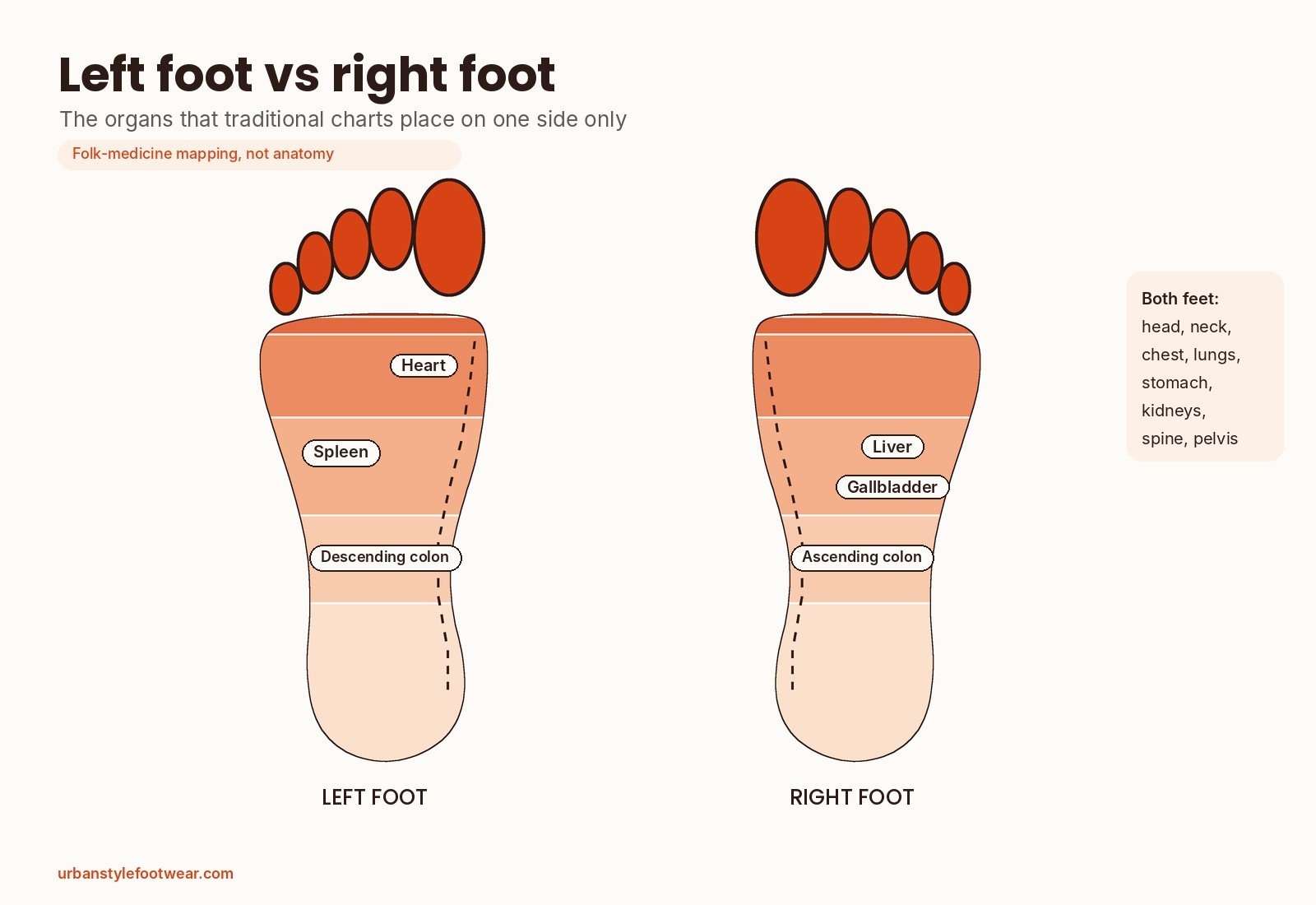
Many people search for the left and right foot separately, and the answer is simpler than the pages that rank for it suggest. Most of the chart is the same on both feet. A few organs sit on one side of the body, so charts place them on the matching foot only.
Left foot reflexology
The left foot is the side where charts place the heart (ball of the foot, toward the inner edge), the spleen (upper arch, outer side) and the descending colon (lower arch). The reasoning is purely mirror logic: the heart sits left of centre in the chest, and the descending colon runs down the left side of the abdomen, so the chart puts them on the left foot.
Right foot reflexology
The right foot carries the liver and gallbladder (upper arch, outer side) and the ascending colon (lower arch), because those sit on the right side of the abdomen.
Does it matter which foot you work on?
For relaxation, no. Practitioners normally treat both feet in a session. Cleveland Clinic describes a typical session as about 50 minutes, roughly 25 minutes per foot. If you do a short home routine, work both feet. There is no published evidence that working one foot rather than the other changes any result. Our step-by-step guide to doing foot reflexology at home covers both feet.
Common organ questions: liver, kidney, stomach and more
People often search for one organ at a time. Here is where a traditional chart places each, and an honest note on what that does and does not mean.
| Organ or area | Where charts place it | Reality check |
|---|---|---|
| Liver | Right foot, upper arch toward the outer edge | No evidence that pressing here affects liver function |
| Kidneys | Both feet, upper arch near the centre | Does not treat kidney disease. Anyone with kidney problems should ask their clinician first |
| Stomach | Both feet, upper arch, stronger on the left in some charts | Digestive symptoms that persist need medical assessment |
| Heart | Left foot, ball of the foot | Chest pain is an emergency. Never use a foot chart to assess it |
| Spine | Inner edge of both feet | Gentle pressure along the arch edge can feel good, which is all that can be claimed |
| Sinuses | Tips and bases of the toes | Some people find toe massage relaxing. It is not a sinus treatment |
| Lower back and sciatic nerve | Heel and the back of the inner ankle | Back pain is better explained by posture, footwear and movement |
You will also see pages about reflexology points for the arch of the foot. Pain in the arch is far more likely to come from the structures of the foot itself, such as the plantar fascia, than from any organ. If that is your problem, see our guides to plantar fasciitis and what reflexology can and cannot do for it.
How to read the chart without being misled
- Treat it as a guide to where to press, not a diagnosis. Reflexologists say tender spots indicate congestion in a related body part. No research supports that. Feet are tender for ordinary reasons: shoes, standing time, tight calves, a recent hard walk.
- Expect charts to disagree. There is no standard. Different schools place the stomach, pancreas and adrenals slightly differently. That is expected if the map is a tradition and not a measurement.
- Do not use it to decide medical treatment. If a chart suggests a “problem” organ, that is not information about your health.
- Pressure matters more than precision. Firm but comfortable pressure, never sharp pain. Our guide to foot pressure points explains the difference between reflexology zones and named acupressure points.
Is the chart supported by evidence?
The foot-to-organ mapping has not been validated. The National Center for Complementary and Integrative Health (NCCIH) says that the claim that reflexology promotes relaxation and healing is not proven, and Cancer Research UK states there is no scientific evidence that it can cure or prevent any disease. Cleveland Clinic notes there is no evidence that reflexology works better than a standard foot massage, and the MSD Manual describes its effects as indistinguishable from nonspecific massage.
A urinary study shows why the “map” question is hard to test. In a trial of 109 women with an overactive bladder, reflexology was compared with a nonspecific foot massage. Daytime urinary frequency fell more after reflexology (about 1.9 fewer episodes versus 0.55), but 88.9% of the reflexology group and 67.4% of the comparison group believed they had received real reflexology, so blinding was imperfect (International Urogynecology Journal, 2007). A chart can only be tested if people cannot tell what they are getting.
The pattern across the research is consistent: small studies, uneven quality, and benefits that look like the effects of relaxing touch. For a fuller review, read does foot reflexology work? and, for the head-to-head question, reflexology vs foot massage.
Safety before you press
Check with a clinician first if you have:
- Circulation problems in the feet, or a history of blood clots or inflammation of leg veins
- Foot ulcers, open wounds, or a fungal infection such as athlete’s foot
- Gout, or a foot injury or recent surgery
- Diabetes or other conditions that reduce feeling in the feet
- A low platelet count, or you are pregnant
This list follows the cautions given by Cleveland Clinic, Cancer Research UK and WebMD. Reflexology is generally low risk. Reported side effects are mild and short-lived, such as light-headedness or tender feet. Never delay care for chest pain, shortness of breath, severe headache or sudden weakness because of a foot chart. If you have numbness, read our guide on reflexology for neuropathy in feet before pressing hard.
If your feet hurt, look at the cause
If you came here because your feet or heels hurt, a chart will not locate the cause. Start with our foot pain guide and why do my feet hurt. For the full cluster, see the main foot reflexology guide.
Why different charts show different zones
If you compare charts online, you will notice they do not all match. Some show the toes and ball of the foot mapped to the head, neck and chest. Others place organs in slightly different positions, or add the top of the foot, ankle and inner edge. There is no single official chart, and the differences reflect that reflexology is a tradition developed by different practitioners over time, not a measured anatomical map. That is also why the same spot may be linked to different organs depending on the source. For the research behind the idea, see does foot reflexology work?
How to use a chart without over-trusting it
- Treat it as a guide to a routine, not as a diagnostic tool. A tender spot does not mean the matching organ has a problem.
- Use the whole foot. A short sequence from toes to heel is easier and more relaxing than hunting for one zone.
- Stay at moderate pressure. Tenderness is common in tired feet and is not a medical finding.
- Do not skip care. If you have symptoms, see a clinician rather than testing zones.
- Try the hands too. Reflexology can also be applied to the hands, which is useful if your feet are painful or you cannot reach them.
When you are ready to practise, the home routine turns the chart into a 10-minute sequence, and foot pressure points explains the acupressure view. The complete guide lists the safety checks.
Frequently asked questions
What is a foot reflexology chart?
It is a map of the soles that links regions of the feet to organs and body systems, used by reflexologists to decide where to apply pressure. It is a traditional teaching tool and has not been validated as anatomy.
What does the left foot represent in reflexology?
Charts treat each foot as a map of the body, with the left foot carrying organs on the left side, mainly the heart, spleen and descending colon, in addition to the zones shared by both feet.
What does the right foot represent in reflexology?
The right foot carries the liver, gallbladder and ascending colon on most charts, plus the zones shared by both feet.
Where is the liver point on the foot?
On a traditional chart, on the right foot in the upper arch toward the outer edge. There is no evidence that pressing there affects the liver.
Is a foot reflexology chart scientifically accurate?
No. The mapping is traditional and has not been confirmed by research. Reviews of reflexology find low-quality evidence overall and effects that resemble those of ordinary massage.
Can I use a chart to diagnose a health problem?
No. Tender areas on the foot do not reliably indicate problems elsewhere. Talk to a clinician about symptoms.
Is it safe to follow a chart at home?
For most healthy adults, gentle, comfortable pressure is low risk. People with circulation problems, blood clots, foot wounds, reduced sensation or pregnancy should check with a clinician first.
Is there one official reflexology chart?
No. Charts vary by school and source, and the zones are a tradition rather than a measured anatomical map.
Does a tender spot on my foot mean a problem in that organ?
No. Tenderness is common in tired or tight feet and has not been shown to indicate disease in the mapped organ.
Can I use a reflexology chart on my hands?
Yes. Reflexology is also applied to hands, with its own map, though evidence is similarly limited.
More in the foot reflexology series
- Reflexology vs acupressure: zones compared with points
- Foot reflexology for headaches and migraines: what trials found
- Foot reflexology for sleep: research and a bedtime routine
- Best reflexology foot massagers: devices and what to know
- Foot comfort and supportive footwear: fit and everyday habits
Sources
- NCCIH: Reflexology
- Cleveland Clinic: Reflexology (published August 30, 2022)
- Cancer Research UK: Reflexology (reviewed June 17, 2022)
- WebMD: Reflexology (medically reviewed August 2, 2025)
- MSD Manual Professional: Reflexology
- Reflexology vs nonspecific foot massage for detrusor overactivity, Int Urogynecol J 2007 (PubMed 17003953)
Educational information only, not medical advice. Reflexology is a complementary practice and should not replace care from a doctor.