
Reflexology vs Foot Massage: What Is the Difference and Which Is Better?
The short answer
Foot massage works on the muscles and tissues of the foot to relax them. Foot reflexology applies pressure to set areas of the sole that tradition links to organs and body systems. They feel similar, and the research cannot separate them well: Cleveland Clinic says there is no evidence reflexology works better than a foot massage, and the MSD Manual describes its effects as indistinguishable from nonspecific massage.
- Choose foot massage if your goal is tired, tight or sore feet.
- Choose reflexology if you enjoy a structured, chart-guided session and mainly want relaxation.
- Do not choose either to treat a disease. Neither is a proven treatment.
Side-by-side comparison
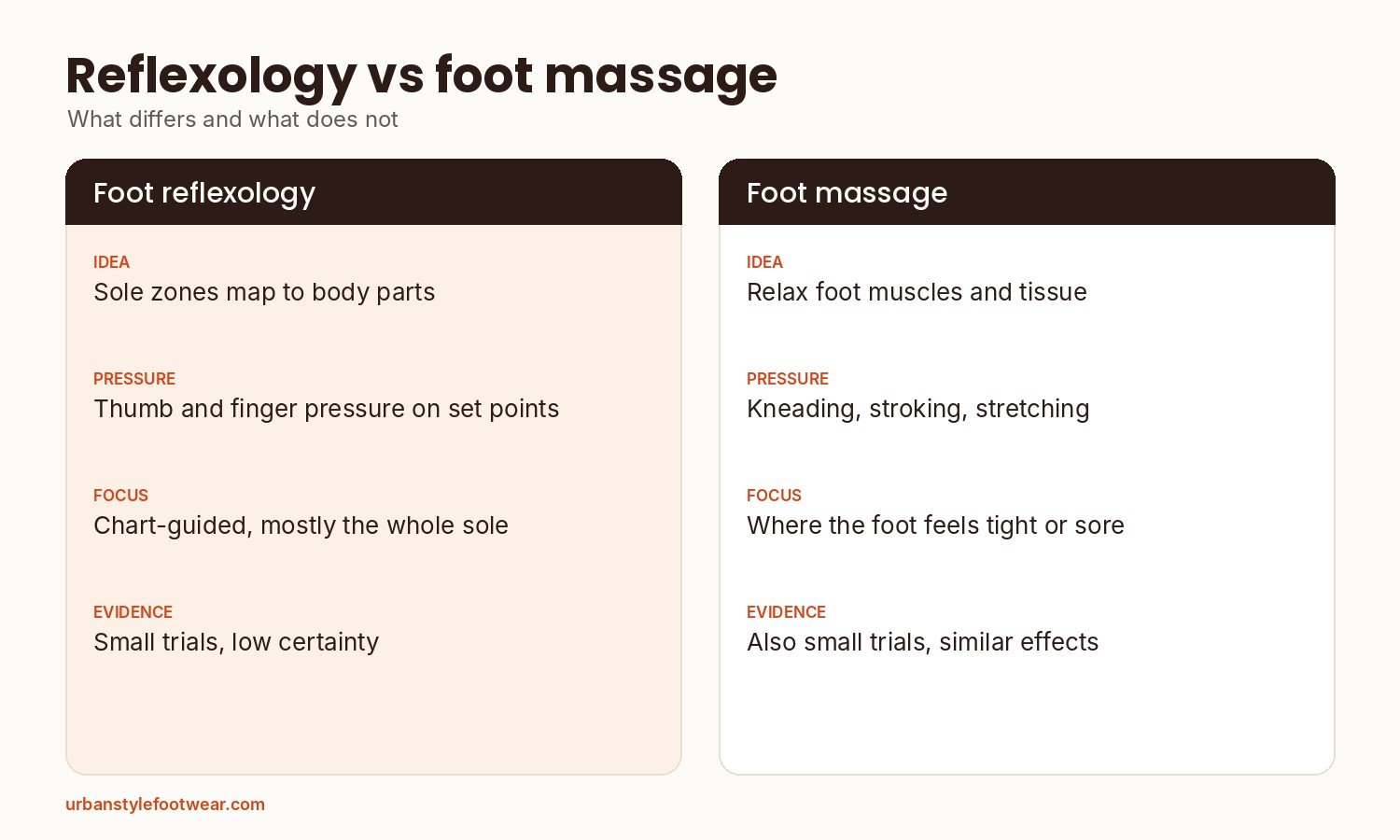
| Foot reflexology | Foot massage | |
|---|---|---|
| Underlying idea | Areas of the sole correspond to organs and body parts | Relaxing the foot’s own muscles and soft tissue |
| Technique | Thumb and finger pressure on defined zones, usually in a set order across the whole sole | Kneading, stroking, stretching and circular movements, often with oil |
| Where it focuses | Wherever the chart directs, whether or not the foot feels sore | Where the foot feels tight, tired or sore |
| Typical session | About 50 minutes, roughly 25 per foot (Cleveland Clinic) | Varies widely. Short sessions are common |
| Evidence | Small trials of mixed quality | Also small trials, with similar results |
| Best-supported benefit | Relaxation and lower anxiety | Relaxation and relief of tired feet |
How the techniques differ
Reflexology follows a chart. The practitioner presses the toes, ball, arch and heel in sequence because tradition says each region maps to a body part. See our original foot reflexology chart for the zones. The pressure is typically firm, but should not be painful.
Foot massage has no chart. The therapist reads the foot: tight calves leading into the arch, a stiff big toe joint, a sore heel pad. The aim is to loosen tissue and increase comfort.
The practical overlap is large. Both involve touch, warmth, rhythm and an unhurried 20 to 50 minutes, and those ingredients are probably doing much of the work. Cleveland Clinic and WebMD both describe a calming effect on the nervous system as a leading theory, and that idea does not require the chart to be correct.
What the research says
The key problem is that it is hard to design a fair comparison. People who receive reflexology usually know they are receiving something special, and people given a nonspecific foot massage as the comparison often suspect it. In a 2007 trial of 109 women with detrusor overactivity, daytime urinary frequency fell by 1.90 episodes with reflexology versus 0.55 with nonspecific foot massage (p = 0.029), yet the 24-hour difference was not significant (p = 0.055), and 88.9% of the reflexology group and 67.4% of the massage group believed they had received true reflexology. The blinding leaked.
A more recent trial used a sham comparison. In a 2025 randomized trial of 300 people awaiting laparoscopic gallbladder surgery, reflexology plus standard care was compared with sham reflexology plus standard care and with standard care alone. The authors reported a small but significant advantage for reflexology in reducing pre-operative anxiety (p = 0.022), and about a 1.3-point difference on the anxiety scale among people with moderate to high baseline anxiety (p = 0.023).
So the fair reading is that reflexology may offer a small benefit for anxiety in some settings, but the overall evidence does not show that its chart-based method beats a good foot massage. For the full review, see does foot reflexology work?
Which should you choose?
| If you want to… | Better fit | Why |
|---|---|---|
| Ease tired, achy feet after a long day | Foot massage | Targets sore tissue directly |
| Unwind with a structured, hands-on routine | Reflexology | Ritual and sequence can feel calming |
| Cut cost or save time | Self foot massage | Can be done at home in 10 minutes. See how to do foot reflexology at home |
| Treat heel or arch pain | Neither alone | See plantar fasciitis and the foot pain guide |
| Use a device between sessions | A foot massager | See best reflexology foot massagers |
Choosing a practitioner
- Ask about training. WebMD notes that in the United States reflexologists can train through accredited programs and take a national board exam.
- Ask what they claim. Be wary of anyone who says they can diagnose illness from your feet, or promises to cure a condition. Cancer Research UK states there is no scientific evidence that reflexology cures or prevents disease.
- Tell them your health history, including pregnancy, diabetes, clots and foot problems.
- Speak up about pressure. Pressure should be firm and comfortable.
Safety
Check with a clinician before either if you have:
- Circulatory problems in the feet, blood clots or leg vein inflammation
- Foot ulcers, wounds, gout, or a fungal infection such as athlete’s foot
- Reduced feeling in the feet, for example from diabetes
- A low platelet count, thyroid problems, epilepsy, or pregnancy (Cleveland Clinic advises telling a reflexologist if you are pregnant)
Side effects of reflexology are generally mild and short-lived, such as tender feet or light-headedness, according to Cancer Research UK. Neither treatment should delay care for foot pain that is severe, sudden, or follows an injury.
What a session actually feels like
A common worry in forums is whether reflexology hurts or whether it is simply a foot massage by another name. In practice, sessions usually look like this:
- You sit or recline, fully clothed apart from shoes and socks, and the practitioner takes a short health history.
- The feet may be warmed or cleansed, then worked with thumbs and fingers in slow, steady pressure, often following a set sequence across the whole foot.
- Pressure ranges from light to firm. Some spots feel tender. It should never be sharp or unbearable, and you can ask for lighter pressure at any time.
- A session often lasts about 30 to 60 minutes, and many people feel relaxed or sleepy afterwards.
A standard foot massage tends to focus on the muscles of the foot and sometimes the calf, with broad strokes, kneading and stretches. The goal is to ease tension in the tissue itself. Reflexology uses smaller, more targeted pressure and follows a map of zones. Our foot reflexology chart shows that map.
Which one fits your goal
| Your goal | Better fit | Why |
|---|---|---|
| Tired, achy feet after standing | Foot massage | Directly works the muscles and soft tissue that are tired. |
| General relaxation and stress relief | Either | Cleveland Clinic says there is no evidence reflexology works better than a foot massage, so pick the one you enjoy. |
| A calming, structured ritual before bed | Reflexology routine | The set sequence is easy to repeat. See reflexology for sleep. |
| Heel or arch pain | Neither as a treatment | Stretching and supportive shoes have the best track record. See reflexology and plantar fasciitis. |
| Numb or tingling feet | Ask a clinician first | Reduced feeling makes pressure risky. See reflexology for neuropathy. |
Finding a good practitioner and what to ask
People in forum threads often ask how to avoid the practitioners who overpromise. These are sensible things to look for:
- Training and membership. Ask where they trained and whether they belong to a professional body in your country. Rules and registers differ by country, so check locally.
- No diagnosing and no cure claims. A responsible practitioner treats reflexology as complementary and does not tell you to stop medication or skip medical care.
- A health questionnaire. They should ask about pregnancy, diabetes, clots, foot problems and medications before starting.
- Clear pricing and session length stated upfront. Prices vary widely by region.
- Comfort control. You should be able to say “lighter” or “stop” without pushback.
Is it worth trying?
The honest answer from the evidence is that reflexology has not been proven to treat any condition, but a calm, supported hour with your feet worked on is low risk for most healthy adults, and relaxation is a real benefit. If it helps you unwind, that matters, as long as you do not use it to replace medical care. If cost is a concern, a foot massage or the free home routine gives much of the same calming effect. For the full research picture, read does foot reflexology work?
Aftercare and what is normal afterwards
After a session, it is common to feel relaxed, a little sleepy, or lightly tender in the feet. Some people feel mildly light-headed for a moment when they stand, so get up slowly. Drink water if you are thirsty, and take it easy for the rest of the day if you can. Stop worrying if your feet feel a bit sore, but get advice if you notice pain that lasts more than a day or two, swelling, redness, a rash or numbness, or if you feel unwell. Tenderness is normal. Bruising or ongoing pain is not.
If you had a professional session, avoid stacking it with other deep-pressure treatments on the same day, and leave a gap between sessions of professional touch therapies, as University of Minnesota guidance suggests waiting at least 48 hours.
Myths to ignore
- “It releases toxins.” No evidence supports this. Your liver and kidneys clear waste.
- “Crystals under the skin are being broken up.” Not supported by anatomy or imaging.
- “It cures infertility, cancer or diabetes.” Reflexology has not been shown to cure any disease. Be wary of anyone who says otherwise.
- “A painful spot means a sick organ.” Tender feet are common and not a diagnosis.
- “Harder is better.” Strong pressure adds soreness, not benefit.
The sensible framing is simple: reflexology is a relaxing touch therapy that some people enjoy. Our complete guide has the evidence and safety details.
Frequently asked questions
Is reflexology the same as foot massage?
No. Foot massage relaxes the foot’s muscles and soft tissues. Reflexology applies pressure to chart-defined zones believed to match organs. They feel alike, and research cannot clearly separate their effects.
Is reflexology better than a foot massage?
There is no good evidence that it is. Cleveland Clinic says no evidence shows reflexology works better than a foot massage.
Which is better for tired or sore feet?
A foot massage, because it targets the tissue that is actually tired or sore.
Does reflexology hurt?
It should not. Pressure should be firm but comfortable. Tell the practitioner if anything is painful.
How long is a reflexology session?
Cleveland Clinic describes about 50 minutes, roughly 25 minutes per foot.
Can I do either at home?
Yes. A gentle 10-minute routine is a reasonable start. Avoid it if you have numb feet, clots, foot wounds or other conditions listed above, unless a clinician agrees.
Does reflexology hurt?
It should not. Some spots may feel tender, but pressure should stay comfortable. Tell the practitioner if anything hurts, because stronger pressure is not more effective.
How long does a reflexology session take?
Most sessions run about 30 to 60 minutes, though length varies by practitioner. A home routine can be 10 minutes.
Is reflexology just a foot massage?
They overlap, but reflexology uses targeted pressure following a map of zones, while a foot massage works the muscles with broader strokes. Evidence has not shown reflexology to work better.
Can I have both on the same day?
Healthy adults generally can, but there is no need. If you feel sore or light-headed afterwards, give your feet a rest.
Should I tip or book a series of sessions?
Tipping customs differ by country. Be cautious about prepaying for a large package of sessions, especially if promised results are medical. Try one session first.
Read next: the complete guide to foot reflexology, reflexology vs acupressure, and foot comfort and supportive footwear.
More in the foot reflexology series
- Foot pressure points: acupressure points and what they claim
- Foot reflexology for headaches and migraines: what trials found
- Foot reflexology for sleep: research and a bedtime routine
- Foot reflexology for plantar fasciitis: heel pain and what helps
- Reflexology for neuropathy in the feet: safety first
Sources
- Cleveland Clinic: Reflexology (published August 30, 2022)
- MSD Manual Professional: Reflexology
- Cancer Research UK: Reflexology (reviewed June 17, 2022)
- WebMD: What conditions can reflexology help with? (medically reviewed August 2, 2025)
- Reflexology vs nonspecific foot massage for detrusor overactivity, Int Urogynecol J 2007 (PubMed 17003953)
- Reflexology vs sham reflexology vs standard care for preoperative anxiety, 2025 (PubMed 41020221)
Educational information only, not medical advice.