
Reflexology vs Acupressure: Differences, Evidence and Which to Try
The short answer
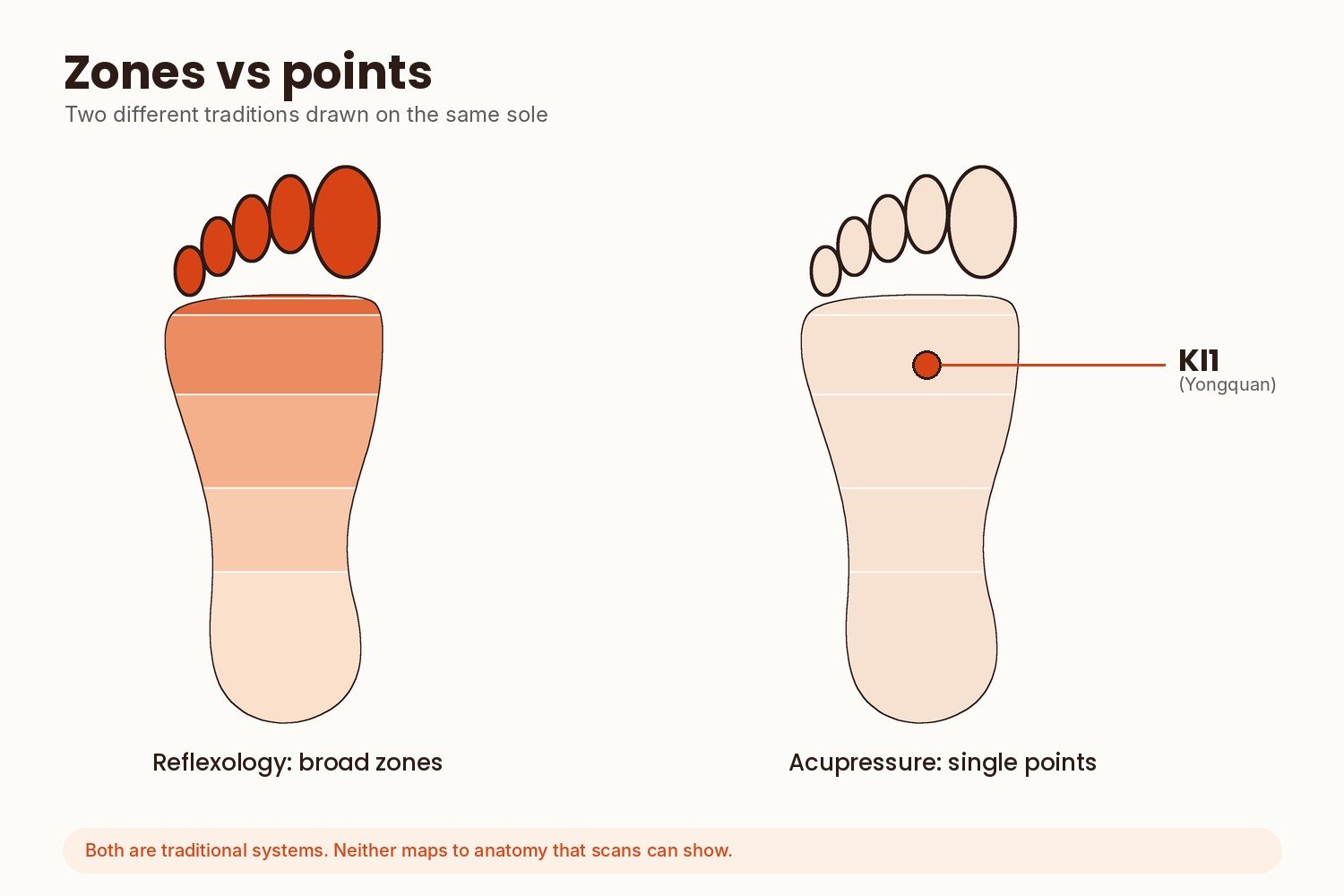
Reflexology presses broad zones on the feet (and sometimes hands or ears) that are said to correspond to organs. Acupressure presses small, named points anywhere on the body, taken from traditional Chinese medicine, with the same idea behind acupuncture but no needles. Both are complementary practices with limited and often low-quality evidence, and both are generally gentle when done correctly.
- Reflexology: a structured foot (or hand) sequence guided by a zone chart.
- Acupressure: one point at a time, on the foot, ankle, leg, hand, head and elsewhere.
- If you only want relaxation: either is fine. If you want to treat a condition, see a clinician first.
How they compare
| Foot reflexology | Acupressure | |
|---|---|---|
| Origin | Zone therapy, with the foot as a map of the body | Traditional Chinese medicine, with points along meridians |
| Where | Mostly the feet, sometimes hands and ears | Points across the whole body |
| What is pressed | Zones and areas of the sole | Individual named points (for example Kidney 1, Liver 3) |
| Method | Sequence of thumb and finger pressure over both feet | Steady pressure on one point at a time |
| Relative to needles | Not related to acupuncture | Needle-free counterpart to acupuncture (Cleveland Clinic) |
| Self-care | Possible, with a chart and gentle pressure | Very common as self-care |
| Evidence | Small trials, low certainty | Small trials, uneven quality |
The two ideas behind them
Reflexology assumes that regions of the foot correspond to body parts. Our foot reflexology chart shows the typical layout. The mapping is traditional. Neither the National Center for Complementary and Integrative Health nor the MSD Manual treats it as proven.
Acupressure assumes energy (qi) flows along channels and that pressure at specific points can influence it. Cleveland Clinic describes acupressure as a self-applied massage using the same points as acupuncture, performed with fingers or thumbs rather than needles.
The two overlap more than their theories suggest. Practitioners sometimes combine them. On the foot, the key difference is scope: a reflexologist works across zones, while an acupressure routine picks specific spots. See the full list of named points in our guide to foot pressure points.
Foot massage and acupressure in practice
People searching for “foot massage acupressure” usually want a simple self-care routine. A reasonable, low-risk approach is:
- Warm the foot and sit comfortably.
- Use your thumb to apply steady pressure to one point for about 30 to 60 seconds, then release slowly. Common starting points are Kidney 1 on the sole and Liver 3 on the top of the foot.
- Follow with gentle strokes across the sole and arch, as in a normal foot massage.
- Repeat on the other foot.
The timing is a convention, not an evidence-based dose. Keep pressure comfortable (about 4 to 6 out of 10). Cleveland Clinic advises against pressing hard enough to bruise and suggests stopping if you feel worse. For a reflexology-style sequence, use our home routine.
What the research says
Studies often group these methods together, which is useful here because it shows how similar their evidence looks.
- Insomnia (2012 systematic review). Researchers pooled 40 randomized trials of acupressure, reflexology and auricular acupressure. Only 10 used sham controls, only 4 were double-blind, and every trial had at least one area at high risk of bias. Acupressure alone did marginally better than sham, and acupressure or reflexology did better than routine care or no treatment, but the authors concluded the evidence did not allow a clear conclusion because of methodological limits and equivocal results.
- Restless legs in haemodialysis patients (2025 meta-analysis). Massage and acupressure reduced restless legs severity, while reflexology had no effect in the subgroup analysis. Sleep quality was not improved by any of the interventions.
- Acupressure in general (Cleveland Clinic, January 2025). The article cites a 2024 review reporting positive effects for gastrointestinal problems, though results vary, and a 2021 trial in which acupressure combined with acupuncture improved some sleep outcomes in people with breast cancer. It also says research on effectiveness is still ongoing.
- Reflexology in general. See does foot reflexology work? and reflexology vs foot massage.
The honest summary: neither method has strong, consistent evidence for treating a specific condition, and results from one population do not transfer to another. Benefits that do appear look like the effects of calm, attentive touch.
Which should you try?
| Your goal | Better fit |
|---|---|
| A full, structured foot session | Reflexology |
| A short, targeted routine you can do anywhere | Acupressure |
| Nausea or travel sickness, or other non-foot symptoms | Ask a clinician first and do not rely on foot points |
| Sore, tired feet | Foot massage. See foot comfort and supportive footwear |
| Heel pain | Neither alone. See reflexology for plantar fasciitis and plantar fasciitis |
Safety
Check with a clinician first if you:
- Have diabetes, neuropathy or numb feet
- Have poor circulation, a history of clots or leg vein inflammation
- Have foot ulcers, wounds, gout, a fungal infection or a recent injury
- Are pregnant. Some foot and ankle points are traditionally avoided in pregnancy
- Take blood thinners or have a low platelet count
Do not use either practice to delay care for chest pain, sudden severe headache, new weakness, or any symptom that worries you.
Which should you choose?
Both are touch-based practices with similar evidence limits, so the practical question is what you want from the experience.
- Choose reflexology if you want a calming, whole-foot routine that is easy to follow at home or with a practitioner. See our 10-minute home routine.
- Choose acupressure if you prefer a small number of specific points, such as a point on the sole, the inner ankle or the wrist, and you like short, focused holds. Our guide to foot pressure points explains the best-known ones.
- Choose neither as a treatment for pain, numbness or a diagnosed condition. See a clinician, then use these as a complement if they are appropriate for you.
Can you combine them?
Yes. Many people finish a reflexology routine by holding one or two acupressure points, or begin with a warm foot soak and slow strokes before pressing specific points. Combining them does not add risk for healthy adults as long as pressure stays moderate and you keep sessions short. It also does not add proven benefit, so keep expectations realistic. If you try several touch therapies close together, University of Minnesota guidance suggests leaving a couple of days between professional sessions.
Terms you will see: qi, meridians and zones
These words explain much of the confusion in online discussions:
- Qi (chi) is described in traditional Chinese medicine as a life energy. It has not been measured by science.
- Meridians are the channels along which qi is said to flow, and acupressure points are said to sit on them. No anatomical structure matching meridians has been identified.
- Zones are the reflexology idea that regions of the foot correspond to organs and body parts. See the foot reflexology chart.
You do not need to believe in any of these models to find the touch relaxing. You simply should not rely on them for health decisions.
Safety differences
For healthy adults, both are low risk when pressure is moderate. The main differences are practical. Reflexology involves longer contact across the foot, so it is a bigger consideration if you have foot wounds, clots, gout or reduced feeling. Acupressure involves shorter holds on single points, but pressing hard on one spot can still bruise. Pregnancy needs particular care, because some points and zones are traditionally avoided. Always ask a clinician if you have a medical condition. Our complete guide to foot reflexology lists the full safety checklist.
Finding two well-known foot points safely
Two points are mentioned often in guides. Treat the descriptions as traditional locations, not medical targets.
- Kidney 1 (KD1): on the sole, in the hollow just behind the ball of the foot, roughly one third of the way from the base of the toes to the heel. Press with a thumb for a few seconds at a time.
- Spleen 6 (SP6): on the inner leg, about four finger widths above the inner ankle bone, just behind the shinbone. Use steady, moderate pressure.
Press gently, never hard enough to cause pain, and stop if you feel numbness or tingling. For more on specific points, see foot pressure points.
Pregnancy and acupressure
Pregnancy is the situation where the two practices are most often questioned. SP6 is commonly listed among points avoided in pregnancy in acupressure guidance, and reflexology guidance advises caution because stimulation may trigger contractions, according to University of Minnesota guidance. If you are pregnant, do not self-treat these areas. Ask your midwife or doctor first, and if you see a practitioner, tell them you are pregnant.
How the research on acupressure compares
Acupressure has been studied for several symptoms, with the best-known example being a wrist point for nausea. Results across conditions are mixed, trial quality varies, and reviews often note small samples and difficulty blinding. The same caveat applies to reflexology. In plain terms: both are reasonable relaxation practices, neither is proven to treat disease, and both should sit alongside normal medical care. For the reflexology evidence in more depth, see does foot reflexology work?
Frequently asked questions
What is the difference between reflexology and acupressure?
Reflexology presses zones on the feet, hands or ears that are said to match organs. Acupressure presses specific named points across the body, based on traditional Chinese medicine, without needles.
Is reflexology a type of acupressure?
No, they come from different theories, although they overlap in practice and both use finger or thumb pressure.
Which one works better?
No reliable evidence shows one is better. Studies of both are small and of uneven quality, and a 2025 meta-analysis of restless legs found benefit for acupressure and massage but not for reflexology in that group.
Can I do acupressure on my own feet?
Yes, with gentle pressure. Avoid it if you have numb feet, clots, foot wounds or are pregnant, unless a clinician agrees.
Is acupressure the same as acupuncture?
No. Acupuncture uses thin needles at similar points. Acupressure uses finger or thumb pressure.
Is acupressure stronger than reflexology?
There is no evidence that either is stronger. They use different traditions and maps, and both have limited proof for treating conditions.
Which is better for beginners?
Reflexology routines are simple to follow because they cover the whole foot in sequence. Acupressure is easy too, but needs you to locate specific points.
Do I need a practitioner for either?
No, for gentle self-care. A practitioner can be helpful if you want guidance, but check their training and avoid anyone who promises cures.
Can I use a massage tool for acupressure points?
A blunt tool such as a smooth ball can help, but avoid hard or spiked tools on sensitive feet, and do not use them if your feet are numb.
Start with the complete guide to foot reflexology for the basics.
More in the foot reflexology series
- Foot reflexology for headaches and migraines: what trials found
- Foot reflexology for sleep: research and a bedtime routine
- Reflexology for neuropathy in the feet: safety first
- Best reflexology foot massagers: devices and what to know
Sources
- Cleveland Clinic: What Is Acupressure? How It Works (published January 30, 2025)
- Acupressure, reflexology, and auricular acupressure for insomnia: a systematic review of RCTs (PubMed 22841034)
- Massage, acupressure and reflexology on restless legs syndrome severity and sleep quality in haemodialysis patients: systematic review and meta-analysis, 2025 (PubMed 39905773)
- NCCIH: Reflexology
- MSD Manual Professional: Reflexology
Educational information only, not medical advice.