US to Australian Shoe Size Conversion Chart
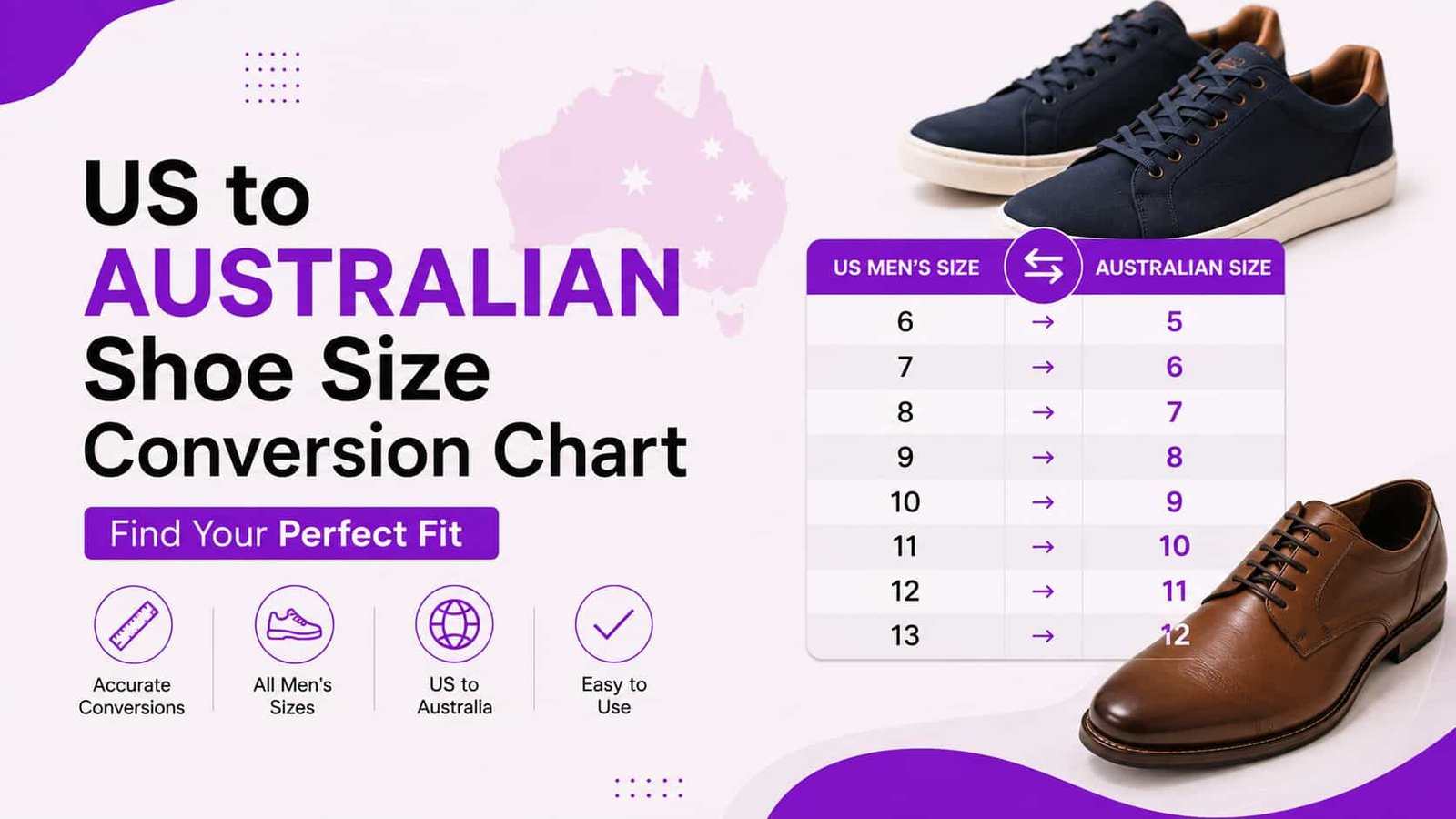
Quick answer: Australian shoe sizes depend on whether the shoe is a men’s, women’s or kids’ shoe.
- Men’s: Australia uses UK sizes, so AU = US minus 1. A US men’s 9 is an AU 8, and an AU 9 is a US 10.
- Women’s: Australia uses US sizes, so AU = US. A US women’s 8 is an AU 8.
- Kids’: Australia uses UK kids’ sizes, so AU = US minus 1. A US 10C is an AU 9.
Unisex boots labelled “AU/UK” (Blundstone is the best known) are the big exception for women: a US women’s 8 is a Blundstone 5. Check the label before you order.
US to Australian Shoe Size Converter
Works both ways: US to AU, AU to US, plus UK, EU and foot length in cm.
Every result comes from foot length, the same formulas as our main shoe size conversion calculator, so this tool and the charts below always agree. Brands can differ by half a size, so check the brand’s own chart when it has one.
Men’s shoes
AU = US − 1Australia follows the UK scale for men. US 9 = AU 8 = UK 8.
Women’s shoes
AU = USAustralia follows the US scale for women. US 8 = AU 8 (UK 6 on most charts).
Kids’ shoes
AU = US − 1Australia follows UK kids’ sizes. US 10C = AU 9, US 2Y = AU 1.
What Is a US to Australian Shoe Size Conversion?
A US to Australian shoe size conversion tells you which Australian (AU) number fits the same foot as your US size. It matters because Australia does not use one system for everyone. Men’s and kids’ shoes follow the British (UK) scale, while women’s shoes follow the American (US) scale, as noted in the shoe size overview on Wikipedia and in the size guides of Australian retailers such as Williams.
So the answer to “what is my size in Australia?” depends on the shoe:
- A man who wears a US 10 buys an AU 9 in Australia.
- A woman who wears a US 8 buys an AU 8. No change.
- A child in a US 12C wears an AU 11.
The fastest way to be sure is to forget the size number for a moment and use your foot length in centimeters. Every chart on this page lists it, and it never changes between countries.
US to Australian Shoe Size Conversion Chart
These charts cover half sizes for men (US 4 to 16), women (US 4 to 13) and kids (toddler to big kid). Foot (cm) is the length of your bare foot from heel to longest toe, not the length of the shoe. Every row is calculated from foot length, so the US, AU, UK and EU columns line up with each other and with the converter above.
Men’s US to Australian shoe size chart
What size is a US 9 in Australia? A US men’s 9 is an AU 8, which is also UK 8 and about EU 42.5, for a foot of about 26.2 cm. Subtract 1 from any US men’s size to get the Australian size.
| US Men | Australia (AU) | UK | EU | Foot (cm) | Foot (in) | US Women equiv. |
|---|---|---|---|---|---|---|
| 4 | 3 | 3 | 36 | 22.0 | 8.67″ | 5.5 |
| 4.5 | 3.5 | 3.5 | 36.5 | 22.4 | 8.83″ | 6 |
| 5 | 4 | 4 | 37.5 | 22.9 | 9.00″ | 6.5 |
| 5.5 | 4.5 | 4.5 | 38 | 23.3 | 9.17″ | 7 |
| 6 | 5 | 5 | 38.5 | 23.7 | 9.33″ | 7.5 |
| 6.5 | 5.5 | 5.5 | 39 | 24.1 | 9.50″ | 8 |
| 7 | 6 | 6 | 40 | 24.6 | 9.67″ | 8.5 |
| 7.5 | 6.5 | 6.5 | 40.5 | 25.0 | 9.83″ | 9 |
| 8 | 7 | 7 | 41 | 25.4 | 10.00″ | 9.5 |
| 8.5 | 7.5 | 7.5 | 41.5 | 25.8 | 10.17″ | 10 |
| 9 | 8 | 8 | 42.5 | 26.2 | 10.33″ | 10.5 |
| 9.5 | 8.5 | 8.5 | 43 | 26.7 | 10.50″ | 11 |
| 10 | 9 | 9 | 43.5 | 27.1 | 10.67″ | 11.5 |
| 10.5 | 9.5 | 9.5 | 44.5 | 27.5 | 10.83″ | 12 |
| 11 | 10 | 10 | 45 | 27.9 | 11.00″ | 12.5 |
| 11.5 | 10.5 | 10.5 | 45.5 | 28.4 | 11.17″ | 13 |
| 12 | 11 | 11 | 46 | 28.8 | 11.33″ | 13.5 |
| 12.5 | 11.5 | 11.5 | 47 | 29.2 | 11.50″ | 14 |
| 13 | 12 | 12 | 47.5 | 29.6 | 11.67″ | 14.5 |
| 13.5 | 12.5 | 12.5 | 48 | 30.1 | 11.83″ | 15 |
| 14 | 13 | 13 | 48.5 | 30.5 | 12.00″ | 15.5 |
| 14.5 | 13.5 | 13.5 | 49.5 | 30.9 | 12.17″ | 16 |
| 15 | 14 | 14 | 50 | 31.3 | 12.33″ | 16.5 |
| 15.5 | 14.5 | 14.5 | 50.5 | 31.8 | 12.50″ | 17 |
| 16 | 15 | 15 | 51.5 | 32.2 | 12.67″ | 17.5 |
“US Women equiv.” is the women’s size for the same foot length (men’s + 1.5), useful when a man is buying a women’s or unisex style. More on that in our men’s to women’s shoe size conversion chart.
Women’s US to Australian shoe size chart
Women’s sizes don’t change. A US women’s 7 is an AU 7, and a US 8.5 is an AU 8.5. The UK column is 2 lower on most Australian charts (US 8 = UK 6), which matters only if you shop at a UK store or buy a shoe labelled in UK sizes.
| US Women | Australia (AU) | UK | EU | Foot (cm) | Foot (in) | US Men equiv. |
|---|---|---|---|---|---|---|
| 4 | 4 | 2 | 34 | 20.7 | 8.17″ | 2.5 |
| 4.5 | 4.5 | 2.5 | 35 | 21.2 | 8.33″ | 3 |
| 5 | 5 | 3 | 35.5 | 21.6 | 8.50″ | 3.5 |
| 5.5 | 5.5 | 3.5 | 36 | 22.0 | 8.67″ | 4 |
| 6 | 6 | 4 | 36.5 | 22.4 | 8.83″ | 4.5 |
| 6.5 | 6.5 | 4.5 | 37.5 | 22.9 | 9.00″ | 5 |
| 7 | 7 | 5 | 38 | 23.3 | 9.17″ | 5.5 |
| 7.5 | 7.5 | 5.5 | 38.5 | 23.7 | 9.33″ | 6 |
| 8 | 8 | 6 | 39 | 24.1 | 9.50″ | 6.5 |
| 8.5 | 8.5 | 6.5 | 40 | 24.6 | 9.67″ | 7 |
| 9 | 9 | 7 | 40.5 | 25.0 | 9.83″ | 7.5 |
| 9.5 | 9.5 | 7.5 | 41 | 25.4 | 10.00″ | 8 |
| 10 | 10 | 8 | 41.5 | 25.8 | 10.17″ | 8.5 |
| 10.5 | 10.5 | 8.5 | 42.5 | 26.2 | 10.33″ | 9 |
| 11 | 11 | 9 | 43 | 26.7 | 10.50″ | 9.5 |
| 11.5 | 11.5 | 9.5 | 43.5 | 27.1 | 10.67″ | 10 |
| 12 | 12 | 10 | 44.5 | 27.5 | 10.83″ | 10.5 |
| 12.5 | 12.5 | 10.5 | 45 | 27.9 | 11.00″ | 11 |
| 13 | 13 | 11 | 45.5 | 28.4 | 11.17″ | 11.5 |
Some brands print a different UK number for the same women’s size: Nike puts UK 2.5 below the US size and adidas 1.5 below. See brand labels. For the full women’s scale, see our women’s shoe size chart.
Kids’ US to Australian shoe size chart
Australian kids’ shoes use UK kids’ sizes, which run one size below US kids’ sizes. Both systems restart at 1 after 13.5, so a “size 1” in Australia is a big kid’s size, not a baby size. “Kids” marks the toddler and little kid range; “junior” marks the restarted big kid range.
| US Kids | Australia / UK kids | EU | Foot (cm) | Foot (in) | Typical age* |
|---|---|---|---|---|---|
| 2C | 1 (kids) | 17.5 | 9.5 | 3.75″ | 3-6 months |
| 2.5C | 1.5 (kids) | 18 | 9.9 | 3.92″ | 6-12 months |
| 3C | 2 (kids) | 18.5 | 10.4 | 4.08″ | 6-12 months |
| 3.5C | 2.5 (kids) | 19 | 10.8 | 4.25″ | 6-12 months |
| 4C | 3 (kids) | 20 | 11.2 | 4.42″ | 12-18 months |
| 4.5C | 3.5 (kids) | 20.5 | 11.6 | 4.58″ | 12-18 months |
| 5C | 4 (kids) | 21 | 12.1 | 4.75″ | 12-18 months |
| 5.5C | 4.5 (kids) | 21.5 | 12.5 | 4.92″ | 18-24 months |
| 6C | 5 (kids) | 22.5 | 12.9 | 5.08″ | 18-24 months |
| 6.5C | 5.5 (kids) | 23 | 13.3 | 5.25″ | 18-24 months |
| 7C | 6 (kids) | 23.5 | 13.8 | 5.42″ | 2-3 years |
| 7.5C | 6.5 (kids) | 24.5 | 14.2 | 5.58″ | 2-3 years |
| 8C | 7 (kids) | 25 | 14.6 | 5.75″ | 2-3 years |
| 8.5C | 7.5 (kids) | 25.5 | 15.0 | 5.92″ | 3-4 years |
| 9C | 8 (kids) | 26 | 15.5 | 6.08″ | 3-4 years |
| 9.5C | 8.5 (kids) | 27 | 15.9 | 6.25″ | 3-4 years |
| 10C | 9 (kids) | 27.5 | 16.3 | 6.42″ | 4-5 years |
| 10.5C | 9.5 (kids) | 28 | 16.7 | 6.58″ | 4-5 years |
| 11C | 10 (kids) | 28.5 | 17.1 | 6.75″ | 4-5 years |
| 11.5C | 10.5 (kids) | 29.5 | 17.6 | 6.92″ | 5-6 years |
| 12C | 11 (kids) | 30 | 18.0 | 7.08″ | 5-6 years |
| 12.5C | 11.5 (kids) | 30.5 | 18.4 | 7.25″ | 5-6 years |
| 13C | 12 (kids) | 31.5 | 18.8 | 7.42″ | 6-7 years |
| 13.5C | 12.5 (kids) | 32 | 19.3 | 7.58″ | 6-7 years |
| 1Y | 13 (kids) | 32 | 19.5 | 7.67″ | 7-8 years |
| 1.5Y | 13.5 (kids) | 33 | 19.9 | 7.83″ | 7-8 years |
| 2Y | 1 (junior) | 33.5 | 20.3 | 8.00″ | 7-8 years |
| 2.5Y | 1.5 (junior) | 34 | 20.7 | 8.17″ | 8-9 years |
| 3Y | 2 (junior) | 35 | 21.2 | 8.33″ | 8-9 years |
| 3.5Y | 2.5 (junior) | 35.5 | 21.6 | 8.50″ | 8-9 years |
| 4Y | 3 (junior) | 36 | 22.0 | 8.67″ | 9-11 years |
| 4.5Y | 3.5 (junior) | 36.5 | 22.4 | 8.83″ | 9-11 years |
| 5Y | 4 (junior) | 37.5 | 22.9 | 9.00″ | 9-11 years |
| 5.5Y | 4.5 (junior) | 38 | 23.3 | 9.17″ | 11-13 years |
| 6Y | 5 (junior) | 38.5 | 23.7 | 9.33″ | 11-13 years |
| 6.5Y | 5.5 (junior) | 39 | 24.1 | 9.50″ | 11-13 years |
| 7Y | 6 (junior) | 40 | 24.6 | 9.67″ | 11-13 years |
*Typical age is only a rough guide; children of the same age can be two or three sizes apart. Measure every 2 to 3 months. Our kids’ shoe size chart and how to measure kids’ feet guide go into more detail.
Australian Shoe Sizes to American
Shopping from a US store with an Australian size in mind? Read across from your AU size. For a men’s shoe, add 1. For a women’s shoe, keep the same number.
| Australian size | US Men’s (men’s shoe) | US Women’s (women’s shoe) | EU (men’s) | EU (women’s) |
|---|---|---|---|---|
| AU 3 | US 4 | – | 36 | – |
| AU 3.5 | US 4.5 | – | 36.5 | – |
| AU 4 | US 5 | US 4 | 37.5 | 34 |
| AU 4.5 | US 5.5 | US 4.5 | 38 | 35 |
| AU 5 | US 6 | US 5 | 38.5 | 35.5 |
| AU 5.5 | US 6.5 | US 5.5 | 39 | 36 |
| AU 6 | US 7 | US 6 | 40 | 36.5 |
| AU 6.5 | US 7.5 | US 6.5 | 40.5 | 37.5 |
| AU 7 | US 8 | US 7 | 41 | 38 |
| AU 7.5 | US 8.5 | US 7.5 | 41.5 | 38.5 |
| AU 8 | US 9 | US 8 | 42.5 | 39 |
| AU 8.5 | US 9.5 | US 8.5 | 43 | 40 |
| AU 9 | US 10 | US 9 | 43.5 | 40.5 |
| AU 9.5 | US 10.5 | US 9.5 | 44.5 | 41 |
| AU 10 | US 11 | US 10 | 45 | 41.5 |
| AU 10.5 | US 11.5 | US 10.5 | 45.5 | 42.5 |
| AU 11 | US 12 | US 11 | 46 | 43 |
| AU 11.5 | US 12.5 | US 11.5 | 47 | 43.5 |
| AU 12 | US 13 | US 12 | 47.5 | 44.5 |
| AU 12.5 | US 13.5 | US 12.5 | 48 | 45 |
| AU 13 | US 14 | US 13 | 48.5 | 45.5 |
| AU 13.5 | US 14.5 | – | 49.5 | – |
| AU 14 | US 15 | – | 50 | – |
| AU 14.5 | US 15.5 | – | 50.5 | – |
| AU 15 | US 16 | – | 51.5 | – |
A dash means that AU size is outside the usual range for that shoe type. If an AU men’s size is too small for the men’s range, look at the women’s or kids’ column instead.
How to Convert US to Australian Sizes
You only need to know which kind of shoe you are buying. Then use one of three rules:
- Men’s shoe: subtract 1. US 8 to AU 7, US 9 to AU 8, US 10 to AU 9, US 11 to AU 10, US 12 to AU 11. Half sizes work the same way: US 9.5 is AU 8.5.
- Women’s shoe: no change. US 6 is AU 6, US 7.5 is AU 7.5, US 9 is AU 9.
- Kids’ shoe: subtract 1. US 8C is AU 7, US 13C is AU 12. For big kids, US 3Y is AU 2.
Going the other way (AU to US), reverse the rule: add 1 for men’s and kids’ shoes, and keep the number for women’s shoes.
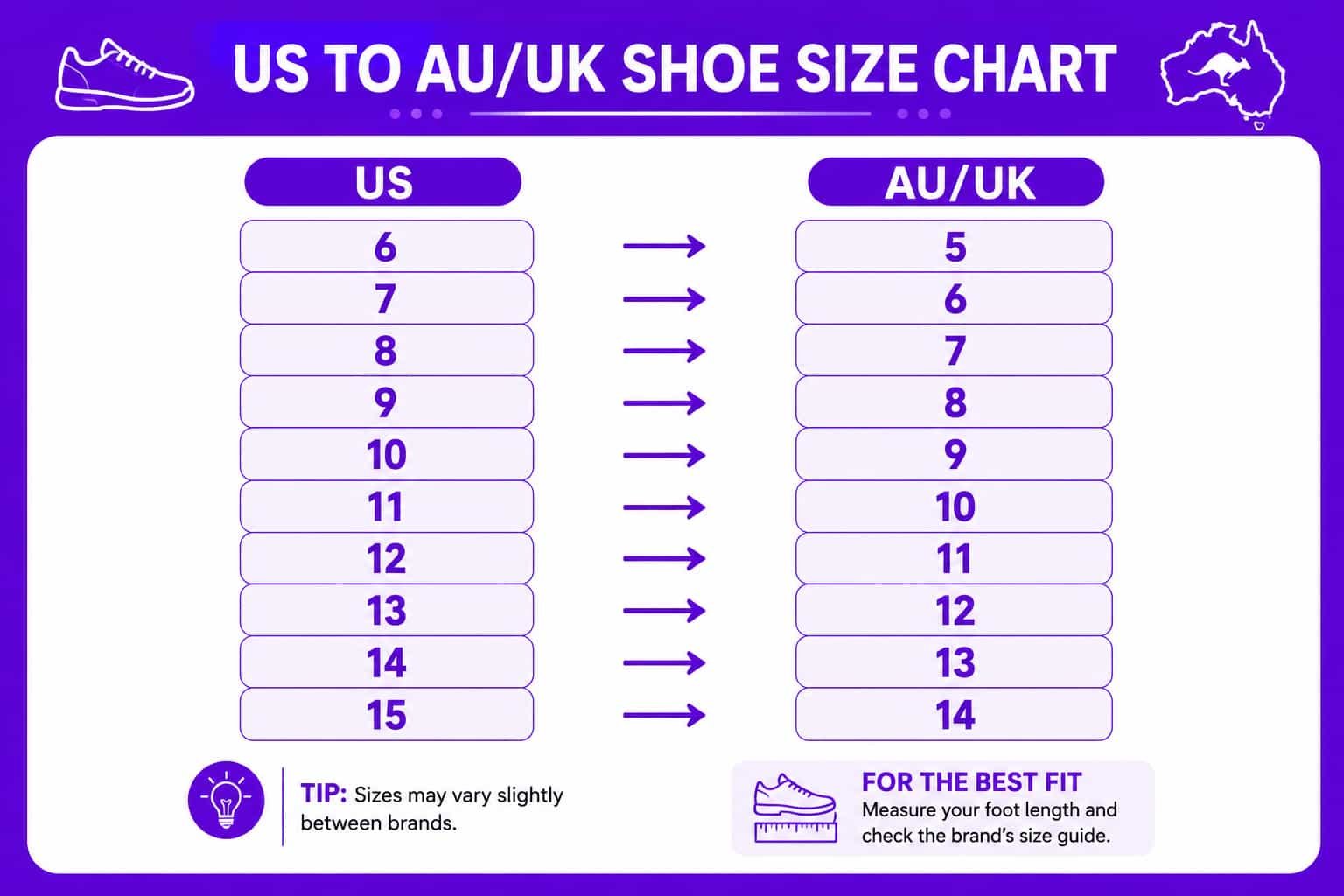
Common mistake: ordering an AU men’s size that matches your US number. A US men’s 10 ordered as an AU 10 is a full size too long, about 8.5 mm. Convert first, then check the brand’s chart if it has one.
If you already know your EU size, that works too: EU sizes are the same in Australia and the US for the same shoe, because EU sizing is unisex and based on length. For more on how the three systems relate, see US vs UK vs EU shoe size conversion.
Are US and Australian Shoe Sizes the Same?
For women’s shoes, yes. For men’s and kids’ shoes, no.
Same: women’s shoes
Australian women’s sizes use the US numbers. If you wear a women’s 8 in the US, you look for an 8 in an Australian shoe store. Retailers such as Williams Shoes, Trimly and Finder’s shopping guide all state this.
Different: men’s and kids’ shoes
Australian men’s and kids’ sizes use the UK numbers, which are one size lower than US for the same foot. A US men’s 9 is an AU 8. A US 11C is an AU 10.
This split is why so many people get confused. A couple shopping together may find the woman’s size unchanged and the man’s size one lower, in the same store.
Is Australian Sizing the Same as UK Sizing?
For men’s and kids’ shoes, yes: Australian and UK sizes are identical, so a UK 8 is an AU 8 and you can use a UK chart directly. That also makes Australian men’s sizes the same as Indian sizes, since India uses the UK scale too (see Indian vs UK shoe size).
For women’s shoes, no. An Australian women’s size is about 2 higher than a UK women’s size on most Australian charts: AU 7 = UK 5, AU 8 = UK 6. So if you order women’s shoes from a UK store, go down about 2 sizes from your AU size.
A quick check that helps when you are unsure: look at the EU number. It is the same in every country, so if a UK site and an Australian site show the same EU size for a shoe, you have matched the length. Need to convert UK to US as well? Our UK 8 to US size guide walks through one common example.
Brand Labels: Why Nike, adidas and Blundstone Show Different AU Numbers
The rules above match a standard foot-length chart and most brand charts. A few big brands print a slightly different UK or AU number on the same shoe, so it helps to know them before you order. These numbers come from each brand’s published chart (Nike, adidas) and Blundstone’s own help page, checked October 2026.
Men’s: the same US size on different labels
| US Men | AU (standard chart) | Nike UK label | adidas UK label | Blundstone AU/UK |
|---|---|---|---|---|
| US 6 | 5 | 5.5 | 5.5 | 5 |
| US 7 | 6 | 6 | 6.5 | 6 |
| US 8 | 7 | 7 | 7.5 | 7 |
| US 9 | 8 | 8 | 8.5 | 8 |
| US 10 | 9 | 9 | 9.5 | 9 |
| US 11 | 10 | 10 | 10.5 | 10 |
| US 12 | 11 | 11 | 11.5 | 11 |
| US 13 | 12 | 12 | 12.5 | 12 |
- Nike follows the US minus 1 rule for most sizes. Its Australian men’s size chart lists US 9 as UK 8. Two small quirks: US 6.5 and US 7 are both labelled UK 6, and US 6 is UK 5.5. See our Nike shoe size chart.
- adidas labels its UK size only half a size below the US size. On the adidas shoe size chart, a US men’s 9 is a UK 8.5. In Australian stores that sell adidas in UK sizes, a US 9 adidas buyer usually picks 8.5, not 8. See our adidas shoe size chart.
- Blundstone, the Tasmanian boot brand, labels boots in AU/UK sizes for everyone. For men, Blundstone says the AU/UK size is 1 less than your US size, which matches the standard rule.
Women’s: the same US size on different labels
| US Women | AU women’s (most stores) | UK (most AU charts) | Nike UK label | adidas UK label | Blundstone AU/UK |
|---|---|---|---|---|---|
| US 5 | 5 | 3 | 2.5 | 3.5 | 2 |
| US 6 | 6 | 4 | 3.5 | 4.5 | 3 |
| US 7 | 7 | 5 | 4.5 | 5.5 | 4 |
| US 8 | 8 | 6 | 5.5 | 6.5 | 5 |
| US 9 | 9 | 7 | 6.5 | 7.5 | 6 |
| US 10 | 10 | 8 | 7.5 | 8.5 | 7 |
| US 11 | 11 | 9 | 8.5 | 9.5 | 8 |
- In most Australian stores, women’s shoes are sold in US sizes, so your US size is your AU size.
- Blundstone and other unisex boots labelled AU/UK are the exception. Blundstone says that for women the AU/UK size is 3 less than your US size. A US women’s 8 is a Blundstone 5, not an 8. This catches out a lot of buyers.
- Nike and adidas UK labels differ by a full size for women (UK 5.5 vs UK 6.5 for a US women’s 8). Ignore the UK number and use the US number or the cm column.
Rule of thumb: if a shoe is labelled “AU/UK” and sold as unisex, treat the number as a UK size. Women then subtract about 2.5 to 3 from their US size, and men subtract 1.
How to Measure Your Foot for Accurate Sizing
How do you measure your foot for Australian shoe sizing? Stand on a sheet of paper, mark your heel and longest toe, and measure the distance in centimeters. Then find that number in the Foot (cm) column of the chart, or type it into the converter.
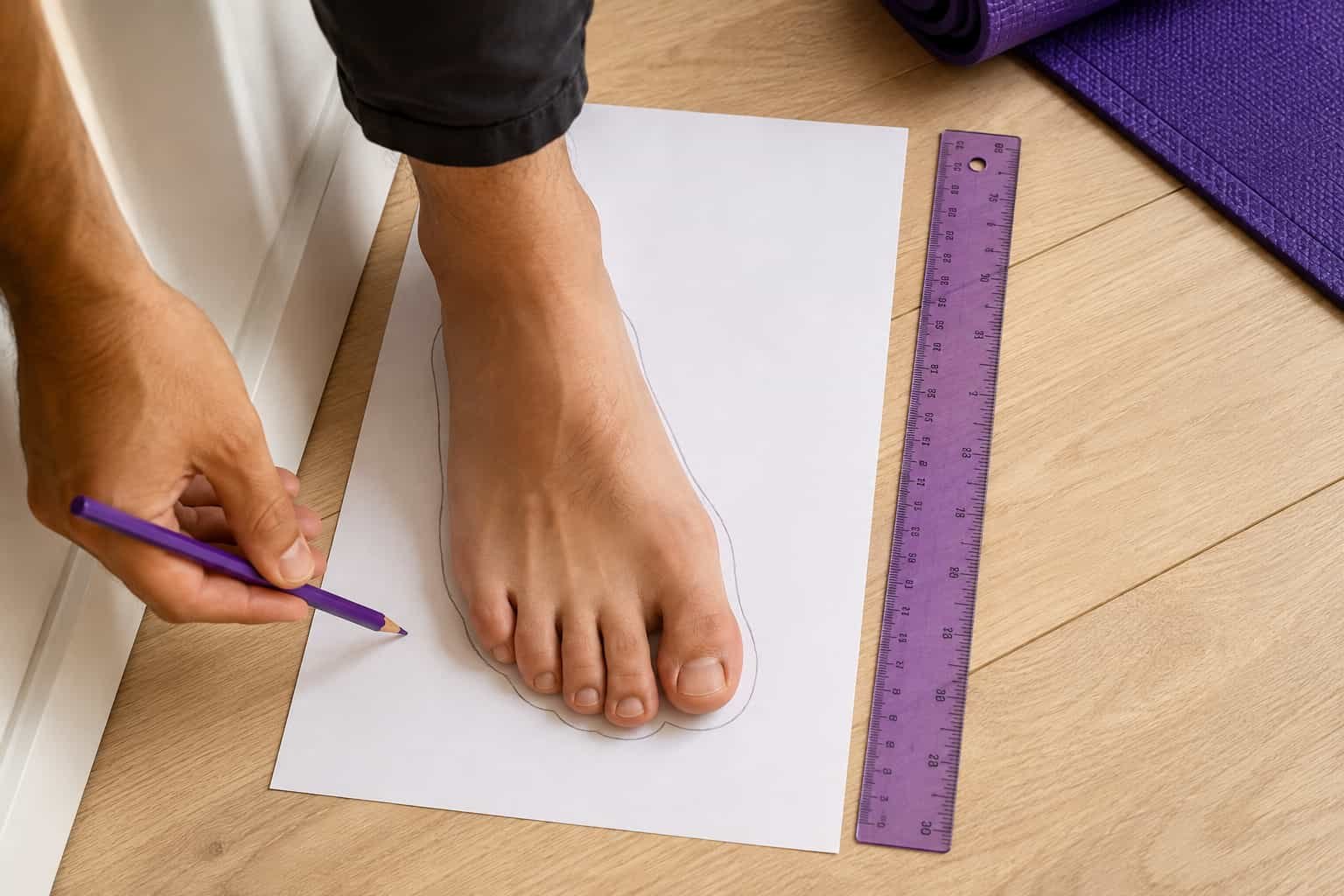
- Put a sheet of paper on a hard floor, against a wall.
- Stand on it with your heel touching the wall, wearing the socks you would wear with the shoes.
- Mark the tip of your longest toe. For some people that is the second toe.
- Measure from the wall to the mark in centimeters.
- Repeat for the other foot and use the longer measurement.
- Match it to the chart. If you fall between two sizes, choose the larger one.
Quick reference
- When: at the end of the day or after exercise, when feet are at their largest. This is also the advice of Victoria’s Better Health Channel.
- Toe room: about 1 to 1.5 cm between your longest toe and the front of the shoe.
- Both feet: one foot is often slightly longer. Fit the longer one.
More detailed steps, including a printable ruler, are in our how to measure foot size at home guide, with separate guides for men’s feet and women’s feet.
Signs You’re Wearing the Wrong Shoe Size
Signs your shoes are too small
- You can’t wiggle your toes, or they curl inside the shoe.
- Pressure or redness across the widest part of the foot.
- Blisters on the heel or the sides of the toes.
- Numbness or tingling after an hour or so of wear.
Signs your shoes are too big
- Your heel lifts out of the shoe as you walk.
- Your foot slides forward going downhill or down stairs.
- You need thick socks to keep the shoe snug.
- You have to pull the laces unusually tight to hold your foot in place.
Poor fit is common (more data in our footwear statistics hub). A review of 18 studies found that between 63% and 72% of people wore shoes that did not match the length or width of their feet, and that poor fit was linked to foot pain and foot disorders (Buldt and Menz, Journal of Foot and Ankle Research, 2018). If a shoe feels tight across the ball of the foot, a longer size is usually not the fix; a wider fit is. Our shoe width guide explains the width letters.
Why Australian and US Sizes Don’t Match
US and UK sizes both come from the old English barleycorn, a unit of one third of an inch (about 8.47 mm). Each full size is one barleycorn longer. The difference is where each system starts counting. According to the standard formulas, a UK adult size is about 3 times foot length in inches minus 23, and a US men’s size is about 3 times foot length minus 22. That one-step offset is why US men’s is always one number higher than UK and Australian men’s.
Australia follows the UK system for men’s and children’s shoes, while women’s shoes follow US sizing, so women’s numbers match the US instead. Neither system is more accurate; they just count from different starting points. To see which system every major country uses, and the average shoe size in each, see our shoe size by country guide.
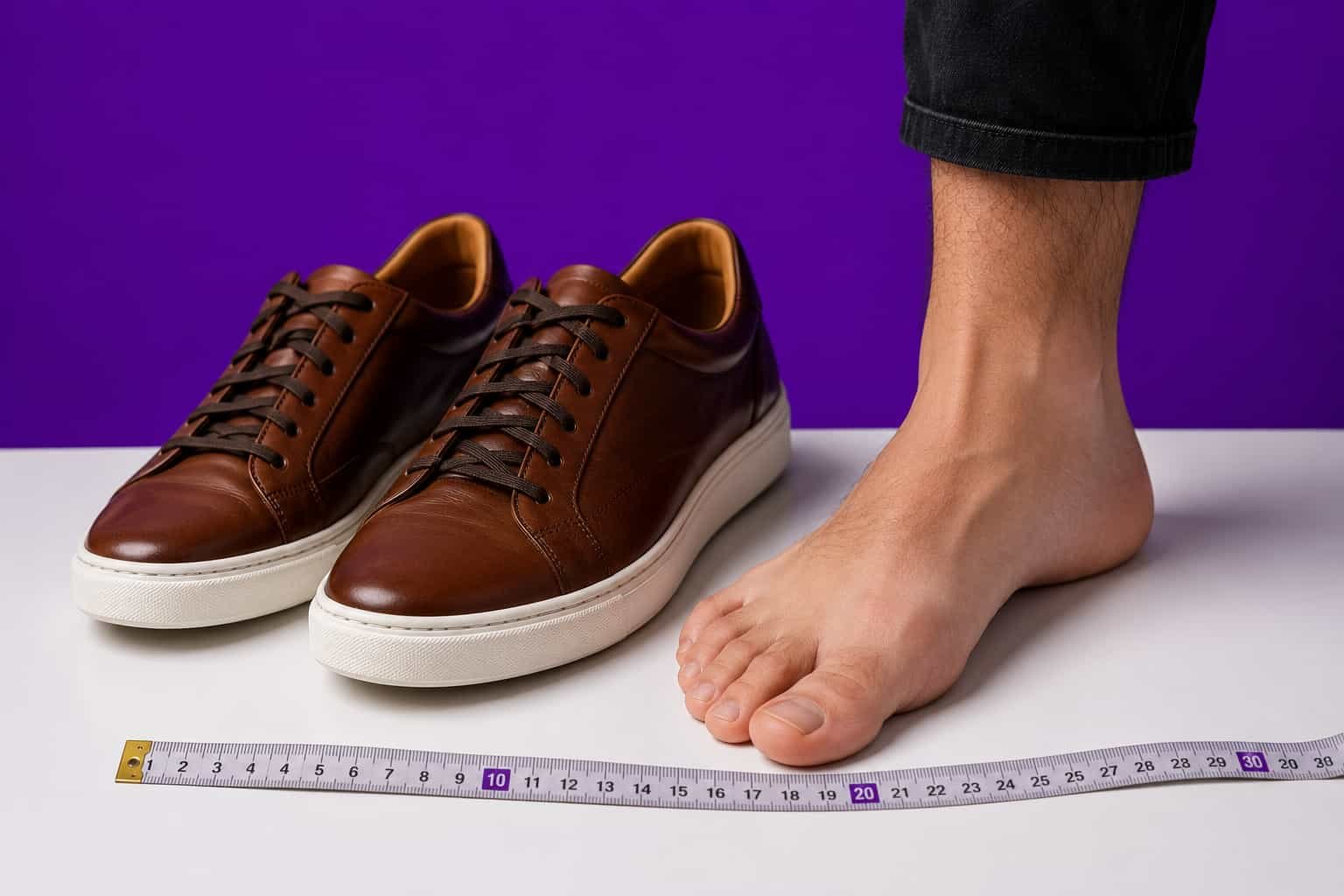
The number on the box is also only half the story. Every brand builds shoes on its own last, the foot-shaped mold a shoe is made on, so two shoes marked AU 8 can fit differently. That is why the brand charts and your foot length in cm matter more than the size alone.
What Australian research says about fit
A 2026 RMIT University study of 107 Australian women found that 72% wore a different US size from the one their foot length indicated, and most sized up. Women with the same length-based size differed by up to 40 mm around the widest part of the foot, and more than half didn’t know their UK size. The researchers suggest many women size up to get more width, not because they chose the wrong size (RMIT University, August 2026).
The practical lesson: if you always “size up”, check whether a wide fitting in your true length would fit better. For measured foot lengths and widths from other studies, see our foot size statistics.
Buying Guide: What to Check Before You Order from Australia
What should you check before buying shoes from an Australian store? Four things: which size system the listing uses, the brand’s own chart, width options and the return policy.
- The size system on the listing. Look for “US”, “UK”, “AU” or “AU/UK” next to the number. A women’s listing in “AU/UK” usually means UK sizing, not US.
- The brand’s own chart. Many Australian retailers show the brand’s table next to the product. Match your foot length in cm to it.
- Width. If you know you need a wide or narrow fit, filter for it. Length alone won’t fix a width problem.
- Returns. Check the return window and who pays international shipping. A wrong size is far cheaper to fix before you order.
- Fit reviews. Search reviews for “runs small”, “runs large” or “true to size”.
Shopping elsewhere too? See our guides to US to Japan, China to US and US to Mexico sizes, or the international shoe size chart for every country at once.
Common Mistakes When Converting AU Sizes
- Using one rule for everyone. “Subtract 1” is right for men and kids, but wrong for women.
- Assuming AU = US for men. A US men’s 10 is an AU 9, not an AU 10.
- Treating an AU/UK women’s label as AU. On unisex boots like Blundstone, a US women’s 8 is a 5.
- Mixing up adidas and Nike labels. adidas puts UK half a size closer to US than Nike does.
- Rounding down between sizes. A slightly long shoe can be fixed with an insole; a short one can’t.
- Ignoring width. Length conversion doesn’t help if the shoe is too narrow.
- Trusting an old measurement. Feet can change over time. Measure again before a big purchase.
Expert Tips for Ordering Australian Shoes
Shopper checklist
- Measure both feet in cm, late in the day, and use the longer one.
- Check whether the shoe is men’s, women’s, kids’ or unisex.
- Men and kids: subtract 1 from US. Women: keep the US number.
- On unisex AU/UK labels, women subtract about 3 (Blundstone).
- Compare your cm to the brand’s own chart when it has one.
- Between sizes, go up. Fix extra room with an insole or thicker sock.
- Confirm the return policy before you buy.
A good habit: save your foot length in cm on your phone. It is the one number that works in every store, in every country. If you are often between two sizes, our men’s half size guide and women’s half size guide explain when to go up or down.
How we checked these numbers
- Formulas: sizes are calculated from foot length (UK = 3 × foot inches − 23; US men’s = UK + 1; US women’s = men’s + 1.5; EU from foot length in cm), the same formulas used across our shoe size conversion charts.
- Australian rules: men’s and kids’ AU = UK; women’s AU = US. Confirmed against Wikipedia’s shoe size article and the size guides of Australian retailers Williams Shoes, Trimly and Finder.
- Brand labels: Nike’s Australian men’s chart, the adidas shoe size chart and Blundstone’s help page, checked October 27, 2026.
- Limits: brands can differ from a standard chart by about half a size. When a brand chart and this chart disagree, follow the brand.
Frequently Asked Questions
Are USA and Australian shoe sizes the same?
For women’s shoes, yes: an Australian women’s 8 is a US women’s 8. For men’s and kids’ shoes, no: Australia uses UK sizes, which are one size lower, so a US men’s 9 is an AU 8.
What is a US size 9 in Australian shoe size?
A US men’s 9 is an AU 8 (UK 8, about EU 42.5, foot length about 26.2 cm). A US women’s 9 stays an AU 9. On adidas shoes labelled in UK sizes, a US men’s 9 is a UK 8.5.
What is an American size 7 in Australia?
A US men’s 7 is an AU 6. A US women’s 7 is an AU 7. A US kids’ 7C is an AU 6 kids’. In Blundstone boots, a US women’s 7 is a size 4.
What is a US size 10 in Australian sizing?
A US men’s 10 is an AU 9 (about EU 43.5, foot length about 27.1 cm). A US women’s 10 is an AU 10.
Is a 38 a size 7 or 8?
EU 38 is usually a women’s 7 in both US and Australian sizing (UK 5). Some brands call it 7.5. For men, EU 38 is about a US 5.5, which is AU 4.5. Check the cm column of the brand’s chart to be sure.
How do I convert Australian shoe sizes to American?
For a men’s shoe, add 1 (AU 9 = US 10). For a women’s shoe, keep the same number (AU 7 = US 7). For a kids’ shoe, add 1 (AU 10 = US 11C). The Australian to American chart lists every size.
Is Australian shoe size the same as UK shoe size?
For men’s and kids’ shoes, yes. For women’s shoes, no: Australian women’s sizes are about 2 higher than UK women’s sizes (AU 8 = UK 6 on most charts).
Why are women’s Australian shoe sizes the same as US?
Australia uses UK sizing for men’s and children’s shoes but US sizing for women’s shoes. It is a labelling convention, not a different measurement: the women’s numbers simply match the US scale.
What size Blundstone should I get if I wear a US women’s 8?
Blundstone labels boots in AU/UK sizes and says the women’s AU/UK size is 3 less than your US size, so a US women’s 8 is a Blundstone 5. For men, take 1 off your US size: a US men’s 10 is a Blundstone 9.
Do all Australian brands use the same size chart?
Most follow the rules on this page, but brand charts can differ by about half a size, and some unisex or work boot brands label everything in AU/UK sizes. Always check the product page or the brand’s chart.
Are Australian kids’ shoe sizes different from US?
Yes. Australian kids’ shoes use UK sizes, which are one size below US. A US 10C is an AU 9, and a US 3Y is an AU 2. Both systems restart at 1 after the toddler range.
Should I size up if I’m between two Australian sizes?
Usually, yes. A slightly longer shoe can be adjusted with an insole or thicker sock, while a shoe that is too short will rub no matter what you do. If the issue is tightness across the foot, try a wide fit instead of a longer size.
Do wide feet need a different AU size?
Not a different length size. Look for a wide fitting in your normal length, for example 2E for men or D for women. Width letters tell you the width; the number tells you the length.
What is my size in Australia if I wear EU 42?
EU 42 is about a US men’s 8.5 and an AU 7.5 on a standard chart. Brands differ: Nike lists EU 42 as US 8.5 and adidas as US 8.5 as well. For women, EU 42 is about a US and AU women’s 10 to 10.5.
Are Australian boots sized differently from sneakers?
Not by design, but many boots are cut roomier for thicker socks, and many Australian boot brands use unisex AU/UK labels. Check the product notes and the label system before converting.
What’s the fastest way to check my AU size while shopping?
Measure your foot once in cm and keep the number on your phone. Then match it to any chart, or enter it in the converter above.
Final Thoughts
Converting US to Australian shoe sizes comes down to one question: whose shoe is it? Men and kids subtract 1. Women keep the same number. Watch for unisex AU/UK labels like Blundstone, and for adidas putting its UK size half a size higher than Nike.
If you remember only one thing, make it your foot length in centimeters. Measure today, use the converter above, and check the brand’s chart before you order. For every other size system in one place, use our shoe size conversion chart and calculator.
Related Size Guides
Adults
Countries
Sources
- Shoe size, Wikipedia (size systems by country and the UK and US formulas).
- Nike men’s footwear size chart, Nike Australia.
- Shoe size chart, adidas.
- Buying another pair, Blundstone help centre (AU/UK to US sizing).
- Size guide, Williams Shoes (Australian women’s sizes match US sizes).
- Most Australian women wearing shoes that don’t match their feet, RMIT University, August 2026.
- Choosing the right shoe, Better Health Channel, Victorian Government.
- Buldt AK and Menz HB, Incorrectly fitted footwear, foot pain and foot disorders, Journal of Foot and Ankle Research, 2018.