
Men’s Half Size Guide: Should You Size Up or Down?
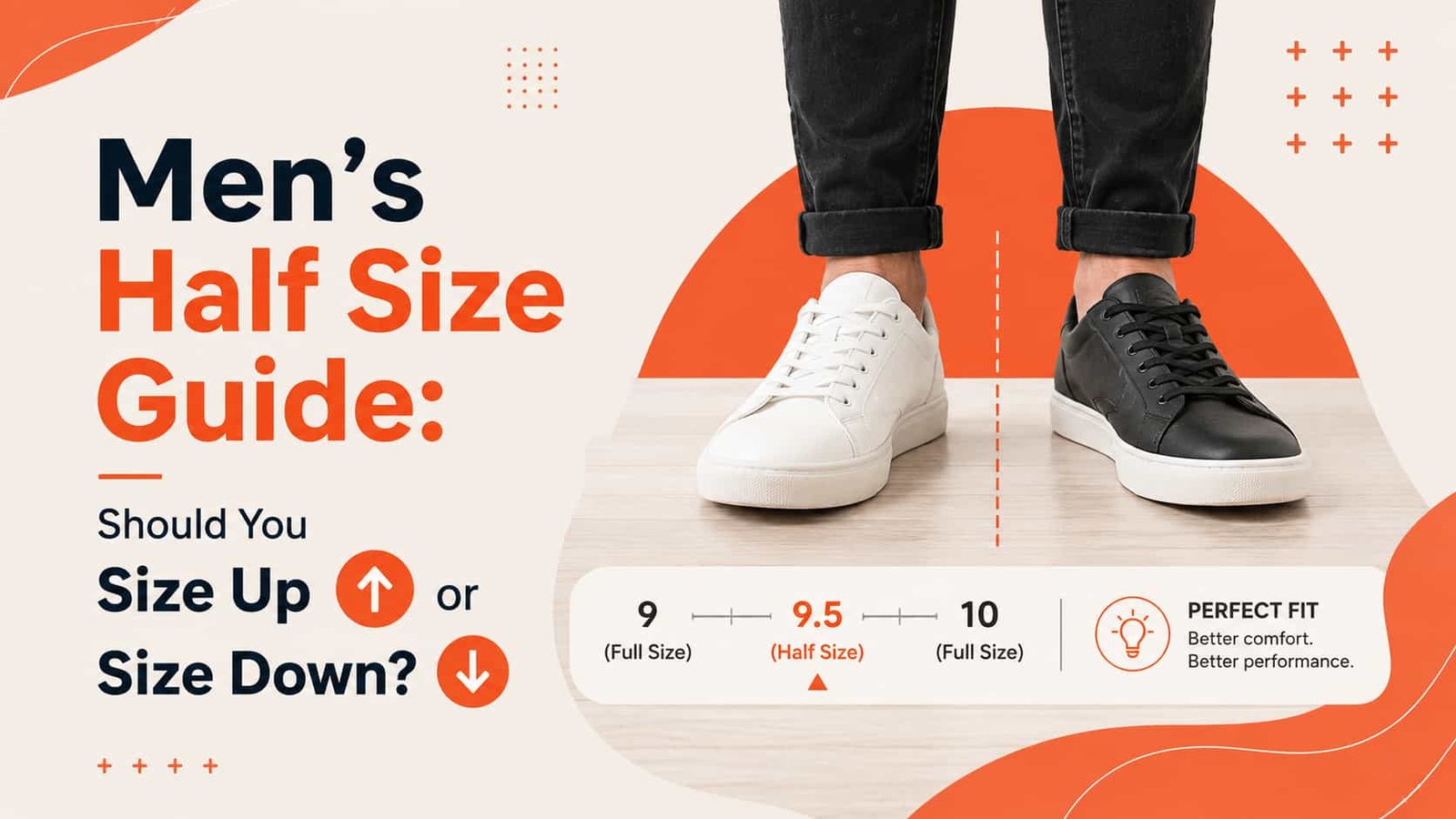
Half sizes exist because not all feet fit neatly into standard whole sizes. If your foot measures between two sizes, a half size provides the missing middle ground. The answer to whether you size up or down depends on your foot width, the specific shoe brand, and the shoe’s construction. In most cases, if your foot measures closer to a half size, you should purchase that half size rather than forcing yourself into a whole size that does not fit. Many men wear the wrong size for years simply because they do not understand how half sizes work or which direction to go. After two decades fitting customers, I can tell you that the men who purchase half sizes when their measurements indicate they should report significantly higher satisfaction than those who compromise with a whole size that does not fit correctly.
⚡ Quick Answer
- Half sizes split the difference between two whole sizes by approximately 0.15 inches.
- If your foot measures between sizes, a half size is usually better than forcing a whole size.
- Size up if the shoe runs narrow, size down if it runs wide.
- Not all brands carry half sizes, which limits options for some men.
What Half Sizes Actually Mean
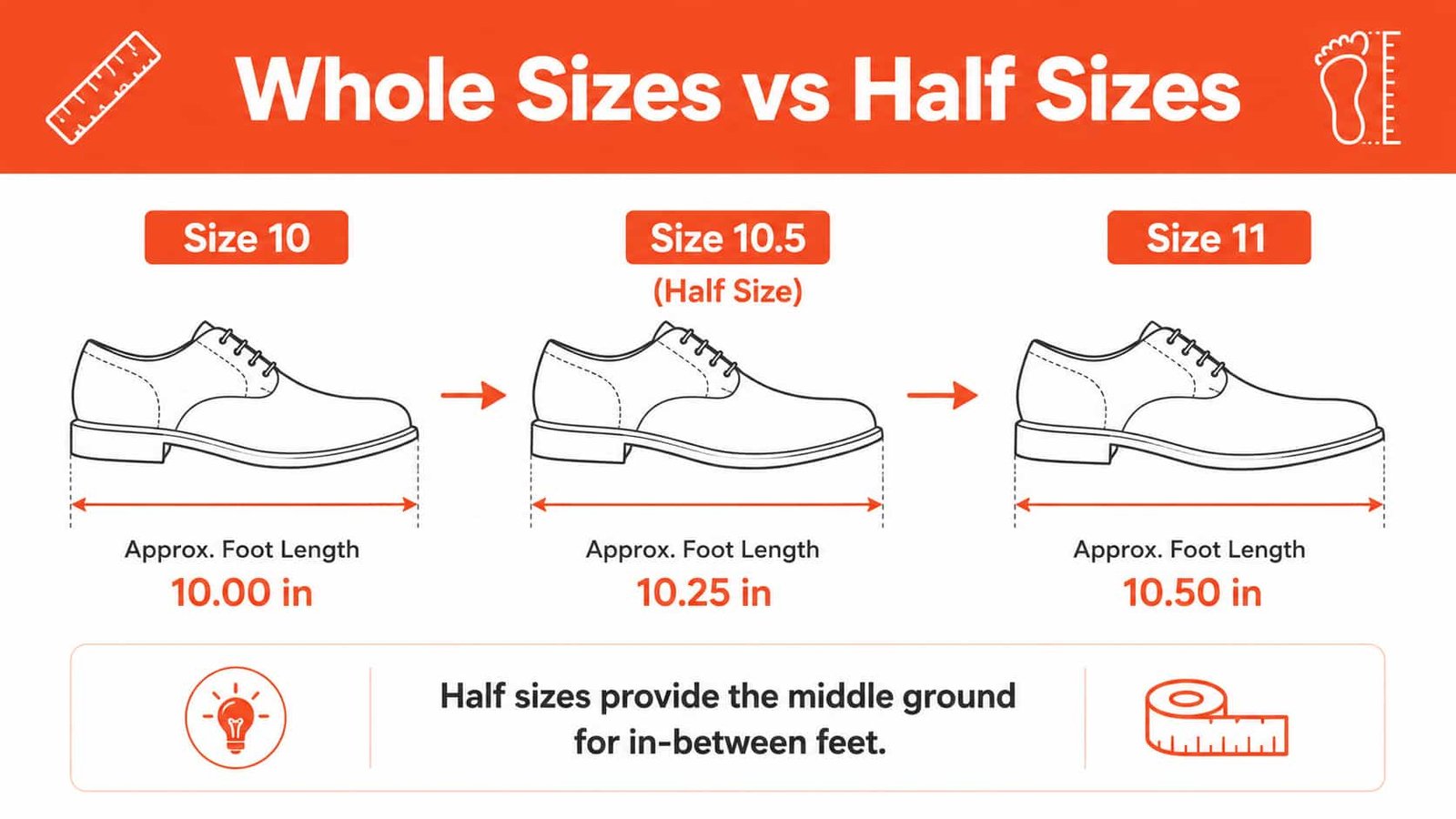
Half sizes exist to accommodate feet that do not fit standard whole sizes. The gap between a size 10 and size 11 is approximately 0.33 inches of foot length. A half size (10.5) splits this gap and represents approximately 0.15 to 0.17 inches of additional length beyond size 10. This small difference matters significantly in comfort because a shoe that is too short creates pressure at the toe and can lead to toenail problems over time.
Not all shoe categories use half sizes equally. Athletic shoes and casual sneakers almost always come in half sizes, as manufacturers understand that the athletic customer base values precise fit. Dress shoes, especially higher-end dress shoes, often skip half sizes entirely, limiting options for men whose feet fall in between. Work boots and specialized footwear sometimes carry half sizes and sometimes do not, depending on the manufacturer.
Half sizes are standard in North America and are expressed with a 0.5 after the whole size number. A size 10.5 is a half size shoe. However, international sizing systems handle half sizes differently. UK sizing uses different intervals, and EU sizing uses entirely different numbers. A US half size does not directly translate to a half size in other systems, which is why ordering shoes internationally requires careful reference to size charts.
👟 Did You Know?
Half sizes were originally created as a compromise when standardized whole sizes left too many customers with poor fits. Before widespread half size adoption, men with in-between feet either wore shoes that were too small and caused blisters or too large and caused slipping.
How Half Sizes Are Measured
A half size increment represents approximately 0.167 inches or 0.42 centimeters of foot length added to the previous whole size. However, this is not uniform across all sizing systems. Shoe manufacturers measure using the Paris point system, where each full size represents exactly one-third of a centimeter. Half sizes are not exact halves but rather intermediate points in this mathematical system.
What matters practically is that half sizes provide a measurable step between whole sizes. If your foot measures 10.4 inches, a size 10 may be slightly tight and a size 11 clearly too large, but a size 10.5 often provides the ideal fit. Some men find that a half size eliminates heel slipping that occurs in the next size up or prevents toe cramping that occurs in the size below.
The confusion arises because not all brands space their sizes equally. Some manufacturers create half sizes that are genuinely intermediate. Others create half sizes that sit closer to the smaller size or closer to the larger size, depending on their design philosophy. This is why ordering the same size from two different brands can result in notably different fits.
💡 Expert Tip
When trying on shoes in a store, always try both the whole size below and the half size, even if one feels clearly too small. The padding, arch support, and materials vary enough that the half size often provides a surprise fit improvement over both whole sizes.
Size Up or Down: The Real Decision
The decision to size up or down when facing a half size situation depends on three factors: your actual foot measurement, the shoe’s intended fit, and how the specific brand handles sizing.
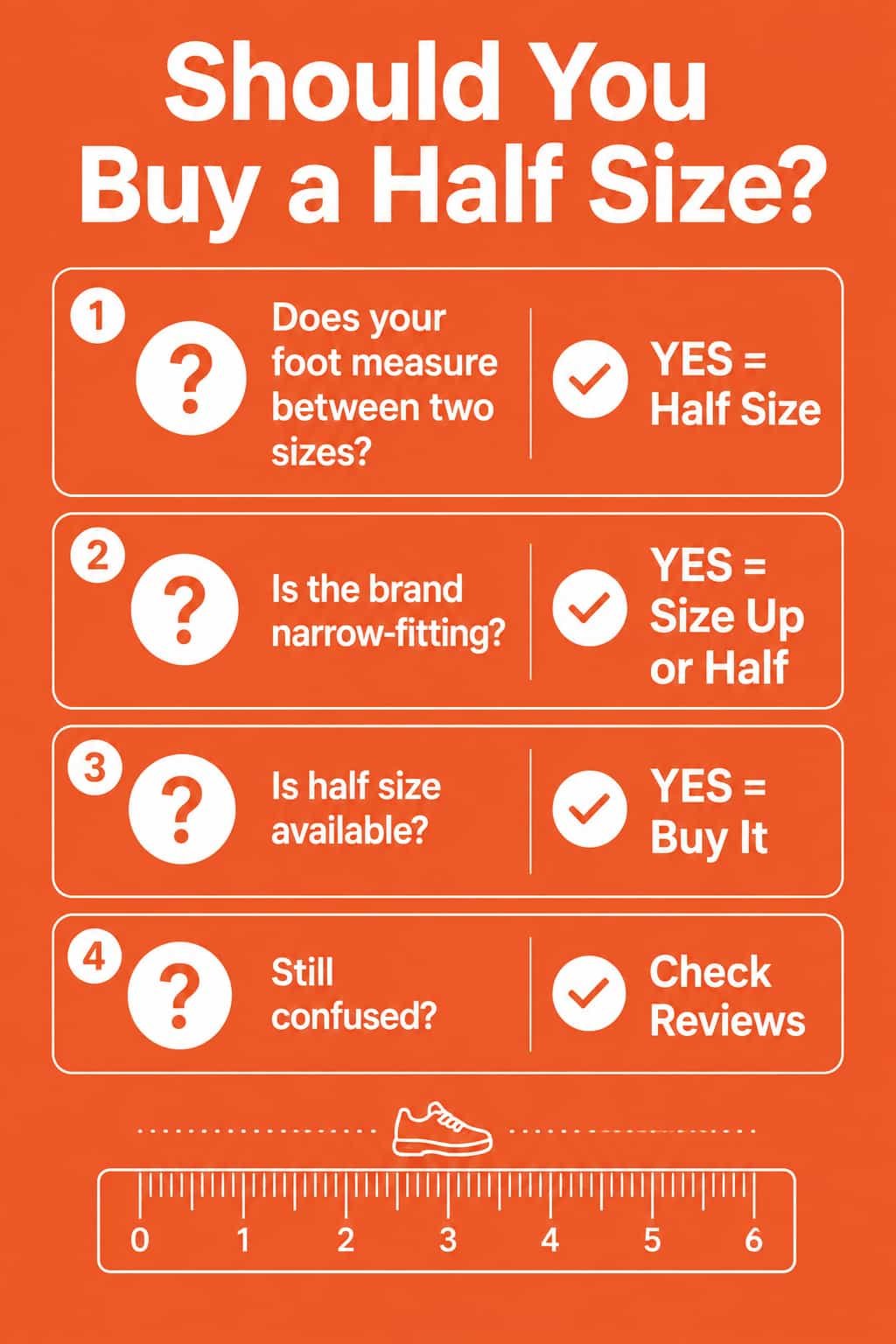
If your foot measures closer to the larger size, size up. If your measurement of 10.4 inches is clearly closer to a 10.5 or 11 territory, a half size (10.5) or the full size up (11) makes sense. If your measurement of 10.1 inches is solidly in the size 10 range with just a touch of uncertainty, stick with size 10 rather than stepping up to 10.5.
If the shoe runs narrow, size down from where your measurement indicates. A narrowly constructed shoe in size 11 might fit like a normal size 10.5 or even 10. Conversely, if a shoe runs wide, size up. A widely constructed size 10 might fit like a size 10.5 or 11. This is why checking customer reviews mentioning fit is crucial before purchasing online.
Your foot width matters independently. A man with size 10 length but wide feet might fit better in a size 10 EE wide shoe than a size 10.5 standard width. Width and length are separate variables, and addressing width often solves fit issues more effectively than adjusting length alone.
⚠ Common Mistake
Assuming that sizing up from a whole size to the next whole size is an acceptable alternative to buying a half size is one of the biggest errors. Going from a size 10 to 11 leaves too much room and creates heel slip, lacing issues, and foot instability. A half size is the correct compromise, not a full size jump.
Half Sizes vs Whole Sizes: Fit Comparison
A properly fitted half size shoe almost always feels better than a whole size shoe that is either slightly too small or too large. The difference between a shoe that is correct and one that is half a size off is the difference between all-day comfort and afternoon pain.
When a shoe is a half size too small, pressure develops at the toe box after the first hour of wear. Your longest toe hits the front of the shoe, and over time this can lead to toenail darkening or even loss of toenails. The lacing system feels tight no matter how loose you make it, and your foot essentially has no room to shift or adjust as your foot naturally expands and contracts throughout the day.
When a shoe is a half size too large, heel slipping occurs with every step. You find yourself clenching your toes to keep the shoe from sliding off, which creates fatigue and tension in the foot. The arch support does not align with your foot’s arch because your foot is sitting too far back or too far forward in the shoe. After a full day, your heels are blistered from the repetitive rubbing.
A correctly fitted half size puts your longest toe approximately a thumb’s width from the front of the shoe, keeps your heel stable without slipping, and aligns your arch support with your actual foot anatomy. The lacing system feels snug at a comfortable tension. Your foot stays comfortable regardless of whether you are standing, walking, or sitting.
✅ Correct Fit Checklist
- About a thumb’s width of space between longest toe and shoe front.
- Heel stays in place without lifting when you walk.
- No pinching across the ball of the foot.
- Toes can wiggle freely without touching the top of the shoe.
- Comfort remains consistent after 30 minutes of wear.
- Lacing feels snug at moderate tension, not tight or loose.
Interactive Half Size Selector Tool
Use this tool to determine whether you need a whole size, half size, or wide width option based on your foot measurements.
📊 What Size Should You Buy?
Enter your foot length and width to get a personalized sizing recommendation including whether a half size would benefit you.
Which Brands Carry Half Sizes
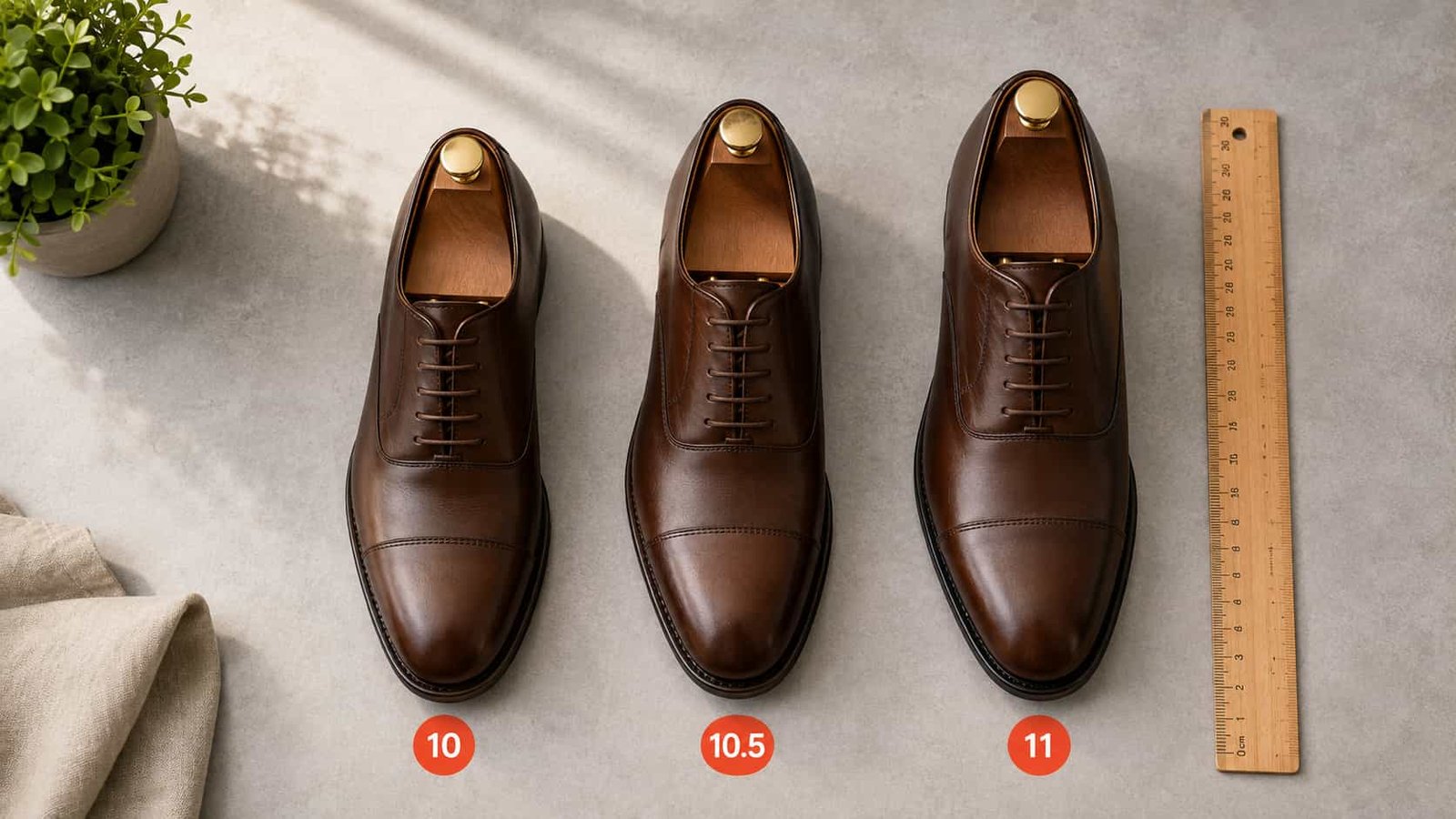
Not all brands offer half sizes, which creates real problems for men whose feet measure in-between. Athletic brands like Nike, Adidas, and New Balance almost always carry half sizes because their customer base expects them. Running shoes, basketball shoes, and cross-training shoes come in half sizes as standard.
Casual sneaker brands like Converse, Vans, and Puma carry some half sizes but not always for every style. A specific Vans model might come in half sizes while another does not. This requires checking the specific product listing before purchasing.
Dress shoe manufacturers have inconsistent policies. Allen Edmonds and Johnston Murphy carry extensive half size options. Clarks sometimes carries half sizes. Many luxury dress shoe brands from Europe do not carry half sizes at all, forcing men to order from the US and return if the fit is wrong.
Work boot manufacturers vary widely. Timberland carries half sizes for most styles. Thorogood and Red Wing offer half sizes for many models but not all. Smaller work boot brands often skip half sizes entirely.
Online retailers like Amazon and Zappos carry more half size options than physical stores, partly because they can ship from centralized warehouses with deeper inventory. However, you have to actually search for half sizes to find them, and some retailers do not clearly label half sizes in their size selector.
📝 Where to Find Half Sizes
- Athletic brands: Almost always available, widest selection.
- Online retailers: Better inventory than physical stores.
- Brand websites directly: Fullest selection of each brand’s offerings.
- Specialty shoe stores: Often carry half sizes for their main product categories.
- Department stores: Limited half size selection, often only major brands.
- Physical shoe stores: Often limited to showing you what is in stock that day.
Half Size Availability Problems
The biggest challenge with half sizes is that not all stores stock them equally. A size 10 may have fifteen color options, while size 10.5 has three. This forces men with half size feet to either compromise on color or style, or order online and deal with return processes.
International shipping compounds the problem. Half sizes are a North American convention. If you order from a European retailer, they may not even carry half sizes, requiring you to navigate their sizing system entirely differently. What appears to be a half size on a US retailer may not exist in the European equivalent.
Seasonal inventory issues also affect half sizes. Retailers order inventory based on predicted demand, and half sizes consistently underperform whole sizes in sales. This means stores reduce half size orders for less popular shoe models, and by mid-season, half size availability becomes limited.
Limited options can pressure men into accepting a whole size that does not fit perfectly rather than waiting for a half size option to restock. This happens too often and is one reason men report discomfort with shoes that technically should work but do not quite fit right.
⚠ Availability Reality
Do not settle for a whole size shoe that does not fit just because the half size is out of stock. Wait for the correct size to restock, order from a different retailer that carries half sizes, or ask the store about ordering a half size they do not currently have in stock. Wearing the wrong size for months is far worse than waiting a few weeks for the correct size.
Common Half Size Mistakes
The most frequent error is assuming that if a half size is not available, the size up is acceptable. A size 10 shoe that is slightly tight is not solved by jumping to size 11. The jump is too large and creates different problems rather than solving the original ones. If your size 10.5 is not available, better options are ordering from another retailer or waiting for restock.
Another common mistake is ignoring width entirely. A man with size 10 length but wide feet may benefit more from a size 10 EE (extra wide) than a size 10.5 standard width. Addressing width is often more effective than adjusting length. Never assume that a half size alone will solve fit problems if width is also an issue.
Men also frequently assume that half sizes work the same way across all brands. They buy a 10.5 from Brand A and assume a 10.5 from Brand B will fit identically. In reality, each brand’s 10.5 may sit in a slightly different position relative to the size scale. Always check the specific brand’s size chart before ordering.
Overlooking reviews that mention sizing is another frequent mistake. Customer reviews from people who have actually purchased and worn the shoe provide invaluable information about whether that specific brand’s half sizes run narrow, wide, or true to size. This information is more reliable than anything a size chart can tell you.
💡 Smart Sizing Strategy
- Measure your foot in inches and centimeters before shopping.
- Check customer reviews for sizing information specific to that brand.
- Look at the brand’s size chart, not the shoe store’s generic chart.
- If you are between sizes, buy the half size, not the rounded whole size.
- If the half size is unavailable, order from another retailer rather than sizing up or down.
- Measure both feet and size to the larger one.
- Try on both the half size and the adjacent whole size if possible before buying online.
Width and Half Sizes
Half sizes and width sizes are independent variables that work together. You can have size 10.5 in standard width (D), size 10.5 in wide width (E or EE), or even size 10.5 in narrow width (B or C), though narrow is rare for men.
If your foot measures size 10 length but wide width, you have several options. Size 10 EE wide width, size 10.5 standard width, or size 10.5 E wide width. The correct choice depends on which addresses your specific fit issue. If the problem is length, a half size helps. If the problem is width, a wider width designation helps. If both are problems, addressing both dimensions simultaneously is ideal.
Many men make the mistake of addressing width by sizing up in length. A man with size 10 length and EE width sometimes buys a size 11 standard width instead of a size 10 EE. The size 11 provides width room through being overall larger, but it also leaves extra length that creates other problems like heel slipping.
The solution is to separate the two measurements and address each independently. Measure your foot length and width, then find shoes that match both dimensions correctly. This usually gives you better results than trying to solve one dimension by adjusting the other.
Width availability is sometimes even worse than half size availability. A brand might carry size 10, 10.5, and 11 in standard width but only size 10 and 11 in wide width, skipping the half size entirely for wide widths. This can make finding the perfect size 10.5 EE almost impossible through retail channels.
Width and Half Size Reference:
| Size | Standard (D) | Wide (E) | Extra Wide (EE) |
| 9 | Available | Sometimes | Rare |
| 9.5 | Available | Sometimes | Rare |
| 10 | Available | Frequent | Available |
| 10.5 | Available | Sometimes | Rare |
| 11 | Available | Frequent | Available |
| 11.5 | Available | Sometimes | Rare |
| 12 | Available | Frequent | Available |
Expert Sizing Tips
After two decades fitting men with various sizing challenges, I have learned several techniques that improve the odds of getting the right size on the first purchase.
First, measure your foot using our detailed foot measurement guide. Do not rely on what you remember from a previous shoe purchase. Your feet change over time, and memory is unreliable. Direct measurement gives you the baseline you need to make good decisions.
Second, read customer reviews on the specific product, not generic reviews of the brand. A review saying “this shoe runs small” is only relevant if the reviewer was talking about the exact shoe you are considering. Different shoes within a brand can have different fits.
Third, use the brand’s official size chart, not the retailer’s generic size chart. Many retailers use a universal chart that does not account for individual brand sizing quirks. Go to the manufacturer’s website and find their size chart specific to that shoe model.
Fourth, if ordering online for the first time from a brand, choose a retailer with free returns. Zappos, Amazon, and many other retailers offer free return shipping. This eliminates the risk of ordering wrong and having to pay to ship the shoes back.
Fifth, when ordering a half size that is not visually obvious in the size selector, call customer service to confirm your order went through correctly. Sometimes online systems have issues with half sizes, and confirming saves you from receiving the wrong size.
Finally, after receiving the shoes, try them on before committing to wearing them outside. Wear them around your house for fifteen minutes to verify they fit as expected. If they do not, start the return process immediately while the shoes are still in returnable condition.
📊 Size Reference Chart
When You Measure:
- 9.5 to 10 inches / 24-25.4 cm = Size 6-8 range
- 10 to 10.5 inches / 25.4-26.7 cm = Size 8-9 range with half sizes
- 10.5 to 11 inches / 26.7-27.9 cm = Size 9-11 range with half sizes
- 11 to 11.5 inches / 27.9-29.2 cm = Size 11-13 range with half sizes
- 11.5+ inches / 29.2+ cm = Size 13 and above
FAQs About Half Sizes
Should I buy a half size if my foot measures exactly between two whole sizes?
Yes, definitely. A half size is specifically designed for this situation. If your foot measures 10.35 inches, which falls between a size 10 and size 11, a size 10.5 is the correct choice. Do not compromise by forcing your foot into a whole size.
Are half sizes more expensive than whole sizes?
No. Half sizes are priced identically to whole sizes from the same manufacturer. The pricing difference, if any, comes from different brands or models, not from the half size designation itself.
Do all shoe types come in half sizes?
No. Athletic shoes and casual shoes almost always come in half sizes. Dress shoes, boots, and specialty footwear vary. Some styles carry half sizes, others do not. You have to check the specific shoe.
Can I order a half size online if the website does not show it as available?
Sometimes yes, sometimes no. Call customer service and ask if they can order a half size for you that is not displayed on the website. Some retailers have inventory that is not displayed online. If they cannot help, try a different retailer.
Is a half size shoe less durable than a whole size?
No. Durability is not affected by whether a shoe is a half size or a whole size. Durability depends on materials and construction quality, which are the same regardless of size designation.
What if I need a half size but the brand only makes whole sizes?
Consider a different brand that does make half sizes. Or, consult our wide shoe size guide to see if addressing width through a wider width designation solves your fit problem without needing a half size.
Can I return a half size shoe if it does not fit?
Yes, if purchased from a retailer with a return policy. Most online retailers allow returns of shoes in unworn condition. Always check the return policy before ordering.
Do all retailers carry half sizes for all brands?
No. Local shoe stores often do not stock half sizes regularly. Online retailers like Amazon, Zappos, and brand websites directly usually have better half size selection. Check multiple retailers if one does not have your half size in stock.
Is there a standard conversion for half sizes between sizing systems?
Not exactly. Half sizes work differently in UK, EU, and US systems. A US 10.5 is not the same as a UK 10.5 or EU 10.5. Always use the brand’s specific size chart for conversion.
Should I size up or down if the only available option is a whole size?
Neither is ideal. If forced to choose, size down rather than up. An undersized shoe creates toe discomfort but is generally more wearable than an oversized shoe that slides around. Better yet, order from a retailer that carries half sizes.
Can growing children skip half sizes to save money?
Not if the child’s foot measures at a half size. Children’s feet grow quickly, and wearing an ill-fitting shoe can cause foot problems and pain. Correct sizing for children is just as important as for adults. Always measure and size correctly, regardless of age.
What if I have one foot that is a half size larger than the other?
Size both feet separately and buy shoes in the larger size. Most retailers will accept the smaller shoe or provide an exchange if you contact them before wearing the shoes. Explain that you have asymmetrical feet and need to exchange for your actual size.
Final Thoughts
Choosing the right shoe size comes down to understanding your actual foot measurements and being willing to seek out the correct size rather than compromising with a close approximation. Half sizes exist because standard whole sizes leave too many men with poor fits. If your foot measures at a half size, buying that half size is not settling for something specialty or unusual. It is buying the correct size for your feet.
Measure your feet using our complete foot measurement guide, note whether your measurement falls at a half size, and commit to purchasing half sizes when they are available. For more comprehensive sizing information and to understand your measurements in context, consult our complete men’s shoe size chart. If you need to convert between different sizing systems, our shoe size conversion calculator handles the math instantly.