

How to Measure Women’s Feet at Home: Complete Shoe Size Guide
Quick Answer
- The easiest way to measure women’s feet at home is to place your foot on paper, mark the heel and longest toe, and measure the distance between the two points.
- Measure both feet because one foot can be slightly longer or wider than the other.
- Measure while standing so your feet are carrying your normal body weight.
- Record your measurement in centimeters or millimeters and compare it with the specific shoe brand’s size chart.
- Foot length is only part of fit. Foot width and the shape of the shoe also matter.
Knowing how to measure women’s feet can make online shoe shopping much easier. You do not need expensive equipment. A sheet of paper, a pen and a ruler or measuring tape are usually enough.
The most important part is consistency. Measure both feet while standing, record the longer measurement, and then compare it with the shoe brand’s sizing chart. Footwear companies can use different sizing systems and different shoe shapes, so your measurement is more useful than simply relying on the size printed inside an old pair of shoes.
If you want to check the result against different sizing systems, you can also use the Shoe Size Conversion Chart & Calculator.
What Do You Need to Measure Women’s Feet at Home?
You only need a few simple items to complete a basic foot measurement.
| Item | Why You Need It |
| Plain paper | Provides a surface for tracing or marking |
| Pen or pencil | Marks the heel and longest toe |
| Ruler | Measures foot length |
| Measuring tape | Useful for measuring foot width |
| Wall | Helps keep your heel in a consistent position |
| Socks | Optional if you normally wear them with the shoes |
A ruler is useful for foot length, while a flexible measuring tape can help measure the circumference around the widest part of the foot.
For the most consistent measurement, use a hard, flat floor rather than a thick carpet.
Check Your Foot Measurement
Enter your heel-to-toe measurement to see it in centimeters, millimeters and inches.
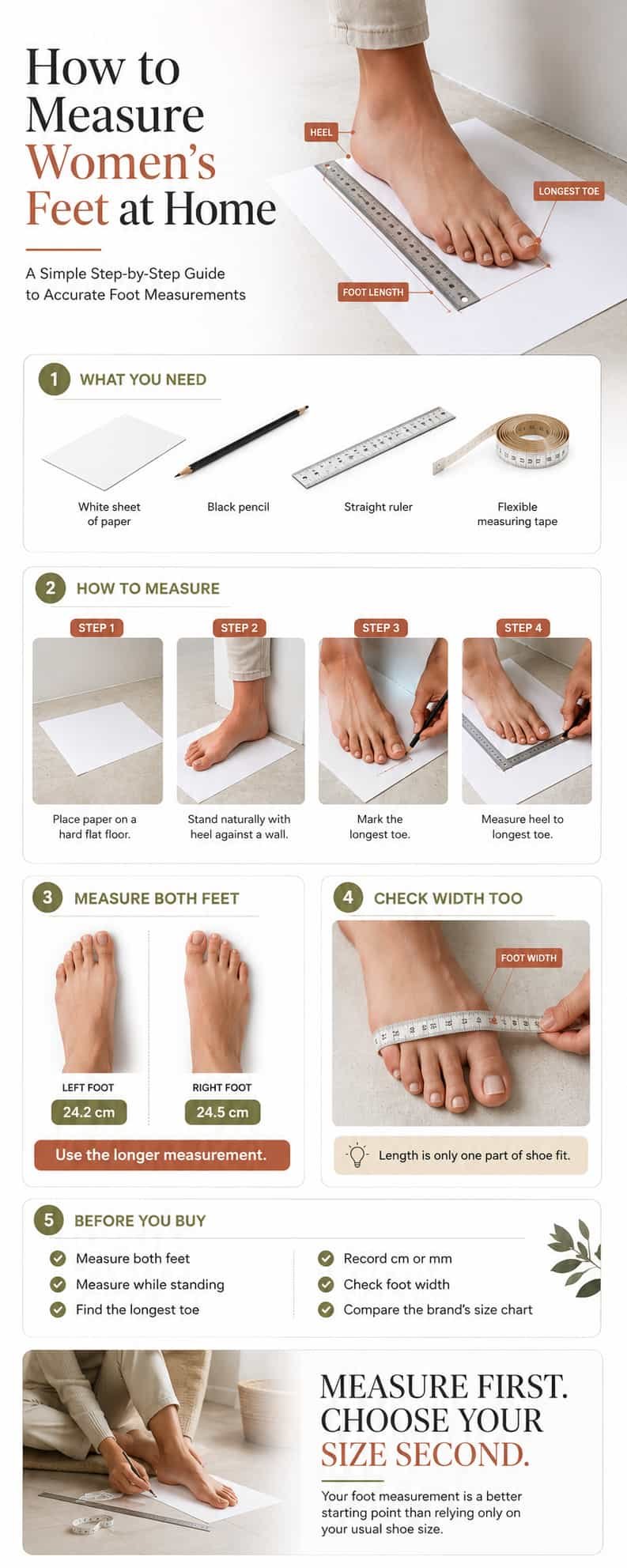
How to Measure Women’s Feet at Home
The simplest method is to measure each foot on a sheet of paper.
Step 1: Put the paper on a flat floor
Place a sheet of paper on a hard, flat surface.
Position one edge of the paper against a wall if possible.
This helps you keep your heel in the same position while measuring.
Step 2: Place your heel against the wall
Stand naturally with your heel lightly touching the wall.
Do not force your foot backward or curl your toes.
Keep your weight distributed normally between both feet.
Standing is important because the foot changes shape slightly when it carries body weight. Footwear measurement guidance from ASICS also recommends standing with the feet positioned naturally and measuring both feet.
Step 3: Mark the longest part of your foot
Ask someone to mark the end of your longest toe.
Your longest toe may be your big toe, but it does not have to be.
Do not assume the big toe is always the longest point.
Step 4: Measure from heel to toe
Measure the straight distance from the back of your heel to the mark at your longest toe.
Record the result in centimeters or millimeters.
This is your basic foot length.
Step 5: Repeat the process for the other foot
Measure your other foot using exactly the same method.
Do not skip this step.
Your feet are often slightly different in length or width, and professional shoe measurement guidance recommends checking both feet.
Step 6: Use the longer measurement
If one foot is longer than the other, use the longer foot as your main reference when selecting a shoe size.
For example:
| Foot | Measurement |
| Left foot | 24.2 cm |
| Right foot | 24.5 cm |
| Measurement to use | 24.5 cm |
This prevents you from choosing a size based on the smaller foot.
Measurement Tip
If possible, have another person mark your longest toe while you stand naturally. It is easier to keep your foot and body in the correct position when someone else does the marking.
How Do You Measure Women’s Foot Length?
Foot length is measured from the back of the heel to the end of the longest toe.
The easiest method is to place your foot on paper, keep your heel against a wall, mark the longest toe and measure the straight distance between the two points.
Do not measure around the curve of your foot.
The measurement should follow a straight line from heel to the longest toe. ASICS describes foot length measurement using the heel and longest toe as the reference points.
Foot length example
Suppose your measurements are:
- Left foot: 24.1 cm
- Right foot: 24.5 cm
Your reference measurement should be 24.5 cm.
You can then compare 24.5 cm with the shoe brand’s size chart.
This does not automatically mean that every brand’s 24.5 cm measurement will correspond to exactly the same labeled size.
How Do You Measure Women’s Foot Width?
Foot length tells you how long your foot is. Width tells you how much space your foot needs across its broadest area.
To measure width at home, stand naturally and use a flexible measuring tape around the widest part of your forefoot, usually around the area near the ball of the foot.
Keep the tape comfortably against the foot.
Do not pull it tightly enough to compress your foot.
Some footwear brands provide narrow, standard, wide and extra-wide options. Width labeling is not universal, so check the specific brand’s guide before choosing a width.
Do Not Ignore Width
A shoe can be long enough but still feel uncomfortable if the forefoot is too narrow. If you notice pressure, tightness or visible bulging around the sides of the shoe, check whether you need a different width.
Why Should You Measure Both Feet?
You should measure both feet because they may not be exactly the same size.
One foot may be slightly longer, wider or shaped differently from the other.
This is normal.
The practical rule is simple:
Measure both feet and use the larger measurement when choosing your starting shoe size.
Professional footwear measurement guidance also recommends measuring both feet and using the larger foot when there is a difference.
Should You Measure Your Feet While Standing?
Yes.
Measuring while standing gives you a more realistic measurement because your feet are supporting your body weight.
Keep your posture natural.
Do not sit down and pull your toes forward while measuring.
A standing measurement is especially useful when you are measuring feet for everyday shoes, walking shoes or other footwear that will be worn while standing and walking. ASICS recommends a natural standing position with weight distributed evenly during measurement.
When Is the Best Time to Measure Your Feet?
Late in the day is often a practical time to measure your feet because feet can change slightly in size during the day.
More importantly, measure your feet under conditions that are similar to how you will wear the shoes.
If you plan to wear socks with your shoes, consider measuring with those socks on.
If you normally wear the shoes barefoot, measure without socks.
The goal is not to create the smallest possible measurement. The goal is to represent how your feet will actually fit inside the shoes.
How Much Space Should You Leave in Shoes?
Your foot measurement and the shoe’s internal fit are not exactly the same thing.
Shoes generally need some space in front of the longest toe so that your toes are not pressed against the front of the shoe.
However, there is no single extra-space number that works for every shoe type.
Running shoes, walking shoes, dress shoes, boots and sandals can have different fit requirements.
Some manufacturers recommend adding additional length when using a foot measurement to select certain footwear. For example, ASICS recommends additional space for running footwear in its measurement guidance.
The safest approach is to use the manufacturer’s specific sizing and fit guidance rather than adding a fixed amount to every shoe.
How Do You Convert Foot Measurements Into Women’s Shoe Size?
Once you know your foot length, compare it with the shoe brand’s size chart.
Do not immediately convert the measurement into a US, UK or EU number using a generic chart and assume the result will fit every brand.
Different manufacturers can use different lasts, shapes and sizing practices.
Your process should be:
- Measure both feet.
- Record the longer foot.
- Record the measurement in cm or mm.
- Find the brand’s size chart.
- Compare your measurement with the chart.
- Check the available width.
- Consider the shoe style.
- Review the brand’s fit recommendations.
For general international conversions, use the Women’s Shoe Size Conversion Chart.
For a broader reference, you can also compare your result with the Women’s Shoe Size Chart.
How Do You Measure Women’s Feet in Centimeters?
Centimeters are one of the easiest units to use when measuring your feet at home.
Place your foot on paper and measure from heel to longest toe.
For example:
| Foot Length | Metric Measurement |
| 22.5 cm | 225 mm |
| 23.0 cm | 230 mm |
| 23.5 cm | 235 mm |
| 24.0 cm | 240 mm |
| 24.5 cm | 245 mm |
| 25.0 cm | 250 mm |
| 25.5 cm | 255 mm |
| 26.0 cm | 260 mm |
| 26.5 cm | 265 mm |
| 27.0 cm | 270 mm |
This table simply converts centimeters into millimeters.
It should not be treated as a universal shoe-size conversion table because shoe sizing varies between systems and brands.
How Do You Measure Women’s Feet in Inches?
If your ruler uses inches, measure the same heel-to-longest-toe distance in inches.
You can convert centimeters to inches using:
Inches = centimeters ÷ 2.54
For example:
24.5 cm ÷ 2.54 = approximately 9.65 inches.
When possible, keep your original measurement in centimeters or millimeters as well.
Metric measurements are often easier to compare with detailed footwear size charts.
How Do You Measure Feet for Online Shoe Shopping?
Measuring your feet before ordering online can reduce the risk of selecting the wrong size.
Start with your actual foot measurement instead of relying only on the size of your current shoes.
Then check:
- Foot length
- Foot width
- Brand size chart
- Shoe type
- Toe-box shape
- Available widths
- Return policy
If you are ordering from another country, also check whether the retailer is showing US, UK, EU or metric sizing.
A numerical size alone does not tell you the complete shape of the shoe.
How Do You Measure Feet for Sneakers?
For sneakers, use the same basic measurement process.
Stand on paper, keep your heel against a wall, mark your longest toe and measure both feet.
If you normally wear socks with sneakers, consider them when taking your measurement.
Then check the sneaker manufacturer’s own size chart.
Running and athletic footwear can have specific fit recommendations, so avoid applying a generic conversion rule to every pair.
How Do You Measure Feet for Boots?
Boots require the same basic foot measurement, but the way you intend to wear them matters.
If you normally wear thicker socks with boots, consider those socks during the fitting process.
Also check:
- Toe space
- Heel movement
- Forefoot width
- Instep pressure
- Shaft fit
- Boot construction
A boot that is long enough can still feel uncomfortable if the instep or forefoot is too tight.
How Do You Measure Feet for Dress Shoes?
Dress shoes often have a different shape from sneakers.
Pointed or narrow toe boxes can reduce the usable space around the toes even when the labeled size appears correct.
Measure your feet first, then pay attention to the shape of the shoe.
If your toes feel compressed, changing the width or choosing a different toe shape may be more useful than simply moving up in length.
Can Your Shoe Size Change Over Time?
Yes, your shoe fit can change over time.
Changes in foot shape can occur for different reasons, including age, body changes and changes in the way you use your feet.
That does not mean your shoe size will automatically change every year.
It simply means that if your usual shoes suddenly feel tight, loose or uncomfortable, it is worth measuring your feet again.
Common Mistakes When Measuring Women’s Feet
Mistake 1: Measuring only one foot
This can cause you to choose a size based on your smaller foot.
Better approach: Measure both feet.
Mistake 2: Measuring while sitting
Your feet may not be loaded in the same way as when you stand.
Better approach: Measure while standing naturally.
Mistake 3: Measuring from the heel to the big toe automatically
Your longest toe may not be your big toe.
Better approach: Measure to the longest point.
Mistake 4: Using a soft measuring tape for length
A flexible tape can curve and produce an inaccurate straight-line measurement.
Better approach: Use a ruler for heel-to-toe length.
Mistake 5: Pressing your toes against the wall
This can shorten the effective measurement.
Better approach: Keep your heel against the wall and let your toes sit naturally.
Mistake 6: Ignoring width
A correct length does not guarantee a comfortable fit.
Better approach: Check width when the brand provides it.
Mistake 7: Assuming every brand uses the same conversion
US, UK, EU and metric sizing are not interchangeable labels.
Better approach: Use the specific manufacturer’s size chart.
Mistake 8: Measuring only the shoe instead of your foot
The inside of a shoe is not always a direct representation of the labeled size.
Better approach: Start with your foot measurement.
Common Mistake
Do not choose a larger shoe simply because you want it to last longer. Excess length can create unwanted movement, while a wider or differently shaped shoe may solve the actual fit problem more effectively.
How Do You Know if Your Shoe Size Is Correct?
A correctly fitting shoe should feel secure without creating uncomfortable pressure.
Check these areas when trying shoes:
- Your longest toe should not press against the front.
- Your heel should not repeatedly slip.
- The sides should not squeeze the forefoot.
- Your toes should have enough room to move naturally.
- The upper should not visibly bulge over the sides.
- You should be able to walk comfortably.
Width matters too. Visible stretching, pressure and bulging around the forefoot can indicate that the shoe is too narrow.
Quick Fit Checklist
- ✓ Both feet measured
- ✓ Longer foot used for sizing
- ✓ Measurement taken while standing
- ✓ Length checked against the brand chart
- ✓ Width considered
- ✓ Shoe tried with normal socks when applicable
- ✓ Toes have comfortable space
- ✓ Heel feels secure
Why Does the Same Women’s Shoe Size Fit Differently Between Brands?
Shoe size is only one part of footwear fit.
Brands can use different shoe lasts, toe shapes, widths and construction methods.
Even two shoes with the same labeled size can feel different because their internal shapes are not identical.
ASICS, for example, provides separate width categories and notes that shoe fit depends on more than length alone.
This is why your measurement should be the starting point, not the final answer.
What Should You Do if Your Feet Are Different Sizes?
If one foot is longer or wider, choose footwear based on the larger foot.
For example:
| Measurement | Left | Right |
| Length | 24.2 cm | 24.6 cm |
| Width | 9.1 cm | 9.3 cm |
In this example, the right foot should guide the size decision.
If the difference is significant and creates repeated fit problems, consider footwear with adjustable features such as laces, straps or a more accommodating width.
How Often Should You Measure Women’s Feet?
You do not need to measure your feet every week.
However, it is useful to measure again when:
- Your usual shoes start feeling tight.
- You are buying a new type of footwear.
- You are shopping from a new brand.
- Your feet have changed noticeably.
- You have not measured your feet for a long time.
- You are buying expensive footwear online.
Keeping a note of your foot length and width can also make future online shopping easier.
What Is the Best Way to Measure Women’s Feet Without a Shoe Measuring Device?
The paper method is one of the easiest alternatives.
You need:
- Paper
- Pen or pencil
- Ruler
- Wall
Place the paper against the wall, stand with your heel lightly touching the wall, mark the longest toe, and measure the straight distance from heel to toe.
Measure both feet and use the larger measurement when comparing with a shoe chart.
This method is simple, inexpensive and practical for home use. ASICS also provides home measurement instructions based on paper, a pen and a ruler or tape measure.
How to Measure Women’s Feet for the Most Accurate Result
For the most useful home measurement, follow this order:
1. Prepare your tools
Use paper, a pen and a ruler.
2. Use a hard floor
Avoid thick carpet.
3. Stand naturally
Keep your weight evenly distributed.
4. Keep the heel against a wall
This gives you a consistent reference point.
5. Measure both feet
Do not assume they are identical.
6. Measure to the longest toe
Do not automatically use the big toe.
7. Record centimeters and millimeters
This makes comparison easier.
8. Measure width if needed
Especially when buying narrow or wide footwear.
9. Compare with the brand’s chart
Do not rely only on a generic conversion.
10. Check the shoe’s shape
Length is only one part of fit.
Frequently Asked Questions
How do I measure women’s feet at home?
Place your foot on a sheet of paper with your heel against a wall. Stand naturally, mark the end of your longest toe, and measure the straight distance from the heel to that mark. Repeat the process for your other foot and use the longer measurement when checking a shoe size chart.
What is the easiest way to measure foot size at home?
The paper, pen and ruler method is one of the easiest. It does not require a specialized shoe measuring device. For a more detailed step-by-step explanation, you can also follow our How to Measure Foot Size at Home guide.
Should I measure both feet?
Yes. Feet can differ slightly in length and width. Measure both feet and use the larger measurement as your main reference when selecting footwear.
Should I measure my feet standing or sitting?
Standing is generally the better option because your feet are supporting your body weight. Keep your posture natural and distribute your weight evenly while measuring.
Which part of the foot should I measure?
Measure from the back of the heel to the end of your longest toe. The longest toe is not necessarily the big toe.
How do I measure women’s foot width?
Stand naturally and use a flexible measuring tape around the widest part of your forefoot. Do not pull the tape tightly enough to compress your foot. Compare the result with the footwear brand’s width information when available.
Should I measure my feet with socks on?
It depends on how you will wear the shoes. If you normally wear socks with the footwear, measuring with similar socks can provide a more realistic reference.
Can I use my current shoe size instead of measuring?
You can use your current size as a starting point, but measuring is more reliable when shopping from a new brand or buying online. Different brands and shoe styles can fit differently.
How do I convert my foot measurement to US, UK or EU size?
Measure your foot first, then compare the measurement with the specific brand’s size chart. You can also use a general Shoe Size Conversion Chart & Calculator for an initial comparison.
What if one foot is bigger than the other?
Use the larger foot as your main reference. If the difference is noticeable, choose footwear that accommodates the larger foot and consider adjustable styles.
Why does my shoe size change between brands?
Different brands can use different lasts, toe-box shapes and width specifications. A labeled size does not guarantee that the internal shape will be identical between brands.
How do I know if my shoes are too narrow?
Persistent pressure around the forefoot, discomfort at the sides or visible bulging of the shoe material can indicate that you need a wider fit. Check the brand’s width options rather than automatically increasing the length.
Final Tips for Measuring Women’s Feet
Learning how to measure women’s feet at home does not have to be complicated.
The basic process is simple:
Measure both feet → find the longer foot → record the measurement → check the brand’s chart → consider width and shoe shape.
Do not worry if your feet are slightly different sizes. Do not assume the size printed inside your current shoes will work for every brand. Most importantly, do not choose a shoe based on the number alone.
Your foot measurement gives you a much better starting point.
- If you are ready to compare your measurement with different sizing systems, use the Women’s Shoe Size Conversion Chart.
- For a broader reference, check the Women’s Shoe Size Chart.
- If you want to learn the basic measurement process in another format, see our How to Measure Foot Size at Home guide.
- And when you need to compare international sizes, use the Shoe Size Conversion Chart & Calculator.
A few minutes of accurate measuring can make online shoe shopping much easier and help you start with the size that is actually based on your feet.