
UK 8 to US Shoe Size: Nike, EU & CM Conversion Chart (2026 Guide)
If you wear a UK size 8, converting it to a US, EU, or CM size can be confusing because shoe sizing is not perfectly standardized across countries or brands.
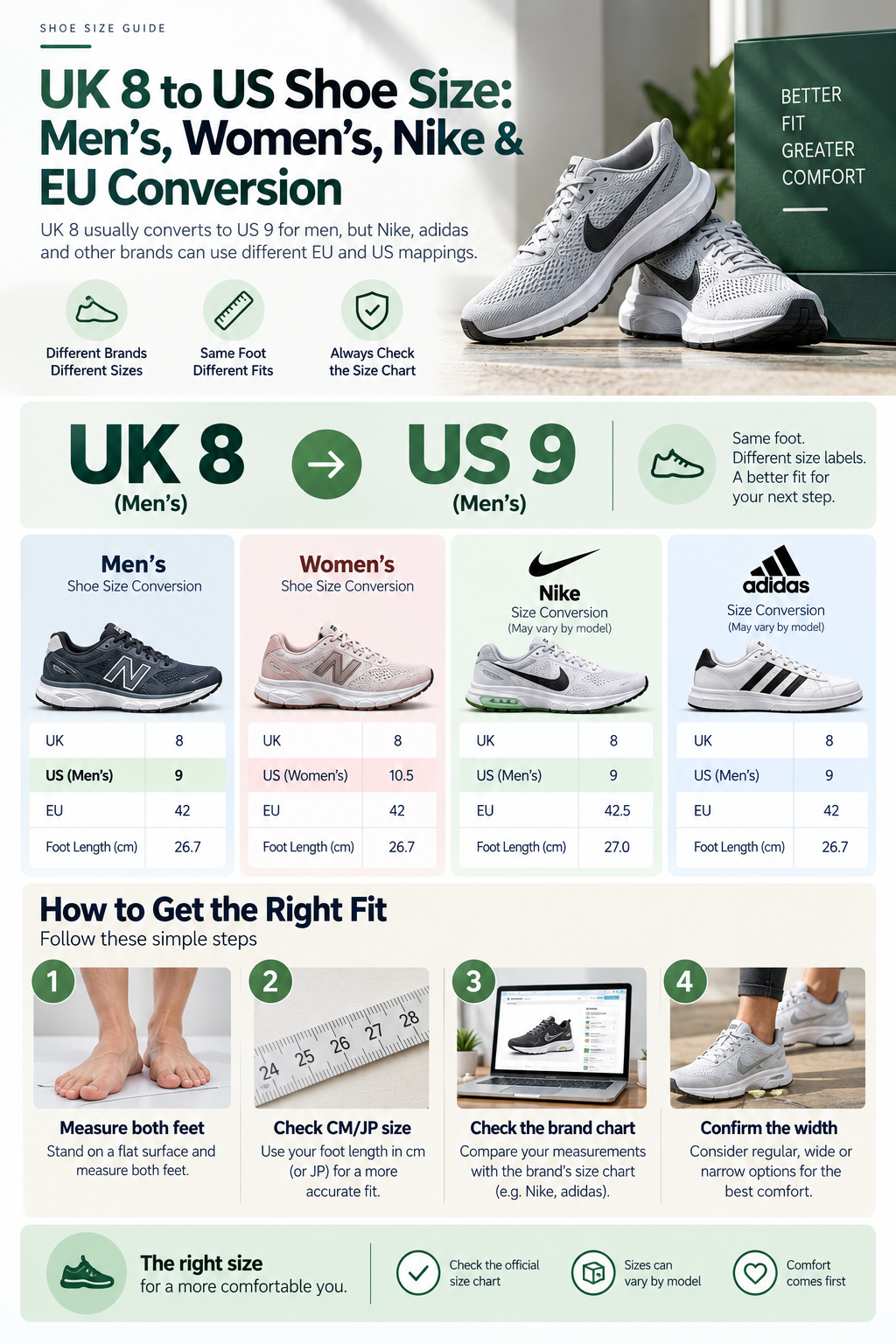
For most men’s footwear, UK 8 converts to US 9 and approximately EU 42. For women’s footwear, UK 8 is generally around US 10 to 10.5, although the exact conversion can vary by brand.
The safest way to choose the right size is not to rely on the number alone. Your foot length in centimeters, the brand’s size chart, shoe width, and the shape of the shoe can all affect the final fit.
The Quick Answer
What is a UK size 8 in US size?
For men’s shoes, a UK size 8 generally converts to a US size 9 and approximately EU size 42.
For women’s shoes, a UK size 8 generally converts to around a US size 10 to 10.5, depending on the brand and sizing system.
The important part is that shoe-size conversion is not completely universal. Nike, Adidas, Converse, Vans, Clarks, and other footwear brands can use different lasts, measurements, and conversion charts.
For example, a Nike men’s UK 8 is generally US 9, while an Adidas men’s UK 8 is generally US 8.5. This is why simply converting UK 8 to US without checking the brand can result in the wrong fit.
The safest approach is to compare the foot length in centimeters (CM) with the manufacturer’s size chart before buying.
Shoe Size Conversion Calculator
Men’s Shoe Size Conversion Chart
| UK | US | EU | CM | Inches |
|---|---|---|---|---|
| 6 | 7 | 40 | 25.0 | 9.8″ |
| 7 | 8 | 41 | 26.0 | 10.2″ |
| 8 | 9 | 42 | 27.0 | 10.6″ |
| 9 | 10 | 43 | 28.0 | 11.0″ |
| 10 | 11 | 44 | 29.0 | 11.4″ |
| 11 | 12 | 45 | 30.0 | 11.8″ |
| 12 | 13 | 46 | 31.0 | 12.2″ |
Women’s Shoe Size Conversion Chart
| UK | US | EU | CM | Inches |
|---|---|---|---|---|
| 5 | 7 | 38 | 24.0 | 9.4″ |
| 6 | 8 | 39 | 25.0 | 9.8″ |
| 7 | 9 | 40-41 | 26.0 | 10.2″ |
| 8 | 10-10.5 | 41-42 | 27.0 | 10.6″ |
| 9 | 11-12 | 42-43 | 28.0 | 11.0″ |
| 10 | 12-13 | 43-44 | 29.0 | 11.4″ |
Kids’ Shoe Size Conversion Chart
| US | UK | EU | CM |
|---|---|---|---|
| 10.5 | 9.5 | 28 | 17.1 |
| 11 | 10 | 29 | 17.8 |
| 12 | 11 | 30 | 18.4 |
| 13 | 12 | 31 | 19.1 |
| 1 | 13 | 32 | 20.1 |
| 2 | 1 | 33 | 21.0 |
| 3 | 2 | 35 | 22.0 |
| 4 | 3 | 36 | 22.6 |
| 5 | 4 | 37 | 23.3 |
| 6 | 5 | 39 | 24.3 |
| 7 | 6 | 40 | 25.2 |
The Universal Footwear Frustration
You find the perfect pair of sneakers online. The color is right, the reviews look good, and you finally select your usual size.
Then the shoes arrive.
The length seems close, but your toes feel cramped. Your heel slips. Or the shoe feels completely different from another pair carrying the same size number.
This is one of the biggest problems with international footwear shopping.
A UK 8 to US shoe size conversion looks simple on paper, but the number on the box does not tell the entire story.
The same UK size can feel different because footwear brands use different lasts, shapes, widths, materials, and measurement conventions.
That is especially important when shopping for brands such as Nike, Adidas, Converse, Vans, and other athletic or lifestyle footwear.
Why UK 8 to US Conversion Can Be Confusing
The UK, US, and EU sizing systems are based on different measurement conventions.
A UK men’s 8 is generally equivalent to a US men’s 9. However, that does not mean every US size 9 shoe will have exactly the same internal dimensions.
The reason is simple: shoe size is not just length.
A shoe’s fit can also depend on:
- Foot width
- Toe-box shape
- Heel width
- Instep height
- Shoe last
- Upper material
- Insole thickness
- Midsole construction
- Intended activity
- Brand-specific sizing
This is why two shoes marked UK 8 can feel completely different.
UK 8 to US for Men’s Shoes
For men’s footwear, the most commonly used conversion is:
UK 8 = US 9 = approximately EU 42
This is a useful starting point for everyday shoes, sneakers, boots, and many casual footwear styles.
However, it should not be treated as an absolute rule.
Some brands use half-size differences or different regional charts. Athletic footwear can also have different internal dimensions from formal shoes.
If you are buying a running shoe, training shoe, or performance sneaker, check the manufacturer’s own size chart before placing your order.
UK 8 to US for Women’s Shoes
Women’s conversions can be more confusing.
A UK women’s size 8 commonly corresponds to approximately US women’s 10 to 10.5, depending on the brand.
For example, a brand may use a US 10 conversion while another may list US 10.5.
This is why women shopping internationally should avoid relying on a simple “+2” or “+2.5” conversion rule.
Instead, compare the manufacturer’s CM or JP measurement with your actual foot length.
For more detailed international sizing information, see our US vs UK vs Euro shoe size conversion guide.
Why Nike Can Feel Different
Nike is one of the brands that causes confusion for international shoppers.
A men’s Nike UK 8 is generally listed as US 9, but the actual fit can vary significantly between Nike models.
Different Nike shoes can have different:
- Toe-box shapes
- Upper materials
- Heel structures
- Cushioning systems
- Internal volumes
- Width characteristics
A Nike running shoe may therefore feel very different from a Nike lifestyle sneaker even when both are marked UK 8.
The answer is not automatically to go up half a size.
First, check your foot measurement and the specific model’s size chart.
Nike vs Adidas: Why the Same UK Size Can Have Different US Numbers
One of the easiest ways to see why international conversions can be confusing is to compare Nike and Adidas.
A commonly used conversion is:
| Brand | UK Men’s 8 | Approx. US Men’s Size |
| Nike | 8 | 9 |
| Adidas | 8 | 8.5 |
| General UK-to-US | 8 | 9 |
The important point is that the number printed on the US label can vary by brand.
That does not necessarily mean one company is wrong.
Each brand maintains its own sizing and product specifications.
Always prioritize the brand’s official size chart when purchasing a specific model.
How to Choose the Right Shoe Size
Forget the number on the box for a moment.
The best way to choose your size is to start with your actual foot measurement.
1. Measure Your Foot in Centimeters
Place your heel against a wall and stand naturally on a sheet of paper.
Mark the position of your longest toe and measure the distance from the wall to that mark.
Repeat the process for both feet.
Use the measurement of your larger foot when selecting your shoe size.
If your larger foot measures approximately 27 cm, use that measurement when checking the brand’s size chart.
This is generally more reliable than converting between several international sizing systems.
For additional guidance, see our Indian shoe size vs UK shoe size guide.
2. Measure Both Feet
Most people have one foot that is slightly larger than the other.
That difference may be small, but it can become noticeable in tightly fitted footwear.
Measure both feet and use the larger measurement when choosing a size.
3. Leave Enough Toe Room
Your longest toe should not press directly against the front of the shoe.
For everyday walking and running footwear, you generally want some space in front of the longest toe.
The exact amount depends on the shoe type, foot shape, and activity.
If your toes touch the front when standing normally, the shoe is likely too short.
4. Check the Width
A UK 8 tells you about size, but it does not automatically tell you whether the shoe is wide enough.
If the sides of your foot feel compressed while there is plenty of room in front of your toes, the problem may be width rather than length.
Instead of automatically buying a longer shoe, look for a wider version when the brand offers one.
Global Size Comparison Table
The following table gives a practical reference for a UK 8.
| Size System | Men’s | Women’s | Approx. Foot Length | Notes |
|---|---|---|---|---|
| UK | 8 | 8 | 26.5-27 cm | Starting reference |
| US | 9 | 10-10.5 | Around 27 cm | General conversion |
| EU | 42 | 42-42.5 | Around 27 cm | Brand variation exists |
| Nike | US 9 | US 10.5 | Around 27 cm | Check Nike’s model chart |
| Adidas | US 8.5 | US 10 | Around 26.5-27 cm | Check model-specific sizing |
| Converse | US 8-9 | US 10 | Around 27 cm | Shape differs by model |
Important: These values are general references. Brand-specific charts should take priority when available.
Why Material Changes the Fit
The material used in the upper can change how a shoe feels.
Leather
Leather footwear can soften and conform somewhat with use.
However, you should not buy a shoe that is painfully tight simply because someone says leather will “stretch.”
A properly fitted leather shoe should feel comfortable from the beginning, with normal break-in occurring as the material softens.
Mesh
Mesh is common in running and walking shoes.
It can provide a more flexible fit, but the structure underneath the mesh still determines much of the shoe’s shape.
Do not assume that a mesh shoe will become significantly longer after wearing it.
Knit
Knit uppers can feel flexible around the foot, but flexibility does not necessarily mean additional length.
If your toes are already touching the front, sizing up or choosing another model may be more appropriate.
Synthetic Leather
Synthetic leather generally does not behave exactly like natural leather.
If the shoe creates strong pressure points when you first try it on, do not depend on a long break-in period to solve the problem.
The Afternoon Swell Test
Your feet can change in volume throughout the day because of normal activity and fluid shifts.
For that reason, measuring or trying shoes later in the day can provide a more realistic idea of how the shoes will feel during normal use.
This is particularly useful if you spend many hours walking or standing.
The Sock Variable
The socks you plan to wear also matter.
Thin dress socks, everyday cotton socks, athletic socks, and thick winter socks can occupy different amounts of space inside a shoe.
If you are buying boots for thick socks, test the footwear with the socks you actually intend to wear.
Do not select a larger shoe simply because of a theoretical sock difference without checking the actual fit.
The Insole Can Change the Fit
A thick insole reduces the available internal volume of a shoe.
This matters if you use:
- Orthotics
- Arch-support insoles
- Replacement footbeds
- Cushioned aftermarket insoles
If you plan to replace the original insole, check whether the shoe has a removable footbed and test the fit with the insert you actually intend to use.
Common UK 8 Shoe-Size Mistakes
Mistake 1: Assuming UK 8 Always Means US 9
For men’s footwear, UK 8 to US 9 is a useful general conversion.
But brands can differ.
Always check the manufacturer’s chart.
Mistake 2: Ignoring CM Measurements
A CM measurement can help you compare sizes across different international systems.
When available, use it as an important reference point alongside the brand’s size chart.
Mistake 3: Sizing Up Only Because the Shoe Feels Narrow
If the length is already correct but the shoe is too narrow, going up a full size can make the shoe unnecessarily long.
Look for a wider model when available.
Mistake 4: Assuming Every Nike Fits the Same
Different Nike models can have different shapes.
Your best size in one Nike model may not feel identical in another.
Mistake 5: Buying Based Only on Reviews
Customer reviews can be useful, but people have different foot shapes and preferences.
A review saying “true to size” does not guarantee that the shoe will fit your foot the same way.
UK 8 Shoe Size by Use Case
Daily Walking
If you walk several kilometers every day, prioritize:
- Comfortable toe space
- Appropriate width
- Stable heel fit
- Cushioning
- Breathability
Do not choose a shoe simply because the converted number matches your usual size.
Running
Running shoes need enough room for your foot to move naturally as your feet warm up and swell.
Pay particular attention to:
- Toe-box space
- Heel security
- Width
- Running-specific sizing recommendations
Check the model-specific chart before buying.
Gym Training
Training shoes often need a more secure fit than running shoes.
A shoe that is excessively long can reduce stability during lateral movement and strength exercises.
Travel
Travel shoes need to remain comfortable after several hours of walking.
Prioritize comfort, breathability, secure heel fit, and enough toe space.
UK 8 to EU Size
A men’s UK 8 is generally around EU 42.
A women’s UK 8 can correspond to approximately EU 42 or 43, depending on the brand.
This is why the question “What is UK 8 in EU?” does not always have one universal answer.
If you are purchasing a specific shoe, use the manufacturer’s EU and CM measurements rather than relying exclusively on a generic conversion chart.
You can also use our shoe size conversion chart and calculator for a broader comparison of international sizing systems.
Is a UK 8 a Large Shoe Size?
For men’s footwear, UK 8 is a very common adult size and is generally within the standard range.
For women’s footwear, UK 8 is toward the larger end of many standard women’s size ranges.
However, size classification depends on the market and brand.
More importantly, your shoe size is simply a measurement reference. It does not indicate whether your feet are unusually large or small.
How to Check Your Shoe Fit at Home
When your shoes arrive, perform a simple fit check before removing tags or wearing them outdoors.
Stand naturally and check:
- Your toes are not pressing against the front.
- Your heel does not lift excessively.
- The widest part of your foot sits comfortably inside the widest part of the shoe.
- There is no painful pressure on the sides.
- Your toes can move naturally.
- The shoe feels secure without requiring excessive tightening.
If the shoe fails these checks, consider exchanging it before wearing it outside.
Frequently Asked Questions
Is UK size 8 the same as US size 8?
No.
For men’s shoes, UK 8 generally converts to US 9.
For women’s shoes, UK 8 generally converts to approximately US 10 to 10.5, depending on the brand.
What is UK size 8 in Euro size?
A men’s UK 8 is generally approximately EU 42.
For women’s footwear, UK 8 can fall around EU 42 to 43 depending on the manufacturer.
What is UK 8 in US Nike men’s?
A men’s Nike UK 8 is generally listed as US 9.
Always check the size chart for the exact Nike model before purchasing.
What is UK 8 in US Nike women’s?
A women’s Nike UK 8 is commonly listed around US 10.5.
Because brand-specific charts can change by product and market, verify the model’s current Nike size chart before ordering.
What is UK 8 in Adidas men’s?
An Adidas men’s UK 8 is commonly listed as approximately US 8.5.
This is a good example of why brand-specific conversion charts matter.
Does UK 8 fit a 27 cm foot?
A foot around 27 cm can commonly fall near UK 8 in men’s footwear, but the correct shoe size depends on the manufacturer’s actual CM chart and the shoe model.
If your foot is exactly 27 cm, compare that measurement with the manufacturer’s recommended foot-length range.
Is Euro 41 the same as UK 8?
Usually not.
A men’s EU 41 is generally smaller than a men’s UK 8.
A men’s UK 8 is more commonly around EU 42.
Do Vans run true to size?
Vans sizing can vary by model and individual foot shape.
Rather than relying only on general statements about Vans, compare your foot measurement with the specific model’s size chart.
Should I size up in Nike?
Not automatically.
If a Nike shoe feels short, compare your foot measurement with Nike’s CM sizing.
If it feels narrow but has adequate length, consider a wider model rather than simply buying a longer size.
What is the best time of day to measure your feet?
Late afternoon or evening is often a practical time because your feet may be slightly larger after normal daily activity.
Measure both feet and use the larger measurement when checking the size chart.
Final Takeaway
A UK men’s size 8 is generally a US men’s size 9 and approximately EU 42.
But that conversion is only the starting point.
If you are buying Nike, Adidas, running shoes, boots, or any other footwear online, the safest approach is to:
- Measure both feet.
- Record the measurement in centimeters.
- Use the larger foot measurement.
- Check the specific brand’s size chart.
- Check the exact shoe model when possible.
- Consider width as well as length.
- Leave appropriate space for your toes.
- Try the shoes with the socks or insoles you actually plan to use.
The number on the shoe box is useful, but your actual foot measurement and the manufacturer’s size chart are more reliable than a generic UK-to-US conversion rule.
If you are still unsure, start with the CM measurement and then convert it to the brand-specific US, UK, or EU size.
For more footwear sizing help, explore our children’s shoe size by age chart and our Indian shoe size vs UK shoe size guide.