
Reflexology for Neuropathy in the Feet: What Research Shows and How to Stay Safe
The short answer
Some small trials suggest reflexology may reduce neuropathic foot pain in people with diabetes, but the evidence is early and low in certainty, and reflexology does not repair damaged nerves. The bigger issue is safety. Neuropathy can reduce your ability to feel pressure, heat and injury, so firm pressure, hot water or hard massage tools can harm feet without you noticing. If you have neuropathy, talk to your doctor before trying reflexology, keep pressure very light, and never skip daily foot checks.
- What the research suggests: a 2026 meta-analysis found about 1.6 points lower pain on average in diabetic neuropathic pain, but included mixed study designs.
- What it does not show: that nerves heal, or that reflexology beats standard care.
- Priority one: protect your feet with daily checks, good shoes and prompt medical care for any sore.
Why neuropathy changes the safety rules
The US Centers for Disease Control and Prevention says about half of people with diabetes have nerve damage, most often in the feet and legs. It can cause numbness, tingling or pain, or no symptoms at all. It can also reduce your ability to sense pain, heat and cold. Because pain normally warns you of injury, small cuts or sores can go unnoticed, then become infected or slow to heal, which raises the risk of ulcers and, in severe cases, amputation.
That is why general reflexology advice does not apply unchanged. Reduced sensation means you cannot rely on “it feels fine” as a safety check, and strong pressure or a hot foot soak can cause damage you do not feel. Our complete guide to foot reflexology lists the other conditions that need caution.
What the research shows
| Study | What it did | What it found |
|---|---|---|
| Meta-analysis, 2026 | 8 studies (5 randomized trials and 3 quasi-experimental studies, 590 people) of reflexology in diabetes with neuropathic pain | Total pain was 1.64 points lower on average (95% CI -1.81 to -1.47), with better quality of life. The authors call it a potentially effective complementary technique. |
| Randomized trial, 2026 | 65 women with type 2 diabetes and neuropathic pain. Reflexology by trained nurses plus routine treatment vs routine treatment alone | Significant reductions in neuropathic pain scores. No adverse events related to the intervention were reported. Effect sizes were very large, and the control group had no sham treatment. |
| NCCIH summary | Review of reflexology research | Describes small research in multiple sclerosis for burning and prickling sensations and says the claim that reflexology promotes healing is not proven. |
How to read the results
- Self-reported pain. Participants know they received a treatment, and the control groups often received no comparable attention.
- Very large effects are a warning sign. The 2026 trial reported effect sizes that are unusually big for a gentle touch therapy, so the true effect is probably smaller.
- Mixed designs. The meta-analysis combined randomized and non-randomized studies.
- Short-term. Studies measure changes over weeks, not nerve repair or long-term complications.
- Nurse-delivered. The trial used trained nurses, who can check skin and sensation. Self-massage at home is not the same.
For how this compares with other conditions, see does foot reflexology work?
If your doctor agrees you can try it
Safety rules for numb or tingling feet
- Ask your doctor or podiatrist first, especially with diabetes, circulation problems, ulcers, or a history of foot wounds.
- Check both feet before and after. Look at the soles with a mirror.
- Keep pressure very light, about 2 to 4 out of 10. You cannot rely on pain as a warning.
- Do not use hot water, heat pads or heated massagers. The CDC advises washing diabetic feet in warm, not hot, water, and not soaking them.
- Avoid hard tools, such as balls, rollers or spiked devices.
- Keep sessions short, and have a practitioner or carer do it if you cannot see or reach your feet.
- Stop and call your doctor if you see redness, a blister, a mark that does not fade, or swelling.
If you use a reflexologist, tell them about your neuropathy and diabetes up front. For a self-routine with the lightest pressure, adapt our home routine only after medical approval. Our guide to reflexology foot massagers explains why devices need extra care if you have reduced feeling.
Daily foot care comes first
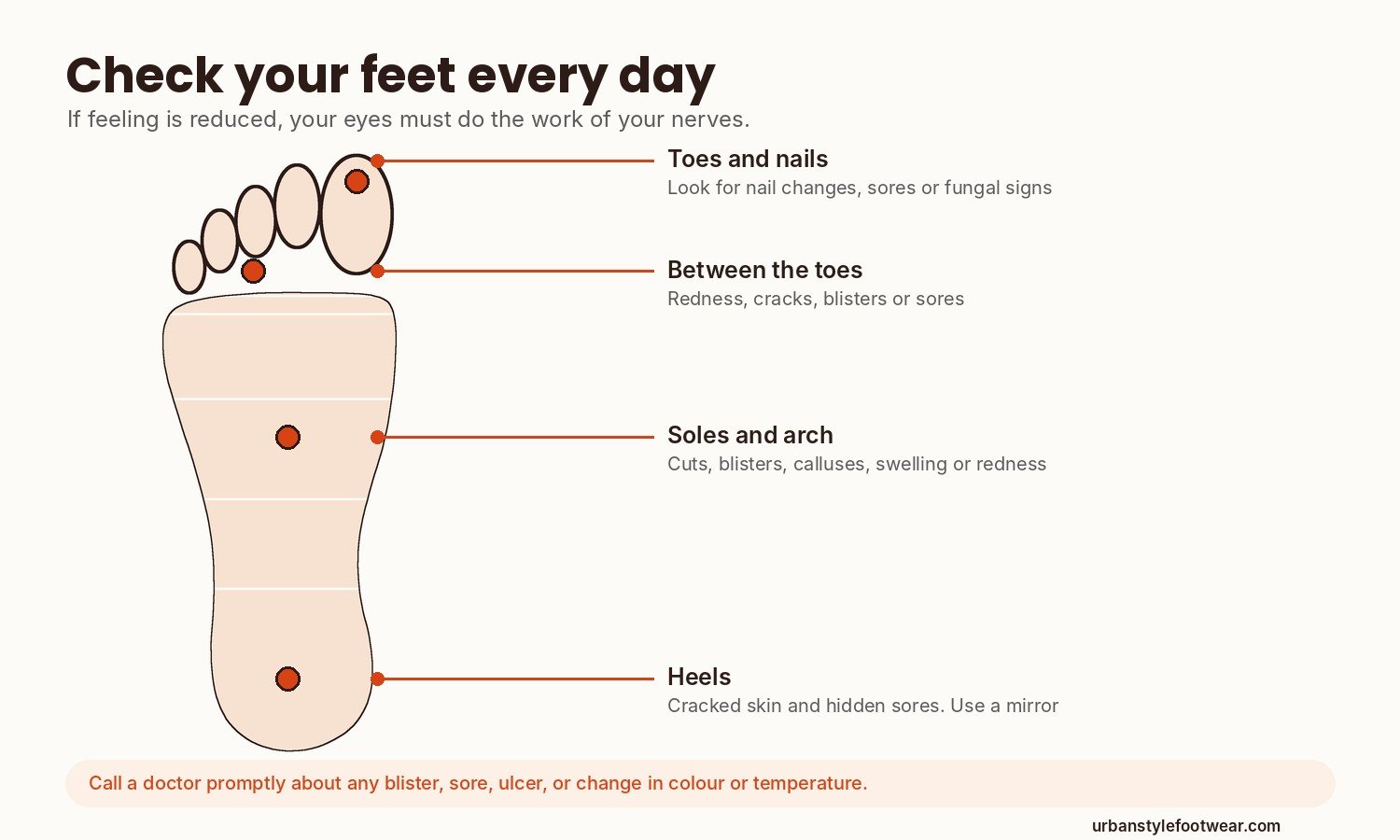
CDC advice for people with diabetes is a better foundation than any massage technique:
- Check both feet every day for cuts, redness, swelling, sores, blisters, calluses or nail changes. Use a mirror or ask someone to check the soles.
- Wash in warm, not hot, water. Do not soak. Dry thoroughly, and moisturize the tops and soles but not between the toes.
- Always wear shoes, socks or slippers, even indoors, and never walk barefoot.
- Trim toenails straight across and smooth sharp edges.
- Choose well-fitting shoes, ideally shopping late in the day when feet are largest, and break them in gradually.
For footwear ideas, see our guides to the best walking shoes for neuropathy and best orthopedic slippers, and foot comfort and supportive footwear.
When to call a doctor
The CDC advises contacting your doctor or foot doctor right away, without waiting for your next appointment, if you have:
- Leg pain or cramping during activity
- Tingling, burning or pain in the feet, or a reduced sense of touch or of heat and cold
- Changes in foot shape, colour or temperature, or hair loss on the feet or lower legs
- Dry or cracked skin, thick yellow toenails or fungal infections
- Any blister, sore, ulcer, infected corn or ingrown toenail
New numbness or tingling should be assessed even if you do not have diabetes, because neuropathy has many causes. See our foot pain guide for other causes of foot symptoms.
Neuropathy has many causes
Diabetes is the best-known cause, but it is not the only one. Peripheral neuropathy can also follow vitamin B12 deficiency, alcohol use, some medicines including certain chemotherapy drugs, kidney disease, thyroid problems, infections, injury and inherited conditions, and sometimes no cause is found. That matters because the right treatment depends on the cause. New numbness, tingling or burning in the feet should be assessed by a clinician, not managed with a foot technique alone.
Questions to ask your doctor or practitioner
- What is causing my neuropathy, and could it be treated or slowed?
- How much feeling have I lost, and is it safe for me to have foot massage at all?
- Which pressure and temperature limits should I follow?
- Do I need regular foot checks with a podiatrist?
- Are there shoes or insoles I should use?
- What changes should make me call you right away?
If you see a reflexologist, give them the answers. They should be willing to adapt pressure and avoid heat.
Everyday comfort measures
- Wear soft, seamless socks and well-fitting shoes with a roomy toe box. See our guides to walking shoes for neuropathy and foot comfort and supportive footwear.
- Check inside shoes for stones or rough seams before putting them on.
- Move regularly, as your clinician advises, because activity supports circulation.
- Keep blood sugar in the range your care team recommends, if you have diabetes.
- Avoid heating pads, hot water bottles and hot foot soaks, since you may not feel burns.
- Test bath water with your elbow or a thermometer, not your feet.
How to read marketing claims
Search for neuropathy and foot massage and you will meet products and practitioners that promise to restore nerves. Be careful. No foot massager or reflexology technique has been shown to repair nerve damage. Be wary of claims such as “reverses neuropathy”, “clinically proven” without a named study, or testimonials used as evidence. Better signs are named trials, clear limits, and advice to see a doctor. Our foot massager guide explains device cautions, and the complete guide covers the broader safety list.
A daily foot check, step by step
- Sit in good light with a mirror on the floor, or ask someone to help.
- Look at the tops, the soles, the heels and between the toes for cuts, blisters, redness, swelling, dry or cracked skin, and changes in nails.
- Feel for warm spots or areas that feel different from the rest.
- Check inside your shoes by hand for stones, rough seams or folded linings.
- Write down or photograph anything new, so you can show your care team.
- Call your doctor promptly about any sore that does not heal quickly, rather than waiting.
This takes 2 or 3 minutes and does more for your feet than any massage technique.
Movement and exercise with neuropathy
Regular movement supports circulation and blood sugar control, and is often encouraged for people with diabetes. Low-impact options such as walking in good shoes, cycling or swimming are common, but follow your clinician’s advice, particularly if balance is affected or you have foot ulcers. Wear well-fitting shoes and socks, check feet after activity, and avoid barefoot walking. If you find a foot massage relaxing, treat it as comfort only, and keep it gentle. See the complete guide to foot reflexology for the conditions that need extra caution.
Frequently asked questions
Can reflexology help neuropathy in the feet?
Small trials suggest it may reduce neuropathic pain in diabetes, but the evidence is early and low in certainty. It does not repair nerves, and safety needs extra care when feeling is reduced.
Is reflexology safe for diabetic neuropathy?
It can be done gently under medical guidance. Because you may not feel injury, use very light pressure, avoid heat and hard tools, and check your feet before and after. Ask your doctor first.
Can foot massage reverse nerve damage?
There is no evidence it does. Treating the underlying cause and protecting the feet matter most.
Should I use a heated foot massager if my feet are numb?
It is safer to avoid heat. Reduced sensation means you could burn your skin without noticing.
What should I do instead?
Follow your care plan, check your feet daily, wear well-fitting shoes, and call a doctor about any new symptom or sore.
What about neuropathy caused by chemotherapy?
This guide covers diabetic neuropathy, where most reflexology research sits. For nerve symptoms from chemotherapy, talk to your cancer care team before trying reflexology.
Can reflexology reverse neuropathy?
There is no evidence that it reverses nerve damage. Small studies suggest it may reduce neuropathic pain in diabetes, but certainty is low.
Is it safe to use a foot massager with neuropathy?
Use extra care. Avoid heat and hard or spiked tools, keep sessions short, check your feet before and after, and ask your doctor first.
What helps neuropathy pain besides massage?
Your doctor may suggest treating the cause, medicines for nerve pain, and foot protection. Self-care such as good shoes and daily checks supports this.
Should I see a podiatrist?
Many people with neuropathy benefit from regular foot checks by a podiatrist, particularly with diabetes. Ask your doctor for a referral.
More in the foot reflexology series
- Foot reflexology chart: zones, left and right foot
- Foot pressure points: acupressure points and what they claim
- Reflexology vs foot massage: how they differ
- Reflexology vs acupressure: zones compared with points
- Foot reflexology for headaches and migraines: what trials found
- Foot reflexology for sleep: research and a bedtime routine
- Foot reflexology for plantar fasciitis: heel pain and what helps
Sources
- CDC: Diabetes and Your Feet (last reviewed May 15, 2024)
- Reflexology massage on pain and quality of life in diabetic neuropathic pain: systematic review and meta-analysis, 2026 (PubMed 42321037)
- Foot reflexology massage on neuropathic pain in women with type 2 diabetes: randomized controlled trial, 2026 (PubMed 41314919)
- NCCIH: Reflexology
- Cleveland Clinic: Reflexology (published August 30, 2022)
Educational information only, not medical advice. Talk to your doctor before using reflexology if you have neuropathy or diabetes.