
Foot Reflexology Explained: The Chart, the Technique and What Research Really Shows
The short answer
Foot reflexology is a pressure massage of the feet based on the belief that areas of the sole map to organs and body systems. That map is a tradition, not anatomy. The National Center for Complementary and Integrative Health (NCCIH) says the claim that it causes healing in the matching body parts has not been proven.
- What it can reasonably offer: relaxation and a pleasant, low-risk foot rub. Several small trials report short-term relief of anxiety and some symptoms, but the evidence is low in quality and often cannot separate reflexology from a plain foot massage.
- What it cannot do: diagnose disease, or cure or prevent it. Cancer Research UK states there is no scientific evidence that it can cure or prevent any disease.
- Who should check with a clinician first: anyone with circulation problems in the feet, blood clots, foot ulcers, gout, fungal foot infections, low platelet counts, reduced feeling in the feet, or a pregnancy.
What foot reflexology is
Reflexology applies different amounts of pressure to specific points on the feet, and sometimes the hands or ears. Practitioners believe those points correspond to other parts of the body. Cleveland Clinic describes the usual tool as a foot chart that shows which area of the foot is linked to which organ or body part.
The idea is usually traced to “zone therapy”, an early twentieth century theory that the body is divided into zones running from head to toe, with the feet acting as a kind of control panel. Reflexology as it is taught today grew out of that theory. It sits in the category of complementary practice, meaning something people use alongside medical care and not instead of it. The University of Minnesota’s Earl E. Bakken Center describes it the same way, as a practice that is not used to diagnose or cure disease.
One more thing to be clear about, because many articles blur it: reflexology is not the same as a regular foot massage. A foot massage works on the muscles and tissues of the foot itself. Reflexology uses pressure on mapped zones with the aim of affecting somewhere else in the body. Whether that second part actually happens is the question the rest of this guide tries to answer honestly.
How it is said to work
There is no single agreed explanation. Reviews and health publishers list several theories, and none of them has been confirmed:
- Zone theory. The body is divided into vertical zones, and pressing a zone on the foot affects the matching zone elsewhere.
- Traditional Chinese medicine. Pressure is thought to keep the flow of qi (vital energy) balanced along pathways called meridians. The MSD Manual describes this as a belief that stimulating the right area clears an energy blockage behind a symptom.
- Nervous system response. Touch on the feet may calm the nervous system and trigger a relaxation response. Cleveland Clinic and WebMD both describe this as a theory. This is the explanation that fits best with what we can actually measure, because relaxation is the effect people report most often.
- Pain perception. Pressure and attention may change how pain is felt, in the same way that rubbing a bumped elbow makes it feel better.
Notice that the third and fourth theories do not need the chart to be correct. A calming touch to the feet could be relaxing whether or not the heel is connected to the lower back. That distinction matters when we get to the evidence.
Our foot reflexology chart
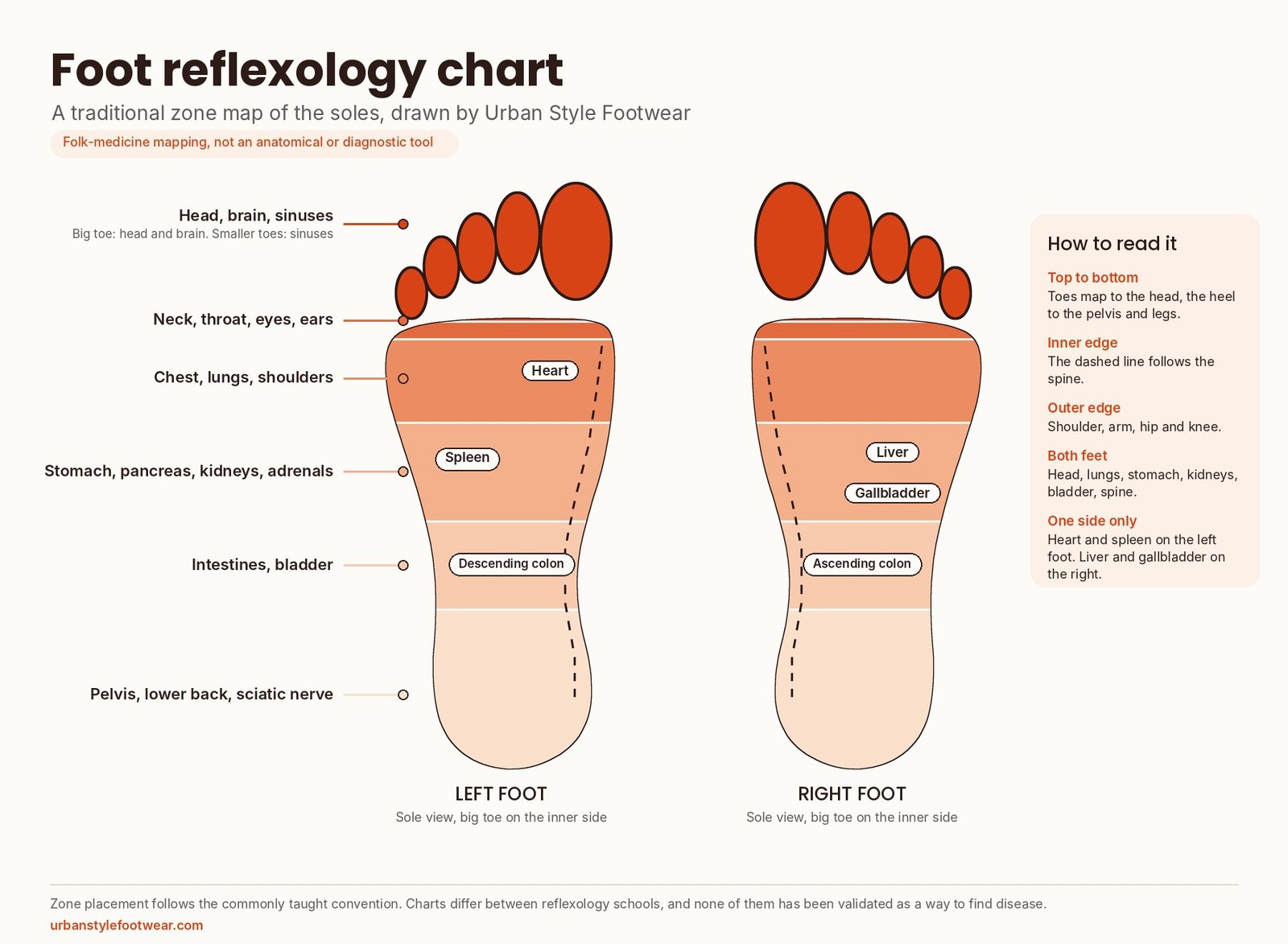
Most charts you will find online are copied from each other, and some are screenshots with no explanation. Below is an original chart we drew for this guide, followed by the same information as plain text so you can read it, search it and use it with a screen reader. For a closer look at each zone, see our full foot reflexology chart guide.
The chart in text
| Foot zone | Traditionally mapped to | Left or right? |
|---|---|---|
| Big toe | Head and brain | Both feet |
| Smaller toes | Sinuses | Both feet |
| Base of the toes | Neck, throat, eyes, ears | Both feet |
| Ball of the foot | Chest, lungs, shoulders | Both feet. Heart on the left foot only |
| Upper arch | Stomach, pancreas, kidneys, adrenal glands | Mostly both. Spleen on the left, liver and gallbladder on the right |
| Lower arch | Intestines, bladder | Both. Descending colon on the left, ascending colon on the right |
| Heel | Pelvis, lower back, sciatic nerve | Both feet |
| Inner edge | Spine, from neck near the big toe down to the tailbone near the heel | Both feet |
| Outer edge | Shoulder, arm, hip and knee | Each foot maps to its own side |
How to read it, and how not to
- Top to bottom. The toes sit at the “head” end and the heel at the “pelvis” end, so the foot is read like a small body lying along the sole.
- Left to right. The left foot is said to map the left side of the body and the right foot the right side. That is why the heart appears only on the left chart and the liver only on the right. We explain the differences in more detail in left foot vs right foot reflexology.
- Charts disagree. Different schools place some organs a few millimetres apart, and some add zones on the top of the foot. If two charts differ, that is normal, and it is a hint that the maps are conventions and not measurements.
- A tender spot is not a diagnosis. Feet have many nerve endings, and a spot can feel sore because of shoes, standing, a tight tendon or simply how hard someone pressed. Nothing in the research reviewed here supports reading tenderness as a sign of a problem in the matching organ. If you have symptoms, see a clinician. Do not use a chart to decide what is wrong. The same goes for the pressure points on the feet that you see in many online diagrams.
What the research actually shows
This is the part most reflexology pages skip or blur. I read the main sources one by one, and the pattern is consistent: the studies are mostly small, many are low quality, and the strongest findings relate to relaxation and symptoms people report themselves. Here is the summary, followed by the details. If you want the question answered on its own page, see does foot reflexology work?
| Claim | What the sources say | Weight of evidence |
|---|---|---|
| Feels relaxing, eases stress or anxiety | Small trials and reviews report short-term improvements. Cleveland Clinic notes there is no good evidence it works better than ordinary foot massage. | Some, short term |
| Eases pain (labour, cancer-related, other) | The MSD Manual describes low-quality evidence in palliative care and labour. Cochrane’s 2018 review of manual methods found low-certainty evidence that massage lowers first-stage labour pain. | Low certainty |
| Changes blood pressure, heart rate, breathing | A 2022 meta-analysis pooled randomized trials on vital signs. Trial quality varies, so treat it as a lead for better studies. | Low certainty |
| Eases symptoms in cancer or multiple sclerosis | NCCIH reports that in a National Cancer Institute funded study of women with advanced breast cancer, some symptoms such as shortness of breath improved, while nausea and pain did not. A small body of research suggests it may reduce burning or prickling sensations in MS. | Limited |
| Helps irritable bowel syndrome | NCCIH says there is too little evidence to say. | Too little |
| Treats organs or cures disease through the chart | NCCIH says healing of the matching body parts has not been proven. Cancer Research UK says there is no scientific evidence it can cure or prevent any disease. | None |
“Weight of evidence” is our plain-language reading of the sources above, not a formal grade from any of them.
The big review: 18 trials, no convincing proof
In 2009, Edzard Ernst reviewed randomized controlled trials of reflexology in the Medical Journal of Australia. Eighteen trials met his criteria, covering conditions as different as asthma, back pain, diabetes, headache, dementia, menopause and multiple sclerosis. Five reported positive results. His conclusion was that the best evidence did not convincingly show that reflexology works for any medical condition. He also noted that quality was often poor, sample sizes were low, the better-designed trials were less likely to be positive, and he could not combine them statistically because the trials were too different from one another.
That review is old, and newer trials exist, but later reviews describe the same weaknesses. The MSD Manual summarizes most clinical studies as showing nonspecific effects on subjective symptoms such as relaxation, which cannot be told apart from the effects of massage.
Reflexology vs a plain foot massage
This is the comparison that matters most, and the best illustration I found is a trial in women with overactive bladder. In 2007, researchers randomly assigned 109 women with symptomatic detrusor overactivity to either foot reflexology or nonspecific foot massage, published in the International Urogynecology Journal. Daytime urination frequency fell more in the reflexology group (by 1.90 on average, against 0.55), a difference that reached statistical significance. The difference in 24-hour frequency did not. And more of the reflexology group believed they had received “real” reflexology (88.9% against 67.4%), which shows how hard it is to blind these trials. The authors concluded that the evidence was insufficient to confirm a benefit and called for larger studies with better controls.
We compare the two side by side in reflexology vs foot massage. Cleveland Clinic reaches the same place from a distance: no well-designed study shows reflexology to be better than foot massage. It may still be useful. It just may not be special.
Five checks before you trust a reflexology study
If you read a headline claiming reflexology “works” for something, run through these before you believe it:
- What was the comparison? “Reflexology vs nothing” will almost always look good, because being touched and given 30 minutes of attention is pleasant. “Reflexology vs foot massage” is the fairer test.
- Could people tell which treatment they got? In the bladder trial above, they partly could. When people know, expectation does some of the work.
- How many people? A trial with 30 participants can swing widely by chance.
- Was the outcome measured or reported? Heart rate on a monitor is harder to fool than a self-rated pain score.
- Does it last? A drop in anxiety measured right after a session says little about next week.
Realistic benefits
Putting the evidence together, here is what I would tell a friend who asked whether to try it.
- It may help you unwind. This is the most consistent finding, and it is plausible: slow, firm touch to the feet is relaxing for many people. If winding down at night is your goal, read about foot reflexology for sleep.
- It may make your feet feel better. People who stand or walk all day often enjoy any attention to tired feet. That benefit does not depend on the chart being right.
- It may be a useful extra for people under medical care, for comfort and well-being, when their care team agrees. Cancer Research UK is clear that it should not be used as a treatment or cure.
- It is not a way to find or fix disease. Skip any practitioner or article that promises to read your health from your feet.
People also ask about specific problems, and the evidence and safety advice differ for each one. We cover headaches and migraines, plantar fasciitis and neuropathy in the feet separately.
Safety, side effects and who should be careful
For most healthy adults, reflexology appears to be low risk when done gently. In the NCI-funded breast cancer study described by NCCIH, it was found to be safe even for very fragile patients. Cancer Research UK and Healthline list the usual mild after-effects as lightheadedness, tender feet and emotional sensitivity, and Cancer Research UK adds needing to urinate more often.
Check with a doctor or nurse first if you have:
- Circulation problems in the feet or legs
- Blood clots, or inflammation of the leg veins
- Foot ulcers, open wounds or a recent foot or ankle injury
- Gout
- Fungal infections such as athlete’s foot
- A low platelet count or other bleeding or bruising problem
- Reduced feeling in your feet, for example from diabetes or neuropathy, because you may not notice when pressure is too hard (see our guide to reflexology and neuropathy in the feet)
- A pregnancy. Tell any practitioner. Some traditions avoid certain foot points in pregnancy, although Healthline notes the evidence for this is weak. Do not use reflexology to try to start labour unless your doctor has approved it.
Do not massage, and get medical care promptly, if:
- One calf or leg is suddenly swollen, warm, red or painful
- You have chest pain, sudden shortness of breath, or numbness and weakness that came on quickly
- A foot wound is red, hot, draining or not healing
A pressure scale you can use
Most injuries and bad experiences come from pressing too hard. Here is the simple scale I suggest, which is my own editorial rule of thumb and not a clinical standard. Rate pressure from 1 (barely touching) to 10 (painful).
Stay in the 3 to 5 range. A tender spot is okay. Sharp, burning, electric or tingling pain is not, so lighten up or stop. Reflexology should never leave a bruise.
What a professional session is like
According to Cleveland Clinic, a typical session lasts about 50 minutes, with roughly 25 minutes on each foot. The reflexologist usually asks about your health, lifestyle and eating habits first. You stay clothed apart from your shoes and socks, with trousers rolled up past the lower leg, either lying on a table or sitting in a recliner. Lotion or cream is optional.
Choosing a practitioner
- Ask about training. WebMD’s guidance points to completion of an accredited program of at least 110 hours and national board certification. Ask to see credentials, and remember that rules differ by state.
- Tell them everything relevant: medical conditions, medications, pregnancy, and any cancer history. Cancer Research UK advises confirming the therapist has experience with people who have cancer, because some points may need gentler pressure or avoiding.
- Walk away from big promises. Anyone who claims to diagnose illness from your feet, to cure a disease, or to replace your medication is not someone to trust with your health.
A gentle 10-minute routine at home
This is a relaxation routine, not a treatment. It does not ask you to find “points” for specific conditions, because there is no good evidence that doing so works. A longer step-by-step version is in our guide to foot reflexology at home.
- Prepare (1 minute). Wash and dry your feet. Sit comfortably with one foot resting on the opposite knee, in a warm room. Look over the skin. If you see cuts, blisters, a rash, an open sore, or a swollen calf, stop here.
- Warm up (1 minute). Stroke the whole sole with the flat of your hand, from toes to heel, at pressure 2 or 3.
- Toes (1 minute). Hold each toe at its base and gently roll it in small circles, then give it a soft, brief stretch. Ten seconds per toe is plenty.
- Ball of the foot (1 minute). Use your thumb to make slow, small circles across the pad behind the toes at pressure 3 to 4.
- Arch (1 to 2 minutes). Glide your thumb or knuckle slowly from the ball toward the heel along the length of the arch.
- Heel (1 minute). Use the heel of your palm or a loose fist to press and circle. If your heel hurts, keep the pressure light and see our guide to heel pain when walking.
- Finish (1 minute). Circle the ankle in both directions, then repeat the opening hand strokes.
Repeat on the other foot. A few times a week is plenty for a gentle routine. If anything hurts or feels odd afterwards, stop and talk to a clinician.
Reflexology vs massage vs acupressure
| Foot reflexology | Foot massage | Acupressure | |
|---|---|---|---|
| Idea behind it | Foot zones map to organs | Work on foot muscles and soft tissue | Pressure on points along meridians, anywhere on the body |
| Where pressure goes | Mapped zones on feet, sometimes hands and ears | The whole foot and lower leg | Points across the body, including the feet |
| Proven to treat disease | No | No, but widely used for comfort | Not established as a general treatment |
| Main realistic benefit | Relaxation | Relaxation and tired-foot relief | Relaxation and comfort |
Our reflexology vs acupressure comparison goes further into how the two traditions differ. The bladder trial and Cleveland Clinic’s comment above both suggest that if you simply enjoy a good foot massage, you are likely getting most of what reflexology can reliably offer. If you would rather use a device than your thumbs, see the best reflexology foot massagers and what to look for in one.
If your feet hurt, look at the cause
Rubbing sore feet can feel wonderful, but it treats how the foot feels and not why it hurts. I grew up in my family’s footwear business, now in its fourth generation, and the pattern is familiar: people come in with aching feet after years of shoes that were too tight, too flat, too worn out or simply wrong for what they were doing all day.
If your feet ache regularly, these guides help you find the cause:
- Our foot pain guide for a map of where foot pain comes from
- Why do my feet hurt? for common causes and when to see a doctor
- Plantar fasciitis if heel and arch pain is worst with your first steps in the morning
- Best shoes for standing all day if your job keeps you on your feet
- Foot comfort and supportive footwear for what makes an everyday shoe kinder to your feet
And if you have numbness, burning, tingling or a wound that is slow to heal, that deserves a medical visit, not a foot rub.
Myths and facts
| Myth | What is actually true |
|---|---|
| “A tender spot means the matching organ has a problem.” | No research reviewed here supports this. Feet get sore from shoes, standing, tight tendons and pressure. See a clinician about symptoms. |
| “Reflexology can cure disease.” | Cancer Research UK says there is no scientific evidence that it can cure or prevent any disease. NCCIH says healing of body parts is unproven. |
| “Everyone’s chart is the same.” | Charts differ between schools, and they are conventions, not measurements. |
| “The harder the pressure, the better.” | No. Stay at a comfortable 3 to 5 out of 10, and never press until it bruises. |
| “It is just a placebo, so it is useless.” | Not quite. The evidence suggests the benefit is mostly relaxation and comfort. That can be worthwhile, as long as you do not expect it to do more. |
Frequently asked questions
Does foot reflexology really work?
It appears to help some people relax, and a few small studies report short-term relief of anxiety or some symptoms. There is no convincing evidence that it treats or cures any medical condition, and no good evidence that it works better than an ordinary foot massage.
What does reflexology do to your body?
Physically, it is pressure and touch on the feet, which can feel relaxing and may help you unwind. The idea that pressing a zone on the foot affects a specific organ has not been proven.
Is foot reflexology safe?
For most healthy adults it appears to be safe when done gently. Mild after-effects such as lightheadedness, tender feet or feeling emotional can happen. People with circulation problems, blood clots, foot ulcers, gout, fungal infections, low platelets, reduced foot sensation or a pregnancy should check with a clinician first.
Is reflexology the same as a foot massage?
No. A foot massage works on the foot’s own muscles and tissues. Reflexology applies pressure to mapped zones with the aim of affecting other parts of the body. In practice, studies have trouble showing that reflexology does more than a good foot massage.
Why is the right foot different from the left on the chart?
Reflexology charts map the left foot to the left side of the body and the right foot to the right side. That is why the heart and spleen appear on the left foot, and the liver and gallbladder on the right. It is a tradition, and charts vary slightly.
How long should a session last, and how often?
A professional session typically runs about 50 minutes, around 25 per foot, according to Cleveland Clinic. For a gentle home routine, 5 to 10 minutes per foot is plenty. There is no evidence-based schedule that applies to everyone.
Can I do reflexology if I am pregnant?
Tell your doctor and any practitioner first. Some traditions avoid certain foot points during pregnancy, though Healthline notes the evidence behind that caution is weak. Do not use reflexology to try to bring on labour without your doctor’s approval.
Can reflexology replace my medication or treatment?
No. Reflexology is a complementary practice. Keep following your care plan, and tell your care team if you add it.
Bottom line
Foot reflexology is best understood as a relaxing, low-risk form of touch for most healthy adults, wrapped in a map that has never been shown to work as a map. Enjoy it for what it can honestly give you, keep the pressure gentle, tell your practitioner about your health, and do not use it to diagnose anything or to postpone care. If your feet hurt, find out why.
Sources
- National Center for Complementary and Integrative Health, Reflexology (page last updated January 2020).
- Cleveland Clinic, Reflexology: What It Is, and Does It Work? (published August 30, 2022).
- Cancer Research UK, Reflexology and cancer (last reviewed June 17, 2022).
- Ernst E. Is reflexology an effective intervention? A systematic review of randomised controlled trials. Medical Journal of Australia. 2009;191(5):263-266.
- MSD Manual Professional Edition, Reflexology.
- Smith CA, et al. Massage, reflexology and other manual methods for pain management in labour. Cochrane Database of Systematic Reviews. 2018.
- Jing et al. The Effects of Foot Reflexology on Vital Signs: A Meta-Analysis of Randomized Controlled Trials. Evidence-Based Complementary and Alternative Medicine. 2022.
- Randomized controlled trial of foot reflexology for patients with symptomatic idiopathic detrusor overactivity. International Urogynecology Journal. 2007.
- Healthline, Benefits and Safety of Reflexology (medically reviewed, updated January 14, 2026).
- WebMD, What Is Reflexology? (medically reviewed August 2, 2025).
- University of Minnesota, Earl E. Bakken Center for Spirituality and Healing, Reflexology.
This article is for general education. It does not replace advice from your doctor, nurse or podiatrist. If you have a medical condition, speak to a qualified clinician before starting reflexology.