Plantar Fasciitis Exercises That Actually Work: Rebuilding Arch Mobility and Banishing Heel Pain

⚡ Quick Picks – Best Shoes for Plantar Fasciitis 2026
- 🏆 Best Overall (Women): Skechers Work Max Cushioning Elite SR – Max cushioning + slip-resistant outsole for all-day work shifts
- 🦶 Best Arch Support: Skechers Arch Fit Arcade – Arcata – Podiatrist-certified insole, 120,000 foot scans behind the design
- 💰 Best Value Slip-On (Women): Skechers Work D’lux Walker SR – Ozema – EH-safe, slip-resistant, memory foam under $65
- 👟 Best for Men: Skechers Afterburn M. Fit Wonted – Leather upper, memory foam insole, wide-fit options
- 🏅 Best Max Cushion (Premium): Brooks Women’s Ghost Max 2 – APMA-accepted, nitrogen-infused DNA Loft v3 foam, PDAC A5500 certified
- 😴 Best Hands-Free Slip-On: Skechers Glide-Step Altus Hands Free – Heel Pillow tech + air-cooled memory foam, machine washable
- 👠 Best Casual Work Style (Women): Skechers Uno – Stand On Air – Visible air cushion midsole, stylish wedge design, moderate-to-max cushion
- 🥿 Best Professional Loafer: Clarks Women’s Cheyn Madi Pull-On – Full-grain leather, OrthoLite footbed, office-ready look
INTRODUCTION
It is a feeling of pure dread. Every single morning, before you even open your eyes, you feel it—the anticipation of that first step. The moment your heel makes contact with the floor, a sharp, white-hot, needle-like pain shoots through your foot, making you grasp the nightstand just to stay upright. You spend the next ten minutes limping like a pirate on his wooden peg, cursing your feet and wondering if you will ever walk, run, or simply stand pain-free again.
For over twenty years on the retail floor, I have listened to thousands of customers tell this exact same story. They sit on my fitting bench, look at me with defeated eyes, and ask: “why do my feet hurt so intensely when I am buying the most expensive, heavily cushioned shoes on the market?”
If you are currently suffering from this debilitating condition, you have probably been told to rest, roll your foot on a frozen water bottle, and wait it out. But here is the hard truth that most doctors and shoe companies do not tell you: passive rest is a trap.
While resting might temporarily numb the acute inflammation, it does absolutely nothing to fix the structural weakness in your foot. The moment you return to your normal life, go on a long walk, or start your shift at work, those microscopic tears in your arch will rip wide open again.
To achieve permanent, long-term relief, you must transition from passive resting to active rehabilitation. Your plantar fascia—the thick, guitar-string-like band of tissue running along the bottom of your foot—does not just need cushioning; it needs strength, elasticity, and load tolerance./In this experience-driven guide, we will dive deep into the science-backed plantar fasciitis exercises, targeted plantar fasciitis stretches, and kinetic-chain movements that actually work to restore your arch. We will break down why these exercises work, how to execute them with perfect form, and how to pair them with the right footwear to ensure you never have to limp through your morning again.
WHY THIS MATTERS: THE MYTH OF PASSIVE REHABILITATION
If you spend any time browsing orthopedic forums on Reddit, watching physical therapy videos on YouTube, or talking to shoe salespeople, you will see a massive amount of conflicting advice.
One person swears by sleeping in a rigid boot. Another tells you to buy $400 custom orthotics. A third insists that barefoot shoes are the only “natural” cure. It is incredibly easy to feel overwhelmed, throw your hands up, and buy the softest, squishiest shoe you can find online, hoping the pain will just fade away on its own.
But let’s look at what is actually happening to your foot. Your plantar fascia is a highly specialized ligament made of dense collagen fibers. It is designed to act as a tension-bearing bowstring. Every time your foot strikes the ground, your arch flattens, and the fascia stretches to absorb the impact. When your foot prepares to push off, the big toe bends upward (dorsiflexes), activating the Windlass Mechanism—a natural structural pulley system that tightens the fascia, lifts your arch, and transforms your foot into a rigid, powerful lever for propulsion.
[THE WINDLASS MECHANISM IN ACTION]
Normal Standing Toe Extension (Windlass)
Leg (Ankle) Leg (Ankle)
| |
_|_ _|_
===/===\=== ===/===\===\ <-- Big toe bends up
( Arch ) <-- Fascia slack ( Arch ) \ Fascia winds tight,
\______/ \______/ raising the arch
When you develop plantar fasciitis, that bowstring has become frayed, inflamed, and structurally disorganized. If you only rest and cushion your foot, those frayed collagen fibers will attempt to knit themselves back together overnight in a shortened, resting position. This nocturnal contraction explains why do heels hurt in the morning so intensely: your very first step flat on the floor violently rips those newly formed, delicate collagen fibers apart.
If you rely solely on pillow-soft cushioning, your foot never learns how to handle tension again. The muscles in your arch will atrophy, your foot will lose its natural lateral stability, and you will become entirely dependent on shoes to hold you up.
To break this vicious cycle, we must use targeted physical stimulus to encourage mechanotransduction—the process by which your body’s cells convert mechanical loading into cellular signals to repair, realign, and strengthen collagen fibers. By systematically exercising and stretching the tissues, we program them to heal in a strong, functional, elongated state.
THE CLINICAL BIOMECHANICS OF THE FOOT EXERCISE GAP
Before we dive into the exercises, we must address the “Kinetic Chain.” Your foot does not operate in a vacuum. It is the literal foundation of your entire body, and it is physically connected to your calves, hamstrings, glutes, and hips.
Many of the customers who sit on my fitting bench are shocked when I tell them that their heel pain is actually being driven by weak hips or tight, restricted calves.
If your calves (the gastrocnemius and soleus muscles) are tight, they pull upward on your Achilles tendon. Because the Achilles tendon and the plantar fascia physically merge around the bottom of your heel bone (the calcaneus), tight calves act as a constant, high-tension winch, keeping the plantar fascia under extreme stretch even when you are sitting down.
Similarly, if your glute muscles are weak, your hip will drop slightly when you take a step. This hip drop forces your thigh bone (femur) to rotate inward, which forces your shin bone (tibial shaft) to rotate inward, which ultimately causes your arch to collapse flat against the floor—a biomechanical error known as overpronation. This repetitive, biomechanical collapse places immense lateral traction on the plantar fascia with every single stride, eventually leading to severe heel pain when walking.
Therefore, an effective rehabilitation program must address three key areas:
- Immediate Tissue Desensitization: Calming the acute, sharp stabs of pain.
- Targeted Progressive Loading: Rebuilding the structural integrity of the fascia itself.
- Kinetic Chain Integration: Strengthening the calves, ankles, and hips to prevent the foot from collapsing in the first place.
9 PLANAR FASCIITIS EXERCISES & STRETCHES THAT ACTUALLY WORK
Let’s break down the nine most effective, retail-tested movements to rebuild your feet. We have organized these into three distinct phases, moving from acute pain relief to advanced structural strengthening.
[YOUR THREE-PHASE FOOT REHABILITATION ROADMAP]
Phase 1: Desensitize (Acute) ──> Phase 2: Load (Sub-Acute) ──> Phase 3: Integrate (Long-Term)
- Great Toe Extension - The Rathleff Protocol - Tibialis Anterior Raise
- Bedside Towel Stretch - Bent-Knee Calf Stretch - Single-Leg Balance
- Frozen Water Bottle Roll - Towel Marble Curls - Glute Medius Lateral Walk
PHASE 1: PAIN SUPPRESSION & TISSUE DESENSITIZATION (ACUTE STAGE)
Perform these exercises when your pain is highly acute, sharp, and sensitive. The goal of this phase is not to build massive strength, but to gently elongate the tissues, increase blood flow, and calm down the nervous system’s pain signals.
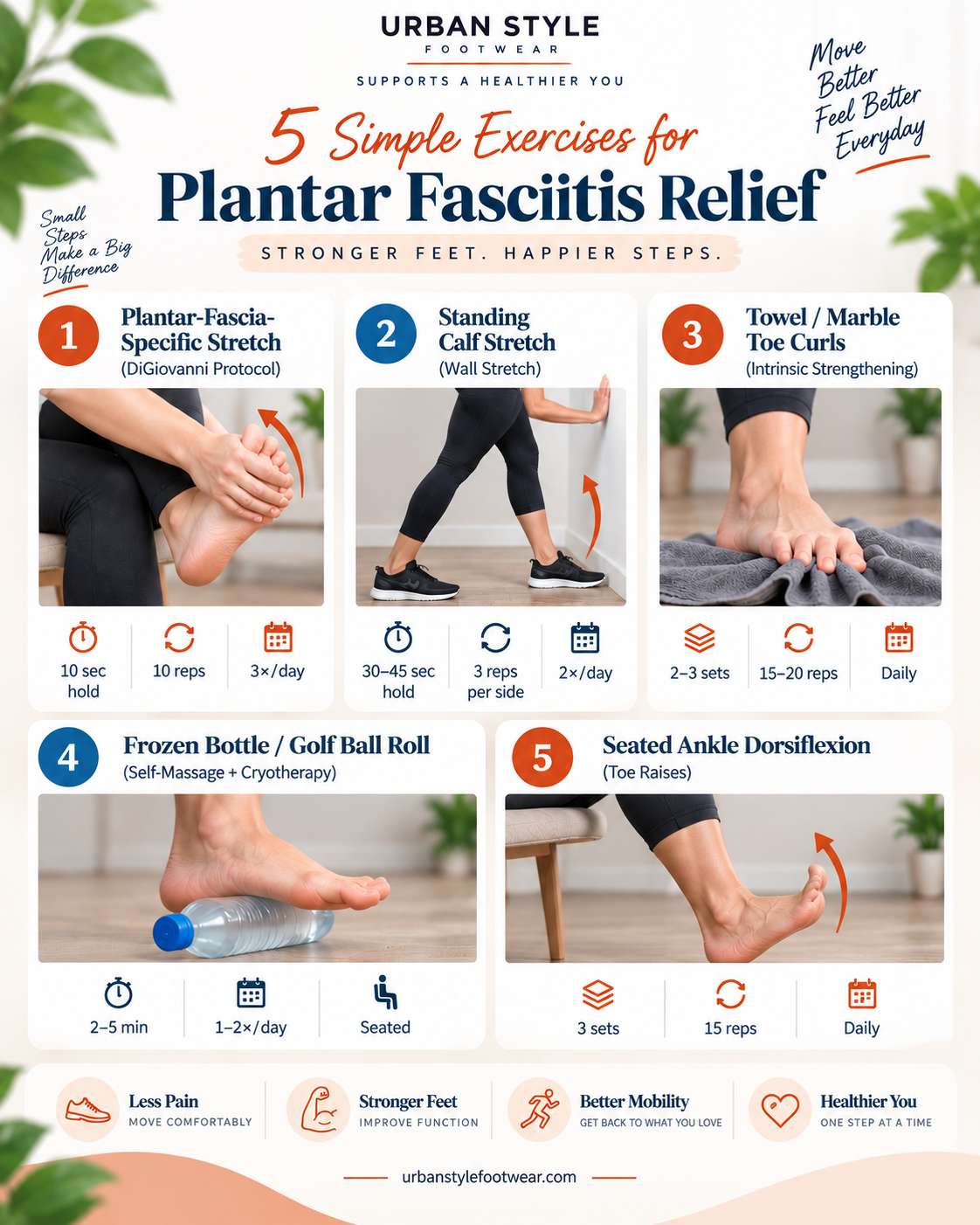
Exercise 1: The Bedside Towel Stretch
- The Biomechanical Focus: This is your primary weapon against the “first-step shock.” It stretches the calf muscles and the plantar fascia simultaneously before you put any weight on them, reversing the effects of nocturnal shortening.
- How to Perform It:
- Before you take your first morning steps, sit up on the edge of your bed.
- Loop a long beach towel, a bedsheet, or a yoga strap around the ball of your foot, just beneath your toes.
- Keep your knee straight and gently pull the towel toward your chest, drawing your toes up toward your shin.
- Hold this stretched position for $30\text{ seconds}$. Do not bounce or jerk the towel.
- Release slowly and repeat for $3\text{ sets of }30\text{-second holds}$ on each foot.
- The Footwear Veteran’s Observation: I tell all my customers to keep a towel draped over their headboard or nightstand. If you slip into this stretch before your feet touch the cold hardwood, you will bypass the initial tearing of newly formed collagen, reducing your morning limping by up to $80\%$.
Exercise 2: Hand-Assisted Great Toe Extension
- The Biomechanical Focus: This movement directly engages the Windlass Mechanism, pulling the plantar fascia tight and manually stretching the tightest band of tissue running through your inner arch.
- How to Perform It:
- Sit comfortably in a chair and cross your painful foot over your opposite knee.
- Using the hand on the same side as your painful foot, grab your big toe at the base joint.
- Gently pull the big toe back toward your shin bone until you feel a firm, comfortable stretch along the bottom of your foot and arch.
- With your opposite hand, use your thumb to massage along your arch, searching for tight, tender knots.
- Hold the toe extension stretch for $15\text{ seconds}$. Perform $10\text{ repetitions}$ on each foot.
- The Footwear Veteran’s Observation: Many runners make the mistake of pulling all their toes back together. Biomechanically, your big toe is responsible for over $80\%$ of the tension on your plantar fascia. Pulling the big toe back independently is twice as effective as stretching the smaller outer toes.
Exercise 3: The Frozen Water Bottle Roll
- The Biomechanical Focus: This is a dual-action therapeutic movement. It provides myofascial release (massaging the tissue) while simultaneously applying local cryotherapy (cold) to constrict inflamed blood vessels and numb localized nerve pain.
- How to Perform It:
- Fill a plastic water bottle with water and freeze it solid.
- Place the frozen bottle on a non-slip floor (or a towel) and sit on a sturdy chair.
- Place the arch of your foot directly on top of the bottle.
- Applying moderate, downward pressure, roll your foot slowly from the base of your toes down to the front edge of your heel.
- Roll back and forth for $5\text{ to }10\text{ minutes}$. Pay extra attention to any tight, crunchy spots.
- The Footwear Veteran’s Observation: Do not perform this standing up. Standing places your full body weight on the cold, stiff tissue, which can cause micro-tears. Keep it seated, and treat it as a soothing, end-of-day recovery ritual after standing all day at work.
PHASE 2: TARGETED LOADING & DYNAMIC MOBILIZATION (SUB-ACUTE STAGE)
Transition to this phase once your sharp, stabbing morning pain has softened into a dull, manageable ache. The exercises in this section are designed to build structural load tolerance in your tendons and fascia.
[THE RATHLEFF PROTOCOL HEEL RAISE]
Step 1: Flat Step 2: Rise (Windlass)
( Ankle ) ( Ankle )
| |
_|_ _|_ <-- Heel rises up
_/_|_ \_ _/_|_ \_ Towel rolls under toes,
[________] [________] loading the fascia under
============ ============ heavy tension
(Towel flat on floor) (Towel rolled under toes)
Exercise 4: The Rathleff Protocol (High-Load Heel Raises)
- The Biomechanical Focus: This is the undisputed holy grail of plantar fasciitis rehabilitation, popularized by Danish researcher Michael Rathleff in 2014. By placing a rolled-up towel beneath your toes, we force the big toe into extension (activating the Windlass Mechanism) while simultaneously performing a heel raise (putting a heavy load on the fascia). This stimulates mechanotransduction, signaling the body to lay down dense, organized, resilient new collagen fibers.
- How to Perform It:
- Place a thick bath towel on the floor and fold it in half. Place a sturdy step or block on top of it, or stand on a stair.
- Roll up the edge of the towel so it forms a small cylinder about the thickness of your thumb.
- Stand on the edge of the step with your toes resting on the rolled-up towel, and your heels hanging off the back of the step.
- Take $3\text{ seconds}$ to lift your heels up as high as you can (eccentric loading phase).
- Hold that peak contracted position for $2\text{ seconds}$.
- Slowly lower your heels back down past the level of the step over a slow $3\text{ seconds}$ (concentric phase).
- Perform $3\text{ sets of }10\text{ repetitions}$, resting $1\text{ minute}$ between sets. Perform this every other day.
- The Footwear Veteran’s Observation: This is the single most important exercise you can do. If you have low arches or suffer from flat feet problems, this exercise acts like structural masonry, rebuilding the dynamic strength of your foot’s dynamic suspension system. If it feels too difficult initially, start by doing it with both feet on a flat floor before transitioning to a single-leg heel raise on a stair.
Exercise 5: The Soleus-Targeted Bent-Knee Wall Stretch
- The Biomechanical Focus: Your calf consists of two main muscles: the gastrocnemius (which crosses the knee joint) and the soleus (which does not). Standard straight-leg calf stretches only target the gastrocnemius. To release the deep, stubborn tension that pulls directly on your heel bone via the soleus muscle, you must bend your knee while stretching.
- How to Perform It:
- Stand facing a wall, about arm’s length away. Place both hands flat against the wall.
- Step your painful foot back, keeping both feet pointing straight forward.
- Instead of keeping your back leg straight, bend both of your knees and sink your weight downward and forward.
- Press the heel of your back foot firmly down into the floor. You should feel a deep stretch lower down in your calf, just above your ankle joint.
- Hold this bent-knee position for $30\text{ seconds}$. Repeat for $3\text{ sets}$ on each side.
- The Footwear Veteran’s Observation: I have watched hundreds of runners stretch their calves in my store, and $90\%$ of them do it with a perfectly straight knee. If you do not bend your knee, you are completely missing the soleus muscle. Since the soleus is highly active during standing and walking, keeping it tight is a major catalyst for chronic foot pain.
Exercise 6: Towel Curls & Marble Pickups (Intrinsic Muscle Building)
- The Biomechanical Focus: These movements target the “intrinsic” muscles—the tiny, deep muscles on the bottom of your foot that support your arch structure. Strengthening these muscles reduces the daily load placed on the passive plantar fascia ligament.
- How to Perform It:
- Sit on a chair and place a small hand towel flat on a smooth wood or tile floor.
- Place your foot flat on the end of the towel nearest to you.
- Using only your toes, curl and squeeze the fabric, pulling the towel toward your heel.
- Repeat until you have scrunched the entire towel. Do this for $3\text{ repetitions}$ per foot.
- To progress, place $10\text{ marbles}$ on the floor and use your toes to pick them up one by one, dropping them into a small cup.
- The Footwear Veteran’s Observation: Think of your foot muscles like the suspension cables on a bridge. If the cables are strong, the bridge remains perfectly supported. If the cables are weak, the bridge sags, placing all the stress on the main foundation. Intrinsic foot exercises are the keys to building strong dynamic cables.
PHASE 3: KINETIC CHAIN INTEGRATION & STABILITY (STRENGTHENING & PREVENTION)
Perform these exercises once your heel pain has largely resolved and you are looking to prevent future flare-ups while walking, running, or standing for long shifts.
Exercise 7: Single-Leg Balance on Foam/Uneven Surface
- The Biomechanical Focus: This exercise builds neuromuscular coordination, ankle stability, and proprioception. It forces the foot to constantly adjust to an unstable surface, strengthening all the stabilizing muscles of the lower limb.
- How to Perform It:
- Stand next to a wall or counter for safety.
- Place a thick foam balance pad, a folded yoga mat, or a soft pillow on the floor.
- Stand on the pad with your painful foot, lifting your opposite foot off the ground.
- Attempt to balance on your single leg for $30\text{ seconds}$ without letting your raised foot touch the floor.
- Keep your hips level and avoid letting your ankle wobble excessively.
- Perform $3\text{ sets of }30\text{-second balances}$ on each side.
- The Footwear Veteran’s Observation: When you look at customers balancing, you can see their toes clawing at the pad. This clawing motion is fantastic for rebuilding the transverse arch of your forefoot, which helps prevent secondary complications like neuroma or toe strain.
Exercise 8: Tibialis Anterior Raises (The Decelerator)
- The Biomechanical Focus: The tibialis anterior muscle runs down the front of your shin. It is responsible for lifting your foot up (dorsiflexion) and controlling your foot as it hits the ground during walking. If this muscle is weak, your foot will slap the ground during heel-strike, sending a massive shockwave directly to your heel bone.
- How to Perform It:
- Stand with your back, shoulders, and hips resting flat against a wall. Place your feet about $12\text{ inches}$ away from the wall.
- Keeping your heels firmly pressed into the floor, lift both of your forefeet and toes up as high as possible.
- Hold the peak lift for $1\text{ second}$, then slowly lower your toes back down to the floor over $2\text{ seconds}$.
- Perform $3\text{ sets of }15\text{ to }20\text{ repetitions}$. You should feel a deep, warm burn on the front of your shins.
- The Footwear Veteran’s Observation: This is one of the most underrated leg exercises in the fitness world. If you are a walker or runner, strengthening your shins acts like an active decelerator, reducing heel-strike impact forces by up to $30\%$ and protecting your heel fat pad from structural wear and tear.
Exercise 9: Glute Medius Lateral Band Walks
- The Biomechanical Focus: This movement targets the gluteus medius—the lateral hip muscle that prevents your pelvis from dropping and your knee from collapsing inward when you take a step. Strengthening your hips is the ultimate key to correcting overpronation at its root source.
foot pain relief exercises - How to Perform It:
- Place a small resistance loop band around your ankles or just above your knees.
- Lower your hips into a shallow, $45\text{-degree}$ mini-squat posture, keeping your chest up and feet shoulder-width apart.
- Take a slow, deliberate step to the right with your right foot, maintaining constant tension on the resistance band.
- Follow with your left foot, returning to your starting hip-width stance.
- Take $10\text{ steps}$ to the right, then reverse and take $10\text{ steps}$ to the left. Perform $3\text{ sets}$.
- The Footwear Veteran’s Observation: This is a classic “top-down” solution. If you only treat the foot, you are only treating the victim. The real culprit is often a lazy hip muscle. If you keep your hips strong, your stride will remain perfectly straight, preventing your arches from collapsing.
THE FOOTWEAR CONNECTION: WHY EXERCISES FAIL IN FLAT SHOES
As a professional shoe fitter, I spend half my day analyzing what people wear and the other half explaining why those choices are keeping them in pain. You can perform all the stretching and loading exercises in the world, but if you step off your exercise mat and slip into a pair of flat, unsupportive fashion sneakers or worn-out slippers, you will instantly undo all of your hard work.
Your footwear and your rehabilitation exercises must act as a collaborative team. The shoe provides the external, protective scaffolding, while the exercises build the internal, biological strength.
[YOUR DYNAMIC SYSTEM: REHAB VS. FOOTWEAR]
[Exercises & Stretches] <───────────────> [Structural Shoes]
Builds internal muscle strength Provides external scaffolding
Realigns collagen fibers Relieves localized tissue stress
Improves kinetic chain alignment Locks heel in place
When you are recovering from plantar fasciitis, look for these four essential structural shoe metrics:
1. A Moderate-to-High Heel-to-Toe Drop
The “heel-to-toe drop” is the difference in height between the heel of your shoe and the forefoot. If you are rehabbing an active heel injury, look for a shoe with an $8\text{mm}$ to $12\text{mm}$ drop. This slightly elevated heel acts like a physical ramp, mechanically shortening your calf-Achilles-fascia chain. This offloads the tension on your painful arch, allowing the micro-tears to heal while you build strength. For deeper details on how this works, read our expert analysis on choosing the correct heel drop for plantar fasciitis.
2. Torsional Rigidity
Hold your shoe in both hands—one hand on the heel, the other on the toe—and try to twist it like a wet towel. If the shoe twists easily into a spiral, do not wear it. A supportive shoe must have a rigid midfoot shank (usually made of TPU or carbon fiber) that prevents the middle of the shoe from twisting or folding, protecting your arch from collapsing under load.
3. A Stiff Heel Counter
Squeeze the back of your shoe’s heel cup. It should be firm and stiff, resisting compression. A strong heel counter locks your heel bone into a neutral alignment, preventing your ankle from rolling inward (overpronating) and protecting your delicate fat pad from shearing forces.
To understand how these footwear design principles fit into your overall healing path, check out our comprehensive foot pain guide, which breaks down the biomechanics of shoe design and lower-limb health.
RETAIL-FLOOR BUYER Q&A: ANSWERED BY A FOOTWEAR VETERAN
When people sit on my fitting bench, they don’t want to hear complex medical jargon. They want straightforward, honest answers to the practical problems they face. Here are the five questions I get asked most often on the retail floor:
Q1: “Can I exercise through the pain, or do I need to stop completely?”
The honest answer: It depends entirely on the type of pain. If your pain is a sharp, white-hot, stabbing sensation (which usually means active, acute tearing), you must stop high-impact activities immediately. Focus on seated, non-weight-bearing stretches and ice rolling. However, if the pain is a dull, warming, muscular ache that stays below a $3$ out of $10$ on a pain scale, you should absolutely continue with progressive loading exercises like the Rathleff Protocol. Complete rest causes your tissues to weaken, prolonging your recovery.
Q2: “Why do my heels feel worse after calf stretching?”
The honest answer: You are probably over-stretching or using ballistic (bouncing) movements. When your plantar fascia is highly inflamed, aggressive stretching can trigger a protective muscular spasm, causing the calves to contract even tighter to guard the joint.
Additionally, if you stretch your calves on a stair and drop your heels too low too fast, you place your plantar fascia under extreme mechanical tension, which can worsen the micro-tears. Keep your stretches gentle, static, and controlled.
Q3: “Are barefoot shoes good for rehabbing plantar fasciitis?”
The honest answer: Barefoot shoes can be a fantastic long-term goal for foot strengthening, but wearing them during an active, acute flare-up of plantar fasciitis is a recipe for disaster.
If you have spent your entire life wearing traditional, cushioned shoes with a raised heel, your calves and Achilles tendons are shortened. Switching abruptly to zero-drop barefoot shoes forces those tight tissues to stretch beyond their functional capacity, instantly worsening your heel pain. Rebuild your strength first using supportive footwear, and transition to minimalist footwear slowly over several months.
Q4: “Do custom orthotics make my feet lazy over time?”
The honest answer: Only if you use them as a permanent crutch without doing your exercises. Think of an orthotic like a dental cast or a brace: it is highly useful to stabilize an injured joint and allow tissues to heal in a correct alignment.
However, if you wear orthotics for years without doing any intrinsic foot strengthening, your arch muscles will become lazy. The goal should be to use orthotics to calm the acute pain, while simultaneously performing exercises to build your own natural arch support.
Q5: “How long before I see real results from these stretches?”
The honest answer: You will likely feel a minor reduction in morning stiffness within the first two weeks of doing bedside towel stretches. However, physical restructuring of collagen fibers is a slow biological process.
Clinical studies show that the Rathleff Protocol requires eight to twelve weeks of consistent, every-other-day execution to show significant, long-term changes in fascia thickness and load tolerance. Patience and consistency are your best friends. To understand what to expect along your healing path, check out our guide on typical plantar fasciitis recovery time.
PRO TIPS FROM A FOOTWEAR EXPERT: THE 4 EXERCISE FIELD TESTS
Before you start your exercise routine, perform these four simple, hands-on tests that we use on the retail floor to check your foot’s structural integrity and alignment:
[The 4-Step Foot Integrity Field Test]
1. The Great Toe Test ───> Bend big toe upward. Arch must raise naturally.
2. The Wet Footprint Test ───> Wet foot & step on cardboard. Check arch surface contact.
3. The Heel Squeeze Test ───> Squeeze heel bone. Sharp pain points to a stress fracture.
4. The Sole Wear Check ───> Look at bottom of shoe. Inner wear indicates overpronation.
Test 1: The Great Toe extension Test (Windlass Check)
Sit in a chair and keep your foot flat on the floor. Now, try to bend your big toe upward using only your toe muscles.
- The Verdict: If your big toe bends up easily and you see your arch raise up naturally, your Windlass Mechanism is functioning beautifully. If your big toe is stiff, resists bending, or causes sharp pain along the inner side of your foot, your fascia is highly restricted and needs manual mobilization before you start loading exercises.
Test 2: The Wet Footprint Test
Dip the bottom of your foot in a shallow bowl of water, then step firmly onto a dry piece of cardboard or a dark tile floor. Look at the shape of your footprint.
- The Verdict: If you see a thin, curved line along the outer edge of your foot, you have high arches. If you see a full, solid footprint where your entire foot touches the board, you are dealing with low arches or flat feet. Knowing this tells you how much dynamic stability your shoes need to provide.
Test 3: The Heel Squeeze Test
Squeeze the back-sides of your heel bone (the calcaneus) between your thumb and fingers, applying firm pressure as if you were pinching a ball.
- The Verdict: If this squeeze causes a sharp, deep, agonizing pain inside the bone itself, you may be dealing with a calcaneal stress fracture rather than typical ligament inflammation. This requires medical rest and imaging, not stretching exercises.
Test 4: The Sole Wear Pattern Check
Take your favorite, most-worn pair of daily shoes and flip them over. Look closely at the wear patterns on the rubber outsole.
- The Verdict: If the rubber is heavily worn down along the inner border of the heel and the ball of your foot, your feet are actively collapsing inward (overpronation). This means you must focus heavily on glute and tibialis anterior exercises to correct your alignment.
PLANATAR FASCIITIS EXERCISE & HEEL STRETCHING MATRIX
To help you quickly identify which exercises match your current pain levels and symptoms, refer to this practical reference matrix:
| Exercise Name | Primary Targeted Tissue | Ideal Healing Phase | Recommended Frequency | Difficulty Level | Expected Biomechanical Outcome |
|---|---|---|---|---|---|
| Bedside Towel Stretch | Gastrocnemius, Achilles, Fascia | Acute (Morning) | Daily, before standing | Very Low | Reverses nocturnal tissue shortening, stops first-step tearing |
| Great Toe Extension | Plantar Fascia (Windlass) | Acute / Sub-Acute | Daily, $3\text{ sets of }15\text{-second holds}$ | Low | Manually mobilizes tight fascia fibers, increases local blood flow |
| Ice Bottle Roll | Plantar Fascia, Arch muscles | Acute (End of Day) | Seated, $10\text{ minutes}$ daily | Low | Constricts inflamed vessels, numbs localized pain, releases knots |
| The Rathleff Protocol | Calves, Achilles, Fascia | Sub-Acute / Chronic | Every other day, $3\text{ sets of }10\text{ reps}$ | Medium-High | Promotes mechanotransduction, aligns new collagen, builds load |
| Bent-Knee Wall Stretch | Soleus muscle, Lower Achilles | Sub-Acute / Chronic | Daily, $3\text{ sets of }30\text{-second holds}$ | Low | Releases deep calf tension that pulls directly on your calcaneus |
| Towel Curl & Marbles | Intrinsic arch stabilizers | Sub-Acute / Chronic | $3\text{ times}$ per week, $10\text{ minutes}$ | Medium | Builds dynamic muscle support, reduces the load on passive ligaments |
| Single-Leg Balance | Proprioceptors, Ankle stabilizers | Chronic (Prevention) | Daily, $3\text{ sets of }30\text{ seconds}$ | Medium | Improves balance, ankle strength, and lateral foot stability |
| Tibialis Raises | Tibialis Anterior (Shin) | Chronic (Prevention) | $3\text{ times}$ per week, $3\text{ sets of }15\text{ reps}$ | Low-Medium | Strengthens front shin, acts as active decelerator for heel-strike |
| Glute Lateral Walks | Gluteus Medius (Hip) | Chronic (Prevention) | $3\text{ times}$ per week, $3\text{ sets of }10\text{ steps}$ | Medium | Aligns the entire leg, preventing hip drop and inward arch collapse |
5 CRITICAL MISTAKES TO AVOID WHEN STRETCHING YOUR FEET
Even with the best intentions, it is incredibly easy to make simple stretching or lifestyle mistakes that prolong your recovery. Here are the five most common errors I see on the retail floor:
1. Squeezing Your Toes When Stretching
When most people stretch their calves against a wall, they let their toes curl inward, clawing at the floor. This is a massive mistake. Clawing your toes actually shortens the plantar fascia, locking it in a contracted state while you try to force your heel down.
Always keep your toes relaxed, flat, and splayed out wide during calf stretches to ensure the entire kinetic chain is being elongated.
2. Performing Dynamic, Bouncing Stretches (Ballistic Stretching)
When your heel is stiff, your natural instinct is to bounce up and down on a step to “loosen it up.” This ballistic stretching is highly dangerous for inflamed tissues.
A cold, inflamed ligament is highly inelastic; exposing it to sudden, high-velocity bounces will cause microscopic tearing and immediate pain flare-ups. Always perform your exercises and stretches using slow, controlled, static movements.
3. Neglecting the Hips and Knees
If you only focus on your foot, you are ignoring the rest of your skeletal system. Your foot is the final interface in a complex kinetic chain.
If your hips are weak, your knees will bend inward, forcing your arches to collapse flat against the floor. Always incorporate lateral hip and core stability movements into your weekly routine to correct your walking posture from the top down.
4. Walking Barefoot on Tile and Hardwood Floors
I cannot emphasize this enough: walking barefoot on hard floors during recovery is the absolute enemy of healing. Without any structured support, your arch is forced to flatten completely under your full body weight with every single step.
This sudden, high-velocity stretch causes immediate micro-tearing, erasing several days of physical therapy progress. Keep a pair of supportive recovery slides next to your bed and slip into them before taking a single step.
5. Relying Solely on Passive Therapies (The “Magic Bullet” Illusion)
Many people buy a custom orthotic, slip it into their shoes, and assume they are cured. This passive approach is a temporary band-aid.
While an orthotic is highly beneficial to support your foot and calm acute pain, it does not build tissue strength. If you do not perform dynamic loading exercises like the Rathleff Protocol, your foot will remain structurally weak, and the pain will return the moment you take your shoes off.
EXTERNAL AUTHORITY REFERENCES
For deep, science-based research on foot rehabilitation, human biomechanics, and tissue loading protocols, consult these highly respected organizations:
- The American Podiatric Medical Association (APMA): The leading national professional organization representing podiatric physicians in the United States, offering excellent guidelines on conservative foot care.
- The Journal of Orthopaedic & Sports Physical Therapy (JOSPT): A highly respected, peer-reviewed clinical journal publishing cutting-edge research on physical therapy protocols for lower-limb injuries, including the Rathleff Protocol.
- The International Society of Footwear Biomechanics: A specialized research group focusing on the physical interaction between the human foot and modern shoe materials, providing high-quality data on joint loading and orthotic design.
FAQ: 10 HIGHLY SEARCHED QUESTIONS ANSWERED BY A FOOTWEAR VETERAN
Q1: Can stretching actually cure plantar fasciitis?
Yes, but stretching is only half the battle. Gentle stretches like the bedside towel stretch are fantastic for reducing morning stiffness and desensitizing tight tissues. However, to cure the condition permanently, you must incorporate progressive loading exercises like high-load heel raises to rebuild the physical strength of the fascia.
Q2: Is it normal for my feet to hurt worse the morning after doing exercises?
No. A mild, muscular ache in your calves or arches is normal as your muscles adapt to a new routine. However, if you experience a sharp, burning pain or a significant increase in morning heel stiffness, you have likely loaded the tissue too aggressively. Reduce your repetitions or return to Phase 1 stretches until the acute inflammation calms down.
Q3: Why does my heel pain return after I sit at my desk for an hour?
This is known as post-static dyskinesia, and it is a classic symptom of plantar fasciitis. When you sit and rest, your plantar fascia and calves cool down, shortening back into a contracted state. The moment you stand up, your body weight forces those cold, tight tissues to stretch abruptly, causing immediate pain. To prevent this, perform the bedside towel stretch or draw circles with your ankles before standing up from your desk. If your pain continues to flare up after long periods of inactivity, understanding why do feet hurt when first wake up will help you identify the common habits that keep your lower-limb tissues tight and inflamed.
Q4: Should I stretch my feet if my pain is caused by heel spurs?
Yes, absolutely. Many people believe a heel spur is a sharp needle poking into their flesh, but in reality, a heel spur is a flat, horizontal bone growth caused by the constant pulling of an inflamed plantar fascia. If you are confused about your symptoms, understanding the difference between heel spurs vs plantar fasciitis is a critical first step. By stretching your calves and performing loading exercises, you relieve the tension on your fascia, which stops the pulling and eliminates the pain, regardless of whether a spur is present.
Q5: How many times a day should I perform these stretching exercises?
Gently perform your Phase 1 stretches (like the towel stretch and big toe stretch) two to three times a day, especially before stepping out of bed or standing up after sitting at a desk. However, perform your Phase 2 progressive loading exercises (like the Rathleff heel raises) every other day to allow your muscle and collagen fibers forty-eight hours to rest, recover, and rebuild.
Q6: Can tight calf muscles actually cause pain on the bottom of my foot?
Yes, definitely. Your calf muscles connect directly to your heel bone via the Achilles tendon, which is physically linked to your plantar fascia. When your calves are tight, they pull upward on your heel, putting constant, high-tension traction on the bottom of your foot and causing severe tight calves foot pain.
Q7: Are night splints effective when combined with exercises?
Yes, they are highly effective. A night splint mechanically holds your ankle at a perfect $90^\circ$ angle throughout the night, completely preventing your tissues from shortening while you sleep. When you pair a night splint with morning stretching exercises, you eliminate the morning shock and allow the fascia to heal in an elongated, functional state.
Q8: Should I apply ice or heat to my heel after doing exercises?
If your heel feels hot, throbbing, or swollen after exercises, apply ice (or roll on a frozen water bottle) for $10\text{ to }15\text{ minutes}$ to reduce acute inflammation and numb local nerve endings. However, if your heel simply feels stiff and tight, apply moist heat or take a warm shower before exercising to increase local circulation and soften the collagen fibers.
Q9: Can flat feet cause my plantar fasciitis to worsen?
Yes, absolutely. If you have low arches, your foot naturally rolls inward (overpronates) with every step, causing your arch to flatten. This collapse puts immense, abnormal lateral stretch on your plantar fascia, leading to chronic microscopic tearing. Performing intrinsic foot exercises and high-load heel raises is essential to build your dynamic arch support.
Q10: How long does it typically take to recover from walking heel pain?
If you consistently wear supportive, structured footwear, perform your morning stretches, and avoid barefoot walking on hard floors, typical recovery ranges from three to six months. However, severe, untreated cases can persist for a year or more, making early active rehabilitation critical to a fast recovery.
CONCLUDING THOUGHTS & THE PATH FORWARD
Plantar fasciitis is not a life sentence, nor is it a natural part of growing older. It is simply a physical warning sign from your body that your footwear is failing to support your natural skeletal structure and that your dynamic foot muscles have become weak.
[Your Foot Health Active Checklist]
☐ Stop walking barefoot on hardwood or tile floors first thing in the morning
☐ Perform the bedside towel stretch and big toe extension before standing up
☐ Rebuild your dynamic arch strength using the Rathleff Protocol every other day
☐ Strengthen your hips and shins to stabilize your walking posture from the top down
☐ Replace daily shoes that have worn-out, compressed foam midsoles
If you want to break the cycle of waking up in agony, prioritize active tissue loading over passive rest, and choose shoe structure over fast-fashion trends. Look for shoes with dense, compression-molded midsoles, rigid midfoot shanks, and supportive heel cups that keep your feet in a neutral plane. Treat your feet with the respect they deserve—after all, they are the foundation of your entire kinetic chain.
READY TO FIND DEEP HEEL PAIN RELIEF? Best Shoes for Plantar Fasciitis — Browse Every Category
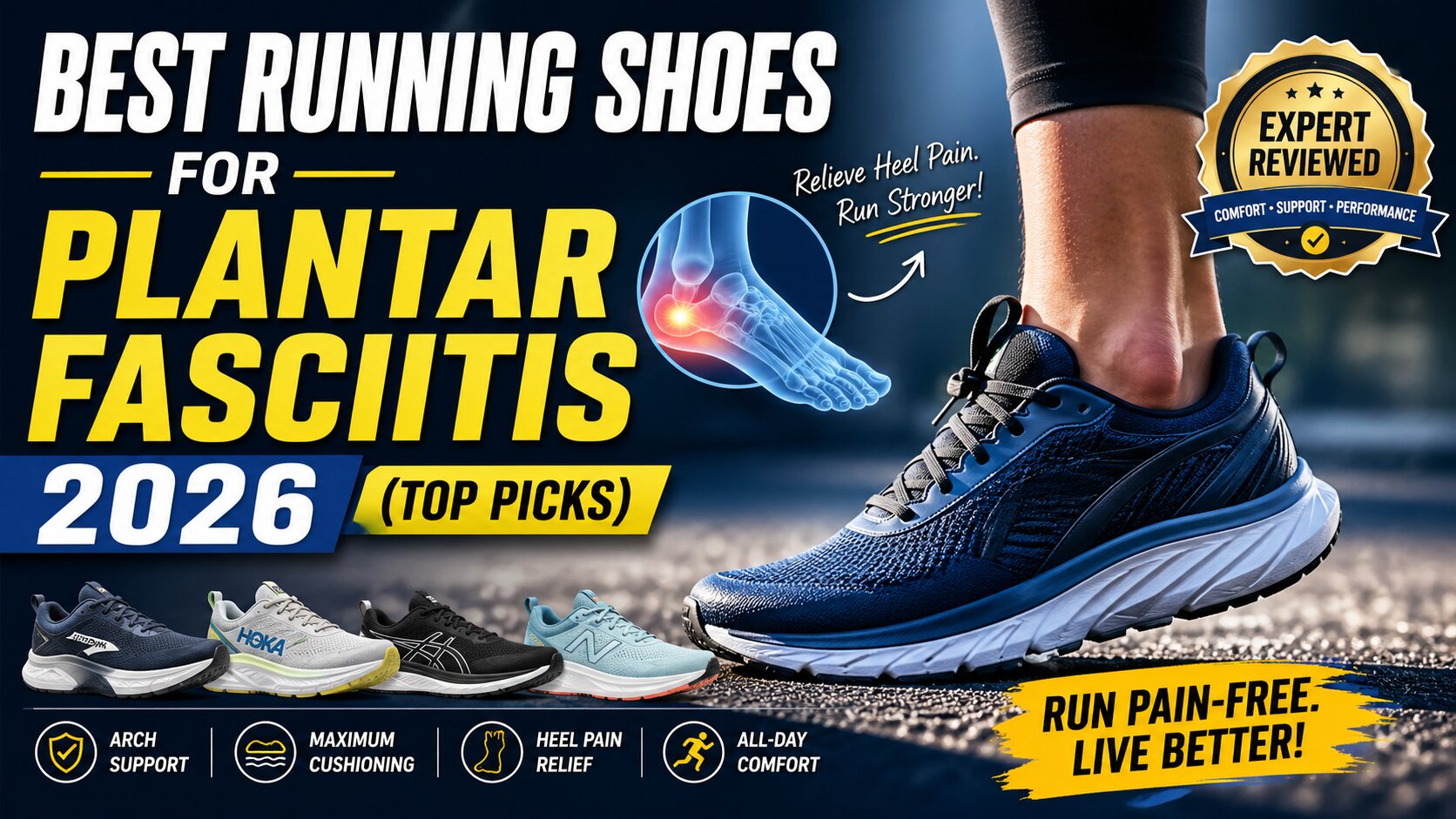
Best Running Shoes for Plantar Fasciitis
Running on asphalt demands responsive cushioning that doesn’t bottom out under repetitive impact. Retail insight: U.S. runners often overlook heel-to-toe drop—5–8mm reduces strain on the plantar fascia during heel strike, especially on concrete sidewalks common in urban areas. Common mistake: Choosing maximal cushioning without stability features, leading to overpronation and increased fascia tension. For deeper analysis including gait-specific recommendations and brand comparisons, see our full guide on best running shoes for plantar fasciitis.
Best Walking Shoes for Plantar Fasciitis
Walking shoes need a balance of cushioning for heel strike and forefoot flexibility for toe-off. Retail insight: Many U.S. walkers buy “comfort” shoes that are too soft, causing instability on uneven sidewalks or cracked pavement common in older cities. Common mistake: Ignoring outsole durability—blown rubber wears fast on abrasive concrete, losing traction and cushioning prematurely. Explore our dedicated review of best walking shoes for plantar fasciitis for surface-specific recommendations.
Best Sandals for Plantar Fasciitis
Supportive sandals require contoured footbeds, secure straps, and adequate arch support—often missing in fashion-focused designs. Retail insight: Summer heat in the South and Southwest increases foot swelling, making adjustable straps and breathable materials non-negotiable for all-day comfort. Common mistake: Choosing flat flip-flops or slides, which eliminate arch support and increase fascia strain with every step. See our full breakdown of best sandals for plantar fasciitis for warm-weather solutions.
Best Work Shoes for Plantar Fasciitis
Healthcare and retail workers need slip resistance, all-day support, and durability on hard floors. Retail insight: U.S. hospital and retail floors are often polished concrete or tile—rubber outsoles with multi-directional tread prevent slips while absorbing impact. Common mistake: Prioritizing style or lightweight design over shock absorption, leading to end-of-shift heel pain that compounds overnight. Dive deeper into best work shoes for plantar fasciitis for occupation-specific picks.
Best Sneakers for Plantar Fasciitis
Everyday sneakers are the most-worn shoe category for plantar fasciitis sufferers, which makes getting the fit right critical. Retail insight: Lifestyle sneakers marketed as “cushioned” often use EVA foam with a durometer rating too soft to support the medial arch under bodyweight compression. Common mistake: Buying a half-size too small to feel “secure”—a snug toe box increases forefoot pressure and redistributes strain back onto the fascia. Browse our tested picks in best sneakers for plantar fasciitis for options that balance street style with genuine support.
Best Slip-On Shoes for Plantar Fasciitis
Slip-ons are convenient but the category is full of structurally weak options that make morning foot pain significantly worse. Retail insight: Many U.S. customers reach for slip-ons post-injury or during flare-ups because lace-ups feel like too much effort—but most slip-ons sacrifice heel counter rigidity to allow easy on/off. Common mistake: Assuming a removable footbed means the shoe accepts orthotics—many slip-on designs have shallow heel cups that cause orthotic lift and instability. Our best slip-on shoes for plantar fasciitis guide flags which styles are actually orthotic-compatible.
Best Dress Shoes for Plantar Fasciitis (Men & Women)
Dress shoes are the hardest category to get right for plantar fasciitis—fashion typically wins over function in design. Retail insight: Many professional environments in the U.S. still require leather uppers and low-profile soles, leaving sufferers little room to prioritize support without compromising appearance. Common mistake: Choosing pointed toe boxes in dress heels or oxfords, which compress the forefoot and increase plantar load during toe-off. See our curated list of best dress shoes for plantar fasciitis for work-appropriate styles that don’t sacrifice your foot health.
Best Boots for Plantar Fasciitis
Boots offer natural ankle support, but the wrong pair can lock the ankle into a position that increases plantar fascia tension. Retail insight: Fall and winter boot shopping in the U.S. peaks in October—customers often prioritize weatherproofing and aesthetics, overlooking the internal footbed structure entirely. Common mistake: Selecting fashion boots with a rigid, flat insole and no heel cushioning, then wearing them on hard floors during the colder months when fascia tissue is already less pliable. Check our full best boots for plantar fasciitis review for cold-weather picks with real arch support.
Best Slippers for Plantar Fasciitis
The first steps out of bed in the morning are often the most painful for plantar fasciitis—and most household slippers make that worse. Retail insight: A large portion of U.S. slipper sales are cheap flat-soled gift items with zero arch support, effectively the worst possible footwear for a condition that peaks upon waking. Common mistake: Going barefoot on hardwood or tile floors instead of reaching for supportive footwear first thing—hard surfaces create the same impact forces as outdoor walking. Our best slippers for plantar fasciitis guide covers indoor-only and indoor-outdoor options built around morning pain management.
Best Women’s Shoes for Plantar Fasciitis
Women experience plantar fasciitis at roughly twice the rate of men, largely due to footwear design history and biomechanical factors. Retail insight: Women’s shoe categories—from ballet flats to wedge heels—are disproportionately designed with aesthetics-first construction, often featuring thin outsoles and inadequate medial post support. Common mistake: Assuming a wide toe box alone is enough—women with plantar fasciitis also need a deep heel cup and a midsole firm enough to resist medial collapse under gait. Explore our comprehensive best women’s shoes for plantar fasciitis guide across every style category.
Best Men’s Shoes for Plantar Fasciitis
Men’s plantar fasciitis is frequently linked to high-impact activity, work environments that require prolonged standing, and delayed treatment. Retail insight: Men tend to under-report foot pain and delay replacing worn-out shoes—midsole compression in a shoe worn beyond 300–500 miles provides almost no shock absorption, even if the upper still looks intact. Common mistake: Sizing up to accommodate swelling without addressing the underlying support deficit, which leads to heel slippage and increased fascia strain. See our best men’s shoes for plantar fasciitis for picks across casual, athletic, and work categories.
Best Wide Width Shoes for Plantar Fasciitis
Wide-width shoppers with plantar fasciitis face a compounded challenge—finding supportive footwear that doesn’t compress the forefoot or cause bunion friction. Retail insight: In the U.S. market, wide-width availability drops significantly above 2E sizing, pushing many customers toward soft, unsupportive styles simply because they fit. Common mistake: Buying standard-width shoes and assuming a broken-in upper will compensate—forefoot compression increases plantar load regardless of how worn the shoe feels. Our best wide width shoes for plantar fasciitis guide covers 2E and 4E options from brands that don’t cut support to accommodate width.
Best Nursing Shoes for Plantar Fasciitis
Nurses and clinical staff log 8–12 miles per shift on hard hospital floors—footwear failure here has real consequences beyond just foot pain. Retail insight: Hospital infection control policies often restrict open-toe shoes, leaving nursing staff with a narrower footwear window where slip resistance, closed toe, and arch support must all coexist. Common mistake: Choosing lightweight clogs for comfort without checking the heel counter rigidity—many popular nursing clogs allow excessive heel motion that aggravates the fascia over a long shift. Our best nursing shoes for plantar fasciitis picks are tested specifically against shift-length wear.
Best Shoes for Standing All Day with Plantar Fasciitis
Standing-intensive jobs put continuous static load on the plantar fascia—different from walking but equally damaging without proper support. Retail insight: Anti-fatigue mats are standard in U.S. warehouse and kitchen environments, but they’re not a substitute for adequate footwear—the mat absorbs surface impact while the shoe still has to manage arch and heel biomechanics. Common mistake: Wearing cushioned foam shoes on static shifts, which compress quickly under sustained load and bottom out by hour four. See our best shoes for standing all day with plantar fasciitis guide for picks that hold up across an entire shift.
Best Shoes for Teachers with Plantar Fasciitis
Teachers combine prolonged standing with constant movement across hard classroom floors—a pattern that creates unique plantar fasciitis stress. Retail insight: Most U.S. school environments don’t allow overt athletic footwear, pushing teachers toward “professional casual” styles that often lack the structural support their daily movement demands. Common mistake: Wearing flat-soled loafers or ballet flats during classroom hours because they look appropriate—both styles eliminate the heel-to-toe drop that reduces fascia tension during standing. Our best shoes for teachers with plantar fasciitis list focuses on professional-looking picks with real biomechanical credentials.
Best Gym Shoes for Plantar Fasciitis
Gym footwear is high-stakes for plantar fasciitis—lateral movement, jumping, and heavy lifting each create different load profiles on the fascia. Retail insight: Many U.S. gym-goers use their road running shoes for cross-training, not realizing that lateral stability—not just forward cushioning—is what prevents fascia strain during agility drills or weight training. Common mistake: Training in zero-drop or minimalist footwear during a plantar fasciitis flare-up, which places the fascia under maximum stretch with every rep. Our best gym shoes for plantar fasciitis guide breaks down picks by training type.
Best HOKA Shoes for Plantar Fasciitis
HOKA’s maximal cushioning platform has made it a go-to brand for plantar fasciitis sufferers—but not every HOKA model is appropriate for every foot type. Retail insight: HOKA’s rocker geometry and nitrogen-infused foam work exceptionally well for neutral and mild overpronators, but high-arched supinators can find the platform destabilizing without a supplemental orthotic. Common mistake: Buying the most-hyped HOKA model without checking the shoe’s heel bevel angle and midsole firmness—softer HOKA foam in recovery models isn’t built for high-mileage daily wear. See our full best HOKA shoes for plantar fasciitis breakdown with model-by-model analysis.
Best Brooks Shoes for Plantar Fasciitis
Brooks has built its reputation on biomechanically engineered footwear—a genuine plus for plantar fasciitis sufferers who need predictable support. Retail insight: Brooks’ GuideRails technology targets excess motion at the knees and hips, which indirectly reduces the compensatory gait patterns that tighten the plantar fascia over long distances. Common mistake: Choosing the Ghost over the Adrenaline GTS without understanding your pronation pattern—the Ghost is neutral while the Adrenaline GTS offers medial post support for overpronators. Our best Brooks shoes for plantar fasciitis guide maps each model to the right foot type.
Best New Balance for Plantar Fasciitis
New Balance offers one of the widest size and width ranges in the U.S. market—a critical differentiator for plantar fasciitis patients whose foot shape falls outside standard sizing. Retail insight: New Balance’s Fresh Foam X and ABZORB midsole technologies deliver different cushioning profiles—Fresh Foam X prioritizes plush responsiveness while ABZORB targets localized heel impact absorption, the more directly relevant spec for fascia pain. Common mistake: Overlooking New Balance’s 990 series in favor of newer releases—the 990v6 remains one of the most podiatrist-recommended shoes for plantar fasciitis due to its structured heel counter and dual-density insole. Browse our best New Balance for plantar fasciitis picks with width-specific recommendations.
Best ASICS for Plantar Fasciitis
ASICS’ GEL technology remains one of the most clinically cited midsole systems for heel strike attenuation—directly relevant to plantar fasciitis management. Retail insight: ASICS runs narrow through the heel compared to New Balance or Brooks, which is worth noting for customers with wider heel anatomy—a loose heel counter negates much of the GEL cushioning benefit. Common mistake: Choosing ASICS Gel-Nimbus (neutral, plush) when overpronation is the underlying cause of fascia strain—the Gel-Kayano or Gel-Kayano Lite with its Dynamic DuoMax support system is the correct pick. See our detailed best ASICS for plantar fasciitis guide for model-specific recommendations.
Best Saucony for Plantar Fasciitis
Saucony’s PWRRUN and PWRRUN+ foam technologies offer a firm-yet-responsive cushioning profile that suits plantar fasciitis sufferers who find overly soft shoes aggravating. Retail insight: Saucony tends to run slightly narrower through the midfoot than Brooks or New Balance—customers with wider feet should prioritize the Echelon series, which comes in wide widths with a roomier forefoot platform. Common mistake: Dismissing Saucony as a “niche running brand” and overlooking its walking and everyday categories, which include some of the best arch-supportive casual footwear on the market. Explore our best Saucony for plantar fasciitis picks across running and lifestyle categories.
Best Vionic Shoes for Plantar Fasciitis
Vionic was built specifically around orthotic biomechanics—its Orthaheel technology is one of the few retail insole systems with peer-reviewed clinical backing for plantar fasciitis relief. Retail insight: Vionic bridges the gap between medical-grade arch support and mainstream fashion better than most brands, making it a strong recommendation for female customers who need support but refuse to sacrifice style. Common mistake: Assuming all Vionic shoes offer the same level of support—the brand spans casual, active, and dress categories with varying midsole firmness, and the sandal lineup is noticeably softer underfoot than the walking shoe range. Our best Vionic shoes for plantar fasciitis guide ranks models by arch support intensity.
Best Dansko for Plantar Fasciitis
Dansko’s rocker-sole construction and built-in contoured footbed originally made it the standard footwear recommendation across nursing and culinary professions. Retail insight: Dansko’s stapled welt construction produces a stiffer outsole than glued alternatives—this limits forefoot flex but significantly reduces cumulative fascia strain across long standing shifts on hard floors. Common mistake: Ordering Dansko in U.S. sizing rather than their European size system, which typically runs one full size larger—an ill-fitting Dansko loses most of its support benefit as the foot slides within the footbed. See our best Dansko for plantar fasciitis breakdown including sizing guidance.
What to Look for in Plantar Fasciitis Shoes (Buying Guide)
Understanding what separates a genuinely supportive shoe from a “comfort-marketed” one is the most valuable thing a plantar fasciitis sufferer can learn. Retail insight: The three structural non-negotiables are a firm heel counter, a supportive medial arch post, and a midsole with adequate durometer rating—foam that compresses below 15 Asker C under bodyweight provides negligible fascia protection by midday. Common mistake: Relying on brand reputation alone without physically testing the shoe’s heel counter rigidity by squeezing it between thumb and forefinger—it should resist compression with minimal flex. Our comprehensive plantar fasciitis shoe buying guide walks through every spec with plain-language explanations.
Can Shoes Cause Plantar Fasciitis?
Footwear is one of the most controllable risk factors for developing plantar fasciitis—and one of the most overlooked. Retail insight: Thin-soled fashion footwear, worn-out athletic shoes past their midsole life, and zero-drop minimalist shoes adopted too quickly are among the most common footwear-related triggers seen in U.S. podiatry offices. Common mistake: Assuming only “bad” shoes cause plantar fasciitis—even high-quality shoes worn past 400–500 miles provide negligible midsole support and can trigger or worsen the condition. Read our detailed breakdown of whether shoes can cause plantar fasciitis for the full mechanical explanation.
Plantar Fasciitis Insoles vs Supportive Shoes: Which Is Better?
This is one of the most common questions I get from customers, and the answer depends entirely on the structural integrity of the shoe you’re working with. Retail insight: Aftermarket orthotics placed inside a structurally weak shoe are the equivalent of adding a performance engine to a car with no suspension—the underlying platform can’t support the correction you’re trying to make. Common mistake: Spending $60+ on custom orthotics before replacing footwear that has already degraded beyond its useful midsole life, rendering the orthotic ineffective within weeks. Our insoles vs supportive shoes guide helps you decide which investment makes more sense for your current situation.
How to Choose Shoes If You Have Plantar Fasciitis
Buying shoes for plantar fasciitis isn’t just about picking the most cushioned option on the shelf—it requires matching shoe architecture to your specific gait pattern and foot geometry. Retail insight: A trained shoe store associate will perform a wet footprint test or brief gait assessment before recommending footwear—if a retailer skips this step entirely, you’re essentially buying blind. Common mistake: Shopping online without understanding your pronation type or arch height, then attributing poor results to the condition rather than the mismatch between shoe and foot mechanics. Our how to choose shoes for plantar fasciitis guide provides a self-assessment framework you can use before you buy.
How Long Does Plantar Fasciitis Take to Heal with Proper Shoes?
Recovery timelines vary, but footwear quality is one of the strongest predictor variables for how quickly symptoms resolve. Retail insight: Patients who switch to appropriate footwear within the first six weeks of symptoms typically see significant relief within 6–12 weeks—those who delay can extend their recovery to 12–18 months or longer. Common mistake: Interpreting reduced morning pain after two weeks of supportive footwear as full recovery and reverting to previous shoe habits, which almost always triggers a relapse of inflammation. Our article on how long plantar fasciitis takes to heal with proper shoes outlines what realistic recovery stages look like.
Best Plantar Fasciitis Shoes Under $50
Budget-friendly plantar fasciitis footwear does exist, but the under-$50 category requires more selective shopping than higher price points. Retail insight: At this price point, EVA foam density and heel counter construction are where most manufacturers cut costs—physical squeeze-testing the heel counter before buying is essential, as many budget shoes collapse with minimal lateral pressure. Common mistake: Trusting customer review counts over structural specifications—a shoe with 4,000 five-star reviews may be popular for fit and style while offering no meaningful plantar fasciitis support. See our vetted best plantar fasciitis shoes under $50 picks that pass a structural integrity check.
Best Plantar Fasciitis Shoes Under $100
The $50–$100 range is where genuine biomechanical value starts to emerge—brands like New Balance, Saucony, and ASICS offer entry-level stability models with meaningful medial post construction at this price. Retail insight: Many of the most podiatrist-recommended plantar fasciitis shoe models land between $80–$100, making this price band arguably the best value tier for clinical-level support without premium brand markup. Common mistake: Chasing sale prices on last-year’s models without checking if the midsole technology has been meaningfully updated—some refreshed models improve foam density while keeping the same upper design and colorway. Browse our top-tested best plantar fasciitis shoes under $100 by category.
Best Premium Shoes for Plantar Fasciitis
Above $150, you’re paying for advanced foam compounds, superior last construction, and often APMA-recognized designs built around podiatric research. Retail insight: Premium plantar fasciitis footwear from HOKA, Brooks, Vionic, and Kuru typically uses nitrogen-infused midsole technology or proprietary heel cup geometry that genuinely outperforms what’s available at lower price points—the durability per dollar often justifies the upfront cost. Common mistake: Assuming premium price guarantees universal compatibility—a $200 HOKA Bondi may be ideal for a neutral runner but completely wrong for a high-arch supinator, making fit assessment no less important at the top end of the market. Our best premium shoes for plantar fasciitis guide breaks down whether the investment is worth it for your specific foot type.