
Plantar Fasciitis Shoes: The Complete 2026 Guide to the Best Footwear for Heel Pain Relief
Introduction: Your Feet Are Trying to Tell You Something
You get out of bed in the morning. The moment your foot hits the floor — that stabbing, sharp heel pain hits back. You hobble to the bathroom like you’ve aged thirty years overnight. And somewhere in the back of your mind you’re thinking: is this really just about my shoes?
Yeah. It usually is.
Plantar fasciitis is one of the most common, most misunderstood, and most fixable foot conditions on the planet — and the wrong footwear is both a leading cause and the single most impactful daily solution. Whether you’re on your feet all day at work, logging miles as a runner, or just walking around a city on vacation, your shoes are either helping your plantar fascia heal or quietly making everything worse.
We’ve spent years handling shoes at a retail level — testing soles, examining insoles, watching customers walk, talking to people who’ve dealt with chronic heel pain for years. I’ve seen people spend $200 on the wrong pair and keep suffering, and I’ve seen a well-chosen $80 sneaker genuinely change someone’s quality of life. This guide is everything we know, laid out clearly, so you make the right call.
Let’s get into it.
TL;DR — Quick Answer
The best shoes for plantar fasciitis need deep heel cushioning, firm arch support (especially at the midfoot), a slight heel-to-toe drop of 8–12mm, and a supportive midsole made from EVA foam or equivalent. Top-rated picks include HOKA, New Balance, Brooks, and ASICS. Add a quality insole if needed. Avoid flat, rigid, or worn-out soles entirely.
Best Shoes & Insoles for Plantar Fasciitis
Curated picks — real ratings, real relief
As an Amazon Associate, Urban Style Footwear earns from qualifying purchases. This doesn’t affect our recommendations — we only link to products we’d genuinely stand behind.
- Introduction: Your Feet Are Trying to Tell You Something
- TL;DR — Quick Answer
- What Is Plantar Fasciitis? (And Why Most People Get It Wrong)
- Causes of Plantar Fasciitis: Why Your Footwear Is Probably the Villain
- Symptoms: How to Know It's Plantar Fasciitis (Not Just Sore Feet)
- Diagnosis: What a Doctor Will Actually Do
- Treatment Options: What Actually Works
- Best Shoes for Plantar Fasciitis: What to Look For (Core Section)
- Best Shoes for Plantar Fasciitis by Category
- Best Plantar Fascia Insoles and Shoe Inserts: When Your Shoes Need a Boost
- HOKA Shoes for Plantar Fasciitis: Worth the Hype?
- New Balance Shoes for Plantar Fasciitis
- Shoe Buying Guide for Plantar Fasciitis: Step-by-Step Framework
- Materials Deep Dive: What's Actually Inside Your Shoes
- Comparison Tables
- Pro Tips from the Shop Floor (Things Brands Don't Advertise)
- Common Mistakes to Avoid When Buying Plantar Fasciitis Shoes
- Exercises and Prevention: The Other Half of the Equation
- People Are Asking: Straight Answers to Common Questions
- From Our Experience: What We've Seen Work (And What Hasn't)
- 🛒 Shop Our Top-Recommended Picks on Amazon
- Frequently Asked Questions About Plantar Fasciitis Shoes
- Internal Links: Deep-Dive Into Your Specific Category
- Final Word: The Shoe Is the Treatment
What Is Plantar Fasciitis? (And Why Most People Get It Wrong)
The Anatomy Behind the Pain
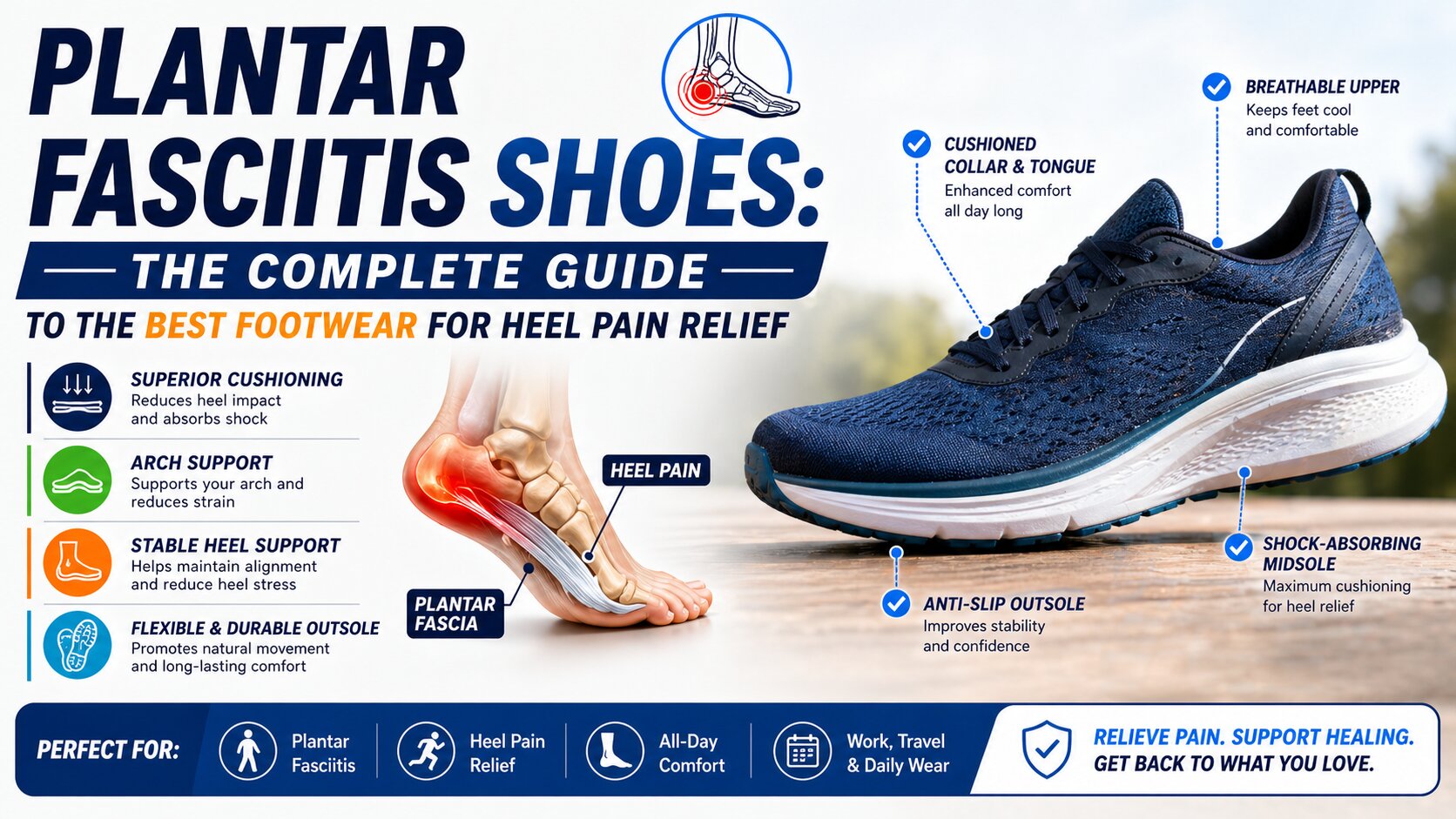
The plantar fascia is a thick band of tissue — almost like a bowstring — that runs along the bottom of your foot, connecting your heel bone (calcaneus) to your toes. Its job is to absorb shock and support the arch of your foot with every step you take.
When that tissue gets overloaded — too much stress, too little support, too many hours standing on hard surfaces — tiny tears develop. The tissue becomes inflamed. That inflammation is what causes the brutal stabbing pain you feel in your heel, especially those first steps in the morning or after sitting for a while.
According to the American Academy of Orthopaedic Surgeons, plantar fasciitis affects roughly 2 million people in the US alone every year, making it the most common cause of heel pain treated by foot specialists.
Who Actually Gets Plantar Fasciitis?
Here’s the thing — it’s not just runners. That’s the biggest myth I hear. In all the years I’ve worked with footwear customers, the people who come in suffering most are:
- Nurses and healthcare workers standing 10–12 hour shifts
- Teachers on their feet all day on hard floors
- Warehouse workers and retail staff
- Runners — especially those who increased mileage too fast
- People who’ve recently gained weight (more load on the fascia)
- Anyone switching to flat shoes after wearing heeled footwear for years
- Middle-aged adults (peak age is 40–60, but it hits younger people too)
Spotted a Reddit thread once in r/Fitness that said “plantar fasciitis is just your feet telling you to sit down and buy better shoes” — and honestly, that’s not far off. 😄
Causes of Plantar Fasciitis: Why Your Footwear Is Probably the Villain
Flat Feet and High Arches
Both extremes are problematic. People with flat feet (overpronation) put uneven stress on the fascia because the arch collapses inward with every step. People with very high arches don’t have enough natural shock absorption, so the fascia takes the full brunt of impact.
Neither condition is a life sentence — but both require shoes that compensate for the structural weakness.
Overuse and Standing Jobs
If you’re running 40+ miles a week and suddenly jump to 60, your plantar fascia doesn’t get time to recover between sessions. Same goes for anyone who starts a job that involves standing on concrete all day without the right footwear. The cumulative micro-stress adds up fast.
One of my longtime customers — a sous chef who stands on kitchen tile for 14 hours — came in barely able to walk. He’d been wearing clogs with zero arch support for two years. Within three months of switching to proper plantar fascia footwear, the pain was almost completely gone.
Poor Footwear Is the #1 Preventable Cause
This one stings because it’s the most avoidable. Shoes with:
- Flat, thin soles (hello, minimalist trend)
- No arch support whatsoever
- Worn-out cushioning that looks fine but has lost its shock absorption
- Wrong heel drop for your gait pattern
…are basically plantar fasciitis generators. Seen it hundreds of times.
On a Facebook footwear group I follow, someone posted: “My podiatrist told me my $12 Old Navy flip flops caused six months of heel pain.” The comments were FULL of people saying “same.” Don’t be those people.
Symptoms: How to Know It’s Plantar Fasciitis (Not Just Sore Feet)
Classic Signs
- Sharp stabbing heel pain — worst in the morning, first 10–20 steps
- Pain after long periods of rest (sitting at a desk, car rides)
- Aching along the bottom of the foot toward the arch
- Stiffness that gradually loosens as you walk
- Heel tenderness when you press the inner part of your heel
When It Gets Serious
If left untreated, plantar fasciitis can develop into a heel spur — a bony calcium deposit that forms at the attachment point of the fascia. That can require orthotics, steroid injections, or in rare cases, surgery. Don’t let it get there. Catching it early with proper plantar fasciitis footwear and stretching makes all the difference.
Diagnosis: What a Doctor Will Actually Do
If you’re seeing a podiatrist or orthopedic specialist, here’s what to expect:
- Physical exam — pressing specific points on the heel and arch
- Gait analysis — watching how you walk and identifying overpronation
- X-ray or ultrasound — to rule out stress fractures and visualize heel spurs
- MRI (rare) — for complex or unresolved cases
Most people don’t need imaging to diagnose plantar fasciitis. The clinical presentation is usually clear enough. But if your heel pain doesn’t respond to conservative treatment (rest, stretching, proper shoes) within 6–8 weeks, see a specialist. Don’t just keep buying shoes and hoping.
Treatment Options: What Actually Works
The good news? Most plantar fasciitis resolves with conservative treatment. Here’s the evidence-backed approach:
1. Rest and Activity Modification
Cut back on high-impact activity. That doesn’t mean zero movement — low-impact options like swimming and cycling actually help maintain conditioning without stressing the fascia.
2. Ice Therapy
Rolling a frozen water bottle under your foot for 15–20 minutes after activity reduces inflammation noticeably. Old trick, still works.
3. Stretching and Physical Therapy
This is arguably the most important part of recovery:
- Calf stretches (tight calves directly increase plantar fascia tension)
- Plantar fascia stretch (pull your toes back toward your shin before getting out of bed)
- Towel curls and marble pickups for intrinsic foot strength
The American Physical Therapy Association has documented that stretching protocols reduce plantar fasciitis symptoms in up to 90% of patients within 10 months.
4. Orthotics and Plantar Fascia Insoles
Custom orthotics prescribed by a podiatrist are the gold standard, but quality over-the-counter plantar fascia insoles do serious work for most people. Look for:
- Semi-rigid arch support (not just soft cushioning)
- Deep heel cup (cradles and stabilizes the heel)
- Metatarsal pad (offloads pressure from the ball of foot)
Brands like Superfeet, Powerstep, and Spenco are consistently well-reviewed. We’ll cover shoe insoles for arch support and plantar fasciitis in more detail below.
5. Night Splints
Wearing a splint that holds the foot in dorsiflexion overnight keeps the fascia gently stretched while you sleep — preventing that brutal morning contraction that causes those first-step stabs.
6. When to See a Doctor
- Pain lasting more than 6–8 weeks without improvement
- Pain so severe you’re limping
- Swelling, bruising, or numbness
- Bilateral heel pain (both feet simultaneously)
Best Shoes for Plantar Fasciitis: What to Look For (Core Section)
This is the real meat of it. Let’s talk about what separates a great plantar fasciitis shoe from just a shoe that looks supportive.
The 5 Non-Negotiable Features
1. Arch Support That Actually Does Something
Generic foam arch support that squishes flat after a week is useless. You need a firm, structured arch support that holds its shape and matches your arch type. Neutral arches need moderate support; flat feet need motion control; high arches need cushioning plus support.
I always tell people: if you can press your thumb through the arch of an insole with zero resistance, throw it out.
2. Deep Heel Cup
A deep heel cup doesn’t just feel good — it realigns the fat pad under your heel, which naturally cushions impact. Shoes without this feature let the fat pad splay outward with each step, putting direct impact on the heel bone and fascia.
3. Heel-to-Toe Drop (8–12mm Is the Sweet Spot)
Heel drop is the difference in height between the heel and forefoot. Here’s why it matters for plantar fasciitis:
- Zero drop / minimal drop (0–4mm): Great in theory, brutal if you have plantar fasciitis. Puts maximum load on the fascia.
- Moderate drop (8–12mm): Reduces tension on the calf and plantar fascia. Most doctor-recommended shoes for plantar fasciitis sit here.
- High drop (12mm+): Can help short-term but may weaken supporting muscles over time.
4. Midsole Cushioning That Lasts
EVA (ethylene-vinyl acetate) foam is the industry standard. The best plantar fasciitis footwear uses compression-molded EVA or proprietary versions like:
- HOKA’s Meta-Rocker geometry with thick EVA midsoles
- New Balance’s Fresh Foam compound
- Brooks’ DNA Loft cushioning
- ASICS’ Gel technology
What to avoid: cheap PU (polyurethane) foam that compresses permanently within weeks.
5. Rocker Sole Geometry
A rocker sole — where the sole curves upward at the toe — significantly reduces forefoot pressure and encourages a smooth heel-to-toe transition without straining the fascia. HOKA pioneered this in running, and it’s now found in their walking and casual shoes too.
Best Shoes for Plantar Fasciitis by Category
🏃 Best Running Shoes for Plantar Fasciitis
Running puts 3–4x your body weight through each foot strike. For runners with plantar fasciitis, you need maximum shock absorption plus enough stability to control overpronation.
What to look for:
- High-stack midsole (30mm+ at heel)
- 8–12mm heel drop
- Motion control or stability category
- Wide toe box to allow natural splay
Top performers in this space include HOKA Clifton, Brooks Adrenaline GTS, ASICS Gel-Kayano, and New Balance 860. All have consistently appeared in podiatrist recommendation lists and online community top picks.
Pro insight: I’ve had multiple customers who tried the HOKA Clifton after months of suffering and said within two weeks the morning pain had dropped dramatically. The rocker sole geometry is genuinely different.
👉 Read our full guide: Best Running Shoes for Plantar Fasciitis 2026
🚶 Best Walking Shoes for Plantar Fasciitis
Walking shoes handle a different load pattern than running shoes — less peak impact, but more cumulative hours of wear. The best walking sneakers for plantar fasciitis prioritize all-day cushioning over maximum responsiveness.
Key features:
- Firm, structured midsole (not just soft foam)
- Breathable upper (mesh or engineered knit)
- Removable footbed (so you can add your own plantar fascia insoles)
- Slip-resistant outsole for varied surfaces
New Balance 990v6 and HOKA Transport are consistently cited as ideal walking shoes for plantar fasciitis. On an Instagram thread from a travel blogger I follow, she mentioned wearing the NB 990 for 18,000 steps a day through Europe and having zero heel issues — contrast that to her previous trip in flats where she could barely walk by day three.
👉 Read our full guide: Best Walking Shoes for Plantar Fasciitis 2026
👡 Best Sandals for Plantar Fasciitis
“But can I wear sandals with plantar fasciitis?”
Yes — but not just any sandals. Most flat sandals are basically the worst thing you can wear. Plantar fascia sandals need:
- Contoured footbed with built-in arch support
- Heel cup
- Firm (not floppy) midsole
- Adjustable straps for secure fit
Birkenstock (the Arizona with the cork footbed) is almost universally praised in the plantar fasciitis community — there’s even a Reddit post in r/PlantarFasciitis with 400+ upvotes titled “Birkenstocks literally saved my summer.” HOKA Ora Recovery Slide and Vionic sandals are also strong options.
Saw a meme once that said: “Plantar fasciitis is God’s way of telling you to buy Birkenstocks.” The comments were 90% people agreeing unironically. 😂
👉 Read our full guide: Best Sandals for Plantar Fasciitis 2026
💼 Best Work Shoes for Plantar Fasciitis
For nurses, teachers, retail workers, chefs — people who need plantar fasciitis footwear that can handle 8–12 hour shifts while looking professional (or at least not ridiculous in a workplace).
Requirements for work shoes:
- Slip-resistant outsole (kitchen/hospital floors)
- Closed-toe protection
- Supportive midsole that doesn’t collapse after one shift
- Easy to clean
- Options for men’s and women’s fits
Dansko Professional clogs have become almost iconic in the nursing world for a reason. New Balance 626 is a workhorse for retail and warehouse environments. For office settings where dress code matters, Clarks Originals and Ecco both offer plantar fasciitis-friendly options that don’t scream “orthopedic shoe.”
👉 Read our full guide: Best Work Shoes for Plantar Fasciitis — Stand All Day
👟 Best Sneakers for Plantar Fasciitis
This is what most people are actually searching for. The best sneakers for plantar fasciitis blend the look of everyday footwear with the structural support your fascia demands.
Men’s top picks: New Balance 990, HOKA Clifton, Brooks Ghost, ASICS GT-2000 Women’s top picks: New Balance Fresh Foam 880, HOKA Bondi, Brooks Adrenaline GTS, Saucony Tempus
For women specifically, the challenge is finding ladies’ shoes for plantar fasciitis that don’t look clinical. The HOKA Bondi has genuinely crossed into fashion territory — I’ve seen it on style accounts and plantar fasciitis recovery accounts with equal frequency. That’s a win.
Good sneakers for plantar fasciitis don’t have to be ugly. That era is over.
👉 Read our full guide: Best Sneakers for Plantar Fasciitis 2026
🩴 Best Slip-On Shoes for Plantar Fasciitis
Slip-ons are tricky because convenience often comes at the cost of fit security — and loose-fitting shoes are terrible for plantar fasciitis. But there are solid options:
- HOKA Ora Recovery Slide — thick EVA midsole, great for post-workout recovery
- Skechers GO WALK series — divisive in the footwear world (some love it, some hate it) but legitimately comfortable for light walking
- Vionic Tide II — sandal/slip-on hybrid with excellent arch support
The key: look for slip-ons with a snug heel counter even without laces. If the heel slides around, it’s a no.
👉 Read our full guide: Best Slip-On Shoes for Plantar Fasciitis
Best Plantar Fascia Insoles and Shoe Inserts: When Your Shoes Need a Boost
Sometimes a great shoe is 80% of the way there and a quality insole gets you to 100%. Plantar shoe inserts work by:
- Adding targeted arch support the original insole lacks
- Providing a deeper heel cup
- Redistributing pressure away from the heel
- Correcting mild overpronation
Best Insoles for Plantar Fasciitis
| Insole | Best For | Arch Type | Price Range |
|---|---|---|---|
| Superfeet GREEN | Running & walking | High to medium arch | $50–$55 |
| Powerstep Pinnacle | All-day work shoes | Medium arch | $35–$45 |
| Spenco Total Support | Casual shoes | All arch types | $30–$40 |
| Sof Sole ATHLETE | Athletic footwear | Neutral arch | $20–$28 |
| Dr. Scholl’s Plantar Fasciitis | Budget-friendly option | Medium arch | $15–$20 |
Retailer tip: The best insoles for plantar fasciitis aren’t always the most expensive. Powerstep consistently outperforms more expensive options in customer feedback we’ve seen across forums and review platforms. It’s our most recommended off-the-shelf option.
Shoe insoles with arch support for plantar fasciitis should be replaced every 6–12 months depending on use. Don’t get attached — a worn-out insole provides zero benefit.
HOKA Shoes for Plantar Fasciitis: Worth the Hype?
HOKA has become almost synonymous with plantar fasciitis relief, and for good reason. Here’s why HOKA One One shoes stand out for plantar fasciitis:
- High-stack midsole: More foam between your foot and the ground means dramatically reduced heel impact
- Meta-Rocker technology: The curved sole creates a rolling motion that naturally reduces forefoot and heel pressure
- Wide base: More stability than traditional running shoes
- Surprisingly light weight: Despite the thick midsole
The HOKA Bondi (for cushioning priority), HOKA Clifton (balanced cushioning + responsiveness), and HOKA Arahi (for overpronators) are the three models that consistently appear in podiatrist recommendations and positive patient reviews.
Are HOKA one one shoes good for plantar fasciitis? Based on what we see in the footwear world and what customers report back — yes, genuinely. They’re not magic, but for many people they’re the closest thing to it.
New Balance Shoes for Plantar Fasciitis
New Balance is the other brand that comes up again and again when people ask about doctor-recommended shoes for plantar fasciitis. Their 990 series (Made in USA, wide width options available) has a loyal following among people who need serious support for long hours.
Why New Balance works:
- Available in a genuinely wide range of widths (2A to 4E) — critical for proper fit
- Fresh Foam midsole provides cushioning without going mushy
- Many models accept aftermarket insoles without sacrificing fit
The New Balance 928 was specifically marketed to diabetic and orthopedic patients — it’s a legitimate medical-grade option if standard walking shoes aren’t cutting it.
For the best new balance shoes for plantar fasciitis, the 990v6, 860v14, and 1080v13 are the three I’d point people toward depending on their use case (lifestyle, running, and max cushion respectively).
Shoe Buying Guide for Plantar Fasciitis: Step-by-Step Framework
Step 1: Know Your Arch Type
Wet test: wet your foot and step on brown paper.
- Full footprint = flat foot (needs motion control / stability)
- Curved print with thin middle = high arch (needs cushioning + support)
- Moderate curve = neutral arch (most stability and neutral shoes work)
Step 2: Measure Both Feet
Feet change size. One foot is often slightly larger than the other. Always fit to the larger foot. Measure in the afternoon — feet swell during the day. Many people discover they’ve been wearing the wrong size for years.
Step 3: Check the Heel Counter
Pinch the back of the shoe. It should be firm and resistant to compression. A soft, collapsible heel counter provides no stability.
Step 4: Twist Test the Midsole
Hold the shoe at both ends and try to twist it. A good plantar fasciitis shoe should have minimal torsional flex — it shouldn’t rotate like a wet towel. If it twists easily, the midsole can’t support your arch.
Step 5: Press the Arch
With the shoe in hand, press the arch from the insole side. It should push back — not just squash flat. If the insole caves under mild thumb pressure, it’s already useless.
Step 6: Walk Before You Commit
If buying in store, walk on hard floor, not just carpet. If buying online, use a retailer with free returns — and actually walk in them at home on hard flooring before the return window closes.
Step 7: Replace on Schedule
Running shoes: every 300–500 miles. Walking shoes: every 8–12 months depending on daily use. Worn-out cushioning is invisible to the eye but very real in its damage.
Materials Deep Dive: What’s Actually Inside Your Shoes
EVA Foam (Ethylene-Vinyl Acetate)
The gold standard for midsoles. Lightweight, shock-absorbing, and relatively durable. High-quality compression-molded EVA lasts significantly longer than injection-molded EVA. Most premium plantar fasciitis footwear uses EVA variants.
TPU (Thermoplastic Polyurethane)
Often used for stability plates and heel counters. Adds firmness and structure without adding weight. Common in motion-control and stability shoes.
Polyurethane (PU) Foam
Heavier than EVA but more durable. Common in work boots and dress shoes that need longevity. Less cushioned than EVA — usually supplemented with gel or foam insoles.
Rubber Outsoles
Durable, grippy, and necessary for real-world use. Carbon rubber in high-wear zones extends outsole life dramatically. Blown rubber (lighter, softer) is better for indoor/light use.
Mesh and Engineered Knit Uppers
Breathable, lightweight, and comfortable for extended wear. Modern mesh is surprisingly durable. The weak point is usually structure — mesh alone doesn’t provide lateral support, which is why internal overlays and heel counters matter.
Comparison Tables
EVA vs PU Midsole for Plantar Fasciitis
| Feature | EVA Foam | Polyurethane (PU) |
|---|---|---|
| Cushioning | Excellent | Moderate |
| Weight | Light | Heavier |
| Durability | 6–18 months | 18–36 months |
| Cost | Moderate | Moderate–High |
| Best for PF | ✅ Yes | Acceptable |
| Arch support | Moderate | Better with additions |
Heel Drop Comparison
| Heel Drop | Effect on Plantar Fasciitis | Best For |
|---|---|---|
| 0–4mm (Minimal) | ❌ Increases fascia tension | Barefoot/minimalist training only |
| 4–8mm | ⚠️ Neutral — depends on arch | Experienced runners, neutral feet |
| 8–12mm | ✅ Reduces fascia stress | Most PF sufferers |
| 12mm+ | ✅ Short-term relief | Recovery, dress shoes |
Shoe Category Comparison for Plantar Fasciitis
| Category | Cushioning | Arch Support | Durability | Work-Appropriate |
|---|---|---|---|---|
| Running shoes | ⭐⭐⭐⭐⭐ | ⭐⭐⭐⭐ | ⭐⭐⭐ | ❌ |
| Walking shoes | ⭐⭐⭐⭐ | ⭐⭐⭐⭐ | ⭐⭐⭐⭐ | Sometimes |
| Work shoes | ⭐⭐⭐ | ⭐⭐⭐⭐ | ⭐⭐⭐⭐⭐ | ✅ |
| Sandals (supportive) | ⭐⭐⭐ | ⭐⭐⭐ | ⭐⭐⭐ | ❌ |
| Slip-ons | ⭐⭐⭐ | ⭐⭐⭐ | ⭐⭐⭐ | Sometimes |
| Dress shoes | ⭐⭐ | ⭐⭐ | ⭐⭐⭐⭐ | ✅ |
Pro Tips from the Shop Floor (Things Brands Don’t Advertise)
1. The “Crinkle Test” for Cheap Insoles Pull out the insole and try to crinkle it. If it sounds like paper and folds like cardboard, it’s providing zero functional support. Real EVA insoles have resistance and spring back.
2. Wide Width Is Often the Fix More plantar fasciitis cases I’ve seen stem from shoes that are too narrow than too flat. A narrow toe box compresses the foot, alters gait, and creates compensatory stress on the fascia. Before you assume you need a $200 specialty shoe — try a wide width version of what you already own.
3. The “Drop Your Shoe” Heel Counter Test Drop your shoe heel-first onto a hard floor from about 8 inches. If the heel counter collapses or deforms, it’s too soft. This is especially common in budget fashion sneakers that look structured but aren’t.
4. Soles Wear Faster Than You Think The cushioning in athletic shoes degrades significantly before any visible wear appears on the outsole. A shoe can look brand new and be functionally dead inside. If you’ve been wearing the same pair for over a year of daily use — the cushioning is gone, guaranteed.
5. Morning Pain Is an Insole Problem More Than a Shoe Problem If your shoe feels fine during the day but you still get brutal morning pain, the issue is likely that your insole isn’t providing enough heel cup depth. Swap to a deeper-cupped aftermarket insole before buying a whole new shoe.
Common Mistakes to Avoid When Buying Plantar Fasciitis Shoes
❌ Choosing Style Over Structure
The most common mistake. Flat-soled fashion sneakers look great and absolutely destroy plantar fasciitis recovery. A shoe can look supportive (thick sole, chunky aesthetic) and be biomechanically useless. Check the spec sheet, not just the photo.
❌ Ignoring Heel Drop Numbers
Most people have never heard of heel drop before developing plantar fasciitis. Once you understand it, you won’t buy another shoe without checking. It matters more than most people realize for fascia tension.
❌ Assuming Your Size Hasn’t Changed
Feet change with age, pregnancy, weight shifts, and activity level changes. Get measured properly — both feet, standing up, in the afternoon. Tens of thousands of people are walking around in the wrong size right now.
❌ Buying Online Without a Return Policy
Can’t blame people for this one — the deals are real. But if you’re treating plantar fasciitis, you need to be able to return a shoe after actually walking on hard floors. Always check return policies. Zappos and many major retailers offer free returns — use that.
❌ Expecting Instant Results
The right shoes start helping immediately, but they’re not painkillers. Combined with stretching, rest, and potentially insoles, most people see meaningful improvement in 4–8 weeks. If you switch shoes and feel no improvement after 10 days, it’s not necessarily the wrong shoe — the fascia needs time.
❌ Skipping the Insole Upgrade
Many otherwise great plantar fasciitis shoes come with mediocre stock insoles. Pulling the stock insole and dropping in a Superfeet or Powerstep can transform the feel of the shoe. Don’t assume the factory insole is the final word.
Exercises and Prevention: The Other Half of the Equation
Good shoes get you 60% there. This section covers the other 40%.
Morning Routine (Do This Before Your First Step)
The 90-Second Fascia Stretch:
- Sitting on the edge of the bed, cross one foot over the opposite knee
- Pull your toes back toward your shin until you feel a stretch along the arch
- Hold for 30 seconds. Repeat 3x per foot.
- Then stand up.
This pre-stretches the fascia before it takes full load and dramatically reduces that first-step pain.
Calf Stretches (Non-Negotiable)
Tight calves directly pull on the Achilles tendon, which pulls on the plantar fascia. If your calves are tight, your fascia is under constant tension even at rest.
Wall calf stretch:
- Hands on wall, back leg straight, front knee bent
- Press back heel firmly to floor
- Hold 30 seconds per side, twice daily
Intrinsic Foot Strengthening
- Towel scrunches: Put a small towel on the floor and use your toes to bunch it up. Builds the small muscles that support the arch.
- Single-leg balance: Stand on one foot for 30–60 seconds. Builds proprioception and arch strength.
- Heel raises: Rise onto tiptoe, hold 2 seconds, lower slowly. Strengthens the posterior chain that supports the fascia.
What to Avoid During Recovery
- Running on hard pavement (switch to trails or treadmill)
- Going barefoot on hard floors (use supportive house slippers for plantar fasciitis — more on that below)
- Stair climbing in unsupportive shoes
- Long periods of standing without arch support
Best House Slippers for Plantar Fasciitis
This one matters more than people think. Most people step out of bed and shuffle around in flat slippers or completely barefoot — on tile or hardwood. Those are the conditions that trigger morning pain.
The best slippers for plantar fasciitis have arch support built in, not just soft fabric. Vionic Gemma, HOKA Ora Recovery Slide, and Oofos OOahh all provide what flat slippers can’t. This isn’t a luxury — for active recovery, it’s essential.
People Are Asking: Straight Answers to Common Questions
Is walking good or bad for plantar fasciitis? Walking in supportive shoes is actually beneficial for mild-to-moderate plantar fasciitis. It maintains circulation and prevents stiffness. The key is the shoe — walking in flat or worn-out footwear makes it worse.
How long does plantar fasciitis take to heal? With proper footwear, stretching, and rest, most cases improve significantly within 6–8 weeks. Severe or chronic cases can take 6–12 months. Consistent treatment is the most important factor.
Can plantar fasciitis go away permanently? Yes — the majority of cases resolve completely with conservative treatment. But returning to unsupportive footwear after recovery is a common cause of relapse.
Do I need custom orthotics or will off-the-shelf insoles work? For most people, high-quality OTC insoles (Superfeet, Powerstep) are sufficient. Custom orthotics are recommended when OTC insoles haven’t helped after 8–12 weeks of consistent use, or if there’s a significant structural foot issue.
Are zero-drop shoes good or bad for plantar fasciitis? Generally bad for active cases. Zero-drop shoes place the calf and fascia under maximum tension. After full recovery, some people successfully transition to minimal drop shoes — but it requires a very gradual, months-long process.
What’s the best shoe brand for plantar fasciitis? HOKA and New Balance are consistently the most recommended by podiatrists and patients alike. Brooks, ASICS, and Saucony are also strong options. Brand matters less than specific shoe features — heel drop, midsole construction, and arch support are what count.
Can I wear heels if I have plantar fasciitis? High heels (3+ inches) are problematic. A small heel lift (1–2 inches / kitten heel) can actually provide temporary relief for some patients because it reduces tension on the fascia. Platform shoes with cushioned soles are sometimes acceptable. Stilettos are a hard no during active flare-ups.
From Our Experience: What We’ve Seen Work (And What Hasn’t)
I’ve seen the full range of plantar fasciitis stories. Customers who swore by one brand, colleagues who needed custom orthotics, runners who healed within weeks, and retail workers who struggled for years because they couldn’t bring themselves to wear athletic shoes with their uniform.
The pattern that we see most clearly: the people who recover fastest are the ones who take footwear seriously in every context — not just during exercise. It’s the commute shoes, the house slippers, the weekend flip flops — they all matter. You can’t wear perfect running shoes for one hour and then undo it with flat sandals for twelve.
I’ve also seen that the cheap fix usually isn’t. A $15 gel insert from a pharmacy feels better for exactly three days, then it’s flat. A $40 Powerstep lasts six months. That math is obvious in hindsight.
The customers who come back to thank me — genuinely, not as a sales thing — are usually the ones who paired the right shoe with consistent stretching and gave it real time. That combination works. Almost every time.
🛒 Shop Our Top-Recommended Picks on Amazon
Best Shoes & Insoles for Plantar Fasciitis
Curated picks — real ratings, real relief
As an Amazon Associate, Urban Style Footwear earns from qualifying purchases. This doesn’t affect our recommendations — we only link to products we’d genuinely stand behind.
Frequently Asked Questions About Plantar Fasciitis Shoes
What are the best shoes for plantar fasciitis overall? HOKA Clifton and New Balance 990 are the most universally recommended options for plantar fasciitis across podiatrists and patient communities. Look for an 8–12mm heel drop, firm arch support, and a deep heel cup.
Are running shoes good for plantar fasciitis even if I don’t run? Yes — running shoes often have the best combination of cushioning and support for plantar fasciitis, regardless of activity. Many people wear them as everyday shoes during treatment.
What makes a sandal suitable for plantar fasciitis? A good plantar fasciitis sandal needs a contoured, firm footbed with a built-in arch support — not just soft foam. Birkenstock, Vionic, and HOKA slides are commonly cited as the best sandals for plantar fasciitis.
Do I need to replace my insoles separately even in expensive shoes? Sometimes yes. Many shoes come with basic insoles that don’t provide enough arch support for active plantar fasciitis. Upgrading to a Superfeet or Powerstep insole can significantly improve a shoe that’s otherwise well-constructed.
Are Skechers good for plantar fasciitis? Some models can work for mild cases — the GO WALK series has decent cushioning. However, most Skechers lack the structural support needed for moderate-to-severe plantar fasciitis. They’re better suited for light daily wear during recovery.
How do I know if my shoes are making plantar fasciitis worse? Key signs: pain that consistently increases during or after wearing a specific pair; shoes that have visible heel compression; shoes with minimal heel-to-toe drop; footwear you’ve been using for over a year without replacement.
Can dress shoes work for plantar fasciitis? Most traditional dress shoes are problematic — thin soles, narrow toe boxes, minimal support. Look for dress shoes from brands like Ecco, Clarks, or Rockport that specifically engineer comfort. Adding a plantar fascia insole to a quality dress shoe is often the best compromise.
What heel drop should I look for? 8–12mm is the sweet spot for most plantar fasciitis sufferers. Avoid zero-drop shoes during active flare-ups.
Are wide-fit shoes important for plantar fasciitis? Often yes. A shoe that’s too narrow forces the foot into an unnatural position that creates downstream stress on the fascia. If you’ve never tried wide-width shoes and you have persistent plantar fasciitis, it’s worth experimenting.
How often should I replace my shoes if I have plantar fasciitis? Every 300–500 miles for running shoes, or every 8–12 months for daily walkers. If you’re actively treating plantar fasciitis, replace on the earlier end of those ranges. Worn midsoles provide false security — they look fine and do nothing.
Internal Links: Deep-Dive Into Your Specific Category
If you’re ready to move from understanding to buying, these guides break down the exact top picks, what to avoid, and honest comparisons by category:
- ✅ Best Shoes for Plantar Fasciitis 2026 — Top Picks for Pain Relief
- 🏃 Best Running Shoes for Plantar Fasciitis 2026
- 🚶 Best Walking Shoes for Plantar Fasciitis 2026
- 🩴 Best Sandals for Plantar Fasciitis 2026 — With Arch Support
- 💼 Best Work Shoes for Plantar Fasciitis — Stand All Day
- 👟 Best Sneakers for Plantar Fasciitis 2026
- 🥿 Best Slip-On Shoes for Plantar Fasciitis
Final Word: The Shoe Is the Treatment
Plantar fasciitis doesn’t have to be a months-long nightmare. For most people, the combination of the right footwear, consistent stretching, and a bit of patience is enough to resolve it completely. The shoe is not a secondary concern here — it is the treatment, functioning every minute of every day.
The brands are less important than the features. HOKA for maximum cushioning and rocker geometry. New Balance for width variety and structural integrity. Brooks and ASICS for running. Birkenstock for sandals. Vionic for women’s dress-casual options. These are starting points, not gospel — your foot, your arch type, your daily activity, and your budget all shape the right choice.
What we’ve seen consistently: the people who approach this methodically — understanding what their feet need, checking specs, replacing on schedule, and pairing shoes with insoles and stretching — get better. The people who buy based on how it looks or what was on sale often come back six months later, still suffering.
Take your foot health seriously. Your shoes are either working for you or against you, all day, every day. Make them work for you.
Information in this guide is for educational purposes. For persistent or severe heel pain, consult a licensed podiatrist or orthopedic specialist. Individual results vary based on foot structure, activity level, and treatment consistency.