
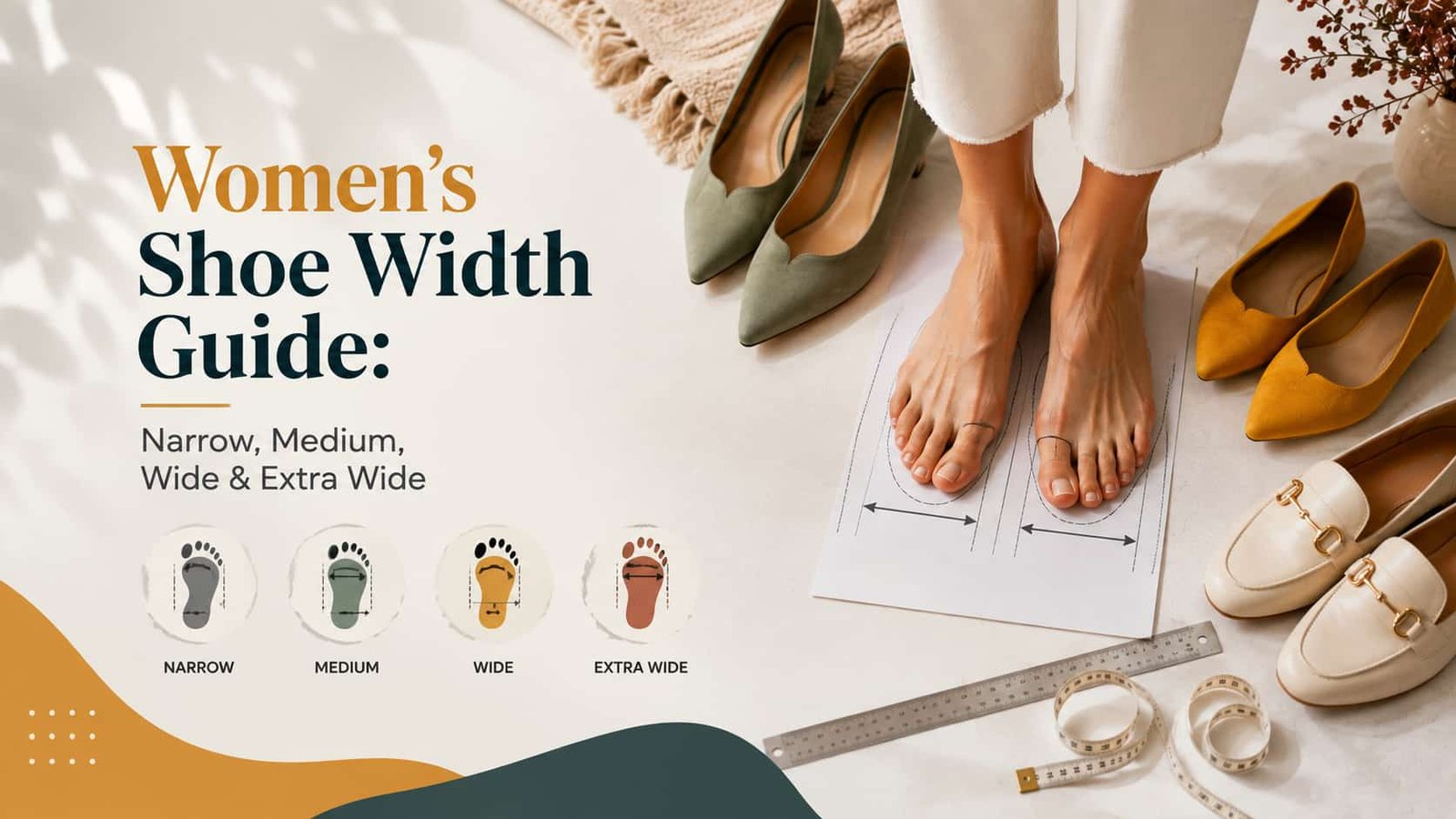
Women’s Shoe Width Guide: Narrow, Medium, Wide & Extra Wide
Quick Answer
- Women’s shoe width describes how much space a shoe provides across the foot, especially around the forefoot.
- Common width labels include narrow, standard or medium, wide and extra wide.
- In some sizing systems, women’s standard width is represented by the letter B, while 2A may indicate narrow and D may indicate wide.
- Width letters are not universal across every brand, so always check the manufacturer’s own width chart.
- If your shoes feel tight at the sides even when the length is correct, you may need a wider width rather than a longer shoe.
Choosing the right shoe is about more than finding the correct length. If a shoe feels tight across the sides of your feet, your toes feel crowded, or the upper stretches over your forefoot, the problem may be width, not length.
A women’s shoe width guide helps you understand labels such as narrow, standard, wide, 2A, B, D and 2E. These labels can vary between brands, but they are designed to describe how much room a shoe provides across the foot. ASICS, for example, lists B as its standard women’s width, 2A as narrow, D as wide and 2E as extra wide.
Before choosing a width, it is worth measuring your feet. Our guide on how to measure foot size at home explains the basic process for measuring both feet accurately.
What Does Women’s Shoe Width Mean?
Women’s shoe width refers to the amount of space available across the shoe for the width and shape of your foot.
It is different from shoe length.
For example, two shoes can have the same length but provide different amounts of room across the forefoot.
| Width category | What it generally means |
| Narrow | Less room across the foot |
| Standard or Medium | Typical width for that brand’s women’s footwear |
| Wide | More room across the forefoot |
| Extra Wide | Substantially more room than the standard width |
The exact letter used for each category depends on the manufacturer.
That is why a width label should always be read together with the brand’s own size and fit information.
What Shoe Width Should You Check?
Answer a few simple questions to identify the width category worth checking first.
This is a general fit guide, not a universal shoe-width measurement. Always compare your foot measurements with the individual brand’s size chart.
What Are the Common Women’s Shoe Width Letters?
Common women’s shoe width letters include 2A, B, D and 2E, although not every brand uses all of them.
A commonly used system is:
| Width label | Common description |
| 2A | Narrow |
| B | Standard or Medium |
| D | Wide |
| 2E | Extra Wide |
| 4E | Very Wide or Extra Wide in some systems |
This is a useful reference, not a universal rule.
ASICS currently identifies 2A as narrow, B as standard, D as wide and 2E as extra wide for women’s shoes. New Balance also offers women’s footwear in widths including 2A, B, D, 2E and 4E on selected models.
Width Label Reminder
Do not assume that the same width letter means exactly the same fit everywhere. Width labels should be checked against the individual brand’s sizing guide because footwear companies can use different lasts, measurements and fit specifications.
What Is Standard or Medium Women’s Shoe Width?
For many women’s shoe systems, standard or medium width is represented by the letter B.
ASICS, for example, identifies B as the standard women’s width.
Standard does not mean that every woman’s foot will fit comfortably in a B-width shoe.
It simply describes the manufacturer’s reference width for that shoe range.
If your foot feels comfortable from side to side and you do not experience pressure or excessive movement, standard width may be a suitable starting point.
What Does 2A Mean in Women’s Shoes?
In many women’s footwear systems, 2A represents a narrow width.
A 2A shoe generally provides less width than a standard B-width shoe within the same sizing system.
ASICS uses 2A for women’s narrow footwear. New Balance also labels selected women’s shoes as Narrow (2A).
However, the width label alone should not determine your choice.
The shoe’s shape, heel width, toe box and construction can all affect how a narrow shoe feels.
What Does B Mean in Women’s Shoes?
B commonly represents a standard or medium women’s shoe width.
For example, ASICS lists B as the standard women’s width.
If you normally wear standard-width footwear comfortably, B may be the width you encounter most often in women’s shoe ranges that use this letter system.
But remember that standard width is a brand reference, not a measurement that guarantees a perfect fit.
What Does D Mean in Women’s Shoes?
D is commonly used to indicate a wide women’s shoe.
ASICS uses D for women’s wide footwear, while New Balance also lists D as a women’s wide option.
If your foot length is correct but the shoe feels tight across the forefoot, moving to a wide width can be more appropriate than simply choosing a longer shoe.
A longer shoe does not automatically create the right amount of width.
What Does 2E Mean in Women’s Shoes?
2E is commonly used for extra-wide footwear in women’s width systems that offer it.
ASICS lists 2E as extra-wide for women. New Balance also offers selected women’s shoes in 2E.
The availability of 2E varies by brand, shoe model, and market.
If you need a wider shoe, look for the actual width option offered for the specific model you want to buy.
Is Women’s Shoe Width the Same in Every Brand?
No.
Women’s shoe width labels are not completely standardized across all brands and markets.
A B-width shoe from one company may not feel identical to a B-width shoe from another company.
The shoe’s last, toe-box shape, upper material, construction and intended activity can all influence the final fit.
For this reason, use a general women’s shoe width chart to understand the terminology, but use the manufacturer’s own chart when choosing a particular shoe.
If you are also comparing length between different sizing systems, our Shoe Size Conversion Chart & Calculator can help you understand the length conversion separately from width.
How Do You Know if You Need Narrow Women’s Shoes?
You may need a narrow shoe if your feet have relatively little width and standard shoes consistently feel loose around the sides.
Possible signs include:
- Your foot moves noticeably from side to side.
- Your heel slips despite having the correct length.
- You tighten the laces considerably to keep the shoe secure.
- The shoe feels loose around the forefoot.
- Your foot does not fill the shoe’s width comfortably.
One sign alone does not prove that you need a narrow width.
The shape of the shoe matters too.
How Do You Know if You Need Wide Women’s Shoes?
Narrow
Less room across the foot than the standard width in systems that use this label.
Standard
A common women’s standard width reference in several footwear sizing systems.
Wide
More room across the foot than the standard width in common systems.
Extra Wide
More room than wide in systems that offer this width category.
You may need a wider shoe if your foot feels compressed across the forefoot even though the length seems correct.
Common signs include:
- Pressure along the sides of the forefoot.
- Toes feeling crowded.
- The upper stretching noticeably over the widest part of the foot.
- Bulging along the sides of the shoe.
- Numbness or discomfort caused by side pressure.
- A standard-width shoe feeling tight while a longer size feels too long.
ASICS specifically notes visible stretching or bulging on the outside of the forefoot as an indicator that additional width may be needed.
A Common Fit Mistake
If a shoe feels too tight across the sides, going up in length may not solve the problem. A wider width or a different shoe shape may provide a better fit while keeping the correct length.
How Do You Measure Women’s Shoe Width at Home?
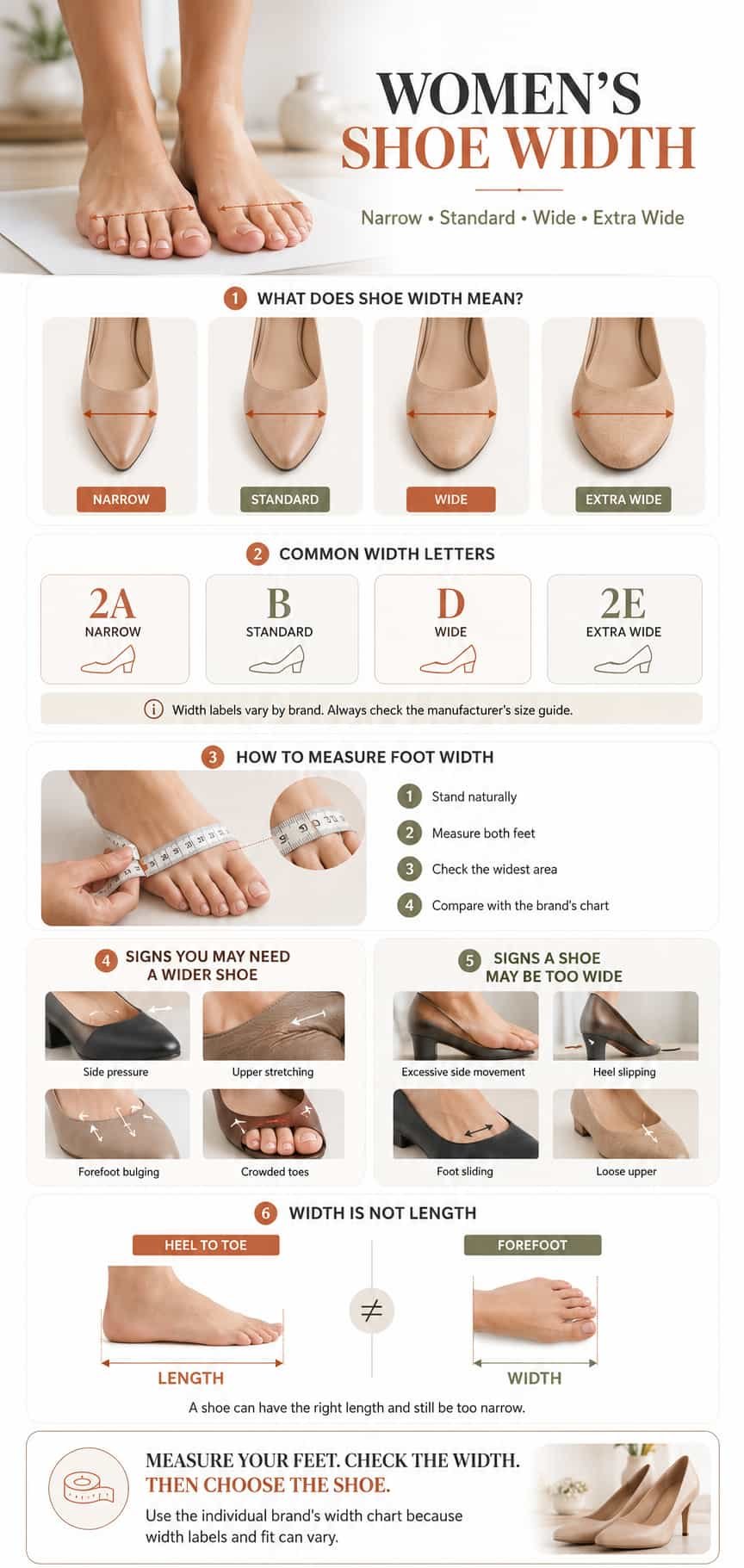
You can measure your foot width at home with paper, a pen and a flexible measuring tape.
The most useful measurement is taken around the widest part of your foot, depending on the measurement method recommended by the shoe brand.
For a simple home check:
- Place your foot on a flat surface.
- Stand naturally.
- Keep your weight distributed normally.
- Identify the widest part of your forefoot.
- Measure the width using the method recommended by the shoe manufacturer’s chart.
- Repeat the process for your other foot.
- Compare the result with the brand’s width guide.
Do not pull a flexible measuring tape tightly enough to compress the foot.
If you want the complete process for measuring your feet, read our How to Measure Foot Size at Home guide.
Should You Measure Both Feet for Shoe Width?
Yes.
Your feet may differ slightly in length, width or shape.
Measure both feet and pay attention to the larger or wider foot when selecting footwear.
For example:
| Measurement | Left Foot | Right Foot |
| Length | 24.1 cm | 24.4 cm |
| Width | 8.8 cm | 9.1 cm |
| Wider foot | No | Yes |
In this example, the right foot should receive more attention when choosing the shoe.
A shoe that fits the smaller foot perfectly may still feel restrictive on the larger one.
Does Shoe Width Change With Shoe Size?
Yes, width dimensions generally change as shoe size changes.
A width designation is not simply one fixed measurement that applies to every length.
ASICS notes that differences between narrow, standard, wide and extra-wide widths are proportional to shoe size and are generally measured in only a few millimeters.
That is why a width chart should always be interpreted alongside the shoe size.
You should not compare a width number from one shoe size directly with another size and assume they are identical.
Women’s Shoe Width Chart: Narrow, Standard, Wide and Extra Wide
The following chart is a practical reference for understanding commonly used women’s width labels.
| Width | Common letter | General meaning |
| Narrow | 2A | Less width than standard |
| Standard | B | Common women’s reference width |
| Wide | D | More width than standard |
| Extra Wide | 2E | More room than wide |
| Very Wide | 4E | Offered by some brands and models |
This chart explains common terminology rather than guaranteeing a universal measurement.
ASICS and New Balance both use width systems that include several of these labels, but availability and naming can differ by model.
What Is the Difference Between Shoe Width and Shoe Length?
Length tells you how much space the shoe provides from heel to toe.
Width describes how much room is available across the foot.
You need both for a comfortable fit.
| Problem | Possible issue |
| Toes hit the front | Length may be too short |
| Sides feel tight | Width may be too narrow |
| Foot slides sideways | Width may be too wide |
| Heel slips | Shoe shape or width may be unsuitable |
| Toes feel compressed | Toe box may be too narrow |
| Shoe feels loose everywhere | Size or width may be too large |
This is why buying a longer shoe is not always the right solution when the real problem is width.
Can You Have Wide Feet but Still Wear a Standard Shoe?
Yes.
Foot width is only one part of overall shoe fit.
Some people with relatively wide feet can comfortably wear standard shoes if the shoe has a roomy forefoot or flexible upper.
Others may need a designated wide width even when their foot measurement does not seem dramatically different.
The goal is not to choose the widest possible shoe.
The goal is to find a shoe that provides enough room without allowing unnecessary movement.
Can You Have Narrow Feet but Wear Standard Shoes?
Yes.
Shoe shape can make a major difference.
A standard-width shoe with a secure heel and appropriate upper may fit a narrow foot better than another standard shoe with a roomy design.
If standard shoes feel loose, look at the heel, forefoot and overall shape before automatically choosing a narrow width.
Adjustable laces or straps can also improve security.
Does Foot Shape Matter More Than the Width Letter?
The width letter is useful, but it does not tell the entire story.
Two shoes with the same width label can feel different because their toe boxes, heels, uppers and lasts can differ.
For example, a shoe designed with a rounded toe box may feel more comfortable than a narrow-looking pointed shoe even when both carry the same labeled width.
Think of the width letter as a starting point.
The actual shape of the shoe is the next part of the fitting process.
How Should Women’s Running Shoes Fit?
Running shoes should feel secure without squeezing the forefoot.
Your toes should not be pressed together by excessive side pressure, and the shoe should hold your heel securely while allowing natural movement.
Running footwear may also have specific fit recommendations from the manufacturer.
For example, ASICS provides separate width options for some running and training shoes and identifies narrow through extra-wide categories.
When choosing running shoes, check the model’s individual width availability rather than assuming every running shoe uses the same fit.
How Should Women’s Walking Shoes Fit?
Walking shoes should feel stable and comfortable without excessive pressure across the foot.
Pay particular attention to:
- Forefoot width
- Heel security
- Toe space
- Arch area
- Upper pressure
- Overall stability
If your current walking shoes feel tight at the sides, compare the same model in a wider width before automatically increasing the length.
New Balance, for example, currently offers selected women’s walking footwear in several width options, including narrow, standard, wide and extra-wide choices.
How Should Women’s Dress Shoes Fit?
Dress shoes can be more complicated because their shape often differs from athletic footwear.
Pointed toes, narrow openings and structured materials can create pressure even when the numerical size appears correct.
When buying dress shoes, check:
- Toe-box shape
- Forefoot width
- Heel security
- Material flexibility
- Overall length
If your toes are being squeezed from the sides, simply moving up one length may create excessive space in front without fixing the width problem.
How Should Women’s Sandals Fit?
Sandals need to hold the foot securely without excessive pressure.
Check that:
- Your toes do not hang over the front.
- The heel does not extend beyond the sole.
- Straps do not dig into the skin.
- The foot does not slide excessively from side to side.
- The widest part of your foot sits comfortably on the footbed.
Adjustable straps can be particularly useful if your feet fall between width categories.
What Are the Signs That Women’s Shoes Are Too Narrow?
A shoe may be too narrow when you notice persistent side pressure or visible distortion.
Watch for:
- Pressure around the forefoot
- Toes being pushed together
- Side bulging
- Red pressure marks
- Numbness or tingling
- Difficulty spreading your toes naturally
- Discomfort that appears quickly after putting the shoes on
ASICS identifies visible stretching, bulging and tightness as signs that a different width may be needed.
If these problems occur repeatedly, review both the width and the shoe’s overall shape.
What Are the Signs That Women’s Shoes Are Too Wide?
Shoes can also be too wide.
Possible signs include:
- Your foot slides from side to side.
- You need to tighten the laces excessively.
- Your heel moves significantly.
- The shoe folds around your foot.
- You feel unstable while walking.
- Your toes do not sit naturally in the toe box.
A wider shoe is not automatically better.
The correct width should provide enough room without allowing excessive movement.
Fit Check
A good width should feel comfortable across the forefoot while keeping your foot secure. If you are constantly tightening the shoe to stop movement, the shoe may be too wide or the shape may not suit your foot.
How Do You Choose Between Medium and Wide Women’s Shoes?
Start with your actual foot measurement and then compare it with the brand’s width guide.
If your foot is near the upper end of the standard range, try the brand’s wide option if available.
If a standard shoe already feels comfortable and secure, there is no reason to choose wide simply because you have heard that wider shoes are more comfortable.
Comfort and fit should guide the decision.
How Do You Choose Between Wide and Extra Wide Women’s Shoes?
Look at the amount of pressure and space across your forefoot.
A wide shoe may be enough if you need some additional room.
An extra-wide shoe may be useful when a wide model still creates noticeable pressure across the sides.
Do not judge width only by appearance.
Use the manufacturer’s width measurement and then assess the actual fit when wearing the shoe.
Are Women’s Shoe Width Letters the Same as Men’s?
Not necessarily.
A major source of confusion is that the same letter can represent different width categories depending on whether the shoe is made for women or men.
ASICS, for example, lists B as standard for women but D as standard for men.
That means you should never interpret a width letter without checking the sizing system it belongs to.
This is especially important when comparing men’s and women’s footwear.
Can Women’s Shoe Width Be Converted Like Shoe Size?
Width should not be treated like a simple US-to-UK or US-to-EU conversion.
Shoe length systems can be converted using charts, but width depends heavily on the manufacturer’s sizing system and shoe construction.
For length conversions, you can use the Women’s Shoe Size Conversion Chart.
For width, always check the individual brand’s width information.
What Should You Check Before Buying Women’s Wide Shoes Online?
Before placing an online order, check five things:
- Your longer foot’s length.
- Your wider foot’s width.
- The brand’s size chart.
- The available width options.
- The retailer’s return or exchange policy.
Do not rely only on reviews saying that a shoe runs “wide” or “narrow.”
Those descriptions are useful clues, but your own measurements and the manufacturer’s fit information provide a stronger starting point.
Women’s Shoe Width Buying Checklist
Before You Buy
- ✓ Measure both feet.
- ✓ Record your longer foot.
- ✓ Measure width when necessary.
- ✓ Check the shoe’s width options.
- ✓ Read the brand’s width chart.
- ✓ Check the toe-box shape.
- ✓ Consider socks if you will wear them.
- ✓ Check the return policy when buying online.
Common Women’s Shoe Width Mistakes
Choosing length when you actually need width
If the sides are tight but the toe length is correct, increasing the length can leave too much space in front.
Assuming B always means exactly the same thing
B is commonly used as standard women’s width, but the actual shoe construction still varies.
Ignoring the wider foot
Always consider both feet when choosing your starting point.
Buying the widest shoe available
More width is not automatically better.
Too much room can cause movement and reduce stability.
Ignoring the toe box
A shoe can have adequate overall width but still feel cramped if the toe box is narrow or pointed.
Using another person’s width recommendation
Foot shape is personal.
A width that works perfectly for someone else may not work for you.
Looking only at reviews
Reviews can provide useful information, but they should not replace your own measurements and the manufacturer’s fit guide.
How to Find Your Women’s Shoe Width
If you are unsure where to start, follow this simple process:
Measure → Compare → Try → Check → Adjust
Measure
Measure both feet while standing naturally.
Compare
Compare your measurements with the shoe brand’s chart.
Try
Try the shoe with the socks you normally wear.
Check
Walk around and pay attention to side pressure, heel movement and toe space.
Adjust
If the length is right but the width is wrong, look for another width rather than automatically changing the length.
Frequently Asked Questions
What is the standard women’s shoe width?
In some common women’s width systems, B represents the standard or medium width. ASICS currently lists B as its standard women’s width. However, width terminology varies by manufacturer, so check the individual shoe brand’s guide before buying.
What does 2A mean in women’s shoes?
2A commonly represents a narrow women’s shoe width. It indicates less width than the standard width within systems that use this designation. ASICS and New Balance both use 2A for selected women’s narrow footwear.
What does B mean in women’s shoes?
B commonly represents standard or medium women’s width. It is one of the most common width letters used in women’s footwear systems. However, the actual fit can vary between brands and shoe models.
What does D mean in women’s shoes?
D commonly represents a wide women’s width in sizing systems used by brands such as ASICS and New Balance. If a standard shoe feels tight across the forefoot while the length feels correct, a D-width option may provide more room.
What does 2E mean in women’s shoes?
2E commonly represents an extra-wide women’s shoe in systems that offer this width. Availability varies between brands and models, so check the width options for the specific shoe you are considering.
How do I know if I need wide shoes?
You may need wide shoes if your foot feels compressed across the forefoot, the sides of the shoe create pressure, or the upper visibly stretches or bulges. Measure your feet and compare the result with the manufacturer’s width chart before choosing a wider size.
Can I just buy a bigger shoe if it feels too narrow?
Not always. Increasing length creates more room from heel to toe, but it does not necessarily provide the right width. If the length already fits, a wider width may be a better solution.
Should I measure both feet for width?
Yes. Your feet may differ in width and shape. Measuring both helps you identify which foot needs more room and gives you a better starting point when choosing footwear.
Is women’s shoe width the same in every brand?
No. Width labels and measurements can vary between manufacturers. A B-width shoe from one brand should not automatically be assumed to have exactly the same fit as a B-width shoe from another brand.
Is D a wide or medium women’s shoe?
In common systems used by brands such as ASICS and New Balance, D is a wide women’s width. This is different from some men’s sizing systems, where D can represent standard width. Always check whether the width chart is for women’s or men’s footwear.
Are wide shoes better for wide feet?
They can be, but not every person with a wider foot needs the same amount of extra space. The best choice depends on your foot measurement, the shoe’s shape and how securely it fits.
How do I measure my shoe width at home?
Measure your foot while standing naturally and follow the measurement method provided by the shoe brand. A flexible measuring tape can be useful, but avoid pulling it tightly around your foot. Measure both feet and compare the results with the brand’s width chart.
Why do my shoes feel tight even though the length is correct?
The shoe may not provide enough width or may have a toe box that does not suit your foot shape. Check the width option before increasing the shoe length.
Why does my foot slide around in wide shoes?
The shoe may provide more width than your foot needs, or its overall shape may not suit your foot. Check heel security and forefoot movement rather than assuming you need a narrower size immediately.
Final Thoughts on Women’s Shoe Width
The right women’s shoe width should give your foot enough room to move naturally without allowing excessive side-to-side movement.
The most useful starting point is your own foot measurement.
Remember the basic width categories:
Narrow → Standard → Wide → Extra Wide
You may also see width letters such as 2A, B, D and 2E, but these labels should always be interpreted using the manufacturer’s own sizing information.
- If you are unsure about your overall shoe size, start with the Women’s Shoe Size Chart and then compare the available width options.
- If you already know that you need more room, our Women’s Wide Shoe Size Chart provides a more focused reference.
- If your feet are narrower, you can also check the Women’s Narrow Shoe Size Chart.
The goal is not simply to find a shoe labeled “wide” or “narrow.” It is to find the combination of length, width and shoe shape that lets your feet feel comfortable and secure.
Measure first, compare the brand’s chart, and then judge the actual fit.