
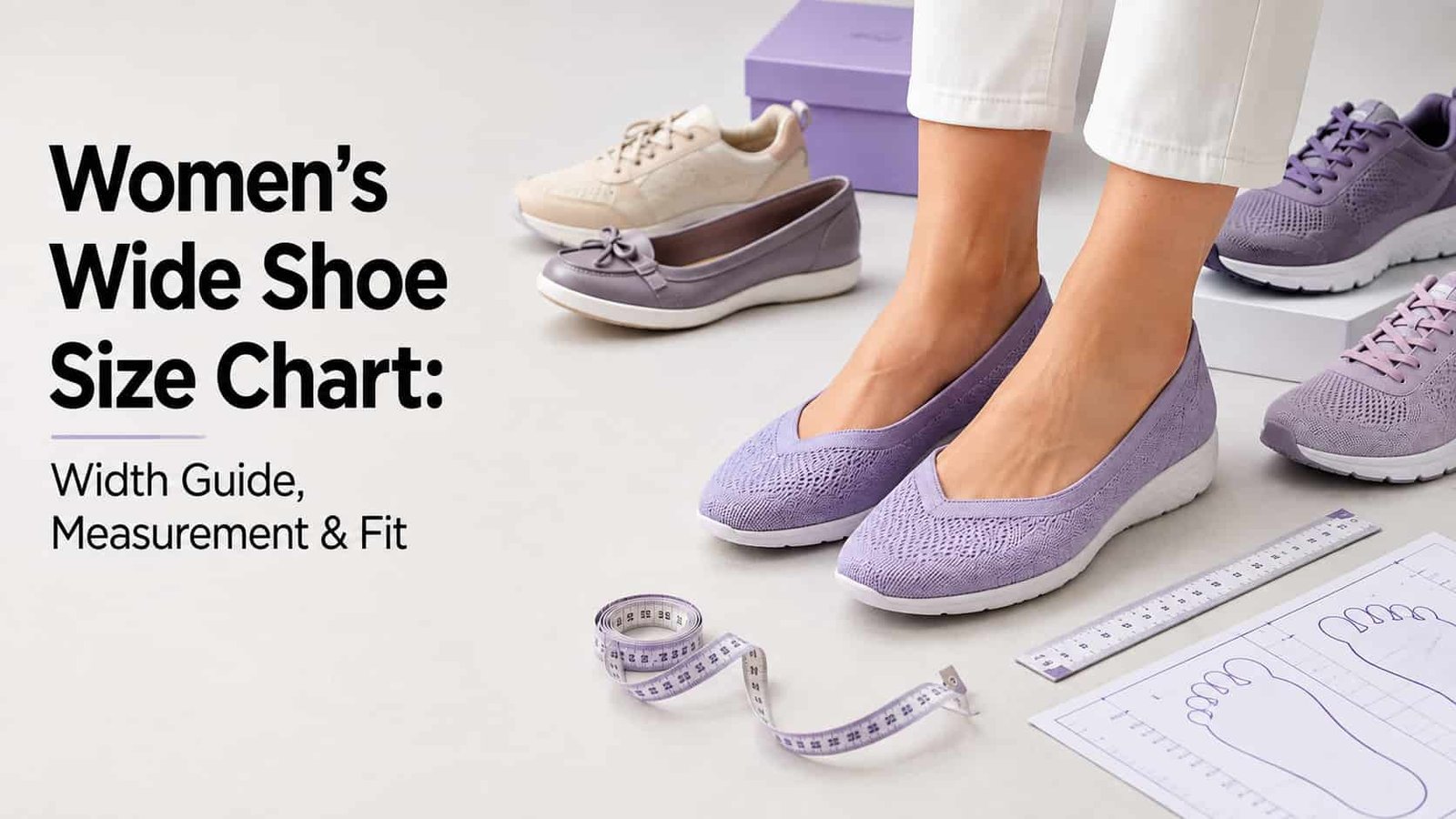
Women’s Wide Shoe Size Chart: Width Guide, Measurement & Fit
Quick Answer
- Wide shoes provide more room across the foot, especially through the forefoot and toe-box area.
- A women’s wide shoe is not simply a longer shoe. Width and length are separate parts of fit.
- Width codes vary between brands, so always check the manufacturer’s chart before buying.
- Measure both feet at the widest part of the forefoot and compare the result with the brand’s width guide.
- If your toes feel squeezed or the sides of your shoes bulge, you may need more width rather than more length.
If your shoes feel tight across the toes or the sides of your feet, the problem may not be your shoe size. You may need a wider fit.
A women’s wide shoe size gives your foot more room across the forefoot and midfoot than a standard-width shoe. The exact width label depends on the brand. For example, ASICS uses B as women’s standard, D as wide and 2E as extra wide, while Clarks uses D as standard and E as wide in its own sizing system.
The safest approach is to measure your foot, identify your normal length size, then check the width options offered by the specific brand.
Women’s Wide Shoe Size Chart
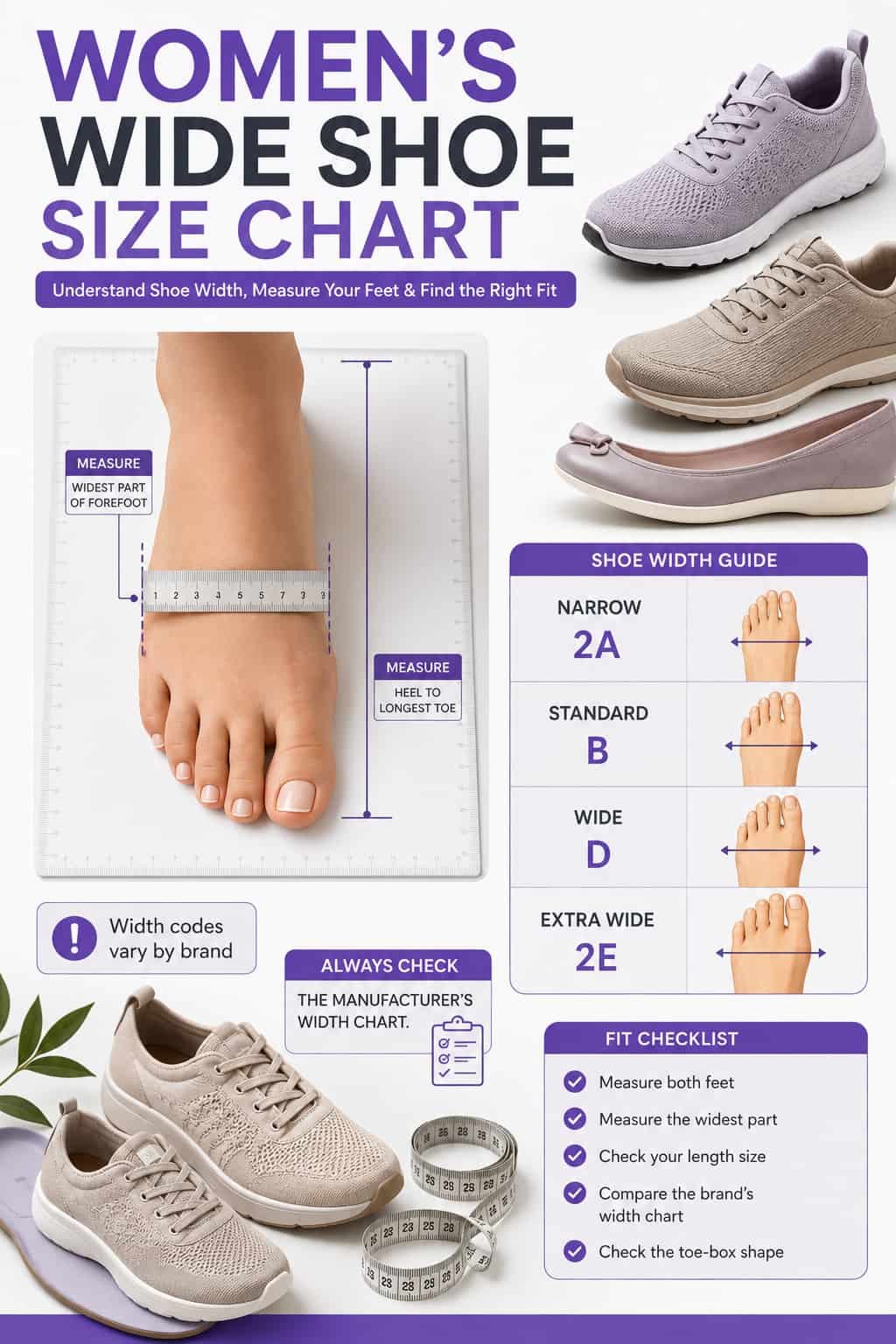
The chart below shows common women’s width labels used by major footwear brands. These codes are useful for understanding product descriptions, but they are not universal across every manufacturer.
| Width Category | Common Width Code | What It Means |
| Narrow | 2A | Less room across the foot |
| Standard | B | Common women’s standard in many athletic brands |
| Wide | D | More room across the forefoot |
| Extra Wide | 2E | More room than a standard wide fit |
| Extra Wide | 4E | Used by some brands for an even wider fit |
ASICS identifies women’s 2A as narrow, B as standard, D as wide and 2E as extra wide. New Balance also uses 2A, B, D and 2E across its women’s width options.
However, other brands use different letter systems. Clarks, for example, lists D as standard and E as wide in its own women’s footwear system.
The important lesson: never choose a width from the letter alone. Read the individual brand’s width chart.
What Does Wide Mean in Women’s Shoes?
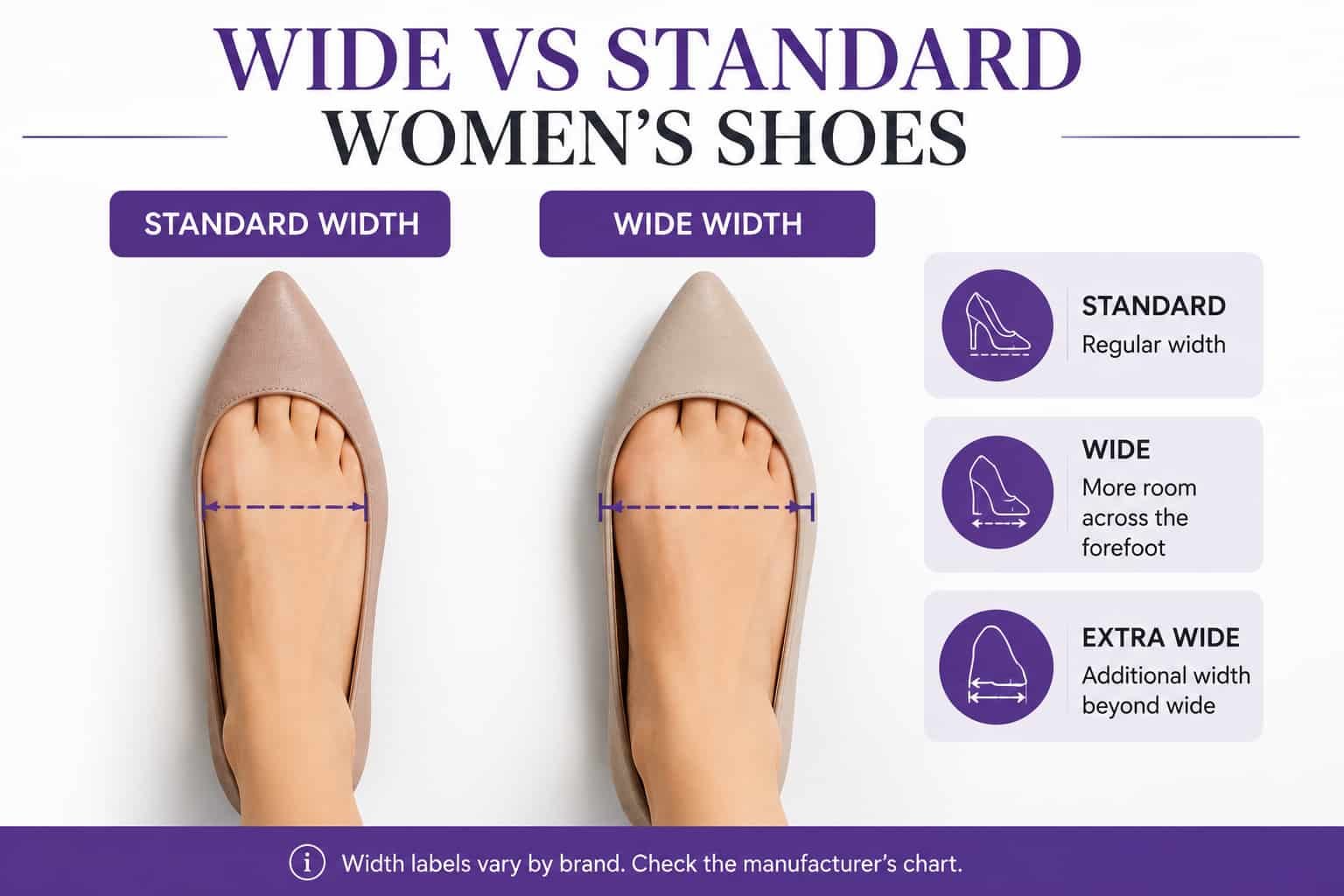
A wide women’s shoe has additional space across the foot compared with the brand’s standard-width version.
Most of this additional room is useful around the forefoot, where the foot is widest.
A wide shoe does not necessarily have a longer sole. It is designed to provide more lateral space while maintaining the appropriate length.
This distinction matters because many shoppers try to solve a width problem by buying a longer shoe. That can leave too much space in front of the toes while the sides still feel uncomfortable.
Women’s Shoe Width Finder
Select a width to understand what it generally means.
Provides additional room across the forefoot compared with standard width in some women’s footwear sizing systems.
Width Check
If the length feels right but your toes or the sides of your foot feel squeezed, look at width options before automatically going up a full shoe size.
How Do Women’s Shoe Width Sizes Work?
Women’s shoe width is usually represented by a letter or combination of letters and numbers.
The problem is that the meaning of each code can change between manufacturers.
For example, one brand may describe a D width as wide, while another brand may use D as its standard women’s width. ASICS and Clarks demonstrate this difference clearly.
Common width descriptions include:
- Narrow
- Standard or medium
- Wide
- Extra wide
- Extra-extra wide
Some brands use codes such as 2A, B, D, 2E and 4E.
When shopping online, look for the words “width,” “fit,” “wide,” “extra wide” or a width code next to the shoe size.
What Is the Difference Between Women’s Wide and Standard Shoes?
The main difference is the amount of space available across the foot.
A standard shoe is designed around the manufacturer’s regular width. A wide version provides additional room across areas such as the forefoot and midfoot.
This does not mean that everyone with a wide foot should automatically buy a larger size.
For example, a woman who normally wears US 8 standard may need US 8 wide rather than US 8.5 standard.
The correct choice depends on the shape and measurements of the foot and the construction of the shoe.
Do You Need Women’s Wide Shoes?
Select the signs that describe how your current shoes feel.
How Do You Know If You Need Women’s Wide Fit Shoes?
Several signs can suggest that your current shoes are too narrow.
The most useful clues appear while standing and walking.
Your toes feel compressed
If your toes are pushed together or feel squeezed inside the toe box, the shoe may not provide enough width.
The sides of the shoe bulge
Visible stretching or bulging along the outside of the shoe can indicate that the upper is being forced around your foot. ASICS specifically identifies visible stretching or bulging around the forefoot as a sign that additional width may be needed.
Your foot spills over the sole
If the widest part of your foot extends noticeably beyond the shoe’s platform, the shoe may be too narrow.
You feel pressure across the forefoot
A shoe can have enough length while still creating uncomfortable pressure across the ball of the foot.
You keep loosening the laces
If you repeatedly loosen a shoe because the upper feels tight around your forefoot, a wider version may provide a better fit.
Your feet feel uncomfortable after short periods
If a shoe becomes uncomfortable quickly even though the length seems correct, width may be worth checking.
Common Mistake
Buying a longer shoe to solve a width problem can create a poor fit. Extra length does not necessarily provide the right amount of space around the sides of your foot.
How Do You Measure Your Foot Width at Home?
You can measure your foot width at home with paper, a pencil and a ruler.
For the most useful result, measure both feet while standing.
Step 1: Place paper on a hard floor
Put a sheet of paper on a flat surface.
Avoid thick carpet because it can affect your position.
Step 2: Stand naturally
Place one foot firmly on the paper.
Keep your weight evenly distributed rather than sitting down.
Step 3: Mark the foot outline
Ask someone to trace around your foot carefully.
Keep the pencil upright rather than angled underneath the foot.
Step 4: Find the widest point
Measure across the widest part of your foot.
This is usually around the ball of the foot.
Step 5: Measure the other foot
Repeat the process for your other foot.
One foot can be slightly wider or longer than the other.
Step 6: Compare with the manufacturer’s chart
Use your measurements alongside the shoe brand’s own size and width information.
For a complete measurement walkthrough, see our How to Measure Foot Size at Home guide.Expert Tip
Measure both feet. If one foot is slightly wider or longer, use the larger measurement when deciding which shoe size and width to try.
Women’s Wide Shoe Width Chart by Brand
There is no single width-letter system that applies to every women’s shoe brand.
That is one of the most important things to understand before using a women’s wide width chart.
Here are examples from established footwear sizing systems:
| Brand Example | Narrow | Standard | Wide | Extra Wide |
| ASICS | 2A | B | D | 2E |
| New Balance | 2A | B | D | 2E |
| Clarks | C | D | E | EE |
The codes above are brand-specific examples, not a universal conversion table. ASICS and New Balance use D as a women’s wide width, while Clarks uses E for women’s wide in its own system.
This is why the product page’s own sizing information should take priority over a general width chart.
What Is the Standard Women’s Shoe Width?
There is no single universal letter that represents standard women’s width across every brand.
In the ASICS system, B is the standard women’s width and D is wide. New Balance also lists B as standard and D as wide for women’s shoes.
Clarks uses a different system in which D represents standard and E represents wide.
So if you see a “D” on a women’s shoe, do not assume it always means the same thing.
Check the brand.
Women’s Wide Shoe Size Chart: Example Measurements
Some manufacturers provide actual width measurements for individual shoe sizes.
For example, New Balance’s women’s width guide shows that its width measurements increase as shoe size increases. For a women’s US 8, its guide lists approximately 8.4 cm for 2A, 8.8 cm for B, 9.2 cm for D and 9.5 cm for 2E.
| US Women’s Size | Narrow 2A | Standard B | Wide D | Extra Wide 2E |
| 6 | 8.0 cm | 8.4 cm | 8.7 cm | 9.0 cm |
| 7 | 8.2 cm | 8.6 cm | 8.9 cm | 9.3 cm |
| 8 | 8.4 cm | 8.8 cm | 9.2 cm | 9.5 cm |
| 9 | 8.6 cm | 9.0 cm | 9.4 cm | 9.7 cm |
| 10 | 8.8 cm | 9.2 cm | 9.6 cm | 9.9 cm |
| 11 | 9.0 cm | 9.4 cm | 9.8 cm | 10.1 cm |
| 12 | 9.3 cm | 9.6 cm | 10.0 cm | 10.3 cm |
Important: these measurements are from the New Balance width system and should not be treated as a universal measurement standard for every brand.
Does Shoe Size Affect Shoe Width?
Yes.
As shoe size increases, the dimensions of the shoe generally increase as well.
This means a wide width for a smaller shoe is not necessarily the same physical width as a wide width for a larger shoe.
New Balance’s women’s sizing guide illustrates this by showing increasing width measurements across its size range.
This is another reason why a simple statement such as “wide shoes are always X inches wide” would be misleading.
Are Wide Shoes the Same as Half Sizes?
No.
A half size primarily changes the length of the shoe.
A width option changes the amount of room across the foot.
For example, if your US 8 shoe has the correct length but feels tight across the forefoot, moving to an 8.5 may add length without giving you the same type of fit as an 8 wide.
If you are unsure whether length or width is the problem, measure your foot and compare it with the manufacturer’s size chart.
You can also read our women’s half size guide for more information about half-size differences.
Can You Wear Wide Shoes If Your Feet Are Not Very Wide?
You can, but the shoe should still fit securely.
An unnecessarily wide shoe can allow too much side-to-side movement.
The goal is not to choose the widest available shoe. The goal is to match the shoe to your foot shape.
If your foot is average width, start with the brand’s standard width.
If the standard width creates pressure or the upper visibly stretches, investigate the brand’s wide option.
Are Women’s Wide Shoes Longer?
Usually, no.
A wide shoe is designed to provide additional width, not simply additional length.
However, the exact construction can vary between brands and shoe styles.
If you need more room across the forefoot, look for a width option in your normal length size before automatically increasing the length.
Do Wide Shoes Have More Room in the Toe Box?
Often, yes, but it depends on the shoe design.
Many wide shoes provide additional room through the forefoot and toe-box area.
ASICS notes that much of the additional width in its width options is found in the forefoot.
However, toe-box shape still matters.
Two shoes can both be labeled wide but have different shapes. One may feel generous around the toes while another may still feel restrictive.
What Should You Look for in Women’s Wide Fit Shoes?
When shopping for women’s wide fit shoes, look beyond the width label.
1. A roomy toe box
Your toes should have enough space to sit naturally without being pushed together.
2. A secure heel
Extra width should not mean that your heel slides around.
3. Flexible materials
Materials that can accommodate normal foot movement may feel more comfortable around the forefoot.
4. The correct length
Do not sacrifice length just to get additional width.
5. The right width option
If the brand offers standard, wide and extra-wide versions, compare them before choosing.
6. The intended activity
Running shoes, walking shoes, casual sneakers, boots and dress shoes can have very different shapes.
Wide Shoe Buying Checklist
- Measure both feet.
- Check your foot length.
- Measure the widest part of your foot.
- Check the brand’s width terminology.
- Confirm the shoe’s available widths.
- Look at the toe-box shape.
- Check the return policy before ordering online.
What Is the Difference Between Wide and Extra Wide Shoes?
Extra-wide shoes provide more width than the brand’s wide option.
The exact code varies.
For example, ASICS identifies D as women’s wide and 2E as women’s extra wide. New Balance also uses D for wide and 2E for extra wide in its women’s sizing system.
Extra wide can be useful when a normal wide shoe still creates pressure around the forefoot.
However, do not choose extra wide simply because your standard shoe feels uncomfortable. Check whether the problem is width, length, arch shape or the shoe’s overall construction.
Can You Convert Women’s Shoe Width Between Brands?
Not reliably with a simple formula.
A width code belongs to the manufacturer’s sizing system.
For example, D can mean wide in one brand and standard in another.
The better approach is:
- Measure your foot.
- Identify your normal length size.
- Find the brand’s width chart.
- Compare your measurement with the brand’s information.
- Check reviews or fit notes when available.
- Use the retailer’s return policy as a safety net.
How Should Wide Shoes Fit?
A well-fitting wide shoe should feel comfortable without squeezing your forefoot or allowing your foot to slide excessively.
Your toes should have room to move.
The widest part of your foot should sit comfortably within the shoe.
The heel should remain reasonably secure while walking.
Look for these signs:
Good fit:
- Toes are not compressed.
- Forefoot feels comfortable.
- Heel remains stable.
- Shoe does not bulge excessively.
- You can walk without pressure points.
Possible poor fit:
- Toes feel squeezed.
- Sides of the upper bulge.
- Foot spills over the sole.
- Heel slips significantly.
- You feel pressure after only a short time.
Fit Reminder
A wide shoe should feel spacious where you need it, but it should not feel loose everywhere. Width, length and overall shoe shape all work together.
Common Mistakes When Buying Women’s Wide Shoes
Choosing a larger length instead of a wider fit
This is one of the most common mistakes.
If the shoe is too narrow, a longer size may leave unnecessary space in front of your toes.
Assuming every D is wide
Width codes are brand-specific.
Always check the manufacturer’s chart.
Measuring only the length
Foot width matters too.
Ignoring toe-box shape
A wide label does not guarantee the same toe-box shape across different models.
Buying based on the size you wore years ago
Your preferred size can change between brands, models and shoe types.
Ignoring return policies
Online shoe shopping is easier when you know you can exchange an incorrect size or width.
Can Wide Shoes Improve Comfort?
The right width can improve comfort when a standard-width shoe is restricting your foot.
A shoe that matches your foot shape can reduce unnecessary pressure and make walking more comfortable.
The key is finding the right width rather than simply choosing the widest option.
If a shoe is too narrow, moving to a wider version may help. If a shoe is too wide, your foot may move around inside it.
Fit should always be the goal.
Women’s Wide Shoe Size FAQs
What is a women’s wide shoe size?
A women’s wide shoe size provides more room across the foot than the brand’s standard width. The exact width code varies by manufacturer. For example, ASICS uses D for women’s wide, while Clarks uses E for women’s wide in its own sizing system. Always check the brand’s width chart before buying.
What width is considered wide for women’s shoes?
There is no universal width letter for every brand. ASICS and New Balance commonly use D as a women’s wide width, while Clarks uses E for women’s wide. This difference shows why the manufacturer’s own chart should be used instead of assuming one width code applies everywhere.
How do I know if I need wide women’s shoes?
You may need wide shoes if the sides of your feet feel squeezed, your toes are compressed, the shoe upper visibly bulges around the forefoot or your foot extends beyond the shoe’s platform. Measure your foot and compare it with the specific brand’s width chart before choosing.
Is D a wide women’s shoe?
It depends on the brand. In ASICS and New Balance women’s sizing, D is commonly listed as wide. In Clarks’ system, D is standard and E is wide. Width letters are not universal, so always check the brand’s sizing information.
Is 2E wider than D for women’s shoes?
In sizing systems such as ASICS and New Balance, 2E is wider than D and is used for extra-wide women’s footwear. The exact terminology can vary by manufacturer, so confirm the width chart for the shoe you are buying.
Should I buy wide shoes if my toes hurt?
Toe discomfort can be caused by insufficient width, but it can also come from shoe length, toe-box shape or other fit issues. If the shoe length is correct and the forefoot feels compressed, compare the standard and wide versions of the same shoe.
Are wide shoes longer than regular shoes?
Wide shoes are designed primarily to provide additional width, not simply extra length. A wide version of the same shoe size can offer more space across the forefoot while maintaining the same nominal length size. Always compare the brand’s measurements before ordering.
Can I measure my foot width at home?
Yes. Stand on a sheet of paper, trace your foot, then measure across the widest part of the forefoot. Repeat for both feet and compare the larger measurement with the manufacturer’s width chart.
Are women’s wide shoes available in half sizes?
Many brands offer both half sizes and multiple width options, but availability varies by model. A half size changes length, while a width option changes the space across the foot. Check the individual shoe’s available combinations before ordering.
Can women with normal-width feet wear wide shoes?
They can, but a shoe should match the foot rather than simply provide as much room as possible. If a wide shoe allows excessive movement, a standard width may be more appropriate. Comfort and stability are both important.
Why do my shoes feel tight even though the length is correct?
The shoe may be too narrow, particularly around the forefoot. It could also have a narrow toe box or a shape that does not match your foot. Try comparing the same shoe in a wider width before increasing the length.
Do all brands use the same women’s width chart?
No. Width codes and measurements vary between manufacturers. ASICS, New Balance and Clarks use different women’s width terminology, so a width letter should always be interpreted using the brand’s own chart.
Women’s Wide Shoe Size: Final Guide
Finding the right women’s wide shoe size is about more than choosing a larger number.
First, make sure the shoe length is correct.
Then look at the width.
If your foot feels squeezed across the forefoot, check whether the brand offers a wide or extra-wide version in your normal length.
Most importantly, remember that width letters are not universal. A D width can mean wide for one brand and standard for another.
Measure both feet, check the manufacturer’s chart and pay attention to how the shoe actually fits when you stand and walk.
Related Guides
- If you want to understand your overall women’s sizing, check the Women’s Shoe Size Chart for a broader guide to women’s shoe measurements and sizing.
- To measure your foot correctly before choosing a width, follow our How to Measure Foot Size at Home guide for a step-by-step measurement process.
- If your feet are narrower rather than wider, our Women’s Narrow Shoe Size Chart can help you compare narrower width options.
- If your shoe feels slightly short or you are deciding between full and half sizes, see our Women’s Half Size Guide to understand how half-size changes affect fit.
- For converting women’s shoe sizes between different sizing systems, use our Shoe Size Conversion Chart & Calculator to compare US, UK, EU and other size formats.
The right wide shoe should give your foot the space it needs without creating unnecessary movement. Measure first, check the brand’s width system and choose the fit that matches your actual foot rather than relying on a width letter alone.