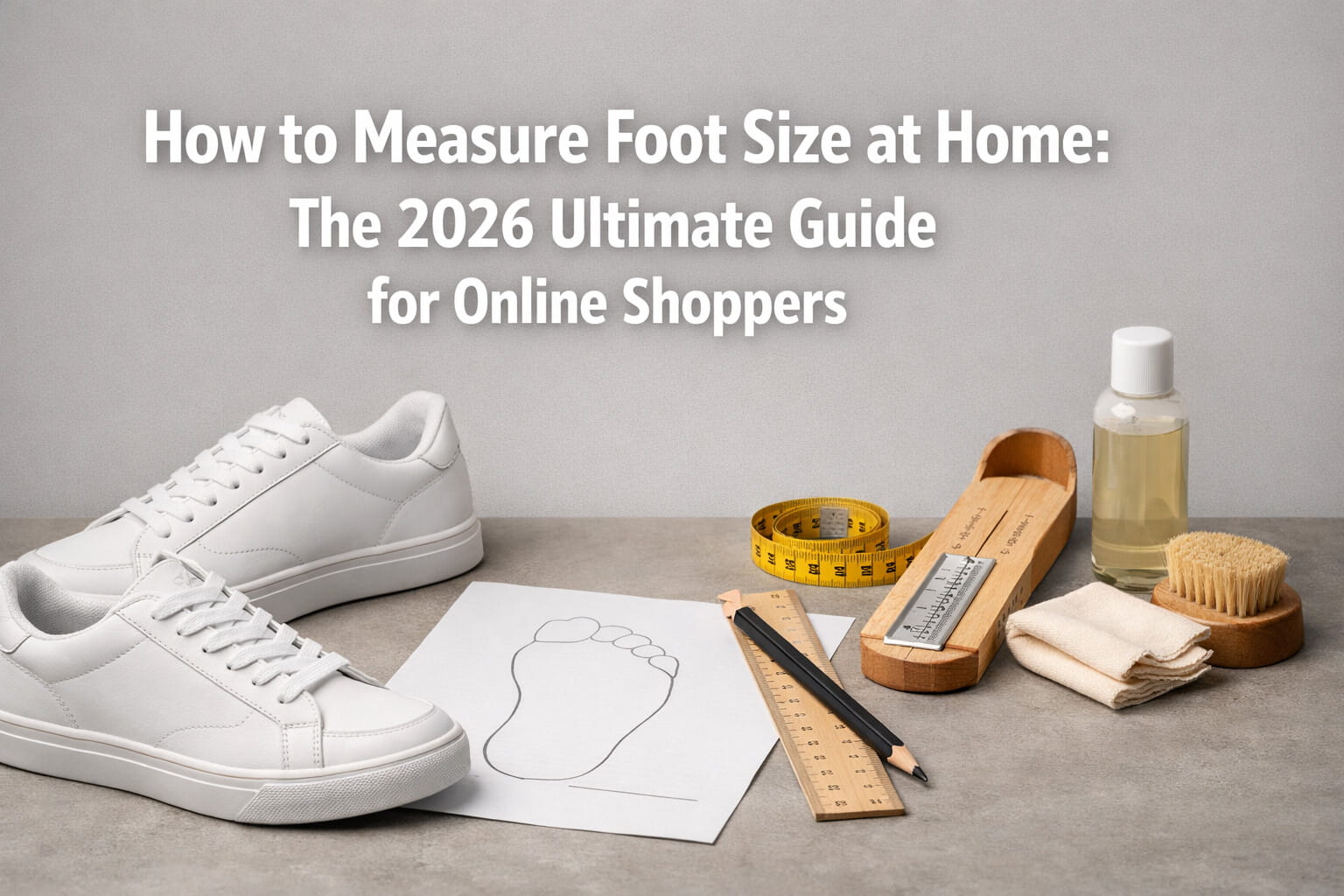

Women’s Narrow Shoe Size Chart: Width Guide, Measurement & Fit
Quick Answer: What Is a Women’s Narrow Shoe Size?
- A women’s narrow shoe is designed to provide less room across the forefoot than the brand’s standard width.
- Common narrow-width codes include 2A in some athletic footwear systems and C in some other brands.
- Width codes are not universal, so always check the manufacturer’s width chart.
- If your shoes feel loose at the sides while the length feels correct, you may need a narrow fit rather than a smaller length.
- Measuring both feet is the best starting point before buying narrow width women’s shoes.
If your shoes are the right length but your feet slide from side to side, your heels slip, or the upper does not hold your foot securely, you may have narrower feet.
A women’s narrow shoe size is designed to provide less width than a brand’s standard women’s shoe. The exact width code depends on the manufacturer. For example, ASICS lists 2A as women’s narrow and B as women’s standard, while Clarks lists C as narrow and D as standard.
That difference is important because there is no single narrow-width letter that applies to every shoe brand.
The best approach is to measure your feet, confirm your normal shoe length, and then compare your measurements with the specific brand’s width chart.
Women’s Narrow Shoe Size Chart
A women’s narrow shoe size provides less room across the foot than that brand’s standard width. The table below shows common width codes used by established footwear brands.
| Width Category | Common Example | General Fit |
| Narrow | 2A | Less room across the foot in some athletic brands |
| Narrow | C | Narrow fit in some traditional footwear systems |
| Standard | B | Standard women’s width in some athletic brands |
| Standard | D | Standard women’s width in some brands |
| Wide | D or E | Depends on the brand |
| Extra Wide | 2E or EE | Depends on the brand |
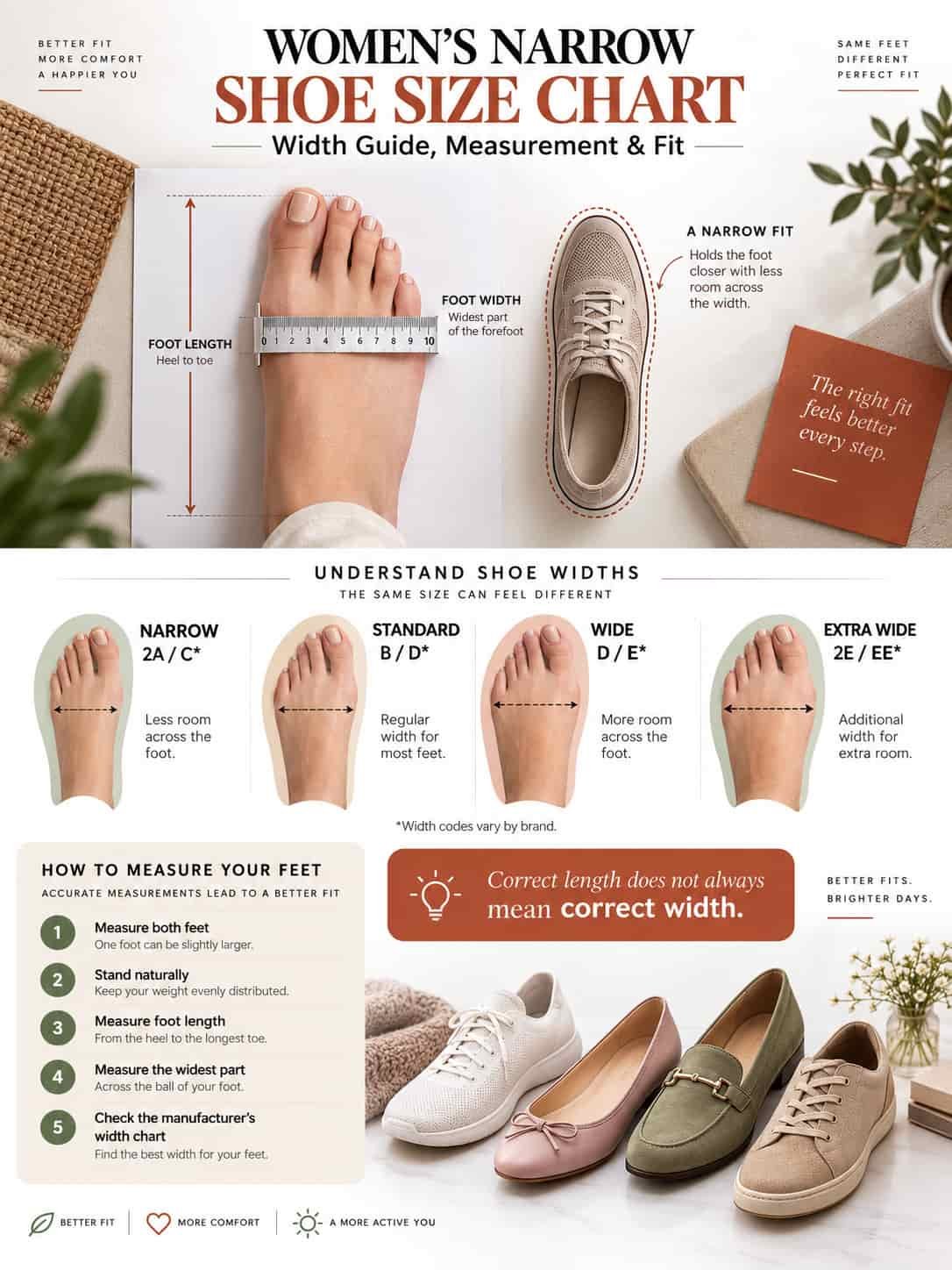
The most important point is that these codes are brand-specific. ASICS identifies 2A as women’s narrow and B as women’s standard, while Clarks identifies C as narrow and D as standard.
So a “C” or “2A” should never be interpreted without checking the manufacturer’s own sizing information.
Women’s Shoe Width Finder
Select a width to see what it generally means.
Provides less room across the foot than the brand’s standard women’s width.
What Does Narrow Mean in Women’s Shoes?
A narrow women’s shoe is designed to provide less room across the foot than the manufacturer’s standard width.
The difference is most noticeable around the forefoot and midfoot.
A narrow shoe can help a foot feel more secure when a standard-width shoe leaves excessive space around the sides.
It is important to understand that narrow does not mean shorter.
If the length of your shoe feels correct but your foot moves too much from side to side, changing the width may be more appropriate than choosing a smaller shoe size.
For a broader look at women’s footwear sizing, see the Women’s Shoe Size Chart.
How Do Women’s Shoe Width Sizes Work?
Women’s shoe width is usually represented by letters or combinations of letters and numbers.
Examples include 2A, B, C, D, E and EE.
The difficulty is that these codes are not universal.
For example, ASICS uses B as women’s standard and 2A as women’s narrow. Clarks uses D as women’s standard and C as women’s narrow.
This means you should not compare width letters between brands as if they were identical measurements.
Instead, use the width code as part of the manufacturer’s sizing system.
Do You Need Narrow Shoes?
Select the signs that describe your current shoe fit.
How Do You Know If You Have Narrow Feet?
Several signs can indicate that your feet may be narrower than the standard width used by a particular brand.
Your foot slides from side to side
If your foot moves noticeably inside the shoe even when the length is correct, the shoe may be too wide.
Your heel slips repeatedly
Heel movement can happen for several reasons, but excessive slipping in a correctly sized shoe can be a sign that the shoe is too roomy for your foot.
You tighten the laces excessively
If you constantly pull your laces tight to keep the shoe secure, you may need a narrower shape.
There is extra space around your forefoot
A standard shoe may leave visible space around the sides of your forefoot if the shoe is wider than your foot.
Your foot does not feel secure while walking
A good shoe should hold your foot securely without squeezing it.
Common Mistake
If a shoe feels loose, do not immediately choose a shorter shoe. If the length is already correct, the problem may be width rather than length.
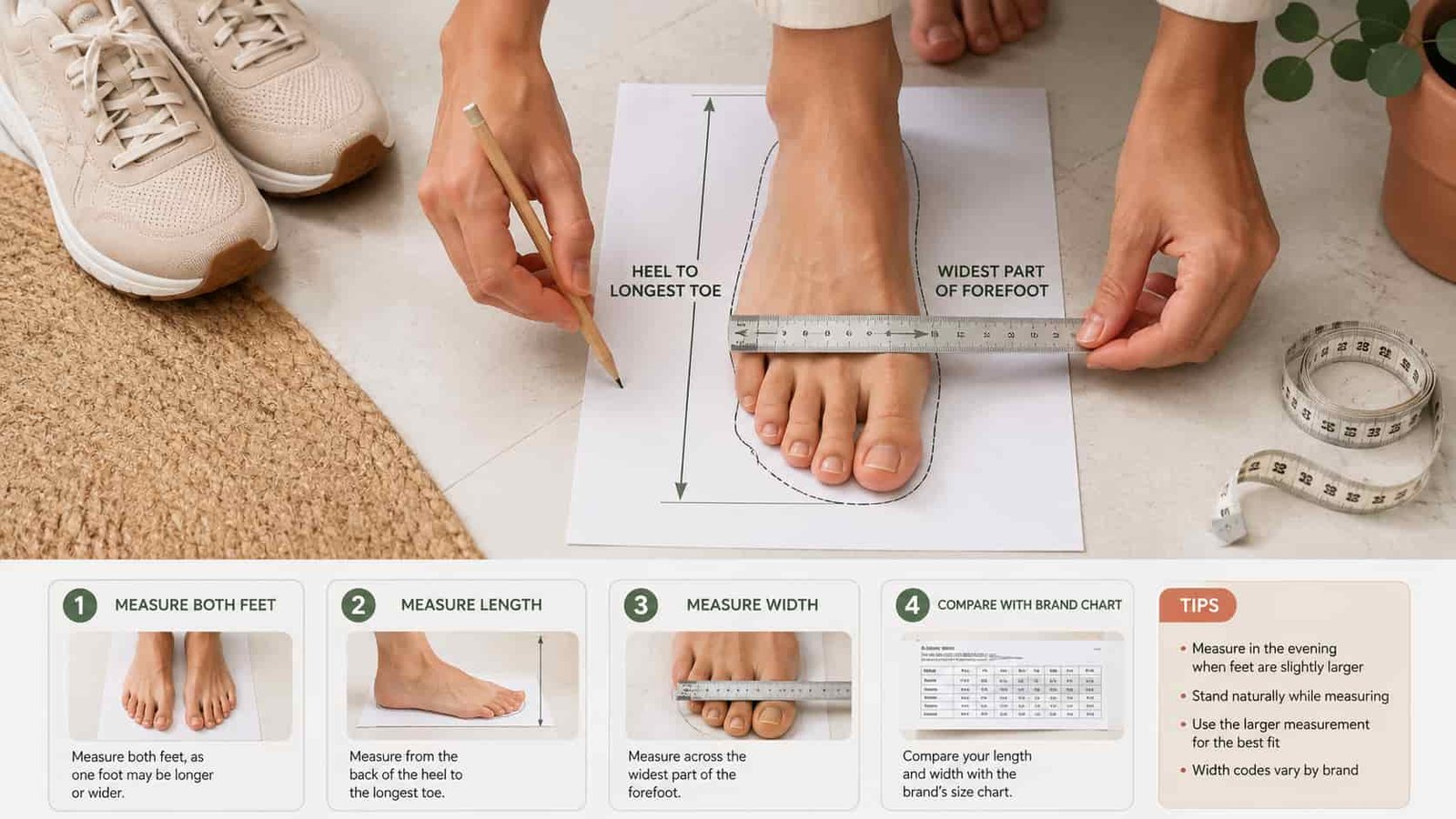
How Do You Measure Foot Width at Home?
Measuring your foot width at home gives you a useful starting point when choosing narrow width women’s shoes.
You need paper, a pencil and a ruler or measuring tape.
Step 1: Place paper on a hard surface
Put a sheet of paper on a flat floor.
Avoid thick carpet because it can change your standing position.
Step 2: Stand naturally
Place one foot on the paper and distribute your weight normally.
Do not measure while sitting because your foot can spread differently when it carries your body weight.
Step 3: Trace around your foot
Ask someone to trace around the foot while keeping the pencil upright.
Step 4: Measure the widest part
Measure across the widest part of your forefoot.
This measurement gives you a useful reference for comparing your foot with a manufacturer’s width chart.
Step 5: Measure both feet
Repeat the process for your other foot.
Your feet may not be exactly the same length or width.
Step 6: Compare with the brand chart
Use your measurements together with the specific brand’s sizing information.
For a complete measurement walkthrough, use the How to Measure Foot Size at Home guide.
Fit Tip
Measure both feet while standing and use the larger measurement when choosing your size. This helps prevent selecting a shoe that fits one foot but feels restrictive on the other.
Women’s Narrow Shoe Width Chart by Brand
A brand-specific chart is more useful than a universal width chart because manufacturers use different systems.
Here are examples from established footwear brands:
| Brand | Narrow | Standard | Wide | Extra Wide |
| ASICS | 2A | B | D | 2E |
| Clarks | C | D | E | EE |
| New Balance | 2A | B | D | 2E |
ASICS explicitly identifies 2A as women’s narrow, B as standard, D as wide and 2E as extra wide.
Clarks uses C for women’s narrow, D for standard, E for wide and EE for extra wide in its US women’s fit guide.
New Balance’s women’s width guide uses 2A for narrow, B for medium, D for wide and 2E for extra wide.
These differences are exactly why you should check the individual brand before ordering.
Is 2A a Narrow Women’s Shoe Size?
In some footwear systems, yes.
ASICS identifies 2A as women’s narrow, while B is women’s standard. New Balance also uses 2A for women’s narrow and B for medium.
However, 2A should not be treated as a universal measurement across all footwear brands.
If a product page lists 2A, read the manufacturer’s width guide before deciding whether it matches your feet.
Is C a Narrow Women’s Shoe Size?
C can represent a narrow women’s shoe in some sizing systems.
Clarks lists C as narrow and D as standard in its US women’s width guide.
This is a good example of why width letters cannot be converted between brands using a simple formula.
A C width in one manufacturer’s system may not represent the same physical width as a C width elsewhere.
Is B a Narrow Women’s Shoe Size?
Not always.
ASICS uses B as women’s standard width, not narrow.
This is one of the most common sources of confusion when shoppers compare different shoe brands.
If you normally wear a B-width shoe from one brand, do not assume that B means narrow everywhere.
Always check the brand’s own width definitions.
What Is the Difference Between Narrow and Standard Women’s Shoes?
The primary difference is the amount of space across the foot.
A standard shoe is designed around the manufacturer’s regular width.
A narrow shoe provides less room across the forefoot and midfoot.
For example, if a standard shoe has the correct length but your foot moves from side to side, a narrow version of the same length may provide a more secure fit.
The goal is not to make the shoe feel tight. The goal is to remove unnecessary movement while keeping your foot comfortable.
Are Narrow Shoes Shorter Than Standard Shoes?
No.
Narrow shoes are designed primarily to change the width, not the length.
If your normal size is US women’s 8 and the length feels correct, an 8 narrow can be more appropriate than a 7.5 standard if the issue is excessive width.
Choosing a smaller length to compensate for a wide shoe can push your toes toward the front.
This is why it helps to identify whether your problem is length or width before changing sizes.
Narrow Shoes vs Half Sizes: What Is the Difference?
A half size primarily changes the length of the shoe.
A width option changes the amount of room across the foot.
For example:
US 8 standard: Correct length but too much side-to-side movement.
US 7.5 standard: Potentially less length, but may cause the toes to feel crowded.
US 8 narrow: Similar length with a narrower fit.
If you are unsure whether you need a half size or a different width, use the Women’s Half Size Guide before changing your size.
What Features Should You Look for in Women’s Narrow Fit Shoes?
Finding the right women’s narrow fit shoes involves more than looking for a width label.
Secure heel
The heel should stay reasonably stable while walking.
Snug but comfortable forefoot
The shoe should hold your foot without squeezing your toes.
Appropriate toe box
A narrow shoe should still give your toes enough room to move naturally.
Correct length
Do not sacrifice length simply because you need a narrower width.
Adjustable closure
Laces, straps or adjustable fastening systems can help fine-tune the fit.
Brand-specific width options
Look for brands that clearly identify narrow width choices.
Narrow Shoe Buying Checklist
- Measure both feet.
- Confirm your correct length.
- Measure the widest part of your foot.
- Check the manufacturer’s width chart.
- Look for a narrow-width option in your normal length.
- Check the heel fit.
- Check the toe-box shape.
- Review the return policy before ordering.
How Should Narrow Women’s Shoes Fit?
A well-fitting narrow shoe should feel secure without squeezing your toes.
Your heel should not move excessively.
The shoe should hold your foot comfortably while allowing normal toe movement.
Signs of a good narrow fit
- Heel remains reasonably secure.
- Foot does not slide from side to side.
- Toes have natural movement.
- The shoe does not create painful pressure.
- The forefoot feels supported.
- The shoe length feels correct.
Signs the shoe may still be too wide
- Your heel repeatedly slips.
- Your foot moves sideways while walking.
- You need to tighten the shoe excessively.
- There is noticeable empty space around the forefoot.
- Your foot does not feel secure.
Signs the shoe may be too narrow
- Toes feel compressed.
- The sides create pressure.
- The upper stretches noticeably.
- You feel discomfort soon after putting the shoe on.
The goal is a secure fit, not a tight fit.
Can Narrow Shoes Improve Comfort?
They can improve comfort when a standard-width shoe provides too much space for your foot.
A shoe that matches your foot shape can feel more stable and secure.
However, a narrow shoe will not solve every fit problem.
A shoe can feel loose because of its length, heel shape, lacing system or overall construction.
That is why measuring your feet and checking the specific shoe’s sizing information is more useful than choosing a width based on appearance alone.
Can Women With Narrow Feet Wear Standard Shoes?
Yes, but the fit needs to be secure.
Some standard shoes may work well for narrower feet because of their shape, materials or adjustable closure.
If a standard shoe consistently allows your foot to slide sideways or your heel to move excessively, a narrow version may be a better option.
Try to compare the same model in different widths when possible. This makes it easier to identify whether width is the main issue.
Can You Convert Women’s Narrow Width Between Brands?
Not accurately with one universal formula.
Width systems differ between manufacturers.
ASICS uses 2A for women’s narrow, while Clarks uses C for women’s narrow. New Balance also uses 2A for women’s narrow.
Instead of converting the letter itself, use this process:
- Measure your foot.
- Confirm your normal shoe length.
- Find the brand’s width chart.
- Compare the available narrow option.
- Check the shoe’s return policy.
For US, UK and EU size conversions, use the Shoe Size Conversion Chart & Calculator.
What Are the Most Common Narrow Shoe Shopping Mistakes?
Choosing a smaller size instead of a narrower width
If the length is correct, reducing the length may make the shoe uncomfortable without solving the width issue.
Assuming B means narrow
B is standard women’s width in ASICS, for example.
Assuming every C is narrow
C is narrow in Clarks’ women’s system, but width codes are brand-specific.
Measuring only one foot
Your feet can differ slightly in length and width.
Ignoring heel movement
Excessive heel slipping can be an important sign that the shoe does not match your foot shape.
Focusing only on the width letter
The actual construction and shape of the shoe matter too.
Quick Reminder
A width label is only a starting point. Your foot measurement, the shoe’s construction and the manufacturer’s sizing chart should all be considered before ordering.
How Often Should You Check Your Shoe Fit?
Adults do not normally need the same frequent sizing checks as children, but your shoe fit can change over time.
It is worth measuring again when:
- Your usual shoes suddenly feel loose.
- Your feet slide inside shoes that previously fit well.
- You are buying from a new brand.
- You are changing from sneakers to dress shoes or boots.
- You are ordering shoes internationally.
- Your usual size no longer feels comfortable.
A quick measurement can help determine whether you need a different width, length or shoe shape.
Women’s Narrow Shoe Size FAQs
What is a women’s narrow shoe size?
A women’s narrow shoe size provides less room across the foot than the manufacturer’s standard width. The exact width code varies between brands. ASICS uses 2A for women’s narrow, while Clarks uses C for women’s narrow in its US women’s width system.
Is 2A narrow for women’s shoes?
In sizing systems used by brands such as ASICS and New Balance, 2A represents a women’s narrow width. However, width codes are brand-specific, so check the manufacturer’s chart before using 2A as your reference.
Is C a narrow women’s shoe?
C represents narrow women’s width in the Clarks US women’s width system. Other brands may use different codes, so C should not be treated as a universal narrow-width measurement.
Is B narrow or standard for women’s shoes?
B is standard women’s width in the ASICS sizing system. Other brands can use different width conventions, which is why the manufacturer’s own chart should always be checked before ordering.
How do I know if I have narrow feet?
You may have narrower feet if your correctly sized shoes feel loose around the sides, your foot moves from side to side, or your heel slips excessively. Measuring both feet and comparing your measurements with a brand’s width chart provides a better answer than relying only on how a shoe feels.
How do I measure women’s foot width at home?
Stand on a sheet of paper, trace around your foot and measure across the widest part of the forefoot. Repeat the measurement for both feet while standing. Then compare the result with the manufacturer’s women’s width chart.
Should I buy a smaller shoe if my feet are narrow?
Not necessarily. If the shoe length is already correct, a narrow version of the same length may provide a better fit than choosing a shorter shoe. A smaller size can push your toes toward the front.
Are narrow shoes shorter than regular shoes?
No. Narrow shoes primarily change the width rather than the nominal length. A narrow version of the same shoe size is designed to provide less space across the foot while maintaining the same general length category.
Can I wear standard-width shoes if I have narrow feet?
Yes. Some standard-width shoes can work for narrower feet, especially when they have adjustable laces or straps and a secure heel. If your foot consistently moves inside the shoe, compare the same model in a narrow width if available.
What is the difference between narrow and half sizes?
A half size primarily changes shoe length, while a narrow width changes the space across the foot. If the length is correct but the shoe feels too loose around the sides, changing width may be more useful than choosing a smaller half size.
Are women’s narrow shoe sizes the same across brands?
No. Width systems vary between manufacturers. For example, ASICS uses 2A for women’s narrow while Clarks uses C. New Balance also uses 2A. Always use the individual brand’s sizing information.
Why does my heel slip even though my shoe size is correct?
Heel slipping can happen when the shoe is too wide, but it can also be caused by the shoe’s heel shape, construction or closure system. If the length is correct and your foot still moves excessively, compare a narrower width or a different shoe shape.
Final Guide to Women’s Narrow Shoe Size
Finding the right women’s narrow shoe size starts with separating length from width.
If your shoe is long enough but your foot slides from side to side, the problem may be that the shoe is too wide rather than too long.
Measure both feet, check the widest part of your foot and compare your results with the specific brand’s width chart.
Remember that width codes are not universal. ASICS uses 2A for women’s narrow, while Clarks uses C, which shows why a brand-specific chart is more reliable than a generic width conversion.
- For overall women’s sizing, see the Women’s Shoe Size Chart.
- If you need help measuring your feet, use the How to Measure Foot Size at Home guide.
- If you want to compare narrow and wide fits, see the Women’s Wide Shoe Size Chart.
- For half-size questions, use the Women’s Half Size Guide.
- For international sizing, use the Shoe Size Conversion Chart & Calculator.
The best narrow shoe is not simply the smallest shoe. It is the shoe that matches your foot length and width while keeping your heel secure and your toes comfortable.