
Women’s Shoe Size Conversion Chart: US to UK, EU & CM
Women’s Shoe Size Converter
Convert a women’s US shoe size into approximate UK and EU sizes.
Quick Answer
A women’s shoe size conversion chart helps you compare US, UK and EU shoe sizes, but there is no universal conversion that fits every brand. As a general guide, a US women’s size 8 is commonly around a UK 6 and EU 38 to 39. Your actual foot length is the better starting point, especially when buying shoes online.
- Measure both feet before choosing a size.
- Use the larger foot when comparing measurements.
- Check the individual brand’s size chart before ordering.
- Do not assume the same number fits the same way across every brand.
What Is a Women’s Shoe Size Conversion Chart?
A women’s shoe size conversion chart shows how a shoe size in one sizing system compares with another. The most common systems shoppers encounter are US, UK and EU sizing.
For example, a US women’s size 8 is commonly listed around UK 6 and EU 38 to 39, depending on the brand and sizing method.
The important point is that conversion charts are guides, not guarantees. International footwear sizing is not perfectly standardized. ISO 19407:2023 also treats size conversion as a guideline and bases its approach on foot length.
That is why the safest way to choose your size is to measure your foot first and then compare the measurement with the specific brand’s chart.
Size Check
Do not convert by number alone. A US 8, UK 6 and EU 39 may represent a similar size range, but the actual fit can change with the brand, shoe shape, width and intended use.
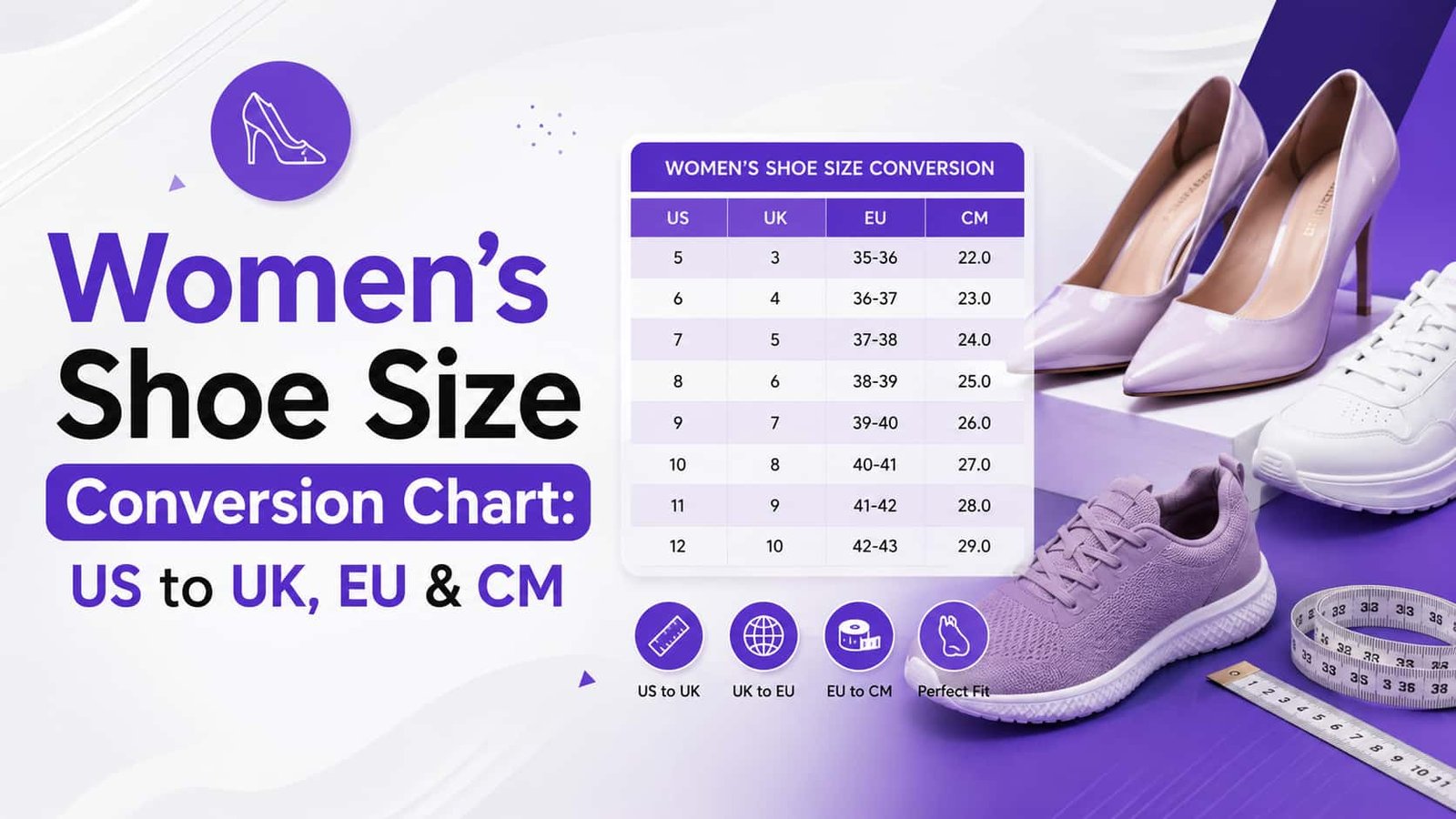
Women’s Shoe Size Conversion Chart: US to UK, EU & CM
The following chart provides a practical general reference for women’s shoe sizes. EU sizing can vary slightly between brands, so use the foot-length measurement as an additional reference rather than relying on the conversion alone.
| US Women’s Size | UK Size | EU Size | Approx. Foot Length |
|---|---|---|---|
| 5 | 3 | 35-36 | 22.0 cm |
| 5.5 | 3.5 | 36 | 22.5 cm |
| 6 | 4 | 36-37 | 22.9 cm |
| 6.5 | 4.5 | 37 | 23.3 cm |
| 7 | 5 | 37-38 | 23.7 cm |
| 7.5 | 5.5 | 38 | 24.1 cm |
| 8 | 6 | 38-39 | 24.6 cm |
| 8.5 | 6.5 | 39 | 25.0 cm |
| 9 | 7 | 39-40 | 25.4 cm |
| 9.5 | 7.5 | 40 | 25.9 cm |
| 10 | 8 | 40-41 | 26.2 cm |
| 10.5 | 8.5 | 41 | 26.7 cm |
| 11 | 9 | 41-42 | 27.1 cm |
| 11.5 | 9.5 | 42-43 | 27.6 cm |
| 12 | 10 | 42-43 | 28.0 cm |
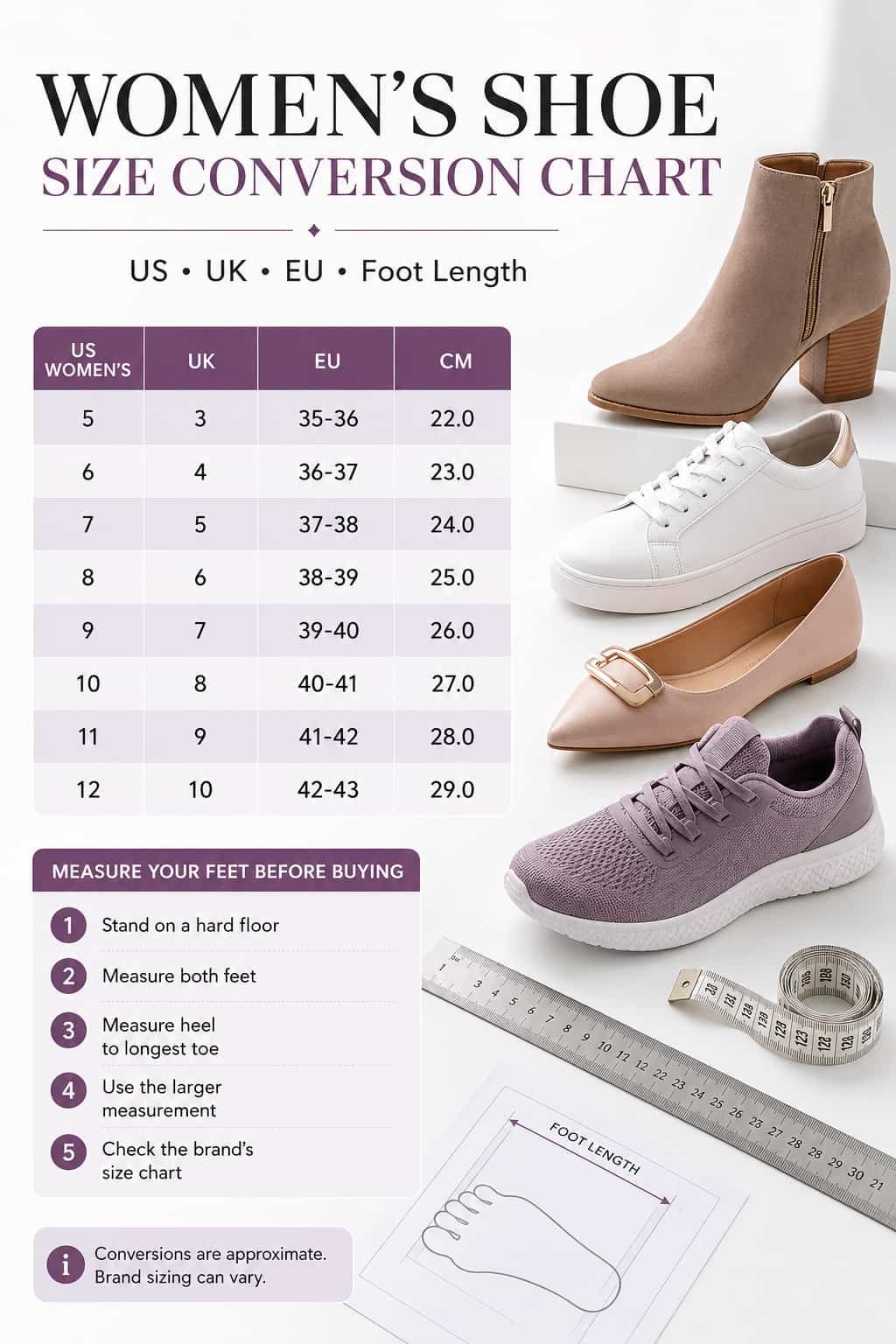
These are general conversion values rather than a universal brand specification. Current retailer charts demonstrate why the numbers can differ. For example, ASOS lists its women’s US 8 as UK 6, EU 39 and 246 mm, while other brands use slightly different measurements.
How to use the chart
Start with the shoe size you normally wear in the country where you usually buy shoes.
Then find the corresponding UK or EU size.
Before ordering, compare the result with the shoe brand’s own size chart.
If your foot measurement falls between two listed sizes, look at the brand’s fitting instructions rather than automatically choosing a larger or smaller size.
What Is a US Women’s Shoe Size Compared With UK Size?
A US women’s shoe size is generally about two size numbers higher than the equivalent UK women’s size, although individual brands can differ.
For example, a common conversion is:
| US Women’s | UK |
|---|---|
| 5 | 3 |
| 6 | 4 |
| 7 | 5 |
| 8 | 6 |
| 9 | 7 |
| 10 | 8 |
| 11 | 9 |
| 12 | 10 |
This is useful when shopping from a UK retailer while knowing your usual US size.
However, do not treat the difference as a mathematical rule for every shoe. Brand-specific sizing can change the conversion.
If the product page provides a UK size chart, use that chart first.
What Is a US Women’s Shoe Size Compared With EU Size?
US women’s sizes are commonly converted to EU sizes using a range rather than one fixed number.
For example, a US women’s size 8 is commonly around EU 38 or 39. A US women’s size 9 is commonly around EU 39 or 40.
The reason for the range is simple: European sizing and US sizing are based on different sizing conventions, and manufacturers do not all build shoes around exactly the same measurements.
ISO’s current footwear conversion standard specifically recognizes the limitations of converting between sizing systems and uses foot length as the logical starting point.
How Do You Measure Your Shoe Size at Home?
You can measure your foot at home with a piece of paper, a pencil and a ruler or measuring tape.
The process takes only a few minutes.
Step 1: Place paper on the floor
Put a sheet of paper on a hard, flat surface.
Avoid measuring on thick carpet because your foot can sink slightly into the surface.
Step 2: Stand normally
Place one foot on the paper with your heel close to a wall.
Stand naturally rather than sitting down. Your body weight changes the way your foot rests on the ground.
Step 3: Mark the longest point
Ask someone to mark the end of your longest toe.
For some people this is the big toe. For others, the second toe may extend farther.
Step 4: Measure the foot
Measure from the back of the heel to the longest toe.
Record the measurement in centimeters and inches.
Step 5: Repeat with the other foot
Measure both feet.
It is completely normal for one foot to be slightly longer than the other. Use the larger measurement when choosing your size.
Step 6: Compare with the brand chart
Take your foot-length measurement and compare it with the manufacturer’s chart for the exact shoe you want.
Nike, for example, provides a dedicated women’s footwear chart and specifically advises users who do not know their size to measure foot length. It also notes that the CM value shown on a shoe box may not be identical to actual foot length.
For a more detailed walkthrough, see our How to Measure Foot Size at Home guide.
Expert Tip
Measure both feet at the end of the day if possible. Feet can change slightly in volume during the day, so measuring when they are at their largest can help you avoid choosing a shoe that feels tight later.
Is Foot Length More Important Than Your Usual Shoe Size?
Yes. Your foot length is generally a more useful starting point than the number printed on a shoe.
Your usual size can change between brands, shoe types and even different models from the same brand.
A size 8 running shoe, size 8 dress shoe and size 8 boot may not have identical internal dimensions.
This is why professional and manufacturer sizing guidance commonly includes measurements alongside shoe sizes. Clarks, for example, provides foot-length information in its women’s fit guide and notes that women’s sizing can vary between brands and styles.
What Should You Do If You Are Between Shoe Sizes?
If your foot measurement falls between two sizes, check the shoe manufacturer’s recommendations first.
The better choice can depend on the shoe style.
A running shoe may need more room in the toe area than a structured dress shoe. A pointed-toe shoe can also feel much tighter than a rounded-toe design even when both carry the same size label.
Your foot width matters too.
If the shoe is available in different widths, choosing the correct width can be better than simply going up a full size.
Common Mistake
Do not automatically buy a full size larger just because your toes feel crowded. The problem may be shoe width, toe-box shape or the specific design rather than length.
Why Can Women’s Shoe Sizes Differ Between Brands?
Women’s shoe sizes differ between brands because manufacturers can use different lasts, materials, construction methods and fit preferences.
Even when two shoes carry the same US size, they can feel different on the foot.
A sneaker may have a flexible upper and generous toe area. A formal pump may have a narrower shape. A boot may fit differently because of its construction and intended use.
That is why a conversion chart should be treated as a starting point.
The brand’s own chart should be the final reference when it is available.
What Is the Difference Between Shoe Size and Foot Length in CM?
Foot length in centimeters is a measurement of your physical foot.
A shoe’s CM label is not always an exact measurement of your bare foot.
This distinction is important when shopping internationally.
For example, Nike explicitly warns that the CM size displayed on its shoe boxes and labels is different from foot length in centimeters.
When a website provides both “foot length” and “CM size,” read the instructions carefully before selecting your size.
Quick Reminder
Foot length = your measurement. Shoe size = the manufacturer’s sizing label. They are related, but they are not always identical.
How Should Women’s Shoe Size Fit?
A properly fitting shoe should feel secure without squeezing your toes or creating pressure points.
Your heel should stay reasonably stable while walking.
Your toes should have enough room to move naturally.
The widest part of your foot should not feel compressed by the sides of the shoe.
Check the fit while standing and walking because the foot behaves differently when it is carrying your body weight.
Signs the shoe may be too small
- Your toes press against the front.
- You feel pressure across the widest part of your foot.
- Your toes are forced into an uncomfortable position.
- The shoe creates painful rubbing.
- Your foot feels numb or cramped.
- You immediately want to remove the shoes after wearing them.
Signs the shoe may be too large
- Your heel repeatedly slips.
- Your foot moves forward inside the shoe.
- You need to tighten the shoe excessively.
- Your toes grip the floor to keep the shoe in place.
- The shoe feels unstable while walking.
A shoe should feel comfortable from the start. Do not depend on the idea that a badly fitting shoe will automatically become the correct size after it is “broken in.”
Does Shoe Width Matter as Much as Length?
Yes. Length is only one part of fit.
Women’s shoes may be offered in narrow, standard, wide or extra-wide options depending on the brand.
If your toes have enough length but the sides feel tight, the problem may be width rather than size.
Going up in length can create extra space at the front without solving the pressure around the sides.
When possible, look for a shoe that matches both your length and width.
Should You Use Your Old Shoe Size When Buying Online?
Your old size can be a useful starting point, but it should not be your only reference.
If you are buying the same brand and a similar model, your previous size may provide a helpful clue.
If you are buying from a different brand or country, measure again.
This is especially important when purchasing shoes online because you cannot physically try them before ordering.
Our shoe size conversion chart and calculator can also help you compare different sizing systems.
Women’s Shoe Size Conversion: Common Examples
Here are some quick examples shoppers often need.
US women’s 6 to UK
A US women’s size 6 is commonly around a UK size 4.
US women’s 7 to UK
A US women’s size 7 is commonly around a UK size 5.
US women’s 8 to UK
A US women’s size 8 is commonly around a UK size 6.
US women’s 9 to UK
A US women’s size 9 is commonly around a UK size 7.
US women’s 10 to UK
A US women’s size 10 is commonly around a UK size 8.
Remember that these are general conversions. Always check the brand chart for the exact shoe.
Women’s Shoe Size Conversion for Online Shopping
International shopping makes shoe conversion especially important.
Before placing an order, check these five things:
- Which sizing system does the website use?
- Is the listed size for women?
- Does the brand provide foot length?
- Does the shoe have different width options?
- What is the retailer’s return policy?
Do not assume that an EU size can be converted using the same formula for every brand.
If the product page provides a size chart, use it.
If the product page provides a foot-length measurement, compare your measured foot against that information.
What Are the Most Common Women’s Shoe Sizing Mistakes?
Mistake 1: Assuming every size 8 is identical
A size label does not guarantee identical fit across brands.
Mistake 2: Measuring only one foot
One foot can be slightly longer than the other.
Mistake 3: Measuring while sitting
Standing gives a more useful measurement because your foot is carrying your body weight.
Mistake 4: Ignoring width
A shoe can be long enough but still too narrow.
Mistake 5: Using an old size without checking
Your preferred size can change with different brands, shoe shapes and foot changes over time.
Mistake 6: Confusing CM label with foot length
A CM number on a shoe box may not equal your measured foot length.
Mistake 7: Buying based only on the conversion
Conversion charts are useful, but the brand’s own chart is more important.
How Often Should You Measure Your Feet?
Adults generally do not need to measure their feet as frequently as children, but it is worth measuring again when your normal shoes suddenly feel different.
You should also measure when:
- You are buying from a new brand.
- You are ordering from another country.
- Your usual shoe size no longer feels comfortable.
- You are buying a different type of footwear.
- Your feet have changed over time.
- You are unsure between two sizes.
A quick measurement can prevent an unnecessary return.
Women’s Shoe Size Checklist
- Measure both feet.
- Record the longer foot.
- Measure in centimeters and inches.
- Check the exact brand chart.
- Confirm whether the size is US, UK or EU.
- Check width options.
- Review the retailer’s return policy.
Frequently Asked Questions About Women’s Shoe Sizes
What is a women’s shoe size conversion chart?
A women’s shoe size conversion chart compares women’s shoe sizes across systems such as US, UK and EU. It is useful when shopping internationally, but it should be treated as a general guide. Because brands can use different sizing specifications, comparing your measured foot length with the manufacturer’s chart is usually more reliable.
What is a US women’s size 8 in UK?
A US women’s size 8 is commonly around a UK women’s size 6. However, this is a general conversion rather than a universal rule. Check the specific shoe brand’s chart before ordering, especially when buying online or from an international retailer.
What is a US women’s size 8 in EU?
A US women’s size 8 is commonly around EU 38 to 39. The exact EU size can vary depending on the manufacturer and shoe style. If the brand provides a foot-length chart, use your measured foot length to make the final decision.
How do I know my women’s shoe size?
Measure both feet from heel to your longest toe while standing. Record the longer measurement and compare it with the specific brand’s women’s shoe size chart. This method is more dependable than relying only on the size you normally wear.
Are US and UK women’s shoe sizes the same?
No. US and UK women’s shoe sizes use different sizing systems. A common rule of thumb is that the UK size is about two numbers lower than the US women’s size, but individual brands can differ.
Is EU shoe sizing the same as US women’s sizing?
No. EU and US sizing systems are different. A single US women’s size can correspond to an EU range depending on the brand. Use the manufacturer’s chart whenever possible.
Should I choose the larger shoe if I am between sizes?
Not automatically. First check the brand’s sizing instructions and consider the shoe’s width and shape. If your foot is between sizes, the correct choice can depend on the construction and intended use of the shoe.
Why are my usual shoes the right size but a new pair feels tight?
Different brands and shoe designs can fit differently even when the printed size is identical. Toe-box shape, width, materials and construction can all affect comfort. Compare your foot measurement with the new brand’s size chart before deciding.
Does shoe width affect women’s shoe size?
Yes. Width can have a major effect on comfort. If a shoe feels tight around the sides even though the length is correct, look for a wider fit rather than simply increasing the length.
Should I measure both feet?
Yes. It is common for one foot to be slightly longer than the other. Measure both feet and use the larger measurement when comparing your foot with a manufacturer’s size chart.
Is foot length in CM the same as a CM shoe size?
Not always. Some manufacturers use CM values as a shoe-sizing label rather than as a direct statement of your actual bare-foot length. Always read the brand’s instructions carefully.
Can my shoe size change as an adult?
Yes. Foot dimensions can change over time, and the way a shoe fits can also change with different brands and styles. If your usual shoes suddenly feel uncomfortable, measuring your feet again is a sensible first step.
The Best Way to Use a Women’s Shoe Size Conversion Chart
A women’s shoe size conversion chart is most useful when you treat it as a starting point rather than a final answer.
First, measure your feet.
Next, identify whether the retailer uses US, UK or EU sizing.
Then compare your measurement with the specific brand’s chart.
Finally, check the shoe’s width, construction and return policy before ordering.
The goal is not simply to find a matching number. The goal is to find a shoe that fits your actual foot comfortably.
If you are still unsure, start with our women’s shoe size chart and then measure your feet using our How to Measure Foot Size at Home guide.
Related Shoe Size Guides
Final Takeaway
The easiest way to get women’s shoe sizing right is to stop relying on the number alone.
Measure your feet, compare the result with the brand’s own chart, and then use the US, UK and EU conversion as a reference.
A few minutes spent measuring before you order can save you from the most common online shoe-buying mistake: choosing a familiar size that does not actually fit the shoe.
Use the chart as your starting point, use your foot measurement as your guide, and always give the specific brand’s sizing information the final say.