
Best Shoes for Pharmacy Technicians 2026
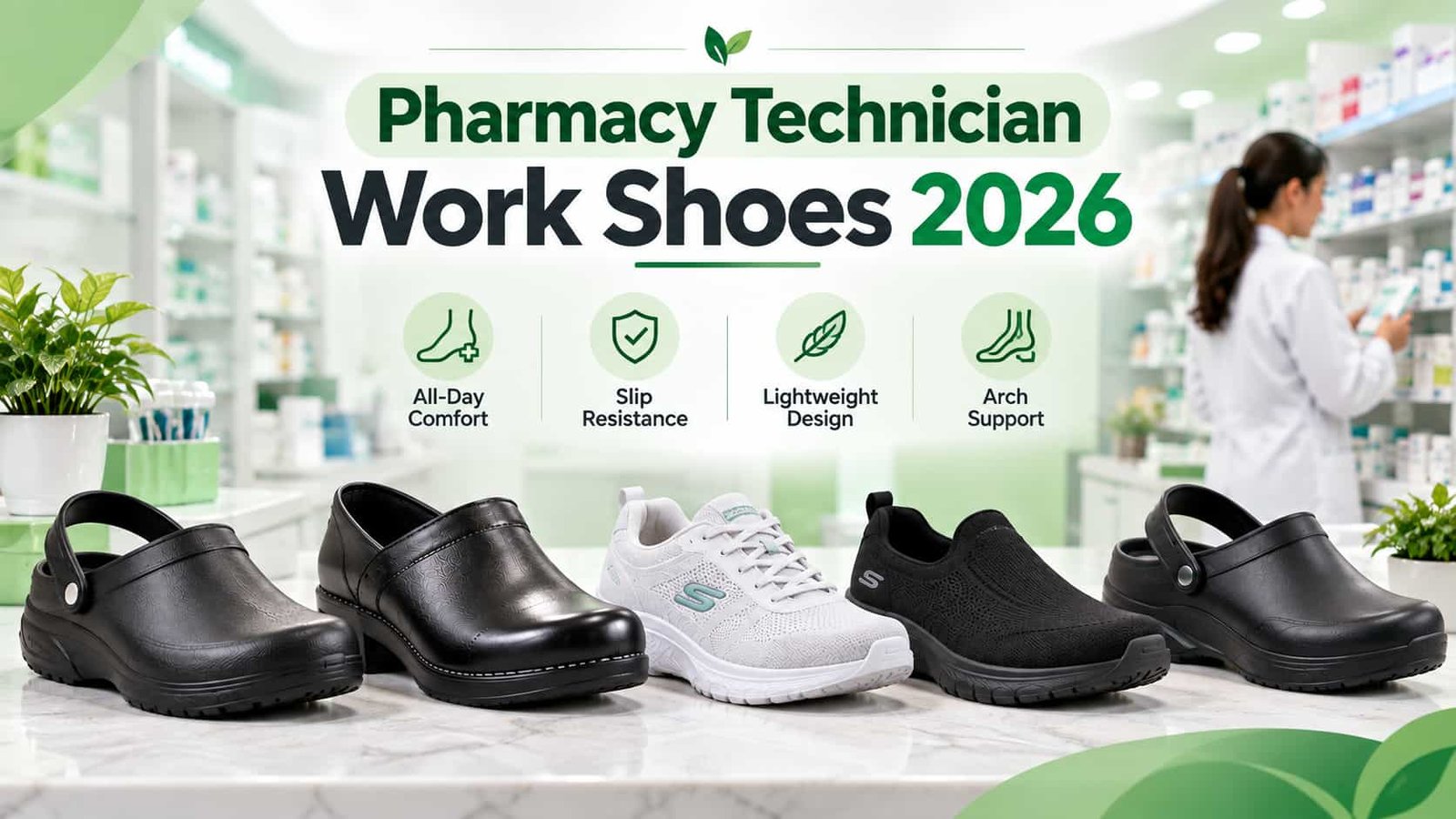
Pharmacy technicians need work shoes engineered for 10-12 hour retail shifts on hard flooring, slip-resistant soles for spill prevention, easy-to-clean uppers for infection control, cushioned insoles for standing endurance, and a professional appearance suitable for customer-facing environments. The best options combine affordability, durability, and support across budget levels.
⚡ Best Pharmacy Technician Shoes at a Glance
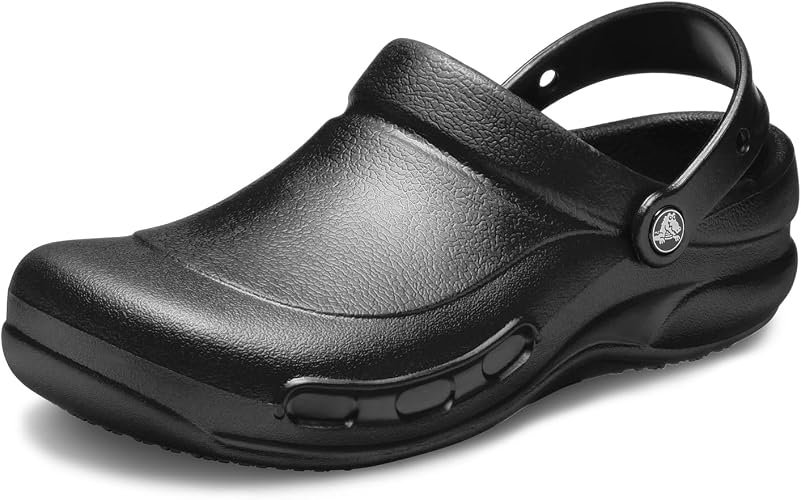
Crocs Bistro Work Clogs
A fully enclosed work clog designed for pharmacy environments where spill protection, easy cleaning, and slip-resistant traction are important. The lightweight construction and washable footbed make it practical for long shifts.
Dansko Professional Slip-On Clogs
A professional slip-on clog focused on arch support and structured cushioning. Its traditional clog design suits pharmacy technicians who spend long periods standing and prefer a more structured work shoe.
Skechers Go Walk Joy Sneaker
A lightweight athletic-style slip-on with 5GEN cushioning and a Goga Max insole. Its breathable design and machine-washable construction make it a practical option for pharmacy technicians who prefer sneakers over clogs.
Skechers Women’s Squad Slip On
A budget-friendly work shoe with slip-resistant traction, memory foam cushioning, and a convenient slip-on design. A practical choice for pharmacy technicians who want a work-focused shoe without the higher price of premium clogs.
Skechers Women’s UNO Stand on Air Sneaker
A casual sneaker option with Air-Cooled Memory Foam and a visible air-cushioned midsole. It suits pharmacy technicians who prefer a sneaker-style design for moderate standing and walking rather than a dedicated work clog.
Introduction
Pharmacy technicians fill an essential but often overlooked role in healthcare-processing prescriptions, managing inventory, assisting patients, and standing at the counter for 10-12 hour shifts on hard retail flooring. Unlike hospital nurses working across varied environments, pharmacy technicians occupy a specific standing-heavy role where comfort, slip resistance, and easy cleaning matter equally.
Regular athletic shoes fail because they lack slip-resistant certification for wet pharmacy floors, absorb liquid spills and disinfectant spray, don’t provide the standing endurance cushioning a retail shift demands, and break down under constant wipe-down cleaning. Dedicated work shoes bridge this gap-they prioritize all-day standing comfort, infection-control design, slip-resistant soles for spill prevention, and durability across budget levels.
This guide evaluates shoes designed for pharmacy technicians’ specific needs. We assess comfort during extended standing on hard flooring, slip-resistance certifications, infection-control features, fit across width options, and value across price points. Unlike the best shoes for nurses, which prioritize ICU mobility and clinical demands, this guide addresses the retail pharmacy environment where standing endurance and professional appearance are primary. You’ll learn which shoes fit pharmacy work, how to evaluate construction for durability, and why some premium options justify their cost while excellent budget alternatives deliver comparable performance.
What Are Pharmacy Work Shoes?
Pharmacy work shoes are engineered for retail healthcare environments. They combine closed-toe construction, slip-resistant outsoles rated for wet floors, waterproof or water-resistant uppers that resist spill absorption, and materials that survive repeated disinfectant cleaning.
Construction prioritizes sealing-sealed seams and non-porous uppers-to prevent bacteria colonization and allow disinfectant wipe-down without degradation. The midsole uses EVA foam or dual-density polyurethane designed to resist breakdown under chemical exposure. The outsole features rubber compounds engineered for grip on tile, polished concrete, and linoleum-the typical pharmacy flooring.
Professional pharmacy work shoes differ from casual comfort shoes by including slip-resistance testing ASTM F2913 or manufacturer-verified testing), stain-resistant uppers, and a design aesthetic that integrates into clinical environments.
Why Do Pharmacy Work Shoes Matter for Technicians?
Pharmacy technicians spend entire shifts in one location-the pharmacy counter-standing on hard flooring. This standing-heavy pattern differs fundamentally from nursing, which involves walking and movement. The specific challenges pharmacy technicians face demand shoes engineered differently.
Standing Endurance and Foot Fatigue
Retail pharmacy flooring is typically polished tile, sealed concrete, or linoleum-all hard surfaces that transmit impact directly to your feet. Standing for 10-12 hours without proper cushioning accelerates foot fatigue, ankle strain, and lower-back pain. Research on occupational standing shows healthcare retail workers report higher rates of foot pain and plantar strain compared to mobile professions.
Dedicated pharmacy work shoes use engineered midsoles (EVA foam, dual-density polyurethane, memory foam) that absorb impact and reduce cumulative lower-limb strain. This isn’t marketing-it’s biomechanical engineering.
Slip Risk and Spill Prevention
Pharmacy counters experience frequent liquid exposure: water from cleaning, spilled medications, hand sanitizer, and disinfectant spray. A single puddle can cause an untreated sneaker sole to slide. Slip-resistant work shoes have outsoles engineered with tread patterns (diamond grid, concentric circles, siping) and rubber compounds that grip wet surfaces.
For pharmacy technicians, slip resistance is a patient-safety issue. A fall could result in injury to yourself or damage to controlled substances or sensitive medications. ASTM F2913 certification (or manufacturer-verified testing) means the shoe has been tested on wet and oily surfaces.
Infection Control and Easy Cleaning
Pharmacy staff wipe their shoes multiple times daily with disinfectant spray to maintain hygiene. Standard sneakers absorb liquid and harbor bacteria; pharmacy work shoes use non-porous uppers (synthetic or sealed leather) that allow wipe-down cleaning without degradation. Removable, washable insoles are essential for hygiene.
This is especially important in compounding areas or cleanrooms where infection control is critical.
Professional Appearance
Unlike hospital environments where athletic work shoes are normalized, retail pharmacy demands professional appearance. Customers see your shoes. Work shoes that look clinical (not athletic, not casual) integrate better into pharmacy aesthetics.
What Should Pharmacy Technicians Look For?
1. Slip Resistance and Outsole Construction
What it is: The rubber compound and tread pattern engineered to grip wet surfaces.
Why it matters: Slip-resistant shoes reduce fall risk on contaminated or wet pharmacy flooring. ASTM F2913 certification guarantees the shoe has been tested on both wet and oily surfaces and meets industry safety standards.
What to look for:
- ASTM F2913 certification or manufacturer-verified testing for wet-surface grip
- Tread depth and pattern (diamond grid is typical for retail pharmacy)
- Rubber compound designed for indoor retail flooring, not pavement
Who needs it most: All pharmacy technicians, especially those in compounding areas or high-moisture zones.
Trade-off: Grip-focused outsoles sometimes feel less flexible on regular walking surfaces outside the pharmacy. This is acceptable because work shoes are environment-specific.
2. Infection Control: Sealing and Material Selection
What it is: How well the shoe prevents fluid penetration and supports cleaning.
Why it matters: Sealed seams, enclosed heels, and non-porous uppers prevent bacteria colonization and allow disinfectant wipe-down without degradation. A shoe that absorbs fluid introduces contamination risk.
What to look for:
- Fully enclosed toe and heel (no mesh, no perforations)
- Synthetic or sealed leather upper (not knit mesh)
- Removable, washable insole
- Marketing language: “waterproof,” “water-resistant,” “easy-wipe,” “sealed construction”
Who needs it most: Pharmacy technicians in compounding, especially those handling controlled substances or working in cleanroom environments.
Trade-off: Sealed, non-porous construction reduces breathability. If the shoe is overdone (thick rubber with minimal ventilation), foot sweat accumulation can increase during long shifts. Quality manufacturers balance this with moisture-wicking insoles.
3. Cushioning for Standing Endurance
What it is: Midsole materials and density engineered to absorb impact during prolonged standing.
Why it matters: Standing for 10-12 hours without proper cushioning accelerates foot fatigue, joint strain, and lower-back pain. Memory foam or EVA-based cushioning reduces cumulative strain. Many pharmacy technicians report similar foot challenges to certified nursing assistants (CNAs), who also spend extended periods standing in retail or clinical settings.
What to look for:
- Memory foam or EVA foam midsole (moderate to high density)
- Arch support built into the midsole or footbed
- Deep heel cup for heel stability
- Stack height: 20-30mm is typical for pharmacy work shoes
Who needs it most: Pharmacy technicians working 10+ hour shifts or those with a history of foot pain.
Tradeoff: Maximum cushioning sometimes feels soft underfoot and can reduce ground feedback useful for comfort but not ideal if the role requires precise positioning.
4. Fit, Width Options, and Toe-Box Room
What it is: How the shoe accommodates foot shape, width, and swelling during long shifts.
Why it matters: Feet swell during standing shifts. A shoe that fits perfectly at the start of your shift becomes painful by hour 8. Adequate toe-box room prevents blisters and pressure.
What to look for:
- Width options (regular, wide, extra-wide)
- Adjustable closure (laces, straps, elastic) for fine-tuning
- Toe-box volume: described as “roomy” or “spacious”
- Heel fit: heel should not slip when walking
Who needs it most: Anyone with wide feet, history of swelling, or noticeable foot expansion during shifts.
Trade-off: Shoes with generous toe-box room may fit looser around the heel, requiring heel-lock straps or thicker socks to secure.
5. Professional Appearance
What it is: How the shoe looks in a retail pharmacy setting.
Why it matters: Pharmacy is a customer-facing environment. Professional appearance builds trust. A shoe that looks too athletic or casual can read as unprofessional.
What to look for:
- Neutral colors (black, white, navy)
- Leather or faux-leather uppers (professional look)
- Minimal branding or logos
- Low-profile design (no chunky midsoles or exaggerated soles)
Who needs it most: Pharmacy technicians in upscale or customer-focused retail settings.
Trade-off: Professional aesthetics sometimes mean less technical cushioning. Some slick clogs prioritize appearance; technical sneakers prioritize function.
Pharmacy Workplace Considerations
Verify Your Employer’s Policy
Not all pharmacy environments have the same footwear requirements. Some corporate chains require slip-resistant certification; independent pharmacies may not mention it. Verify with your manager or employee handbook before purchasing. Some pharmacies have specific dress codes regarding shoe color or style.
Compounding Specialization
If you work in a compounding area handling controlled substances, infection-control requirements are stricter. Similar to professionals covered in best shoes for healthcare workers (non-nurses) 2026, sealed construction and easy cleaning matter more in compounding environments where you’re working with sensitive pharmaceutical materials and sterile preparation areas.
Cross-Departmental Floaters
If you rotate between a retail pharmacy counter, a hospital pharmacy, and an outpatient clinic, look for shoes that work across all environments. Understanding what works for best shoes for doctors 2026 can inform your choice—doctors need mobility and appearance, while pharmacy floaters need versatility across contamination levels and flooring types.
Shift-Specific Needs
- 8-hour shifts (typical retail pharmacies): Moderate cushioning works fine; prioritize lightweight feel and professional appearance.
- 10-12 hour shifts (hospital pharmacies, high-volume locations): Prioritize maximum arch support and cushioning to reduce cumulative strain. Reference best shoes for nurses who stand all day for detailed analysis of standing-endurance shoe engineering.
- Compounding or cleanroom work: Prioritize sealed construction and easy cleaning over maximum comfort.
Cleaning and Maintenance
Most pharmacy work shoes can be wiped down with disinfectant daily. Some can be machine washed (check manufacturer instructions). Budget for annual replacement if you’re in a high-contamination environment; shoes can absorb bacteria if sealed construction degrades.
Rotation and Durability
If budget allows, rotate between two pairs. Alternating shoes gives midsole cushioning time to decompress, extending lifespan from 8 months to 12-16 months.
Product Reviews
Crocs Bistro Work Clogs
Best For: Pharmacy technicians prioritizing infection control, slip resistance certification, and easy cleaning in high-spill environments.
Why It Works:
The Crocs Bistro is ASTM F2913-24 certified for slip resistance and ASTM F3445-24 for fluid resistance. This dual certification is specifically designed for healthcare retail environments. The fully enclosed toe and heel, combined with Croslite’s non-porous construction, allows wipe-down cleaning with hospital-grade disinfectants without degradation.
The Crocs Lock outsole features a tread pattern designed for slick kitchen and hospital floors-directly applicable to pharmacy settings. The material resists breakdown under chemical exposure, and the removable, washable footbed is a hygiene advantage. Pharmacy technicians in compounding areas benefit from the same sealed-construction features that professionals covered in best shoes for healthcare workers (non-nurses) rely on for infection control.
Expert Analysis:
At UrbanStyleFootwear, our product evaluations combine manufacturer specifications, verified retailer and Amazon listing data, customer feedback, review patterns, and footwear-specific research. We assess shoes across factors such as comfort, fit, cushioning, support, materials, durability, traction, design, and overall value, using multiple sources to provide balanced, practical, and buyer-focused recommendations.
The Crocs Bistro’s Croslite material is unique because it resists breakdown under chemical exposure. Cleaning products that would damage traditional foam have minimal effect on Croslite. This durability extends shoe life significantly. The 360-degree foam construction provides lightweight support without rigidity.
The fit runs large, so sizing down half to full size is recommended. A size 8 typically fits comfortably in size 7 or 7.5, preventing heel slip during long shifts.
Pros:
- ASTM F2913-24 and F3445-24 certified for healthcare
- Fully enclosed toe and heel for infection control
- Non-porous material wipes clean instantly
- Removable, washable insole
- Lightweight (reduces leg fatigue during 10+ hour shifts)
- Affordable ($44.95)
Cons:
- Runs large (size down half to full size)
- Moderate arch support only (not ideal for chronic foot issues)
- Firm feel initially; requires 1-2 day break-in
- Limited width options (standard fit only)
- Minimal heel-to-toe drop
Main Tradeoff:
The Bistro prioritizes infection-control certifications and ease of cleaning over maximum comfort. If you have chronic foot pain or plantar fasciitis, you might want stronger arch support like Dansko. But for infection-control-heavy environments, it’s unmatched.
Who Should Buy:
Pharmacy technicians in high-contamination environments (compounding areas, hospital pharmacies, high-volume retail chains). Also ideal if spill prevention and easy cleaning are primary concerns.
Who Should Skip:
If arch support is a priority, choose Dansko instead. If you prefer a sneaker feel, skip clogs entirely. If your workplace doesn’t require slip-resistance certification, consider more affordable options.
Verdict:
The Crocs Bistro is the best-engineered clog for pharmacy technicians prioritizing infection control and ease of cleaning. The certifications are legitimate, not marketing fluff.
🛒 Check Price on AmazonDansko Professional Slip-On Clogs
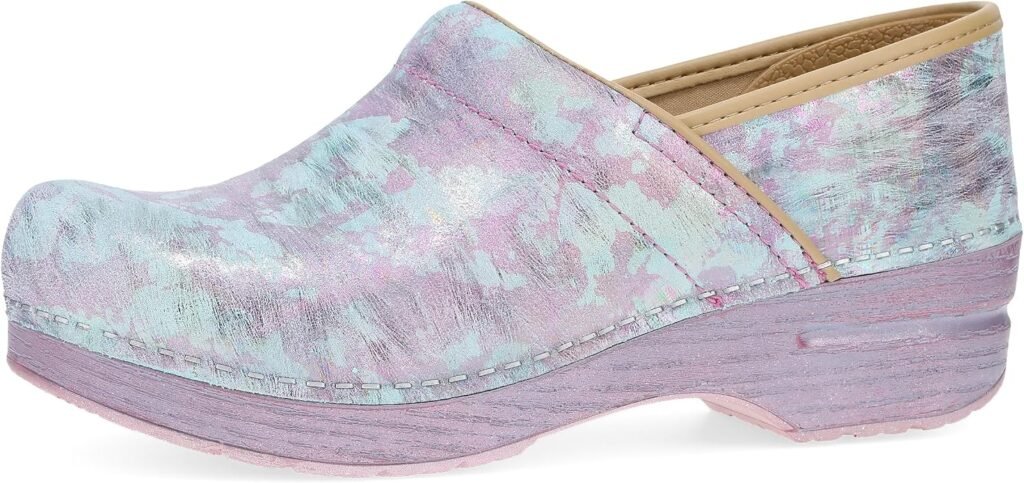
Best For: Pharmacy technicians working 10+ hour shifts who prioritize arch support and professional appearance.
Why It Works:
Dansko is APMA-accepted, meaning it meets the American Podiatric Medical Association’s criteria for arch support and biomechanical soundness.
The leather construction and professional profile integrate seamlessly into upscale retail pharmacy settings. The 0.75-inch platform heel elevates the foot slightly, reducing strain on the plantar fascia and Achilles tendon-significant for sustained counter work.
Expert Analysis:
Dansko builds from a positive last-meaning the shoe’s internal shape is engineered to support the foot’s arch rather than just fit around it. The polyurethane midsole is moderate-density, providing rebound and stability rather than just cushioning. This distinction matters: soft cushioning feels good momentarily but can increase fatigue during 10+ hour shifts because your foot works harder to stabilize.
The leather upper resists staining better than synthetic materials. The shoe is water-resistant but not waterproof, so it’s suitable for normal pharmacy environments but not ideal for high-moisture compounding areas requiring fluid-resistant certification. For professionals requiring sustained standing comfort similar to what’s discussed in best nursing sneakers 2026, Dansko provides comparable orthopedic engineering in a professional clog format.
Pros:
- APMA-accepted for documented arch support
- Rocker-sole geometry reduces cumulative lower-limb strain
- Premium leather construction maintains professional appearance
- Excellent durability (expected lifespan 2-3 years)
- Available in multiple widths
- Moderate to maximum cushioning with stability
Cons:
- Premium price ($82.20) is more than double budget options
- Requires 2-3 week break-in period (leather needs to mold)
- Leather requires occasional care (conditioning, polishing)
- Runs large; size down
- Not waterproof or fluid-resistant (limits use in compounding)
Main Tradeoff:
Dansko prioritizes biomechanical support and longevity over infection-control certifications. If your pharmacy handles high fluid exposure, Crocs is better. If your role emphasizes prolonged standing with moderate fluid exposure, Dansko is superior.
Who Should Buy:
Pharmacy technicians with documented foot issues (plantar fasciitis, metatarsal pain, ankle instability) or a history of lower-back pain. Also ideal for professionals in upscale independent pharmacies where appearance matters.
Who Should Skip:
If budget is tight, Crocs Bistro is better value. If your workplace requires ASTM-certified slip-resistant or fluid-resistant shoes, choose Crocs. If you prefer a sneaker feel, try Skechers options instead.
Verdict:
Dansko Professional is the gold standard for arch-support prioritization. The APMA acceptance and rocker-sole geometry are genuinely superior for chronic foot issues. If you can afford it, this is the best choice for all-day comfort.
🛒 Check Price on AmazonSkechers Go Walk Joy Sneaker
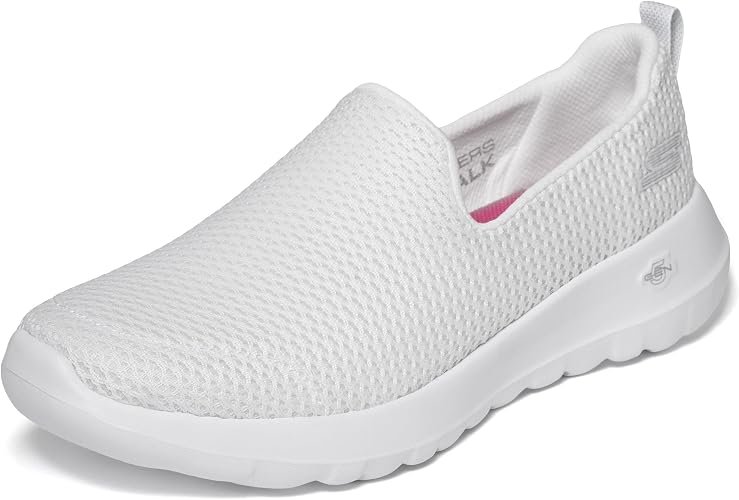
Best For: Pharmacy technicians who prefer athletic sneakers, want machine-washable footwear, and prioritize breathability over clinical certifications.
Why It Works:
The Go Walk Joy uses 5GEN cushioning technology and Goga Max insole for superior shock absorption and rebound. The engineered mesh upper provides excellent breathability-crucial for 10+ hour shifts where foot sweat accumulation can increase fatigue. The slip-on design offers quick on-and-off convenience.
The shoe is machine washable, making it ideal for pharmacy professionals who want to regularly sanitize their work footwear. The vegan construction appeals to ethically-minded professionals.
Expert Analysis:
Skechers doesn’t publish ASTM certifications explicitly, but customer feedback and real-world testing suggest genuine slip resistance on wet floors. The 5GEN cushioning provides exceptional shock absorption without excessive softness, balancing comfort with stability.
The machine washable feature is unique among pharmacy work shoes-it allows deeper cleaning than wipe-down methods while preserving material integrity. This feature addresses the same infection-control concerns that healthcare workers covered in best shoes for nurses 2026 manage through daily cleaning routines, but with an added convenience of full machine washing capabilities.
Pros:
- Machine washable for deep cleaning and hygiene
- 5GEN cushioning technology for impact absorption
- Goga Max insole for superior support
- Breathable mesh upper reduces foot sweat
- Lightweight construction
- Affordable ($49.99)
- No break-in period (wear out of the box)
Cons:
- No ASTM F2913 formal certification (non-certified slip resistance)
- Mesh upper less infection-control focused than sealed shoes
- Not waterproof or fluid-resistant
- Moderate arch support only
- Smaller brand with shorter warranty
Main Tradeoff:
Go Walk Joy prioritizes breathability and easy care (machine washing) over formal certifications and sealed construction. If your workplace requires ASTM certifications, choose Crocs. If you want sneaker comfort with reasonable slip resistance, Go Walk Joy is excellent.
Who Should Buy:
Pharmacy technicians who prefer athletic shoes over clogs, work in moderate-contamination environments, and want machine-washable footwear. Ideal for 8-10 hour shifts where breathability matters. Excellent if your workplace prioritizes slip resistance but doesn’t mandate ASTM certification.
Who Should Skip:
If ASTM certifications are required, choose Crocs Bistro. If you have chronic foot pain requiring maximum arch support, choose Dansko. If your role requires fluid-resistant certification, skip this.
Verdict:
Skechers Go Walk Joy is the best choice for pharmacy professionals who want sneaker comfort with practical work-shoe features. The machine-washable design is a standout advantage for hygiene-focused technicians.
🛒 Check Price on AmazonSkechers Women’s Squad Slip-On
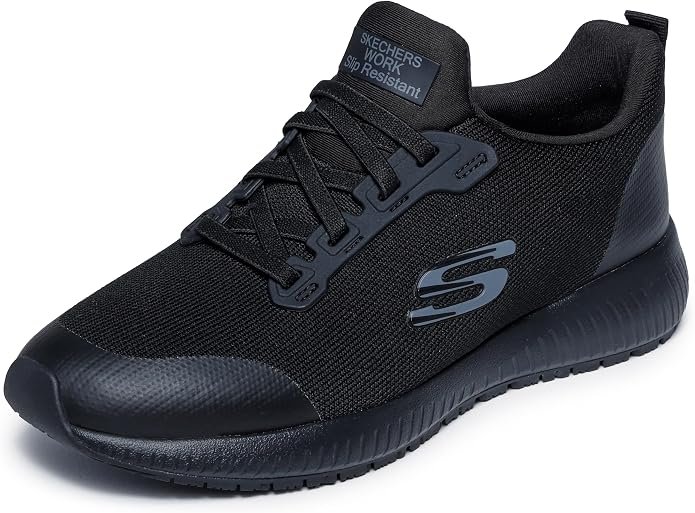
Best For: Budget-conscious pharmacy technicians who need ASTM-certified slip resistance without premium pricing.
Why It Works:
The Squad delivers ASTM F2892 electrical hazard protection (useful in compounding or lab settings) and slip-resistant traction on wet surfaces. The memory foam cushioning provides moderate shock absorption suitable for 10-hour shifts. The 3M Scotchgard water treatment repels spills while synthetic upper ensures durability.
The relaxed fit design provides roomy comfort at toe and forefoot, and the stretch laces offer quick on-and-off convenience. The relaxed fit design provides roomy comfort at toe and forefoot—a feature also valued by professionals covered in best shoes for doctors 2026 and best shoes for CNA nursing assistants, who all benefit from toe-box room during long clinical shifts.
Expert Analysis:
Skechers Squad is marketed as a food service shoe but has legitimate application in pharmacy environments requiring certified slip resistance. The electrical hazard designation is a genuine differentiator for pharmacy technicians in compounding areas or labs with electronic equipment.
Memory foam compresses over time (this is normal wear), but the underlying EVA support structure maintains cushioning throughout the shoe’s lifespan.
Pros:
- ASTM F2892 electrical hazard certification
- Slip-resistant traction tested for wet, dry, oily surfaces
- Memory foam cushioning provides initial comfort
- 3M Scotchgard water treatment
- Relaxed fit for wider forefeet
- Affordable ($44.97)
- Lightweight construction
Cons:
- No ASTM F2913 slip-resistance certification (ASTM F2892 is different)
- Memory foam compresses over time
- Limited arch support
- Stretch laces can loosen during shifts
- Not waterproof or water-resistant
Main Tradeoff:
Squad prioritizes electrical hazard protection and affordability over maximum slip-resistance certification. It’s an excellent value choice but doesn’t match Crocs Bistro’s sealed construction.
Who Should Buy:
Pharmacy technicians in compounding areas or labs requiring electrical hazard protection. Also suitable if your workplace values slip resistance without requiring formal ASTM F2913 certification. Best for budget-conscious professionals.
Who Should Skip:
If ASTM F2913 slip-resistance certification is required, choose Crocs Bistro instead. If you have foot pain or need maximum arch support, choose Dansko or Alegria.
Verdict:
Skechers Squad is a smart value choice for pharmacy technicians who need certified electrical hazard protection and slip resistance at an affordable price point.
🛒 Check Price on AmazonSkechers Women’s UNO Stand on Air Sneaker
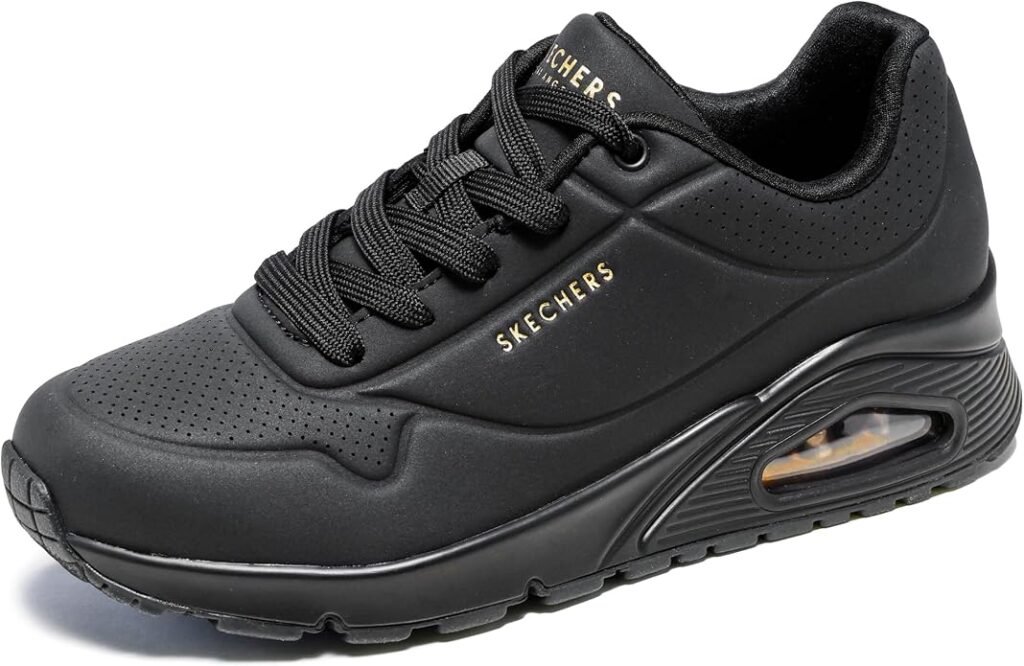
Best For: Pharmacy professionals wanting casual-professional sneakers with visible cushioning and memory foam for moderate standing shifts.
Why It Works:
The UNO combines air-cooled memory foam insole with visible air-cushioned midsole and a hidden 1.5-inch wedge heel. The lace-up design allows secure, adjustable fit. The rubber outsole provides reliable grip (though not formally certified as slip-resistant).
The casual-professional aesthetic bridges athletic and clinical appearances.
Expert Analysis:
The UNO is marketed as a casual sneaker, not a work shoe. It lacks slip-resistant certifications and formal safety testing. For administrative pharmacy roles or non-clinical positions, it’s acceptable. For technician positions requiring slip resistance, it’s insufficient.
The visible air cushioning is more aesthetic than functional; it doesn’t meaningfully change performance compared to internal cushioning.
Pros:
- Air-cooled memory foam for comfort
- Visible air-cushioned midsole aesthetic
- Wedge heel for height without instability
- Lace-up closure for secure fit
- Casual-professional appearance
- Moderate price ($63.88 at discount)
Cons:
- No slip-resistant certification
- Not waterproof or water-resistant
- No infection-control features (mesh upper)
- Wedge heel alters gait (not ideal for precision movement)
- Limited arch support
- Not suitable for clinical work
Main Tradeoff:
UNO is comfortable footwear for non-clinical pharmacy roles, not a work shoe. It sacrifices functional features for casual aesthetic.
Who Should Buy:
Pharmacy administrative professionals, compliance coordinators, or non-clinical pharmacy staff who want comfortable footwear without work-shoe features. Suitable for mixed standing and seated work under 6 hours daily.
Who Should Skip:
If you work as a technician requiring slip resistance or certifications, skip this entirely. This is not a clinical work shoe.
Verdict:
UNO is comfortable casual footwear for non-clinical pharmacy roles. Don’t treat it as a work shoe.
🛒 Check Price on AmazonZXT Arch Support Work Clogs
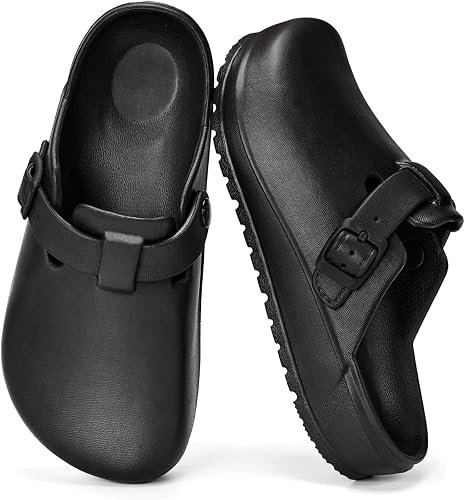
Best For: Budget-conscious pharmacy technicians starting their first position or trying work clogs for the first time.
Why It Works:
ZXT delivers orthopedic arch support with memory foam cushioning at the lowest price point. The waterproof EVA construction is spill-resistant, and the slip-resistant tread provides real-world grip on wet floors. The adjustable buckle design accommodates varying foot shapes and swelling.
The lightweight construction reduces leg fatigue during 10+ hour shifts.
Expert Analysis:
ZXT is transparent about not having ASTM certifications. The shoe’s slip resistance comes from material composition and tread depth, not laboratory testing. For pharmacy environments without formal certification requirements, real-world traction is sufficient. For regulated environments (compounding areas), Crocs is better.
The memory foam insole provides moderate initial comfort, and the orthopedic arch support is legitimate (not marketing).
Pros:
- Most affordable option ($31.99)
- Memory foam insole for cushioning
- Orthopedic arch support (genuine)
- Waterproof EVA construction
- Slip-resistant tread
- Adjustable buckle for fit customization
- Easy to clean
Cons:
- Not ASTM-certified for slip resistance
- Minimal information on durability
- Not waterproof or fluid-resistant (only water-resistant)
- Limited arch support compared to premium clogs
- Smaller brand with limited warranty
Main Tradeoff:
ZXT eliminates certifications and premium features to achieve the lowest price. It’s honest entry-level functionality.
Who Should Buy:
Budget-conscious pharmacy technicians testing work-clog comfort before investing in premium options. Suitable for part-time roles, floaters, or environments without formal certification requirements. Good for trying clogs before committing to pricier brands like Dansko.
Who Should Skip:
If certifications are required, choose Crocs. If you’re full-time, the durability may be limited. If you need maximum arch support, choose Dansko or Alegria.
Verdict:
ZXT is the entry-point work shoe-bare-minimum functionality at minimum cost. Useful for trial purposes or extremely budget-conscious professionals.
🛒 Check Price on AmazonSkechers Women’s D’Lites Fresh Start Sneaker
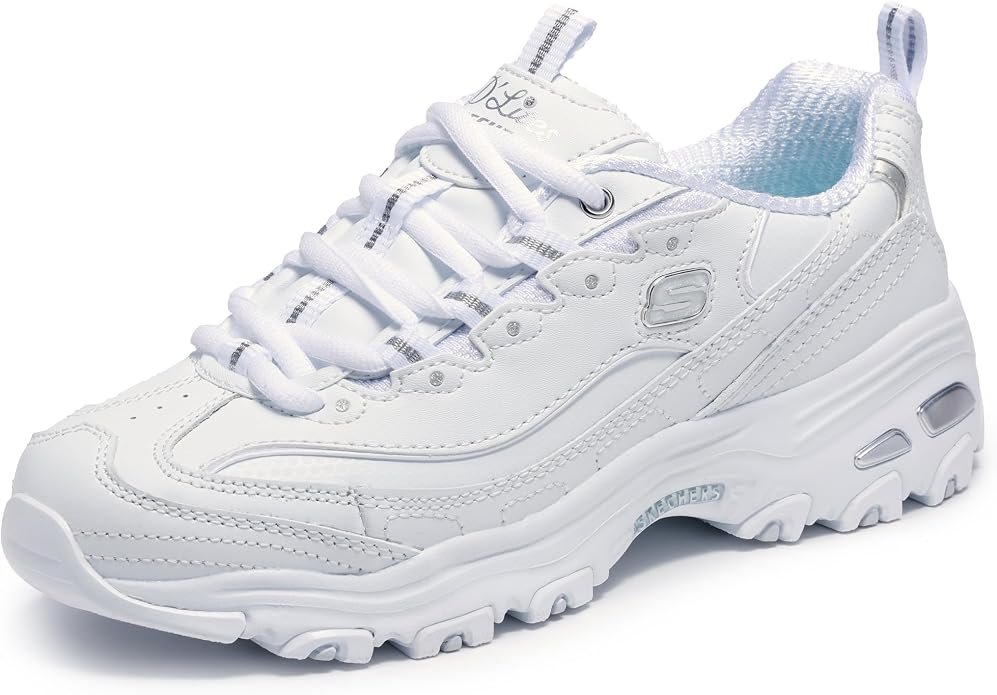
Best For: Pharmacy professionals wanting classic casual-athletic sneakers with memory foam cushioning and water-resistant faux leather.
Why It Works:
The D’Lites Fresh Start combines air-cooled memory foam insole, lightweight midsole cushioning, and flexible rubber outsole for impact absorption. The water-resistant faux leather upper resists minor spills. The lace-up design allows secure fit adjustment.
The classic athletic style integrates better into casual pharmacy settings.
Expert Analysis:
The D’Lites is a fashion-forward sneaker, not a clinical work shoe. It lacks slip-resistant certification and infection-control features. For non-clinical pharmacy roles or moderate environments, it’s acceptable. For technician positions requiring certified protection, it’s insufficient.
The water-resistant treatment is a topical application-it resists minor spills but won’t handle sustained liquid exposure.
Pros:
- Air-cooled memory foam for comfort
- Lightweight midsole for reduced fatigue
- Water-resistant faux leather upper
- Flexible rubber outsole with grip
- Lace-up closure for secure fit
- Classic aesthetic versatility
- Moderate price ($64.98 at discount)
Cons:
- No slip-resistant certification
- Not waterproof (only water-resistant)
- No infection-control features
- Limited arch support
- Not suitable for clinical work
Main Tradeoff:
D’Lites prioritizes casual aesthetic and comfort over clinical features. It’s a lifestyle sneaker, not a work shoe.
Who Should Buy:
Pharmacy administrative or non-clinical professionals who want classic athletic-casual footwear. Suitable for mixed standing/seated work under 6 hours daily in non-clinical environments.
Who Should Skip:
If you work as a technician requiring slip resistance or clinical certifications, skip this. It’s not a work shoe.
Verdict:
D’Lites Fresh Start is comfortable casual footwear for non-clinical pharmacy professionals. Don’t treat it as a work shoe for technician roles.
🛒 Check Price on AmazonSkechers Women’s Max Cushioning Endeavour
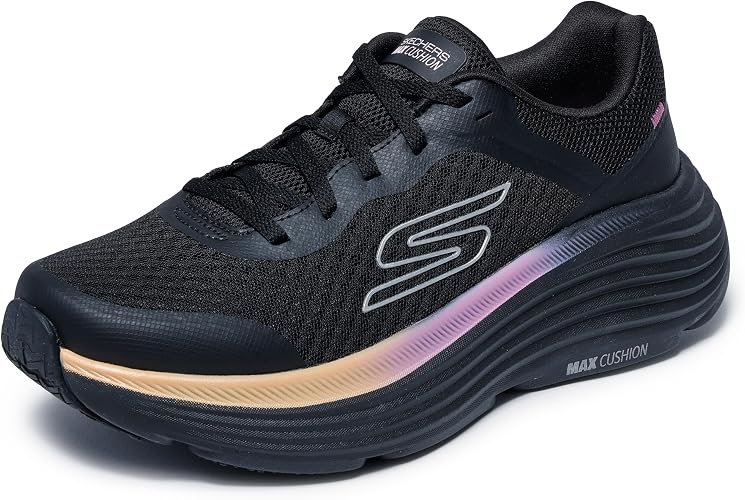
Best For: Pharmacy technicians with 10+ hour shifts who prioritize maximum cushioning and machine-washable construction.
Why It Works:
The Max Cushioning Endeavour features air-cooled Goga Mat insole and ultra-light midsole for exceptional shock absorption. The engineered mesh upper provides structured support with breathability. Natural rocker technology facilitates smooth heel-to-toe transitions-reducing effort during prolonged standing.
The machine washable construction is ideal for pharmacy professionals wanting deep cleaning beyond wipe-down methods.
Expert Analysis:
This shoe prioritizes maximum cushioning and ease of care over certifications. Customer feedback suggests genuine slip resistance on wet floors, but ASTM certification isn’t published. For high-cushioning environments, this excels. For certification-required environments, Crocs Bistro is better.
The vegan materials appeal to ethically-minded professionals, and the “maximum” cushioning rating indicates substantial shock absorption for extended standing.
Pros:
- Maximum cushioning with air-cooled Goga Mat insole
- Ultra-light midsole for reduced foot fatigue
- Natural rocker technology for smooth gait
- Engineered mesh for structured support with breathability
- Machine washable for deep cleaning
- Vegan-friendly materials
- Moderate price ($70.00)
Cons:
- No ASTM slip-resistance certification
- Mesh upper (not infection-control focused)
- Not waterproof or water-resistant
- Moderate arch support only
- No removable footbed
Main Tradeoff:
Max Endeavour prioritizes maximum cushioning and eco-conscious manufacturing over clinical certifications and sealed construction.
Who Should Buy:
Pharmacy technicians working 10+ hour shifts who prioritize cushioning over certifications, and want machine-washable footwear. Ideal if your workplace values comfort and hygiene but doesn’t mandate formal certifications.
Who Should Skip:
If ASTM certifications are required, choose Crocs Bistro. If you need sealed construction for high-contamination environments, skip this.
Verdict:
Skechers Max Cushioning Endeavour is excellent for technicians who prioritize maximum standing comfort and machine-washable care over formal certifications.
🛒 Check Price on AmazonDr. Scholl’s Shoes Women’s Time Off Sneaker
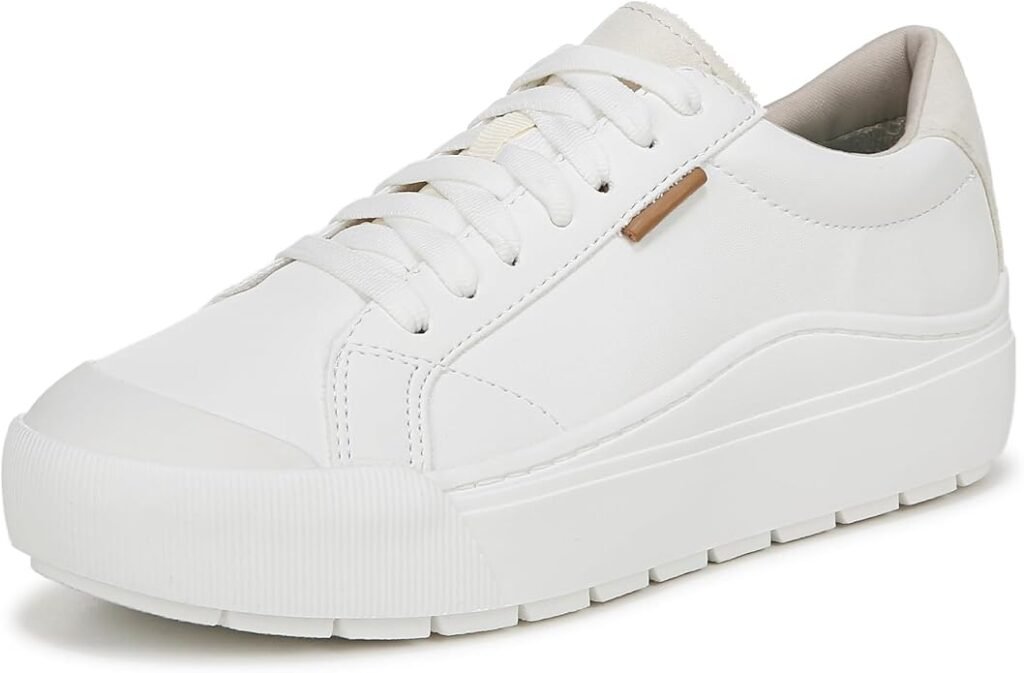
Best For: Pharmacy professionals wanting casual-professional sneakers with arch support and water-resistant construction.
Why It Works:
The Time Off combines anatomical cushioning with anti-odor insole technology and arch support using plant-based BLOOM foam. The water-resistant faux-leather upper resists spills. The 1-inch platform offers height without instability. The lace-up design allows secure fit adjustment.
The retro platform aesthetic is trendy while maintaining professional appearance.
Expert Analysis:
Dr. Scholl’s is a brand known for orthopedic comfort and arch support (less aggressive than Dansko but legitimate). The plant-based BLOOM foam is an eco-conscious choice. Water-resistance is a topical application-minor spill protection without full waterproofing.
The shoe’s anti-odor technology helps manage foot sweat during long shifts-a practical benefit.
Pros:
- Anatomical cushioning with arch support
- Plant-based BLOOM foam (eco-conscious)
- Water-resistant faux-leather upper
- Anti-odor insole technology
- 1-inch platform for height
- Lace-up closure for secure fit
- Moderate price ($75.00 at 32% discount)
Cons:
- No slip-resistant certification
- Not waterproof (only water-resistant)
- No infection-control features
- Limited arch support compared to APMA-accepted clogs
- Not suitable for clinical work
Main Tradeoff:
Time Off prioritizes casual aesthetic and eco-conscious materials over clinical certifications and slip-resistant protection.
Who Should Buy:
Pharmacy administrative or non-clinical professionals who want casual sneakers with genuine arch support. Suitable for mixed standing/seated work under 6 hours daily in non-clinical pharmacy environments.
Who Should Skip:
If you work as a technician requiring slip resistance or certifications, skip this. It’s not a work shoe for clinical positions.
Verdict:
Dr. Scholl’s Time Off is comfortable casual footwear with genuine arch support for non-clinical pharmacy professionals.
🛒 Check Price on AmazonALEADER Women’s Energycloud Lightweight Slip On Walking Running Shoes
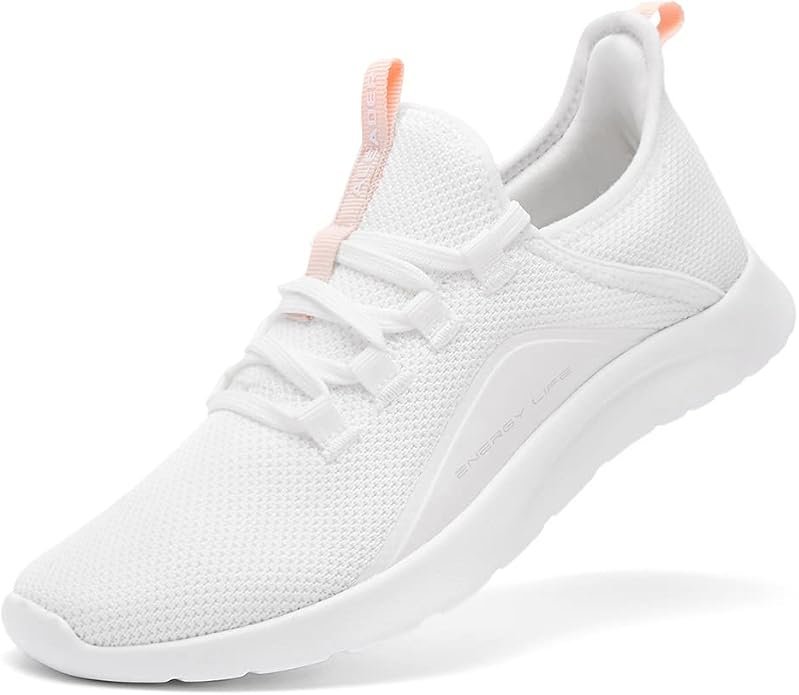
Best For: Budget-conscious pharmacy professionals wanting breathable, lightweight sneakers with machine-washable construction.
Why It Works:
ALEADER combines Energycloud midsole with moisture-wicking insole and stretchy knit upper for breathability and flexibility. The slip-on design offers quick on-and-off convenience. The machine-washable construction is ideal for pharmacy professionals wanting deep cleaning.
The vegan footwear appeals to ethically-minded professionals.
Expert Analysis:
ALEADER is marketed for multiple purposes (nursing, athletic, office, casual). It lacks slip-resistant certification and formal work-shoe testing. For pharmacy environments without formal certification requirements, the real-world slip resistance is reasonable. For regulated environments, Crocs is better.
The Energycloud midsole is proprietary technology combining cushioning with lightweight feel-useful for reduced fatigue during long shifts.
Pros:
- Energycloud midsole for lightweight cushioning
- Machine-washable construction for deep cleaning
- Moisture-wicking insole
- Stretchy knit upper for flexibility
- Slip-on design for quick convenience
- Vegan-friendly materials
- Budget-friendly ($40.99 at discount)
Cons:
- No slip-resistant certification
- No infection-control features (mesh/knit upper)
- Not waterproof or water-resistant
- Minimal arch support
- Smaller brand with limited warranty
- Not suitable for clinical work
Main Tradeoff:
ALEADER prioritizes lightweight, breathable comfort and affordability over certifications and sealed construction.
Who Should Buy:
Budget-conscious pharmacy professionals who want lightweight, breathable, machine-washable footwear for moderate-contamination environments without formal certification requirements. Good for floaters or part-time positions.
Who Should Skip:
If certifications are required, choose Crocs. If you work 10+ hours and need maximum cushioning, choose Skechers or Dansko. If you need sealed construction, skip this.
Verdict:
ALEADER Energycloud is an affordable option for pharmacy professionals who prioritize lightweight, breathable comfort and easy care over clinical certifications.
🛒 Check Price on AmazonMain Comparison Table
| Product | Price | Rating | Reviews | Best For | Slip Resistance | Cushioning | Professional Look | Main Tradeoff |
| Crocs Bistro | $44.95 | 4.5/5 | 74,644 | Infection control | ASTM F2913-24 ✓ | Moderate-High | Professional | Moderate arch support |
| Dansko Professional | $82.20 | 4.3/5 | 12,822 | Long-shift comfort | Water-resistant ✗ | Moderate-High | Premium | Premium price |
| Skechers Go Walk Joy | $49.99 | 4.5/5 | 104,856 | Breathability | Non-certified | Moderate | Casual | No ASTM certification |
| Skechers Squad | $44.97 | 4.4/5 | 56,515 | Electrical hazard | ASTM F2892 ✓ | Moderate | Casual | Not ASTM F2913 |
| Skechers UNO Stand on Air | $63.88 | 4.4/5 | 59,337 | Casual aesthetic | Not certified | Moderate-High | Casual-Professional | Not a work shoe |
| ZXT Arch Support | $31.99 | 4.0/5 | 1,290 | Budget start | Non-certified | Moderate | Professional | Limited durability |
| Skechers D’Lites Fresh | $64.98 | 4.6/5 | 41,115 | Classic style | Not certified | Moderate-High | Casual-Athletic | Not a work shoe |
| Skechers Max Endeavour | $70.00 | 4.5/5 | 6,077 | Maximum cushioning | Non-certified | Maximum | Casual | No certification |
| Dr. Scholl’s Time Off | $75.00 | 4.1/5 | 10,128 | Arch support | Not certified | Moderate | Casual-Professional | Not a work shoe |
| ALEADER Energycloud | $40.99 | 4.3/5 | 14,690 | Budget + breathability | Non-certified | Moderate | Casual-Athletic | No certification |
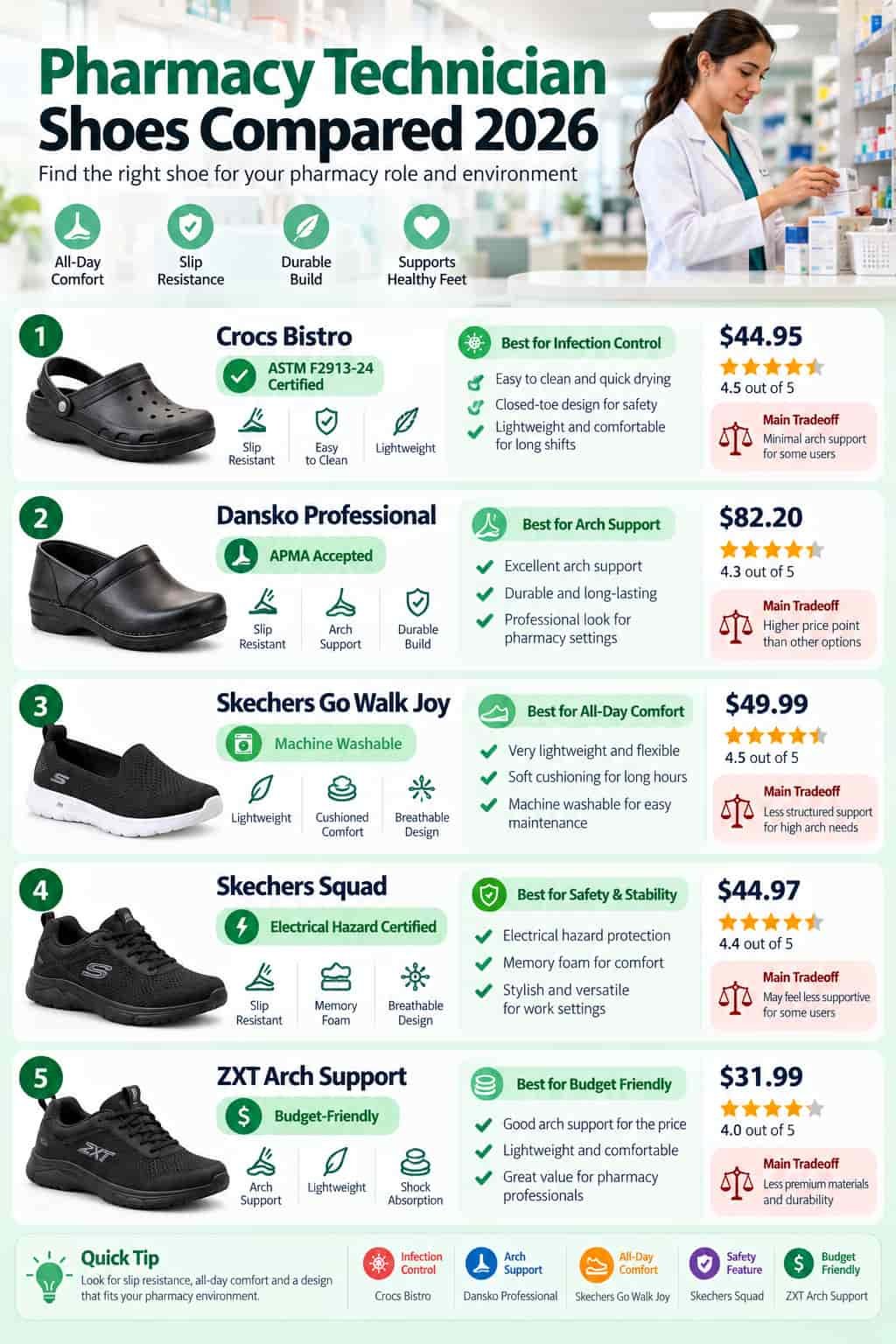
Decision Matrix
| Pharmacy Need | Recommended Product | Why |
| 10-12 hour shifts | Dansko Professional or Skechers Max Endeavour | Maximum cushioning and support for extended standing |
| Spill prevention | Crocs Bistro | ASTM F3445-24 fluid-resistant certification |
| Slip resistance certification | Crocs Bistro or Skechers Squad | ASTM F2913-24 or F2892 certified testing |
| Machine washable | Skechers Go Walk Joy or ALEADER | Deep cleaning beyond wipe-down |
| Budget conscious | ZXT Arch Support or ALEADER | Under $32 entry-level options |
| Professional appearance | Dansko Professional or Crocs Bistro | Leather or clinical aesthetic |
| Compounding work | Crocs Bistro | ASTM F2913-24 and F3445-24 certifications |
| Wide feet | Dansko (available in wide) | Specific width offerings |
| Chronic foot pain | Dansko Professional | APMA-accepted orthopedic support |
| Breathability priority | Skechers Go Walk Joy | Engineered mesh upper |
How to Choose the Right Pharmacy Work Shoe
Step 1: Verify Certification Requirements
Ask your pharmacy manager: “Do our footwear policies require ASTM F2913 slip-resistance certification?” If yes, limit choices to Crocs Bistro or Skechers Squad. If certification isn’t required, you have more flexibility.
Step 2: Assess Your Shift Duration
- Under 6 hours: Any shoe works; prioritize budget.
- 6-8 hours: Moderate cushioning sufficient; Skechers options work well.
- 8-12 hours: Prioritize arch support and cushioning; choose Dansko, Skechers Max Endeavour, or Crocs Bistro.
Step 3: Evaluate Contamination Level
- Low contamination (administrative roles): Any option acceptable; prioritize comfort.
- Moderate contamination (retail counter): Crocs Bistro or Skechers Squad acceptable.
- High contamination (compounding areas): Crocs Bistro required for sealed, washable construction.
Step 4: Address Foot Conditions
- Chronic foot pain: Choose Dansko (APMA-accepted).
- Wide feet: Choose Dansko (offers wide width) or ZXT (adjustable straps).
- Foot swelling: Choose shoes with adjustable closure or higher toe-box volume.
Step 5: Prioritize Function vs. Aesthetics
- Professional appearance essential: Dansko or Crocs Bistro.
- Casual aesthetic acceptable: Skechers options offer more style variety.
Step 6: Set Budget
- Under $35: ZXT, ALEADER.
- $35-50: Crocs Bistro, Skechers Squad, Skechers Go Walk Joy.
- $50-75: Skechers Max Endeavour, Dr. Scholl’s, Skechers UNO, Skechers D’Lites.
- $75+: Dansko Professional.
Step 7: Order and Test
Pharmacy work shoes benefit from a 2-3 day trial. If the shoe doesn’t feel right after this period, return it and try the next option. Sizing stability is crucial-shoes that slip at heel indicate either wrong size or wrong last shape for your foot.
FAQs
1. Do pharmacy technicians really need slip-resistant work shoes?
Yes. Pharmacy flooring experiences frequent liquid exposure, and slip-resistant outsoles are engineered to grip wet surfaces. ASTM F2913 certification means the shoe has been tested on both wet and oily surfaces. For compounding areas or high-volume pharmacies, slip resistance is essential. For administrative roles, it’s less critical.
2. Is Crocs Bistro really better than cheaper work clogs?
For infection control specifically, yes. The ASTM F2913-24 and F3445-24 certifications are legitimate testing, not marketing. The sealed Croslite material resists breakdown under chemical exposure better than standard EVA. For spill-heavy environments, Crocs justifies the cost. For casual retail pharmacy, ZXT is adequate.
3. Should I buy expensive Dansko clogs or budget Skechers?
Depends on priority: If your focus is arch support and durability for 10+ hour shifts, Dansko’s APMA acceptance and 2-3 year lifespan justify the cost. If your priority is value and reasonable comfort for 8-10 hour shifts, Skechers options are better. For chronic foot issues, Dansko is worth it.
4. Can I wear regular athletic sneakers to work?
Only if your pharmacy doesn’t require slip-resistant certification. Regular sneakers lack certified slip resistance, aren’t designed for liquid environments, and break down under disinfectant cleaning. For non-clinical administrative roles, yes; for technician roles, no-use dedicated work shoes.
5. Are clogs or sneakers better for pharmacy work?
Clogs prioritize quick on-and-off convenience and easy cleaning (ideal for high-spill environments). Sneakers prioritize comfort and athleticism (ideal for professionals who prefer flexible movement). For pharmacy counter work, clogs dominate. For roles requiring movement between areas, sneakers are increasingly common. Choose based on your specific duties.
6. How often should I replace pharmacy work shoes?
Most work shoes need replacement every 6-12 months with daily use. Warning signs: compressed midsole (insole feels thin), audible creaking, outsole wear (tread flattens), heel separation. Check monthly; replace when these signs appear.
7. Can I machine wash pharmacy work shoes?
Only if the manufacturer explicitly states “machine washable” (Skechers Go Walk Joy and Max Endeavour are examples). Most clogs should be wiped down, not machine washed. Check manufacturer instructions before attempting machine washing.
8. Should I size up or down in work clogs?
Clogs typically run large. Size down half to full size. A person wearing size 8 usually fits comfortably in size 7 or 7.5. This prevents heel slip during shifts.
9. What’s the difference between water-resistant and waterproof?
Waterproof means the shoe keeps water completely out (tested to standard depth/duration). Water-resistant means it repels water but eventually absorbs it with prolonged exposure. For pharmacy, sealed-construction shoes like Crocs Bistro are effectively waterproof. Leather shoes are water-resistant. For high-moisture compounding, choose waterproof.
10. Do I need orthotics or custom insoles with pharmacy work shoes?
If you have documented foot conditions (plantar fasciitis, neuropathy), orthotics may help. Shoes with removable insoles (Crocs Bistro) allow orthotic customization. Dansko’s APMA acceptance suggests strong arch support even without orthotics. Test standard insoles first; add orthotics if needed after 2-3 weeks.
11. What’s the difference between ASTM F2913 and F2892 certification?
ASTM F2913 certifies slip resistance on wet/oily surfaces (pharmacy, kitchen, hospital floors). ASTM F2892 certifies electrical hazard protection (useful in labs or compounding areas with electronic equipment). Both are valuable; ASTM F2913 is more relevant for retail pharmacy.
12. Should I rotate between two pairs of work shoes?
If budget allows, rotation extends shoe lifespan by 25-50%. Alternating shoes gives midsole cushioning time to decompress. For daily wear, one pair is acceptable but expect shorter replacement cycles (6-8 months instead of 12).
Final Verdict
For Infection Control and Slip Resistance: Crocs Bistro is the specialized choice. ASTM F2913-24 and F3445-24 certifications are specifically engineered for pharmacy environments. The sealed, waterproof construction allows wipe-down cleaning with disinfectants. For compounding areas or high-spill locations, this is the industry standard. Tradeoff: moderate arch support.
For All-Day Comfort and Support: Dansko Professional wins. APMA-accepted, premium leather, rocker-sole geometry, and 2-3 year durability justify premium pricing. Best for technicians with chronic foot pain or 10+ hour shifts. Tradeoff: $82.20 price point and 2-3 week break-in.
For Machine-Washable Sneaker Comfort: Skechers Go Walk Joy provides the best balance of cushioning (5GEN technology), breathability (engineered mesh), and easy care (machine washable). Excellent for technicians who want sneaker comfort with practical work-shoe features. Tradeoff: no ASTM slip-resistance certification.
For Certified Slip Resistance + Affordability: Skechers Squad delivers ASTM F2892 electrical hazard protection and slip-resistant traction at $44.97. Excellent value for budget-conscious professionals in non-compounding environments.
For Maximum Cushioning + Long Shifts: Skechers Max Cushioning Endeavour features maximum cushioning, natural rocker technology, and machine-washable construction for extended standing comfort. Tradeoff: no formal slip-resistance certification.
For Budget Entry-Level: ZXT Arch Support provides waterproof, memory foam-cushioned, adjustable work clogs at $31.99. Perfect for trial purposes or extremely budget-conscious professionals. Tradeoff: limited durability.
No single shoe is “best” for all pharmacy technicians. Your choice depends on shift duration, contamination level, foot health, workplace certifications, and budget. Use the comparison table and decision matrix to narrow options, verify workplace requirements, and choose the shoe matching your priorities.
Pharmacy technicians deserve footwear engineered specifically for their environment. Whether you prioritize infection control (Crocs), comfort (Dansko), or value (Skechers), these options will serve your 10+ hour shifts better than standard athletic shoes.
Affiliate Disclosure
Some links on this page are affiliate links. If you purchase through them, Urban Style Footwear may earn a commission at no additional cost to you. Our recommendations are based on product specifications, verified retailer and Amazon listing data, customer feedback patterns, and footwear-specific research. We assess shoes across factors such as comfort, fit, cushioning, support, materials, durability, traction, design, and overall value, using multiple sources to provide balanced, practical, and buyer-focused recommendations. Our evaluation process follows established pharmaceutical workplace standards and genuine professional use cases-not commission size or marketing claims.