
12-24 Month Baby Shoe Size Chart (US Sizes + Foot Length Guide 2026)
⚡ Quick Answer
- Most toddlers between 12 and 24 months wear US sizes 4 through 7.
- A 12 month old usually wears a size 4, while a 24 month old usually wears a size 6 to 7.
- Foot length matters more than age. Always measure both feet before buying.
- Leave about 0.4 to 0.5 inches of growing room past the longest toe.
- Plan on a new size roughly every 2 to 3 months during this stage.
A toddler between 12 and 24 months typically wears a US shoe size 4 to 7, depending on how fast their feet are growing. Foot length is a far better guide than age alone, since two 18-month-olds can easily be a full size apart. In our experience fitting thousands of toddlers, parents should size up whenever there’s less than 0.4 inches of room past the big toe, or when a toddler starts curling their toes or pulling their shoes off. Measuring at home every 6 to 8 weeks keeps you ahead of the growth curve.
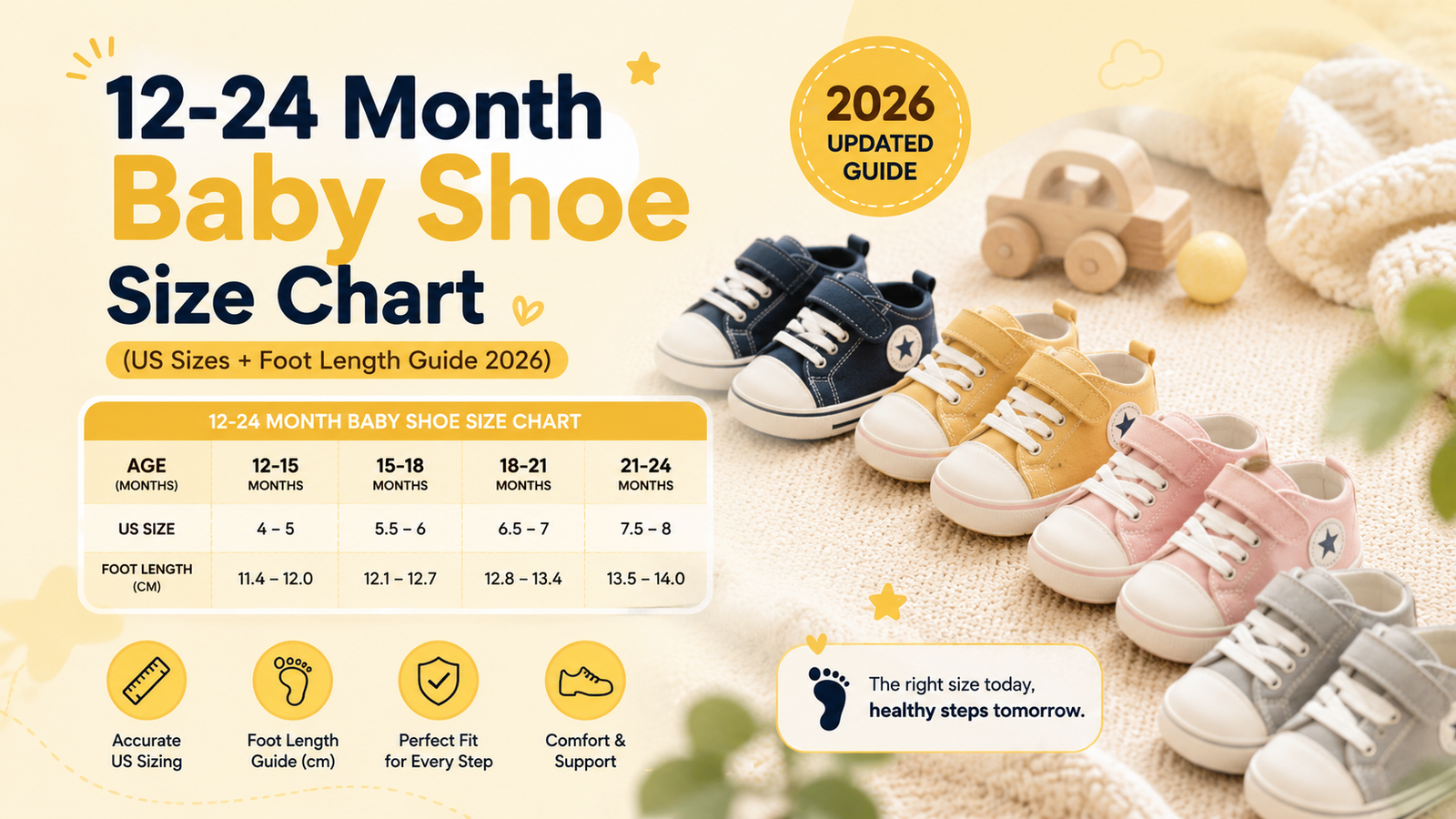
12-24 Month Baby Shoe Size Chart
This chart shows the typical US, UK, and EU shoe sizes for toddlers between 12 and 24 months, along with the foot length range for each size. These numbers come from the sizing standards used by most US footwear brands, but they are still estimates. Your toddler’s actual foot length is what decides the right fit, not the number on the chart.
| Age | Foot Length (inches) | Foot Length (cm) | US Size | UK Size | EU Size |
| 12-15 months | 4.3 – 4.5 in | 11.0 – 11.4 cm | 4 | 3 | 19 |
| 15-18 months | 4.5 – 4.7 in | 11.4 – 12.0 cm | 5 | 4 | 20 |
| 18-21 months | 4.7 – 4.9 in | 12.0 – 12.4 cm | 6 | 5 | 21 |
| 21-24 months | 4.9 – 5.2 in | 12.4 – 13.2 cm | 7 | 6 | 23 |
A quick tip that saves a lot of returns: if your toddler’s foot measures right between two sizes, choose the larger one and add a thicker insole or sock if needed. A slightly roomy shoe is far less of a problem than one that pinches.
👶 Did You Know?
Toddler feet grow close to half a size every two to three months during this stage. That’s why a shoe that fit perfectly at their first birthday can feel snug by the time they’re 15 months old.
How to Measure Your Toddler’s Feet at Home
Measuring a toddler’s foot is trickier than measuring a newborn’s, mostly because toddlers rarely want to sit still. Here’s the method we walk parents through in the store, adapted for home use.
What you’ll need: a piece of paper, a pencil, a ruler or tape measure, and a small snack (seriously, it helps).
Step 1: Trace the foot. Have your toddler stand on the paper with their heel against a wall or straight edge. Trace around the foot while they’re standing, since feet spread out under weight.
Step 2: Measure heel to toe. Find the longest point of the tracing from the back of the heel to the tip of the longest toe. Measure that distance in inches or centimeters.
Step 3: Measure both feet. Most toddlers have one foot slightly longer than the other. Always size to the larger foot.
Step 4: Add growing room. Add roughly 0.4 to 0.5 inches to the measurement. That’s about the width of an adult thumb, and it gives the toes room to move without the shoe being too loose.
Step 5: Check the chart. Match your final number to the foot length ranges in the chart above to find the closest US size.
💡 Expert Tip
Measure feet in the late afternoon or evening rather than first thing in the morning. Toddler feet swell slightly over the course of an active day, and evening measurements give you a truer sense of how the shoe will feel by nap time.
If you want a full walkthrough with printable foot tracing templates, our How to Measure Baby Feet guide covers every step with photos.
Interactive Shoe Size Calculator
Instead of doing the math by hand, use the tool below. Enter your toddler’s foot length and it will instantly show the closest US, UK, and EU size.
Toddler Shoe Size Calculator (12-24 Months)
Enter your toddler’s foot length below to get an instant US, UK, and EU size estimate.
This tool gives an estimate based on standard US sizing. Always check the fit in person when possible, since sizing can vary slightly between brands.
Toddler Foot Growth by Age (12-24 Months)
Growth during this year is fast and it isn't always even. Here's what we typically see at each stage.
12-15 months. Many toddlers are just starting to walk unassisted during this window. Feet tend to be wider and flatter than an older child's, and a lot of parents are surprised their toddler needs a size 4 already. Stick with soft, flexible soles that let the foot move naturally.
15-18 months. Walking becomes steadier, and toddlers start covering more ground, literally. This is usually when the first big growth spurt of the second year happens, often bumping a toddler from a size 4 to a size 5 in a matter of weeks.
18-21 months. Feet are getting longer and a bit narrower relative to length. Toddlers at this age are running, climbing, and testing shoes in ways they weren't before, so durability starts to matter as much as fit.
21-24 months. By two years old, many toddlers are approaching a size 7. Some are already transitioning out of "first walker" style shoes into sturdier toddler sneakers built for outdoor play.
📏 Size Snapshot
Age: 18 months
Typical US Size: 5 to 6
Foot Length: 4.6 - 4.9 inches
Growing Room: 0.4 - 0.5 inches
Signs the Shoe Fits Correctly
A well-fitted toddler shoe should check every box below.
- There's about a thumb's width of space between the longest toe and the front of the shoe.
- The heel doesn't slip when your toddler walks or runs.
- The shoe bends easily at the ball of the foot, not in the middle of the arch.
- Your toddler can wiggle their toes without the shoe feeling loose overall.
- There's no red marks or indentations on the skin after the shoe comes off.
Signs the Shoes Are Too Small
We see this constantly with parents who buy shoes based on the size their toddler wore last season. Watch for these signs.
- Toes are curled or bunched at the front of the shoe.
- Your toddler pulls at their shoes or socks throughout the day.
- Red marks, blisters, or calluses appear after wear.
- Your toddler seems reluctant to walk or suddenly refuses shoes they used to like.
- The toe box feels tight when you press down with your thumb.
⚠ Common Mistake
Sizing up two full sizes so the shoes "last longer" almost always backfires at this age. Loose shoes make it harder for a toddler to balance, they slip off during play, and the extra material can bunch up and rub. One size up at most is the safer call.
Signs the Shoes Are Too Big
Too big causes its own set of problems, especially for toddlers who are still building balance and confidence.
- Heel slips out with every step.
- Your toddler trips more than usual or drags their feet.
- Shoes come off easily during play.
- There's more than a thumb's width of space at the toe.
- Your toddler seems to be adjusting their gait to compensate for loose shoes.
What to Look for When Buying Toddler Shoes
A few features matter more than brand names at this stage.
Flexible soles: Toddlers need to feel the ground to build balance. A sole that bends easily at the ball of the foot supports natural movement better than a stiff one.
Breathable materials: Canvas, mesh, and soft leather all let air circulate, which matters for toddlers who are on their feet more each week.
Secure closures: Velcro straps are easier for toddlers to manage than laces, and they let you adjust the fit as the day goes on.
Wide toe box: Toddler feet are naturally wide. A shoe with a rounded, roomy toe box gives toes room to spread rather than forcing them into a narrow point.
Lightweight construction: A heavy shoe can genuinely slow down a toddler who is still working on coordination.
✅ Parent Checklist
- Measure both feet, standing, in the evening.
- Size to the larger foot.
- Leave 0.4 to 0.5 inches of growing room.
- Remeasure every 6 to 8 weeks.
- Check fit while your toddler is standing and walking, not just sitting.
For toddlers who are new to walking, our Baby Walking Shoes Guide breaks down exactly which features matter most in those first few months on their feet.
Common Mistakes Parents Make
After years of fitting toddler shoes, a handful of mistakes come up again and again.
Trusting the last size instead of remeasuring. A shoe that fit at 14 months might already be too small by 16 months. Skip the guesswork and measure again.
Buying based on age alone. Age charts are a starting point, not a rule. Two toddlers born the same week can be a full size apart.
Ignoring width. Length isn't the only variable. A toddler with wide feet can be in the correct length but still uncomfortable if the shoe runs narrow.
Skipping the standing check. Feet spread out under weight, so a measurement taken while your toddler is sitting will usually run small.
Hand-me-down shoes without a fit check. Worn-in shoes have already molded to another child's foot shape, which can affect how your toddler's foot sits inside.
Expert Tips for This Stage
Tip 1. Buy shoes in the late afternoon whenever possible, since feet are at their largest by then.
Tip 2. Keep a small ruler or measuring tape in your diaper bag. It makes a surprise shoe shopping trip much easier.
Tip 3. Rotate two pairs of shoes if your toddler is in daycare, one for indoor play and one for outside. It cuts down on wear and gives you a clearer sense of fit in each pair.
Tip 4. Check the fit again after any growth spurt, especially right after a big jump in height.
Tip 5. If your toddler is between sizes, go with the larger size and pair it with a slightly thicker sock rather than sizing down for a snugger fit.
Frequently Asked Questions:
What size shoe does a 12-month-old wear? Most 12 month olds wear a US size 4, though it's common to see anywhere from a size 3 to a size 4 and a half. Since many toddlers are just starting to walk at this age, foot shape and width matter as much as length.
What size shoe does an 18-month-old wear? An 18-month-old typically wears a US size 5 to 6. This is usually the middle of a big growth spurt, so it's worth measuring again if it's been more than 6 weeks since the last check.
What size shoe does a 24-month-old wear? Most 2-year-olds wear a US size 6 to 7. By this age, many toddlers are also ready to move into sturdier toddler sneakers built for running and climbing rather than early walker styles.
How often should I buy new shoes during this stage? Plan on a new size roughly every 2 to 3 months between 12 and 24 months. Growth tends to slow down slightly after age 2, so replacements often become less frequent after that.
Should toddler shoes have laces or Velcro? Velcro or hook-and-loop closures are usually the better choice for toddlers. They're faster to adjust, easier for early independence, and there's no risk of a lace coming undone mid run.
Is it okay to buy shoes a size bigger to save money? One size up with a snug insole can work, but anything more than that affects balance and can cause tripping. Two sizes up is too much for a toddler who's still building coordination.
Do toddlers need arch support in their shoes? Most toddlers don't need built-in arch support yet, since their arches are still developing naturally. A flexible, well-cushioned sole is generally more important than structured support at this age.
How do I know if my toddler's feet are wide? If your toddler leaves visible red marks near the sides of their feet after wearing regular width shoes, or if the shoe looks stretched at the widest point, a wide fit style is worth trying.
Can I use a shoe fitting app instead of measuring at home? A ruler and paper tracing is usually just as accurate as an app for this age group, and it's faster with a wiggly toddler. Apps can help if you want a second check, but they aren't required.
Do all shoe brands run the same size? No. Sizing can vary by half a size or more between brands. Always check the fit in person or measure your toddler's foot against the brand's specific size chart before ordering online.
What if my toddler refuses to wear their shoes? This is often a fit issue rather than a behavior issue. Check for tight spots, seams rubbing against the foot, or a heel that's slipping, since toddlers usually can't explain discomfort in words yet.
Should I size up for winter boots? A little extra room for a thicker sock is fine, but avoid sizing up more than half a size for winter boots. Too much extra space makes it harder for your toddler to walk steadily on slippery surfaces.
RELATED ARTICLES
- 0-12 Month Baby Shoe Size Chart
- 0-3 Month Baby Shoe Size Chart
- 3-6 Month Baby Shoe Size Chart
- 6-12 Month Baby Shoe Size Chart (2026)
- Kids Shoe Size Chart
CONCLUSION:
The right shoe size for your toddler comes down to their actual foot measurement, not their age or the size they wore last month. A quick measurement every 6 to 8 weeks, plus a bit of growing room, will keep your toddler comfortable through one of the fastest growth stages of their life.
Measure your toddler's feet before your next shoe purchase, then use the calculator above to find the closest size. If you're not sure whether it's time for a size change, our How to Measure Baby Feet guide walks through the whole process again with photos.