
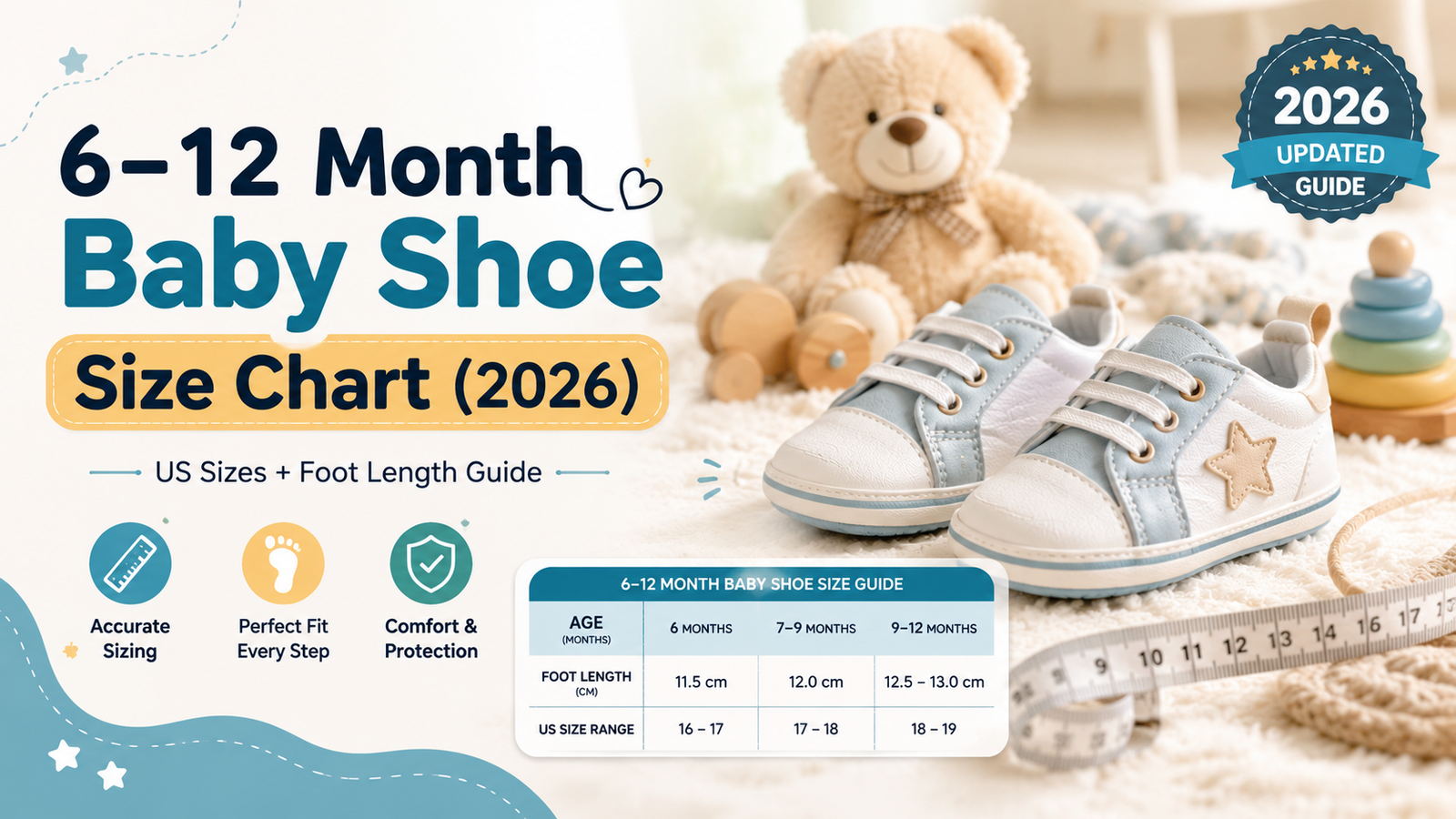
6-12 Month Baby Shoe Size Chart (US Sizes + Foot Length Guide)
⚡ Quick Answer
- 6-9 month babies typically wear US Size 3 (foot ~4.125 in / 10.5 cm).
- 9-12 month babies typically wear US Size 4 (foot ~4.5 in / 11.4 cm).
- Most babies this age don’t need “shoes” for walking yet — soft-soled shoes are for warmth and protection, not support.
- Measure both feet every 4-6 weeks; this is the fastest growth window in your baby’s first year.
- Leave 0.4-0.5 inches of growing room, and re-measure before buying walking shoes once they take real steps.
A baby between 6 and 12 months usually wears a US shoe size 3 to 4, moving from a foot length of about 4.125 inches (10.5 cm) at 6 months to about 4.5 inches (11.4 cm) by 12 months. Measuring foot length beats guessing by age, because this is the stage where growth speeds up the most – some babies jump a full size in six weeks. Size up as soon as your baby starts cruising along furniture or standing unassisted, since a shoe that fit for crawling can suddenly feel tight once toes are gripping the ground for balance.
What Size Shoe Does a 6-12 Month Old Wear?
Most babies between 6 and 12 months wear a US size 3 or 4, depending on exactly where they fall in that six-month window.
In our experience fitting thousands of children’s shoes, this is the single biggest jump parents underestimate. A baby who wore a perfectly snug size 2 at five months can be crowding a size 4 by their first birthday. Here’s the full breakdown:
Find Your Baby’s Shoe Size
Slide to your baby’s measured foot length and we’ll highlight the matching row — no guessing by age required.
| Age | Foot Length (in) | Foot Length (cm) | US Size | UK Size | EU Size |
|---|
Ranges reflect typical growth patterns. Always size to the larger foot and leave 0.4–0.5″ of growing room.
These numbers describe the average, not every baby. If your child's foot lands between two rows, size up, not down. A little extra room costs nothing, while a cramped toe box can genuinely affect how confidently a baby stands and takes their first steps. The American Academy of Pediatrics (AAP) also recommends choosing shoes that fit well and allow natural foot development.
📏 Size Snapshot
Age: 9 months
Typical US Size: 4
Foot Length: 4.375 - 4.5 inches (11.1 - 11.4 cm)
Growing Room: 0.4-0.5 inches
If you've already measured your baby's foot and it's shorter than 4 inches, our 3-6 Month Baby Shoe Size Chart will be more accurate for right now.
How to Measure Your Baby's Feet at 6-12 Months
Here's the good news: measuring an older infant is actually easier than measuring a newborn, because their feet hold still a little longer once they're distracted by a toy.
- Trace, don't hold a ruler to a wiggling foot. Stand your baby (or sit them with feet flat) on a piece of paper and trace around each foot with a pencil held straight up, not angled.
- Measure both feet. One foot is very commonly 1/8 to 1/4 inch longer than the other at this age — always size for the bigger foot.
- Measure heel to longest toe, which for most babies is the big toe, but check — some babies' second toe is longer.
- Do it in the evening. Feet swell slightly by end of day, giving you a more realistic "worst case" measurement.
- Re-measure every 4-6 weeks. This is the fastest-growing stretch of your baby's first year; a size that fit in July may not fit in September.
If your baby is already cruising or taking assisted steps, measure while they're standing and bearing weight — a foot flattens and lengthens slightly under load, and that's the shape the shoe actually needs to fit.
💡 Expert Tip
Trace onto paper rather than trying to use a fabric tape measure. After 25 years in children's footwear, we still find tracing gives parents the most accurate at-home measurement, because it captures the true width and shape of the foot, not just a single length number.
Month-by-Month Growth: What Changes Between 6 and 12 Months
Foot growth isn't the only thing shifting here — how your baby uses their feet changes dramatically, and that should shape what you buy.
6-7 months: Most babies are sitting independently and starting to pivot or scoot. Feet don't need structure yet — soft, flexible soles are ideal.
7-9 months: Crawling begins for many babies. Shoes are optional indoors; if you use them outside or on cold floors, prioritize grip and flexibility over cushioning.
9-10 months: Cruising along furniture starts. This is when a shoe that fit yesterday can suddenly feel tight — standing puts different pressure on the foot than sitting does.
10-12 months: Some babies take their first independent steps, others won't walk until 13-15 months, and both are completely normal. Once independent steps start, this is the point to reassess sizing and consider a proper first walking shoe with a flexible, non-slip sole.
👶 Did You Know?
Between 6 and 12 months, a baby's foot can grow nearly a full shoe size — faster than at almost any other point before their second birthday. Pediatric podiatrists commonly cite this stretch as the reason shoe-size subscriptions and resale groups exist for this age range specifically.
Signs of a Correct Fit
A properly fitted shoe at this age should check every box below:
- A thumb's width (about 0.4-0.5 inches) of space between the longest toe and the front of the shoe
- The heel doesn't slip when your baby crawls, cruises, or is lifted by the underarms
- No red marks, indentations, or fabric bunching when you remove the shoe
- Your baby can wiggle their toes freely — you should be able to pinch a small fold of extra material at the toe box
- The shoe bends easily at the ball of the foot, not in the middle of the sole
✅ Parent Checklist
- Measure both feet, standing if possible.
- Try shoes on with the socks your baby will actually wear.
- Leave 0.4-0.5 inches of growing room at the toe.
- Re-measure every 4-6 weeks during this stage.
- Check for heel slip by lifting your baby under the arms.
Signs Shoes Are Too Small
One common issue we notice at this age is parents assuming a baby is "fussy" when really their shoes have simply become too small — this window moves fast.
- Baby pulls at or resists having shoes put on, more than usual
- Red marks or indentation lines visible on the foot after removal
- Toes curl or you can't find that thumb's-width gap at the front
- The shoe leaves a visible line across the top of the foot
- Baby seems less willing to stand or bear weight than they were a week or two prior
Signs Shoes Are Too Big
Shoes that are too big cause just as many problems as ones that are too small — sometimes more, at this stage.
- Visible heel slip or the shoe rotates on the foot when crawling
- Baby trips, drags their feet, or seems to "shuffle" rather than lift each foot
- The shoe comes off entirely during crawling or attempted steps
- Excess material bunches at the toe when you press down gently
⚠ Common Mistake
Buying a size (or two) up "so it lasts longer" is one of the most common mistakes we see between 6 and 12 months specifically, because this is exactly when babies start cruising and taking first steps. A loose shoe at this stage can genuinely throw off balance and confidence right when your baby is learning to stand on their own.
Buying Guide: What Actually Matters at 6-12 Months
You don't need a "real" shoe with arch support at this age — pediatric podiatrists broadly agree that structured support isn't necessary until a child has been walking confidently for a while. What matters instead:
- Flexible soles. The sole should bend nearly in half at the ball of the foot. A stiff sole restricts the natural foot movement babies need for developing balance.
- Wide, soft toe box. Ten tiny toes need room to spread and grip, not a pointed or narrow shape.
- Breathable materials. Soft leather, canvas, or knit uppers let feet breathe and flex; avoid stiff synthetic materials that hold their shape regardless of foot movement.
- Secure closures. Velcro or elastic works better than laces at this age — it's faster for you and stays snug through a crawling session.
- Non-slip (not thick-tread) soles. Once cruising starts, grip matters more than cushioning. A thin, textured rubber sole beats a thick, springy one.
- Width, not just length. Many babies this age have proportionally wide feet. If a brand's standard width feels tight across the widest part of the foot even when length is correct, size up or look for a wide-fit option rather than forcing a narrow shoe.
⚠ Avoid This
Skip anything with a rigid sole "for support" before your baby is walking independently. We've seen many parents make this mistake with well-meaning gift shoes — a stiff sole on a baby who's only crawling or cruising can actually slow the muscle development that leads to confident walking.
Common Parent Mistakes at This Age
- Sizing by age alone, without measuring, even though this is the fastest-growth window of the first year
- Skipping the width check, focusing only on length
- Reusing the same size from a sibling without re-measuring — foot shape and growth rate vary a lot between children
- Waiting for "real shoes" to check fit, instead of also checking that socks and soft booties aren't too tight
- Forgetting to re-measure after baby starts standing or cruising, since standing changes how the foot sits in the shoe
Frequently Asked Questions
What size shoe does a 9-month-old wear? Most 9-month-old babies wear a US size 4, with a foot length of roughly 4.375 to 4.5 inches. Some babies with smaller feet are still comfortably in a size 3.5, so measuring is more reliable than relying on the age alone.
Do babies need shoes before they can walk? No. Babies who aren't yet walking don't need structured shoes at all — soft booties, socks, or bare feet are better for developing balance and foot strength. Shoes at this stage are mainly for warmth or protection outdoors, not support.
How much bigger should baby shoes be than their feet? Leave about 0.4 to 0.5 inches, roughly a thumb's width, between the longest toe and the front of the shoe. More than that and the shoe will slip; less than that and it will crowd growing toes within a few weeks.
Why does my baby's shoe size feel different between brands? Sizing standards vary by manufacturer, and there's no universal regulation for baby shoe sizing the way there is for some adult categories. Always check the specific brand's size chart rather than assuming a US size 4 fits identically everywhere.
Should I buy wide-width shoes for my baby? If your baby's foot looks proportionally wide, or a standard-width shoe leaves red marks along the sides even at the correct length, a wide-width option is worth it. Cramped width is one of the most overlooked causes of an uncomfortable "correct size" shoe.
How often should I size up between 6 and 12 months? Plan to re-measure every 4 to 6 weeks. This age range grows faster than almost any other stretch in the first year, and many babies move up a full size within two to three months.
What's the difference between a size 3 and a "3C" or "3 Infant"? "C" (as in 3C) simply denotes the infant/toddler sizing category, distinguishing it from a child's youth size or adult size that uses the same number. A 3C is not the same physical size as a youth size 3, so double-check the category, not just the number.
Is it okay to size up "so shoes last longer"? No — this is one of the most common and avoidable mistakes. A shoe that's too loose can cause tripping, heel slip, and reduced walking confidence right at the stage your baby is learning to balance and stand.
My baby's feet are different sizes — which size do I buy? This is completely normal; a small difference between feet is common. Always size to the larger foot, and check that the smaller foot isn't swimming in extra room that could cause slipping.
When should I switch from soft-soled shoes to a "real" walking shoe? Once your baby is taking consistent independent steps, look for a flexible, thin, non-slip sole rather than a cushioned or structured one. The goal is a shoe that mimics barefoot movement, not one that restricts it.
Do socks change what size shoe I should buy? Yes — always try shoes on with the type of socks your baby will actually wear day to day, since thick socks can take up the growing room you're trying to leave.
How do I know if my baby's shoes are already too small? Watch for resistance when putting shoes on, red marks or indentation lines after removal, curled toes, or a sudden reluctance to stand or crawl as much as usual — all common signs it's time to size up.
RELATED ARTICLES
- Baby Shoe Size Chart: 0-12 Months US Guide
- 3-6 Month Baby Shoe Size Chart
- 12-24 Month Baby Shoe Size Chart
- US to UK/EU Baby Shoe Size Conversion Chart
- Kids Shoe Size Chart (Toddler-Youth)
Conclusion
Between 6 and 12 months, your baby's feet will likely move through a full size or more — faster than at almost any other stage in their first year — which is exactly why measuring beats guessing by age every time. The right fit isn't about a stiff, structured "real shoe" just yet; it's about a flexible, well-fitting soft shoe that gives room to grow and freedom to move as your baby crawls, cruises, and eventually takes those first independent steps.
Measure both feet today, leave that thumb's-width of growing room, and plan to check again in four to six weeks. For the next stage of sizing, see our 12-24 Month Baby Shoe Size Chart, or if you need international sizing, our US to UK/EU Baby Shoe Size Conversion Chart has you covered.