
How Much Does It Cost to Make a Shoe? From Factory to Retail Price
My family has sold shoes for four generations, so I wanted a real answer to a simple question: what does a pair actually cost to make? The honest answer is that no brand publishes the factory price of a single model. But the factories, brands, retailers and customs records publish enough to rebuild the journey of a typical pair, from leather and foam to the price on the tag. That is what this page does, with every number sourced and every estimate labelled.
Six headline shoe cost numbers. Select one to see what it counts and where it comes from.
Select a topic above, for example “Factory price”, to see what the number counts.
$21.00The average pair made by Yue Yuen, which makes shoes for Nike, adidas, ASICS and New Balance, sold to brands for US$21.00 in 2025 (Yue Yuen Annual Report, tier B). That is across every shoe it makes, not one model.
$17.39The average pair of footwear the US imported from Vietnam in 2025 was valued at $17.39, including freight and insurance (UN Comtrade, my calculation, tier E). From China it was $7.36.
42.9%Nike kept 42.9% of its revenue as gross margin in fiscal 2026, adidas 51.6% and ASICS 56.8% (company filings, tier B). After marketing and overheads, Nike's operating margin was 8.2%.
about $26In my illustrative model, a $100 sneaker made in Vietnam costs the brand about $25.59 to get to a US warehouse, including duties (tier E). The brand's operating profit is about $4.09.
7.53%On top of the shelf price, the average American pays 7.53% sales tax (Tax Foundation, July 2026, tier C), about $7.53 on a $100 pair.
Not publicNike does not publish what it pays a factory for an Air Force 1 or any other model. Anyone quoting an exact figure is estimating.
Each number names its source and evidence tier. All fifteen of my citable statistics are further down this page.
How much does it cost to make a shoe? The short version
Quick answer. A typical branded sneaker made in Asia leaves the factory for roughly $15 to $30 a pair. Yue Yuen, which makes shoes for Nike, adidas and ASICS, averaged US$21.00 a pair in 2025, and about 43% of a factory’s cost is materials and 57% labour and overheads. After freight and US duties, a sneaker that sells for $100 costs the brand about $26 to land in a US warehouse. The brand sells it to a store for about $50, and the store sells it for $100. On that $100, the factory, brand and store together keep only about $9 as profit; the rest pays for materials, labour, shipping, duties, marketing, staff and stores. No brand publishes the factory price of a specific model, so figures for named shoes are estimates.
This page is part of my footwear industry research. Where shoes are made is on the largest footwear-producing countries page, trade flows are on footwear imports and exports by country, and what Americans spend is on footwear spending statistics.
Key findings
- The factory price of a branded sneaker is usually a fraction of its shelf price. Yue Yuen sold its 252.2 million pairs to brands at an average of US$21.00 in 2025, and Stella International at US$27.7.
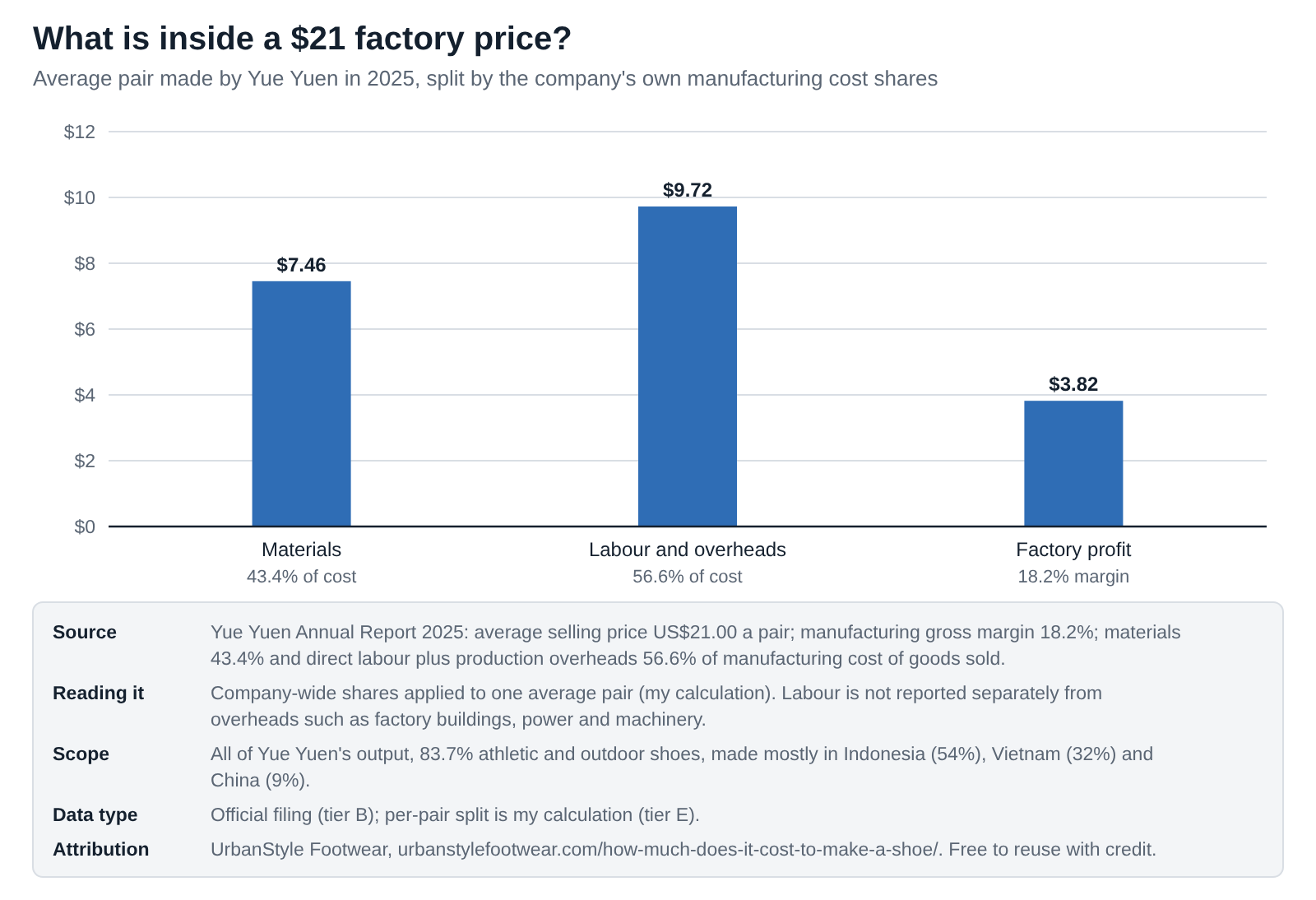
- Inside that factory price, materials are about 43% of cost and labour plus overheads about 57%, by Yue Yuen’s own accounts. On a $21 pair that is about $7.46 of materials, $9.72 of labour and overheads and $3.82 of factory profit.
- Shipping is cheap; duties are not. Freight and insurance added only about 3.9% to the factory value of US footwear imports in 2025, but US duties average about 12%, and Section 301 tariffs have added 12.5% on Vietnam and China since July 24, 2026.
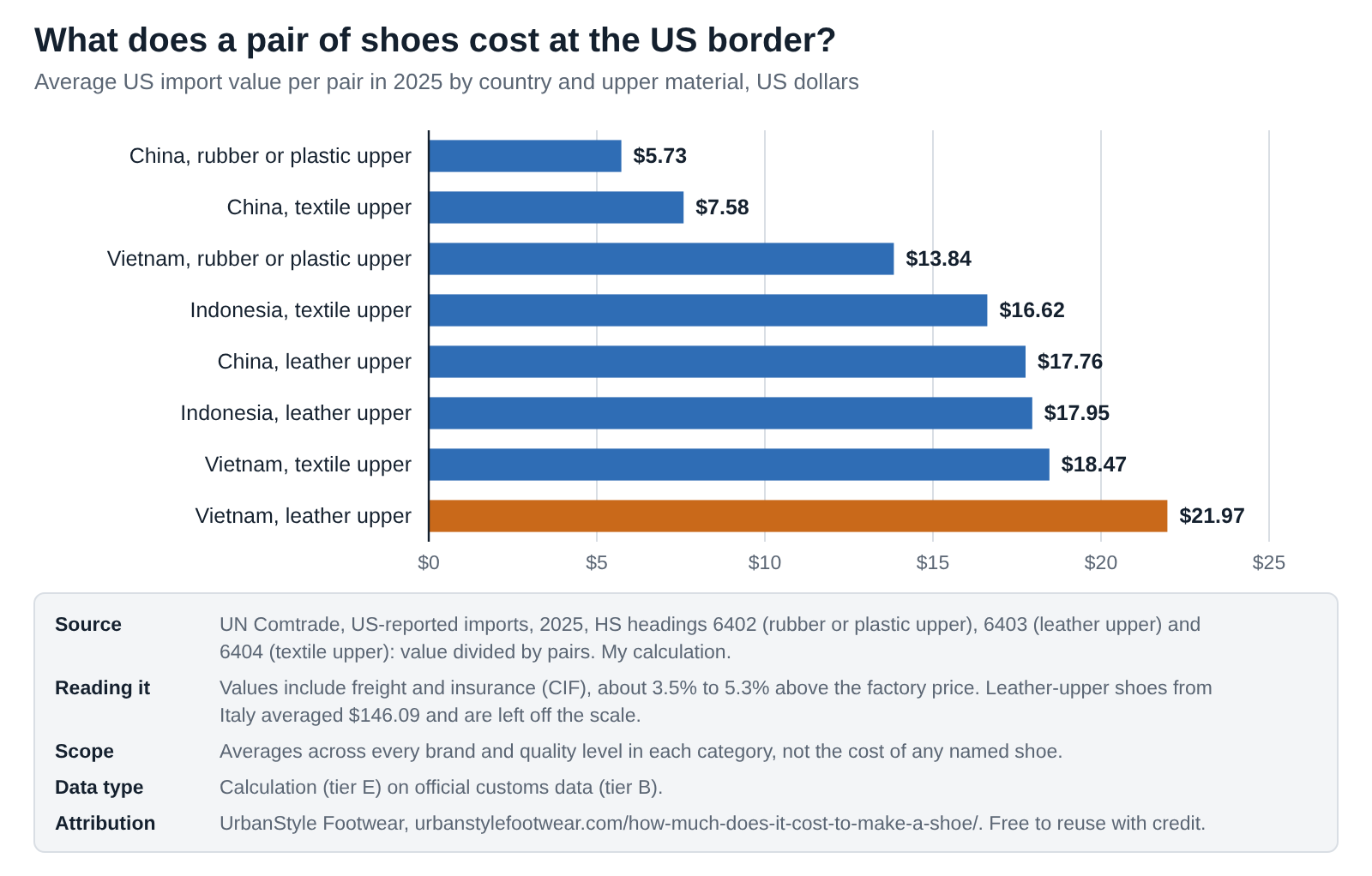
- At the US border, the average pair from Vietnam was worth $17.39 in 2025 and from China $7.36. By type, plastic shoes from China averaged $5.73 and leather shoes from Vietnam $21.97; Italian leather shoes averaged $146.09.
- In my illustrative model, a $100 sneaker made in Vietnam lands in a US warehouse for about $25.59. The brand sells it to a store for $50 and keeps about $4.09 of operating profit after marketing and overheads.
- Stores keep a large slice and little profit. On a $100 sale, the store’s gross margin is about $50, but the shoe retailer DSW made only a 1.7% operating margin in fiscal 2025.
- Brands keep 43% to 57% of revenue as gross margin (Nike 42.9%, adidas 51.6%, ASICS 56.8%), but marketing and overheads take most of it. Nike spent 10.2% of revenue on marketing and 24.5% on overheads.
- Discounts come out of the store’s share first. A 25% markdown on a $100 shoe the store bought for $50 halves its gross margin; the factory and brand were already paid.
- The average American adds 7.53% sales tax on top of the shelf price, about $7.53 on a $100 pair, more than the $7.10 of materials in my model of that shoe.
- None of Nike, adidas or ASICS publishes the factory price of a specific model, including the Air Force 1, Samba OG or GEL-KAYANO 32. Any exact figure for a named shoe is an estimate.
What I noticed while putting this together
Most articles on this question quote the same breakdown of a $100 Nike shoe. When I traced it, it came from a 2014 interview, and another popular analysis used 2016 shipping data. Prices, wages, freight and tariffs have all moved since then, so I rebuilt the picture from 2025 and 2026 documents instead.
The best find was on the factory side. Shoemakers like Yue Yuen and Stella are listed in Hong Kong, so they publish how many pairs they made and what they earned. Divide one by the other and you get an average factory price: US$21.00 a pair at Yue Yuen, the company that makes shoes for Nike, adidas, ASICS and New Balance. Yue Yuen also splits its factory costs into materials (43.4%) and labour plus overheads (56.6%). That is the closest thing to a public factory costing I could find.
The second find was in the customs data. US import records list a value with freight and a value without it. The difference was only 3.5% for shoes from Vietnam. I had assumed shipping was a big part of the cost. It isn’t. Duties are a much bigger deal: about 12% on average, plus the new 12.5% tariff on Vietnam and China.
What surprised me most was how little profit is left at the end. Nike keeps 42.9% of its revenue after paying for the products, but after marketing and overheads its operating margin was 8.2%. DSW, a big shoe retailer, kept 43.6% after buying its stock and ended the year with a 1.7% operating margin. People often say shoes are “marked up five times”. Against a $20 factory price, a $100 tag is exactly that, but most of the markup pays for things that aren’t the shoe.
What is public about the cost of a shoe, and what isn’t
I use four labels throughout. Verified means a figure comes straight from a reliable primary source. Estimated means I calculated it from disclosed figures with the method shown. Indicative means a broad benchmark with real uncertainty. Not publicly known means no reliable source exists.
| Question | Evidence status | Why |
|---|---|---|
| Average factory price per pair | Verified | Listed shoemakers publish pairs and revenue |
| Materials vs labour in factory cost | Verified (company-wide) | Yue Yuen splits its manufacturing cost of goods sold |
| Import value per pair by shoe type | Verified average | US customs records, all brands mixed together |
| Brand and retailer margins | Verified (company-wide) | Annual reports and SEC filings |
| A $100 shoe broken down end to end | Estimated | My model, built from the figures above |
| Wholesale price as a share of retail | Indicative | A long-standing rule of thumb of about half; real terms are private |
| Factory price of a named model | Not publicly known | No brand publishes it |
| Labour cost alone per pair | Not publicly known | Reported only together with overheads |
Four kinds of document carry this page. Pick one to see what it shows and where it falls short.
See what each data source covers and where it falls short
Choose a source to see what it records and how I would read it.
Select a source above.
Factory filings. 2025, published 2026. Yue Yuen and Stella, two listed shoe manufacturers, report pairs made, revenue and margins. That gives an average factory selling price: US$21.00 and US$27.7 a pair. How to read it: Official filings (tier B) and the closest public view of factory prices, but they average every shoe each company makes, from sandals to performance runners.
Brand accounts. FY2025 and FY2026. Nike, adidas and ASICS report revenue, cost of sales, marketing and profit, which shows how a brand's share of each dollar is spent. How to read it: Official (tier B), but company-wide. They mix wholesale and direct sales, footwear and apparel, and every country, so they give proportions, not the cost of one model.
US import records. 2025. US customs records in UN Comtrade give value and pairs for each shoe type and country, with and without freight. That gives an average price per pair at the border. How to read it: Official (tier B), and the best public benchmark by category, but an average across every brand and quality level in that category.
Retailer accounts. FY2025. DICK'S, Foot Locker and DSW report gross and operating margins, which shows what a store keeps from each sale after buying the shoes. How to read it: Official (tier B), but their cost lines include different things (DICK'S includes rent and distribution), and margins are after markdowns.
15 shoe cost statistics you can cite
Each card has one number, one sentence of context and its source. “Copy text” opens a box with the sentence, the source and a link back here. Please cite the original source for any single statistic. Cards marked E are my calculations, and the method is on the card or in the dataset.
Yue Yuen, a contract manufacturer for Nike, adidas, ASICS and New Balance, sold its 252.2 million pairs to brands at an average of US$21.00 a pair in 2025, up from US$20.25 (Annual Report 2025).
Copy text
$21.00 average factory price per pair, Yue Yuen 2025: Yue Yuen, a contract manufacturer for Nike, adidas, ASICS and New Balance, sold its 252.2 million pairs to brands at an average of US$21.00 a pair in 2025, up from US$20.25 (Annual Report 2025). Source: Yue Yuen Annual Report 2025 (HKEX 00551). Via UrbanStyle Footwear: https://urbanstylefootwear.com/how-much-does-it-cost-to-make-a-shoe/
Yue Yuen's manufacturing gross margin was 18.2% in 2025; Stella International, another listed shoemaker, reported 21.8% on an average price of US$27.7 a pair (company filings).
Copy text
18.2% factory gross margin: Yue Yuen's manufacturing gross margin was 18.2% in 2025; Stella International, another listed shoemaker, reported 21.8% on an average price of US$27.7 a pair (company filings). Source: Yue Yuen Annual Report 2025 (HKEX 00551). Via UrbanStyle Footwear: https://urbanstylefootwear.com/how-much-does-it-cost-to-make-a-shoe/
Materials made up 43.4% of Yue Yuen's manufacturing cost of goods sold in 2025 and direct labour plus production overheads 56.6% (Annual Report 2025).
Copy text
43% / 57% materials vs labour and overheads in factory cost: Materials made up 43.4% of Yue Yuen's manufacturing cost of goods sold in 2025 and direct labour plus production overheads 56.6% (Annual Report 2025). Source: Yue Yuen Annual Report 2025 (HKEX 00551). Via UrbanStyle Footwear: https://urbanstylefootwear.com/how-much-does-it-cost-to-make-a-shoe/
Applying Yue Yuen's own cost split to its average $21.00 pair gives about $7.46 of materials, $9.72 of labour and overheads and $3.82 of factory profit (my calculation).
Copy text
$7.46 of materials in a $21 factory price: Applying Yue Yuen's own cost split to its average $21.00 pair gives about $7.46 of materials, $9.72 of labour and overheads and $3.82 of factory profit (my calculation). Source: UrbanStyle calculation. Via UrbanStyle Footwear: https://urbanstylefootwear.com/how-much-does-it-cost-to-make-a-shoe/
US footwear imports from Vietnam averaged $17.39 a pair in 2025 and from China $7.36, including freight and insurance; the average across all suppliers was $13.55 (my calculation from UN Comtrade).
Copy text
$17.39 average US import value per pair from Vietnam: US footwear imports from Vietnam averaged $17.39 a pair in 2025 and from China $7.36, including freight and insurance; the average across all suppliers was $13.55 (my calculation from UN Comtrade). Source: UrbanStyle calculation. Via UrbanStyle Footwear: https://urbanstylefootwear.com/how-much-does-it-cost-to-make-a-shoe/
Freight and insurance added 3.9% to the FOB value of US footwear imports in 2025: 3.5% from Vietnam and 5.3% from China (my calculation from UN Comtrade).
Copy text
3.9% freight and insurance on top of factory price: Freight and insurance added 3.9% to the FOB value of US footwear imports in 2025: 3.5% from Vietnam and 5.3% from China (my calculation from UN Comtrade). Source: UrbanStyle calculation. Via UrbanStyle Footwear: https://urbanstylefootwear.com/how-much-does-it-cost-to-make-a-shoe/
Footwear carries an average US duty rate of about 12%, against 2% for other consumer goods, and cheap or children's shoes often face 20% or 48% (FDRA). Since July 24, 2026, Section 301 tariffs add 12.5% on Vietnam and China (Kroll).
Copy text
12% average US duty on footwear: Footwear carries an average US duty rate of about 12%, against 2% for other consumer goods, and cheap or children's shoes often face 20% or 48% (FDRA). Since July 24, 2026, Section 301 tariffs add 12.5% on Vietnam and China (Kroll). Source: FDRA via Footwear Magazine. Via UrbanStyle Footwear: https://urbanstylefootwear.com/how-much-does-it-cost-to-make-a-shoe/
Nike's gross margin was 42.9% in fiscal 2026 on revenues of $46.4 billion; it spent 10.2% of revenue on marketing and 24.5% on overheads, leaving an operating margin of 8.2% (Nike results; margin my calculation).
Copy text
42.9% Nike gross margin, FY2026: Nike's gross margin was 42.9% in fiscal 2026 on revenues of $46.4 billion; it spent 10.2% of revenue on marketing and 24.5% on overheads, leaving an operating margin of 8.2% (Nike results; margin my calculation). Source: Nike FY2026 results (Form 8-K Exhibit 99.1). Via UrbanStyle Footwear: https://urbanstylefootwear.com/how-much-does-it-cost-to-make-a-shoe/
adidas reported a 51.6% gross margin in 2025 and an 8.3% operating margin, after spending 12.4% of sales on marketing and point-of-sale (adidas Annual Report 2025).
Copy text
51.6% adidas gross margin, 2025: adidas reported a 51.6% gross margin in 2025 and an 8.3% operating margin, after spending 12.4% of sales on marketing and point-of-sale (adidas Annual Report 2025). Source: adidas Annual Report 2025. Via UrbanStyle Footwear: https://urbanstylefootwear.com/how-much-does-it-cost-to-make-a-shoe/
ASICS reported a 56.8% gross margin and a 17.6% operating margin in 2025, the highest of the three brands here (ASICS results).
Copy text
56.8% ASICS gross margin, 2025: ASICS reported a 56.8% gross margin and a 17.6% operating margin in 2025, the highest of the three brands here (ASICS results). Source: ASICS FY2025 results. Via UrbanStyle Footwear: https://urbanstylefootwear.com/how-much-does-it-cost-to-make-a-shoe/
In my model of a $100 sneaker made in Vietnam and sold through a store, the factory price is about $20 and the landed cost after freight and duties about $25.59, about a quarter of the shelf price (UrbanStyle calculation).
Copy text
about $26 landed cost of an illustrative $100 sneaker: In my model of a $100 sneaker made in Vietnam and sold through a store, the factory price is about $20 and the landed cost after freight and duties about $25.59, about a quarter of the shelf price (UrbanStyle calculation). Source: UrbanStyle calculation. Via UrbanStyle Footwear: https://urbanstylefootwear.com/how-much-does-it-cost-to-make-a-shoe/
Using Nike's fiscal 2026 cost proportions on a $50 wholesale price, the brand keeps about $4.09 of operating profit from a $100 sneaker after marketing and overheads (UrbanStyle calculation).
Copy text
about $4 brand operating profit on a $100 sneaker: Using Nike's fiscal 2026 cost proportions on a $50 wholesale price, the brand keeps about $4.09 of operating profit from a $100 sneaker after marketing and overheads (UrbanStyle calculation). Source: UrbanStyle calculation. Via UrbanStyle Footwear: https://urbanstylefootwear.com/how-much-does-it-cost-to-make-a-shoe/
Designer Brands, owner of DSW, made a 43.6% gross margin but only a 1.7% operating margin in fiscal 2025 (company results; operating margin my calculation).
Copy text
1.7% operating margin of a big shoe retailer: Designer Brands, owner of DSW, made a 43.6% gross margin but only a 1.7% operating margin in fiscal 2025 (company results; operating margin my calculation). Source: Designer Brands FY2025 results. Via UrbanStyle Footwear: https://urbanstylefootwear.com/how-much-does-it-cost-to-make-a-shoe/
The population-weighted average combined state and local sales tax in the US was 7.53% on July 1, 2026, about $7.53 on a $100 pair (Tax Foundation).
Copy text
7.53% average US sales tax on top: The population-weighted average combined state and local sales tax in the US was 7.53% on July 1, 2026, about $7.53 on a $100 pair (Tax Foundation). Source: Tax Foundation, July 2026. Via UrbanStyle Footwear: https://urbanstylefootwear.com/how-much-does-it-cost-to-make-a-shoe/
The ASICS GEL-KAYANO 32, list price $165, was selling for $125.93 at REI on October 26, 2026, a reminder that list prices and paid prices differ (REI product page).
Copy text
23% off GEL-KAYANO 32 on the day I checked: The ASICS GEL-KAYANO 32, list price $165, was selling for $125.93 at REI on October 26, 2026, a reminder that list prices and paid prices differ (REI product page). Source: REI product page. Via UrbanStyle Footwear: https://urbanstylefootwear.com/how-much-does-it-cost-to-make-a-shoe/
How much does a factory charge to make a pair of shoes?
Short answer. For branded athletic and casual shoes made in Asia, roughly $15 to $30 a pair. Yue Yuen averaged US$21.00 in 2025 across 252.2 million pairs, with an 18.2% gross margin. Stella International averaged US$27.7 across 55.0 million pairs, with a 21.8% gross margin.
A shoe starts as materials: leather, textiles, rubber, foam, plastics, adhesives, laces and boxes. Factories, or their suppliers, turn those into components such as outsoles, midsoles and uppers, then cut, stitch, mould, last, bond, finish and inspect the shoe. If you want to know what each material actually is, my shoe materials guide explains them.
Brands don’t publish what they pay for this. Factories, at least listed ones, do publish their averages. Here is what Yue Yuen’s 2025 accounts say is inside its average $21 pair:
Embed this chart
<figure style="margin:0"><a href="https://urbanstylefootwear.com/how-much-does-it-cost-to-make-a-shoe/"><img src="https://urbanstylefootwear.com/wp-content/uploads/2026/10/usf-what-is-inside-a-factory-shoe-price.png" alt="Bar chart of a $21 factory shoe price: $7.46 materials, $9.72 labour and overheads, $3.82 factory profit" width="800" style="max-width:100%;height:auto"></a><figcaption>Source: UrbanStyle Footwear, based on the Yue Yuen Annual Report 2025 (UrbanStyle calculation). <a href="https://urbanstylefootwear.com/how-much-does-it-cost-to-make-a-shoe/">How Much Does It Cost to Make a Shoe? From Factory to Retail Price</a></figcaption></figure>Click the code, press Ctrl+C (Cmd+C on Mac), and paste it into any web page. Please keep the attribution link.
View as table
| Part of a $21.00 factory price | USD per pair | Basis |
|---|---|---|
| Materials | 7.46 | 43.4% of factory cost |
| Labour and overheads | 9.72 | 56.6% of factory cost |
| Factory profit | 3.82 | 18.2% gross margin |
Two things stand out. Labour and overheads cost more than materials. And the factory’s own profit is small: $3.82 on a $21 pair, before tax. Yue Yuen’s 252.2 million pairs came from about 276,800 manufacturing staff, roughly 911 pairs per person per year (my calculation). Volume matters: moulds, lasts and machines cost the same whether a factory makes ten thousand pairs or a million, so big runs bring the price per pair down.
What you can safely say. “Yue Yuen, a contract manufacturer for Nike, adidas and ASICS, sold its shoes to brands at an average of US$21.00 a pair in 2025.” Say that it is an average across everything it makes, not the price of one model.
From the factory to the customer: every stage of the cost
Short answer. After the factory price come freight and insurance (about 3.5% to 5.3% extra), US duties (about 12% on average, plus 10% to 12.5% Section 301 tariffs since July 2026), the brand’s warehousing, design, marketing and staff, the retailer’s stores, staff and markdowns, and finally sales tax (7.53% on average).
| Stage | What it covers | Best public evidence | Label |
|---|---|---|---|
| 1. Factory price | Materials, components, assembly, overheads, factory profit | Yue Yuen US$21.00 a pair, Stella US$27.7 (2025) | Verified average |
| 2. Freight and insurance | Ocean shipping and insurance to the US | 3.5% of value from Vietnam, 5.3% from China, 3.9% overall (2025) | Verified average |
| 3. Duties and tariffs | US import duty, plus extra tariffs | About 12% average duty (FDRA); Section 301 12.5% for Vietnam and China, 10% for Indonesia and India, since July 24, 2026 (Kroll) | Indicative |
| 4. Brand costs | Warehousing, design, testing, marketing, athletes, staff, offices | Nike FY2026: cost of sales 57.1%, marketing 10.2%, overheads 24.5% of revenue | Verified (company-wide) |
| 5. Retailer costs | Stores, rent, staff, distribution, marketing, markdowns, returns | Gross margins of 24.4% to 43.6% (Foot Locker, DICK’S, DSW); DSW operating margin 1.7% | Verified (company-wide) |
| 6. Sales tax | State and local tax at the till | 7.53% average combined rate, July 1, 2026 (Tax Foundation) | Verified |
US tariffs on shoes have changed several times since 2025, so here is the timeline that matters for 2026 prices:
| Date | What changed |
|---|---|
| February 20, 2026 | The US Supreme Court ruled that the “reciprocal” tariffs imposed under IEEPA were unlawful. |
| February 24 to July 24, 2026 | A temporary 10% Section 122 surcharge applied on top of normal duties. |
| From July 24, 2026 | Section 301 tariffs replaced it: 12.5% for China and Vietnam, 10% for Indonesia and India, on top of normal duties. |
Normal duty rates on shoes vary a lot by type and material. The FDRA, the US footwear industry association, puts the average at about 12%, against 2% for other consumer goods, and says cheap and children’s shoes often face 20% or 48%. Because duty is charged on the import value, a cheap shoe can carry a higher duty rate than an expensive one. My US footwear market statistics page tracks prices since the tariffs.
Sources: as named in the tables; Kroll (tier D) and FDRA via Footwear Magazine (tier D) for tariffs. Freight shares are my calculations from UN Comtrade (tier E). Tariff coverage of individual products should be checked against the official schedules.Where does the money go on a $100 sneaker?
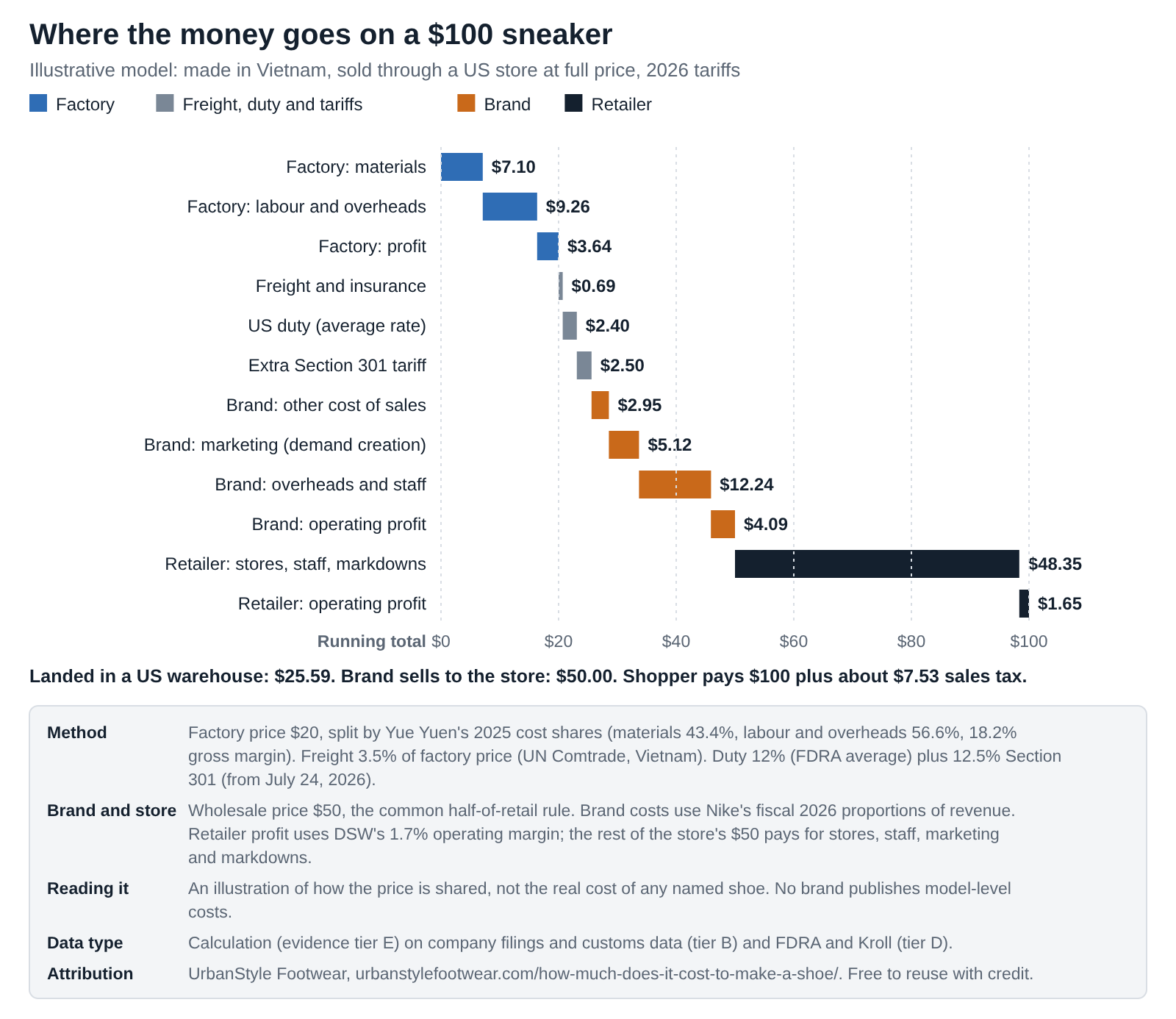
Short answer. In my illustrative model of a $100 sneaker made in Vietnam and sold through a US store: about $20 to the factory, $5.59 to freight, duty and tariffs, $24.41 to the brand (of which about $4.09 is operating profit) and $50 to the store (of which about $1.65 is operating profit). The shopper also pays about $7.53 sales tax.
This is a model, not a leaked costing. I built it from the figures above: a $20 factory price split by Yue Yuen’s cost shares, Vietnam’s freight share from customs data, the average duty and the current tariff, Nike’s cost proportions for the brand, and DSW’s margin for the store.
Embed this chart
<figure style="margin:0"><a href="https://urbanstylefootwear.com/how-much-does-it-cost-to-make-a-shoe/"><img src="https://urbanstylefootwear.com/wp-content/uploads/2026/10/usf-100-dollar-sneaker-cost-breakdown.png" alt="Waterfall of a $100 sneaker: about $20 to the factory, $5.59 freight and duty, $24.41 to the brand, $50 to the store" width="800" style="max-width:100%;height:auto"></a><figcaption>Source: UrbanStyle Footwear, based on Yue Yuen, Nike, DSW and UN Comtrade data with FDRA and Kroll tariff rates (UrbanStyle calculation). <a href="https://urbanstylefootwear.com/how-much-does-it-cost-to-make-a-shoe/">How Much Does It Cost to Make a Shoe? From Factory to Retail Price</a></figcaption></figure>Click the code, press Ctrl+C (Cmd+C on Mac), and paste it into any web page. Please keep the attribution link.
View as table
| Part of the $100 price | USD | Who gets it | How it was set |
|---|---|---|---|
| Factory: materials | 7.10 | Factory | Factory price $20 split by Yue Yuen 2025 cost shares |
| Factory: labour and overheads | 9.26 | Factory | Factory price $20 split by Yue Yuen 2025 cost shares |
| Factory: profit | 3.64 | Factory | Factory price $20 split by Yue Yuen 2025 cost shares |
| Freight and insurance | 0.69 | Shipping and US government | Comtrade freight share for Vietnam; 12% average duty; 12.5% Section 301 |
| US duty (average rate) | 2.40 | Shipping and US government | Comtrade freight share for Vietnam; 12% average duty; 12.5% Section 301 |
| Extra Section 301 tariff | 2.50 | Shipping and US government | Comtrade freight share for Vietnam; 12% average duty; 12.5% Section 301 |
| Brand: other cost of sales | 2.95 | Brand | Nike FY2026 cost proportions applied to a $50 wholesale price |
| Brand: marketing (demand creation) | 5.12 | Brand | Nike FY2026 cost proportions applied to a $50 wholesale price |
| Brand: overheads and staff | 12.24 | Brand | Nike FY2026 cost proportions applied to a $50 wholesale price |
| Brand: operating profit | 4.09 | Brand | Nike FY2026 cost proportions applied to a $50 wholesale price |
| Retailer: stores, staff, markdowns | 48.35 | Retailer | $50 retailer gross margin; profit at DSW 1.7% operating margin |
| Retailer: operating profit | 1.65 | Retailer | $50 retailer gross margin; profit at DSW 1.7% operating margin |
| Sales tax on top (paid to state and local government) | 7.53 | Government | Tax Foundation 7.53% average |
Read it from the top. The first three bars are the factory. Then come the costs of getting the shoe into the US. Then the brand: the rest of its cost of sales (the gap between Nike’s cost-of-sales share and the landed cost), marketing, overheads and finally profit. The last two bars are the store. If you add up only the profit bars (factory $3.64, brand $4.09, store $1.65), the three companies together keep about $9.38 of the $100.
What you can safely say. “In an illustrative model based on 2025 and 2026 company and customs data, a $100 sneaker costs about $26 to land in the US, and the factory, brand and store together keep about $9 as operating profit.” Call it an illustrative model, and say no brand publishes model-level costs.
Change the scenario: how the split moves
A single breakdown can hide how much the answer depends on choices. Pick a scenario to see how the factory, landing and brand numbers change. Every scenario uses the same rules as the $100 model, and the assumptions are listed in each one.
Pick a scenario
| Shelf price | $100.00 |
| Factory price (Vietnam) | $20.00 |
| Freight and insurance | $0.69 |
| US duty at 12% | $2.40 |
| Section 301 tariff at 12.5% | $2.50 |
| Landed cost in a US warehouse | $25.59 |
| Brand revenue for the pair | $50.00 |
| Brand revenue left after landed cost | $24.41 |
| Retailer gross margin | $50.00 |
| Sales tax on top (7.53%) | $7.53 |
Factory price is 20% of the shelf price; landed cost is 26%. The base case. The brand sells to a store at about half the shelf price, the common rule of thumb.
| Shelf price | $100.00 |
| Factory price (Vietnam) | $20.00 |
| Freight and insurance | $0.69 |
| US duty at 12% | $2.40 |
| Section 301 tariff at 12.5% | $2.50 |
| Landed cost in a US warehouse | $25.59 |
| Brand revenue for the pair | $100.00 |
| Brand revenue left after landed cost | $74.41 |
| Retailer gross margin | none (no store) |
| Sales tax on top (7.53%) | $7.53 |
Factory price is 20% of the shelf price; landed cost is 26%. The brand keeps the whole shelf price, but now pays for its own stores or website, shipping to the customer, payments and returns.
| Shelf price | $75.00 |
| Factory price (Vietnam) | $20.00 |
| Freight and insurance | $0.69 |
| US duty at 12% | $2.40 |
| Section 301 tariff at 12.5% | $2.50 |
| Landed cost in a US warehouse | $25.59 |
| Brand revenue for the pair | $50.00 |
| Brand revenue left after landed cost | $24.41 |
| Retailer gross margin | $25.00 |
| Sales tax on top (7.53%) | $5.65 |
Factory price is 27% of the shelf price; landed cost is 34%. The store already paid the brand $50, so a 25% markdown comes out of the retailer's share, not the factory's.
| Shelf price | $100.00 |
| Factory price (Indonesia) | $20.00 |
| Freight and insurance | $0.80 |
| US duty at 12% | $2.40 |
| Section 301 tariff at 10.0% | $2.00 |
| Landed cost in a US warehouse | $25.20 |
| Brand revenue for the pair | $50.00 |
| Brand revenue left after landed cost | $24.80 |
| Retailer gross margin | $50.00 |
| Sales tax on top (7.53%) | $7.53 |
Factory price is 20% of the shelf price; landed cost is 25%. Same shoe from Indonesia, where the extra Section 301 tariff is 10% rather than 12.5%.
| Shelf price | $30.00 |
| Factory price (China) | $6.00 |
| Freight and insurance | $0.32 |
| US duty at 20% | $1.20 |
| Section 301 tariff at 12.5% | $0.75 |
| Landed cost in a US warehouse | $8.27 |
| Brand revenue for the pair | $15.00 |
| Brand revenue left after landed cost | $6.73 |
| Retailer gross margin | $15.00 |
| Sales tax on top (7.53%) | $2.26 |
Factory price is 20% of the shelf price; landed cost is 28%. Factory price near the average US import value of a Chinese rubber or plastic shoe. Cheap shoes often face higher base duty rates, here 20%.
| Shelf price | $165.00 |
| Factory price (Vietnam) | $30.00 |
| Freight and insurance | $1.04 |
| US duty at 12% | $3.60 |
| Section 301 tariff at 12.5% | $3.75 |
| Landed cost in a US warehouse | $38.39 |
| Brand revenue for the pair | $82.50 |
| Brand revenue left after landed cost | $44.11 |
| Retailer gross margin | $82.50 |
| Sales tax on top (7.53%) | $12.42 |
Factory price is 18% of the shelf price; landed cost is 23%. A premium running shoe priced like the GEL-KAYANO 32. The $30 factory price is my assumption, scaled up for more complex foams and uppers.
Three things move the split most: who sells the shoe (a store or the brand itself), whether it sells at full price, and the factory price relative to the shelf price, which is highest for cheap shoes. The country of origin matters less than people expect, because freight is small and the tariff gap between Vietnam and Indonesia is 2.5 points.
All scenarios are my calculations (tier E). The $165 running shoe’s $30 factory price is an assumption, not a figure for any named model.How much do different types of shoes cost to make?
Short answer. At the US border in 2025, a pair of rubber or plastic shoes from China averaged $5.73, textile sneakers from Vietnam $18.47, leather shoes from Vietnam $21.97 and leather shoes from Italy $146.09, freight included.
Customs records are the best public benchmark by category. They average every brand and quality level, so they can’t price one model, but they show how much the type of shoe and the country matter.
Embed this chart
<figure style="margin:0"><a href="https://urbanstylefootwear.com/how-much-does-it-cost-to-make-a-shoe/"><img src="https://urbanstylefootwear.com/wp-content/uploads/2026/10/usf-us-import-value-per-pair-of-shoes-2025.png" alt="Bar chart of 2025 US import value per pair: $5.73 for Chinese plastic shoes up to $21.97 for Vietnamese leather" width="800" style="max-width:100%;height:auto"></a><figcaption>Source: UrbanStyle Footwear, based on UN Comtrade US import data (UrbanStyle calculation). <a href="https://urbanstylefootwear.com/how-much-does-it-cost-to-make-a-shoe/">How Much Does It Cost to Make a Shoe? From Factory to Retail Price</a></figcaption></figure>Click the code, press Ctrl+C (Cmd+C on Mac), and paste it into any web page. Please keep the attribution link.
View as table
| Country and shoe type | US import value per pair, USD (CIF) | HS heading |
|---|---|---|
| China, rubber or plastic upper | 5.73 | 6402 |
| China, textile upper | 7.58 | 6404 |
| Vietnam, rubber or plastic upper | 13.84 | 6402 |
| Indonesia, textile upper | 16.62 | 6404 |
| China, leather upper | 17.76 | 6403 |
| Indonesia, leather upper | 17.95 | 6403 |
| Vietnam, textile upper | 18.47 | 6404 |
| Vietnam, leather upper | 21.97 | 6403 |
| Italy, leather upper | 146.09 | 6403 |
The gap within China is striking. Its rubber or plastic shoes averaged $5.73 a pair, its leather shoes $17.76. Vietnam’s averages are higher than China’s in every category, and Vietnam is also where Nike made 52% of its footwear in fiscal 2026. Leather costs more than textile in both countries. Italy is in a different league, at more than six times Vietnam’s leather average.
Source: UN Comtrade, US-reported 2025 imports, HS 6402 to 6404 (tier B). Per-pair values are my calculations (tier E).What do well-known shoes cost to make? Six case studies
Short answer. For named models such as the Nike Air Force 1 ’07 ($115), adidas Samba OG ($100) and ASICS GEL-KAYANO 32 ($165), the factory cost is not publicly known. What I can give is the verified price, the materials and the closest category benchmark.
| Shoe | Price | Materials | Where it is made | Closest public benchmark | Manufacturing cost |
|---|---|---|---|---|---|
| Budget shoes | $20 to $40 range Category, not a single model | Mostly rubber or plastic uppers and soles | Mostly China | US imports of rubber or plastic shoes from China averaged $5.73 a pair in 2025 (UN Comtrade, CIF) | Indicative |
| Nike Air Force 1 '07 | $115 nike.com, read October 26, 2026 | Leather upper, foam midsole with Nike Air cushioning, rubber outsole | Not shown on the product page; Nike makes 52% of its footwear in Vietnam, 27% in Indonesia, 16% in China | US imports of leather-upper shoes averaged $21.97 a pair from Vietnam and $17.76 from China in 2025 | Not publicly known |
| adidas Samba OG | $100 adidas.com (Cloud White, B75806), read October 26, 2026 | Soft leather upper, suede overlays, gum rubber sole | Not shown on the product page; adidas sources 41% of its footwear from Vietnam, 31% from Indonesia, 14% from China | Same leather-upper benchmark: $17.95 a pair from Indonesia, $21.97 from Vietnam | Not publicly known |
| ASICS GEL-KAYANO 32 | $165 list ($125.93 seen on sale) REI listing, read October 26, 2026 | Engineered knit and mesh upper, FF BLAST PLUS ECO foam midsole, ASICSGRIP outsole | "Imported", country not stated | US imports of textile-upper shoes averaged $18.47 a pair from Vietnam and $16.62 from Indonesia | Not publicly known |
| Allen Edmonds Park Avenue | $450 list (2026) Dappered, April 2026 ($349 in the anniversary sale) | Leather upper, leather sole | Allen Edmonds says most of its shoes are handcrafted in Port Washington, Wisconsin | US-made, so no import duty or ocean freight; factory costs are not published | Not publicly known |
| Luxury leather shoes | $500 and up Category, not a single model | Leather uppers, often leather soles | Often Italy | US imports of leather-upper shoes from Italy averaged $146.09 a pair in 2025 (UN Comtrade, CIF) | Indicative |
A few notes from the comparison. The Air Force 1 and Samba OG are built in a similar way, a leather upper on a rubber cupsole, and sell for $115 and $100. The GEL-KAYANO 32 uses a knit upper and a newer foam midsole and lists for $165, but it was 23% off at REI the day I checked. The Allen Edmonds Park Avenue is made in Wisconsin, so it skips import duty and ocean freight but pays US wages. And the luxury benchmark shows that even a $146 border value for Italian leather shoes explains only part of a luxury price.
If you own one of these shoes, my adidas Samba review and Nike authenticity guide go deeper on the shoes themselves.
Sources: Nike.com, adidas.com and REI product pages read October 26, 2026 (tier C); Dappered (tier D); Nike Form 10-K and adidas via The Investor for sourcing countries; UN Comtrade (tier B) for benchmarks.Why can similar shoes have very different prices?
Short answer. Four things: materials and construction, engineering and testing, brand spending and demand, and where and how many are made. Two shoes that look alike can differ on all four.
- Materials and construction. Leather costs more than textile at the border in every country above, and a stitched welt that can be resoled takes more skilled labour than a glued cupsole. My guides to full-grain leather and “genuine” leather explain why leather grades differ so much.
- Engineering and testing. New foams, plates and lab testing cost money before a single pair is sold. Those costs sit in the brand’s overheads, which were 24.5% of Nike’s revenue in fiscal 2026.
- Brand spending and demand. Nike spent $4.75 billion (10.2% of revenue) on demand creation in fiscal 2026, and adidas 12.4% of sales on marketing and point-of-sale. Scarcity and hype let some shoes sell above their cost structure.
- Location and scale. Plastic shoes from China averaged $5.73 a pair at the border, leather shoes from Italy $146.09. Small runs spread the cost of moulds, lasts and development over fewer pairs.
Wholesale versus direct-to-consumer: who keeps which part of the price?
Short answer. When a store sells the shoe, the brand gets roughly half the shelf price and the store keeps the rest. When the brand sells direct, it keeps the whole price but pays for its own stores, website, shipping, payments and returns. Nike made about 39% of its Direct plus wholesale revenue through NIKE Direct in fiscal 2026.
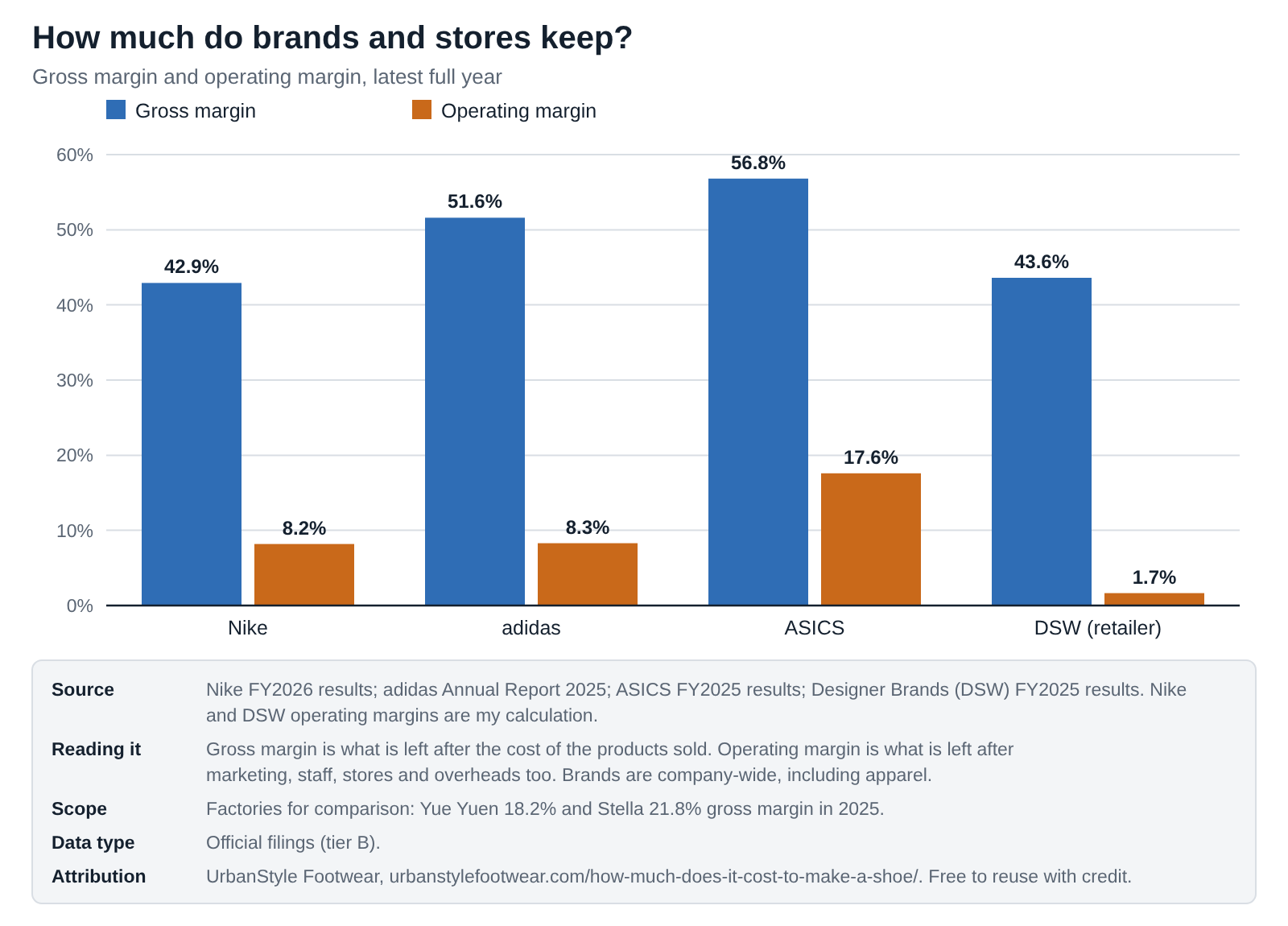
This is why you can’t compare a brand’s margin with a shopper’s price. A brand’s gross margin is measured on the brand’s own revenue, which is a wholesale price for most pairs and a retail price for the ones it sells itself. Here is how the margins compare:
Embed this chart
<figure style="margin:0"><a href="https://urbanstylefootwear.com/how-much-does-it-cost-to-make-a-shoe/"><img src="https://urbanstylefootwear.com/wp-content/uploads/2026/10/usf-shoe-brand-and-retailer-margins.png" alt="Grouped bars of gross and operating margin: Nike 42.9/8.2%, adidas 51.6/8.3%, ASICS 56.8/17.6%, DSW 43.6/1.7%" width="800" style="max-width:100%;height:auto"></a><figcaption>Source: UrbanStyle Footwear, based on Nike, adidas, ASICS and Designer Brands filings. <a href="https://urbanstylefootwear.com/how-much-does-it-cost-to-make-a-shoe/">How Much Does It Cost to Make a Shoe? From Factory to Retail Price</a></figcaption></figure>Click the code, press Ctrl+C (Cmd+C on Mac), and paste it into any web page. Please keep the attribution link.
View as table
| Company | Gross margin | Operating margin | Year |
|---|---|---|---|
| Nike | 42.9% | 8.2% | FY2026 |
| adidas | 51.6% | 8.3% | 2025 |
| ASICS | 56.8% | 17.6% | 2025 |
| DSW (retailer) | 43.6% | 1.7% | FY2025 (to Jan 2026) |
The big gap between gross and operating margin is the cost of being a brand or a store: marketing, staff, rent, technology and the rest. ASICS kept the most at both levels in 2025. DSW shows the retail side: after buying the shoes it kept 43.6%, but after running its stores it kept 1.7%. Returns are part of that bill, and my shoe return statistics show how often shoes come back, especially online.
Sources: Nike, adidas, ASICS and Designer Brands filings (tier B). Operating margins for Nike and DSW are my calculations (tier E).Does an expensive shoe offer better value?
Short answer. Sometimes. A higher price can buy better materials, sturdier construction and more research, but it can also buy marketing, a logo and scarcity. The cost of making a shoe tells you little about how long it will last on your feet.
Here is how I’d think about it, as someone who has sold shoes rather than made them. What manufacturing cost can tell you: whether a price is mostly materials and labour or mostly brand, and why a $30 shoe and a $150 shoe are built differently. What it can’t tell you: comfort, fit, durability or whether a shoe suits your foot.
- Check the materials, not the logo. Full-grain leather, a stitched sole and a removable insole are signs a shoe was built to last. My guide to spotting real leather helps.
- Think in cost per wear. A $165 running shoe that lasts a season of training can cost less per run than a cheaper pair that breaks down early.
- Buy on sale if you can. Markdowns come out of the store’s margin, not the shoe’s quality. The GEL-KAYANO 32 was 23% off the day I checked.
- Prefer repairable shoes for dress and work shoes. Resoling a welted shoe can extend its life for years.
My footwear buying guide covers fit, materials and when to spend more.
What nobody knows about the cost of a shoe
These gaps shaped this page. I’ve kept them visible rather than filling them with guesses.
| Gap | Why it matters | How I handled it |
|---|---|---|
| Factory price of a named model | The number most people want | Labelled “not publicly known”; category benchmarks instead |
| What a factory charges vs what it costs the factory | A factory price includes the factory’s profit | Split using Yue Yuen’s 18.2% margin and cost shares |
| Different definitions of cost of sales | Brands include different things (freight, duties, warehousing) | Used each company’s own figures; compared proportions, not dollars |
| Product-specific duty rates | Rates depend on type, material and value | Used the 12% average and named the current tariff |
| List price vs price paid | Discounts are common | Recorded both where seen (GEL-KAYANO 32) |
| Wholesale terms | Brand and retailer contracts are private | Used the half-of-retail rule and labelled it indicative |
Who reports what about shoe costs?
Each company in the chain reports its own slice. Select a step to see what it reports and how I use it.
1FactoriesYue Yuen, Stella International
Report pairs made, revenue and margins, and Yue Yuen splits its costs into materials and labour plus overheads. I use them for the factory price and what is inside it.
2US customsUN Comtrade (US-reported imports)
Records value and pairs for every shoe type and country, with and without freight. I use it for border prices, freight shares and category benchmarks.
3BrandsNike, adidas, ASICS
Report revenue, cost of sales, marketing, overheads and profit for the whole company. I use their proportions to split the brand’s share of a price.
4RetailersDICK’S, Foot Locker, DSW
Report gross and operating margins after buying their stock and running their stores. I use them for the store share.
5Tariff and tax notesFDRA, Kroll, Tax Foundation
Give average duty rates, the current tariff schedule and sales tax. They change often, so every figure is dated.
How good is the evidence behind these shoe cost figures?
Short answer. Strong for averages, weak for single models. Of the 81 rows in this page’s dataset, 35% are official filings and customs records (tier B), 5% are product pages and tax research (tier C), 9% are secondary reporting (tier D) and 52% are my calculations (tier E).
| Evidence tier | Rows | Share |
|---|---|---|
| A Peer-reviewed research | 0 | 0% |
| B Official records and filings | 28 | 35% |
| C Industry research | 4 | 5% |
| D Secondary reporting | 7 | 9% |
| E UrbanStyle calculations | 42 | 52% |
| Total | 81 | 100% |
- Tier B carries the inputs. Factory, brand and retailer filings and US customs data.
- Tier E is the model. Every breakdown and scenario is my arithmetic, shown in full.
- Tier D covers tariffs and older comparisons, which change often and come through trade press and law-firm notes.
Where other shoe cost articles go wrong
I read the pages that rank for “how much does it cost to make a shoe” and “how much does it cost Nike to make a shoe”. Some of these problems I saw directly, and the rest are traps that are easy to fall into. This is not a complete audit of anyone’s work.
- Problem 1Breakdowns from 2014 and 2016 still presented as current, before recent changes in wages, freight and tariffs.
- Problem 2An estimated cost for a named model presented as fact.
- Problem 3A brand’s gross margin compared with the shopper’s price, which mixes wholesale and retail revenue.
- Problem 4The whole markup treated as profit, ignoring marketing, staff, stores and markdowns.
- Problem 5Development and tooling costs for a start-up brand presented as the cost of making one pair.
- Problem 6Tariffs quoted without a date, when US footwear tariffs changed several times in 2025 and 2026.
- Problem 7No sources or downloadable data, so nobody can check the numbers.
Sources and evidence tiers
Evidence hierarchy
- APeer-reviewed research. Not used; costs come from company and customs records.
- BOfficial records and filings. Nike, adidas, ASICS, Yue Yuen, Stella, DICK’S and Designer Brands filings, and UN Comtrade.
- CCompany statements and research bodies. Official product pages and the Tax Foundation.
- DSecondary reporting. FDRA statements via trade press, Kroll’s tariff note, Dappered and older analyses used for comparison.
- ECalculations. The $100 model, scenarios, per-pair splits and margins, with the method stated.
Primary versus secondary data
Primary source: the company or agency that produced the data. Secondary source: an article summarising someone else’s data. Where I could only read a secondary source, the table says so.
Source table
| Source | Year | Sample | Geography | Finding used | Tier | Series ID | Primary source |
|---|---|---|---|---|---|---|---|
| NIKE, Inc., fiscal 2026 fourth quarter and full year results (June 30, 2026), Exhibit 99.1 to Form 8-K | 2026 | Company financial statements, year ended May 31, 2026 | Global | Revenues $46,398 million; cost of sales $26,487 million; gross margin 42.9%; demand creation $4,754 million; operating overhead $11,360 million; income before taxes $3,900 million; net income $3,108 million; NIKE Direct $17.7 billion; wholesale $27.5 billion | B | Form 8-K Exhibit 99.1 | Nike results (SEC exhibit) |
| NIKE, Inc., Form 10-K for fiscal 2026 | 2026 | Company annual filing | Global | 95 finished-goods footwear factories in 11 countries; Vietnam, Indonesia and China made about 52%, 27% and 16% of NIKE Brand footwear; imported products are subject to duties that affect cost | B | Form 10-K, Item 1 | SEC filing |
| adidas Annual Report 2025, consolidated income statement | 2025 | Company financial statements (IFRS, euros) | Global | Net sales EUR 24,811 million; cost of sales EUR 12,006 million; gross margin 51.6%; marketing and point-of-sale expenses EUR 3,079 million; operating profit EUR 2,056 million (8.3%) | B | n/a | adidas report |
| ASICS Corporation, consolidated financial summary for the year ended December 31, 2025 | 2025 | Company results presentation (yen) | Global | Net sales 810.9 billion yen; gross margin 56.8%; operating margin 17.6% | B | n/a | ASICS results (PDF) |
| Yue Yuen Industrial (Holdings) Limited, Annual Report 2025 (HKEX filing, April 21, 2026) | 2025 | Listed contract manufacturer for Nike, adidas, ASICS, New Balance and Salomon; 252.2 million pairs in 2025 | Indonesia, Vietnam, China | Average selling price US$21.00 a pair (2024: US$20.25); manufacturing gross margin 18.2%; manufacturing cost of goods sold US$4,618.3 million, of which materials 43.4% and direct labour plus production overheads 56.6%; about 276,800 manufacturing staff; production 54% Indonesia, 32% Vietnam, 9% China | B | HKEX 00551 | HKEX filing (PDF) |
| Stella International Holdings Limited, annual results announcement for 2025 (HKEX filing, March 19, 2026) | 2025 | Listed footwear manufacturer; 55.0 million pairs in 2025 | Asia | Average selling price US$27.7 a pair (2024: US$28.4); gross margin 21.8%; manufacturing revenue split sports 48.2%, fashion 24.2%, casual 19.9%, luxury 7.7% | B | HKEX 01836 | HKEX filing (PDF) |
| DICK'S Sporting Goods, fourth quarter and full year 2025 results (Exhibit 99.1, March 12, 2026) | 2025 | Retailer financial statements, year ended January 31, 2026 | United States | DICK'S segment gross margin 36.33%; Foot Locker segment gross profit $758.9 million on $3,106.2 million of sales from September 8, 2025; cost of goods sold includes occupancy and distribution costs | B | Form 8-K Exhibit 99.1 | SEC exhibit |
| Designer Brands Inc. (DSW), fourth quarter and fiscal 2025 results (March 26, 2026) | 2025 | Footwear retailer financial results, year ended January 31, 2026 | United States | Net sales $2,892.7 million; gross margin 43.6%; operating profit $47.8 million (1.7%) | B | n/a | Designer Brands release |
| United Nations Comtrade database, US-reported footwear imports 2025 (HS 64 and headings 6402 to 6404), read October 25 and 26, 2026 | 2025 | US customs records reported to the UN, with CIF and FOB values and pairs | United States | Import value per pair by shoe type and country; CIF values 3.5% above FOB for Vietnam, 5.3% for China, 3.9% for all suppliers | B | HS 6402, 6403, 6404 | UN Comtrade |
| Tax Foundation, "State and local sales tax rates, midyear 2026" (July 6, 2026) | 2026 | Tax research organisation | United States | Population-weighted average combined state and local sales tax rate of 7.53% as of July 1, 2026; five states with no statewide sales tax | C | n/a | Tax Foundation page |
| Nike.com, "Nike Air Force 1 '07 Men's Shoes", product page (read October 26, 2026) | 2026 | Official product listing | United States | Price $115; leather upper, Nike Air cushioning, foam midsole, rubber outsole | C | n/a | Nike product page |
| adidas.com, "Samba OG Shoes" (B75806), product page (read October 26, 2026) | 2026 | Official product listing | United States | Price $100; soft leather upper, suede overlays, gum sole | C | n/a | adidas product page |
| REI, "ASICS GEL-Kayano 32 Road-Running Shoes, Men's", product page (read October 26, 2026) | 2026 | Retailer listing | United States | List price $165, shown at $125.93 (23% off); knit and mesh upper, FF BLAST PLUS ECO midsole, ASICSGRIP outsole; "Imported" | C | n/a | REI product page |
| Footwear Magazine, "FDRA warns new footwear tariffs could push total costs past $5 billion" (July 14, 2025, updated October 3, 2026) | 2025 | Trade association statement reported by trade press | United States | Footwear carries an average duty rate of 12%, against 2% for other consumer goods; low-value and children's shoes often face 20%, 48% or more | D | n/a | Footwear Magazine article |
| World Footwear, "China remains top US footwear supplier but market share hits 35-year low" (April 9, 2026), reporting FDRA analysis of USITC data | 2026 | US import statistics as analysed by FDRA | United States | Average landed cost of US footwear imports from Vietnam $21.17 a pair in 2025, a 24-year high | D | n/a | World Footwear article |
| Kroll, "A tale of tariff substitution" (September 9, 2026) | 2026 | Law and advisory firm analysis | United States | IEEPA tariffs invalidated February 20, 2026; 10% Section 122 surcharge from February 24 to July 24, 2026; Section 301 tariffs from July 24, 2026 at 12.5% for China and Vietnam and 10% for Indonesia and India | D | n/a | Kroll article |
| Dappered, "Allen Edmonds: up to 40% off anniversary sale" (April 3, 2026) | 2026 | Menswear deals site | United States | Park Avenue leather-sole oxford $450 list, $349 on sale; most Allen Edmonds shoes handcrafted in Port Washington, Wisconsin | D | n/a | Dappered article |
| Solereview, "What does it cost to make a running shoe?" (May 22, 2016) | 2016 | Independent analysis of 2016 shipping data and 2015 annual reports | United States | Brand wholesale revenue taken as about 50% of retail; landed cost about 21% above factory price; US footwear duty 10% to 20% | D | n/a | Solereview article |
| UrbanStyle Footwear calculations on this page | 2026 | Arithmetic on figures from the sources above; method stated | Global | The $100 waterfall, scenarios, per-pair splits, margins and import values per pair | E | n/a | Methodology |
Methodology: how I estimate the cost of a shoe
Sources and data collection. I read Yue Yuen’s 2025 annual report and Stella International’s 2025 results on the Hong Kong exchange, Nike’s fiscal 2026 results and 10-K, adidas’s 2025 annual report, ASICS’s 2025 results, DICK’S and Designer Brands’ fiscal 2025 results, and US import records in UN Comtrade, including CIF and FOB values and pairs by shoe type. Prices come from Nike.com, adidas.com and REI, read October 26, 2026. Tariffs come from Kroll and the FDRA, and sales tax from the Tax Foundation.
The $100 model. Factory price $20, split using Yue Yuen’s 2025 manufacturing gross margin (18.2%) and cost shares (materials 43.4%, labour and overheads 56.6%). Freight and insurance at 3.5% of the factory price, the gap between CIF and FOB values for US imports from Vietnam. Duty at the FDRA’s 12% average plus the 12.5% Section 301 tariff for Vietnam. Wholesale price $50, the common half-of-retail rule. Brand costs use Nike’s fiscal 2026 shares of revenue (cost of sales 57.1%, demand creation 10.2%, operating overhead 24.5%); “other cost of sales” is the brand’s cost of sales minus the landed cost. Retailer profit uses DSW’s 1.7% operating margin. Sales tax at 7.53%.
Verified figures versus estimated ranges. Figures taken directly from a filing or official page are verified. The model, scenarios and per-pair splits are estimates. Category benchmarks are indicative. Model-level factory costs are not publicly known, and I don’t give them.
Assumptions, exclusions and limitations
- Averages, not models. Factory prices and import values average many shoes. A specific shoe can sit well above or below them.
- Company-wide ratios. Nike’s proportions include apparel, direct sales and every country; applied to one wholesale pair, they are an approximation.
- Duty rates vary. Real rates depend on the exact product classification, and tariffs have changed often.
- Wholesale terms are private. The half-of-retail rule is a convention, not a disclosed figure.
- Exchange rates. adidas and ASICS report in euros and yen; I compare their percentages, not currency amounts.
- Excluded: resale prices, start-up development costs, environmental costs and sales outside the US.
Data freshness
| Date | Change |
|---|---|
| October 26, 2026 | First publication. Factory filings for 2025, Nike fiscal 2026, adidas and ASICS 2025, retailer results, UN Comtrade 2025, tariffs as of July 24, 2026 and sales tax as of July 1, 2026. Downloadable dataset, four charts, scenario explorer and calculations with stated methods. |
| When US tariffs change | Planned update of the duty lines and scenarios. |
| January 2027 | Next scheduled full review. |
Last full source review: October 26, 2026. Next scheduled review: January 2027.
Corrections. If you spot an error or work in footwear sourcing or costing and can improve these estimates, email info@urbanstylefootwear.com with the subject “Data correction”. I’ll check it and note any change in the table above. How we review products is explained in our methodology.
For journalists and researchers
You can use the statistics and charts on this page with credit to UrbanStyle Footwear. Wherever you can, please cite the original source printed with each statistic. My own calculations are marked tier E and can be cited to me.
A sentence you can use. “Yue Yuen, which makes shoes for Nike and adidas, sold its shoes to brands at an average of $21 a pair in 2025. In an illustrative model, a $100 sneaker costs about $26 to land in the US, and the factory, brand and store together keep about $9 of the price as profit.” (Sources: Yue Yuen Annual Report 2025; model by UrbanStyle Footwear)
Media kit
All figures with value, unit, geography, segment, basis, period, source and evidence tier.
Four charts with source, scope and data type printed on each image. SVG versions are under each chart above.
The 15 citable statistics on one printable PDF.
Every source with year, sample, geography, tier, series ID and link.
Every line of the illustrative $100 sneaker, with who gets it and how it was set.
Ready-made citations below. Media and research enquiries go to info@urbanstylefootwear.com.
Cite this page
Suggested citation
UrbanStyle Footwear. “How Much Does It Cost to Make a Shoe? From Factory to Retail Price.” Updated October 26, 2026. https://urbanstylefootwear.com/how-much-does-it-cost-to-make-a-shoe/
APA style
Vahith, A. (2026, October 26). How much does it cost to make a shoe? From factory to retail price. UrbanStyle Footwear. https://urbanstylefootwear.com/how-much-does-it-cost-to-make-a-shoe/
Link (HTML)
<a href="https://urbanstylefootwear.com/how-much-does-it-cost-to-make-a-shoe/">How Much Does It Cost to Make a Shoe? by UrbanStyle Footwear</a>Click any citation, then press Ctrl+C (Cmd+C on Mac) to copy it.
For individual statistics, UrbanStyle recommends citing the original source listed in the source table whenever possible.
Data requests. Data correction or dataset request: info@urbanstylefootwear.com
Frequently asked questions
How much does it cost to make a pair of shoes?
For branded sneakers made in Asia, factories typically sell a pair to the brand for roughly $15 to $30. Yue Yuen, which makes shoes for Nike, adidas and ASICS, averaged US$21.00 a pair in 2025, and Stella International US$27.7. Cheap rubber or plastic shoes can cost a few dollars. See what a factory charges.
How much does it cost Nike to make a pair of shoes?
Nike does not publish the factory price of any model. Its fiscal 2026 cost of sales was 57.1% of revenue, across all products and sales channels. Factory filings and import records suggest a typical branded sneaker leaves the factory for roughly $15 to $30.
How much of a $100 shoe is profit?
Less than most people think. In my model of a $100 sneaker sold through a store, the factory makes about $3.64, the brand about $4.09 in operating profit and the retailer about $1.65. Most of the price pays for materials, labour, shipping, duties, marketing, staff and stores. See the $100 breakdown.
What percentage of a shoe's price is the manufacturing cost?
In my model of a typical $100 branded sneaker sold through a store, the factory price is about 20% of the shelf price, and the landed cost after freight and duties about 26%. For budget shoes the share can be higher, and for luxury shoes much lower.
Why are shoes so expensive if they cost $20 to make?
Because the factory price is only the first step. Freight, US duties (about 12% on average, plus new tariffs), the brand’s design, testing, marketing and staff, and the retailer’s stores, staff and markdowns all come on top, and each company needs a profit. See every stage of the cost.
How much does it cost to make an Air Force 1?
Not publicly known. Nike sells the Air Force 1 ’07 for $115 but does not disclose what it pays a factory. US imports of leather-upper shoes averaged $21.97 a pair from Vietnam and $17.76 from China in 2025, which gives a category benchmark, not the cost of this shoe.
What is the markup on shoes?
A common rule of thumb is that a store buys a shoe from the brand for about half the shelf price. In my model of a $100 sneaker, the brand buys it from the factory for about $20, a fifth of the shelf price. Real terms vary by brand and retailer and are not published.
How much do tariffs add to the cost of a shoe?
US footwear duties average about 12% of the import value, with cheap and children’s shoes often at 20% or 48%. Since July 24, 2026, Section 301 tariffs add 12.5% for shoes from Vietnam and China and 10% from Indonesia and India. On a $20 factory price, that is about $4.90 for Vietnam. See duties.
Do factory workers get a fair share of a shoe's price?
In Yue Yuen’s 2025 accounts, direct labour and production overheads together were 56.6% of manufacturing cost, about $9.72 of an average $21 pair, but labour alone is not reported separately. On a $100 sneaker, all factory labour and overheads come to roughly $9 in my model.
Is it cheaper for brands to sell direct than through stores?
Selling direct lets the brand keep the whole shelf price instead of about half, but it then pays for stores or websites, shipping to customers, payments and returns. Nike made about 39% of its fiscal 2026 Direct plus wholesale revenue through NIKE Direct. See wholesale versus direct.
Why do luxury shoes cost so much?
Partly materials and labour: US imports of Italian leather shoes averaged about $146 a pair in 2025, many times an Asian sneaker. But design, brand positioning, small runs and exclusivity explain most of a luxury price.
Are expensive shoes better value?
Sometimes. A higher price can buy better leather, construction that can be resoled, or better cushioning, but it can also buy marketing and a logo. Judge on materials, construction, fit and how long the shoe will last. See value.
Why are the same shoes cheaper on sale?
Once a store has bought the shoes, a markdown comes out of the store’s share. A 25% discount on a $100 shoe the store bought for $50 cuts its gross margin from $50 to $25; the factory and brand were already paid.
Can I use these figures and download the data?
Yes, with credit to UrbanStyle Footwear, and cite the original source for any single statistic where you can. The CSV, XLSX, charts and a printable list of key statistics are in the media kit, with citation formats.