

Foot Reflexology for Sleep: What the Research Shows and a Bedtime Routine
The short answer
Foot reflexology may modestly improve sleep quality, according to several randomized trials and meta-analyses, but the evidence is low in certainty and mostly comes from small studies without a sham comparison. A 2021 meta-analysis of 42 randomized trials (3,928 people) found lower sleep-disturbance scores after foot reflexology, yet a 2012 review of 40 trials of acupressure, reflexology and auricular acupressure for insomnia concluded the evidence did not allow a clear conclusion. A calming foot routine before bed is low risk, but it does not replace good sleep habits or medical care for insomnia.
- Realistic expectation: a relaxing wind-down that may help you drift off more easily.
- Not a treatment for: long-term insomnia, sleep apnoea or other sleep disorders.
- See a doctor if sleep problems last months or affect daily life.
What the research shows
| Study | What it did | What it found |
|---|---|---|
| Meta-analysis, 2021 | Pooled 42 randomized trials (3,928 adults) of foot reflexology and sleep disturbance, searched to January 2019 | Greater reduction in Pittsburgh Sleep Quality Index scores than controls (Hedges’ g -1.37). Participants were less likely to have sleep problems afterward (pooled odds ratio 0.25). |
| Meta-analysis, 2020 | 26 randomized trials (2,366 people) of foot reflexology for depression, anxiety and sleep | Foot reflexology may provide an additional non-drug option, but the authors recommended high-quality trials in specific groups and long-term follow-up. |
| Systematic review, 2012 | 40 randomized trials of acupressure, reflexology and auricular acupressure for insomnia | Only 10 used sham controls and 4 were double-blind. Every trial had at least one area of high risk of bias. Evidence did not allow a clear conclusion. |
| Randomized trial, 2025 | 68 people with chronic lymphocytic leukemia on chemotherapy. 10-minute foot reflexology daily for 4 weeks vs control | Sleep score 11.78 vs 16.21 in controls after the intervention. The authors noted no sham control, short follow-up and a relatively small sample. |
| Randomized trial, 2026 | 40 adults with poor sleep. 20-minute foot reflexology with aromatic oils daily for 21 days vs sitting quietly for 20 minutes | Sleep score improved from 14.25 to 10.30 in the treated group (lower is better). |
| Meta-analysis, 2025 | Massage, acupressure and reflexology for restless legs in haemodialysis patients | Interventions reduced restless legs severity but did not change sleep quality. Reflexology had no effect on severity in the subgroup analysis. |
How to read this
- Signals are consistent but weak. Many trials report better sleep scores, yet most compare reflexology with no treatment, so calm time, touch and attention could be doing the work.
- Sleep scores are self-reported. Participants know whether they received a treatment.
- Results vary by population. The best-studied groups are often people with medical conditions, not healthy adults with ordinary sleep trouble.
For the wider evidence, see does foot reflexology work?
Why it might help
Cleveland Clinic and WebMD both describe a calming effect on the nervous system as a leading theory for how reflexology helps. A warm, slow, predictable routine before bed also gives your body a cue to wind down, which is a basic principle of sleep hygiene. Neither explanation requires the foot chart to be accurate. See our foot reflexology chart for how traditional practitioners map the foot.
A 10-minute bedtime foot routine
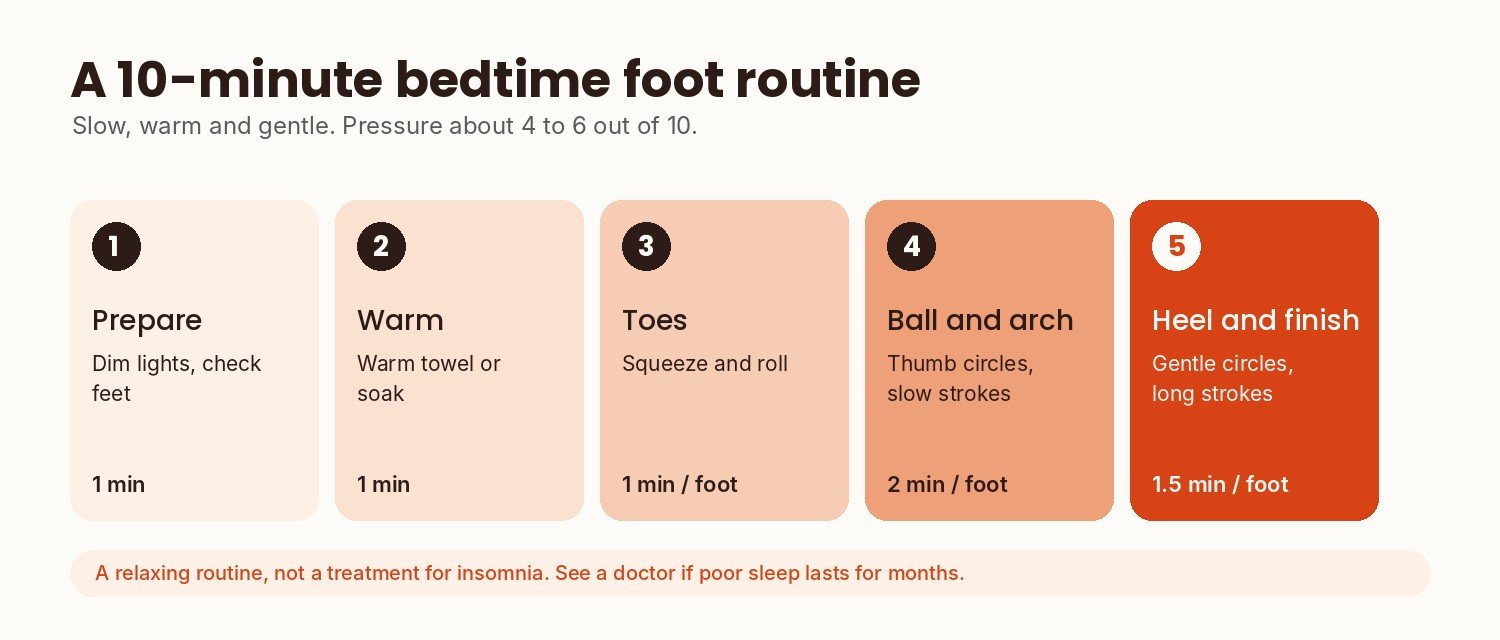
- Prepare (1 minute). Dim the lights, sit on the bed or a chair and check your feet for cuts or sores.
- Warm (1 minute). A warm towel or a short warm foot soak works. If you have reduced feeling, test the temperature with your hand.
- Toes (1 minute per foot). Slowly squeeze and roll each toe.
- Ball and arch (2 minutes per foot). Use thumb circles and slow strokes from the ball to the heel, at about 4 to 6 out of 10 pressure.
- Heel and finish (about 1.5 minutes per foot). Use gentle circles at the heel, then stroke the whole foot from toes to ankle. Put on warm socks if you like and turn off the light.
Pair it with slow breathing. The full step-by-step with an illustration is in our guide to doing foot reflexology at home. Trials have used 10 to 20 minutes daily for 3 to 4 weeks, but that is what researchers tested, not a proven dose.
Sleep habits that matter more
NHS guidance on insomnia lists habits with a stronger foundation than any foot technique:
- Go to bed only when you feel sleepy, and get up at the same time each morning.
- Relax for about an hour before bed, with a bath or a book.
- Keep the bedroom dark and quiet, and make the bed comfortable.
- Exercise regularly during the day, but not within four hours of bedtime.
- Avoid cigarettes, alcohol, tea and coffee for six hours before bed, and avoid heavy late meals.
- Put away phones and screens right before bed, and avoid daytime naps.
When to see a doctor
The NHS advises seeking advice if changing your habits has not helped, if you have had trouble sleeping for months, or if poor sleep makes it hard to cope in daily life. Insomnia lasting three months or longer is classed as long-term. Also get help for loud snoring with pauses in breathing, severe daytime sleepiness, or restless legs that disturb your sleep. Restless legs have their own causes, and our review of the evidence found reflexology had no effect on severity in one meta-analysis.
Safety
Check with a clinician first if you:
- Have diabetes, neuropathy or reduced feeling in the feet. See reflexology for neuropathy in feet
- Have poor circulation, clots, foot wounds, ulcers, a fungal infection or gout
- Are pregnant, or have a low platelet count
- Have skin that reacts to oils, if you plan to use them
Side effects are usually mild and short-lived, such as tender feet or light-headedness. If you feel light-headed, sit still before standing, especially at night.
New to reflexology? Start with the complete guide to foot reflexology.
A full wind-down timeline
The foot routine works best as one part of a wind-down, not a standalone fix. Here is a simple timeline built around the NHS habits above:
- 2 to 3 hours before bed: finish heavy meals and caffeine, and dim bright lights where you can.
- About 1 hour before: put screens away, take a warm bath or shower, and do light stretching or reading.
- 20 to 30 minutes before: do the 10-minute foot routine, then slow breathing.
- At bedtime: lights off, room cool, dark and quiet, and put warm socks on if your feet feel cold.
Consistency matters more than the exact steps. Doing it at the same time each night helps your body link the routine with sleep.
If you wake in the night
If you cannot get back to sleep after about 20 minutes, the NHS advice is to get up, go to another room and do something calm until you feel sleepy, rather than lying in bed worrying. A very gentle foot stroke is fine, but avoid bright light and screens. Do not use strong pressure or devices in the middle of the night, especially if you feel groggy or have reduced feeling in your feet.
Keeping a sleep diary
If you want to know whether the routine is helping, track it for two weeks without it and two weeks with it. Note the time you went to bed, how long you think it took to fall asleep, how many times you woke, what time you woke up, and how rested you felt from 1 to 5. Add caffeine, alcohol, exercise and stress. A diary also gives a doctor useful information if sleep problems persist. Many apps and wearables estimate sleep, but their numbers are approximate, so rely on how you feel.
Mistakes that undo a good routine
- Using it to fight long-term insomnia alone. If sleep trouble has lasted months, see a doctor.
- Pressing too hard. Pain keeps you awake. Aim for slow and soothing.
- Doing it with a phone in hand. Screens work against the calming effect.
- Very hot foot soaks. Water that is too hot can irritate skin and is unsafe if feeling is reduced.
- Expecting instant results. Trials ran for weeks, so give it a fair try, and stop if it does not suit you.
For the full evidence on what reflexology can and cannot do, see does foot reflexology work? and the complete guide.
Sleep environment checklist
- Cool, dark and quiet room, with blackout curtains or an eye mask if needed.
- A comfortable, supportive mattress and pillows.
- No work, TV or phone in bed, so the bed signals sleep.
- A consistent wake-up time, even on weekends.
- Warm, loose socks if your feet are cold. Cold feet can make it harder to settle for some people.
- Comfortable footwear around the house during the evening, so your feet are not tired and aching by bedtime. See foot comfort and supportive footwear.
Special situations: stress, shift work and pregnancy
Stress and racing thoughts. A slow routine gives your mind something steady to focus on. Pair it with slow breathing, and write down worries earlier in the evening so they are not competing for attention at bedtime.
Shift work. Irregular schedules make sleep harder. Keep your wind-down steps the same before every sleep period, and use blackout curtains in the daytime. Persistent difficulty is worth discussing with a doctor.
Pregnancy. Sleep can be disturbed in pregnancy, but reflexology and acupressure on the feet need extra caution. Ask your midwife or doctor first. The full safety list is in our complete guide.
Frequently asked questions
Can foot reflexology help you sleep?
It may modestly improve sleep quality for some people, according to several trials and meta-analyses, though the evidence is low in certainty and many studies lacked a sham control.
How long should I do foot reflexology before bed?
There is no proven dose. Trials used 10 to 20 minutes daily, so a 10-minute routine is reasonable.
Does foot massage help sleep?
A slow, warm foot massage can be relaxing, which helps many people wind down. Evidence that it improves sleep disorders is limited.
Is foot reflexology good for insomnia?
It is not a treatment for insomnia. A 2012 review found the evidence for reflexology and acupressure in insomnia inconclusive. See a doctor if poor sleep lasts for months.
Which foot pressure point is best for sleep?
Acupressure guides name points such as Kidney 1 on the sole and Spleen 6 above the inner ankle, but none has been proven to improve sleep. See our guide to foot pressure points.
Is it safe to do reflexology every night?
For healthy adults, gentle pressure is low risk. Stop if your feet get sore and check with a clinician if you have diabetes, numb feet, clots or are pregnant.
What time of night should I do foot reflexology?
About 20 to 30 minutes before bed works for most people, once you are in a calm environment.
Can foot massage help with restless legs?
The evidence is thin. A 2025 meta-analysis found reflexology had no effect on restless legs severity in one subgroup. Talk to a doctor if restless legs disturb your sleep.
Is it okay to sleep with socks after a foot massage?
Yes, if your feet feel cold and the socks are loose and breathable. Avoid anything tight, and skip heated socks if you have reduced feeling.
How long before I notice any difference?
Trials used 3 to 4 weeks, but there is no proven timeline. If you notice no benefit after a few weeks, other sleep habits may matter more.
More in the foot reflexology series
- Reflexology vs foot massage: how they differ
- Reflexology vs acupressure: zones compared with points
- Foot reflexology for headaches and migraines: what trials found
- Foot reflexology for plantar fasciitis: heel pain and what helps
- Best reflexology foot massagers: devices and what to know
- Foot comfort and supportive footwear: fit and everyday habits
Sources
- Foot reflexology and sleep disturbances: evidence appraisal through a meta-analysis, 2021 (PubMed 33615535)
- Foot reflexology for depression, anxiety and sleep quality in adults: meta-analysis and metaregression, 2020 (PubMed 33014101)
- Acupressure, reflexology and auricular acupressure for insomnia: systematic review, 2012 (PubMed 22841034)
- Foot reflexology and sleep quality in chronic lymphocytic leukemia under chemotherapy, 2025 (PubMed 41132190)
- Foot reflexology massage with aromatic oils and sleep quality, randomized trial, 2026 (PubMed 42428595)
- Massage, acupressure and reflexology for restless legs in haemodialysis, 2025 (PubMed 39905773)
- NHS: Insomnia (last reviewed March 19, 2024)
- Cleveland Clinic: Reflexology (published August 30, 2022)
Educational information only, not medical advice.