
Does Foot Reflexology Work? A Review of the Evidence, Condition by Condition
The short answer
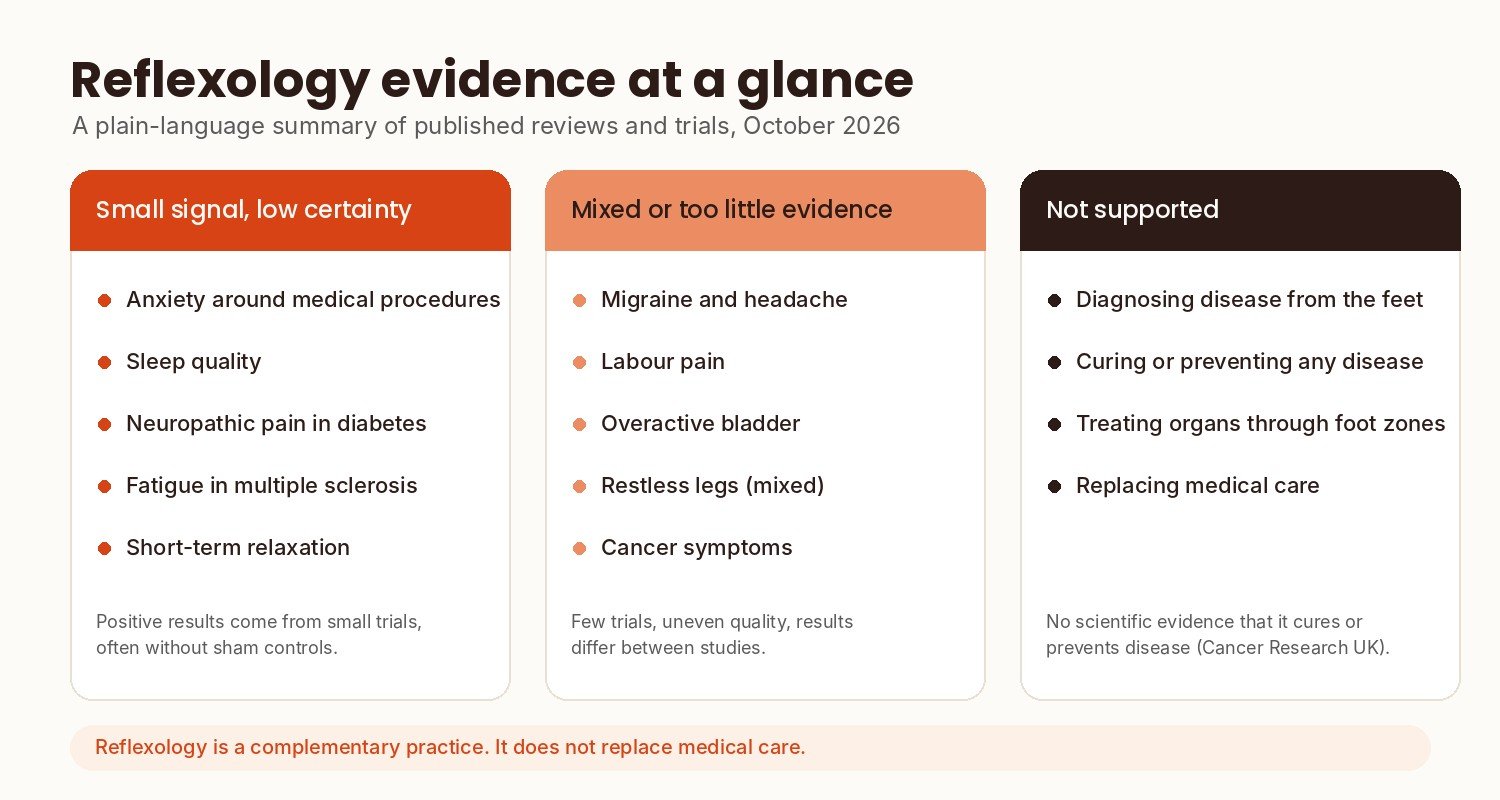
Foot reflexology probably works as a relaxing, low-risk touch therapy. Several reviews of small trials report lower anxiety and better sleep or pain scores, but the evidence is low in certainty, many trials had no sham comparison, and it has not been shown to beat an ordinary foot massage. There is no scientific evidence that it diagnoses, cures or prevents any disease.
- Most consistent signal: reduced anxiety around medical procedures.
- Promising but uncertain: sleep, neuropathic pain in diabetes, fatigue in multiple sclerosis.
- Mixed or thin: migraine, labour pain, bladder symptoms, restless legs, cancer symptoms.
- Not supported: the idea that foot zones diagnose or treat the organs they are mapped to.
The evidence at a glance
What health authorities say
- NCCIH (US National Institutes of Health). The claim that reflexology promotes relaxation and healing is not proven. A study funded by the National Cancer Institute in women with advanced breast cancer found improved shortness of breath but not nausea or pain, and found it safe even for fragile patients. Research on multiple sclerosis was small, and there was too little evidence for irritable bowel syndrome.
- Cleveland Clinic. No evidence shows reflexology works better than a foot massage.
- Cancer Research UK. No scientific evidence that it can cure or prevent any disease. Studies are small and mixed.
- MSD Manual Professional. Its effects are nonspecific and indistinguishable from massage, and meta-analyses in palliative care and labour pain are low quality.
For the plain-language basics, see the complete guide to foot reflexology.
Condition by condition
| Area | What the best available studies show | Confidence |
|---|---|---|
| Anxiety around procedures | A 2026 meta-analysis of 10 studies (913 people) around coronary angiography found lower anxiety right after reflexology (Hedges’ g -1.78) and 30 minutes later (-1.16), with wide confidence intervals. A meta-analysis of 8 studies (485 patients) in open-heart surgery found lower anxiety (g -1.49) but warned of high heterogeneity. A 2025 sham-controlled trial of 300 people before gallbladder surgery found a small, significant advantage over sham reflexology. | Some signal |
| Sleep | A 2021 meta-analysis of 42 randomized trials (3,928 people) found a large reduction in sleep-quality scores (Hedges’ g -1.37). A 2025 trial in leukemia patients found improvements without a sham control, and the authors flagged short follow-up. | Some signal |
| Neuropathic pain in diabetes | A 2026 meta-analysis of 8 studies (590 people, mixed designs) found pain 1.64 points lower on average. Includes quasi-experimental studies. | Some signal |
| Fatigue in multiple sclerosis | A 2025 systematic review of 7 studies (434 people): six found reduced fatigue, one found no significant difference. Authors asked for blinded, larger trials. | Some signal |
| Migraine and headache | A 2025 trial found shorter and less severe migraines with reflexology, but not fewer. A 2024 systematic review found only 3 qualifying studies and urged caution. | Limited |
| Labour pain | Cochrane’s 2018 review found massage reduced first-stage labour pain (low-certainty evidence). MSD calls reflexology meta-analyses in labour pain low quality. | Limited |
| Overactive bladder | A 2007 trial of 109 women found a daytime-frequency benefit versus nonspecific foot massage, but blinding was imperfect. | Limited |
| Restless legs | A 2025 meta-analysis in haemodialysis patients found massage and acupressure reduced severity while reflexology had no effect. | Limited |
| Curing or preventing disease | Not supported. Cancer Research UK found no scientific evidence. | None |
Condition-specific guides: sleep, headaches and migraines, neuropathy and plantar fasciitis.
Why the results look better than they may be
- Blinding is hard. In the 2007 bladder trial, 88.9% of the reflexology group and 67.4% of the nonspecific-massage group believed they had received true reflexology, so expectation may have contributed.
- Many trials have no sham. A trial that compares reflexology with nothing cannot separate the effect of the method from the effect of attention, touch and rest.
- Small samples and mixed designs. Several meta-analyses combine randomized and quasi-experimental studies and report high heterogeneity, which makes large pooled effects less trustworthy.
- Older reviews were already cautious. A 2009 systematic review in the Medical Journal of Australia examined 18 trials, found only 5 positive, and concluded the evidence did not convincingly show benefit for any condition.
- Self-reported outcomes. Anxiety, pain and sleep are scored by participants, who know they got a treatment.
The large effect sizes reported in some meta-analyses (a Hedges’ g above 1) are unusually big for a gentle touch therapy, which is itself a reason for caution.
How to judge a reflexology study
- Was there a sham or active comparison, or only no treatment?
- How many people took part, and how many finished?
- Was the outcome measured by someone who did not know the group?
- Is the effect small and consistent across studies, or one big result?
- Does the claim match the study, such as relaxation, or does it leap to curing disease?
So, does it work?
Works for what? If the question is “can it help me relax and feel less anxious,” the evidence is supportive though low in certainty, and the risk is low for most healthy adults. If the question is “can it treat my condition,” the answer is that it has not been shown to, and it should never replace medical care. If the question is “is it better than a good foot massage,” the evidence does not say so. See reflexology vs foot massage.
Safety reminder
- Check with a clinician first if you have circulation problems, clots, foot ulcers, gout, fungal infections, numbness, a low platelet count or are pregnant.
- Never delay care for severe or unexplained symptoms.
If you want to try it, start with our gentle home routine, and see the foot reflexology chart for the zones.
Is it just placebo?
This is the most common question in forums, and the fairest answer has two parts. First, the foot map itself, the idea that specific spots connect to specific organs, has not been proven, and reviewers say there is no evidence reflexology works better than a foot massage. Second, many people genuinely feel more relaxed afterwards, and relaxation is a real effect even when the proposed mechanism is not confirmed.
Researchers separate two things: the specific effect of pressing a mapped point, and the general effects of touch, rest, attention and expectation. Most positive trials cannot separate them, especially when the comparison group receives nothing. That does not mean people are imagining the relaxation. It means the benefit may come from the experience as a whole rather than from the map.
Why people feel better
- Touch and attention. Being cared for is calming for many people.
- Quiet time. A set period of rest, away from screens, lowers arousal.
- Slow breathing. Most routines encourage it, which is calming in its own right.
- Foot muscle relief. Tired feet feel better after being kneaded.
- Expectation. Believing it will help can shape how you feel, particularly for symptoms such as pain and anxiety that are experienced subjectively.
What stronger evidence would look like
Good evidence for reflexology would need large, well-designed randomized trials with a convincing sham (for example, light touch on non-mapped areas), blinded outcome assessment, pre-registered outcomes, and repeated results in independent groups. A few recent trials, such as a sham-controlled trial of reflexology for anxiety before a procedure, are steps in that direction, but results across the field remain mixed, and many studies are small and short. Pooled analyses can also look more positive than the individual trials justify when the underlying studies are weak, which is why this guide reports certainty alongside results.
A fair verdict by goal
| Goal | What the evidence supports | Read more |
|---|---|---|
| Relaxation and stress | Plausible, low-risk, mostly short-term | Home routine |
| Sleep | Positive signals, low certainty, no sham in most trials | Reflexology for sleep |
| Headaches and migraines | Limited, mixed and low certainty | Headaches |
| Heel pain | No reflexology-specific trial found | Plantar fasciitis |
| Diabetic nerve pain | Early, low certainty, safety concerns | Neuropathy |
| Treating any disease | Not proven. NCCIH says the healing claim is unproven | Complete guide |
If you try it, treat it as a relaxing complement, keep your medical care, and judge it by how you feel after a few sessions rather than by what a chart promises.
Run your own two-week test
If you want to know whether foot reflexology does anything for you, a simple self-experiment is more useful than reading testimonials. It is not a clinical trial, but it keeps you honest.
- Pick one outcome, such as stress level, sleep or foot tiredness, and rate it from 1 to 10 each day for a week without doing anything new.
- For the next week or two, do the same 10-minute routine at a set time, and keep rating the outcome.
- Change nothing else, such as caffeine, bedtime or exercise.
- Compare the two periods. A small shift could still be expectation or normal variation, so be modest in your conclusions.
If your symptom is serious, persistent or getting worse, skip the experiment and see a clinician.
Red flags in reflexology claims
- Claims to cure or reverse serious diseases such as cancer, diabetes or infertility.
- Advice to stop prescribed medication or skip tests.
- “Diagnosing” illness from tender spots on your feet.
- Sales pressure for expensive packages, supplements or devices.
- No mention of safety, health history or limits.
- “Studies show” without naming a study, or testimonials used as proof.
Good sources describe reflexology as complementary and state the limits plainly, as NCCIH and Cleveland Clinic do. Our complete guide follows the same approach.
Frequently asked questions
Does foot reflexology really work?
It may help with relaxation and anxiety, and some small trials show better sleep or pain scores. Evidence is low in certainty, and it has not been shown to cure or prevent disease.
Is reflexology scientifically proven?
No. NCCIH says the claim of promoting relaxation and healing is not proven, and Cancer Research UK says there is no scientific evidence it cures or prevents disease.
Is reflexology just a placebo?
It cannot be ruled out. Several effects may come from touch, attention and relaxation. A 2025 sham-controlled trial found a small advantage over sham, so the answer is not settled.
Is reflexology better than massage?
There is no good evidence that it is. Cleveland Clinic says no evidence shows it works better than a foot massage.
Can reflexology cure anything?
No evidence supports that.
Can reflexology be harmful?
It is generally low risk. Side effects are mild, such as tender feet or light-headedness. Risks rise when people use it instead of medical care, or have conditions such as clots or foot wounds.
Is reflexology scientifically proven?
No. Reviews describe the evidence as limited and low in certainty, and the claim that it treats or heals conditions is not proven.
Why do people swear by it?
Many people feel relaxed, cared for and rested afterwards. Those effects are real even if the foot-to-organ map is not.
Can reflexology be harmful?
For most healthy adults it is low risk. It needs caution with diabetes, neuropathy, clots, foot wounds, gout and pregnancy, and it should never replace medical care.
Does reflexology detox the body?
There is no evidence that it removes toxins. Your liver and kidneys handle that.
More in the foot reflexology series
- Foot pressure points: acupressure points and what they claim
- Reflexology vs acupressure: zones compared with points
- Best reflexology foot massagers: devices and what to know
- Foot comfort and supportive footwear: fit and everyday habits
Sources
- NCCIH: Reflexology
- Cleveland Clinic: Reflexology (published August 30, 2022)
- Cancer Research UK: Reflexology (reviewed June 17, 2022)
- MSD Manual Professional: Reflexology
- Ernst, Medical Journal of Australia 2009: Is reflexology an effective intervention?
- Cochrane 2018: Massage, reflexology and other manual methods for pain management in labour
- Reflexology for pain and anxiety in coronary angiography, systematic review and meta-analysis, 2026 (PubMed 42170911)
- Reflexology and anxiety in open heart surgery, systematic review and meta-analysis, 2026 (PubMed 41575357)
- Reflexology vs sham reflexology vs standard care for preoperative anxiety, 2025 (PubMed 41020221)
- Foot reflexology and sleep disturbances, meta-analysis, 2021 (PubMed 33615535)
- Reflexology massage and neuropathic pain in diabetes, systematic review and meta-analysis, 2026 (PubMed 42321037)
- Foot reflexology for multiple sclerosis-related fatigue, systematic review, 2025 (PubMed 39960275)
- Massage, acupressure and reflexology for restless legs in haemodialysis, 2025 (PubMed 39905773)
- Reflexology vs nonspecific foot massage for detrusor overactivity, 2007 (PubMed 17003953)
- Foot reflexology and migraine pain, randomized controlled trial, 2025 (PubMed 40486630)
- Plantar reflexology for headache, systematic review, 2024 (PubMed 39267896)
Educational information only, not medical advice. Figures are taken from the published abstracts cited above.