

How Leather Is Made: Chrome vs Vegetable-Tanned Leather
Editorial Guide | Footwear Materials |
Summarise this tanning guide with AI
Open an assistant and submit the prefilled request. The assistant reads the page only after you submit it.
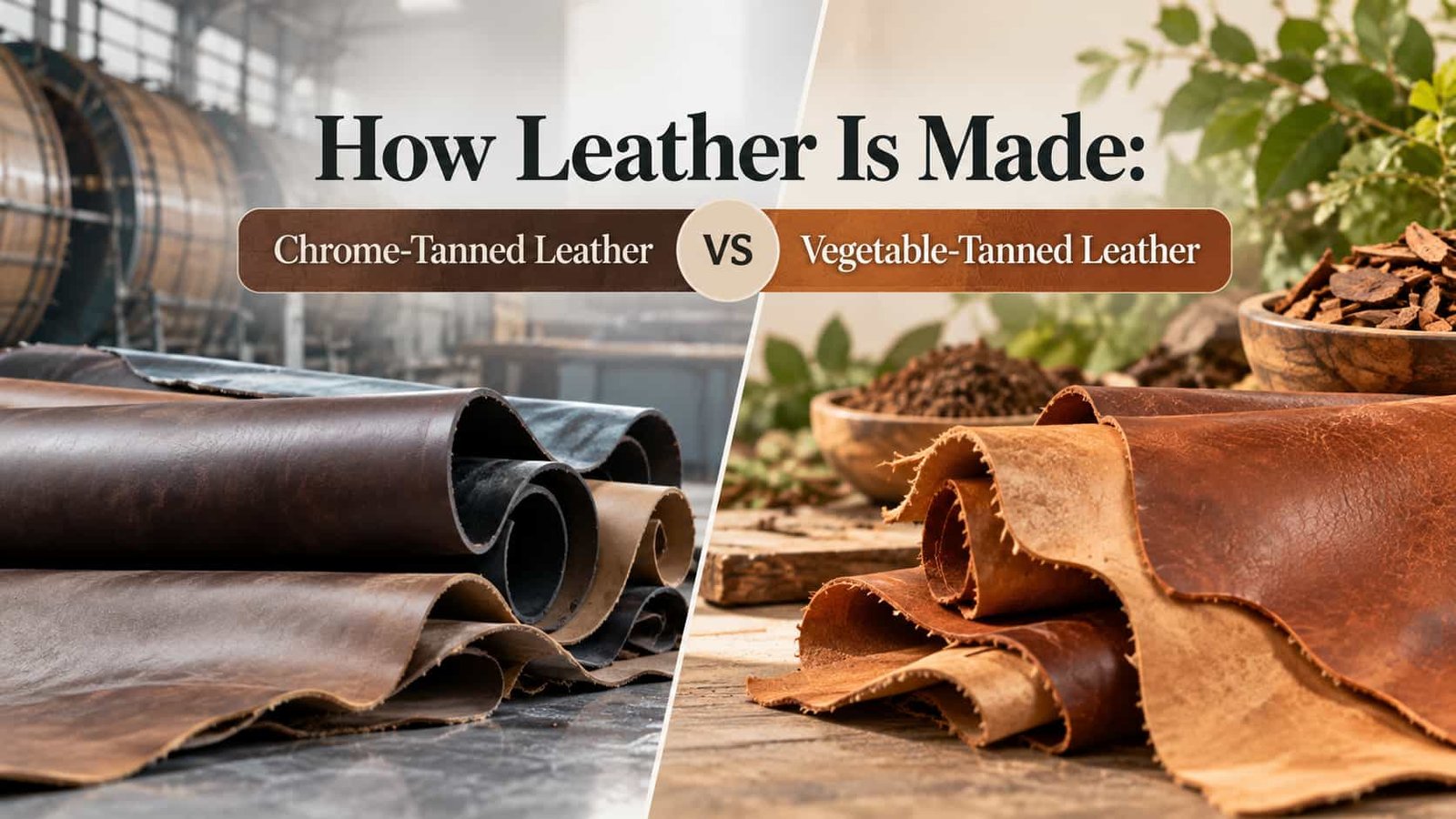
Chrome vs. vegetable-tanned leather comes down to the tanning agent. Chrome tanning uses chromium salts and takes about a day, giving soft, flexible, water-tolerant leather common in shoe uppers. Vegetable tanning uses plant tannins and takes far longer, giving firmer leather that develops a patina and is common in soles, belts and traditional boots.
Key Takeaways
- Tanning is what makes leather. It changes the hide’s protein structure so it will not rot.
- Chrome tanning is the dominant method. It is fast and produces soft, consistent leather, and it is used for most shoe uppers.
- Vegetable tanning is slower and older. It uses plant tannins and gives firmer leather with more character.
- Water affects them differently. Vegetable-tanned leather darkens and can harden if soaked and dried, while chrome-tanned leather is more tolerant.
- Neither is simply “better.” Match the method to what the shoe needs to do.
Chrome vs Vegetable Tanning at a Glance
Here is the quick comparison. Details follow below, and these are typical tendencies, not rules for every product.
| Feature | Chrome tanned | Vegetable tanned |
| Tanning agent | Chromium salts (chromium sulfate) | Tannins from bark and other plant matter |
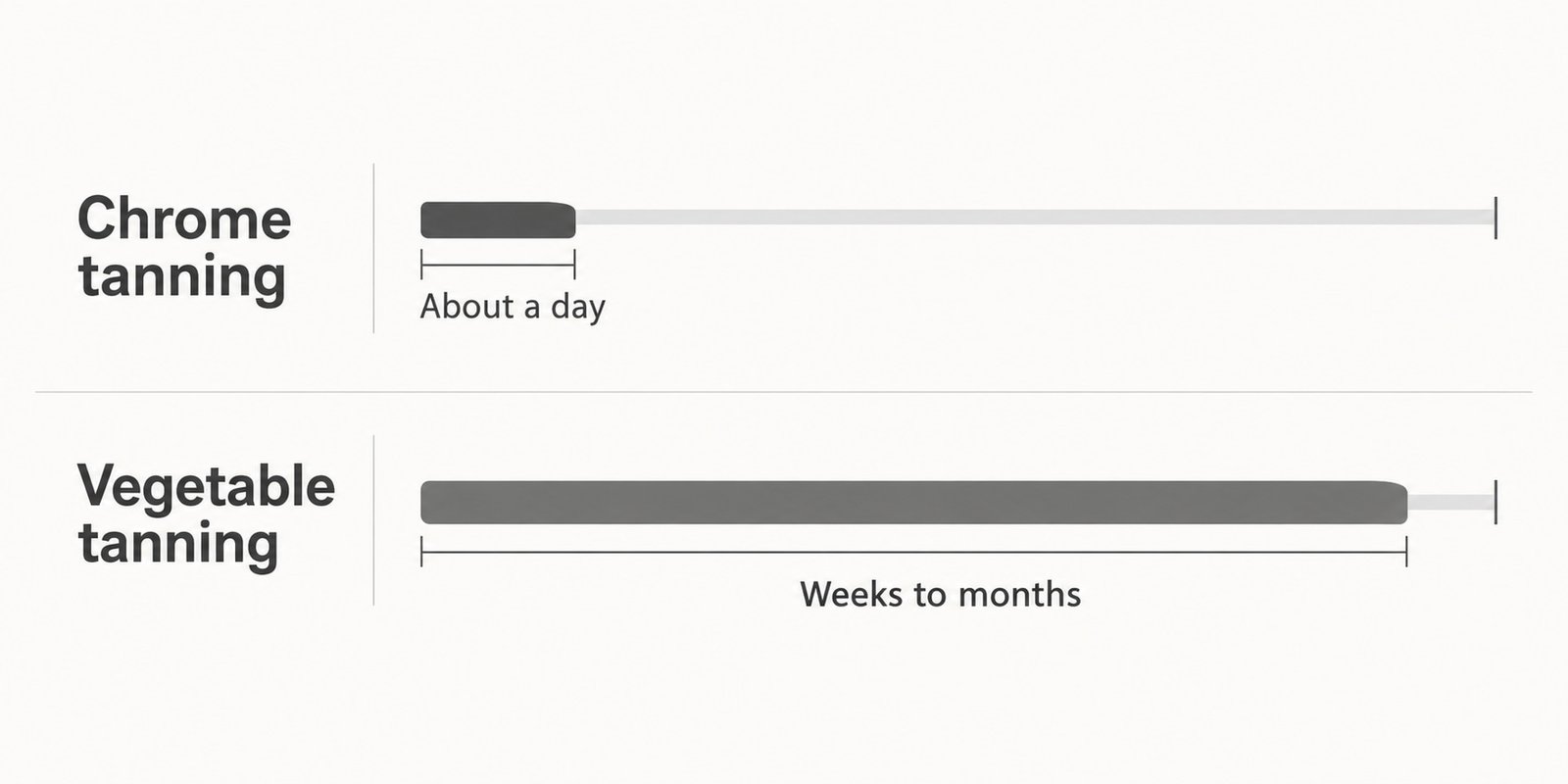
| Time | Around a day, in large drums | Weeks to months, depending on method |
| Feel when new | Soft, supple, flexible | Firmer, fuller, more structured |
| Colour range | Wide, consistent, vivid | Natural tans and browns, rich and deep |
| Ageing | Stays fairly uniform | Develops a patina, darkens with light and handling |
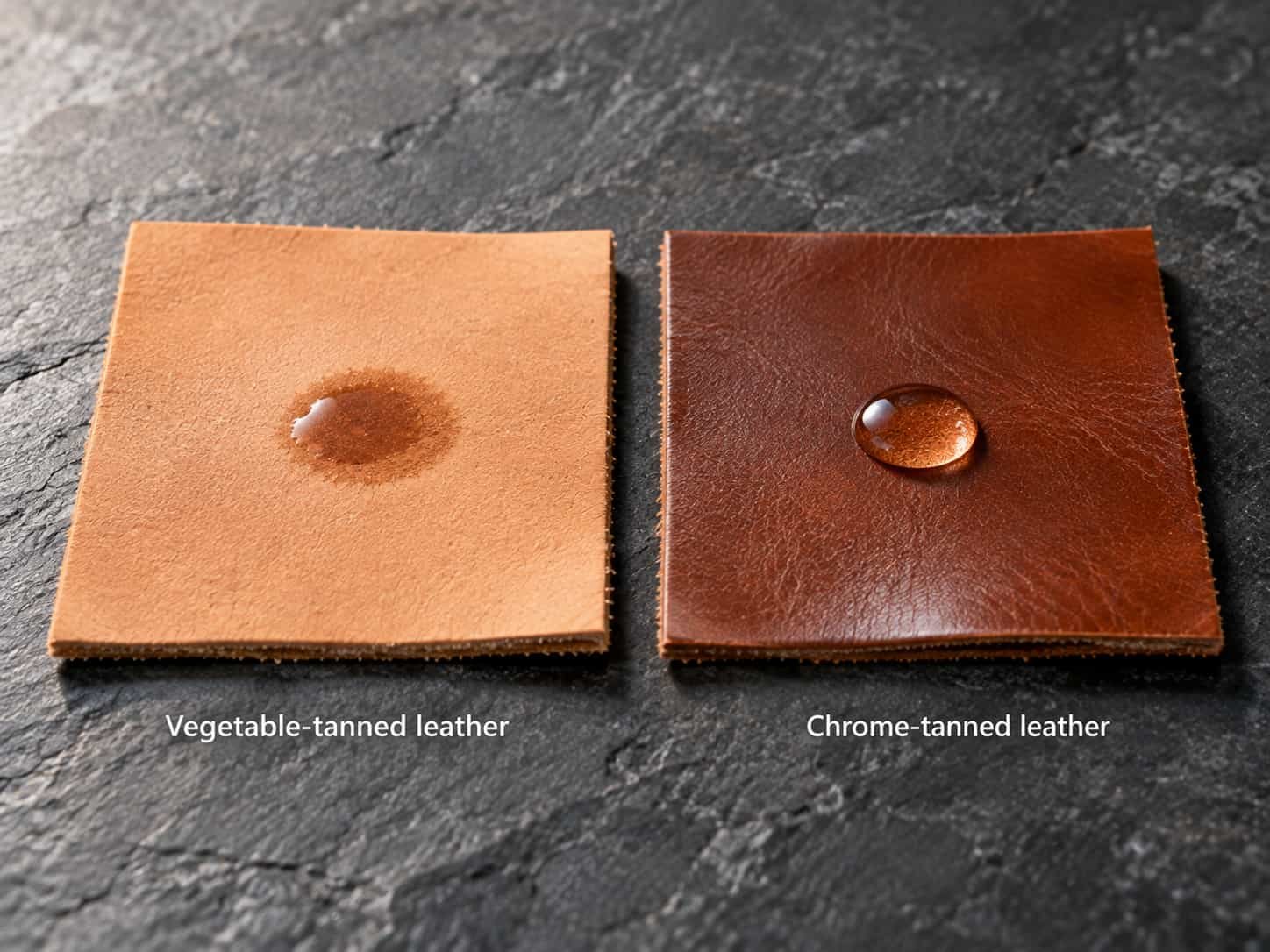
| Water | More tolerant, holds shape better | Darkens, can stiffen and shrink if soaked and dried |
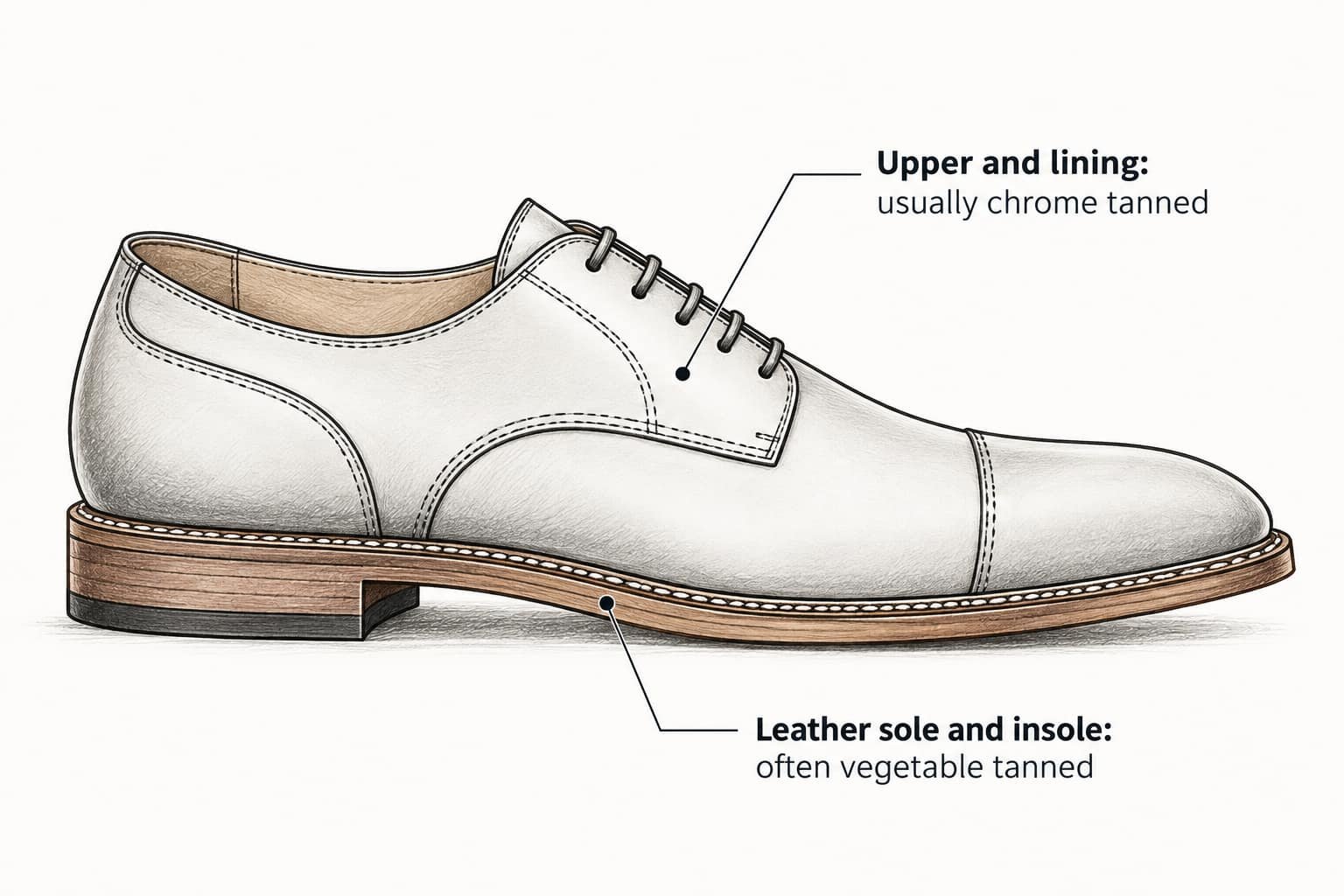
| Typical shoe use | Uppers, linings | Soles, insoles, welts, some traditional uppers |
| Share of global leather | Most (estimates vary, roughly 80 to 90 percent) | A small minority (around 10 percent or less) |
| Cost and availability | Cheaper, widely available | Usually costlier, fewer tanneries |
Where Leather Comes From
Most leather starts as cattle hide, which is usually a by-product of the meat industry. Sheep, goat, pig and horse skins are also used, and the Leather Working Group’s flagship audit was first built around bovine leather. The raw hide arrives at the tannery salted or fresh, and it will spoil quickly unless it is processed.
Before tanning, the hide is cleaned and prepared. Hair is removed, fat and flesh are trimmed, and the hide is soaked and treated so the tanning agent can penetrate evenly. Only after those stages does tanning begin. If you want to know how the hide’s layers become grades such as full grain or split, see full grain vs top grain and what is genuine leather.
What Tanning Actually Does
Raw hide is mostly protein, and protein decays. Tanning permanently changes that protein structure so the material resists rot, and according to Britannica, a tanning agent displaces water from the spaces between the protein fibres and cements those fibres together. The same source names three widely used agents: vegetable tannin, mineral salts such as chromium sulfate, and oils.
That is why the choice of method matters. The tanning agent influences softness, colour, water behaviour, ageing and cost. It does not decide quality on its own, since a well-made chrome-tanned leather can beat a poorly made vegetable-tanned one. It does set the character of the leather you will wear.
How Chrome Tanning Works
Chrome tanning uses chromium salts, most commonly chromium sulfate. The hides are placed in large rotating drums with the tanning solution, and the process usually takes about a day. Wikipedia notes that this speed is why chrome tanning suits large-scale industrial production.
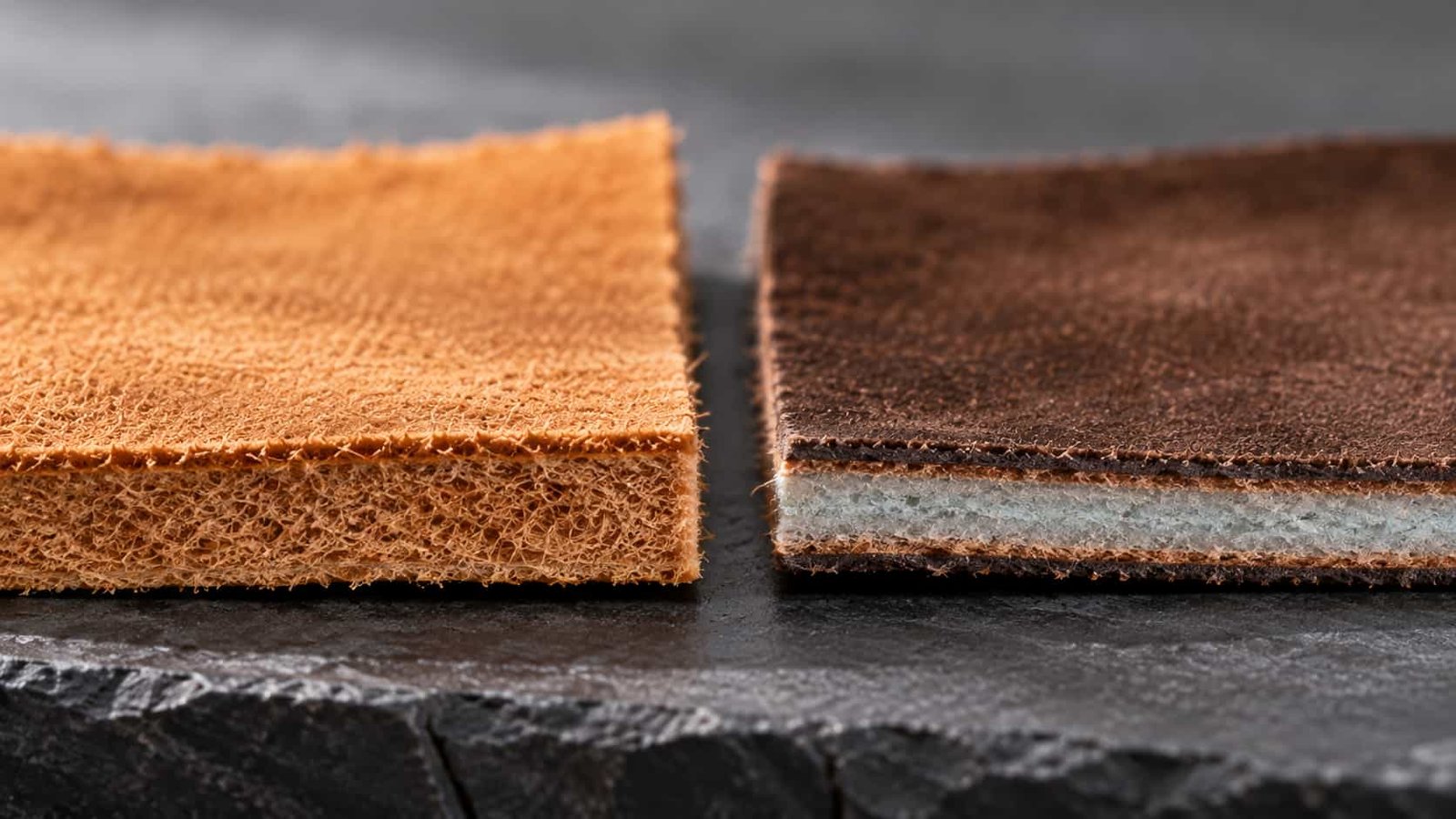
Chrome-tanned hides often leave this stage a pale blue-grey colour, which is why the intermediate product is called “wet blue.” After tanning, the leather is retanned, dyed, fatliquored (treated with oils to keep it supple) and finished. Because the chromium stabilises the leather so thoroughly, chrome tanning gives the maker a lot of control over colour, softness and consistency.
Britannica notes that tanning with chromium salts was introduced toward the end of the 19th century, which makes it the more modern of the two main approaches. Wikipedia describes the resulting leather as more supple and pliable than vegetable-tanned leather, and as less likely to discolour or lose shape in water.
The trade-offs are practical rather than moral. Chrome tanning needs careful chemical management, because wastewater and residues must be handled properly. The leather is also harder to describe as natural or biodegradable in the way vegetable-tanned leather is. The environment section covers this.
How Vegetable Tanning Works
Vegetable tanning is the older method. It uses tannins extracted from plant matter such as tree bark, and Britannica describes the basic procedure as soaking hides in vats of increasingly strong tannin liquors. Wikipedia notes that the colour “tan” takes its name from the appearance of undyed vegetable-tanned leather.
The pace is the defining feature. Vegetable tanning takes far longer than mineral tanning, with timings that run from weeks to several months depending on the method and the tannery. Some leathers are pit tanned in stationary vats, and others are drum tanned to speed things up. Because the tannin penetrates slowly, the leather ends up fuller and firmer.
Vegetable-tanned leather is the traditional choice for sole leather, belts, saddlery and craft work. The leather often has a distinctive natural smell and a colour that deepens with light, handling and age.
Wikipedia also records the behaviour that matters most to shoe wearers: vegetable-tanned leather is not stable in water. It tends to discolour, and if it is soaked and then dried, it shrinks and hardens. That quality is used on purpose in traditional shoemaking, where wet leather is moulded and then dried to hold its shape.
Combination, Oil and Other Methods
Not all leather fits neatly into two boxes. Several variations show up in product descriptions.
- Combination tanning. Leather is tanned with chrome and then retanned with vegetable tannins, or the reverse. The aim is a blend of chrome’s softness and vegetable tanning’s body. These variants are sometimes called semi-chrome.
- Oil tanning. Britannica describes oil tanning as an ancient method used for soft, porous leathers such as chamois, which can be wetted and dried repeatedly. In boot and workwear marketing, “oil tanned” is also used loosely for leather that has been heavily treated with oils and waxes. Because the term is not used consistently, ask the maker how a specific leather was tanned.
- Synthetic and other tannages. Synthetic tanning agents are mostly used as part of combination processes. Aluminium and zirconium salts are also used in some products.
- Chrome-free leather. Some leathers are tanned without chromium and sold as “chrome-free” or “metal-free,” often for baby shoes and automotive use. Check the product page for what the maker actually means by the term.
For a leather with a famously long, slow tannage, see our guide to cordovan leather.
Look, Feel and Ageing
Chrome-tanned leather feels soft and flexible almost immediately. It takes colour evenly and can be made in nearly any shade, so it dominates fashion and everyday footwear. It usually ages more quietly, since the colour and surface stay fairly consistent through wear.
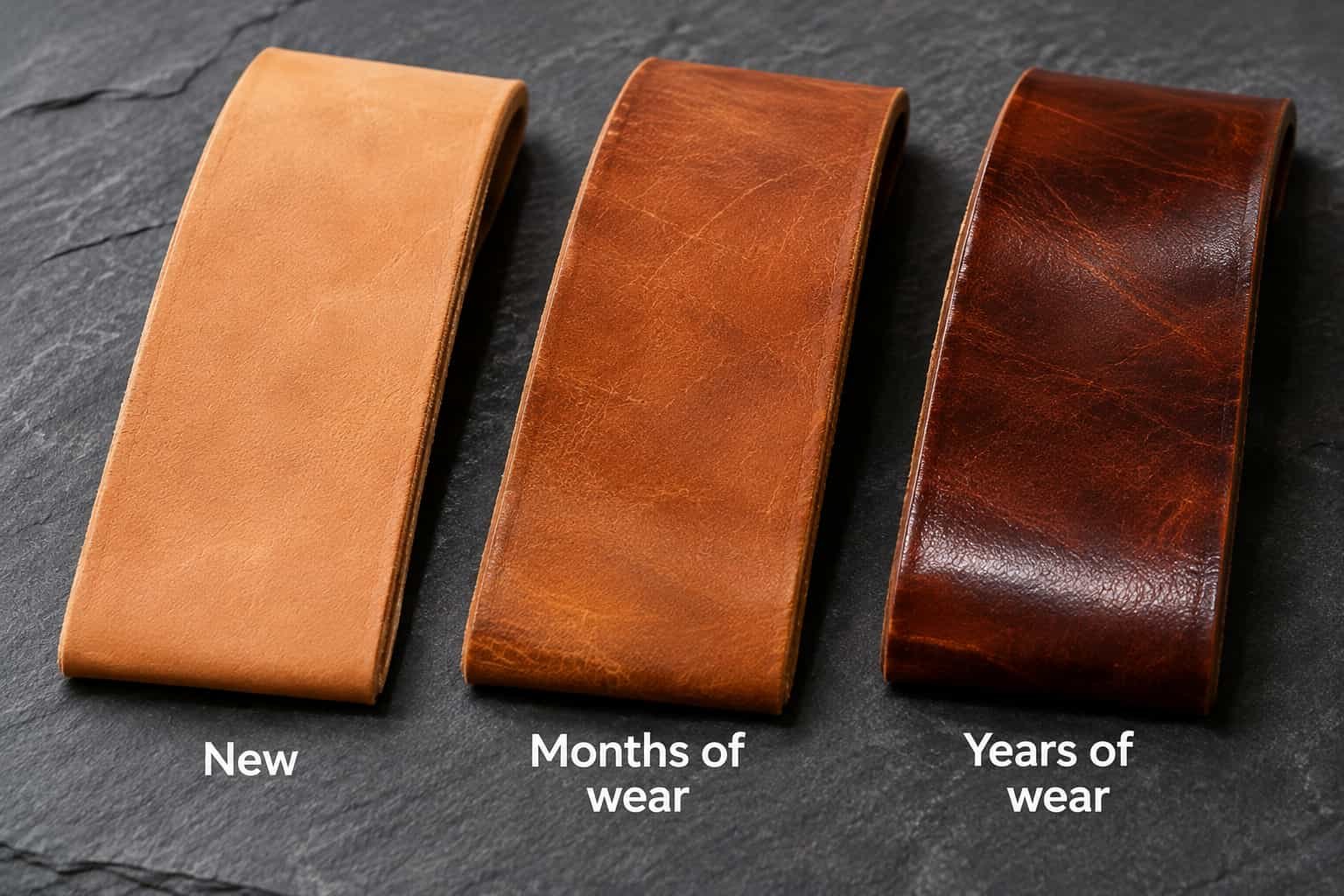
Vegetable-tanned leather feels firmer when new and often needs a break-in period. Its colour is limited to natural tans and browns and dyed variants of them. Over time it can develop a patina, which is the deepening and glossing of the surface that comes from light, handling and natural oils. Many people value this ageing, and others dislike the unevenness it can bring.
If you are choosing by feel, think about how you use the shoe. A chrome-tanned upper will feel comfortable straight out of the box. A vegetable-tanned upper or sole may take longer to soften, and it rewards patience with a shape that follows your foot.
Durability and Water
Anyone who tells you one method is always more durable is overselling. Lifespan depends on the hide, the grade, the finish, the sole construction and the care. A fixed number of years is not reliable for either method.
What can be said in general:
- Chrome tanning gives leather that handles water and heat better and keeps its shape through wet and dry cycles. That makes it a practical choice for everyday uppers worn in changeable weather.
- Vegetable tanning gives leather with good body and the ability to take a patina. It is more sensitive to water, which can darken it, spot it, or stiffen it as it dries.
- Repair. Both can be conditioned and repaired, but vegetable-tanned sole leather on a stitched, welted shoe is the classic case for resoling.
For weather behaviour in general, our guides on how waterproof shoes work and waterproof vs water resistant shoes cover membranes and treatments. Neither tanning method makes leather waterproof by itself.
Which Method Shoes Use
Shoes use both methods, usually in different parts.
- Uppers. Most shoe uppers are chrome tanned. One industry knowledge base puts chrome tanning at roughly 95 percent of shoe upper leather, though figures like this vary by source and region.
- Linings. Soft chrome-tanned leather is common inside the shoe, where flexibility and comfort matter.
- Soles and insoles. Vegetable-tanned leather is traditionally used for leather soles and some insoles, because it is firm and can be shaped.
- Traditional boots and dress shoes. Some makers use vegetable-tanned uppers or combination-tanned leather for the look and the patina.
If a brand does not say how its leather was tanned, that is not a red flag in itself, because most shoes are chrome tanned. It does mean you should ask if tanning matters to you. For related reading on materials, see leather vs suede shoes.
Environment and Health
The environmental case is mixed, and neither method is simply clean or dirty.
- Chrome tanning. Chromium(III) salts are the common form used. A leather knowledge base notes that chromium(VI), a harmful form, can occur as a result of improper tanning conditions, which is why responsible tanneries manage chemicals and effluent carefully. Wastewater treatment is the central issue.
- Vegetable tanning. The tannins are plant-derived and the leather is generally biodegradable, but the process is slow and uses a lot of water and raw material. Few tanneries have the capability to do it.
- Audits. The Leather Working Group runs an audit standard that assesses how a tannery measures, controls and reports the impact of its manufacturing. A tannery’s rating tells you about the tannery’s environmental management, not about how long a particular shoe will last, and it does not rate the shoe factory.
For people with a known chromium allergy, ask a doctor whether chrome-tanned leather is a concern, and look for products that state the tanning method. This article cannot assess individual health questions.
How to Tell Which You Have
Start with the product description or label, because makers who use vegetable tanning usually say so. If that does not settle it, these clues help. None is conclusive alone.
- Cut edge. Look where the leather is cut or skived. Vegetable-tanned leather tends to show a fairly even tan or brown through its thickness, while chrome-tanned leather often shows a bluish or grey band through the middle. Dyeing can change this.
- Smell. Vegetable-tanned leather tends to have a natural, earthy smell. Chrome-tanned leather can smell more neutral or slightly chemical when new.
- Flexibility. Very soft, flexible leather straight from the box is more often chrome tanned. A stiffer, fuller feel is more often vegetable tanned.
- Water. A drop of water on an untreated vegetable-tanned surface tends to darken it. Test only on a hidden area, and dab it dry straight away.
- Ask the maker. A reputable brand should be able to tell you how its leather is tanned.
To find out whether a shoe is real leather in the first place, see the shoe materials guide.
How to Choose
| Your situation | Chrome tanned may suit you | Vegetable tanned may suit you |
| Comfort | You want a soft, no-break-in upper | You will wear in a firmer shoe |
| Weather | You face changeable or wet weather | You mostly wear shoes in dry weather |
| Appearance | You want consistent, even colour | You like a patina and natural character |
| Repair | You want everyday wear with low fuss | You want a stitched sole you can resole |
| Budget | You want a lower price | You will pay more for traditional leather |
| Care | You want easier upkeep | You are happy to condition and look after it |
If you are comparing options, the shoe finder can help you narrow by use and style.
Myths Worth Dropping
- “Chrome-tanned leather is not real leather.” It is real leather. Chrome tanning is the most common method in the world.
- “Vegetable tanned is always better.” It has real strengths, but it suits some jobs better than others, and a poor leather is poor however it was tanned.
- “Vegetable-tanned leather is waterproof.” It is more sensitive to water, not less. Soaking can darken and stiffen it.
- “Chrome tanning is always harmful to the environment.” The impact depends on how the tannery manages chemicals and wastewater, which is what audits try to assess.
- “Oil tanned and chrome tanned are the same.” They are different terms, and “oil tanned” is used inconsistently in marketing.
Frequently Asked Questions
What is the difference between chrome tanning and vegetable tanning?
Chrome tanning uses chromium salts and takes about a day, producing soft, flexible, water-tolerant leather. Vegetable tanning uses plant tannins and takes weeks to months, producing firmer leather that develops a patina. Both are real leather and both are used in footwear.
Is chrome-tanned leather real leather?
Yes. Chrome tanning is the most widely used method for making leather, and most shoe uppers are chrome tanned. The term describes how the hide was tanned, not whether it is genuine.
Is vegetable-tanned leather better?
Not in every case. It offers firmness, character and a patina, and it is the traditional choice for soles. Chrome-tanned leather is softer, more consistent and more water-tolerant, so it often suits everyday uppers better.
How long does vegetable-tanned leather last?
There is no reliable fixed lifespan. It depends on the hide, the grade, the finish, how the shoe is built and how it is cared for. A well-made, repairable shoe in vegetable-tanned leather can last a long time, but that is down to the whole product and not the tanning alone.
How can I tell if leather is chrome-tanned or vegetable-tanned?
Check the product description first. Then look at the cut edge, where chrome-tanned leather often shows a bluish or grey band and vegetable-tanned leather tends to look more evenly tan. Smell and stiffness are weaker clues. If it matters to you, ask the maker.
Is oil-tanned leather the same as chrome-tanned leather?
No. Oil tanning is a separate traditional method used for soft leathers such as chamois. In boot and workwear marketing, “oil tanned” is also used loosely for leather treated with oils and waxes, so ask the maker how it was tanned.
Is full grain leather vegetable tanned?
Not necessarily. Full grain describes which part of the hide is used and how little the surface is altered, not the tanning method. Full grain leather can be vegetable tanned, chrome tanned or combination tanned.
What are the disadvantages of chrome-tanned leather?
It is less natural and less biodegradable than vegetable-tanned leather, and it relies on careful chemical and wastewater management. It also tends to age more uniformly, and some people with a chromium allergy need to be cautious. Check with a doctor if you have concerns.
Which leather is best for belts and soles?
Vegetable-tanned leather is the traditional choice for belts and sole leather because it is firm and holds its shape. Chrome-tanned leather is more common for soft uppers and linings.
Which type of leather is the most waterproof?
Neither is waterproof on its own. Chrome-tanned leather tolerates water better, and waxed or treated leathers shed it more readily. For real wet-weather protection, look at the shoe’s construction and any membrane or treatment rather than the tanning method.
Final Thoughts
Chrome and vegetable tanning are two ways of turning the same raw material into leather, and each shapes how a shoe feels, ages and handles water. Chrome tanning gives soft, consistent, weather-tolerant leather that dominates everyday uppers. Vegetable tanning gives firm, characterful leather that suits soles, belts and traditional boots.
Before you buy, check what the maker says about its leather, think about the weather you will face and decide how much care you will give the shoes. For the wider picture, start with the shoe materials guide, then look at suede and nubuck as leathers with different finishing.
External References
- Britannica, “Tanning”: britannica.com/technology/tanning
- Wikipedia, “Tanning (leather)”: en.wikipedia.org/wiki/Tanning_(leather)
- Wikipedia, “Leather”: en.wikipedia.org/wiki/Leather
- Leather Working Group, audit standards and certification: leatherworkinggroup.com/our-impact/standards-certification
- ProductIP, “Leather tanning” knowledge base: productip.com/kb/…/leather-tanning
- Carryology, “Chrome vs Vegetable Tanned Leather”: carryology.com/insights/chrome-vs-vegetable-tanned-leather


