

Shoe Glossary: A to Z Footwear Terms Explained
Summarise This Guide with AI
Open an assistant below and submit the prefilled request. The assistant reads this page only after you submit it. The guide covers shoe parts, heel terms, construction methods, material abbreviations, fit measurements, and style names.
A shoe glossary explains the terms used to describe footwear parts, construction methods, materials, fit, and styles. Key terms include the upper, midsole, outsole, shank, last, and welt. Some terms describe a shoe’s structure, while others describe its style or how it was made. Knowing the difference helps you read product pages, compare shoes, and ask better questions when you buy.
Key Takeaways
- Shoe terms fall into groups: parts, construction, materials, fit, and style. Knowing the group helps you place an unfamiliar word.
- Some terms look alike but do different jobs. The midsole cushions, the insole sits under the foot, and the outsole touches the ground.
- Construction methods such as cemented, stitched, and Goodyear welted affect durability and flexibility, so they are worth checking on a product page.
- Many glossaries contain errors or repeated entries, so cross-check a term against more than one source before relying on it.
- Style names describe how a shoe looks and closes, while fit terms describe how it is measured. Both matter when you shop.
How to Use This Glossary
A glossary is most useful when you are reading a product page, comparing two shoes, or talking to a repair shop or fitter. The terms below are grouped by what they describe, so you can scan the section that matters to you. Each definition is written in plain language, and where a term has a more detailed page on this site, a link is included.
Two cautions apply. First, a term’s meaning can vary by manufacturer, region, and era. A 2008 footwear glossary, for example, describes many styles that are still in use but may not reflect newer materials. Second, product pages sometimes use marketing names for components. When a name is not in a glossary, the product’s technical notes are the best guide.
For a visual introduction to the layers of a shoe, the anatomy of a shoe guide is a good companion to this page.
Parts of a Shoe
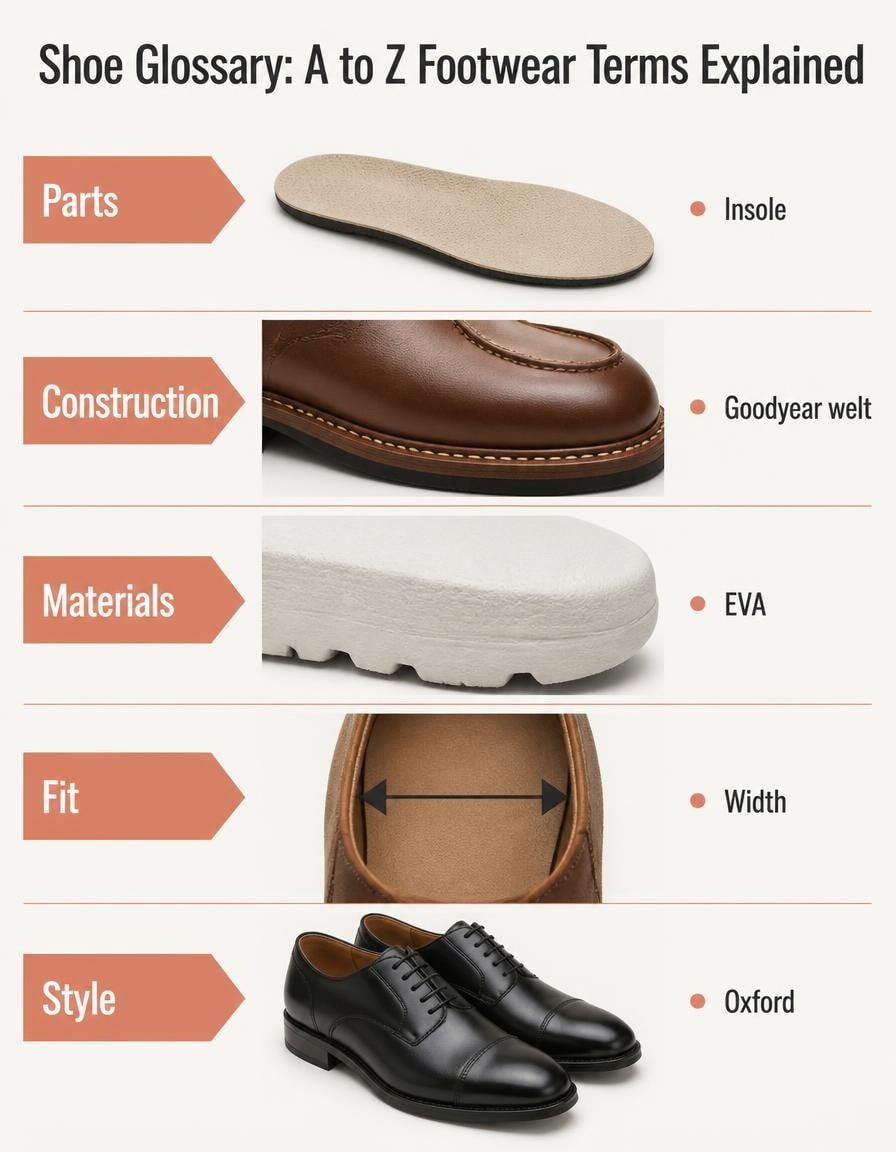
The upper is the part of the shoe that covers the top of the foot, from the heel to the toe. It is usually made of leather, textile, synthetic mesh, or a combination. The upper is attached to the sole and wraps around the foot. Several smaller parts sit within the upper, each with a specific job.
The vamp is the front central part of the upper, covering the top of the foot near the toes. The quarter panel covers the sides from the heel toward the front. The toe box is the front area where the toes sit, and its height and width decide how much room the toes have. The tongue is the strip under the laces that cushions the top of the foot and sometimes includes a gusset to keep out grit.
The eyelet is the hole through which the lace passes, and it may be reinforced with a metal ring. The aglet is the fastening at the end of a lace that stops it fraying. The collar or topline is the opening where the foot enters, and in boots it may be padded for comfort.
The counter is a stiff piece at the back of the shoe that helps the upper hold its shape and cups the heel. Amorim’s glossary describes it as a stiff piece placed between the lining and upper at the heel to retain the shape of the shoe. Our guide on what a heel counter is goes further into the feature.
The insole is the part the foot rests on inside the shoe. It is often cushioned, and some insoles can be removed and replaced. The midsole sits between the insole and the outsole and provides most of the cushioning. The outsole is the bottom layer that contacts the ground. The insole, midsole, and outsole comparison explains these layers in more detail.
The shank is a strip or plate inside the sole, under the arch, that adds rigidity and support. Our guide to what a shoe shank is covers its materials and role.
The last is the foot-shaped form that a shoe is built around. It sets the shape of the finished shoe, and our article on what a shoe last is explains how lasts affect fit.
Heel Terms
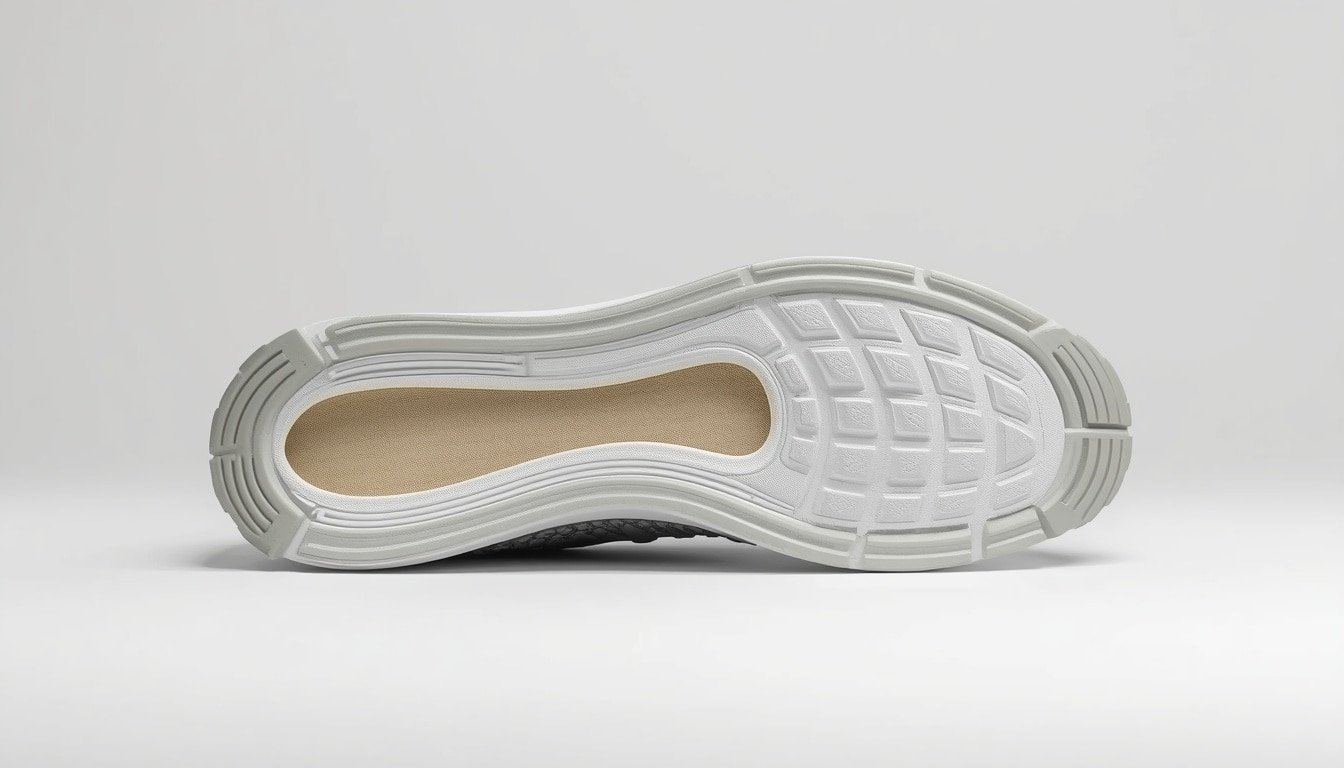
The word heel has two meanings. It can refer to the rear part of the foot, and it can refer to the solid part of the shoe that supports the heel. Most shoppers mean the second meaning.
Heel height is measured from the floor to the bottom of the heel at its front face, which is the point where the heel meets the sole. The AMEFIRD footwear glossary gives standard measures used in the trade: a low heel of about one inch, a medium heel of about two inches, and a high heel of about three inches. Those labels are from an older glossary and are useful for orientation rather than as a fixed rule.
The table below lists common heel types. Each name describes the heel’s shape or how it is built.
| Heel type | What it means |
|---|---|
| Louis or French heel | A heel with a curved back, usually medium to high |
| Baby Louis heel | Similar shape to a Louis heel, but shorter |
| Built heel | Made from layers of leather or fibre, often in contrasting tones |
| Continental heel | A higher heel with a slightly curved back and a flat front |
| Cuban heel | A thick, stacked heel with little curve, tapered at the bottom |
| Stacked heel | A heel with horizontal layers, made from leather or synthetic material |
| Wedge heel | A heel as wide as the shoe, following its contour from toe to heel |
| Stiletto | A high, narrow, tapered heel, sometimes called a spike heel |
| Column heel | A round, column-shaped women’s heel |
Construction and Bottoming Terms
Bottoming is the process of attaching the sole to the upper. Amorim’s glossary describes the main methods as cementing, moulding or vulcanizing, and sewing. Each method affects weight, flexibility, durability, and the cost of repair.
A cemented construction glues the upper to the sole. It is generally lighter and more flexible, and it is common in casual and lightweight footwear. A sewn construction stitches the parts together, and the stitching can be visible or hidden.
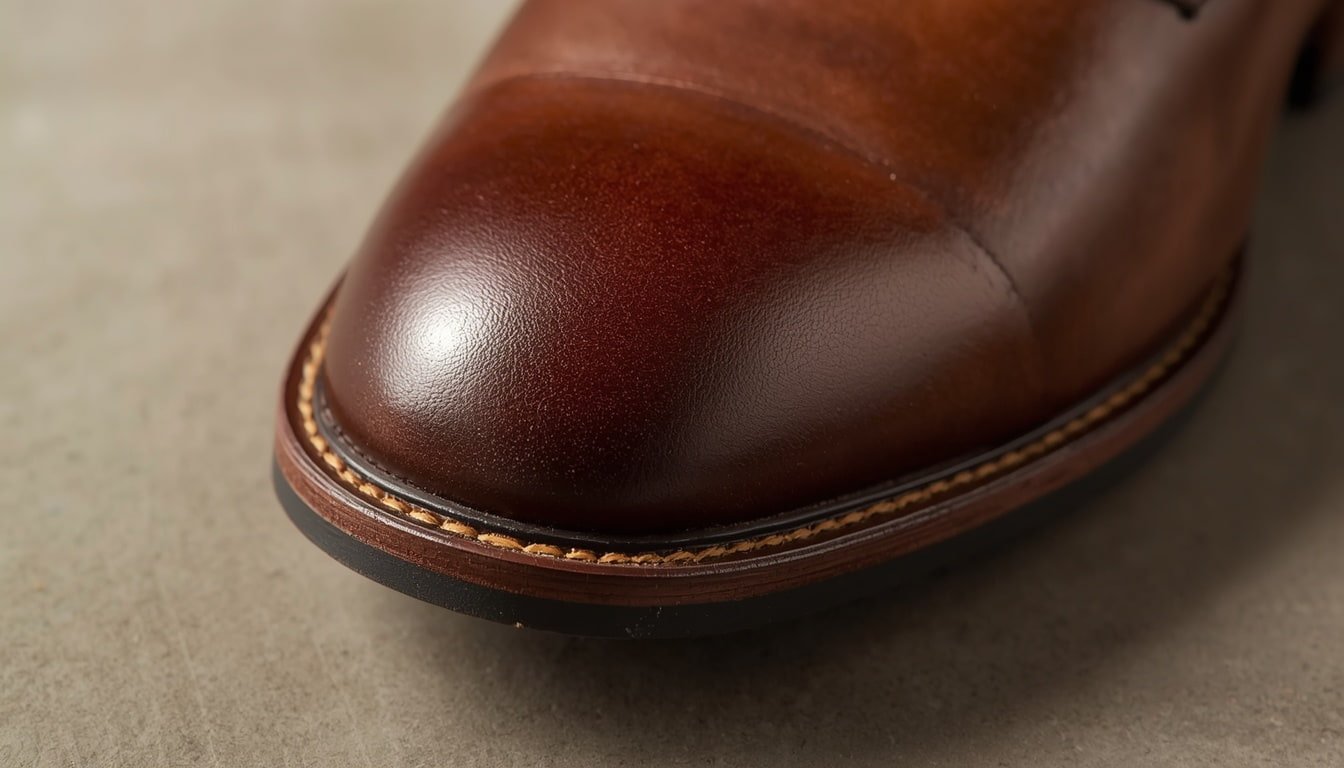
A Goodyear welt is a construction where the upper and sole are stitched together through a strip of leather called the welt. The seam runs around the outside of the shoe, and the insole rib is part of the design. Amorim describes it as a construction with greater durability, because the welt and upper are secured by a strong, flexible stitch. This method is often used in traditional leather shoes that can be resoled.
A welt is the strip of leather sewn between the insole and the outsole to add durability. The welt is the feature that makes a welted shoe possible to resole in many cases, although that depends on the maker.
Injection moulded construction forms the sole by injecting melted material into a mould. Amorim describes it as an efficient way to mass-produce footwear. It is common in casual and sporty shoes.
Vulcanizing joins a rubber or thermoplastic sole to the upper using heat. Vulcanized rubber itself is rubber that has been converted to a more durable and strong state.
Lasting is the process of pulling and shaping the upper over a last before the sole is attached. Amorim describes it as done by pulling and tacking the upper to the last, or by string lasting, where a string tightens the upper’s lower edge around the last.
Foam, Rubber and Material Terms
Many shoe terms describe materials, and some of them are abbreviations. The list below covers common ones.
EVA stands for ethylene vinyl acetate, a synthetic compound that provides cushioning and is easily shaped with heat and pressure. Amorim’s glossary describes it as used for outsoles and cushioning. Our EVA foam explainer covers the material in more depth.
TPU stands for thermoplastic urethane. It is a plastic material that can give support in the midfoot of a running shoe. Our guide to TPU in shoes explains where it appears.
TPR stands for thermoplastic rubber, a plastic material used in injection moulding.
PU is the common abbreviation for polyurethane, a manmade material that can look and feel like leather. PVC, or polyvinyl chloride, is a semi-rigid plastic often used in heel counters and outsoles, and vinyl is a shiny plastic often used for coating.
Crepe sole refers to a natural rubber sole with a crinkled texture, similar to crepe paper. Vulcanized rubber is covered above. Vibram is a registered trademark for a non-slip outsole typically found on hiking boots, so the name refers to a brand, not a generic category.
Dual density midsole is a term for a midsole that uses two foam densities, with the denser foam placed where the foot tends to roll. It is a common design in running shoes.
Energy return describes the response a shoe gives after the foot strikes the ground, a kind of propulsion that supports the stride. It is a performance property, and different foams and plates aim for it in different ways. Our guide to running shoe foam compares the main families.
Rubber outsoles are discussed in more detail in our article on rubber shoe soles.
Fit and Measurement Terms
Fit terms help you compare sizes and measure your feet. Width is typically measured in letters, from AAA through E, EEE, and EEEE in many systems, and it refers to the width of the last measured at the ball of the foot. Amorim’s glossary notes that widths are defined in one-sixth of an inch increments.
Girth is the circumference of a shoe last measured around the ball of the foot. Shaft height is the height of a boot’s shaft, measured from the inside seam. Circumference, in the AMEFIRD glossary, is the measurement around a boot shaft taken at its widest part near the top.
A Brannock device is a measuring tool that records the length and width of the foot to help with fit. Many shoe stores use one.
The break is the natural crease that forms across the vamp from everyday wear. It is a sign that a shoe has been flexed and is not a fit fault in itself.
For the sizing systems that shape how shoe numbers are read, our article on the shoe last explains the relationship between the last, the foot, and the size label.
Shoe Style Names
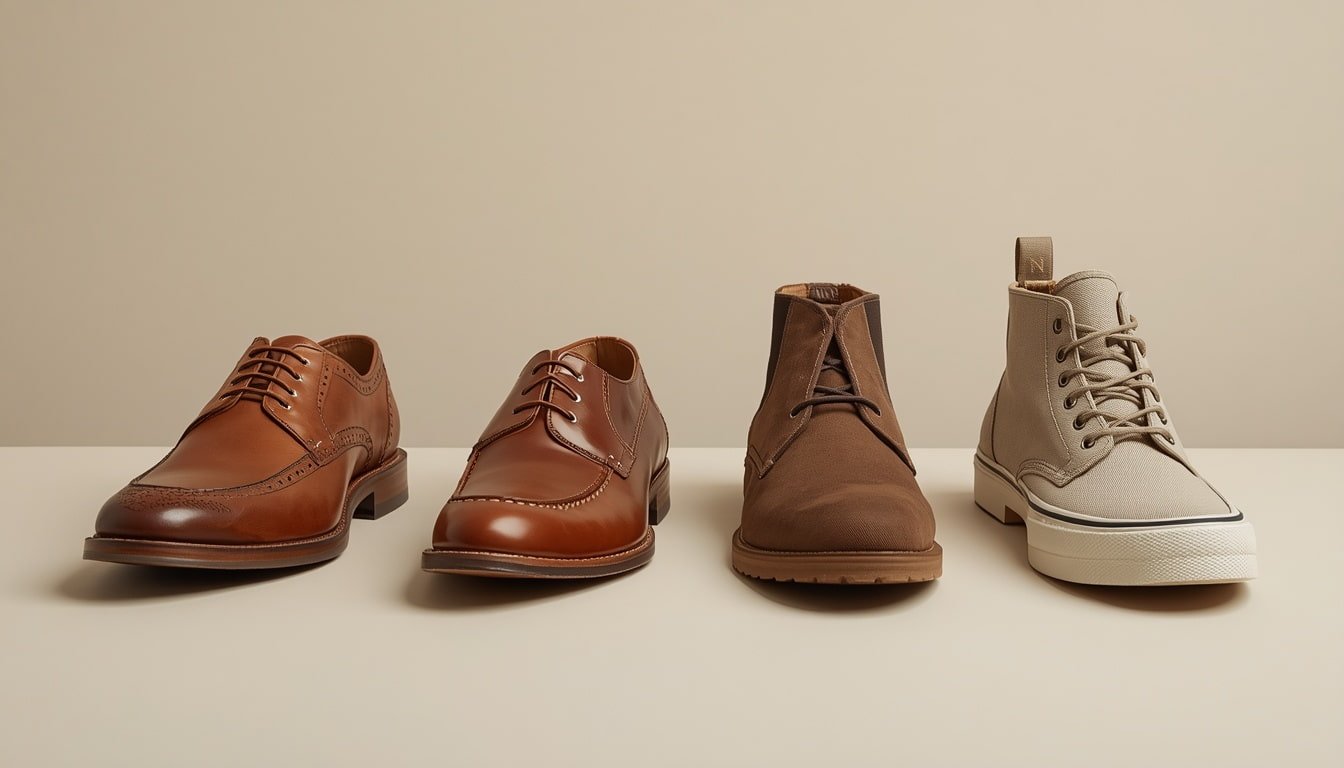
Style names describe how a shoe looks, how it closes, and what it is for. The list below covers common names, with definitions adapted from the AMEFIRD glossary.
| Style | What it means |
|---|---|
| Balmoral | A shoe with a laced V-shaped panel across the foot |
| Blucher | A shoe with two side flaps joined across the foot by lacing |
| Brogue | A heavy oxford-style shoe with pinked and perforated detailing |
| Chelsea boot | An ankle-height pull-on boot with elastic side panels |
| Chukka boot | A laced boot with a plain toe, sitting at ankle height |
| Clog | A casual, comfortable shoe with an open or closed heel and a slip-on style |
| Espadrille | Any shoe with woven rope or rope-look trim, usually on the sole |
| Loafer | A slip-on shoe without laces, ties, or buckles |
| Monk strap | An oxford-like shoe that closes with a strap across the instep |
| Moccasin | A slip-on style with visible stitching and often a soft leather bottom |
| Mule | A closed-toe shoe with no back |
| Oxford | A low shoe laced or tied over the instep |
| Penny loafer | A slip-on with a slit over the instep |
| Sneaker | An athletic shoe, typically canvas with a rubber sole |
| Slingback | A backless shoe with a rear strap around the upper heel |
The AMEFIRD glossary describes the moccasin as possibly the earliest type of shoe. That is a historical note from a style glossary, not a fully settled fact, so treat it as a description of the common view.
Boot Terms
Boot terms describe height, protection, and specific details. A boot is generally any footwear that rises to the ankle or higher. A bootie has the styling of a boot without the height. A demi boot has a shaft that sits no taller than the anklebone.
The rand is a thin rubber band that runs around the junction of the upper and sole and part way up the boot. Amorim’s glossary says it adds waterproofing and protects the upper from abrasion. A scree collar is a lightly padded cuff at the top of the upper that keeps debris out.
The rocket is the curve from the heel to the toe of a boot, which helps with walking. A strike plate or protection plate, described in Amorim’s glossary, is used in lighter boots to guard against sharp trail debris and to add torsional support.
Steel toe is found in industrial footwear. Amorim’s glossary notes that steel toes are tested for their ability to keep a minimum clearance when compressed under different weights. Check the label and the workplace requirement for the rating that applies to your job.
Finishing and Care Terms
Finishing terms describe the surface and appearance of a shoe.
Burnishing is buffing a shoe surface to create an antiqued effect on leather. Dressing is applying polish or gloss to maintain a shoe’s finish and appearance. Artificial grain is a grain look added to a split leather by pigment finish, sometimes with embossing.
Perforation is a pattern of small holes punched into the trim for decoration or ventilation. Pinked detailing has a saw-tooth edge, and scalloped detailing has round, wavy edges. Ruched detailing is gathered or pleated material with stitching accents.
Our guide on how to clean shoes and maintain them covers safe care methods for common materials.
Terms That Are Easy to Confuse
Some terms are easy to mix up, and the confusion can affect a purchase.
Midsole and insole are different layers. The insole is what your foot rests on, and it can often be removed. The midsole is the cushioning layer below it, and it is usually not removable.
Sole and outsole are often used loosely. In many glossaries, the outsole is the bottom layer that touches the ground. Some sources use sole for the whole unit under the foot. Read the context on a product page.
Shank and strike plate are different features. A shank supports the arch and controls bend. A strike plate or protection plate guards against sharp objects, often in the toe or forefoot. A shoe can have one, both, or neither.
Heel and heel counter are also different. The heel is the solid part under the back of the foot. The heel counter is the stiff piece at the back of the shoe that cups the heel. Our guide to the shank and the anatomy guide explain how these parts sit together.
Energy return and cushioning describe different things. Cushioning is how soft or absorbent a sole feels. Energy return describes how much of the impact energy the shoe gives back during push-off. A shoe can be soft and still have modest energy return, or firm with high return.
Waterproof and water-resistant are not the same. Our guide to waterproof and water-resistant shoes explains the difference.
A Practical Decision Guide
The terms that matter most depend on what you are buying.
If you are buying a daily walking shoe, focus on the insole and midsole terms, the heel and counter, and the fit terms such as width and toe box. A removable insole and a supportive counter are useful features for all-day wear.
If you are buying running shoes, look for midsole type, energy return claims, outsole material, and the presence of a shank or midfoot support. Check the product page for foam names and any plate or shank details.
If you are buying work or safety boots, focus on the toe protection rating, the sole’s puncture resistance, the shank material, and the boot’s shaft height. Check the label for the rating that matches your workplace requirement.
If you are buying leather dress shoes, focus on the construction method, such as Goodyear welt or cemented, because that affects how the shoe can be repaired. Check the last shape and width as well.
If you are unsure, ask a fitter to explain any term you do not recognize. A good fitter can show you the feature rather than just naming it.
Frequently Asked Questions
What is a shoe glossary?
A shoe glossary is a list of the terms used to describe footwear parts, construction, materials, fit, and style. It helps shoppers and repair staff use the same language.
What is the difference between the midsole and the insole?
The insole is the surface your foot rests on. The midsole sits beneath it and provides most of the cushioning. The insole is often removable, while the midsole is usually built into the shoe.
What does Goodyear welt mean?
A Goodyear welt is a construction method in which the upper and sole are stitched together through a strip of leather called the welt. The seam runs around the outside of the shoe. It is often used in traditional leather shoes that can be repaired.
What is a shank in a shoe?
A shank is a strip or plate inside the sole, under the arch, that adds rigidity and support. It helps control how the middle of the shoe bends and resists twisting.
What is the difference between a brogue and an oxford?
An oxford is a low shoe laced over the instep. A brogue is a heavy oxford-style shoe with pinked and perforated detailing. Many brogues are oxfords, but not every oxford is a brogue.
What do EVA and TPU mean?
EVA stands for ethylene vinyl acetate, a synthetic compound used for cushioning and outsoles. TPU stands for thermoplastic urethane, a plastic often used for midfoot support in running shoes.
Where can I learn more about the materials in my shoes?
Start with the product page’s technical notes, then read our shoe materials hub. For medical questions about foot health, consult a clinician or podiatrist.
Conclusion
A shoe glossary turns unfamiliar product language into useful knowledge. The most helpful terms for most shoppers are the parts of a shoe, the construction method, the foam and material names, and the fit measurements. Read terms in context, check the product page, and cross-reference a definition when a source seems unclear. Your next step is to pick one product you are considering, identify its key terms, and look up any you do not recognize. For a broader foundation, explore the footwear knowledge section and the shoe finder.
Sources
- Amorim Cork Solutions, “Glossary,” Knowledge Center, Footwear: https://amorimcorksolutions.com/en-us/materials-applications/footwear/knowledge-center/glossary/
- AMEFIRD, “Footwear Glossary: Shoe Styles” (PDF, file dated 06-13-08): https://www.amefird.com/wp-content/uploads/2010/01/1Footwear-Glossary-Shoe-Styles-06-13-08.pdf


