

What Is a Shank in Shoes and Boots? A Practical Guide to Support, Stiffness, and Protection
Summarise This Guide with AI
Open an assistant below and submit the prefilled request. The assistant reads this page only after you submit it. The guide covers what a shoe shank is, where it sits, the main materials, and how to test it.
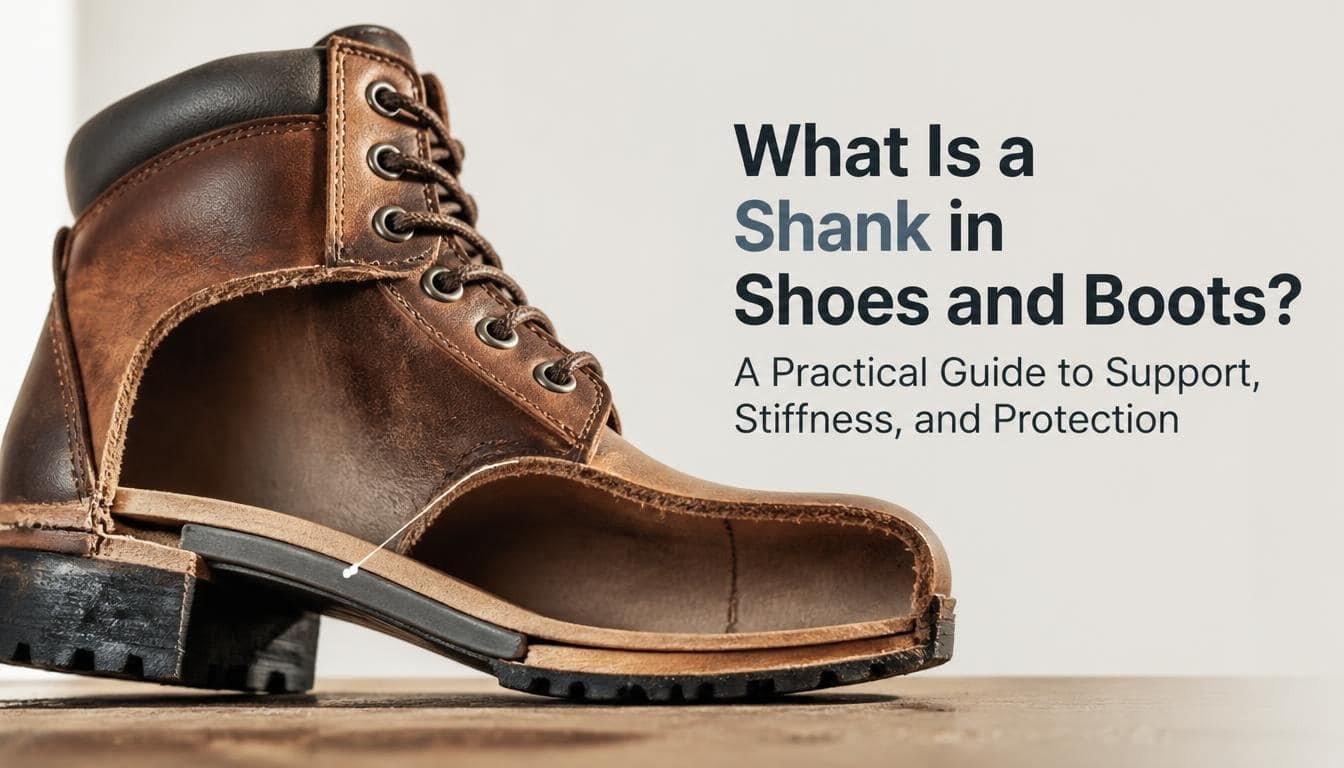
A shank is a long, thin strip between the insole and outsole of a shoe or boot. It stiffens the middle of the sole, supports the arch, and keeps the shoe from folding where the foot does not bend. Work and hiking boots often use steel, fiberglass, or composite shanks. Pointe shoes use a flexible shank that dancers customize. Many everyday shoes use a molded plastic piece in the midfoot.
Key Takeaways
- A shank is a stiff or semi-stiff strip under the arch. It controls how the middle of the shoe bends and resists twisting.
- Materials vary with purpose. Steel is traditional and very rigid, fiberglass and composites are lighter and contain no metal, and pointe shoes use flexible shanks.
- A shank is not the same as a toe cap or a puncture-resistant plate. Each covers a different area and does a different job.
- The bend and twist test is a simple way to check whether a shoe’s middle is doing its job.
- Shank choice depends on the activity. A dancer, a construction worker, and a walker need very different levels of stiffness.
What a Shank Is
A shank is one of the structural parts that shape a shoe’s sole. Wikipedia’s article on footwear shanks describes it as a long, thin piece of material between the insole and the outsole, intended to support the foot and provide structure. The definition covers boots and shoes alike, and it applies whether the shank is made of metal, composite, leather, or plastic. Wikipedia’s entry on the shank gives the broad overview.
Shanks are easy to miss. You rarely see one unless you cut a shoe apart or look closely at the sole from the inside. Most of the time, you only notice a shank when it is missing or has failed. A boot that suddenly bends in the middle, or a dress shoe that folds at the arch, often reveals a shank that has worn out or was never strong enough for the job.
The word itself describes the part’s role in the shoe’s structure. Think of it as a spine that runs through the middle of the sole. It does not do the cushioning. That job belongs to the midsole and the foam. The shank handles the stiffness that keeps the shoe in shape.
If the term “shank” sits alongside other parts you have seen named on shoe pages, the anatomy of a shoe guide places it in the wider structure, and our shoe glossary lists the other terms you are likely to see.
Where the Shank Sits Inside the Shoe
The shank lies between the insole and the outsole, under the arch area of the foot. Wikipedia’s entry describes this location directly, and the position explains its job. The arch is the part of the foot that needs the most support during standing and walking, so the shank sits where the sole would otherwise sag or fold.
A typical shank runs from roughly the heel toward the ball of the foot. It is not usually a full-length piece. Its length and placement vary, and some shanks extend only partway into the midfoot. The forefoot and toes are left flexible, so the shoe still bends where your foot bends when you walk.
This placement is why the shank matters for comfort and stability. A shank that is too short may leave the middle of the sole soft and bendy. A shank that runs too far forward may make the shoe feel stiff at the toes. Engineers balance length, thickness, and material against the activity the shoe is built for.
Because the shank is hidden inside the sole, you can only judge its effect by how the shoe behaves. The bend and twist test later in this guide shows what to look for.
What a Shank Does: Support, Stiffness and Bend
A shank does three main jobs. It supports the arch, it controls stiffness through the middle of the shoe, and it keeps the shoe bending in the right place.
Arch support is the most familiar role. A stiff strip under the arch helps the middle of the shoe resist collapse under load. Standing for long periods, carrying weight, or walking on uneven ground all put stress on the arch, and a shank helps the sole hold its shape. A dedicated fitter or clinician can advise whether support is needed for a particular foot, since arch needs vary widely.
Stiffness control is the second role. A shank resists twisting, so the sole does not wring out like a towel. This matters in work boots, where a twisting sole can make it harder to keep steady on a ladder or uneven surface.
Bend control is the third role. A good shank lets the shoe flex at the ball of the foot, where most people’s feet naturally bend during a step. It keeps the middle flat, so the shoe does not fold at the arch. A shoe that bends in the wrong place can feel unstable or tire the foot faster.
Remember that a shank does not replace cushioning or fit. A well-shanked boot can still feel uncomfortable if the upper or heel does not fit. The shank works best as part of a complete shoe.
Materials Used for Shanks
Shank materials are chosen to match the job, and Wikipedia notes that materials and design vary widely with the footwear’s purpose. The main options are below.
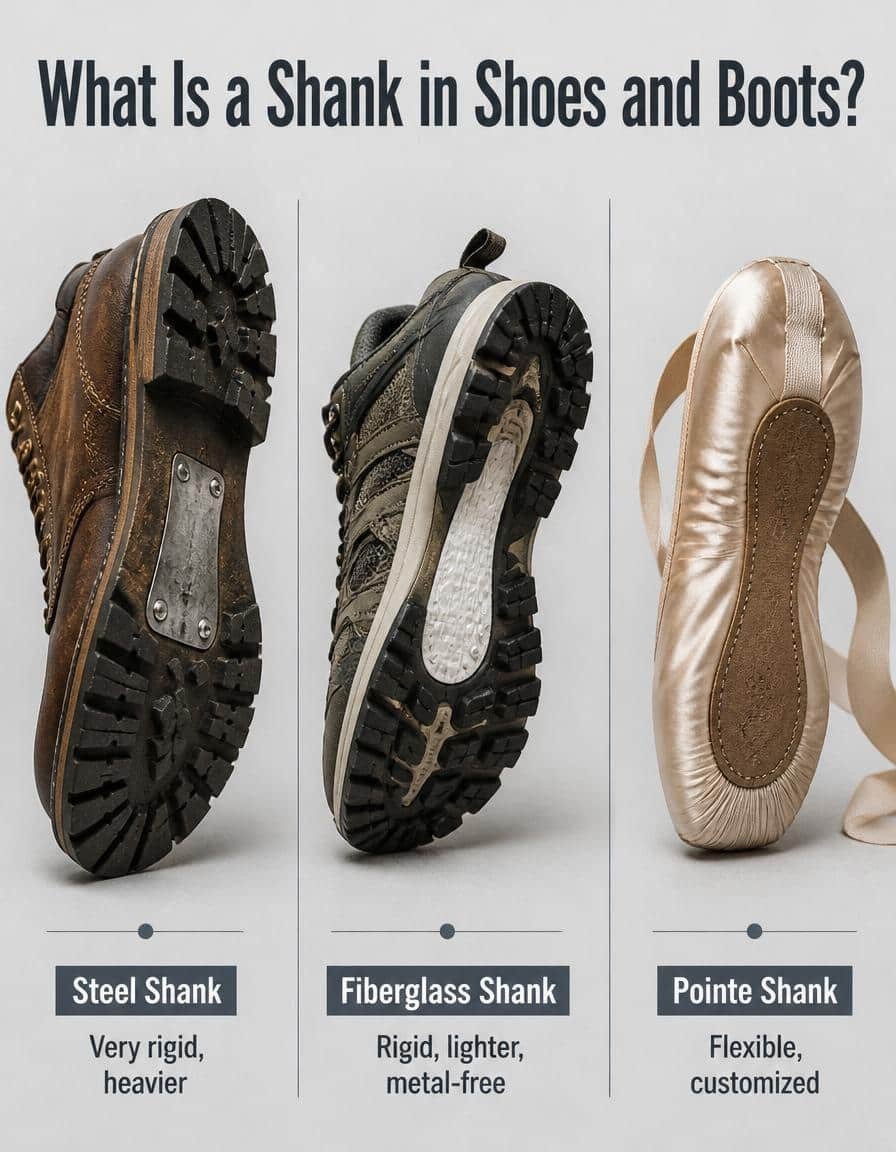
Steel is the traditional choice. It is thin, very rigid, and durable. Wikipedia notes that heavy boots for construction or hiking have historically used steel shanks, which add rigidity and durability. Steel is heavy compared with composites, and it conducts heat and cold more readily than other materials.
Fiberglass is a common modern alternative. Wikipedia notes that contemporary shanks are often made of less heat-conductive materials such as fiberglass and Kevlar. Fiberglass shanks are lighter than steel and contain no metal, which matters where metal detectors are used or where a lighter boot is preferred.
Composites and Kevlar are used in some safety and hiking designs. They offer rigidity with less weight and may be chosen for comfort or insulation.
Leather, plastic, and cardstock are used where flexibility matters more than rigidity. Wikipedia describes pointe shoe shanks as flexible materials like leather, plastic, or cardstock, with customized length, thickness, and stiffness.
Molded plastic or TPU appears in many everyday shoes and work boots as a lighter, midfoot piece. Manufacturers often give these their own trade names.
Steel Shank vs Fiberglass Shank
Readers often compare the two most common rigid options. The table below summarizes general differences described in the sources reviewed. Actual performance depends on the thickness, shape, and surrounding construction of the boot.
| Feature | Steel shank | Fiberglass shank |
|---|---|---|
| Rigidity | Very rigid, traditional choice | Rigid, usually a little more flexible than steel |
| Weight | Heavier | Lighter |
| Metal content | Contains metal | Contains no metal |
| Heat conduction | Conducts heat and cold more readily | Less heat-conductive |
| Common use | Heavy construction and hiking boots | Modern work boots, safety boots, and lighter hiking designs |
| Best suited to | Maximum rigidity and a long-standing design | Lighter weight, metal-free use, and a more comfortable feel |
For safety footwear, the choice of shank does not decide whether a shoe is rated for protection. Check the label and the job requirement rather than assuming a particular material offers a particular rating.
Shanks in Work and Safety Boots
Work boots are the most common place people encounter a shank, and the stakes are higher. A boot used on construction sites, in warehouses, or on uneven ground must keep its shape, resist twisting, and support the arch through a full working day.
Wikipedia notes that rigid shanks add a protective element by shielding feet from puncture wounds and stone bruises. A rigid strip under the sole can help protect against sharp objects that come up through the sole. That is a related benefit, but it is not the same as a certified puncture-resistant plate, which is a separate design feature.
When shopping for work boots, look for information about the shank material and the boot’s intended use. Check whether the boot’s protection features match the job, and ask an employer or safety officer if you are unsure what your workplace requires. If your workplace requires a particular protective rating, check the boot’s label for that rating.
Fit matters as much as the shank. A boot should have room in the toe box, hold the heel, and feel stable at the arch. Our guide on what a heel counter is explains the back of the boot, which works together with the shank to hold the foot.
Shanks in Hiking and Mountaineering Boots
Hiking and mountaineering boots use shanks to manage load over long distances. Wikipedia notes that the shank is crucial to the functionality of mountaineering boots because it reduces the load on the feet and calves over the course of a climb. A stiffer shank helps the boot transfer the force of each step without the foot flexing in ways that tire the muscles.
Stiffness suits some hikers and not others. A rigid boot can feel secure on steep terrain with a heavy pack, but it may feel clumsy on flat trails. A flexible boot may feel more natural on gentle paths, but it can tire the feet on long climbs with heavy loads.
Choose a hiking boot based on the terrain you expect to cover, the weight you carry, and how stiff the boot feels when you flex it by hand. If you plan long trips with heavy loads, a stiffer shank is often a better match. For shorter day hikes on flat ground, a lighter, more flexible boot may be more comfortable. Our shoe finder can help narrow options by use.

Shanks in Pointe Shoes
Pointe shoes are the most specialized use of a shank. Wikipedia describes the shank of a pointe shoe as flexible, made from materials such as leather, plastic, or cardstock, and customized in length, thickness, and stiffness. The shank supports the dancer’s arch when the foot is on the tips of the toes, and it must balance support with the flexibility needed for technique.
Pointe shoes come in different shank types and lengths. Dancers and their teachers usually choose the shank based on the dancer’s foot, strength, and level of training. Because the shank is part of how the shoe supports the foot in demanding positions, the choice is best made with a dance teacher or qualified fitter.
Some readers ask whether a shoe is too tight or whether a shank is too soft or too hard. Those questions depend on the dancer’s foot, training, and the shoe’s fit. If a dancer has pain, numbness, or swelling in the feet, a doctor or podiatrist should assess the problem before changing shoes or shanks.

Shanks in Everyday and Running Shoes
Many everyday shoes, dress shoes, and clogs have a shank. A firm middle keeps the shoe from folding at the arch and gives an arch support or insole a stable base to sit on. A-Proper-Fit’s glossary describes shanks as found in work boots, hiking boots, clogs, and most dress shoes, which matches the general pattern in footwear design.
Running and walking shoes often do not use a traditional steel or fiberglass shank. Many use a molded plastic piece in the midfoot that does a similar job in a lighter, more flexible way. Manufacturers usually give these pieces their own names, so the product page is the best place to check. A shoe that is firm under the arch and bends at the forefoot may have a supportive midfoot piece even if the word “shank” does not appear.
Shoes built for speed or racing may use a carbon or rigid plate instead of a traditional shank. A plate performs a different job from a shank, and our guide to carbon plate running shoes explains that category. Some shoes combine a plate with foam, so read the full construction notes.
Shank, Safety Plate and Toe Cap Compared
Readers often mix up three features that protect or support the foot. This comparison separates them.
| Feature | Location | Main job | Common material |
|---|---|---|---|
| Shank | Under the arch, between insole and outsole | Support the arch, control stiffness and bend | Steel, fiberglass, composite, plastic, leather |
| Puncture-resistant plate | Across the sole, often in the forefoot or full length | Guard against sharp objects from below | Metal or composite mesh or plate |
| Toe cap | Front of the boot or shoe, over the toes | Protect the toes from impact or compression | Steel, composite, or other rated material |
A boot can have any combination of these features. A shank does not guard the toes, and a toe cap does not stiffen the arch. Check each feature separately on the product page, and match the boot to the job rather than assuming one feature covers the others.
The Bend and Twist Test
The bend and twist test is a simple way to check a shoe’s shank in a shop or at home. It does not measure the shank directly, but it shows how the sole behaves.
Hold the shoe by the heel and the toe, and gently push the two ends toward each other. A shoe with a working shank should bend across the ball of the foot, where your foot naturally bends, and stay flat through the middle. If the shoe folds sharply at the arch, the shank may be light or missing.
Next, hold the shoe at both ends and gently twist it, as if wringing a towel. A supportive shoe resists that twist and keeps the sole steady. A shoe that twists easily may not give the arch the support it needs, especially for standing or carrying loads.
Repeat the test on each shoe you are comparing. Use the same firm but gentle pressure each time, and do not force the shoe past its natural range. If a shoe suddenly creaks, bends, or feels different in the middle than it did when new, the shank may have worn or broken. A fitter or repair specialist can advise on the next step.

Who Should Choose a Stiffer Shank
A stiffer shank suits people who stand for long periods on hard surfaces, carry heavy loads, work on uneven ground, or need the sole to hold its shape for safety reasons. Construction workers, warehouse staff, and hikers carrying heavy packs often prefer a firmer shank for those reasons.
A more flexible shank may suit people who walk on flat ground, prefer a natural feel, or are building strength in a new activity. Dancers choose the flexibility their technique and training require, and runners often choose midfoot pieces that balance support with a natural stride.
If you are unsure, start with your activity. Ask what the shoe will do most of the time, and what kinds of surfaces and loads it will face. A knowledgeable fitter can help you compare options by feel and by your foot shape.
If you have a condition that affects your feet, consult a clinician or podiatrist before choosing a stiffer or softer shank. This guide does not provide medical foot advice, and the right support depends on the individual.
Trade-Offs and Limitations
Shanks offer real benefits, and they also have limits.
A stiffer shank can reduce flexibility. Some people feel that a rigid middle makes the shoe harder to walk in, or that it changes the natural bend of the foot. That is a real trade-off, and it is why the right stiffness depends on the activity.
A shank can add weight. Steel shanks are heavier than fiberglass or composite options, and heavier boots can tire the legs over long days. Weigh the protection and support benefits against the comfort cost.
Shank materials also differ in how they feel. Steel conducts heat and cold more readily than some composites. Fiberglass is lighter and metal-free. Choose a material that suits your environment and needs.
A shank cannot fix a poor fit. If the boot is too narrow, too short, or loose at the heel, the shank will not solve the problem. Fit the shoe first, then check the shank.
A shank can also wear out. A shank that has broken or lost stiffness will no longer support the arch as intended. Check the sole regularly, especially in work boots that take heavy use.
Myths Worth Dropping
Myth: A stiffer shank always means a better shoe. A shank should match the activity. A very rigid shank can be uncomfortable for flat walking, and a very flexible one may not support heavy work.
Myth: Every shoe needs a steel shank. Many shoes and boots use fiberglass, composite, or plastic shanks, and many everyday shoes use a molded midfoot piece instead of a traditional shank.
Myth: A shank and a safety plate are the same thing. They are different features. A shank supports the arch, while a safety plate guards against sharp objects under the sole.
Myth: Pointe shoe shanks should be as stiff as possible. Pointe shank stiffness is chosen to balance support and flexibility, and the right choice depends on the dancer’s foot and training.
Myth: If a shoe bends in the middle, it is broken. Some bending across the ball of the foot is normal and necessary. A shoe that folds at the arch, or suddenly changes feel, may need checking.
Caring for Shanked Footwear
Shanks last longest when the shoe is cared for properly. Avoid leaving boots in very hot places, because heat can soften some adhesives and materials around the sole. Let wet boots dry at room temperature and remove the insoles to speed drying.
For cleaning, use lukewarm water, a soft brush, and a mild cleaner. Avoid harsh solvents on leather and synthetic uppers. Our guide on how to clean shoes and maintain them covers safe methods for common materials.
Check the sole regularly for cracks, delamination, or new bends in the middle. Replace worn insoles, since a worn insole can change how the foot sits on the shank. If you notice a change in how the shoe feels or bends, have it checked by a repair specialist or fitter.
Rotating two pairs of work or hiking boots gives each pair time to dry and recover between uses. Many people find this extends the period in which a pair feels consistent, although the effect varies with use.
Frequently Asked Questions
What is a shank in a shoe or boot?
A shank is a long, thin, stiff or semi-stiff strip between the insole and outsole, under the arch. It supports the arch, controls stiffness, and keeps the middle of the shoe from folding where the foot does not bend.
What is the difference between a steel shank and a fiberglass shank?
Steel is the traditional rigid option and is heavier. Fiberglass is lighter, contains no metal, and is less heat-conductive. Both are used in boots, and the right choice depends on weight, environment, and the job.
Is a shank the same as a safety plate?
No. A shank supports the arch and controls stiffness. A puncture-resistant plate covers the sole to guard against sharp objects, and it is a separate feature that is labelled on the product.
Do running shoes have shanks?
Many running and walking shoes do not use a traditional shank. Many use a molded midfoot piece that does a similar job in a lighter way, and manufacturers often give it their own name.
What is the shank in pointe shoes?
The shank in a pointe shoe is a flexible piece made from materials such as leather, plastic, or cardstock. It can be customized in length, thickness, and stiffness, and it supports the arch in pointe work.
How can I tell if a shank has broken?
A shoe that suddenly bends or creaks in the middle, when it used to stay flat, may have lost its shank. Have the shoe checked by a repair specialist or fitter.
Should I choose a stiffer or more flexible shank?
Choose based on your activity, the surfaces you walk on, and the loads you carry. Stiffer shanks suit heavy work and long standing, while flexible shanks suit flat walking and certain dance or training needs. If you have a foot condition, consult a clinician.
Conclusion
A shank is the stiff or semi-stiff strip under the arch that supports the shoe’s middle, controls stiffness, and keeps the sole bending where your foot bends. Materials range from steel and fiberglass to flexible pointe-shoe materials, and each choice suits a different purpose. Your next step is to identify the activity your shoe is for, check the shank material on the product page, and use the bend and twist test before buying. For a broader foundation, start with the shoe materials hub or browse the footwear knowledge section.
Sources
- Wikipedia, “Shank (footwear)”: https://en.wikipedia.org/wiki/Shank_(footwear)
- A Proper Fit Footwear, “What is a shank in a shoe or boot?” (retailer glossary entry): https://aproperfit.net/glossary/shank/


